Schedule A Nurse Immigration for Florida Hospitals: Your EB-3
Florida's growing healthcare demand makes Schedule A nurse immigration a vital pathway for foreign-trained nurses seeking U.S. permanent residency. This guide from Florida Immigration Lawyers details the EB-3 visa process, from employer sponsorship through the Green Card, highlighting the PERM exemption for nurses. Learn about essential documents, processing timelines, and cost factors specific to Florida. We also cover crucial considerations for nurses working in the Sunshine State, including state licensing and the high demand in areas like Miami. Avoid common mistakes and understand when legal counsel is indispensable for a smooth immigration journey. Contact us for a free consultation.

Schedule A nurse immigration offers a streamlined path for foreign-trained registered nurses to obtain U.S. permanent residency, primarily through the EB-3 visa category. This designation, granted by the Department of Labor, exempts employers from the lengthy PERM labor certification process, recognizing a national shortage of nurses. For Florida hospitals, which face significant staffing needs, Schedule A is a critical tool to recruit international talent. Qualified nurses with a valid job offer from a Florida healthcare facility can pursue this route, leading to a Green Card and a fulfilling career in the Sunshine State's robust healthcare sector.
- Schedule A designation expedites Green Card processing for nurses.
- Exempts employers from the PERM labor certification requirement.
- Requires a job offer from a U.S. employer, often a Florida hospital.
- Leads to an EB-3 immigrant visa, granting permanent residency.
- Florida Immigration Lawyers can guide you through each step.
Schedule A Nurse Immigration for Florida Hospitals: Your EB-3 Guide
Florida's healthcare system is renowned for its quality and accessibility, but like many states, it faces a persistent and growing demand for skilled nursing professionals. Hospitals and clinics across the Sunshine State, from the bustling metropolitan areas of Miami and Orlando to the coastal communities, are actively seeking qualified nurses to fill critical roles. For many foreign-trained registered nurses, this presents a unique opportunity for U.S. immigration through a specialized pathway known as Schedule A nurse immigration.
Understanding the intricacies of the Schedule A designation and its connection to the EB-3 visa category is crucial for both nurses seeking to relocate and Florida hospitals looking to bolster their workforce. This comprehensive guide, brought to you by Florida Immigration Lawyers, will delve into the requirements, processes, timelines, and common pitfalls associated with this vital immigration route. We aim to equip you with the knowledge needed to navigate this journey successfully in 2026 and beyond. Do not navigate this complex process alone. Call Florida Immigration Lawyers at 1-844-967-3536 for a free consultation and let our experienced team assist you.
Understanding Schedule A for Nurses in Florida's Healthcare System
The U.S. Department of Labor (DOL) maintains a list of occupations for which there are not enough U.S. workers who are able, willing, qualified, and available. This list is known as Schedule A. When an occupation is listed on Schedule A, employers seeking to hire foreign workers in that field are exempt from the extensive and often time-consuming labor certification process, known as PERM (Program Electronic Review Management). This exemption significantly streamlines the immigration process for these specific professions, and registered nurses are consistently included on this critical list.
For nurses, the Schedule A designation is a game-changer. It acknowledges the nationwide shortage of nursing professionals, allowing Florida hospitals and other healthcare facilities to directly petition for foreign nurses without first proving that no qualified U.S. workers are available. This recognition is codified under federal regulations, specifically 20 CFR § 656.10, which identifies registered nurses as a Schedule A occupation. This means that a Florida employer can proceed directly to filing an Immigrant Petition for Alien Worker (Form I-140) with USCIS, saving months, if not years, in processing time.
Who Qualifies as a Schedule A Nurse?
To qualify for Schedule A classification, a foreign national must meet specific criteria. Generally, this includes holding a full and unrestricted license to practice professional nursing in the state of intended employment, such as Florida. If the nurse is not yet licensed in Florida, they must have passed the Commission on Graduates of Foreign Nursing Schools (CGFNS) examination or hold a full and unrestricted license in another U.S. state. Additionally, they must have passed the National Council Licensure Examination for Registered Nurses (NCLEX-RN). These requirements ensure that only highly qualified and credentialed nurses are considered for this expedited path, maintaining the high standards of U.S. healthcare.
Why Schedule A is Critical for Florida Healthcare
Florida's population continues to grow, particularly with a large elderly demographic, which places immense pressure on its healthcare infrastructure. The demand for nurses in Florida hospitals, urgent care centers, and long-term care facilities is consistently high. Schedule A provides a vital mechanism for these institutions to address staffing shortages and maintain quality patient care. For instance, major healthcare networks in Miami, Orlando, and Tampa frequently utilize this pathway to recruit nurses specializing in critical care, emergency services, and geriatrics. Without Schedule A, the prolonged hiring process would exacerbate existing shortages, impacting healthcare delivery across the state. This pathway is a cornerstone of ensuring robust healthcare staffing for Florida's diverse communities.
The Step-by-Step Schedule A Nurse Immigration Process
The journey to obtaining a Green Card through Schedule A nurse immigration involves several distinct stages, each requiring careful attention to detail and adherence to regulatory requirements. While the PERM labor certification is waived, other crucial steps remain. Understanding this sequence is vital for a smooth process.
-
Employer Files ETA Form 9089 (PERM Exemption): Unlike most employment-based Green Card petitions, the employer does not need to undergo the lengthy recruitment process. Instead, the Florida hospital or healthcare facility files ETA Form 9089, Application for Permanent Employment Certification, directly with the Department of Labor, indicating that the position falls under Schedule A. This form requires detailed information about the job offer, the employer, and the foreign nurse's qualifications, including their nursing credentials and intent to obtain a Florida nursing license. The DOL reviews this application to confirm Schedule A eligibility.
-
Employer Files Form I-140 Petition for Immigrant Worker: Once the DOL certifies the ETA Form 9089 (or determines it meets Schedule A requirements), the employer then files Form I-140, Immigrant Petition for Alien Worker, with U.S. Citizenship and Immigration Services (USCIS). This petition officially requests an immigrant visa for the nurse under the EB-3 category. Supporting documentation includes the certified ETA Form 9089, evidence of the nurse's qualifications (degrees, licenses, CGFNS certificate, NCLEX results), and the employer's ability to pay the offered wage. Premium Processing is often available for Form I-140, which can significantly expedite the USCIS review to within a few weeks for an additional fee. This is a crucial step that establishes the nurse's priority date.
-
National Visa Center (NVC) Processing or Adjustment of Status (I-485): After the I-140 is approved, the next step depends on whether the nurse is inside or outside the U.S., and if a visa number is immediately available. If the nurse is outside the U.S., the approved petition is sent to the National Visa Center (NVC) for consular processing. The NVC collects required documents, background checks, and fees. If the nurse is already in the U.S. on a valid nonimmigrant visa (e.g., H-1B, J-1, or other non-immigrant visa) and their priority date is current according to the Visa Bulletin, they may be eligible to file Form I-485, Application to Register Permanent Residence or Adjust Status, with USCIS. This allows them to obtain their Green Card without leaving the country. It is critical to ensure eligibility for Adjustment of Status to avoid potential issues.
-
Medical Examination: All applicants for an immigrant visa or adjustment of status must undergo a medical examination conducted by a USCIS-approved civil surgeon (for I-485) or a panel physician approved by the U.S. Embassy/Consulate (for consular processing). The examination assesses general health, verifies vaccinations, and checks for certain communicable diseases or conditions that could make an applicant inadmissible to the U.S. The results are sealed and submitted directly to the NVC or USCIS.
-
Interview: For consular processing, the nurse will attend an interview at a U.S. Embassy or Consulate in their home country. For Adjustment of Status, an interview may be waived in some cases, but many applicants, including those for employment-based Green Cards, will attend an interview at a local USCIS field office, such as the Miami Field Office or Orlando Field Office. During the interview, an immigration officer will verify the information provided in the applications, confirm the job offer, and ensure all eligibility requirements are met. Honesty and preparedness are key during this stage.
-
Visa Issuance/Green Card: If the interview is successful and all requirements are met, the immigrant visa will be issued (for consular processing), allowing the nurse to enter the U.S. as a lawful permanent resident. For Adjustment of Status applicants, the Green Card will be mailed to them. This marks the culmination of the immigration journey, granting the nurse permanent residency in the U.S. and the ability to work permanently for their sponsoring Florida hospital.
What to Expect at Each Stage
At each stage, thorough preparation is paramount. Expect requests for additional evidence (RFEs) from USCIS if documentation is incomplete or unclear. Maintaining open communication with your sponsoring Florida hospital and your immigration attorney is essential. The process can be lengthy, so patience and proactive engagement are key to a successful outcome. Always retain copies of all submitted documents and correspondence.
Do not navigate this process alone. Contact Florida Immigration Lawyers today to ensure your Schedule A nurse immigration is handled correctly and efficiently. Our team is ready to assist Florida hospitals and international nurses.
Essential Document Checklist for Schedule A Nurses
Successful Schedule A nurse immigration hinges on submitting a complete and accurate set of documents to USCIS and the Department of Labor. Missing or incorrect documentation can lead to significant delays, Requests for Evidence (RFEs), or even denial. This checklist outlines the critical documents typically required for a Schedule A EB-3 visa petition for nurses seeking to work in Florida.
- Certified ETA Form 9089: The official labor certification application, certified by the Department of Labor under Schedule A.
- Form I-140, Immigrant Petition for Alien Worker: Filed by the sponsoring Florida hospital.
- Proof of Educational Credentials: Official academic transcripts, diplomas, and degrees from nursing schools. These often require evaluation by a credentialing agency to determine U.S. equivalency.
- CGFNS Certificate: Commission on Graduates of Foreign Nursing Schools (CGFNS) certificate or an equivalent credential evaluation that confirms your education is comparable to a U.S. nursing degree.
- NCLEX-RN Results: Proof of passing the National Council Licensure Examination for Registered Nurses.
- U.S. State Nursing License: A current, full, and unrestricted registered nurse license from Florida or another U.S. state. If not yet licensed in Florida, proof of eligibility or intent to obtain one is needed.
- Valid Job Offer Letter: A formal, full-time, permanent job offer from a U.S. employer (e.g., a Florida hospital) specifying the position, salary, and duties.
- Employer's Financial Documents: Evidence that the sponsoring employer has the ability to pay the offered wage, such as annual reports, federal tax returns, or audited financial statements.
- Passport and Visa History: Copies of your valid passport, all previous U.S. visas, and I-94 arrival/departure records.
- Birth Certificate: Official birth certificate for the principal applicant and any accompanying family members.
- Marriage Certificate (if applicable): For spouses, along with birth certificates for any dependent children.
- Police Clearances: Criminal record certificates from all countries where you have lived for more than six months since the age of 16.
- Medical Examination Report: Form I-693, Report of Medical Examination and Vaccination Record, completed by a USCIS-approved civil surgeon.
- Photos: Passport-style photographs for all applicants.
- Resume/Curriculum Vitae: Detailed professional history.
- Letters of Experience: Employment verification letters from previous nursing positions.
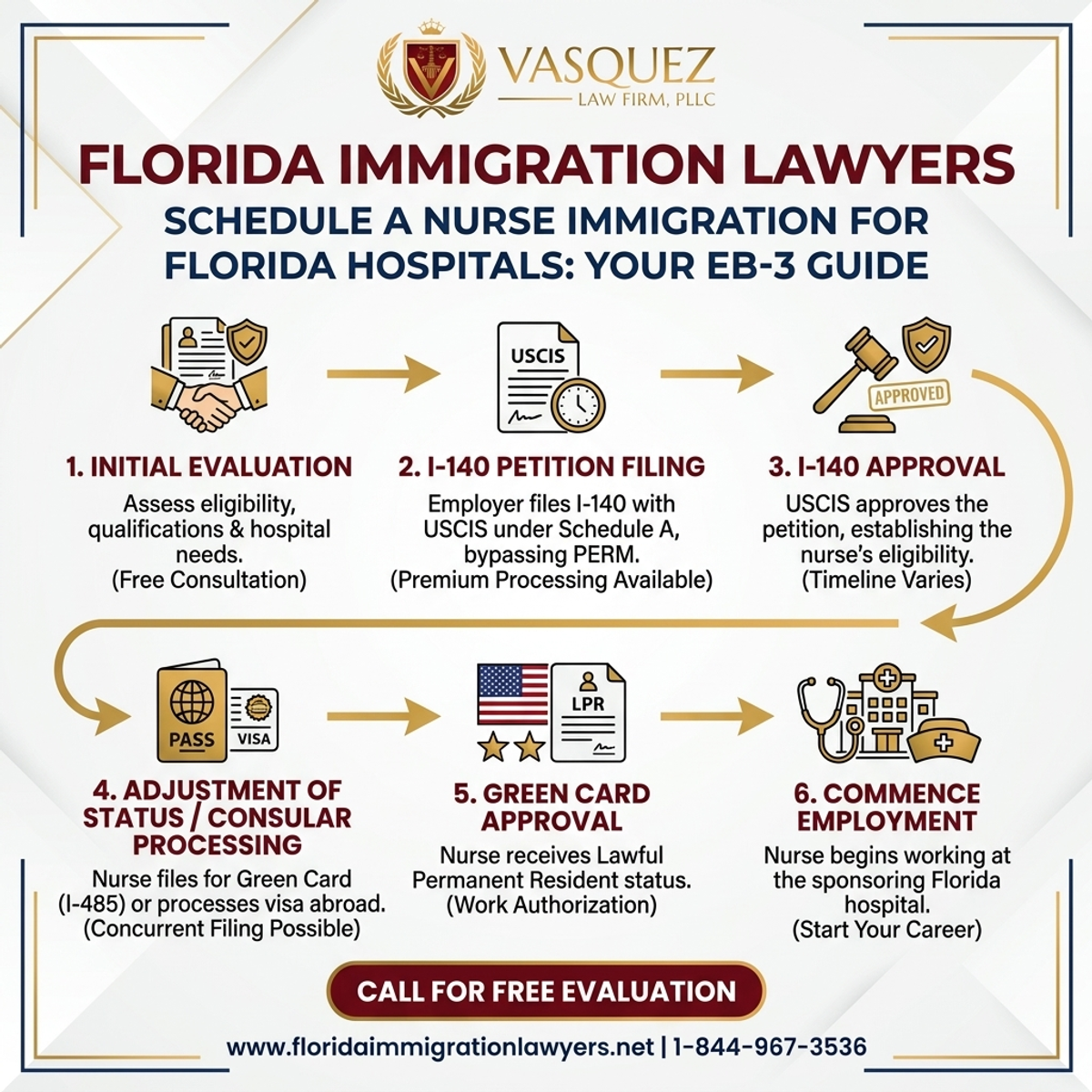
Step-by-Step Process — Schedule A Nurse Immigration for Florida Hospitals: Your EB-3 Guide
Ensuring Your Documents Meet USCIS Standards
It is crucial that all foreign language documents are accompanied by a certified English translation. Translations must be certified by the translator as complete and accurate and by the translator's competence to translate from the foreign language into English. Always submit copies of original documents, keeping the originals safe. USCIS may request originals at any time. Carefully review all forms for accuracy before submission. An experienced immigration attorney can help you compile this extensive list, ensuring every document meets the specific requirements of the EB-3 Schedule A process.
Timelines and Processing Expectations for Florida Applicants
While the Schedule A nurse immigration path is generally faster due to the PERM exemption, it is still a multi-stage process with varying timelines. Understanding these expectations can help manage anxieties and plan your move to Florida. Processing times are subject to change based on USCIS workload, policy shifts, and global demand for immigrant visas.
Navigating Visa Bulletin Priority Dates
A critical factor influencing the timeline is the Visa Bulletin, published monthly by the U.S. Department of State. This bulletin indicates when immigrant visas become available to prospective immigrants based on their priority date (the date the I-140 petition was filed) and their country of chargeability. For nurses, the EB-3 category is typically used. While nurses generally face shorter backlogs compared to other EB-3 professions, processing times can still fluctuate, especially for individuals from countries with high demand. It is essential to monitor the Visa Bulletin closely, which your attorney can help you interpret. You can find current processing times and visa bulletin information on the U.S. Department of State website.
Here’s a general breakdown of typical processing times:
- ETA Form 9089 (DOL Review): While exempt from PERM recruitment, the initial review can still take a few weeks to a few months.
- Form I-140 Petition (USCIS): Standard processing can range from 6 to 12 months. However, if premium processing is utilized, this can be reduced to 15 calendar days for an additional fee. This is a common strategy employed by Florida hospitals to expedite the process.
- NVC Processing (Consular Processing): Once the I-140 is approved, NVC processing involves document collection and fee payments, typically taking 2-4 months before an interview can be scheduled at a U.S. Embassy or Consulate abroad.
- Adjustment of Status (Form I-485, USCIS): If filing for Adjustment of Status within the U.S., processing times can vary significantly by USCIS field office and service center. For example, the USCIS Miami Field Office or the Orlando Field Office might have different processing times. These can range from 12 months to over 24 months, depending on the current backlog.
- Interview and Visa Issuance/Green Card: The interview itself is a one-day event, with visa issuance or Green Card mailing typically following within a few weeks.
For applicants in Florida, USCIS field offices in Miami, Orlando, and Tampa handle interviews for Adjustment of Status. While processing times at these offices are generally comparable, minor variations can occur. It is always best to consult the official USCIS processing times webpage for the most current estimates. Planning for at least 1-2 years from start to finish, even with Schedule A, is a realistic expectation, though individual cases may be faster or slower.
Cost Factors and Fee Breakdown for EB-3 Schedule A
Pursuing Schedule A nurse immigration to work in a Florida hospital involves various fees and costs. Understanding these financial aspects upfront is essential for both the sponsoring employer and the foreign nurse. While specific dollar amounts for government filing fees can change, we can outline the categories of expenses you should anticipate. It is important to note that certain fees are legally required to be paid by the employer, while others may be the responsibility of the applicant.
Employer Responsibilities in Fee Payment
Under Department of Labor regulations, employers are generally required to pay all costs associated with the PERM labor certification process, even when it is waived under Schedule A. This includes the filing fees for ETA Form 9089 and the I-140 petition. It also typically covers the legal fees for the attorney representing the employer in filing these petitions. This ensures that the immigration process does not become a financial burden that deters qualified foreign workers. The employer's ability to pay the offered wage is also a key consideration, and they must demonstrate this financially.
Here’s a breakdown of potential costs:
- USCIS Filing Fees:
- Form I-140, Immigrant Petition for Alien Worker: This fee is typically paid by the employer.
- Form I-485, Application to Register Permanent Residence or Adjust Status: This fee, along with fees for Form I-765 (Employment Authorization Document) and Form I-131 (Advance Parole), is generally paid by the applicant and any dependents.
- Biometrics Fee: Required for Form I-485 applicants, typically paid by the applicant.
- Premium Processing Fee (Optional): For Form I-140, this expedited service fee is often paid by the employer, especially when a Florida hospital needs to fill a position quickly.
Key Statistics — Schedule A Nurse Immigration for Florida Hospitals: Your EB-3 Guide
- Attorney Fees: Legal fees for the immigration attorney representing the employer in filing the ETA Form 9089 and I-140 are typically paid by the employer. Fees for representing the applicant (e.g., for I-485 or consular processing) may be paid by the applicant, although some employers may choose to cover these as well as part of a recruitment incentive.
- Medical Examination Fees: The cost of the mandatory medical examination is paid by the applicant and any accompanying family members. These fees vary by civil surgeon or panel physician.
- Credential Evaluation Fees: If your foreign educational credentials need to be evaluated for U.S. equivalency, there will be fees for these services. This is typically paid by the applicant.
- Translation Fees: Any documents not in English must be translated and certified. These fees are paid by the applicant.
- Travel Expenses: For consular processing, travel to the U.S. Embassy or Consulate for the interview, and subsequent travel to Florida, will be the applicant's responsibility.
- Miscellaneous Fees: Costs for obtaining police certificates, birth certificates, passport photos, etc., are typically borne by the applicant.
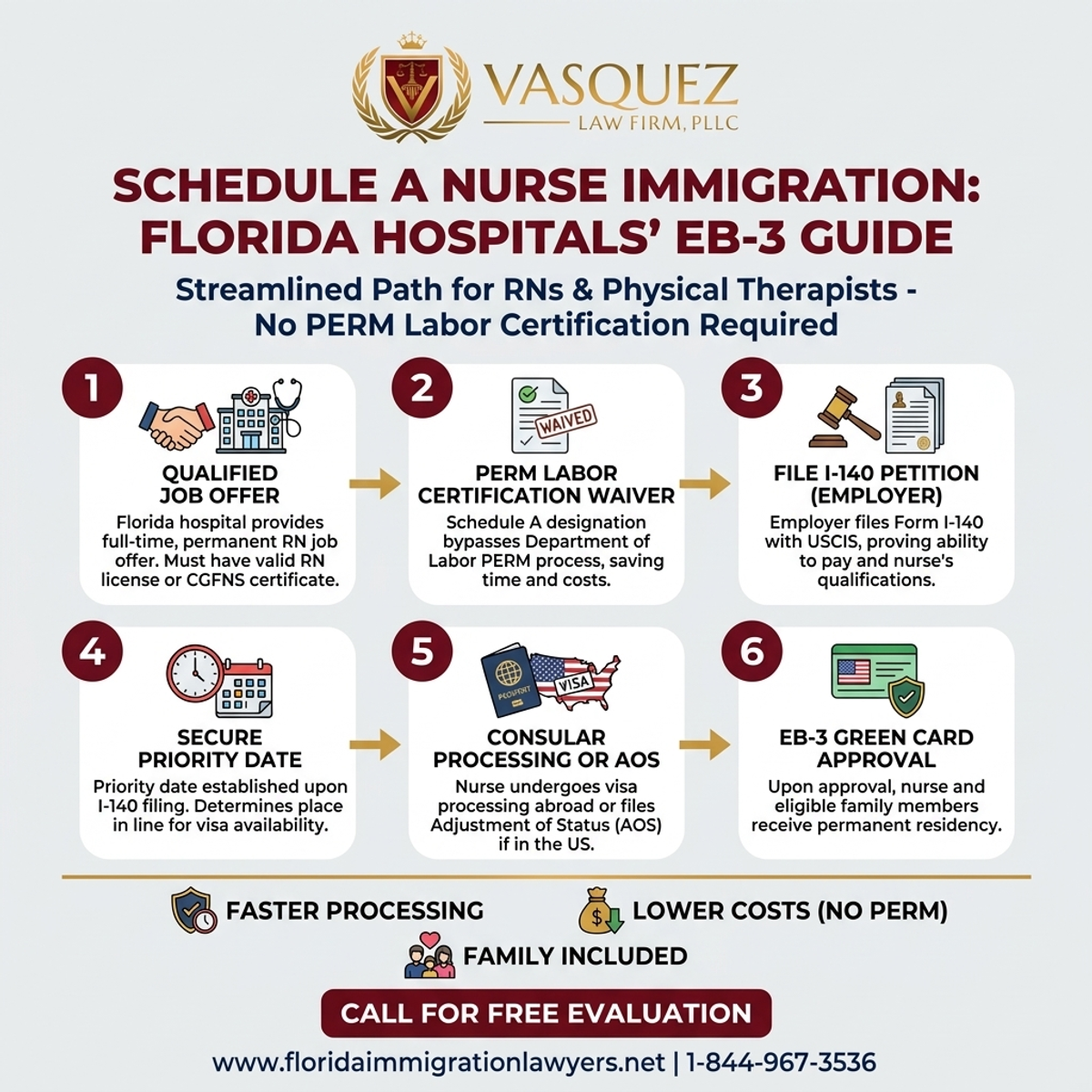
It is crucial to have a clear understanding with your sponsoring Florida hospital regarding who will be responsible for each fee category. A detailed engagement letter with your immigration attorney will also outline all legal fees and service scope. While the process involves significant investment, the long-term benefits of permanent residency and a rewarding career in Florida's healthcare sector often outweigh these initial costs.
Special Considerations for Nurses in Florida's Healthcare System
Immigrating as a nurse to Florida through Schedule A nurse immigration offers a unique opportunity, but it also comes with specific considerations related to the state's healthcare landscape and licensing requirements. Florida's diverse population and dynamic healthcare market present both challenges and rewards for international nurses.
Florida Nursing License Requirements
One of the most critical steps for any foreign-trained nurse is obtaining a Florida nursing license. The Florida Board of Nursing oversees the licensing process, which includes verifying educational credentials, passing the NCLEX-RN, and undergoing background checks. While the Schedule A process allows for an I-140 to be filed if you've passed CGFNS and NCLEX, you must eventually obtain a full Florida license to practice. This process can be lengthy, involving credential evaluation, English proficiency exams (if applicable), and potentially supplemental education. Many Florida hospitals will require proof of progress or a provisional license before the start of employment. Early engagement with the Florida Board of Nursing is highly recommended to understand specific requirements and timelines, which can be found on their official website.
Florida's healthcare system is highly regulated, and compliance with state-specific laws and professional standards is paramount. Nurses must be aware of their scope of practice, ethical guidelines, and continuing education requirements once licensed. Integration into the local healthcare culture, which can vary from large urban hospitals in Miami to smaller rural clinics, also requires adaptability.
Furthermore, Florida is home to a significant immigrant population, particularly in South Florida. This means that bilingual nurses, especially those fluent in Spanish, are highly sought after in areas like Miami-Dade and Broward counties. The ability to communicate effectively with a diverse patient base can be a significant asset and open up more employment opportunities in Florida's healthcare sector. The demand for nurses in Florida is projected to remain strong, ensuring a stable and rewarding career path for those who successfully navigate the immigration and licensing processes.
Common Mistakes to Avoid in Schedule A Nurse Immigration
Navigating the complex world of immigration can be challenging, and even minor errors can lead to significant delays or denials. For Schedule A nurse immigration, avoiding common mistakes is crucial for a successful outcome. Here are 7-12 common pitfalls to watch out for:
-
Incomplete or Inaccurate Forms: Submitting forms with missing information, typos, or inconsistent data is a primary reason for RFEs or denials. Each field on every form must be carefully completed and verified for accuracy. USCIS is highly particular about complete submissions.
-
Missing Deadlines: Immigration processes are time-sensitive. Failing to respond to RFEs, submit documents, or attend interviews by the specified deadlines can result in the abandonment or denial of your application. Always prioritize and track all deadlines.
-
Lack of Proper Credential Evaluation: Not having your foreign nursing credentials properly evaluated by a recognized agency or failing to demonstrate U.S. equivalency can halt the process. Ensure your CGFNS certificate or equivalent evaluation is valid and accepted.
-
Not Passing NCLEX-RN: While the I-140 can sometimes be filed with proof of eligibility, a full and unrestricted U.S. nursing license (requiring NCLEX-RN passage) is ultimately needed. Delaying or failing the NCLEX-RN can jeopardize your ability to practice and secure your Green Card.
-
Inadequate Documentation of Employer's Ability to Pay: The sponsoring Florida hospital must demonstrate its financial ability to pay the offered wage. Insufficient evidence of this can lead to an RFE or denial of the I-140 petition. This is a critical requirement.
-
Misrepresenting Information: Providing false or misleading information on any immigration form or during an interview can lead to severe consequences, including permanent bars from the U.S. Always be truthful and transparent.
-
Failing to Maintain Legal Status (if in U.S.): If you are already in the U.S. and applying for Adjustment of Status, it is imperative to maintain your underlying nonimmigrant status until your I-485 is approved, or your employment authorization document (EAD) is issued. Lapses in status can lead to inadmissibility.
-
Not Disclosing All Criminal or Immigration History: Any past arrests, convictions, or previous immigration violations (even minor ones) must be fully disclosed. Failure to do so can be considered misrepresentation and lead to denial, even if the issue itself would not have made you inadmissible.
-
Incorrectly Interpreting the Visa Bulletin: Misunderstanding priority dates and visa availability can lead to premature or delayed filing of the I-485 application, resulting in rejections or significant setbacks. Always consult the official Visa Bulletin and your attorney.
-
Ignoring Requests for Evidence (RFEs): RFEs from USCIS are common. Ignoring them or providing an incomplete response within the given timeframe will almost certainly lead to a denial. Address RFEs promptly and thoroughly with legal guidance.
-
Lack of Communication with Employer or Attorney: Poor communication between the nurse, the sponsoring Florida hospital, and the immigration attorney can lead to misunderstandings, missed information, and errors in the application process. Maintain open and regular contact.
-
Attempting the Process Without Legal Counsel: While some may try to navigate immigration independently, the complexity of U.S. immigration law, particularly for employment-based visas, makes professional legal guidance invaluable. An experienced attorney can prevent costly mistakes and ensure compliance.
When to Call a Lawyer for Schedule A Nurse Immigration
While the Schedule A nurse immigration process offers a more streamlined path, it is far from simple. The stakes are incredibly high, involving your career and future in the U.S. Knowing when to seek professional legal counsel from Florida Immigration Lawyers can make all the difference between success and frustrating delays or denials. We are here to help nurses and Florida hospitals navigate these complexities.
You should strongly consider calling an immigration lawyer if you encounter any of the following scenarios:
- Initial Consultation: Even before starting the process, a free consultation with Florida Immigration Lawyers can help you understand your eligibility, the specific requirements, and potential challenges. We can assess your unique situation and outline a clear strategy.
- Complex Background: If you have any past immigration issues, criminal history, or unique family circumstances, these can significantly complicate your application. An attorney can help determine potential inadmissibility issues and strategize solutions.
- Employer Concerns: If your sponsoring Florida hospital is new to sponsoring foreign workers or seems hesitant about the process, our attorneys can educate them on their responsibilities and streamline the employer-side of the petition.
- Receiving a Request for Evidence (RFE): An RFE from USCIS indicates that your application is missing information or requires further clarification. Responding correctly and comprehensively to an RFE is critical, and an attorney can formulate a strong response.
- Notice of Intent to Deny (NOID): A NOID is a serious red flag, indicating USCIS intends to deny your petition. Immediate legal intervention is required to address the issues raised and present a compelling argument against denial.
- Changes in Employment: If your job offer with the Florida hospital changes, or you are considering changing employers during the process, this can have significant immigration consequences. An attorney can advise on how to proceed without jeopardizing your application.
- Visa Bulletin Fluctuations: Interpreting the monthly Visa Bulletin and understanding its impact on your priority date can be confusing. An attorney can provide clear guidance on when to expect visa availability and when to file subsequent applications like the I-485.
- Family Petitions: If you wish to include family members (spouse and minor children) in your Green Card application, an attorney can ensure their applications are correctly filed and processed alongside yours.
- Deportation or Removal Concerns: If you are in the U.S. and face any risk of deportation or removal proceedings, immediate legal counsel is paramount. Our deportation defense team can protect your rights.
Florida Immigration Lawyers has extensive experience assisting nurses and healthcare providers throughout Florida with their immigration needs. We understand the specific requirements for Schedule A and the EB-3 visa category, and we are dedicated to providing personalized, effective legal representation. Do not leave your future to chance; let our expertise guide you.
About Florida Immigration Lawyers
Florida Immigration Lawyers is a leading immigration law firm dedicated to serving individuals, families, and businesses across the entire state of Florida. With a deep understanding of U.S. immigration law and a commitment to our clients, we provide comprehensive legal services tailored to meet diverse immigration needs. Our team of experienced attorneys is passionate about helping foreign nationals achieve their dreams of living and working in the United States, including skilled professionals like nurses through the Schedule A pathway.
We specialize in a wide range of immigration matters, including family-based petitions, employment visas like the EB-3, asylum claims, deportation defense, citizenship applications, and more. Our firm prides itself on offering compassionate, client-focused representation, ensuring that every case receives the attention and expertise it deserves. We understand the challenges and anxieties often associated with the immigration process, and we strive to provide clear communication, strategic advice, and unwavering support from start to finish.
At Florida Immigration Lawyers, we believe that everyone deserves access to high-quality legal representation. We offer free consultations to discuss your case and are available 24/7 to address urgent concerns. Our dedicated team is bilingual, speaking both English and Spanish, to better serve Florida's diverse communities. Whether you are a nurse seeking to work in a Miami hospital, a family member petitioning for a loved one, or a business requiring expert immigration guidance, Florida Immigration Lawyers is here to help you navigate the complexities of immigration law. Visit our website at https://www.floridaimmigrationlawyers.net or call us directly at 1-844-967-3536 to schedule your free consultation today.
Sources and References
- U.S. Citizenship and Immigration Services (USCIS)
- U.S. Department of State Visa Bulletin
- Executive Office for Immigration Review (EOIR)
- 8 U.S.C. § 1153(b)(3)(A)(i) - Immigration and Nationality Act (INA) Section 203(b)(3)(A)(i)
- 8 CFR § 204.5(k)(4) - Regulations regarding Schedule A occupations
- 20 CFR § 656.10 - Regulations defining Schedule A occupations for labor certification
Related services: immigration practice areas, family immigration services, business immigration, experienced immigration attorneys.
This article provides general legal information and is not intended as legal advice. Every case is unique, and outcomes depend on specific facts and circumstances. Contact an attorney for advice about your particular situation.
Ready to take the next step in your Schedule A nurse immigration journey for Florida hospitals? Don't leave your future to chance. Contact Florida Immigration Lawyers for a free consultation. Our experienced team is ready to provide the guidance and support you need. Call us today at 1-844-967-3536. Se Habla Espanol - Estamos aqui para ayudarle.
Do Not Navigate This Process Alone
Our experienced immigration attorneys are ready to fight for you. Get a free, confidential consultation today.
Se Habla Español
Frequently Asked Questions

William J. Vásquez
Founding Attorney · Vasquez Law Firm
U.S. Air Force veteran and immigration attorney with thousands of cases resolved. J.D., NCCU School of Law. AILA member. Admitted to the 4th, 5th, and 11th Circuit Courts.
Available 24/7 - Free Evaluations
Related Legal Services
Our Florida immigration attorneys can help you with immigration practice areas, free immigration consultation and experienced immigration attorneys. Call today at 1-844-967-3536 for a free consultation.
Related Links
Related Topics
Free Legal Consultation
Discuss your case with our experienced attorneys. We're available 24/7.
Se Habla Español - Estamos aquí para ayudarle.
Related Articles
Biometrics Appointment in Florida: What to Expect in 2026
Navigating a biometrics appointment in Florida is crucial for your USCIS process. Learn what to expect, how to prepare, and common pitfalls to avoid. Florida Immigration Lawyers are here to help with personalized guidance and support.
Withholding of Removal Explained: Florida Defense in 2026
For those in Florida facing deportation and fearing persecution or torture in their home country, understanding withholding of removal is critical. This form of protection prevents removal to a dangerous country, though it differs significantly from asylum in its eligibility criteria and benefits. It requires proving a "more likely than not" chance of persecution based on protected grounds or torture, a higher standard than asylum's "well-founded fear." While withholding of removal does not lead to a Green Card, it offers mandatory protection if the stringent criteria are met, even for some individuals barred from asylum. The process involves complex legal proceedings before an immigration judge, often in Miami or Orlando immigration courts. A comprehensive application, detailed testimony, and robust supporting evidence, including country conditions reports and affidavits, are essential. Given the high stakes and intricate legal requirements, securing the expertise of a Florida immigration lawyer is paramount to building a strong defense and navigating the path to safety.
US Visa Policy Changes July 2026: What Students in Florida
As of July 2026, international students in Florida seeking a change of status to an F-1 student visa must prepare for potential adjustments to U.S. visa policies. This comprehensive guide from Florida Immigration Lawyers explores the anticipated policy changes, detailing their potential impact on application requirements, processing times, and eligibility criteria. We provide a step-by-step overview of the change of status process, including a document checklist, expected timelines, and cost considerations. Understanding these complexities and avoiding common mistakes is crucial for a successful application. With potential changes approaching, proactive planning and expert legal guidance are more important than ever. Our firm is dedicated to helping students in Tampa and across Florida navigate these challenges, offering tailored advice and robust representation. Learn how to protect your academic future and ensure a smooth transition to F-1 student status.
Dual Citizenship Lawyer: Your 2026 Guide to Naturalization
Achieving U.S. citizenship is a profound milestone, but the path to naturalization, especially with dual citizenship in mind, is fraught with legal intricacies and a critical interview process. This comprehensive guide from Florida Immigration Lawyers demystifies the journey, offering essential citizenship interview tips and highlighting the invaluable role of a dual citizenship lawyer. We cover eligibility, document preparation, timelines, and common pitfalls, all tailored for Florida residents in areas like Pembroke Pines. Discover how expert legal counsel can prepare you for your naturalization interview, address dual nationality concerns, and ensure a smooth, successful application. From initial assessment to interview representation, we provide the support needed to navigate USCIS requirements confidently. Call Florida Immigration Lawyers for a free consultation to start your journey.
