TPS Eligible Countries in Florida 2026: What to Know
Temporary Protected Status (TPS) provides a vital temporary immigration benefit for eligible individuals from designated countries facing humanitarian crises. As of 2026, understanding the current list of TPS eligible countries, the application process, and specific requirements is crucial for residents in Florida. This comprehensive guide details who qualifies for TPS, the step-by-step application process, necessary documentation, and associated costs. We also highlight common mistakes to avoid and when to seek legal counsel to ensure a successful application. Florida Immigration Lawyers offers expert assistance to help you navigate these complex regulations, providing a free case review to discuss your options and secure your future in the U.S.
Which Countries Are Eligible for TPS in Florida as of 2026?
As of 2026, the list of countries eligible for Temporary Protected Status (TPS) in Florida, and nationwide, is determined by the U.S. Secretary of Homeland Security based on prevailing conditions in those nations. While specific designations can change, countries often on the list due to ongoing instability include El Salvador, Haiti, Honduras, Nepal, Nicaragua, Somalia, South Sudan, Sudan, Syria, Ukraine, Venezuela, Yemen, Afghanistan, Cameroon, and Myanmar. It is crucial for potential applicants to verify the most current list directly on the USCIS website, as designations are reviewed and can be extended, terminated, or newly established.
The designation of a country for TPS is a dynamic process, influenced by geopolitical events and humanitarian crises. For instance, a country might be designated due to a devastating earthquake, a protracted civil conflict, or widespread human rights violations. Once designated, individuals from that country who meet the eligibility criteria can apply for TPS during a specific registration period. For Florida residents, especially those in areas with large immigrant populations like Orlando, Tampa, and Miami, staying informed about these designations is key. The Executive Office for Immigration Review (EOIR) also plays a role in processing cases for those already in removal proceedings who may be eligible for TPS, highlighting the interconnectedness of various immigration agencies.
The impact of TPS designations on Florida's communities is significant. Many TPS holders contribute substantially to the state's economy, working in various sectors from agriculture to hospitality and construction. The stability provided by TPS allows them to establish roots, raise families, and contribute to the social fabric of their communities. However, the temporary nature of TPS means that beneficiaries often live with uncertainty, as extensions are not guaranteed. This makes it imperative for individuals to regularly check for updates from USCIS regarding their country's status and any re-registration periods. An immigration attorney can provide invaluable assistance in tracking these changes and preparing for potential re-registrations or new applications.
How Do I Apply for Temporary Protected Status in Florida?
To apply for Temporary Protected Status (TPS) in Florida, eligible individuals must generally file Form I-821, Application for Temporary Protected Status, with U.S. Citizenship and Immigration Services (USCIS) during their country's designated registration period. Additionally, applicants typically file Form I-765, Application for Employment Authorization, to receive a work permit, and Form I-601, Application for Waiver of Grounds of Inadmissibility, if applicable. The process also includes submitting supporting documentation, attending a biometrics appointment, and potentially an interview.
The application process for TPS can be intricate, requiring careful attention to detail and adherence to strict deadlines. For Florida residents, the process typically begins with gathering all necessary documents and accurately completing the required forms. USCIS lockbox facilities handle the initial intake of applications, with specific addresses depending on the form type and the applicant's state of residence. After filing, applicants will receive a receipt notice and a notice for a biometrics appointment, which usually takes place at a local Application Support Center (ASC), such as those serving Central Florida in Orlando or elsewhere in the state.
Here is a step-by-step guide to applying for TPS in Florida:
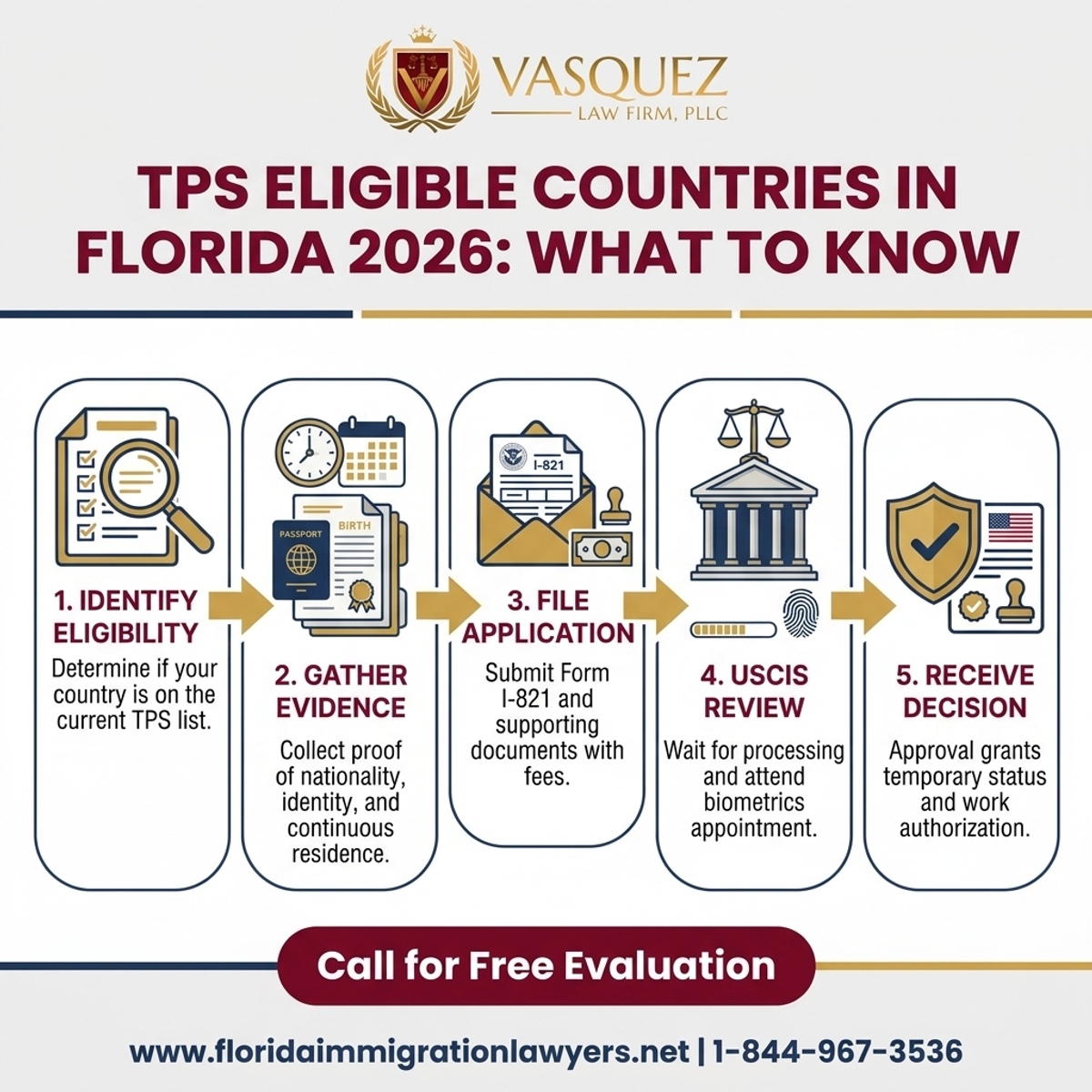
Step-by-Step Process — TPS Eligible Countries in Florida 2026: What to Know
- Determine Eligibility: Confirm your country is currently designated for TPS and that you meet all eligibility criteria, including continuous physical presence and continuous residence since the specified dates.
- Gather Required Documents: Collect all supporting evidence, such as proof of identity, nationality, date of entry, and continuous residence in the U.S. (see detailed checklist below).
- Complete Forms I-821 and I-765: Accurately fill out Form I-821, Application for Temporary Protected Status. If you desire work authorization, also complete Form I-765, Application for Employment Authorization.
- Prepare Supporting Statements and Translations: Include any necessary personal statements, declarations, or affidavits. Ensure all non-English documents are accompanied by certified English translations.
- Pay Filing Fees: Submit the required filing fees for Form I-821 and Form I-765 (if applicable), or include a fee waiver request (Form I-912) if you qualify.
- Mail Your Application: Send your complete application package to the correct USCIS Lockbox facility. The specific address depends on your country's designation and whether you are filing an initial application or re-registering.
- Attend Biometrics Appointment: After filing, you will receive a notice for a biometrics appointment at a local ASC. This involves fingerprinting and photographing for background checks.
- Respond to Requests for Evidence (RFE): USCIS may send an RFE if your application is incomplete or lacks sufficient evidence. Respond promptly and thoroughly.
- Attend Interview (If Required): While not all TPS applicants are interviewed, USCIS may request one. Be prepared to discuss your application and provide additional information.
- Receive Decision: USCIS will send a written decision on your TPS application. If approved, you will receive an Employment Authorization Document (EAD) if you applied for one.
Required Documents for a TPS Application Checklist
A thorough and accurate submission of supporting documents is critical for a successful Temporary Protected Status (TPS) application in Florida. Missing or incorrect documentation can lead to delays or even denial. Ensure you have originals and copies of all necessary paperwork before filing. All non-English documents must be accompanied by a complete English translation certified by the translator as accurate and competent.
Here is a comprehensive checklist of documents generally required for a TPS application:
- Proof of Identity and Nationality:
- Copy of your passport from your designated country (bio-data page).
- Copy of your birth certificate with photo identification.
- National identity document from your country of origin with your photo and fingerprint.
- Any other national identity document from your country of origin.
- Proof of Entry into the United States:
- Copy of your Form I-94, Arrival/Departure Record.
- Entry stamps in your passport.
- Airline or vessel manifests, or other travel records.
- Proof of Continuous Residence in the U.S. (since the designated date):
- Employment records (pay stubs, W-2 forms, letters from employers).
- Rent receipts, utility bills, or mortgage statements.
- School records (transcripts, report cards, letters from schools).
- Hospital or medical records from Florida healthcare providers.
- Affidavits from friends, family, or employers attesting to your presence.
- Bank statements with your Florida address.
- Receipts for money transfers.
- Proof of Continuous Physical Presence in the U.S. (since the designated date):
- This often overlaps with continuous residence proof.
- Any documents showing your physical location within the U.S.
- Photos: Two passport-style photos (if not submitting biometrics digitally).
- Marriage Certificate and Birth Certificates of Children (if applicable): To establish family ties and derivative eligibility.
- Court Dispositions or Police Records (if applicable): If you have any arrests or convictions, you must provide certified copies of court dispositions.
Always refer to the specific instructions for Form I-821 and your country's TPS designation on the USCIS website for the most up-to-date requirements.
Do not navigate this process alone. Contact Florida Immigration Lawyers today for personalized assistance with your TPS application and to ensure all documentation is correctly prepared and submitted.
Understanding TPS Processing Times and Costs in 2026
As of 2026, the processing times for Temporary Protected Status (TPS) applications can vary significantly depending on several factors, including the volume of applications, the specific USCIS service center handling the case, and the complexity of individual cases. While USCIS aims to process applications efficiently, applicants in Florida should anticipate waiting several months, and sometimes over a year, for a final decision. It is common for the Employment Authorization Document (EAD) to be processed separately and potentially arrive before the final TPS decision.
USCIS provides online tools to check current processing times for different form types and service centers, which can offer a general estimate. However, these are estimates and not guarantees. Delays can occur due to Requests for Evidence (RFEs), background check issues, or general backlogs. For those awaiting a decision in Florida, especially in areas like Orlando, patience is often required, but it's important to monitor your case status online and respond promptly to any USCIS communications.
Here is a table illustrating typical processing expectations:
| Stage | Typical Timeframe (as of 2026) | Notes |
|---|---|---|
| Initial Filing to Receipt Notice | 2-4 weeks | Confirmation that USCIS received your application. |
| Receipt Notice to Biometrics Appointment | 4-8 weeks | Appointment at an Application Support Center (ASC). |
| Biometrics to EAD Card (Form I-765) | 3-9 months | Work permit often arrives before final TPS decision. |
| Biometrics to TPS Approval (Form I-821) | 6-18 months+ | Can vary widely based on service center workload. |
| Responding to RFE | Typically 30-87 days to respond | Delays decision; respond thoroughly and promptly. |
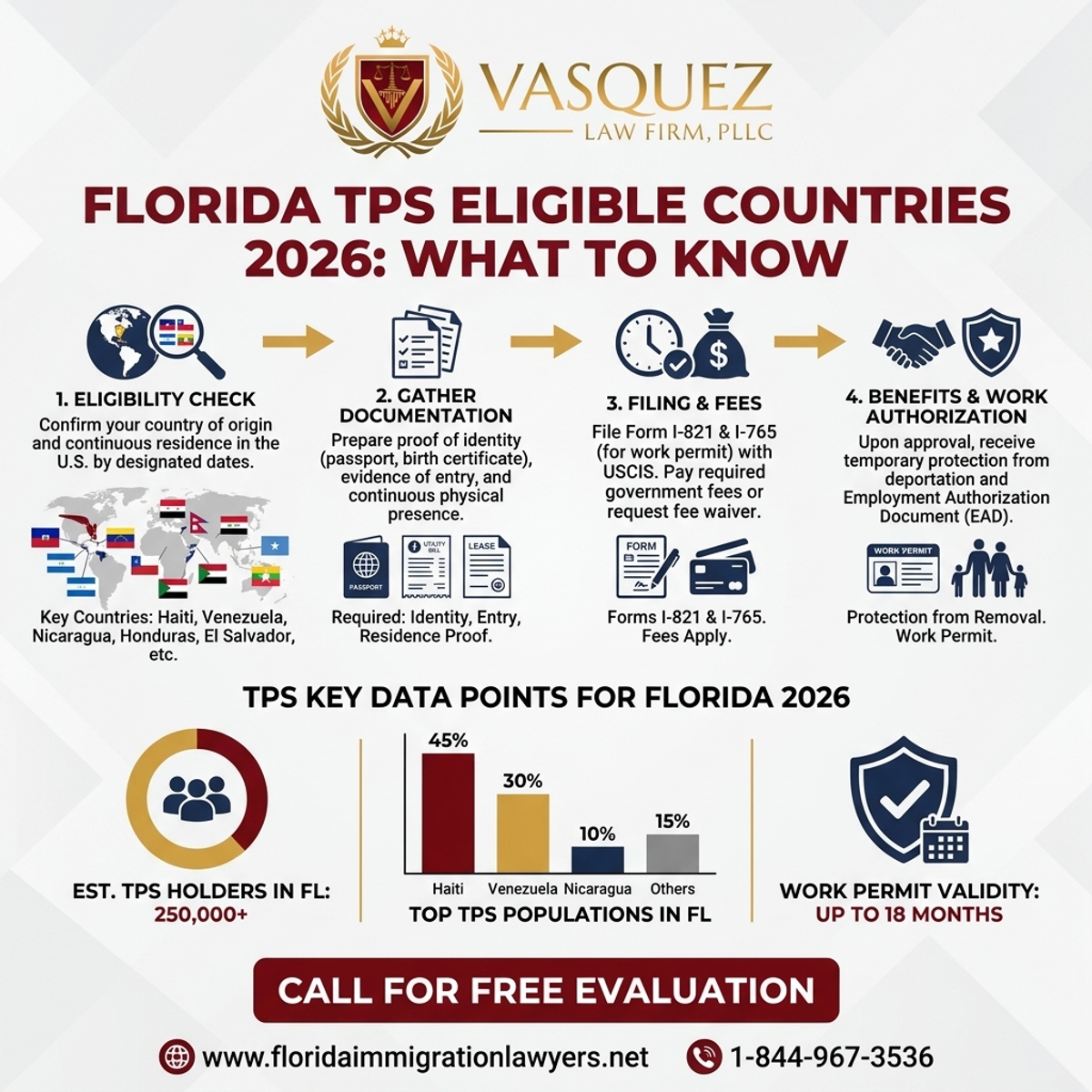
Key Statistics — TPS Eligible Countries in Florida 2026: What to Know
Cost Factors and Fee Breakdown for TPS Applications
The costs associated with a TPS application in Florida primarily include USCIS filing fees, which are subject to change. As of 2026, applicants must be prepared for the following:
| Item | Typical Fee (as of 2026) | Notes |
|---|---|---|
| Form I-821 (Application for TPS) | $50 | Required for all initial and re-registration applications. |
| Form I-765 (Application for Employment Authorization) | $470 | Required if you want a work permit. |
| Biometrics Services Fee | $85 | Mandatory for most applicants aged 14-79. |
| Attorney Fees | Varies | For legal representation and assistance. |
| Translation Services | Varies | If documents are not in English. |
It's important to note that certain applicants may be eligible for a fee waiver (Form I-912, Request for Fee Waiver) if they meet specific income-based guidelines or receive means-tested benefits. However, the fee for Form I-821 ($50) is generally not waivable for initial TPS applications, only for re-registration. Always check the USCIS Fee Schedule for the most current fee information, as these amounts can be updated periodically. An attorney can help you determine if you qualify for a fee waiver and ensure your application is submitted correctly.
Common Mistakes to Avoid in Your TPS Application
Applying for Temporary Protected Status (TPS) requires precision and a thorough understanding of immigration procedures. Even minor errors can lead to significant delays or even denial of your application. Being aware of common pitfalls can help you navigate the process successfully.
- Missing Filing Deadlines: TPS designations come with strict registration and re-registration periods. Missing these deadlines, even by a day, can result in ineligibility, as outlined in 8 CFR Part 244.17.
- Incomplete Forms: Failing to answer all questions on Form I-821 and Form I-765 or leaving sections blank can lead to a Request for Evidence (RFE) or outright rejection. USCIS requires complete information to process your case.
- Insufficient Supporting Documentation: Not providing enough evidence of identity, nationality, date of entry, or continuous residence can be a major setback. Each claim must be substantiated with reliable documents.
- Incorrect Filing Fees or Missing Fee Waivers: Submitting the wrong fee amount or forgetting to include a fee waiver request (Form I-912) when eligible will cause your application to be returned or rejected.
- Failure to Disclose Criminal History: Any past arrests, charges, or convictions, no matter how minor, must be fully disclosed. Failure to do so can be considered misrepresentation and lead to denial and potential immigration consequences.
- Inaccurate or Inconsistent Information: Providing conflicting dates, names, or other details across different forms or documents can raise red flags and lead to suspicions of fraud.
- Not Attending Biometrics Appointment: Missing your scheduled biometrics appointment without rescheduling or a valid excuse can lead to the denial of your application.
- Lack of Certified Translations: Any document not in English must be accompanied by a complete and certified English translation. Failing to provide this will result in the document not being considered.
- Sending to the Wrong USCIS Lockbox: USCIS has specific lockbox addresses depending on the form and the applicant's state of residence. Sending your application to the wrong location will cause delays.
- Not Seeking Legal Advice for Complex Cases: If you have a criminal record, previous immigration violations, or unique circumstances, attempting to apply without legal counsel can lead to irreversible negative outcomes.
When to Call a Lawyer for Your TPS Case
While some TPS applications may seem straightforward, the process can quickly become complex, especially when dealing with specific eligibility criteria, documentation, or past immigration issues. Knowing when to seek professional legal guidance can be the difference between approval and denial. Florida Immigration Lawyers are here to provide the expert assistance you need.
You should strongly consider contacting an experienced immigration attorney if:
- You have any criminal history, including arrests, charges, or convictions, as these can affect your eligibility for TPS under 8 U.S.C. § 1254a(c)(2)(B).
- You have previously been ordered deported or removed from the U.S.
- You have concerns about meeting the continuous physical presence or continuous residence requirements.
- You have had any previous immigration applications denied or have a history of immigration violations.
- You are unsure about which documents to submit or how to obtain them.
- You receive a Request for Evidence (RFE) from USCIS and need help formulating a comprehensive response.
- You are in removal proceedings and need to explore how TPS might impact your case. The Executive Office for Immigration Review (EOIR) handles these proceedings.
- You are considering applying for other forms of immigration relief concurrently with or after TPS.
- You need assistance with re-registration for an existing TPS status.
Our attorneys at Florida Immigration Lawyers are well-versed in immigration law, including TPS applications, asylum claims, and deportation defense. We serve clients throughout Florida, including Orlando and Central Florida, offering strategic advice and diligent representation. With our help, you can navigate the complexities of your TPS case with confidence.
About Florida Immigration Lawyers
Florida Immigration Lawyers is a leading law firm dedicated to providing exceptional legal representation to immigrants across the entire state of Florida. With a deep understanding of U.S. immigration laws and a compassionate approach, our experienced attorneys are committed to helping individuals and families achieve their immigration goals. We pride ourselves on offering personalized service, clear communication, and tireless advocacy for every client, from initial consultations to complex litigation.
Our comprehensive range of services includes family-based immigration, employment visas, deportation defense, asylum, naturalization, and Temporary Protected Status (TPS) applications. We understand the unique challenges faced by immigrant communities in Central Florida and beyond, and we are here to offer reliable, trustworthy legal support. Our team is available 24/7 to answer your questions and provide guidance. We offer free case reviews, ensuring that you can explore your legal options without financial commitment. Choose Florida Immigration Lawyers for dedicated service and a partner who truly cares about your future in the U.S. You can learn more about our team on our attorneys page or schedule a free consultation today. We are here to help you every step of the way.
Sources and References
- U.S. Citizenship and Immigration Services (USCIS)
- Executive Office for Immigration Review (EOIR)
- U.S. Department of State
- 8 U.S.C. § 1254a - Immigration and Nationality Act (INA) Section 244
- 8 CFR Part 244 - Temporary Protected Status
- USCIS Policy Manual
Related services: immigration practice areas, family immigration services, citizenship and naturalization, business immigration.
This article provides general legal information and is not intended as legal advice. Every case is unique, and outcomes depend on specific facts and circumstances. Contact an attorney for advice about your particular situation.
Your immigration journey is too important to navigate alone. Whether you are applying for TPS for the first time, re-registering, or exploring other immigration pathways, Florida Immigration Lawyers is here to provide the expert legal support you deserve. Contact us today for a free case review and let us help you secure your future in Florida. Call 1-844-YO-PELEO now!
Se Habla Espanol - Estamos aqui para ayudarle.
Do Not Navigate This Process Alone
Our experienced immigration attorneys are ready to fight for you. Get a free, confidential case review today.
Se Habla Español
Or leave your details and we’ll call you:
We will call you back within 24 hours
Free evaluation · Private and confidential · Se habla español
Helping Florida immigrant families since 2011
Or talk to us right now

AI voice assistant — available 24/7
FreeFrequently Asked Questions

William J. Vásquez
Founding Attorney · Vasquez Law Firm
U.S. Air Force veteran and immigration attorney with years of hands-on U.S. immigration experience. J.D., NCCU School of Law. AILA member. Admitted to the 4th, 5th, and 11th Circuit Courts.
Available 24/7 - Free Evaluations
Reviewed for legal accuracy by William J. Vásquez
Licensed in North Carolina; U.S. immigration is federal practice.
Related Legal Services
Our Florida immigration attorneys can help you with free immigration consultation, business immigration and deportation defense. Call today at 1-844-YO-PELEO for a free case review.
Related Links
Related Topics
Free Legal Case Review
Discuss your case with our experienced attorneys. We're available 24/7.
Se Habla Español - Estamos aquí para ayudarle.
Related Articles
EB-5 Investor Green Card in Florida: A 2026 Guide
Explore how to obtain an EB-5 investor green card in Florida. Learn about the investment requirements, processes, and benefits of participating in this program. Discover how Florida's economic landscape can be an ideal setting for your investment. Contact Florida Immigration Lawyers for a free case review.
Certificate of Eligibility for Expungement in Florida 2026
For non-U.S. citizens in Florida, understanding how a state expungement impacts immigration status is critical. A certificate of eligibility for expungement in Florida allows a criminal record to be sealed or expunged under state law. However, federal immigration agencies often disregard such state-level relief, still considering the original criminal offense as a conviction for immigration purposes. This can have severe implications for visa applications, green card eligibility, naturalization, and even lead to deportation. This guide clarifies the Florida expungement process, its limited effect on federal immigration law, and key steps to protect your status in 2026. Learn about common mistakes, required documents, timelines, and when to seek expert legal counsel from Florida Immigration Lawyers to navigate these complex issues effectively.
What to Expect at Your First Immigration Consultation in Orlando
What happens at a first immigration consultation in Orlando, which documents to bring, and how to prepare for questions about visas, green cards, citizenship and court cases.
DED Eligibility for Venezuelans and Haitians in Florida
Deferred Enforced Departure (DED) is a vital protection for Venezuelans and Haitians in Florida, offering temporary relief from deportation. Learn about eligibility, application steps, and common mistakes to avoid. Contact Florida Immigration Lawyers for expert assistance.