DED Eligibility for Venezuelans and Haitians in Florida
Deferred Enforced Departure (DED) is a vital protection for Venezuelans and Haitians in Florida, offering temporary relief from deportation. Learn about eligibility, application steps, and common mistakes to avoid. Contact Florida Immigration Lawyers for expert assistance.
What is Deferred Enforced Departure (DED)?
Deferred Enforced Departure (DED) is a temporary protection from deportation granted by the President of the United States to certain foreign nationals. This protection is not automatic and requires eligible individuals to apply. As of 2026, DED offers legal status for a specified period, along with work authorization, allowing recipients to live and work legally in the U.S.
DED is particularly relevant for Venezuelans and Haitians in Florida, given the political and economic instability in their home countries. This measure provides a lifeline to those who cannot safely return home.
Unlike some other forms of humanitarian relief, DED is typically issued by presidential directive, often based on foreign policy considerations or extraordinary circumstances in a particular country that make safe return impossible. While similar to Temporary Protected Status (TPS) in its outcome of temporary relief and work authorization, DED does not fall under the same statutory framework, giving the President more direct authority in its designation and conditions. It provides a critical shield against immediate deportation and allows recipients to contribute to the U.S. economy.
Beyond protection from removal, DED status also typically includes eligibility for an Employment Authorization Document (EAD), commonly known as a work permit. This allows individuals to legally seek and maintain employment, providing financial stability for themselves and their families. In some cases, DED recipients may also be eligible for travel authorization, enabling them to visit family abroad without jeopardizing their status in the U.S., though this requires a separate application and approval.
How Can Venezuelans Qualify for DED in Florida?
To qualify for DED, Venezuelan nationals must have continuously resided in the U.S. since a specific date determined by the President. As of 2026, the eligibility requirements include arrival before March 8, 2021, and continuous residence since then.
Applicants must pass a background check and cannot have certain criminal convictions. It is recommended to consult an immigration attorney to ensure all criteria are met and to assist with the application process.
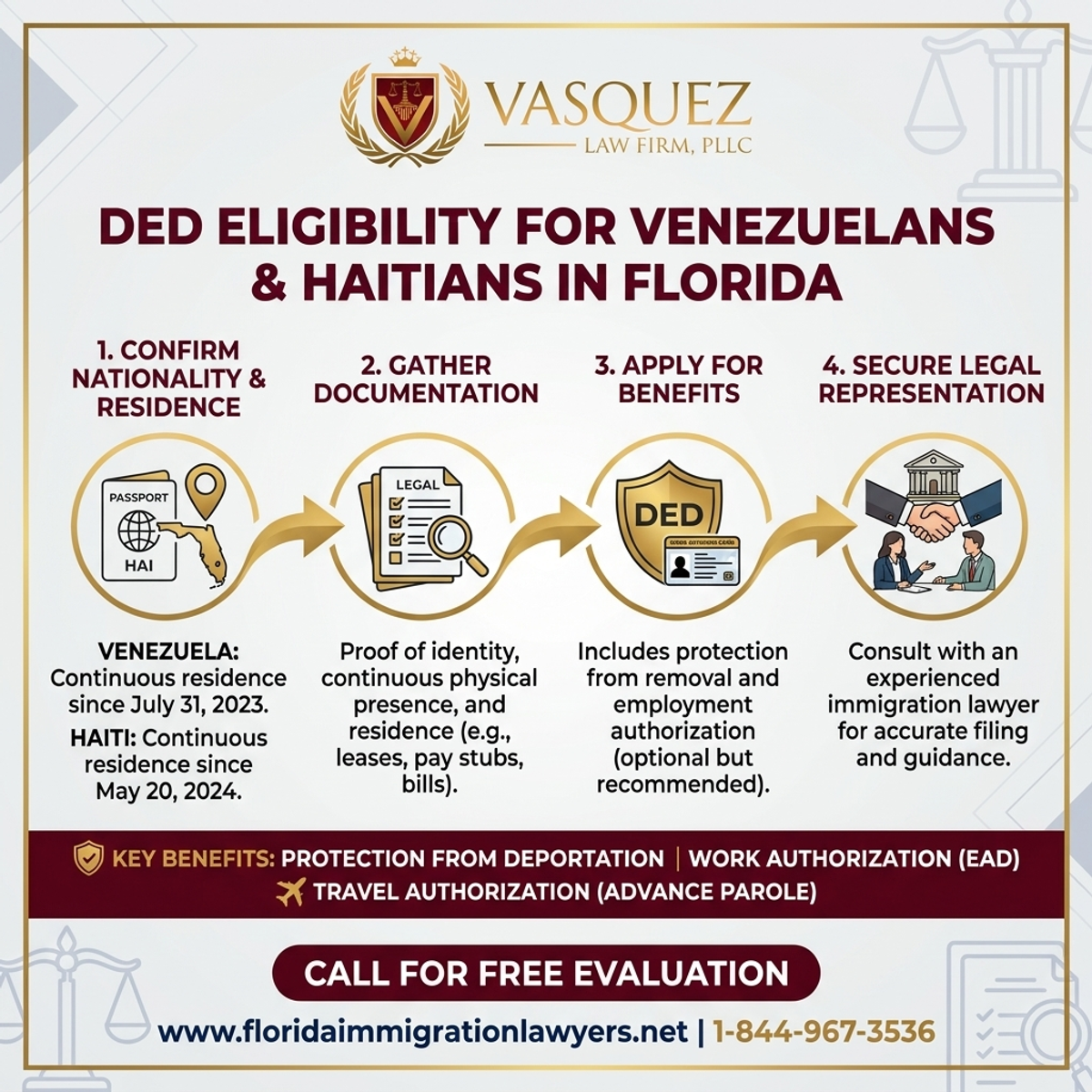
Step-by-Step Process — DED Eligibility for Venezuelans and Haitians in Florida
The continuous residence requirement is crucial. This means that from March 8, 2021, until the present, you must have maintained your physical presence in the United States. Brief, authorized trips outside the U.S. may not break continuous residence, but it's essential to discuss any such travel with an attorney like those at Florida Immigration Lawyers. Proof of continuous residence can include utility bills, lease agreements, employment records, school transcripts, and medical records spanning the entire period.
Furthermore, the background check is a non-negotiable part of the DED application. Certain criminal offenses, particularly felonies or multiple misdemeanors, can render an applicant ineligible. It is vital to be transparent about any past interactions with law enforcement. An immigration attorney can help assess the impact of any prior convictions on your eligibility and advise on the best course of action, potentially even helping to resolve minor issues before they become major obstacles.
A practical tip for Venezuelan applicants is to start gathering all potential evidence of continuous residence and identity as soon as possible. The more documentation you have, the stronger your application will be. This proactive approach can significantly reduce processing delays and increase the likelihood of a favorable outcome. Remember, the team at Florida Immigration Lawyers is ready to assist you with a free case review to ensure you meet all the specific criteria.
Steps for Venezuelans to Apply for DED
- Verify eligibility based on residency and arrival date.
- Complete the necessary forms, such as Form I-765 for employment authorization.
- Gather supporting documents, including proof of identity and residency.
- Submit the application to USCIS and await confirmation.
How Can Haitians Qualify for DED in Florida?
Haitian nationals must meet similar criteria to Venezuelans to qualify for DED. They must have been residing in the U.S. continuously since a date specified by the President. As of 2026, this date is July 29, 2021.
The process involves background checks and requires applicants to have no disqualifying criminal records. Legal advice can help navigate complexities and ensure compliance with all requirements.
For Haitian applicants, the continuous residence requirement from July 29, 2021, is equally stringent. This designation acknowledges the ongoing humanitarian crisis and socio-political challenges in Haiti, making safe return difficult for many. Providing robust evidence of continuous presence in the U.S. since this specific date is paramount. Examples include rental receipts, pay stubs, bank statements, and affidavits from neighbors or employers.
Understanding the nuances of the background check is crucial. Disqualifying factors can range from serious criminal offenses to issues like participation in persecution. It is always advisable to consult with an experienced immigration attorney, such as Florida Immigration Lawyers, if you have any concerns about your criminal history or past immigration record. They can provide an honest assessment and help mitigate potential problems during the application process.
A key practical tip for Haitian applicants is to be meticulous with documentation. Ensure all forms are filled out accurately and completely, and that all supporting documents are organized and clearly labeled. Any discrepancies or missing information can lead to Requests for Evidence (RFEs) or even denial. Engaging with a legal professional can significantly streamline this process and prevent common errors, enhancing the chances of a successful DED application.
Steps for Haitians to Apply for DED
- Check eligibility based on the specified residency date.
- Fill out USCIS forms, including employment authorization documents.
- Collect necessary documentation proving residence and identity.
- Submit the application and wait for a decision.
Document Checklist for DED Application
- Proof of identity (passport or national ID)
- Proof of continuous residence (utility bills, lease agreements)
- Completed USCIS forms (Form I-765)
- Two passport-style photographs
- Evidence of nationality (birth certificate or passport)
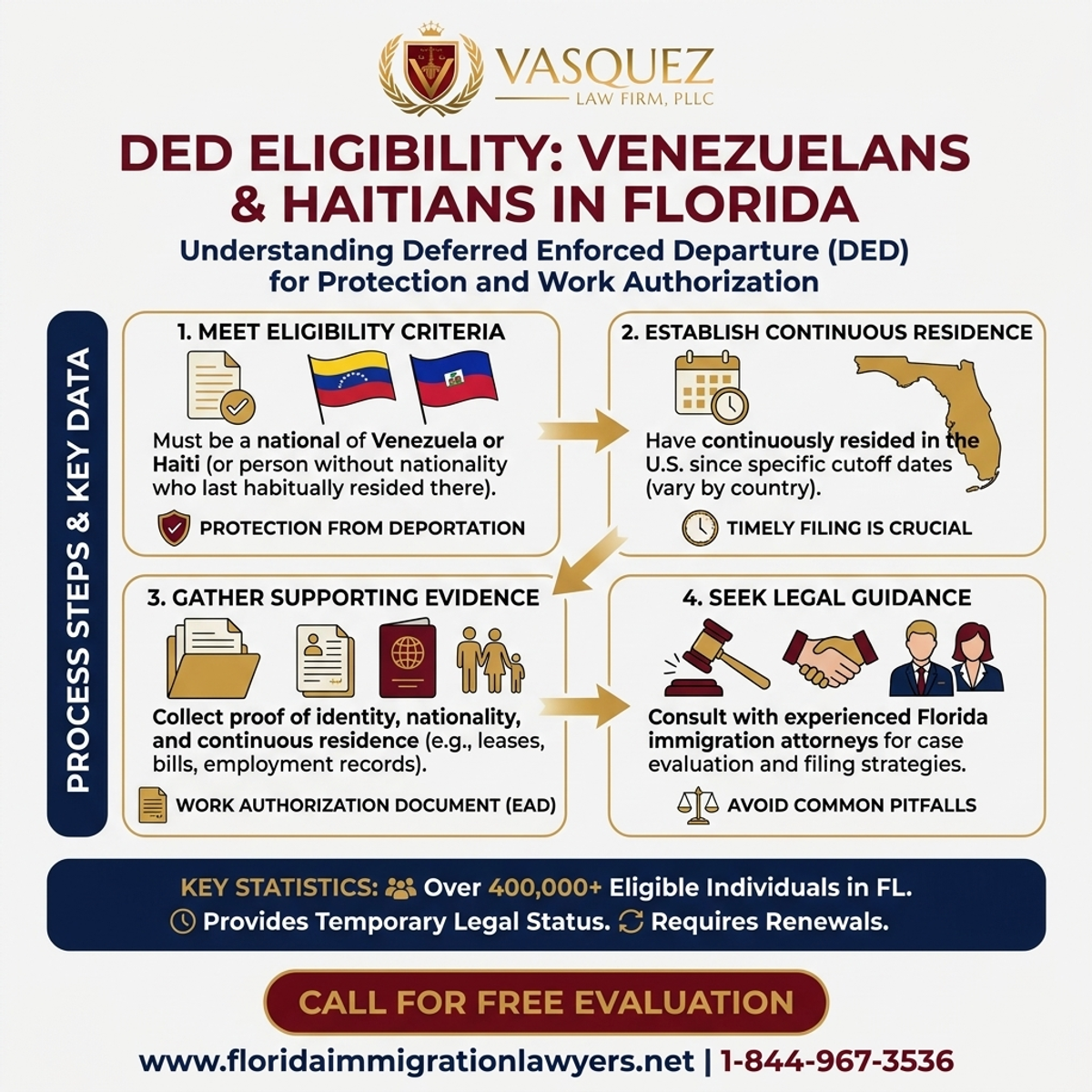
Key Statistics — DED Eligibility for Venezuelans and Haitians in Florida
Beyond the basic list, understanding what constitutes strong evidence is key. For proof of identity, a valid passport is ideal, but if unavailable, a national identity card from your home country or even a foreign birth certificate combined with other identifying documents can be considered. Always provide certified translations for any documents not in English.
When proving continuous residence, think broadly. USCIS looks for a consistent pattern of presence. This can include employment records (pay stubs, W-2s), school records (transcripts, enrollment letters), medical records (doctor's visits, hospital bills), bank statements, and even church or community organization letters. The more varied and comprehensive your evidence, the stronger your claim for continuous residence will be. It’s important to show presence for the entire required period, not just snapshots.
Finally, ensure all USCIS forms, particularly Form I-765 for employment authorization, are the most current versions available on the USCIS website. Outdated forms will be rejected. Two recent, identical passport-style photographs are also a small but crucial detail that can cause delays if not submitted correctly. Florida Immigration Lawyers can help you compile this robust package of documents, ensuring everything is in order before submission.
Timeline and Processing Expectations for DED Applications
| Stage | Typical Timeframe | Notes |
|---|---|---|
| Application Submission | 1-2 months | Ensure all documents are complete |
| USCIS Processing | 3-6 months | May vary based on workload |
| Decision Notification | 1 month | Notification sent by mail |
It's important to understand that these timeframes are estimates and can fluctuate significantly based on USCIS workload, policy changes, and the completeness of your application. The initial 1-2 months for application submission is often spent gathering all necessary documents and carefully completing forms, a process that can be expedited with legal assistance from Florida Immigration Lawyers.
During the 3-6 month USCIS processing period, you may receive a receipt notice, an appointment for biometrics (fingerprints and photos), or a Request for Evidence (RFE). An RFE means USCIS needs more information or clarification, and responding promptly and thoroughly is critical to avoid delays or denial. Monitoring your application status online through the USCIS website using your receipt number is a good practice.
While the decision notification typically takes about a month after processing, some cases may take longer. Patience is a virtue in immigration processes, but also be proactive. If you notice unusually long delays or have not received any updates, consulting with your attorney is advisable. They can inquire on your behalf and provide guidance on next steps, ensuring your case remains on track.
Cost Factors and Fee Breakdown for DED Applications
| Item | Typical Fee | Notes |
|---|---|---|
| Form I-765 Filing | Varies | Fee waivers available for eligible applicants |
| Biometrics Fee | Varies | Required for background check |
The fee for Form I-765 (Application for Employment Authorization) can vary, but typically ranges from $410 to $550, depending on current USCIS regulations. It is crucial to check the most up-to-date fees on the USCIS website before filing, as these figures are subject to change without prior notice. An incorrect fee can lead to your application being rejected and returned, causing significant delays.
The biometrics fee, typically around $85, is for fingerprinting and a background check, which is a mandatory part of the DED application process. This fee covers the cost of collecting your biometric data at an Application Support Center (ASC). Both the I-765 filing fee and the biometrics fee are non-refundable, even if your application is denied.
For individuals facing financial hardship, USCIS offers fee waivers for certain forms, including the I-765. To apply for a fee waiver, you must submit Form I-912, Request for Fee Waiver, along with supporting documentation demonstrating your inability to pay. This could include proof of receiving a means-tested benefit, household income below 150% of the poverty level, or financial hardship. Florida Immigration Lawyers can help you determine if you are eligible for a fee waiver and assist with its preparation, helping to alleviate the financial burden of the application process.
Common Mistakes to Avoid When Applying for DED
Applying for Deferred Enforced Departure is a detailed process where even minor errors can lead to significant delays or outright denial. Being aware of common mistakes and actively working to avoid them is paramount for a successful application.
- Failing to provide continuous residence proof - leads to denial.
- Submitting incomplete forms - causes processing delays.
- Ignoring background check requirements - results in ineligibility.
- Missing application deadlines - forfeits eligibility.
- Not verifying document validity - results in application rejection.
- Overlooking fee waivers - increases financial burden unnecessarily.
- Not seeking legal advice - increases risk of errors.
- Failing to update address with USCIS - leads to miscommunication.
- Disregarding USCIS updates - causes missed opportunities.
- Assuming approval is guaranteed - leads to complacency.
For instance, failing to provide continuous residence proof is a primary reason for denial because it directly contradicts a core eligibility requirement. Similarly, submitting incomplete forms, even missing a single signature or date, will result in your application being returned, wasting valuable time. Ignoring background check requirements by not disclosing relevant information can lead to severe consequences, including accusations of misrepresentation.
Missing application deadlines, especially for initial registration or re-registration periods, is an absolute bar to eligibility. It’s also crucial to verify that all documents are valid, current, and properly translated. Many applicants overlook the option of fee waivers, paying hundreds of dollars unnecessarily when they might qualify for an exemption. Most importantly, not seeking legal advice, particularly from experienced attorneys like Florida Immigration Lawyers, is a common mistake that significantly increases the risk of errors and missed opportunities, jeopardizing your entire application.
When to Call a Lawyer
Consider contacting an immigration lawyer if you have a complex case, previous immigration violations, or criminal convictions. Legal assistance is crucial when navigating the nuances of DED applications. Florida Immigration Lawyers offer expertise and support throughout the process to increase your chances of success.
Complex cases often involve situations beyond straightforward eligibility, such as having a pending asylum application, a prior deportation order, or a history of multiple entries to the U.S. without inspection. These scenarios introduce layers of complexity that require a nuanced understanding of immigration law to ensure DED eligibility is not compromised. An attorney can analyze your specific history and advise on the best strategy to present your case to USCIS.
Furthermore, if you have any criminal history, even seemingly minor offenses, it is imperative to consult with legal counsel. Certain convictions can render you ineligible for DED, and an attorney can assess the nature of your conviction, its implications under immigration law, and whether any waivers or remedies are available. Don't risk a denial by trying to navigate these intricate legal waters alone. The team at Florida Immigration Lawyers is ready to provide a free case review and help you understand your options by calling 1-844-YO-PELEO.
About Florida Immigration Lawyers
Florida Immigration Lawyers is dedicated to providing comprehensive legal services to immigrants in Orlando and Central Florida. We specialize in immigration law, including DED, asylum, deportation defense, and more. Our experienced team offers personalized attention and a free case review. Call 1-844-YO-PELEO or visit our contact page to learn more about our services.
Our firm understands the unique challenges faced by immigrant communities in Florida, especially those from Venezuela and Haiti seeking DED. We are committed to offering compassionate and effective legal representation, ensuring that every client receives the highest standard of service. From initial consultation to final decision, our attorneys work tirelessly to protect your rights and help you achieve your immigration goals.
Beyond DED, our expertise extends to a wide array of immigration matters, including family-based petitions, naturalization, and defense against removal proceedings. We pride ourselves on clear communication, transparent processes, and a deep knowledge of evolving immigration laws. When your future in the U.S. is on the line, trust the dedicated professionals at Florida Immigration Lawyers to be your advocates. Contact us today for your free case review and let us fight for you.
Frequently Asked Questions (FAQs)
Sources and References
- U.S. Citizenship and Immigration Services (USCIS)
- Executive Office for Immigration Review (EOIR)
- 8 U.S.C. Chapter 12 - Immigration and Nationality Act
Related services: immigration practice areas, family immigration services, citizenship and naturalization.
This article provides general legal information and is not intended as legal advice. Every case is unique, and outcomes depend on specific facts and circumstances. Contact an attorney for advice about your particular situation.
For assistance with DED applications, contact Florida Immigration Lawyers. Se Habla Español - Estamos aquí para ayudarle.
If you need legal assistance, learn more about Florida immigration legal team, or call us at 1-844-967-3536 for a free case review.
Do Not Navigate This Process Alone
Our experienced immigration attorneys are ready to fight for you. Get a free, confidential case review today.
Se Habla Español
Or leave your details and we’ll call you:
We will call you back within 24 hours
Free evaluation · Private and confidential · Se habla español
Helping Florida immigrant families since 2011
Or talk to us right now
AI voice assistant — available 24/7
FreeFrequently Asked Questions

William J. Vásquez
Founding Attorney · Vasquez Law Firm
U.S. Air Force veteran and immigration attorney with years of hands-on U.S. immigration experience. J.D., NCCU School of Law. AILA member. Admitted to the 4th, 5th, and 11th Circuit Courts.
Available 24/7 - Free Evaluations
Reviewed for legal accuracy by William J. Vásquez
Licensed in North Carolina; U.S. immigration is federal practice.
Related Legal Services
Our Florida immigration attorneys can help you with asylum protection, citizenship and naturalization and immigration practice areas. Call today at 1-844-YO-PELEO for a free case review.
Related Links
Related Topics
Free Legal Case Review
Discuss your case with our experienced attorneys. We're available 24/7.
Se Habla Español - Estamos aquí para ayudarle.
Related Articles
EB-5 Investor Green Card in Florida: A 2026 Guide
Explore how to obtain an EB-5 investor green card in Florida. Learn about the investment requirements, processes, and benefits of participating in this program. Discover how Florida's economic landscape can be an ideal setting for your investment. Contact Florida Immigration Lawyers for a free case review.
Certificate of Eligibility for Expungement in Florida 2026
For non-U.S. citizens in Florida, understanding how a state expungement impacts immigration status is critical. A certificate of eligibility for expungement in Florida allows a criminal record to be sealed or expunged under state law. However, federal immigration agencies often disregard such state-level relief, still considering the original criminal offense as a conviction for immigration purposes. This can have severe implications for visa applications, green card eligibility, naturalization, and even lead to deportation. This guide clarifies the Florida expungement process, its limited effect on federal immigration law, and key steps to protect your status in 2026. Learn about common mistakes, required documents, timelines, and when to seek expert legal counsel from Florida Immigration Lawyers to navigate these complex issues effectively.
What to Expect at Your First Immigration Consultation in Orlando
What happens at a first immigration consultation in Orlando, which documents to bring, and how to prepare for questions about visas, green cards, citizenship and court cases.
TPS Eligible Countries in Florida 2026: What to Know
Temporary Protected Status (TPS) provides a vital temporary immigration benefit for eligible individuals from designated countries facing humanitarian crises. As of 2026, understanding the current list of TPS eligible countries, the application process, and specific requirements is crucial for residents in Florida. This comprehensive guide details who qualifies for TPS, the step-by-step application process, necessary documentation, and associated costs. We also highlight common mistakes to avoid and when to seek legal counsel to ensure a successful application. Florida Immigration Lawyers offers expert assistance to help you navigate these complex regulations, providing a free case review to discuss your options and secure your future in the U.S.