J-1 Waiver Physician Placement in Florida 2026
Explore the process of securing a J-1 waiver for physicians in Florida. Learn how the Conrad 30 program works, application steps, and common pitfalls to avoid. Discover how Florida Immigration Lawyers can assist you in navigating this complex process.
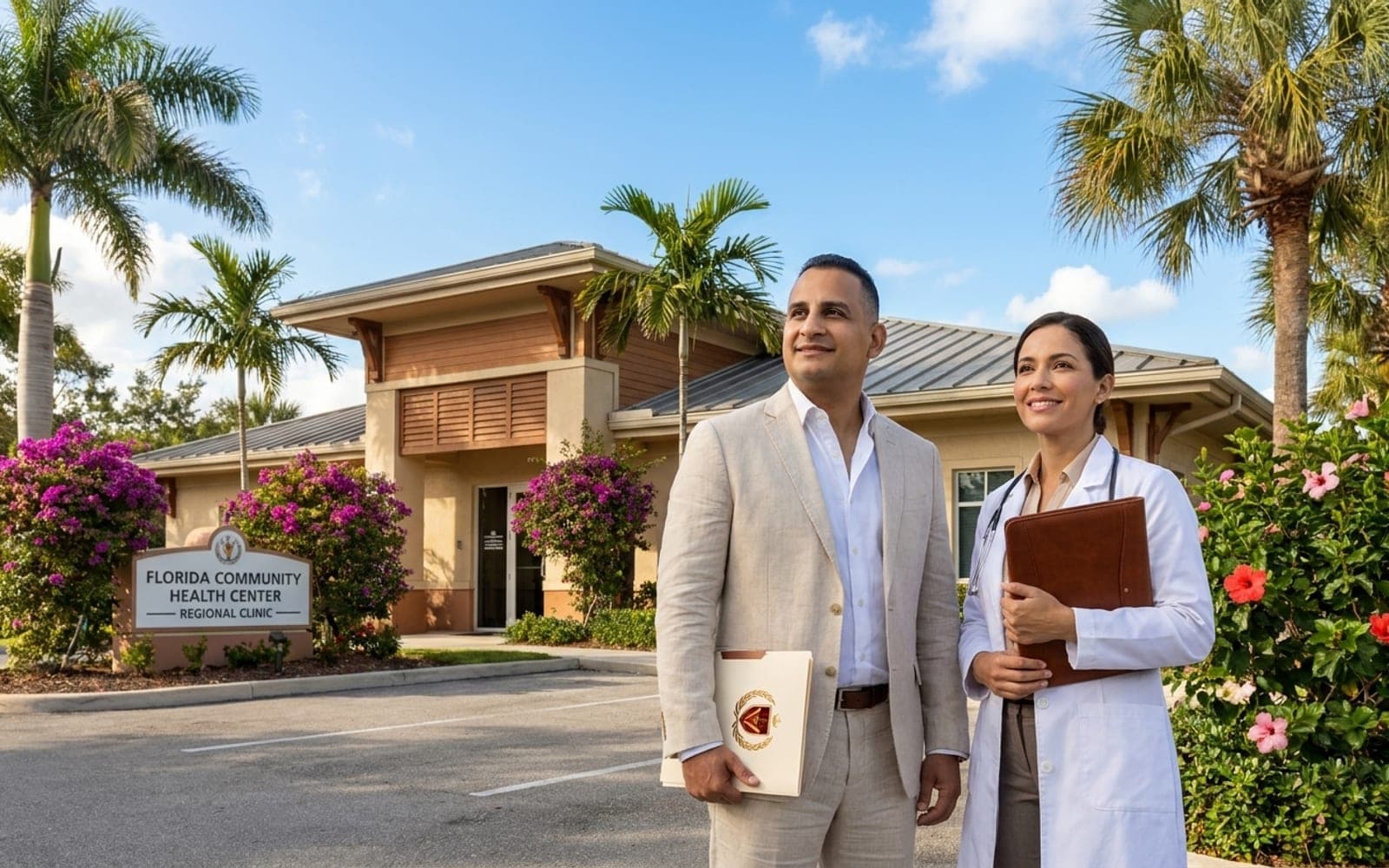
What is a J-1 Waiver and Conrad 30 Program?
A J-1 waiver is a legal exemption that allows international medical graduates on J-1 visas to remain in the U.S. after completing their residency. As of 2026, the Conrad 30 program is a key initiative facilitating this process by allowing up to 30 physicians per state to work in designated underserved areas.
Eligibility for the J-1 waiver typically requires a commitment to work in a Health Professional Shortage Area (HPSA) for at least three years. The Conrad 30 program focuses on placing physicians in critical need areas, offering a mutually beneficial opportunity for both communities and doctors.
The J-1 visa is primarily an exchange visitor visa, often subject to a 'two-year home residency requirement' under Section 212(e) of the Immigration and Nationality Act. This means that after completing their program, J-1 holders must return to their home country for two years before being eligible for certain other visas or a Green Card. The J-1 waiver, particularly through the Conrad 30 program, provides a crucial pathway to bypass this requirement for physicians committed to serving U.S. healthcare needs.
Health Professional Shortage Areas (HPSAs) are designated by the Health Resources and Services Administration (HRSA) based on various factors, including population-to-provider ratios, poverty levels, and infant mortality rates. These designations can be for primary medical care, dental health, or mental health. Physicians seeking a J-1 waiver must secure employment in a facility located within such a designated area, ensuring their service directly addresses a critical public health need.
Understanding the Conrad 30 Program
The Conrad 30 program is crucial for addressing healthcare shortages. It provides a pathway for J-1 visa holders to transition to H-1B status, bypassing the two-year home residency requirement. This allows physicians to remain in the U.S. and serve communities in need.
Each state administers its own Conrad 30 program, often through its Department of Health, with specific application windows and requirements. While the federal government sets the overall framework, individual states like Florida tailor the process to meet their unique healthcare demands. This localized approach ensures that the physicians placed are strategically located to maximize their impact on local communities.
The transition from J-1 to H-1B status is a pivotal step. Once the J-1 waiver is approved, the physician's employer can then file an H-1B petition on their behalf. The H-1B visa is a non-immigrant visa that allows U.S. employers to temporarily employ foreign workers in specialty occupations. This status enables the physician to legally work in the U.S. for the sponsoring facility for the duration of their three-year commitment and beyond, laying the groundwork for potential long-term residency.
How to Apply for a J-1 Waiver in Florida?
Applying for a J-1 waiver in Florida involves several steps, beginning with securing a job offer from a qualifying employer in an underserved area. As of 2026, the application process requires:
- Securing a job offer from a qualified health facility
- Obtaining a State Health Department recommendation
- Filing the waiver application with USCIS
Each step requires careful documentation and adherence to deadlines. Consulting with an immigration attorney can simplify the process and ensure compliance with all legal requirements.
The initial and arguably most critical step is securing a bona fide job offer from a healthcare facility located in a designated Health Professional Shortage Area (HPSA) or Medically Underserved Area (MUA) in Florida. This offer must be for full-time clinical practice for a minimum of three years. Physicians should proactively research facilities in these areas, network with residency program alumni, and utilize specialized medical job boards to find suitable opportunities. The job offer letter itself must contain specific details required by the state and federal agencies.
Once a job offer is secured, the next major hurdle is obtaining a favorable recommendation from the Florida Department of Health. This involves submitting a comprehensive application package to the state, which typically includes the job offer, a contract, evidence of the facility's HPSA designation, a statement of need from the facility, and the physician's credentials. The state reviews these applications to ensure they align with Florida's healthcare priorities and that the physician's placement will genuinely benefit an underserved community. Florida Immigration Lawyers can assist in preparing a compelling state application.
Finally, with the state's recommendation in hand, the physician must file Form I-612, Application for Waiver of the Foreign Residence Requirement, with U.S. Citizenship and Immigration Services (USCIS). This federal application includes the state's recommendation, all supporting documents, and the required filing fee. USCIS then conducts its own review to ensure all federal eligibility criteria are met. Precision and completeness in this final submission are paramount to avoid delays or requests for additional evidence.
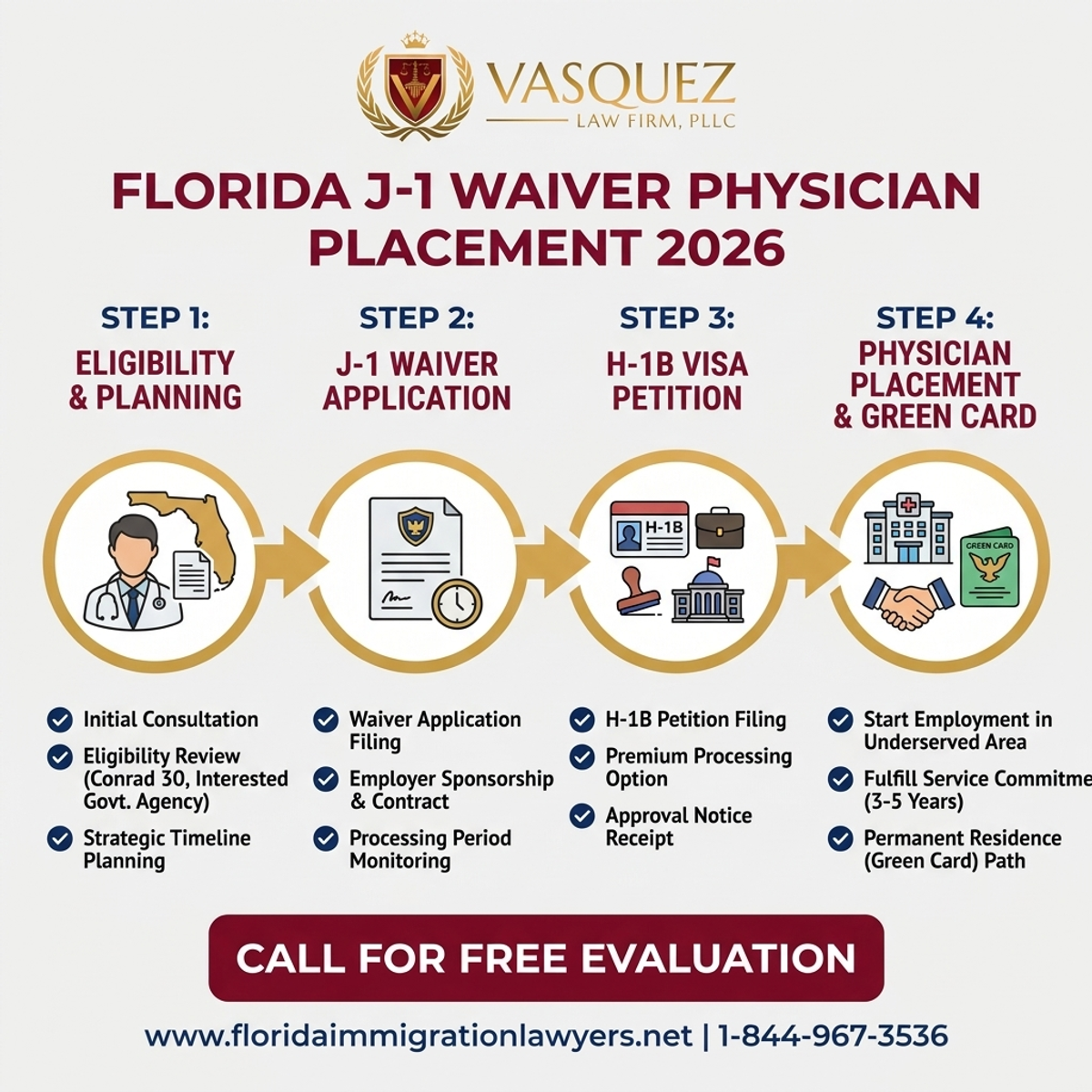
Step-by-Step Process — J-1 Waiver Physician Placement in Florida 2026
Document Checklist for J-1 Waiver Application
- Job offer letter
- Proof of medical licensure
- Recommendation letter from the State Health Department
- Completed USCIS waiver application forms
- Curriculum Vitae (CV)
- Copies of all J-1 visa documents (DS-2019 forms, J-1 visa stamp)
- No Objection Statement (if applicable, from home country)
- Evidence of HPSA designation for the employing facility
What are the Timelines and Processing Expectations?
The timeline for obtaining a J-1 waiver can vary. As of 2026, applicants should expect a processing time of approximately 6 to 12 months, depending on the complexity of the case and the responsiveness of involved agencies.
| Stage | Typical Timeframe | Notes |
|---|---|---|
| Job Offer Secured | 1-2 months | Varies by employer |
| State Health Department Recommendation | 2-3 months | Dependent on state processing |
| USCIS Processing | 3-6 months | Subject to USCIS workload |
The State Health Department recommendation phase can be particularly variable, influenced by the state's annual cap (30 waivers per state) and the volume of applications received. Florida often has a competitive application cycle, so submitting a complete and well-organized package is crucial. Missing documents or errors can lead to significant delays or even rejection at the state level.
USCIS processing times for Form I-612 are also subject to fluctuations based on federal workload, policy changes, and the specific service center handling the petition. While the table provides general estimates, it's wise to monitor the USCIS website for current processing times. Unfortunately, premium processing is not available for the J-1 waiver petition itself, though it may be an option for the subsequent H-1B petition.
To expedite the overall process, physicians should start gathering all necessary documents well in advance, maintain open communication with their prospective employer, and work closely with an experienced immigration attorney. Proactive preparation can significantly reduce potential delays. Florida Immigration Lawyers can help you prepare and track your application, providing timely updates and strategic advice.
Cost Factors and Fee Breakdown
The cost of applying for a J-1 waiver includes filing fees and potential legal assistance costs. It is crucial to plan financially for these expenses to avoid unexpected burdens.
| Item | Typical Fee | Notes |
|---|---|---|
| USCIS Filing Fee | Varies | Check current USCIS fee schedule |
| Legal Assistance | Varies by firm | Consider consulting a lawyer |
| Medical License Application Fees | Varies by state | Required for practice in Florida |
| Credential Evaluation (if needed) | $200-$500 | For foreign medical degrees |
Beyond the direct USCIS filing fee for the I-612 waiver petition, physicians should budget for the subsequent H-1B petition filing fees, which can include various components such as the base filing fee, ACWIA fee, fraud prevention and detection fee, and potentially premium processing fees if chosen for the H-1B. These fees can add up, making financial planning an essential part of the waiver process.
Legal assistance costs represent a significant but invaluable investment. An experienced immigration attorney, like those at Florida Immigration Lawyers, can help navigate the complex requirements, prepare all documentation accurately, respond to Requests for Evidence (RFEs), and represent you throughout the process. While fees vary, the peace of mind and increased likelihood of a successful outcome often outweigh the cost, especially given the high stakes of immigration matters. It's advisable to discuss fee structures and payment plans during your initial consultation.
Additionally, physicians may incur costs for obtaining official transcripts, translating foreign documents, mailing fees, and potentially travel expenses for interviews or document collection. Some employers might offer to cover certain legal or filing fees as part of their recruitment package, so it's worth discussing this during job offer negotiations. Being fully aware of all potential expenses from the outset helps avoid financial surprises.
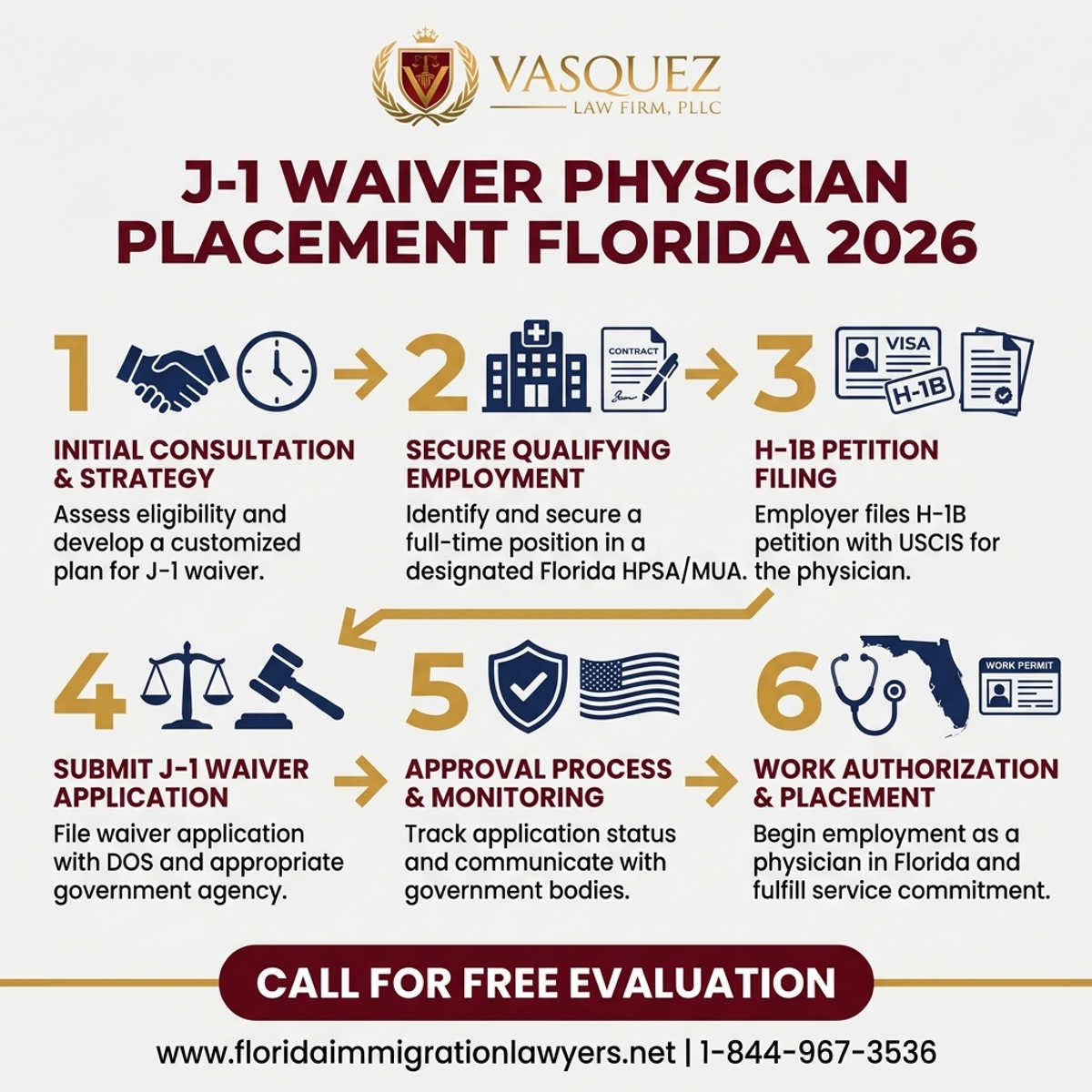
Key Statistics — J-1 Waiver Physician Placement in Florida 2026
What to Expect After Receiving a J-1 Waiver?
After securing a J-1 waiver, physicians can begin their employment in the designated area. It is crucial to fulfill the three-year service commitment to maintain eligibility for future immigration benefits.
Receiving J-1 waiver approval is a significant milestone, but it's important to understand that it does not automatically grant work authorization or permanent residency. The next immediate step is typically for your sponsoring employer to file an H-1B petition on your behalf. This H-1B visa will allow you to legally work in the U.S. in your specialty occupation for the three-year commitment period and can be extended beyond that.
The three-year service commitment is non-negotiable. Physicians must work full-time in the designated HPSA/MUA for the entire duration. Failing to complete this commitment can lead to severe consequences, including the revocation of your waiver, making you subject to the two-year home residency requirement, and potentially jeopardizing your H-1B status and future immigration prospects. It is vital to honor this agreement to ensure a smooth path forward.
Upon successful completion of the three-year service, physicians often become eligible to pursue permanent residency (Green Card). Many choose to apply for an EB-2 National Interest Waiver (NIW), which recognizes their invaluable service in underserved areas as being in the national interest, potentially bypassing the lengthy labor certification process. Other pathways, such as employer-sponsored EB-3 visas, may also be available. Planning for these long-term goals with Florida Immigration Lawyers can help secure your future in the U.S.
Do not navigate this process alone. Contact Florida Immigration Lawyers today.
Common Mistakes to Avoid
The J-1 waiver process is intricate, and even minor errors can lead to significant delays or outright denials. Avoiding these common pitfalls is crucial for a successful outcome, and working with experienced legal counsel, such as Florida Immigration Lawyers, can mitigate these risks significantly.
- Failing to secure a job offer before applying
- Missing application deadlines
- Ignoring state-specific requirements
- Providing incomplete documentation
- Not consulting with an attorney
- Assuming waiver approval guarantees a green card
- Neglecting to maintain communication with USCIS
- Overlooking community service commitments
- Misunderstanding employer obligations
- Failing to renew medical licensure
- Accepting a job offer outside a designated HPSA/MUA
- Not preparing for potential Requests for Evidence (RFEs)
When to Call a Lawyer
Consider hiring an immigration lawyer if you encounter any legal complexities, receive a Request for Evidence (RFE), or face a denial of your J-1 waiver application. Legal guidance is invaluable in navigating these challenges.
Beyond reactive situations, proactive legal counsel can significantly streamline your J-1 waiver journey. An attorney can help you understand the nuances of Florida's specific Conrad 30 program requirements, evaluate the eligibility of potential job offers, and meticulously prepare your application package to minimize the risk of errors or delays. This upfront investment can save you considerable time, stress, and potential costs down the line.
Complex medical specialties, unique family circumstances (such as a spouse on a different visa), or any prior immigration history can add layers of complexity to your J-1 waiver case. In such scenarios, the expertise of a seasoned immigration attorney becomes indispensable. They can devise a tailored strategy, anticipate potential issues, and advocate on your behalf with both state agencies and USCIS. Remember, Florida Immigration Lawyers offers a free case review at 1-844-YO-PELEO to assess your specific situation and provide clear guidance.
Florida Immigration Lawyers can assist with complex cases and provide expert advice for your immigration needs.
Frequently Asked Questions (FAQs) About J-1 Waivers in Florida
Here are some common questions physicians have about the J-1 waiver process in Florida:
Q: What is the primary purpose of the Conrad 30 program for physicians?
A: The Conrad 30 program primarily addresses the critical shortage of healthcare professionals in designated underserved areas across the U.S. It allows foreign physicians on J-1 visas to waive their two-year home residency requirement, enabling them to transition to H-1B status and practice medicine in Health Professional Shortage Areas (HPSAs) or Medically Underserved Areas (MUAs). This benefits both the physicians, who can continue their careers, and the communities, which gain access to much-needed medical care.
Q: Which medical specialties are most in demand for J-1 waivers in Florida?
A: While general practitioners, family medicine, internal medicine, pediatrics, and psychiatry are consistently in high demand for J-1 waivers in Florida's HPSAs, other specialties may also qualify if a specific community demonstrates an acute need. It's crucial for physicians to research the specific needs of potential employers in underserved areas and ensure their specialty aligns with the requirements of the Florida Department of Health. Consulting with Florida Immigration Lawyers can help identify in-demand specialties.
Q: Can I apply for a J-1 waiver if I haven't completed my residency?
A: Generally, no. To be eligible for a J-1 waiver through the Conrad 30 program, physicians must have completed their medical residency or fellowship training. The waiver is intended for graduates who are ready to practice independently in underserved communities. Applying prematurely will likely result in a denial. Focus on completing your training first, then secure an eligible job offer.
Q: What happens if I don't complete my three-year service commitment?
A: Failing to fulfill the three-year service commitment in a designated underserved area can have severe consequences. Your J-1 waiver could be revoked, making you subject to the two-year home residency requirement again. This could jeopardize your H-1B status, future immigration benefits, and potentially lead to deportation. It is paramount to honor this commitment to maintain your legal status and future immigration pathways.
Q: Are there any alternatives to the Conrad 30 program for J-1 waivers?
A: Yes, while Conrad 30 is the most common path for physicians, other waiver options exist, such as the Interested Government Agency (IGA) waivers (e.g., through the Department of Veterans Affairs, HHS, or Appalachian Regional Commission). These are typically for specific types of employment or research. Each IGA has unique eligibility criteria. It's vital to explore all options with an experienced attorney to determine the best path for your specific circumstances.
Q: Can my family members also benefit from my J-1 waiver?
A: Yes, if your J-1 waiver is approved and you successfully transition to H-1B status, your spouse and unmarried children under 21 can typically apply for H-4 dependent visas. H-4 status allows them to reside in the U.S. with you. In some cases, H-4 spouses may also be eligible for employment authorization. Discuss your family's immigration needs with Florida Immigration Lawyers during your consultation.
Q: How do I find a qualifying employer in a HPSA in Florida?
A: Finding a qualifying employer in a Health Professional Shortage Area (HPSA) in Florida requires proactive research. Start by checking the HRSA website for HPSA designations. Network with residency programs, medical associations, and use specialized job boards for physicians. Many rural clinics and community health centers actively seek J-1 waiver candidates. A legal team like Florida Immigration Lawyers can also offer guidance on identifying eligible facilities and securing a suitable job offer.
About Florida Immigration Lawyers
Florida Immigration Lawyers is dedicated to providing comprehensive immigration services across Florida. Our experienced team specializes in J-1 waivers, asylum, deportation defense, and more. Available 24/7, we offer free case reviews and are committed to helping you achieve your immigration goals. Call 1-844-YO-PELEO or schedule a free consultation.
Our firm understands the unique challenges and aspirations of international medical graduates. We go beyond simply filling out forms; we provide strategic guidance tailored to your specific situation, ensuring every step of your J-1 waiver and subsequent immigration journey is handled with precision and care. Our deep knowledge of Florida's state-specific requirements and federal immigration laws makes us a trusted partner for physicians seeking to establish their careers in the U.S.
With a compassionate and client-centric approach, Florida Immigration Lawyers is committed to being your advocate throughout the entire process. From the initial job offer review to the final Green Card application, we are here to provide clear communication, expert advice, and unwavering support. Your success is our priority, and we strive to make your transition into the U.S. healthcare system as seamless as possible.
Sources and References
- U.S. Citizenship and Immigration Services (USCIS)
- Executive Office for Immigration Review (EOIR)
- Health Resources and Services Administration (HRSA)
- 8 U.S.C. Chapter 12 - Immigration and Nationality Act
Related services: immigration practice areas, family immigration services, citizenship and naturalization, H-1B visa services.
This article provides general legal information and is not intended as legal advice. Every case is unique, and outcomes depend on specific facts and circumstances. Contact an attorney for advice about your particular situation.
Se Habla Espanol - Estamos aqui para ayudarle.
If you need legal assistance, learn more about learn about our immigration practice, or call us at 1-844-967-3536 for a free case review.
Do Not Navigate This Process Alone
Our experienced immigration attorneys are ready to fight for you. Get a free, confidential case review today.
Se Habla Español
Or leave your details and we’ll call you:
We will call you back within 24 hours
Free evaluation · Private and confidential · Se habla español
Helping Florida immigrant families since 2011
Or talk to us right now
AI voice assistant — available 24/7
FreeFrequently Asked Questions
William J. Vásquez
Founding Attorney · Vasquez Law Firm
U.S. Air Force veteran and immigration attorney with years of hands-on U.S. immigration experience. J.D., NCCU School of Law. AILA member. Admitted to the 4th, 5th, and 11th Circuit Courts.
Available 24/7 - Free Evaluations
Reviewed for legal accuracy by William J. Vásquez
Licensed in North Carolina; U.S. immigration is federal practice.
Related Legal Services
Our Florida immigration attorneys can help you with family immigration services, immigration lawyer cost in Florida and experienced immigration attorneys. Call today at 1-844-YO-PELEO for a free case review.
Related Links
Related Topics
Free Legal Case Review
Discuss your case with our experienced attorneys. We're available 24/7.
Se Habla Español - Estamos aquí para ayudarle.
Related Articles
EB-5 Investor Green Card in Florida: A 2026 Guide
Explore how to obtain an EB-5 investor green card in Florida. Learn about the investment requirements, processes, and benefits of participating in this program. Discover how Florida's economic landscape can be an ideal setting for your investment. Contact Florida Immigration Lawyers for a free case review.
Certificate of Eligibility for Expungement in Florida 2026
For non-U.S. citizens in Florida, understanding how a state expungement impacts immigration status is critical. A certificate of eligibility for expungement in Florida allows a criminal record to be sealed or expunged under state law. However, federal immigration agencies often disregard such state-level relief, still considering the original criminal offense as a conviction for immigration purposes. This can have severe implications for visa applications, green card eligibility, naturalization, and even lead to deportation. This guide clarifies the Florida expungement process, its limited effect on federal immigration law, and key steps to protect your status in 2026. Learn about common mistakes, required documents, timelines, and when to seek expert legal counsel from Florida Immigration Lawyers to navigate these complex issues effectively.
What to Expect at Your First Immigration Consultation in Orlando
What happens at a first immigration consultation in Orlando, which documents to bring, and how to prepare for questions about visas, green cards, citizenship and court cases.
Immigration Attorney Lakeland Polk County: Your Guide
For residents of Lakeland and Polk County, understanding your immigration options is crucial. This guide demystifies the process, highlighting how an experienced immigration attorney can be your most valuable ally. We cover services from family-based petitions, employment visas, and asylum claims to deportation defense and naturalization. Learn about typical timelines, costs, and common mistakes to avoid. Florida Immigration Lawyers offers dedicated legal representation throughout Central Florida, providing clear, compassionate, and effective assistance for your immigration journey. Contact us for a free case review and expert guidance.