EB-5 Investor Green Card in Florida: A 2026 Guide
Explore how to obtain an EB-5 investor green card in Florida. Learn about the investment requirements, processes, and benefits of participating in this program. Discover how Florida's economic landscape can be an ideal setting for your investment. Contact Florida Immigration Lawyers for a free case review.
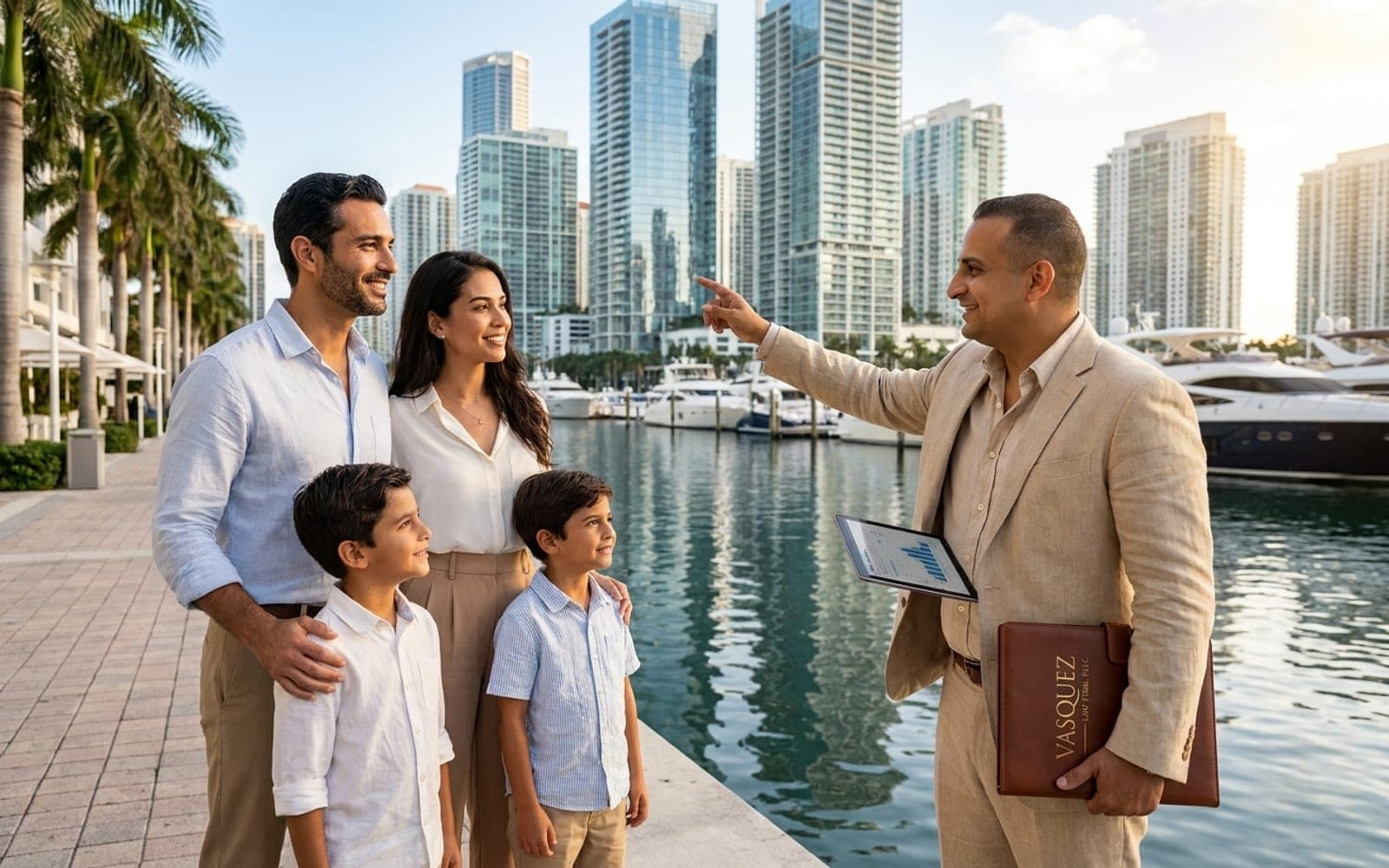
The EB-5 investor green card offers a path to permanent residency in the U.S. through significant investment in a business. Florida, with its growing economy, provides numerous opportunities for foreign investors. Key points include:
- Investment must create 10 full-time jobs
- Minimum investment: $1,050,000 or $800,000 in targeted areas
- Regional centers can simplify the process
- Orlando is a strategic location for investments
Introduction
Imagine a future where you and your family can live and work freely in the United States. The EB-5 investor green card is a gateway to making this dream a reality. As of 2026, Orlando, Florida, stands out as a vibrant hub for EB-5 investment opportunities, offering a robust economy and a welcoming environment for immigrants.
Florida's dynamic economy, particularly in cities like Orlando, presents a compelling landscape for foreign investors. Beyond its world-renowned tourism, Orlando has diversified into burgeoning technology, healthcare, and advanced manufacturing sectors, creating a stable and growth-oriented environment. This economic vitality not historical context supports the job creation mandate of the EB-5 program but also offers a vibrant community for families seeking a new life in the U.S.
The EB-5 program is not merely about an investment; it's about securing a future. It grants eligible investors and their immediate family (spouse and unmarried children under 21) the opportunity to obtain permanent residency, opening doors to educational opportunities, career growth, and the stability of living in one of America's most desirable states. Florida Immigration Lawyers understand these aspirations and are dedicated to guiding you through every step of this transformative journey.
This article explores the EB-5 program's requirements, processes, and benefits, specifically focusing on opportunities in Florida. We will cover how the EB-5 program works, what you need to qualify, and how to avoid common pitfalls. Call Florida Immigration Lawyers at 1-844-YO-PELEO for a free case review and personalized guidance.
What is the EB-5 Investor Green Card?
The EB-5 investor green card is a U.S. immigration program that allows foreign nationals to obtain permanent residency through significant financial investment in the U.S. economy. Established by Congress in 1990, the program aims to stimulate the U.S. economy through job creation and capital investment.
A "new commercial enterprise" can take various forms, including a new business established after November 29, 1990, or a business restructured or expanded substantially. Crucially, the investment must be "at risk," meaning the capital is subject to potential loss and cannot be guaranteed to be returned. This requirement underscores the entrepreneurial nature of the EB-5 program, where investors truly participate in the U.S. economy.
Investors have two primary routes: direct investment or regional center investment. Direct investments require the investor to personally manage the new commercial enterprise and directly demonstrate the creation of 10 full-time jobs. Regional center investments, on the other hand, allow for indirect and induced job creation to be counted, often simplifying the management burden for the investor.
The job creation requirement is paramount. These 10 full-time jobs must be for qualified U.S. workers (U.S. citizens, permanent residents, or other authorized immigrants, excluding the investor and their family). For regional center projects, economic methodologies are used to calculate indirect and induced jobs, which are jobs created as a result of the project's capital expenditure and operational activities. A meticulously prepared business plan is essential to demonstrate how these jobs will be created and sustained, a task where Florida Immigration Lawyers can provide invaluable assistance.
To qualify, investors must invest at least $1,050,000 in a new commercial enterprise, or $800,000 if the investment is in a targeted employment area (TEA). The investment must create or preserve at least 10 full-time jobs for U.S. workers within two years.
How Can I Apply for an EB-5 Green Card in Florida?
Navigating the EB-5 application process requires meticulous attention to detail and a thorough understanding of U.S. immigration law. The journey begins with careful planning and strategic decision-making, particularly concerning the investment project itself. This critical first step sets the foundation for the entire application, making expert guidance from Florida Immigration Lawyers indispensable.
To apply for an EB-5 green card in Florida, follow these steps:
- Choose an Investment Project: Select a qualifying business project, either independently or through a designated regional center.
- File Form I-526: Submit an Immigrant Petition by Alien Investor (Form I-526) to USCIS.
- Investment and Job Creation: Ensure your investment is made, and the requisite jobs are created or maintained.
- Conditional Green Card: Upon approval of Form I-526, apply for a conditional green card using Form I-485 if you are in the U.S., or through consular processing if you are abroad.
- Remove Conditions: After two years, file Form I-829 to remove conditions on your green card.
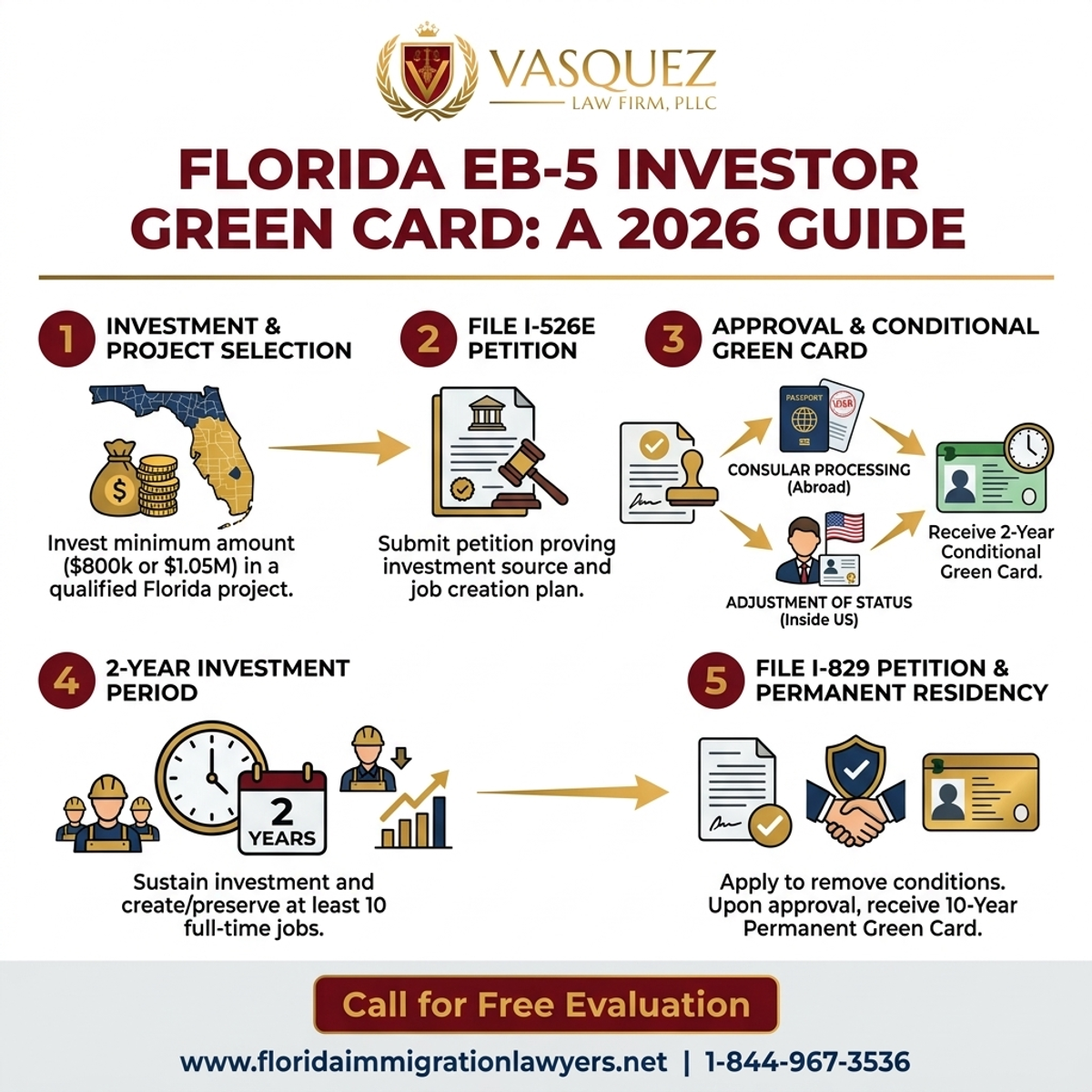
Step-by-Step Process — EB-5 Investor Green Card in Florida: A 2026 Guide
Throughout each stage, from the initial investment to the final removal of conditions, maintaining compliance with USCIS regulations is paramount. Any misstep can lead to delays or even denial. This is where the expertise of an immigration attorney becomes invaluable, ensuring all documentation is accurate, deadlines are met, and potential issues are proactively addressed. Our team at Florida Immigration Lawyers is committed to providing comprehensive support, making your path to permanent residency as smooth as possible.
What Documents Do I Need for the EB-5 Program?
The success of your EB-5 application hinges on the meticulous preparation and submission of a robust set of documents. USCIS requires comprehensive evidence to verify your identity, the lawful source of your investment funds, and the viability of your job-creating enterprise. Gathering these materials accurately and completely from the outset is paramount to avoiding delays and requests for further evidence.
Gather the following documents to support your EB-5 application:
- Valid passport and personal identification
- Proof of investment funds and their lawful source
- Business plan outlining job creation
- Form I-526 receipt notice
- Employment verification documents
- Financial statements and tax returns
Each document serves a crucial purpose in painting a clear and compliant picture for immigration authorities. It's not just about submitting papers; it's about building a compelling case that meets every legal requirement. Florida Immigration Lawyers specialize in helping investors compile and present this critical documentation, ensuring nothing is overlooked and your application stands the best chance of approval.
How Long Does the EB-5 Process Take in 2026?
Understanding the EB-5 processing timeline is essential for realistic planning and managing expectations. While the program offers a direct route to permanent residency, it is not an overnight process. Several stages, each with its own processing duration, contribute to the overall timeline, which can be influenced by various factors including country-specific visa availability.
As of 2026, the EB-5 process timeline can vary widely based on factors such as the specifics of the investment project and USCIS processing times. Here is an overview:
| Stage | Typical Timeframe | Notes |
|---|---|---|
| Form I-526 Approval | 18-30 months | Varies with caseload and project complexity |
| Conditional Green Card | 6-12 months | Adjust status or consular processing |
| Form I-829 Approval | 24-36 months | To remove conditions |
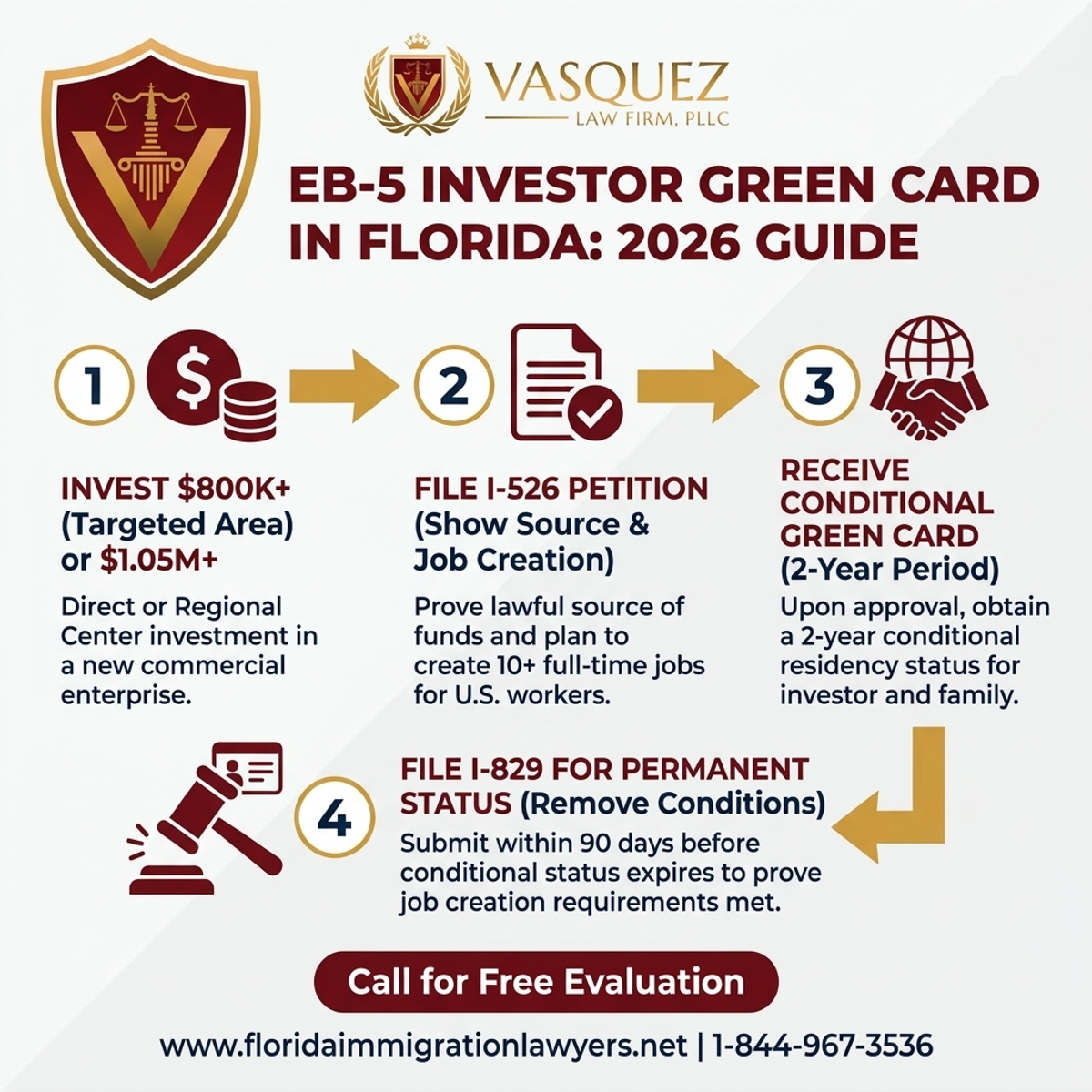
Key Statistics — EB-5 Investor Green Card in Florida: A 2026 Guide
It's important to remember that these are typical timeframes, and individual cases can vary. Factors such as USCIS caseload fluctuations, the complexity of your investment project, and any requests for additional evidence (RFEs) can all impact your specific timeline. Staying informed and having expert legal counsel from Florida Immigration Lawyers can help you navigate these potential variations effectively.
What Are the Costs Involved in the EB-5 Process?
Beyond the significant capital investment, prospective EB-5 immigrants must account for a range of associated costs. These financial commitments are integral to the application process and include government filing fees, administrative charges, and professional service fees. A comprehensive financial plan is crucial to ensure you are fully prepared for the entire journey.
The EB-5 investment must meet specific financial thresholds. Here is a basic breakdown:
| Item | Typical Fee | Notes |
|---|---|---|
| Investment Amount | $1,050,000 or $800,000 | Depending on location of investment |
| Form I-526 Filing Fee | Consult USCIS for current fee | Check latest USCIS fee schedule |
In addition to the investment and USCIS fees, investors should budget for legal representation, which is highly recommended given the program's complexity. Other potential costs include due diligence fees for regional center projects, business plan preparation, economic impact analysis reports, and translation services for foreign documents. A clear understanding of all financial obligations, guided by experts like Florida Immigration Lawyers, ensures a smooth process.
Do not navigate this process alone. Contact Florida Immigration Lawyers today for expert assistance.
Common Mistakes to Avoid
The path to an EB-5 green card is fraught with potential pitfalls that can derail even the most promising applications. Understanding and proactively avoiding these common mistakes is as crucial as meeting the core requirements. Many applicants underestimate the complexity, leading to unnecessary delays or outright denials.
- Insufficient Investment: Failing to meet the minimum investment amounts can lead to denial.
- Poor Source Documentation: Not adequately proving the lawful source of funds can derail your application.
- Job Creation Miscalculations: Not meeting the job creation requirement within the allotted time can result in failure to remove conditions.
- Incomplete Forms: Omitting necessary information can delay processing or lead to denial.
- Ignoring Regional Center Changes: Not staying updated with changes in regional center project requirements can affect your investment.
- Overlooking Deadlines: Missing filing deadlines can jeopardize your immigration status.
- Inadequate Legal Representation: Failing to consult with an experienced immigration attorney can leave you unprepared for complex requirements.
- Choosing the Wrong Investment: Selecting a non-viable project can lead to financial and immigration losses.
- Lack of Financial Planning: Not planning for additional costs like legal fees and living expenses in the U.S. can be problematic.
- Assuming Fast Processing: Believing that the process will be quick can lead to frustration and poor planning.
- Ignoring Immigration Changes: Not keeping abreast of policy changes can lead to unexpected complications.
Consider the mistake of "Poor Source Documentation." Imagine an investor who transfers a large sum from their business account without clear records linking it to legitimate earnings, or receives a gift without proper gift tax documentation. USCIS will scrutinize every dollar, and without clear, verifiable evidence, the application will likely be rejected. This highlights why thorough preparation and expert legal review from Florida Immigration Lawyers are not just advisable, but essential.
When to Call a Lawyer
While the EB-5 program offers an incredible opportunity, its intricate legal framework demands professional guidance. Recognizing when to engage an experienced immigration attorney can significantly enhance your chances of success and mitigate potential risks. Proactive legal counsel can transform a daunting process into a manageable journey.
Considering the complexity of the EB-5 program, it is crucial to know when to seek legal assistance. Contact a lawyer if you:
- Are unsure about the source of your investment funds
- Need help selecting a regional center or project
- Face challenges in meeting the job creation requirement
- Require guidance on maintaining your conditional green card
- Experience delays or issues with USCIS processing
For example, if you are considering a new EB-5 project and need to perform due diligence on the regional center's track record or the project's financial viability, a lawyer can connect you with appropriate financial and business analysts. Similarly, if you receive a Request for Evidence (RFE) from USCIS, a lawyer's expertise is critical in formulating a comprehensive and timely response. Florida Immigration Lawyers are equipped to handle these complexities, providing peace of mind and strategic advice throughout your entire EB-5 journey. Call 1-844-YO-PELEO for immediate assistance.
Florida Immigration Lawyers offer expertise and personalized service to guide you through the EB-5 process. Call us today for a consultation.
About Florida Immigration Lawyers
Florida Immigration Lawyers is dedicated to providing exceptional immigration services throughout Florida. Our team of experienced attorneys specializes in a variety of immigration areas, including investment immigration, asylum, and deportation defense. We are available 24/7 to offer free case reviews and ensure you receive the best legal representation possible. Reach out to us at 1-844-YO-PELEO for more information or to schedule a free consultation.
Sources and References
- U.S. Citizenship and Immigration Services (USCIS)
- Executive Office for Immigration Review (EOIR)
- 8 U.S.C. Chapter 12 - Immigration and Nationality Act
Related services: H-1B specialty occupation visas, L-1 intracompany transfer visas, work visas for professionals, investment and entrepreneur visas.
This article provides general legal information and is not intended as legal advice. Every case is unique, and outcomes depend on specific facts and circumstances. Contact an attorney for advice about your particular situation.
For personalized assistance and to explore your EB-5 investment options, contact Florida Immigration Lawyers at 1-844-YO-PELEO. Se Habla Español - Estamos aquí para ayudarle.
If you need legal assistance, learn more about learn about business immigration options, or call us at 1-844-967-3536 for a free case review.
Do Not Navigate This Process Alone
Our experienced immigration attorneys are ready to fight for you. Get a free, confidential case review today.
Se Habla Español
Or leave your details and we’ll call you:
Free Evaluation in 24 Hours
Or talk to us right now
AI voice assistant — available 24/7
FreeFrequently Asked Questions

William J. Vásquez
Founding Attorney · Vasquez Law Firm
U.S. Air Force veteran and immigration attorney with years of hands-on U.S. immigration experience. J.D., NCCU School of Law. AILA member. Admitted to the 4th, 5th, and 11th Circuit Courts.
Available 24/7 - Free Evaluations
Reviewed for legal accuracy by William J. Vásquez
Licensed in North Carolina; U.S. immigration is federal practice.
Related Legal Services
Our Florida immigration attorneys can help you with asylum protection, citizenship and naturalization and immigration practice areas. Call today at 1-844-YO-PELEO for a free case review.
Related Links
Related Topics
Free Legal Case Review
Discuss your case with our experienced attorneys. We're available 24/7.
Se Habla Español - Estamos aquí para ayudarle.
Related Articles
Certificate of Eligibility for Expungement in Florida 2026
For non-U.S. citizens in Florida, understanding how a state expungement impacts immigration status is critical. A certificate of eligibility for expungement in Florida allows a criminal record to be sealed or expunged under state law. However, federal immigration agencies often disregard such state-level relief, still considering the original criminal offense as a conviction for immigration purposes. This can have severe implications for visa applications, green card eligibility, naturalization, and even lead to deportation. This guide clarifies the Florida expungement process, its limited effect on federal immigration law, and key steps to protect your status in 2026. Learn about common mistakes, required documents, timelines, and when to seek expert legal counsel from Florida Immigration Lawyers to navigate these complex issues effectively.
Immigration Lawyer Orlando Free Consultation in Florida
For individuals and families in Orlando, Florida, navigating the complexities of U.S. immigration law requires expert guidance. An immigration lawyer in Orlando offers crucial support for everything from visa applications and green card processes to naturalization and deportation defense. This comprehensive guide details what a free consultation covers, providing a step-by-step overview of immigration pathways, essential document checklists, and expected timelines in 2026. We also highlight common mistakes to avoid, discuss the critical role of legal counsel in deportation and asylum cases, and explain why choosing a local Orlando immigration attorney is beneficial. Florida Immigration Lawyers is dedicated to serving the diverse community of Orlando with compassionate, effective legal solutions, ensuring you receive personalized advice and robust representation for a successful immigration journey.
Immigration Interview Preparation Florida 2026 Guide
Facing an immigration interview in Florida? This comprehensive guide offers essential 2026 USCIS interview tips for green card and naturalization applicants. Learn how to meticulously prepare your documents, understand the typical timelines, and avoid common mistakes that could jeopardize your case. We cover what to expect at the Orlando USCIS Field Office, provide a detailed document checklist, and explain the various costs involved in the process. With insights into naturalization specifics and when to seek legal counsel, Florida Immigration Lawyers helps you approach your interview with confidence. Our firm is dedicated to empowering immigrants across Florida with the knowledge and support needed for a successful outcome. Get a free case review today.
I-601A Provisional Waiver: Florida Eligibility 2026
The I-601A provisional waiver offers a critical pathway for individuals in Florida to overcome inadmissibility due to unlawful presence. This guide, updated for 2026, explains the eligibility requirements, focusing on the crucial element of demonstrating extreme hardship to a U.S. citizen or LPR spouse or parent. Learn about the step-by-step application process, essential documents, typical costs, and current processing timelines. We also highlight common mistakes to avoid that could jeopardize your application. Whether you are in Orlando or another part of Central Florida, understanding this waiver is vital for those undergoing consular processing. Discover when to seek professional legal assistance from Florida Immigration Lawyers to navigate these complexities and secure your path to lawful permanent residency. Call us for a free case review.