Immigration Interview Preparation Florida 2026 Guide
Facing an immigration interview in Florida? This comprehensive guide offers essential 2026 USCIS interview tips for green card and naturalization applicants. Learn how to meticulously prepare your documents, understand the typical timelines, and avoid common mistakes that could jeopardize your case. We cover what to expect at the Orlando USCIS Field Office, provide a detailed document checklist, and explain the various costs involved in the process. With insights into naturalization specifics and when to seek legal counsel, Florida Immigration Lawyers helps you approach your interview with confidence. Our firm is dedicated to empowering immigrants across Florida with the knowledge and support needed for a successful outcome. Get a free case review today.
Preparing for an immigration interview in Florida is a crucial step toward achieving your immigration goals, whether for a green card, naturalization, or other benefits. It involves meticulous document gathering, thorough review of your application, and practicing responses to potential questions. Understanding the process at the Orlando USCIS Field Office, for instance, and knowing what to expect can significantly reduce stress and improve your chances of a successful outcome. An attorney can provide invaluable guidance, ensuring all aspects of your case are properly presented and that you are fully prepared for the interview.
- Organize Documents: Gather all originals and copies of required evidence.
- Review Application: Understand every detail of your submitted forms.
- Practice Questions: Prepare for common and specific questions with honesty.
- Seek Legal Counsel: An experienced lawyer can prepare you and attend with you.
- Be Honest: Always provide truthful and consistent information.
The journey to securing your immigration status in the United States often culminates in a pivotal moment: the immigration interview. For many individuals and families across Florida, this interview with a U.S. Citizenship and Immigration Services (USCIS) officer can feel daunting. Whether you are seeking a green card through family sponsorship, adjusting your status, or pursuing naturalization to become a U.S. citizen, thorough immigration interview preparation in Florida is essential for success. This comprehensive guide from Florida Immigration Lawyers is designed to demystify the process, provide actionable tips, and help you navigate your interview with confidence. We understand the stakes involved and are here to support you every step of the way.
Preparing effectively means understanding what to expect, gathering the right documents, and knowing how to articulate your case clearly and truthfully. From the moment you receive your interview notice from the Orlando USCIS Field Office or another location, every action you take contributes to your overall readiness. Our firm is dedicated to empowering immigrants across Central Florida and beyond with the knowledge and legal assistance needed for a positive outcome. Do not navigate this complex process alone. Call Florida Immigration Lawyers at 1-844-YO-PELEO for a free case review and let our experienced team help you prepare.
What Happens During a USCIS Immigration Interview in Florida?
An immigration interview, typically conducted by a USCIS officer, is a formal proceeding designed to verify the information provided in your application and determine your eligibility for the requested immigration benefit. During this interview, the officer will review your application forms, supporting documents, and ask you a series of questions under oath. This process applies to various immigration benefits, including adjustment of status for a green card (Form I-485), naturalization (Form N-400), and asylum applications (Form I-589).
In Florida, interviews are primarily held at USCIS Field Offices, such as the Orlando Field Office, which serves applicants across Central Florida. The officer's role is to assess your credibility, ensure the truthfulness of your statements, and confirm that you meet all legal requirements outlined in the Immigration and Nationality Act (INA). They may ask questions about your personal history, family background, employment, travel, and the specifics of your immigration petition. For marriage-based green card interviews, the focus will often be on the bona fides of your marriage, requiring evidence of a shared life. For naturalization, you will also undergo English and civics tests. It is a critical step where attention to detail and honest responses are paramount.
The atmosphere is generally professional, and while it can be nerve-wracking, remembering to stay calm, listen carefully, and answer truthfully is key. Your attorney can be present with you, providing support and ensuring your rights are protected throughout the interview process.
How to Prepare for Your Green Card Interview in 2026?
Preparing for your green card interview in 2026, especially for an adjustment of status interview at a Florida USCIS office, requires a methodical approach. As of 2026, USCIS continues to prioritize efficiency while maintaining strict scrutiny on applications. The goal is to present a clear, consistent, and truthful case that demonstrates your eligibility under the relevant sections of the Immigration and Nationality Act, such as INA § 245 for adjustment of status. This preparation involves more than just gathering documents; it's about understanding your application thoroughly and being ready to articulate your story.
The officer will be looking for consistency between your verbal testimony and the information contained in your application forms and supporting documents. Any discrepancies, even minor ones, could raise concerns. Therefore, a comprehensive review of your entire application package, including all forms like Form I-485 (Application to Register Permanent Residence or Adjust Status) and any underlying petitions like Form I-130 (Petition for Alien Relative), is non-negotiable. Familiarize yourself with every question and every answer you provided, and be prepared to elaborate on them. Your ability to recall details and present a coherent narrative will greatly influence the officer's impression.
Step-by-Step Green Card Interview Preparation Guide:
- Review Your Application Thoroughly: Before anything else, re-read every form you submitted. This includes your I-485, I-130, I-765, I-131, and any other supporting documents. Ensure you remember all dates, addresses, and employment history.
- Gather All Original Documents and Copies: Bring every original document you submitted copies of, plus new documents that have emerged since filing. This includes birth certificates, marriage certificates, passports, visas, I-94 records, financial records, and medical exam results (Form I-693) in a sealed envelope if not already submitted.
- Organize Your Evidence Systematically: Use binders, folders, or tabs to categorize your documents. This makes it easy to quickly retrieve specific evidence when the officer requests it. For marriage-based cases, organize proof of bona fide marriage such as joint bank statements, leases, utility bills, photos, and affidavits from friends and family.
- Practice Answering Potential Questions: Anticipate common questions about your background, how you met your spouse (if applicable), your job, and your intentions in the U.S. Practice answering clearly, concisely, and truthfully. Avoid volunteering too much information unless asked.
- Prepare for the Oath: You will be sworn in to tell the truth. Understand the gravity of this oath and commit to being honest in all your responses. Any misrepresentation can lead to severe consequences, including denial and future immigration bars.
- Dress Appropriately and Professionally: Present yourself respectfully. Business casual attire is generally recommended. This shows respect for the process and the interviewing officer.
- Arrive Early at the USCIS Field Office: Plan to arrive at least 30-45 minutes before your scheduled appointment, especially at busy locations like the Orlando USCIS Field Office. Account for traffic, parking, and security checks.
- Consider Legal Representation: Having an experienced immigration lawyer from Florida Immigration Lawyers attend the interview with you can be a significant advantage. Your attorney can provide support, clarify questions, and address any legal issues that may arise.
Essential Green Card Interview Document Checklist:
- Interview Notice (Form I-797C)
- Government-issued photo identification (e.g., passport, driver's license)
- Birth Certificate (applicant and petitioner, if applicable)
- Marriage Certificate (if applicable)
- Divorce Decrees or Death Certificates for all prior marriages (applicant and petitioner, if applicable)
- Medical Examination Report (Form I-693, in a sealed envelope if not already submitted)
- Affidavit of Support (Form I-864) with all supporting financial documents (tax returns, W-2s, employment letters)
- Proof of bona fide marriage (joint bank accounts, leases, utility bills, insurance, photos, affidavits)
- Photocopies of all submitted applications and petitions
- Originals of all supporting documents submitted as copies
- Any updated documents or information since filing (e.g., new employment, new address, birth of a child)
- Translations of any foreign-language documents, certified by a competent translator
What is the Typical Timeline for an Immigration Interview in Florida?
The timeline for an immigration interview in Florida can vary significantly depending on the type of application, the specific USCIS Field Office (such as Orlando), and the overall USCIS workload. As of 2026, many processing times remain dynamic, influenced by backlogs and policy changes. Generally, after filing your application, you can expect to wait several months before receiving an interview notice. For adjustment of status cases (Form I-485), this waiting period can range from 6 to 18 months or even longer, while naturalization (Form N-400) might see interview notices within 4 to 12 months after biometrics. It is crucial to monitor current processing times on the USCIS website, as these figures are averages and not guarantees.
Factors that can influence your specific timeline include the complexity of your case, whether a Request for Evidence (RFE) is issued, and the volume of applications at your assigned field office. For example, a case with extensive criminal history or prior immigration violations will likely take longer due to increased scrutiny. Conversely, a straightforward case with all documentation in order might proceed more quickly. It is also important to consider that after the interview, the officer may need additional time to review your case, which could lead to a decision being mailed to you weeks or even months later. This post-interview waiting period is common and does not necessarily indicate a problem with your application.
Immigration Interview Timeline Expectations (as of 2026):
| Stage | Typical Timeframe (after filing) | Notes |
|---|---|---|
| Application Filing to Receipt Notice | 1-3 weeks | Acknowledgement that USCIS received your application. |
| Receipt Notice to Biometrics Appointment | 3-8 weeks | Fingerprints, photos, and signature for background checks. |
| Biometrics to Interview Notice | 4-12 months (N-400); 6-18 months (I-485) | Varies significantly by case type and field office workload. |
| Interview to Decision | Immediately to several months | Decision may be given on the spot, or mailed later after review. RFEs can extend this. |
| Decision to Green Card/Certificate Mailing | 2-4 weeks (after approval) | Physical document production and mailing. |
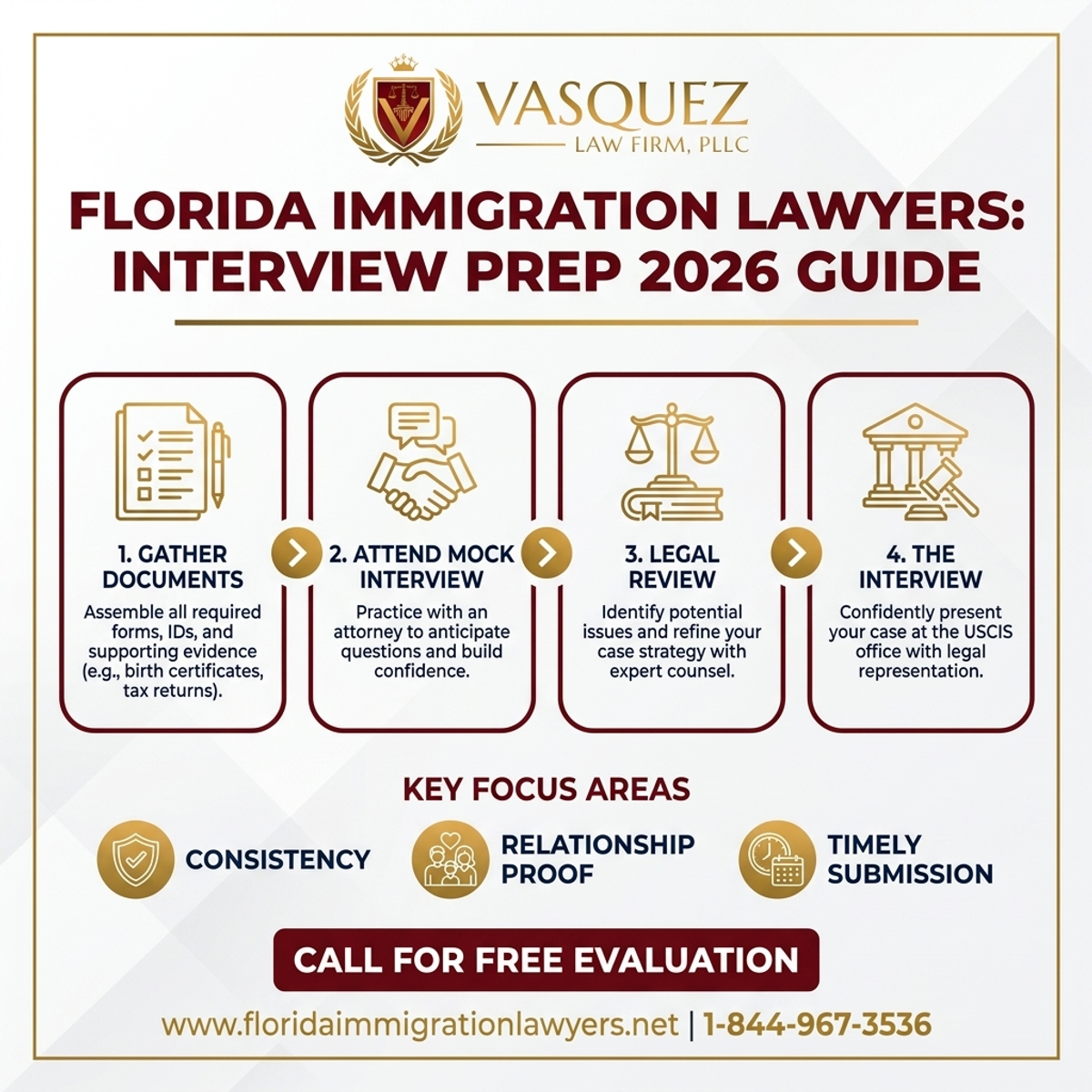
Step-by-Step Process — Immigration Interview Preparation Florida 2026 Guide
Understanding the Costs of Immigration Interview Preparation in Florida
Navigating the immigration process in Florida involves various costs beyond just the filing fees charged by USCIS. When considering immigration interview preparation in Florida, it is important to budget for several potential expenses. These costs can include government filing fees, fees for medical examinations, document translation services, and, significantly, legal fees if you choose to retain an immigration attorney. While some costs are mandatory for all applicants, others are optional but highly recommended for a smoother process and higher chance of success.
Government filing fees are non-refundable and can be substantial, often changing annually. For instance, a Form I-485 application for adjustment of status currently incurs a significant fee, separate from any associated I-130 petition fees. The medical examination, conducted by a USCIS-approved civil surgeon, is also a mandatory expense, with fees varying by provider. Document translation costs arise if any of your supporting documents are not in English, requiring certified translations. While attorney fees represent an investment, the expertise and peace of mind provided by legal counsel, especially for complex cases or interview attendance, can be invaluable.
Typical Costs Associated with Immigration Interview Preparation (as of 2026):
| Item | Typical Fee (Estimate, subject to change) | Notes |
|---|---|---|
| USCIS Filing Fees (e.g., I-485) | Varies by form, check USCIS website | Non-refundable government fees. USCIS fees are subject to change, always verify current fees. |
| Medical Examination (Form I-693) | $200 - $500+ | Required for adjustment of status. Fees vary by civil surgeon. |
| Document Translation Services | $20 - $50+ per page | For any non-English documents requiring certified translation. |
| Attorney Fees for Interview Preparation & Attendance | Varies widely by complexity and firm | Covers legal advice, document review, mock interviews, and representation at the interview. |
| Passport Photos | $10 - $20 | Required for various applications. |
Do not navigate this process alone. Contact Florida Immigration Lawyers today for a free case review. Our team is ready to assist you.
Tips for a Successful Naturalization Interview in Orlando
The naturalization interview is a critical step towards becoming a U.S. citizen. For applicants in Central Florida, this interview will typically take place at the Orlando USCIS Field Office. Success hinges on a combination of thorough preparation, honest communication, and demonstrating your commitment to the principles of the U.S. Constitution and laws. As outlined in INA § 316, applicants must demonstrate good moral character, continuous residence, and an attachment to the principles of the U.S. Constitution. Preparing for this specific interview involves mastering the English language test and the civics test, in addition to reviewing your N-400 application.
The English test assesses your ability to read, write, and speak basic English. The civics test covers U.S. history and government. USCIS provides study materials, and utilizing these resources is paramount. During the interview, the officer will ask questions from your Form N-400, Application for Naturalization, to verify the information and assess your eligibility. These questions can range from your personal history, marital status, employment, and travel, to questions about your good moral character, such as any arrests or citations, even minor ones. It is vital to be completely honest and consistent with your answers, as any misrepresentation can lead to denial and potential legal repercussions.
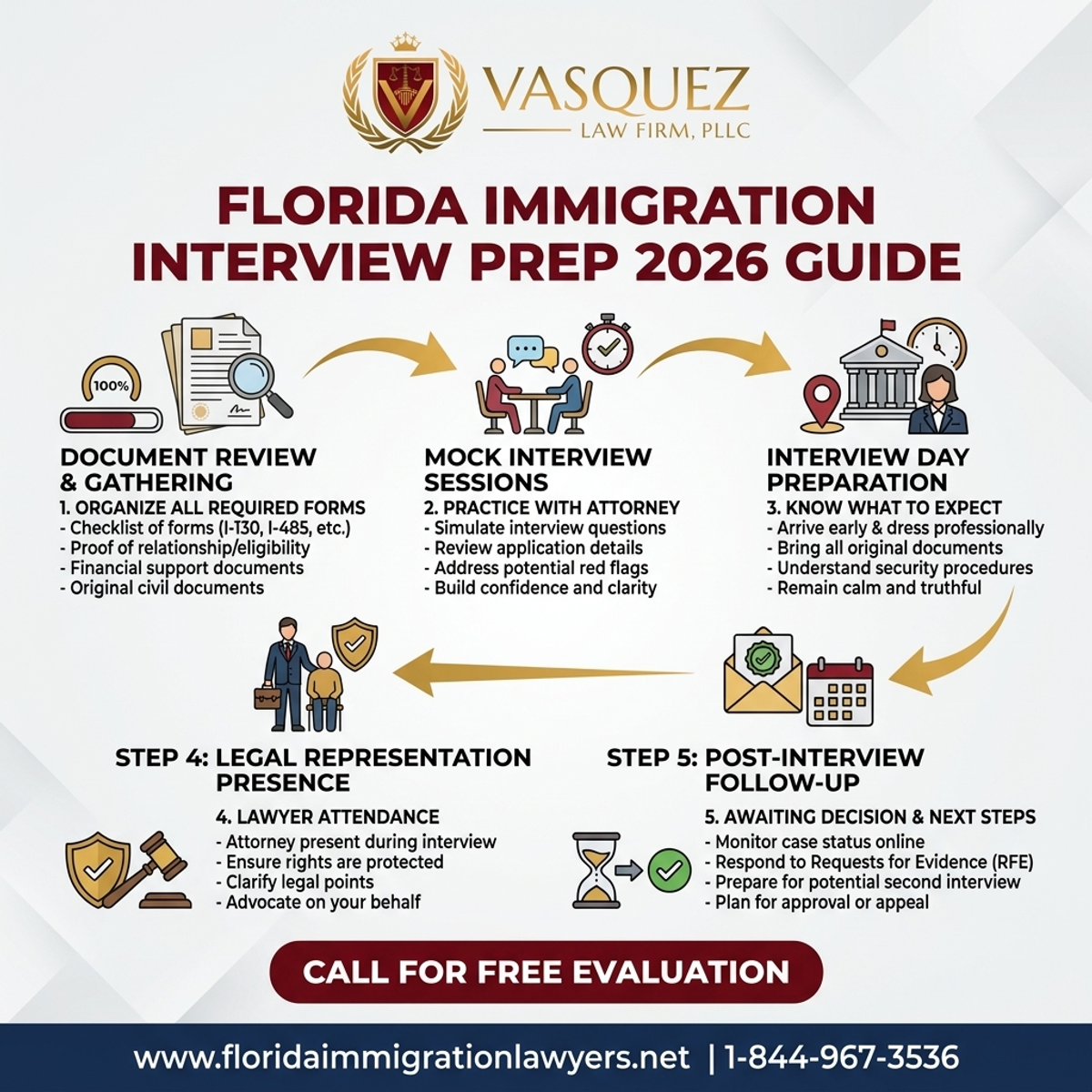
Key Statistics — Immigration Interview Preparation Florida 2026 Guide
Beyond the tests, the officer will evaluate your overall credibility and adherence to the requirements for naturalization. Being polite, respectful, and clear in your responses is always beneficial. If you are unsure about a question, it is better to ask for clarification than to guess or provide an incorrect answer. Remember, the goal is to demonstrate that you meet all the legal requirements for citizenship and are ready to take the Oath of Allegiance.
Common Mistakes to Avoid During Your Immigration Interview
The immigration interview is a high-stakes event, and even minor missteps can lead to delays or, in some cases, outright denials. Being aware of common pitfalls is a critical part of effective immigration interview preparation in Florida. Avoiding these mistakes can significantly increase your chances of a positive outcome and prevent unnecessary complications in your immigration journey.
- Failing to Bring All Required Documents: One of the most frequent errors is forgetting to bring original documents or updated evidence. This often leads to a Request for Evidence (RFE) or rescheduling, prolonging the process.
- Providing Inconsistent Information: Discrepancies between your application forms, supporting documents, and verbal testimony can raise red flags for the USCIS officer, questioning your credibility.
- Lying or Misrepresenting Facts: Any false statements or deliberate misrepresentations under oath can result in an immediate denial, findings of fraud, and even future immigration bans or criminal charges. Honesty is always the best policy.
- Not Reviewing Your Application Thoroughly: Many applicants fail to re-read their own submitted forms, leading to confusion when asked about specific dates or details they previously provided.
- Arriving Late for the Interview: Punctuality is crucial. Arriving late can lead to your interview being canceled and requiring you to reschedule, which delays your case significantly.
- Failing to Disclose Criminal History: Even minor arrests, citations, or past legal issues, regardless of the outcome, must be disclosed. Concealing this information can be interpreted as misrepresentation.
- Not Understanding the Purpose of the Interview: Some applicants arrive without a clear understanding of what the interview is for, leading to unpreparedness for specific lines of questioning.
- Going Alone Without an Attorney (in complex cases): While not always mandatory, for complex cases, having an attorney present can prevent miscommunications, address legal issues, and ensure your rights are protected.
- Being Overly Emotional or Argumentative: Maintaining a calm, respectful, and professional demeanor is important. Emotional outbursts or arguing with the officer can negatively impact your case.
- Failing the English or Civics Test (Naturalization): For naturalization applicants, insufficient preparation for these tests can lead to a second interview or denial.
- Not Updating USCIS with New Information: If your address, employment, or marital status changes after filing, failing to update USCIS can lead to important notices being missed or discrepancies in your record.
When to Call Florida Immigration Lawyers for Your Interview Preparation
While many individuals can navigate straightforward immigration interviews, certain situations strongly warrant the expertise of an experienced immigration attorney. If you find yourself facing any complexities, uncertainties, or potential red flags in your case, it is always advisable to seek legal counsel. Florida Immigration Lawyers specializes in providing comprehensive immigration interview preparation in Florida for a wide range of cases.
You should consider contacting our firm if your case involves: a history of prior immigration denials or issues, any arrests or criminal convictions (even if expunged or minor), previous deportation or removal proceedings, a complex family situation, an asylum claim, significant periods of unlawful presence, or if you simply feel overwhelmed or unsure about the process. Our attorneys can conduct mock interviews, help you organize your documents, identify potential issues, and, most importantly, represent you at the actual interview. We serve clients throughout Central Florida, including Orlando, and are committed to protecting your rights and advocating for your best interests. Don't leave your future to chance.
About Florida Immigration Lawyers
Florida Immigration Lawyers is a leading law firm dedicated to providing exceptional immigration legal services across the entire state of Florida. With a deep understanding of U.S. immigration law and a commitment to our clients, we offer compassionate and effective representation for individuals, families, and businesses. Our experienced attorneys specialize in a wide array of immigration matters, including family-based petitions, business immigration, asylum claims, deportation defense, naturalization, and adjustment of status. We pride ourselves on offering personalized legal strategies tailored to each client's unique situation, ensuring a clear path forward.
Our firm is available 24/7 to address your urgent immigration needs, providing free case reviews to help you understand your options without financial commitment. We serve all of Florida, with a strong presence in Central Florida, including Orlando, and are dedicated to guiding you through every step of the immigration process. With Florida Immigration Lawyers, you gain a trusted advocate who speaks your language and fights tirelessly for your rights. Visit our attorney profiles to learn more about our dedicated team. Call us today at 1-844-YO-PELEO to schedule your free consultation.
Sources and References
- U.S. Citizenship and Immigration Services (USCIS)
- Executive Office for Immigration Review (EOIR)
- U.S. Department of State
- 8 U.S.C. Chapter 12 - Immigration and Nationality Act (INA)
- 8 CFR (Code of Federal Regulations)
- USCIS Policy Manual
Related services: immigration practice areas, free immigration consultation, immigration lawyer cost in Florida.
This article provides general legal information and is not intended as legal advice. Every case is unique, and outcomes depend on specific facts and circumstances. Contact an attorney for advice about your particular situation.
Your immigration journey is important, and proper preparation for your interview is paramount. Let Florida Immigration Lawyers be your guide and advocate. Contact us today for a free case review at 1-844-YO-PELEO. Se Habla Espanol - Estamos aqui para ayudarle.
If you need legal assistance, learn more about speak with an immigration lawyer, or call us at 1-844-967-3536 for a free case review.
Do Not Navigate This Process Alone
Our experienced immigration attorneys are ready to fight for you. Get a free, confidential case review today.
Se Habla Español
Or leave your details and we’ll call you:
Free Evaluation in 24 Hours
Or talk to us right now
AI voice assistant — available 24/7
FreeFrequently Asked Questions

William J. Vásquez
Founding Attorney · Vasquez Law Firm
U.S. Air Force veteran and immigration attorney with years of hands-on U.S. immigration experience. J.D., NCCU School of Law. AILA member. Admitted to the 4th, 5th, and 11th Circuit Courts.
Available 24/7 - Free Evaluations
Reviewed for legal accuracy by William J. Vásquez
Licensed in North Carolina; U.S. immigration is federal practice.
Related Legal Services
Our Florida immigration attorneys can help you with business immigration, deportation defense and family immigration services. Call today at 1-844-YO-PELEO for a free case review.
Related Links
Related Topics
Free Legal Case Review
Discuss your case with our experienced attorneys. We're available 24/7.
Se Habla Español - Estamos aquí para ayudarle.
Related Articles
Certificate of Eligibility for Expungement in Florida 2026
For non-U.S. citizens in Florida, understanding how a state expungement impacts immigration status is critical. A certificate of eligibility for expungement in Florida allows a criminal record to be sealed or expunged under state law. However, federal immigration agencies often disregard such state-level relief, still considering the original criminal offense as a conviction for immigration purposes. This can have severe implications for visa applications, green card eligibility, naturalization, and even lead to deportation. This guide clarifies the Florida expungement process, its limited effect on federal immigration law, and key steps to protect your status in 2026. Learn about common mistakes, required documents, timelines, and when to seek expert legal counsel from Florida Immigration Lawyers to navigate these complex issues effectively.
Immigration Lawyer Orlando Free Consultation in Florida
For individuals and families in Orlando, Florida, navigating the complexities of U.S. immigration law requires expert guidance. An immigration lawyer in Orlando offers crucial support for everything from visa applications and green card processes to naturalization and deportation defense. This comprehensive guide details what a free consultation covers, providing a step-by-step overview of immigration pathways, essential document checklists, and expected timelines in 2026. We also highlight common mistakes to avoid, discuss the critical role of legal counsel in deportation and asylum cases, and explain why choosing a local Orlando immigration attorney is beneficial. Florida Immigration Lawyers is dedicated to serving the diverse community of Orlando with compassionate, effective legal solutions, ensuring you receive personalized advice and robust representation for a successful immigration journey.
I-601A Provisional Waiver: Florida Eligibility 2026
The I-601A provisional waiver offers a critical pathway for individuals in Florida to overcome inadmissibility due to unlawful presence. This guide, updated for 2026, explains the eligibility requirements, focusing on the crucial element of demonstrating extreme hardship to a U.S. citizen or LPR spouse or parent. Learn about the step-by-step application process, essential documents, typical costs, and current processing timelines. We also highlight common mistakes to avoid that could jeopardize your application. Whether you are in Orlando or another part of Central Florida, understanding this waiver is vital for those undergoing consular processing. Discover when to seek professional legal assistance from Florida Immigration Lawyers to navigate these complexities and secure your path to lawful permanent residency. Call us for a free case review.
Naturalization Ceremony Locations and Schedule 2026 Florida
For those in Florida aspiring to U.S. citizenship, understanding the naturalization process, including ceremony locations and schedules for 2026, is essential. This guide from Florida Immigration Lawyers details the N-400 application, eligibility requirements, and typical timelines. We cover the step-by-step journey, from initial filing and biometrics to the naturalization interview and the final Oath of Allegiance ceremony held across Florida's USCIS field offices, including Orlando, Miami, Tampa, and Jacksonville. Learn about critical documents, potential costs, and common mistakes to avoid. Our firm emphasizes the importance of accurate applications and offers expert legal assistance for complex cases, ensuring a smoother path to becoming a U.S. citizen. Get a free case review today.