I-601A Provisional Waiver: Florida Eligibility 2026
The I-601A provisional waiver offers a critical pathway for individuals in Florida to overcome inadmissibility due to unlawful presence. This guide, updated for 2026, explains the eligibility requirements, focusing on the crucial element of demonstrating extreme hardship to a U.S. citizen or LPR spouse or parent. Learn about the step-by-step application process, essential documents, typical costs, and current processing timelines. We also highlight common mistakes to avoid that could jeopardize your application. Whether you are in Orlando or another part of Central Florida, understanding this waiver is vital for those undergoing consular processing. Discover when to seek professional legal assistance from Florida Immigration Lawyers to navigate these complexities and secure your path to lawful permanent residency. Call us for a free case review.
The I-601A provisional waiver allows certain individuals in Florida who are inadmissible due to unlawful presence to apply for a waiver while still in the United States. This crucial step prevents them from needing to travel abroad and risk being barred from re-entry for many years. As of 2026, applicants must demonstrate extreme hardship to a qualifying U.S. citizen or lawful permanent resident spouse or parent to be eligible. The waiver is processed by USCIS, and if approved, it enables individuals to proceed with consular processing for their immigrant visa, significantly streamlining the path to lawful permanent residency.
- Allows waiver application from within the U.S. for unlawful presence.
- Requires demonstration of extreme hardship to a qualifying relative.
- Crucial for those facing a 3 or 10-year bar for unlawful presence.
- Enables smoother consular processing abroad for an immigrant visa.
- Florida residents, including those in Orlando and surrounding areas, can benefit.
Navigating the complex landscape of U.S. immigration law can feel like an insurmountable challenge, especially when facing inadmissibility issues like unlawful presence. For many individuals and families across Florida, from Orlando to communities like Plantation, the fear of leaving the U.S. only to be barred from returning can be paralyzing. Fortunately, the I-601A provisional waiver offers a lifeline, allowing eligible applicants to seek a waiver of inadmissibility while remaining in the United States.
This comprehensive guide, updated for 2026, will demystify the I-601A provisional waiver process, explaining who qualifies, what is required, and what to expect. We will cover the critical element of demonstrating extreme hardship, outline the application steps, discuss costs and timelines, and highlight common pitfalls to avoid. Our goal is to provide clarity and empower you with the knowledge needed to pursue your immigration goals. Do not navigate this intricate process alone. Call Florida Immigration Lawyers at 1-844-YO-PELEO for a free case review and take the first step towards securing your future.
What is the I-601A Provisional Waiver and Who Qualifies?
The I-601A provisional waiver, also known as the 'Stateside Waiver,' is a vital immigration tool designed to help certain immediate relatives of U.S. citizens and lawful permanent residents overcome inadmissibility due to unlawful presence. Specifically, it addresses the 3-year or 10-year bars that would otherwise apply to individuals who have accrued more than 180 days or one year of unlawful presence, respectively, and then depart the U.S. for consular processing. This waiver allows eligible applicants to apply for forgiveness for their unlawful presence *before* leaving the United States for their immigrant visa interview abroad. This significantly reduces the time and uncertainty associated with the traditional waiver process.
To qualify for the I-601A provisional waiver as of 2026, applicants must meet several stringent criteria. You must be physically present in the United States at the time of filing and biometric appointment. You must be at least 17 years old and be the beneficiary of an approved Form I-130, Petition for Alien Relative, or Form I-360, Petition for Amerasian, Widow(er), or Special Immigrant. Crucially, you must be inadmissible *only* due to unlawful presence under INA Section 212(a)(9)(B)(i). If you have other grounds of inadmissibility, such as criminal convictions or misrepresentations, you may not be eligible for the I-601A and might need a different waiver or an alternative immigration strategy. The waiver is primarily for individuals who will undergo consular processing and who would be subject to the unlawful presence bar upon departure. It is not available to those in removal proceedings unless certain administrative closure conditions are met. Understanding these foundational requirements is essential for anyone considering this path.
How Do You Prove Extreme Hardship for an I-601A Waiver?
Proving extreme hardship is the cornerstone of a successful I-601A provisional waiver application. You must demonstrate that your qualifying U.S. citizen or lawful permanent resident spouse or parent would suffer extreme hardship if you were denied admission to the United States. This is a high legal standard, going beyond typical separation or financial difficulties. USCIS adjudicators evaluate the totality of circumstances, considering various factors related to the qualifying relative's health, financial situation, educational needs, family ties, and psychological well-being. The burden of proof rests entirely on the applicant to present compelling evidence.
To effectively demonstrate extreme hardship, applicants in Florida should gather comprehensive documentation. This includes medical records, psychological evaluations, financial statements, employment letters, property deeds, tax returns, educational records, and detailed affidavits from the qualifying relative and other family members. For example, if your U.S. citizen spouse in Orlando relies on your income to pay for critical medical treatments for a chronic illness, or if your U.S. citizen child with special educational needs would be severely impacted by your absence, these are strong arguments. The hardship must be beyond what is normally expected when a family is separated. It is crucial to present a clear, persuasive narrative supported by robust evidence, detailing how your qualifying relative would suffer unique and severe consequences if you were not granted the waiver. A skilled attorney can help you identify and articulate these hardships effectively, ensuring your case is presented in the strongest possible light.
Essential Documents Checklist for I-601A Applicants
A meticulous approach to documentation is critical for the I-601A provisional waiver. Missing or incorrect documents can lead to delays or even denial. Here is a general checklist of essential documents you will typically need, though your specific case may require additional items:
- Form I-601A, Application for Provisional Unlawful Presence Waiver.
- USCIS filing fee.
- Copy of your passport biographical page.
- Proof of your U.S. citizen or LPR qualifying relative's status (e.g., birth certificate, passport, green card).
- Proof of qualifying relationship (e.g., marriage certificate, birth certificate).
- Approved Form I-130 or I-360 petition.
- Receipt from the Department of State for the immigrant visa processing fee.
- Evidence of extreme hardship to your qualifying relative (e.g., medical records, psychological evaluations, financial statements, employment letters, tax returns, educational records, affidavits).
- Proof of your physical presence in the U.S. (e.g., utility bills, leases, school records).
- Biometrics appointment notice and results.
- Any criminal history records, if applicable, along with certified dispositions.
- Photographs (passport-style).
Always ensure all documents are complete, current, and correctly translated into English if necessary, with a certified translator's statement. Organized submission greatly aids USCIS in their review process.
What are the Costs and Timelines for an I-601A Waiver in 2026?
Understanding the financial and time commitments involved in the I-601A provisional waiver process is crucial for planning. As of 2026, the costs primarily include government filing fees and potential legal fees. USCIS fees are subject to change, but generally, the Form I-601A has a specific filing fee. Additionally, there are fees for biometrics services. Beyond government fees, attorney fees will vary based on the complexity of your case and the services provided. These fees cover professional guidance, preparation of forms, drafting hardship arguments, and compiling evidence.
Processing times for the I-601A waiver can fluctuate significantly based on USCIS caseloads and policy changes. While USCIS provides estimated processing times on its website, these are averages and individual cases may take longer. As of late 2026, applicants can generally expect processing times ranging from several months to over a year after submitting their application and attending their biometrics appointment. After a successful I-601A approval, the consular processing stage for the immigrant visa will add additional time, typically a few more months depending on the specific U.S. embassy or consulate abroad. It is important to remember that these timelines are estimates, and applicants should prepare for potential delays. Working with an experienced immigration attorney can help ensure your application is submitted correctly and efficiently, potentially minimizing some delays.
I-601A Waiver Typical Fees (as of 2026)
| Item | Typical Fee (USD) | Notes |
|---|---|---|
| Form I-601A Filing Fee | $[Varies, check USCIS site] | Required for the provisional waiver application. |
| Biometrics Fee | $[Varies, check USCIS site] | For fingerprinting and background checks. |
| Immigrant Visa Processing Fee (DOS) | $[Varies, check State Dept. site] | Paid to Department of State for visa interview. |
| Attorney Fees | Variable | Highly recommended for complex cases, varies by firm and case. |
| Medical Examination (abroad) | Variable | Required before the immigrant visa interview. |
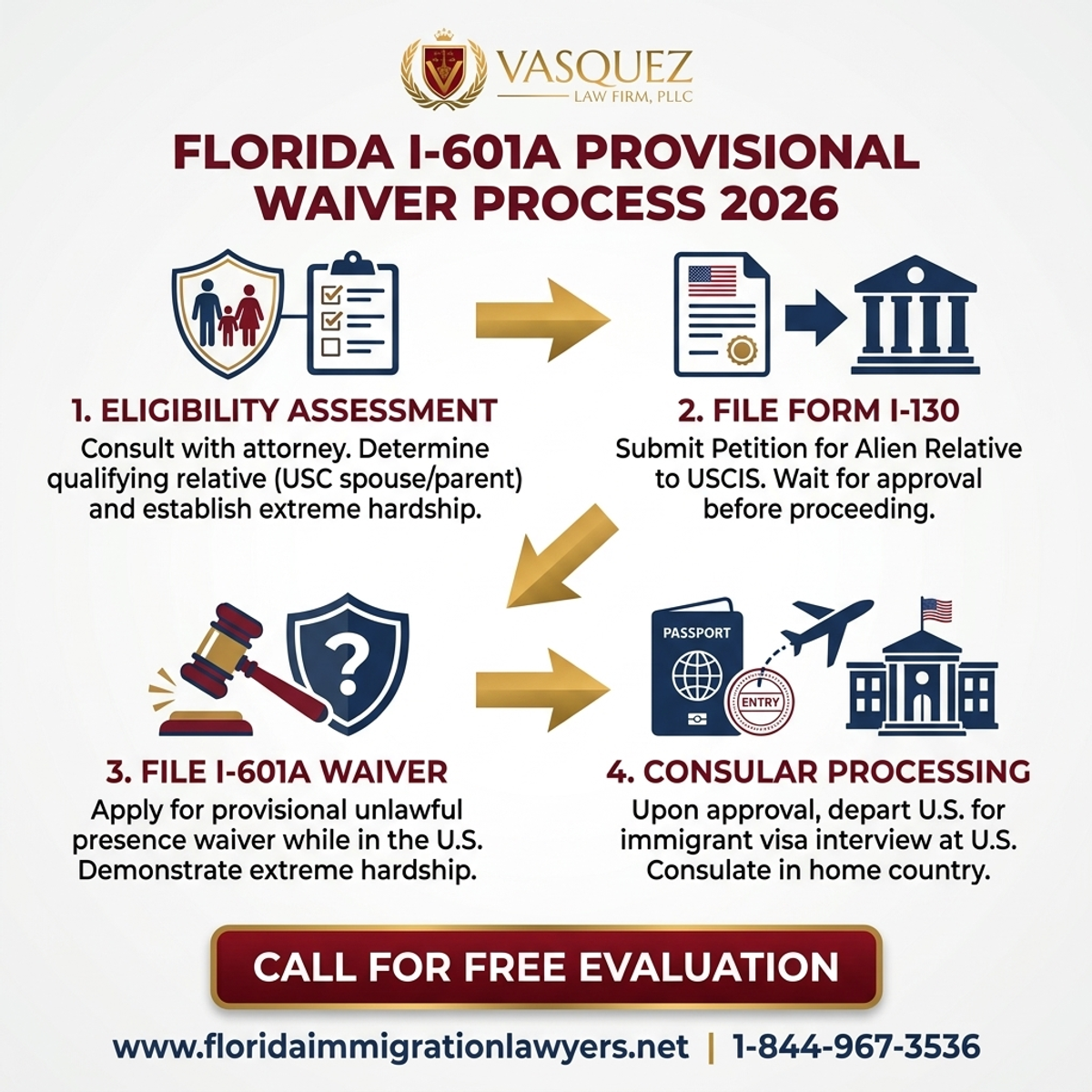
Step-by-Step Process — I-601A Provisional Waiver: Florida Eligibility 2026
I-601A Waiver Typical Processing Timelines (as of 2026)
| Stage | Typical Timeframe | Notes |
|---|---|---|
| I-130 Petition Approval | 6-18 months | Prerequisite for I-601A, varies by service center. |
| I-601A Application Preparation | 1-3 months | Gathering extensive evidence for extreme hardship. |
| I-601A USCIS Processing | 6-18 months | After filing and biometrics, check USCIS processing times. |
| NVC Processing & Interview Scheduling | 2-6 months | After I-601A approval, before overseas interview. |
| Consular Interview Abroad | 1-2 weeks travel | Short trip abroad for interview and visa stamp. |
Do not navigate this process alone. The complexities of immigration law, especially waivers, require expert guidance. Contact Florida Immigration Lawyers today for a free case review and let our experienced team help you understand your options and build a strong case.
Navigating the I-601A Provisional Waiver Process in Florida
The I-601A provisional waiver process, while offering a crucial pathway to legal status, is intricate and demands meticulous attention to detail. For residents of Florida, including those in Orlando and the wider Central Florida area, understanding the local context and resources can be beneficial. While the waiver itself is processed centrally by USCIS, local field offices might handle biometric appointments. For instance, applicants may attend appointments at the USCIS Application Support Centers in Orlando, Miami, or other Florida locations. The success of your application hinges on a thorough understanding of legal requirements and a compelling presentation of your case, particularly regarding extreme hardship. This is where the expertise of a dedicated immigration attorney becomes invaluable.
After your I-601A waiver is approved, the next critical step is to attend your immigrant visa interview at a U.S. embassy or consulate abroad. This is typically in your home country. With an approved provisional waiver, you depart the U.S. knowing that your unlawful presence inadmissibility has already been forgiven, significantly reducing the risk of being stuck outside the country. The interview itself will cover your eligibility for the immigrant visa. Upon successful completion and visa issuance, you can re-enter the U.S. as a lawful permanent resident. This process, from initial petition to final visa, requires careful planning and execution. Florida Immigration Lawyers are well-versed in these procedures and can guide you through each stage, ensuring compliance with all regulations and advocating on your behalf. We understand the unique challenges faced by immigrants in our diverse state and are committed to providing personalized legal support.
Common Mistakes to Avoid with the I-601A Provisional Waiver
The I-601A provisional waiver process is complex, and even minor errors can lead to significant delays or denials. Being aware of common pitfalls can help you avoid costly mistakes:
- Not Meeting All Eligibility Criteria: Many applicants overlook a specific eligibility requirement, such as having other grounds of inadmissibility beyond unlawful presence. This leads to automatic denial and wasted filing fees.
- Insufficient Proof of Extreme Hardship: This is the most common reason for denial. Simply stating hardship is not enough; comprehensive, compelling evidence, such as detailed medical records or psychological evaluations, is essential.
- Filing Without an Approved I-130/I-360: The I-601A can only be filed after the underlying immigrant visa petition (Form I-130 or I-360) has been approved. Filing prematurely will result in rejection.
- Departing the U.S. Before I-601A Approval: The entire purpose of the provisional waiver is to get approval *before* you leave. Departing before approval will trigger the unlawful presence bar, and the I-601A will no longer apply.
- Failing to Disclose All Inadmissibility Grounds: Attempting to hide criminal history or previous immigration violations can lead to charges of misrepresentation, a permanent bar, and severe consequences.
- Incorrectly Identifying the Qualifying Relative: Only a U.S. citizen or LPR spouse or parent can be a qualifying relative for extreme hardship. Siblings or U.S. citizen children are not qualifying relatives for this specific waiver.
- Incomplete or Inaccurate Forms: Simple errors on forms, missing signatures, or outdated information can cause delays or outright rejections. Attention to detail is paramount.
- Missing Deadlines: Failing to respond to Requests for Evidence (RFEs) or attend biometrics appointments within the specified timeframe can lead to abandonment or denial of your application.
- Not Consulting an Attorney: Attempting this complex process without legal counsel often results in critical errors, weak hardship arguments, and ultimately, denial.
- Submitting Untranslated Documents: Any document not in English must be accompanied by a certified English translation. Failure to do so will result in an RFE or rejection.
- Ignoring Updates to Immigration Law: Immigration laws and policies, including those for waivers, can change. Staying informed, ideally through legal counsel, is crucial, especially in 2026.
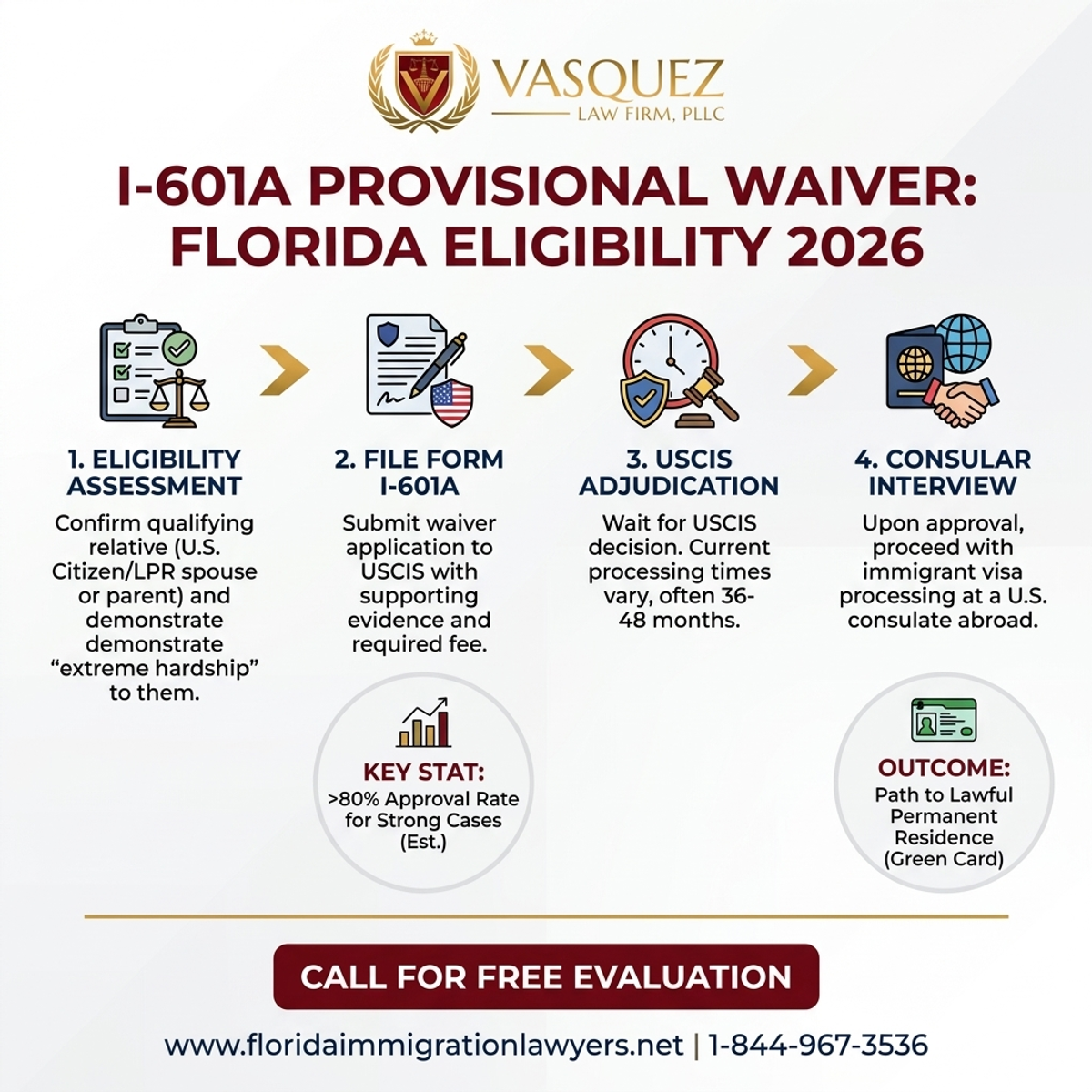
Key Statistics — I-601A Provisional Waiver: Florida Eligibility 2026
When to Call a Florida Immigration Lawyer for Your I-601A Waiver
The I-601A provisional waiver process is fraught with complexities that can overwhelm even the most diligent applicant. While this guide provides general information, every case is unique, and the stakes are incredibly high. Knowing when to seek professional legal assistance is key to a successful outcome. You should contact a Florida immigration lawyer if you are considering the I-601A waiver, especially if you have any questions about your eligibility, the strength of your extreme hardship claim, or the required documentation.
Our experienced attorneys at Florida Immigration Lawyers are here to help. We regularly assist individuals across Central Florida, including Orlando, with I-601A waivers. We can assess your specific situation, determine if you are eligible for the waiver, and identify any other potential grounds of inadmissibility you might face. We will help you gather compelling evidence for extreme hardship, prepare all necessary forms accurately, and represent your interests throughout the entire process, including preparing you for your consular interview. If you have a complex case, such as a prior deportation order, criminal history, or multiple periods of unlawful presence, legal counsel is not just recommended, it is essential. Do not risk your future by attempting to navigate these waters alone. Schedule a free consultation with us today to discuss your options for the I-601A waiver or other family immigration matters. We are dedicated to providing the comprehensive legal support you need.
About Florida Immigration Lawyers
Florida Immigration Lawyers is a leading immigration law firm dedicated to serving individuals and families across the entire state of Florida. With a deep understanding of U.S. immigration law and a compassionate approach, our experienced attorneys are committed to providing exceptional legal representation. We specialize in a wide range of immigration services, including family-based visas, deportation defense, asylum, naturalization, and complex waiver applications like the I-601A. Our firm prides itself on being available 24/7 for our clients, offering free case reviews to help you understand your legal options without obligation. We serve clients in Orlando and throughout Central Florida, offering personalized strategies tailored to your unique circumstances. We understand the challenges immigrants face and are here to be your steadfast advocates. Se Habla Español.
Contact us today at 1-844-YO-PELEO to speak with a dedicated immigration attorney.
Sources and References
- U.S. Citizenship and Immigration Services (USCIS) - Form I-601A Information
- U.S. Department of State - Immigrant Visas
- Immigration and Nationality Act (INA) Section 212(a)(9)(B) - Unlawful Presence
- 8 Code of Federal Regulations (CFR) 212.7 - Waivers of Inadmissibility
- USCIS Policy Manual, Volume 9, Waivers, Part B, Provisional Unlawful Presence Waivers
Related services: immigration practice areas, business immigration, experienced immigration attorneys, immigration lawyer cost in Florida.
This article provides general legal information and is not intended as legal advice. Every case is unique, and outcomes depend on specific facts and circumstances. Contact an attorney for advice about your particular situation.
Embarking on the I-601A provisional waiver journey is a significant step towards securing your future in the United States. With the right legal guidance, you can navigate this process with confidence. Do not leave your immigration future to chance. Contact Florida Immigration Lawyers today for a free case review. Call us at 1-844-YO-PELEO. Se Habla Espanol - Estamos aqui para ayudarle.
Do Not Navigate This Process Alone
Our experienced immigration attorneys are ready to fight for you. Get a free, confidential case review today.
Se Habla Español
Or leave your details and we’ll call you:
Free Evaluation in 24 Hours
Or talk to us right now
AI voice assistant — available 24/7
FreeFrequently Asked Questions

William J. Vásquez
Founding Attorney · Vasquez Law Firm
U.S. Air Force veteran and immigration attorney with years of hands-on U.S. immigration experience. J.D., NCCU School of Law. AILA member. Admitted to the 4th, 5th, and 11th Circuit Courts.
Available 24/7 - Free Evaluations
Reviewed for legal accuracy by William J. Vásquez
Licensed in North Carolina; U.S. immigration is federal practice.
Related Legal Services
Our Florida immigration attorneys can help you with free immigration consultation, business immigration and deportation defense. Call today at 1-844-YO-PELEO for a free case review.
Related Links
Related Topics
Free Legal Case Review
Discuss your case with our experienced attorneys. We're available 24/7.
Se Habla Español - Estamos aquí para ayudarle.
Related Articles
Certificate of Eligibility for Expungement in Florida 2026
For non-U.S. citizens in Florida, understanding how a state expungement impacts immigration status is critical. A certificate of eligibility for expungement in Florida allows a criminal record to be sealed or expunged under state law. However, federal immigration agencies often disregard such state-level relief, still considering the original criminal offense as a conviction for immigration purposes. This can have severe implications for visa applications, green card eligibility, naturalization, and even lead to deportation. This guide clarifies the Florida expungement process, its limited effect on federal immigration law, and key steps to protect your status in 2026. Learn about common mistakes, required documents, timelines, and when to seek expert legal counsel from Florida Immigration Lawyers to navigate these complex issues effectively.
Immigration Lawyer Orlando Free Consultation in Florida
For individuals and families in Orlando, Florida, navigating the complexities of U.S. immigration law requires expert guidance. An immigration lawyer in Orlando offers crucial support for everything from visa applications and green card processes to naturalization and deportation defense. This comprehensive guide details what a free consultation covers, providing a step-by-step overview of immigration pathways, essential document checklists, and expected timelines in 2026. We also highlight common mistakes to avoid, discuss the critical role of legal counsel in deportation and asylum cases, and explain why choosing a local Orlando immigration attorney is beneficial. Florida Immigration Lawyers is dedicated to serving the diverse community of Orlando with compassionate, effective legal solutions, ensuring you receive personalized advice and robust representation for a successful immigration journey.
Immigration Interview Preparation Florida 2026 Guide
Facing an immigration interview in Florida? This comprehensive guide offers essential 2026 USCIS interview tips for green card and naturalization applicants. Learn how to meticulously prepare your documents, understand the typical timelines, and avoid common mistakes that could jeopardize your case. We cover what to expect at the Orlando USCIS Field Office, provide a detailed document checklist, and explain the various costs involved in the process. With insights into naturalization specifics and when to seek legal counsel, Florida Immigration Lawyers helps you approach your interview with confidence. Our firm is dedicated to empowering immigrants across Florida with the knowledge and support needed for a successful outcome. Get a free case review today.
Naturalization Ceremony Locations and Schedule 2026 Florida
For those in Florida aspiring to U.S. citizenship, understanding the naturalization process, including ceremony locations and schedules for 2026, is essential. This guide from Florida Immigration Lawyers details the N-400 application, eligibility requirements, and typical timelines. We cover the step-by-step journey, from initial filing and biometrics to the naturalization interview and the final Oath of Allegiance ceremony held across Florida's USCIS field offices, including Orlando, Miami, Tampa, and Jacksonville. Learn about critical documents, potential costs, and common mistakes to avoid. Our firm emphasizes the importance of accurate applications and offers expert legal assistance for complex cases, ensuring a smoother path to becoming a U.S. citizen. Get a free case review today.