T Visa for Trafficking Victims in Florida: What You Need
The T visa offers vital protection for victims of human trafficking in Florida, granting legal status and a path to recovery. Discover the application process, eligibility criteria, and support available in Orlando, Florida. Call Florida Immigration Lawyers at 1-844-YO-PELEO for expert guidance and a free consultation.
The T visa is specifically designed for victims of human trafficking who have suffered substantial abuse. This visa grants eligible victims temporary legal status to remain in the U.S. and aids in recovery and cooperation with law enforcement. Key takeaways include:
- T visas are for those trafficked into the U.S.
- Applicants must aid law enforcement.
- Status includes work authorization.
- Visa holders may apply for permanent residency.
Introduction
Human trafficking is a grave violation of human rights affecting many individuals in Florida, particularly in areas like Orlando. The T visa offers a lifeline to victims, providing them with a path to safety and legal status in the United States. This article explores the essentials of the T visa process, eligibility criteria, and how victims can seek help. Call Florida Immigration Lawyers at 1-844-YO-PELEO for a free case review if you or someone you know is affected.
Human trafficking is a modern-day form of slavery, a heinous crime that exploits millions globally, including within the United States. Florida, with its extensive coastline, international airports, and large transient populations, unfortunately, serves as both a transit point and a destination for traffickers. Cities like Orlando, a major tourist hub, are particularly susceptible, making residents and visitors vulnerable to various forms of exploitation, from forced labor in hospitality to sex trafficking. Recognizing the urgent need to protect victims and bring perpetrators to justice, the U.S. government established the T visa program.
The T visa is not merely an immigration document; it's a critical humanitarian tool designed to offer solace and a pathway to recovery for survivors. It provides a sanctuary, enabling victims to escape their abusers and begin rebuilding their lives without the constant fear of deportation. This legal protection is paramount, as many victims are undocumented and fear interacting with authorities, making them even more vulnerable to exploitation. By understanding the T visa process, victims can empower themselves and access the support they desperately need. Florida Immigration Lawyers are committed to guiding individuals through this complex journey, ensuring their rights are protected every step of the way.
What is a T Visa and Who Qualifies?
A T visa is a non-immigrant visa for victims of severe human trafficking. To qualify, applicants must demonstrate they are victims of a severe form of trafficking, such as sex trafficking or labor trafficking, and that they are physically present in the United States due to trafficking.
Victims must also comply with any reasonable request from law enforcement for assistance in the investigation or prosecution of human trafficking. Exceptions are available for minors and those unable to assist due to trauma. As of 2026, eligibility also requires demonstrating that removal from the U.S. would cause extreme hardship involving unusual and severe harm.
The "severe form of trafficking" encompasses a broad spectrum of exploitation. Sex trafficking involves commercial sex acts induced by force, fraud, or coercion, or in which the person induced to perform such act has not attained 18 years of age. Labor trafficking, on the other hand, involves the recruitment, harboring, transportation, provision, or obtaining of a person for labor or services through the use of force, fraud, or coercion for the purpose of subjection to involuntary servitude, peonage, debt bondage, or slavery. Examples include individuals forced to work in agriculture, construction, domestic service, or even illicit massage parlors under threat or deception.
Establishing physical presence in the U.S. "due to trafficking" means showing a direct link between the trafficking and the applicant's arrival or continued stay in the country. This could involve being transported across borders by traffickers, or being brought into the U.S. legally but then having their documents confiscated and being forced into servitude. The critical element is demonstrating that the trafficking is the reason for their presence, not merely that trafficking occurred while they were already present for unrelated reasons.
Cooperating with law enforcement is a cornerstone of the T visa program. This typically involves providing statements, testifying in court, or assisting in investigations. However, the law recognizes the immense trauma victims endure. Minors under 18 and individuals who cannot cooperate due to physical or psychological trauma are exempt from this requirement. For adult victims, cooperation must be "reasonable," acknowledging their safety and well-being. A crucial piece of evidence here is the "Declaration of Law Enforcement Officer for Victim of Trafficking in Persons" (Form I-914, Supplement B), where an agency confirms the victim's assistance.
The extreme hardship clause, effective as of 2026, adds another layer of protection. This requires applicants to demonstrate that removal from the U.S. would result in unusual and severe harm. Such harm might include a high risk of re-trafficking in their home country, lack of access to critical medical or psychological care, absence of family support, or persecution based on their status as a trafficking survivor. This criterion ensures that victims are not sent back to situations where their safety and recovery would be severely jeopardized.
Eligibility Criteria
- Victim of severe trafficking
- Present in the U.S. due to trafficking
- Comply with law enforcement requests
- Show extreme hardship if removed
How to Apply for a T Visa
Applying for a T visa involves several steps, beginning with filing Form I-914, Application for T Nonimmigrant Status. This process can be complex, requiring detailed evidence and documentation.
- Complete Form I-914: This is the primary application form, requiring personal information and details of trafficking.
- Gather Supporting Documents: Provide evidence of trafficking, such as police reports or medical records.
- Submit Evidence of Compliance: Include a declaration from law enforcement if applicable.
- File Your Application: Send the completed application and documents to the appropriate USCIS service center.
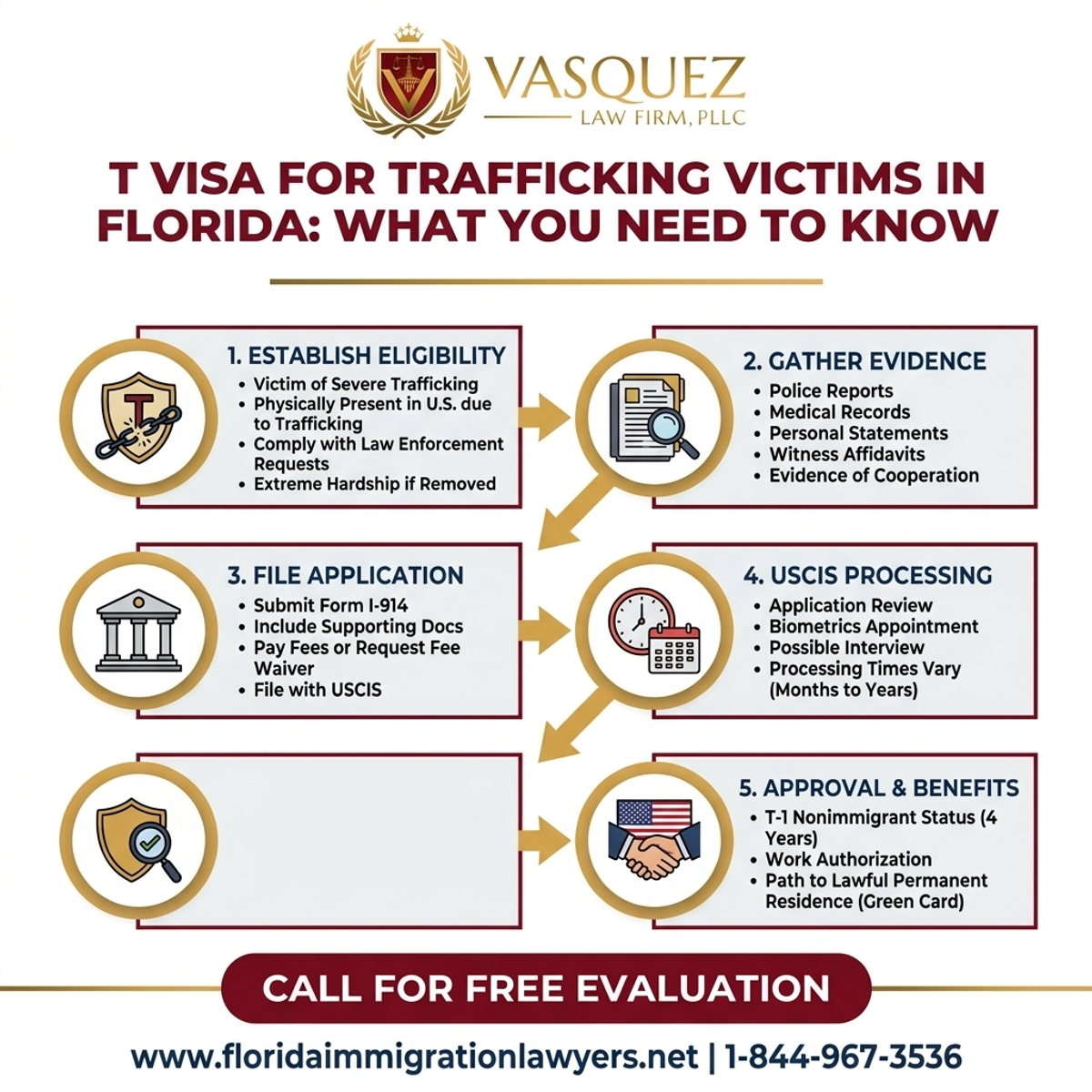
Step-by-Step Process — T Visa for Trafficking Victims in Florida: What You Need to Know
The application process for a T visa, specifically Form I-914, is highly detailed and requires a comprehensive narrative of the trafficking experience. Beyond the basic personal information, applicants must meticulously recount the events of their trafficking, including dates, locations, methods of coercion, and the identities of traffickers if known. This personal statement is crucial, as it provides the human context to the legal definitions of trafficking and helps USCIS understand the full scope of the abuse endured.
Gathering supporting documents is equally vital. This can include police reports, medical records detailing injuries or psychological trauma, witness affidavits, financial records showing exploitation, or even communications with traffickers. In situations where official documentation is scarce, credible affidavits from individuals who can attest to the trafficking, such as social workers, counselors, or religious leaders, can be invaluable. It is important to remember that many victims are isolated and may not have immediate access to formal records, so USCIS considers all available evidence.
Furthermore, the T visa program allows for derivative beneficiaries, meaning certain immediate family members of the principal T visa applicant may also be eligible for T nonimmigrant status. This includes spouses, children, unmarried siblings under 18, and parents (if the principal applicant is under 21). This provision is critical for keeping families together and providing a holistic support system for victims. Navigating these additional applications requires careful attention to detail, and Florida Immigration Lawyers can provide invaluable assistance in ensuring all family members are properly included and protected throughout the process.
Processing times can vary, but as of 2026, applicants should expect a processing time of approximately 6 to 12 months. It's essential to ensure all documents are accurately completed to avoid delays.
Document Checklist for T Visa Applicants
- Form I-914
- Proof of Identity (passport, birth certificate)
- Evidence of Trafficking (police reports, affidavits)
- Proof of Physical Presence in the U.S.
- Evidence of Compliance with Law Enforcement
- Declaration of Severe Hardship
Timeline and Processing Expectations
| Stage | Typical Timeframe | Notes |
|---|---|---|
| Application Submission | 1-2 weeks | Ensure all documents are complete |
| USCIS Processing | 6-12 months | Varies by case complexity |
| Biometrics Appointment | 4-6 weeks after submission | Fingerprinting and photo |
| Decision | 6-12 months after submission | Includes work authorization approval |
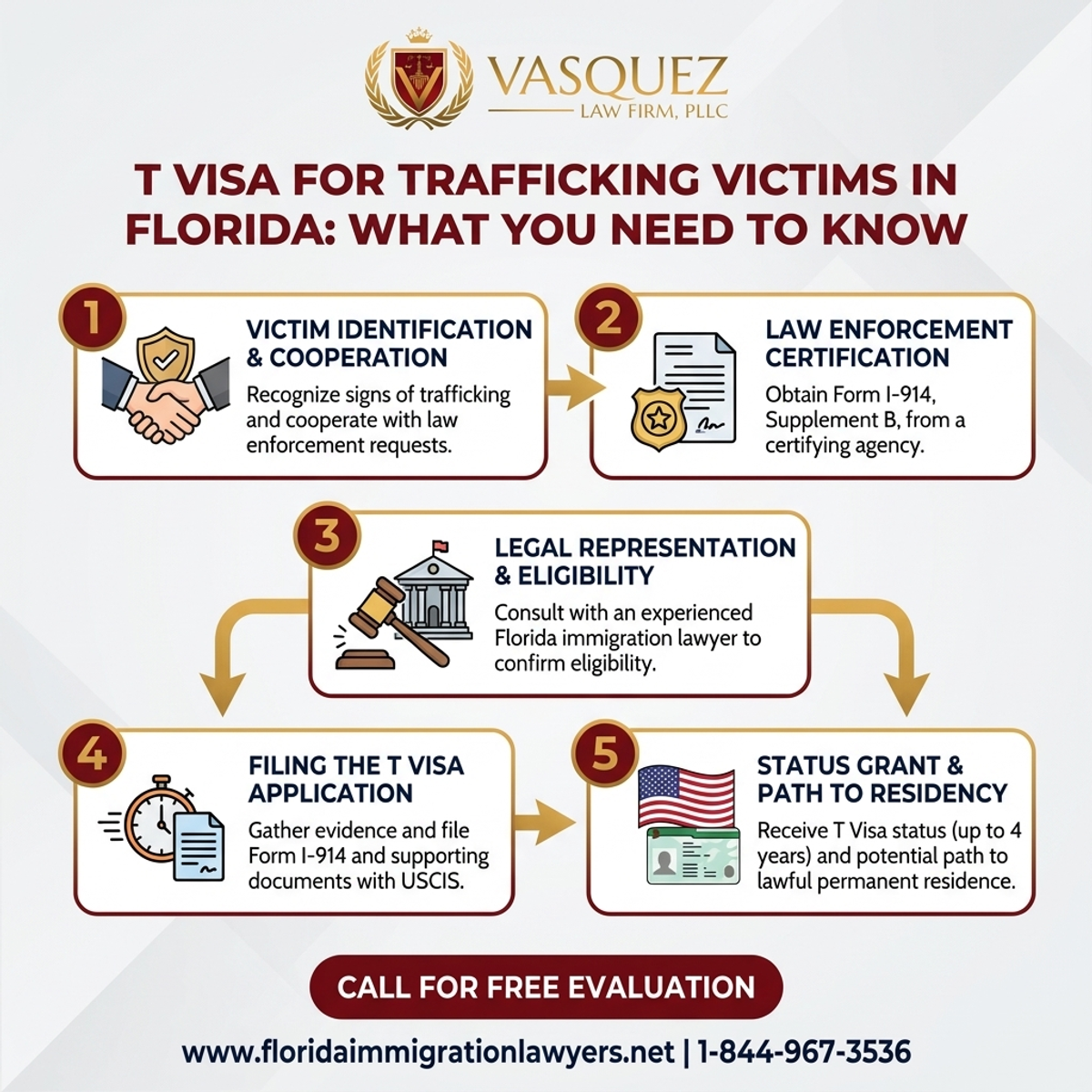
Key Statistics — T Visa for Trafficking Victims in Florida: What You Need to Know
Cost Factors and Fee Breakdown
| Item | Typical Fee | Notes |
|---|---|---|
| Form I-914 Filing | Varies | Fee waivers available |
| Biometrics Fee | Varies | May be waived for victims |
| Legal Assistance | Varies | Consultations with Florida Immigration Lawyers |
Common Mistakes to Avoid
- Incomplete Forms: Missing or incorrect information can delay processing.
- Lack of Evidence: Failing to provide sufficient evidence of trafficking can lead to denial.
- Ignoring Deadlines: Missing filing deadlines can jeopardize your application.
- Failure to Comply with Law Enforcement: Non-compliance can lead to ineligibility.
- Not Seeking Legal Help: Legal guidance can prevent costly errors.
- Submitting False Information: Can result in visa denial and legal consequences.
- Not Demonstrating Extreme Hardship: Failing to show this can lead to denial.
When to Call a Lawyer
Victims of human trafficking should consult with an immigration attorney to navigate the complexities of the T visa process. Legal professionals can assist with gathering necessary documentation, ensuring compliance with all requirements, and representing you in interactions with law enforcement and immigration authorities. If you experience any delays or complications, contact the Florida Immigration Lawyers for assistance.
The journey to obtaining a T visa is often fraught with emotional distress and legal complexities, making professional legal counsel indispensable. An experienced immigration attorney, like those at Florida Immigration Lawyers, can serve as a crucial advocate, guiding victims through every stage of the application. They can help victims articulate their traumatic experiences in a clear and compelling manner on Form I-914, ensuring all legal requirements are met without further traumatizing the individual. This includes identifying and gathering all necessary evidence, from police reports and medical records to affidavits from support personnel, which can be challenging for someone recovering from severe abuse.
Moreover, attorneys can facilitate communication with law enforcement agencies, ensuring that the victim's cooperation is appropriately documented through Form I-914, Supplement B, and that their rights are protected during interviews. They can also represent clients in interactions with U.S. Citizenship and Immigration Services (USCIS), responding to Requests for Evidence (RFEs) or notices of intent to deny, which are common in complex immigration cases. Without legal representation, victims risk missing critical deadlines, submitting insufficient evidence, or inadvertently jeopardizing their case due to misunderstandings of legal jargon or procedural requirements.
Given the sensitive nature of human trafficking cases and the profound impact they have on individuals, having a compassionate and knowledgeable legal team is not just beneficial—it's often essential for a successful outcome. Florida Immigration Lawyers understand the unique challenges faced by trafficking survivors and are dedicated to providing a safe, confidential, and supportive environment. If you or someone you know is a victim, do not hesitate to reach out to Florida Immigration Lawyers at 1-844-YO-PELEO for a free consultation. Our team is ready to provide the specialized assistance you need to navigate this path to recovery and legal status.
About Florida Immigration Lawyers
Florida Immigration Lawyers is dedicated to providing compassionate and comprehensive legal services to immigrants in Florida. Our experienced attorneys specialize in all areas of immigration law, including asylum, deportation defense, and family immigration. We offer free case reviews and are available 24/7. Schedule a free consultation today.
Sources and References
- U.S. Citizenship and Immigration Services (USCIS)
- Executive Office for Immigration Review (EOIR)
- 8 U.S.C. Chapter 12 - Immigration and Nationality Act
Related services: immigration practice areas, citizenship and naturalization, business immigration, experienced immigration attorneys.
This article provides general legal information and is not intended as legal advice. Every case is unique, and outcomes depend on specific facts and circumstances. Contact an attorney for advice about your particular situation.
Final CTA
If you are a victim of human trafficking, help is available. Contact Florida Immigration Lawyers at 1-844-YO-PELEO for a free consultation and take the first step towards securing your future. Se Habla Español - Estamos aquí para ayudarle.
Do Not Navigate This Process Alone
Our experienced immigration attorneys are ready to fight for you. Get a free, confidential case review today.
Se Habla Español
Or leave your details and we’ll call you:
Free Evaluation in 24 Hours
Or talk to us right now
AI voice assistant — available 24/7
FreeFrequently Asked Questions

William J. Vásquez
Founding Attorney · Vasquez Law Firm
U.S. Air Force veteran and immigration attorney with years of hands-on U.S. immigration experience. J.D., NCCU School of Law. AILA member. Admitted to the 4th, 5th, and 11th Circuit Courts.
Available 24/7 - Free Evaluations
Reviewed for legal accuracy by William J. Vásquez
Licensed in North Carolina; U.S. immigration is federal practice.
Related Legal Services
Our Florida immigration attorneys can help you with immigration practice areas, free immigration consultation and business immigration. Call today at 1-844-YO-PELEO for a free case review.
Related Links
Related Topics
Free Legal Case Review
Discuss your case with our experienced attorneys. We're available 24/7.
Se Habla Español - Estamos aquí para ayudarle.
Related Articles
EB-5 Investor Green Card in Florida: A 2026 Guide
Explore how to obtain an EB-5 investor green card in Florida. Learn about the investment requirements, processes, and benefits of participating in this program. Discover how Florida's economic landscape can be an ideal setting for your investment. Contact Florida Immigration Lawyers for a free case review.
Certificate of Eligibility for Expungement in Florida 2026
For non-U.S. citizens in Florida, understanding how a state expungement impacts immigration status is critical. A certificate of eligibility for expungement in Florida allows a criminal record to be sealed or expunged under state law. However, federal immigration agencies often disregard such state-level relief, still considering the original criminal offense as a conviction for immigration purposes. This can have severe implications for visa applications, green card eligibility, naturalization, and even lead to deportation. This guide clarifies the Florida expungement process, its limited effect on federal immigration law, and key steps to protect your status in 2026. Learn about common mistakes, required documents, timelines, and when to seek expert legal counsel from Florida Immigration Lawyers to navigate these complex issues effectively.
Immigration Lawyer Orlando Free Consultation in Florida
For individuals and families in Orlando, Florida, navigating the complexities of U.S. immigration law requires expert guidance. An immigration lawyer in Orlando offers crucial support for everything from visa applications and green card processes to naturalization and deportation defense. This comprehensive guide details what a free consultation covers, providing a step-by-step overview of immigration pathways, essential document checklists, and expected timelines in 2026. We also highlight common mistakes to avoid, discuss the critical role of legal counsel in deportation and asylum cases, and explain why choosing a local Orlando immigration attorney is beneficial. Florida Immigration Lawyers is dedicated to serving the diverse community of Orlando with compassionate, effective legal solutions, ensuring you receive personalized advice and robust representation for a successful immigration journey.
EB-5 Investor Green Card Florida: 2026 Requirements Guide
The EB-5 Immigrant Investor Program offers a direct path to a U.S. green card for foreign nationals who invest in a U.S. commercial enterprise and create jobs. As of 2026, the required investment is $1.05 million, or $800,000 in Targeted Employment Areas (TEAs) or infrastructure projects. Florida, with its dynamic economy in areas like Orlando and Central Florida, provides attractive opportunities for EB-5 investments, often through USCIS-approved regional centers. This comprehensive guide details the qualification criteria, the multi-stage application process—from filing Form I-526E to removing conditions on permanent residency—and crucial aspects like lawful source of funds and job creation. We also cover estimated costs, processing timelines, and a critical document checklist. Avoiding common mistakes is paramount for success, and seeking expert legal counsel from Florida Immigration Lawyers can significantly enhance your chances of achieving permanent residency in the Sunshine State.