EB-5 Investor Green Card Florida: 2026 Requirements Guide
The EB-5 Immigrant Investor Program offers a direct path to a U.S. green card for foreign nationals who invest in a U.S. commercial enterprise and create jobs. As of 2026, the required investment is $1.05 million, or $800,000 in Targeted Employment Areas (TEAs) or infrastructure projects. Florida, with its dynamic economy in areas like Orlando and Central Florida, provides attractive opportunities for EB-5 investments, often through USCIS-approved regional centers. This comprehensive guide details the qualification criteria, the multi-stage application process—from filing Form I-526E to removing conditions on permanent residency—and crucial aspects like lawful source of funds and job creation. We also cover estimated costs, processing timelines, and a critical document checklist. Avoiding common mistakes is paramount for success, and seeking expert legal counsel from Florida Immigration Lawyers can significantly enhance your chances of achieving permanent residency in the Sunshine State.
Quick Answer: EB-5 Investor Green Card Florida
The EB-5 Immigrant Investor Program offers a path to a U.S. green card for foreign investors who make a qualifying capital investment in a U.S. commercial enterprise and create at least 10 full-time jobs for U.S. workers. As of 2026, the standard investment amount is $1.05 million, or $800,000 if investing in a Targeted Employment Area (TEA) or infrastructure project. Florida, with its robust economy and growing population, presents numerous opportunities for EB-5 investments, particularly through USCIS-approved regional centers. The process involves filing Form I-526E or I-526, obtaining a conditional green card, and then applying to remove the conditions.
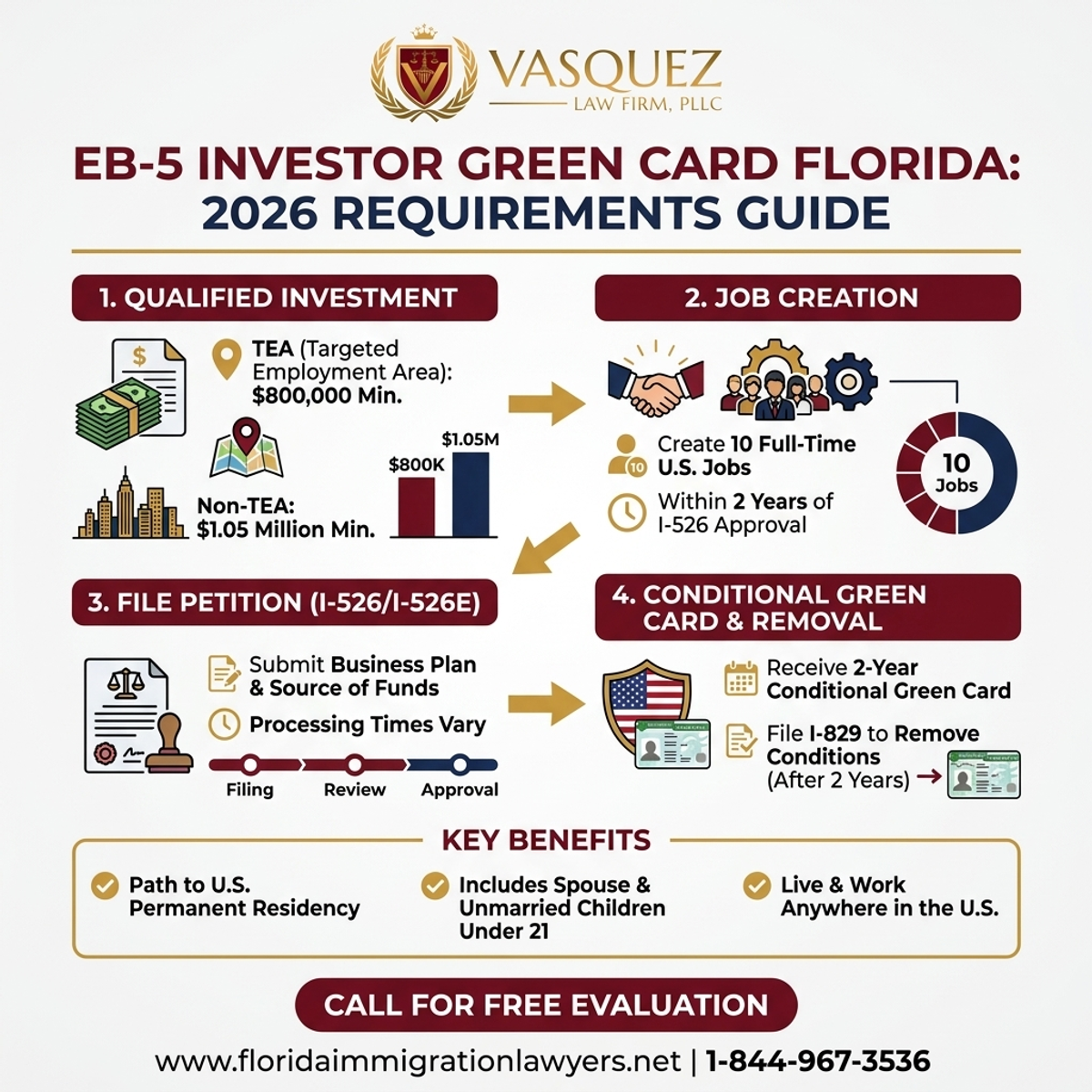
- Minimum Investment: $800,000 (TEA/Infrastructure) or $1.05 million (Standard).
- Job Creation: Must create or preserve 10 full-time jobs.
- Investment Options: Direct investment or through a Regional Center.
- Path to Green Card: Conditional residency followed by permanent residency.
- Florida Advantage: Diverse economy offers many qualifying project opportunities.
EB-5 Investor Green Card Florida: Your 2026 Guide to Investment Immigration
Are you an international investor dreaming of establishing a new life and business in the United States? The EB-5 investor green card program offers a unique pathway to permanent residency for individuals who are willing to make a significant capital investment in a U.S. commercial enterprise. For many, Florida represents an ideal destination, boasting a vibrant economy, a strategic geographical location, and a diverse population. Navigating the complexities of investment immigration, particularly the EB-5 program, requires meticulous planning and a deep understanding of U.S. immigration law.
This comprehensive guide will walk you through the essential aspects of securing an EB-5 investor green card Florida, covering everything from eligibility requirements and the application process to typical costs and timelines as of 2026. We understand that this journey can seem daunting, but with the right information and legal support, your dream of living and investing in Florida can become a reality. We will explore the nuances of direct investments versus regional center projects, highlight common pitfalls to avoid, and explain when it is critical to seek professional legal counsel. Your future in the Sunshine State awaits, and understanding these critical steps is your first move towards achieving it.
Do not embark on this significant immigration journey alone. For personalized guidance and to ensure your application meets all legal requirements, contact Florida Immigration Lawyers today. Call us at 1-844-YO-PELEO for a free case review and let our experienced team help you navigate the EB-5 process with confidence.
What is the EB-5 Investor Green Card Program in 2026?
The EB-5 Immigrant Investor Program is a visa category established by the U.S. Congress in 1990 to stimulate the U.S. economy through job creation and capital investment by foreign investors. As of 2026, the program allows eligible foreign nationals to obtain a green card by investing in a new commercial enterprise that benefits the U.S. economy and creates at least 10 full-time jobs for qualified U.S. workers. This program falls under Section 203(b)(5) of the Immigration and Nationality Act (INA), found in 8 U.S.C. § 1153(b)(5). It is designed to attract foreign capital and entrepreneurial talent, offering a direct route to permanent residency for investors and their immediate families.
The EB-5 program provides two primary investment avenues: direct investments in a new commercial enterprise or investments made through a USCIS-designated Regional Center. Regional Centers are private or public entities approved by USCIS to promote economic growth, improved regional productivity, job creation, and increased domestic capital investment. They offer a more passive investment approach, as job creation can be calculated indirectly. For those seeking to establish a new life and business in Florida, understanding these options is crucial. The program is continually updated by USCIS, and staying informed about current regulations is vital for a successful application.
The initial step for most investors involves filing Form I-526, Immigrant Petition by Alien Entrepreneur, or Form I-526E, Immigrant Petition by Regional Center Investor. Upon approval, investors and their eligible family members (spouse and unmarried children under 21) are granted conditional permanent residence for two years. Before the expiration of this two-year period, investors must file Form I-829, Petition by Investor to Remove Conditions on Permanent Resident Status, demonstrating that the investment was sustained and the required jobs were created or are expected to be created. Successfully navigating these stages is key to obtaining an unconditional green card.
How Do I Qualify for an EB-5 Visa in Florida?
To qualify for an EB-5 visa in Florida, an investor must meet specific criteria outlined by USCIS. The fundamental requirement is to make a capital investment in a new commercial enterprise. As of 2026, the minimum investment amount is $1.05 million for standard investments. However, if the investment is made in a Targeted Employment Area (TEA) or an infrastructure project, the minimum investment is reduced to $800,000. TEAs are typically rural areas or areas experiencing high unemployment, and Florida has several regions that qualify, offering attractive opportunities for investors.
Beyond the investment amount, the enterprise must create or preserve at least 10 full-time jobs for qualifying U.S. workers within two years of the investor's admission to the U.S. as a conditional permanent resident. These jobs must be permanent, full-time positions requiring at least 35 working hours per week. For direct investments, only direct jobs created within the commercial enterprise count. For investments made through a regional center, both direct and indirect or induced jobs can be counted, which offers greater flexibility in meeting the job creation requirement. The lawful source of funds is also paramount; investors must demonstrate that the capital invested was obtained through lawful means.
Step-by-Step Process — EB-5 Investor Green Card Florida: 2026 Requirements Guide
Florida's diverse economy, including sectors like tourism, technology, aerospace, and healthcare, provides fertile ground for various EB-5 projects. Investors must submit a detailed business plan demonstrating how the capital will be used and how the jobs will be created. This plan must be credible and comprehensive, adhering to the requirements outlined in the USCIS Policy Manual. Understanding the nuances of these requirements and how they apply to specific projects in Florida, particularly in areas like Orlando and Central Florida, is essential for a successful application. Working with experienced legal counsel can help ensure all qualification criteria are meticulously addressed.
The EB-5 Application Process: A Step-by-Step Guide for Florida Investors
The EB-5 application process is a multi-stage journey that requires careful preparation and adherence to specific legal guidelines. For investors looking to make Florida their home, understanding each step is crucial. As of 2026, the general process remains consistent, though processing times can fluctuate.
-
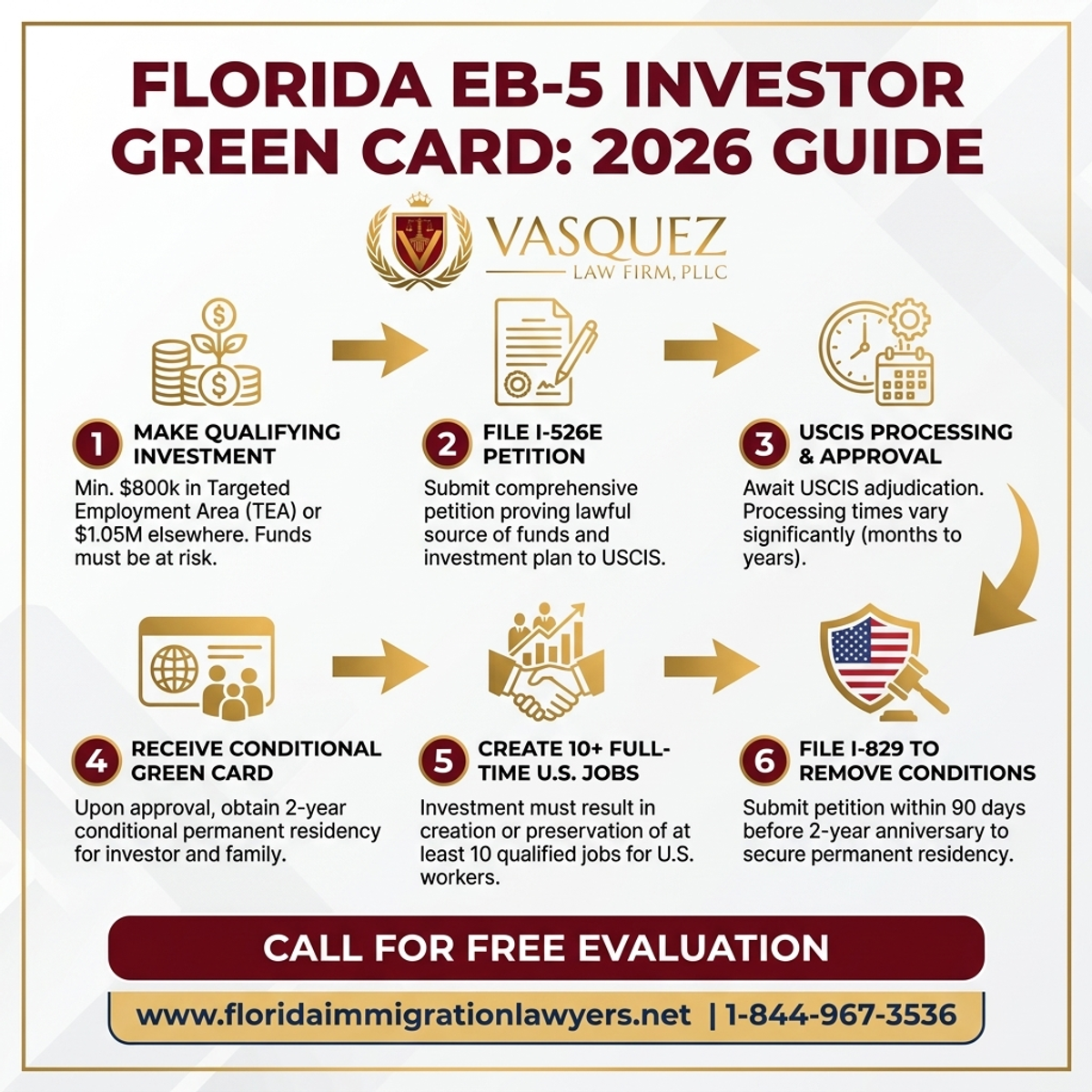
Step 1: Identify an EB-5 Project and Invest Capital.
The first step involves identifying a suitable EB-5 project in Florida. This can be a direct investment in a new or existing commercial enterprise or an investment through a USCIS-approved Regional Center. You must commit and place your capital at risk. Ensure the project meets the investment amount requirements ($800,000 for TEAs/infrastructure or $1.05 million for standard areas) and has a credible plan for creating 10 full-time jobs. Due diligence on the project and the regional center (if applicable) is critical at this stage.
-
Step 2: File Form I-526 or I-526E Petition.
Once the investment is made, your immigration attorney will prepare and file Form I-526, Immigrant Petition by Alien Entrepreneur (for direct investments), or Form I-526E, Immigrant Petition by Regional Center Investor (for regional center investments), with USCIS. This petition includes extensive documentation demonstrating the lawful source of your funds, the commitment of your investment, and the job creation plan. This is a critical step, and any deficiencies can lead to Requests for Evidence (RFEs) or denials.
-
Step 3: Visa Interview or Adjustment of Status.
Upon approval of your I-526 or I-526E petition, the next step depends on your physical location. If you are outside the U.S., you will attend a visa interview at a U.S. embassy or consulate in your home country. If you are already lawfully present in the U.S. under a nonimmigrant visa, you may be eligible to file Form I-485, Application to Register Permanent Residence or Adjust Status, with USCIS. This step converts your nonimmigrant status to conditional permanent resident status.
-
Step 4: Receive Conditional Green Card.
After a successful interview or adjustment of status, you and your eligible family members will be granted conditional permanent resident status for two years. This conditional green card allows you to live and work in the U.S. just like a permanent resident, but it has an expiration date. During this period, the investment must be maintained, and the job creation requirements must be fulfilled.
-
Step 5: File Form I-829 Petition to Remove Conditions.
Within the 90-day period immediately preceding the second anniversary of your conditional permanent resident status, you must file Form I-829, Petition by Investor to Remove Conditions on Permanent Resident Status, with USCIS. This petition requires evidence that you have sustained your investment throughout the conditional period and that the required 10 full-time jobs were created or are in the process of being created as per your business plan. This is the final and crucial step to obtaining an unconditional, permanent green card.
-
Step 6: Obtain Permanent Green Card.
Upon approval of your I-829 petition, the conditions on your permanent resident status are removed, and you and your family receive unconditional green cards. This grants you full permanent resident status in the United States, allowing you to live, work, and travel freely, with the possibility of applying for U.S. citizenship after meeting residency requirements.
Understanding EB-5 Regional Centers in Florida
EB-5 Regional Centers play a pivotal role in the immigrant investor program, especially for those who prefer a less hands-on approach to their investment while still fulfilling job creation requirements. A Regional Center is an economic entity, either public or private, that has been designated by USCIS based on proposals for promoting economic growth, improving regional productivity, creating jobs, and increasing domestic capital investment. Florida hosts several USCIS-approved Regional Centers, offering a diverse array of projects across various sectors, from real estate development to hospitality and manufacturing.
The primary advantage of investing through an EB-5 Regional Center is the flexibility in counting job creation. Unlike direct investments, where only direct jobs (employees on the company's payroll) are counted, Regional Center projects can count direct, indirect, and induced jobs. Indirect jobs are those created in businesses that supply goods or services to the EB-5 project, while induced jobs are those created in the wider community as a result of the spending by the project's employees. This broader definition makes it easier for investors to meet the 10-job requirement, often with a more passive role in the day-to-day management of the business.
Key Statistics — EB-5 Investor Green Card Florida: 2026 Requirements Guide
When considering a Regional Center in Florida, it is essential to conduct thorough due diligence. Investors should scrutinize the Regional Center's track record, the specific project's financial viability, the experience of the project management team, and the economic methodology used to project job creation. Factors like the project's location within a Targeted Employment Area (TEA) can also be critical, as it allows for the reduced $800,000 investment threshold. Many Regional Centers in Central Florida, including those near Orlando, focus on projects that benefit from the region's strong tourism and development industries. Choosing a reputable and well-managed Regional Center is a key decision that can significantly impact the success of your EB-5 immigration journey.
What are the Costs and Timelines for an EB-5 Green Card in Florida?
The costs and timelines associated with obtaining an EB-5 green card in Florida can vary significantly based on the chosen investment project, individual circumstances, and USCIS processing times. As of late 2026, investors should be prepared for substantial financial commitments and a multi-year process.
Cost Factors and Fee Breakdown:
Understanding the financial outlay is paramount for any prospective EB-5 investor. The figures below are typical and subject to change.
| Item | Typical Fee | Notes |
|---|---|---|
| Capital Investment | $800,000 (TEA) / $1,050,000 (Standard) | Required investment in a U.S. commercial enterprise. Must be 'at risk.' |
| USCIS I-526E / I-526 Filing Fee | $3,675 | Fee for filing the initial immigrant petition. |
| USCIS I-829 Filing Fee | $3,750 | Fee for removing conditions on permanent residence. |
| USCIS I-485 Filing Fee (if adjusting status) | $1,225 | Fee for adjustment of status (if applicable). |
| Attorney Legal Fees | $25,000 - $75,000+ | Covers legal counsel for the entire EB-5 process, including petition preparation. |
| Regional Center Administrative Fee | $50,000 - $80,000 | One-time fee charged by Regional Centers for project management and compliance. |
| Due Diligence & Business Plan Costs | $10,000 - $30,000 | Costs for independent project review, economic analysis, and business plan creation. |
| Other Fees (e.g., translation, travel, biometrics) | Variable | Miscellaneous costs associated with the application process. |
Timeline and Processing Expectations:
EB-5 processing times have historically fluctuated. While USCIS has made efforts to streamline the process, investors should anticipate a multi-year journey to permanent residency. The Visa Bulletin provides current information on visa availability by country.
| Stage | Typical Timeframe (as of 2026) | Notes |
|---|---|---|
| I-526E / I-526 Petition Processing | 24 - 48 months (can vary by country of chargeability) | This is the longest initial stage. Premium processing is not available for I-526/I-526E. |
| Visa Interview / Adjustment of Status | 6 - 18 months (after I-526/I-526E approval) | Depends on consulate availability or USCIS field office workload. |
| Conditional Green Card Period | 24 months | During this time, the investment must be maintained, and job creation monitored. |
| I-829 Petition Processing | 36 - 60 months (after filing) | This stage can also be lengthy, but investors retain legal status while it is pending. |
| Total Estimated Time to Permanent Green Card | 6 - 10+ years | From initial investment to unconditional green card, highly dependent on various factors. |
Document Checklist for Your EB-5 Application
A successful EB-5 application hinges on submitting a comprehensive and meticulously organized set of documents. Any missing or incorrectly prepared document can lead to delays, Requests for Evidence (RFEs), or even denial. This checklist outlines the typical categories of documents required for an EB-5 investor green card application in Florida.
- Personal and Identity Documents:
- Valid passport copies for the investor and all accompanying family members.
- Birth certificates for all applicants.
- Marriage certificate (if applicable).
- Police certificates from all countries where the applicant has lived for six months or more since age 16.
- Biographical data (Form G-325A or similar).
- Proof of Lawful Source of Funds:
- Personal and business tax returns for the past five to seven years.
- Bank statements showing the accumulation and transfer of funds.
- Documents demonstrating the source of funds (e.g., salary, sale of property, business profits, inheritance, loan documents, stock sales).
- Appraisal reports for any assets used as collateral or sold to generate funds.
- Investment Capital Documentation:
- Evidence of capital investment, such as bank statements showing transfer of funds to the U.S. commercial enterprise.
- Escrow agreements or partnership agreements confirming the investment is 'at risk.'
- Loan agreements or promissory notes (if applicable).
- Business Enterprise Documents:
- Comprehensive business plan detailing the enterprise, its structure, market analysis, and job creation projections.
- Articles of incorporation or organization for the new commercial enterprise.
- Operating agreements or partnership agreements.
- Evidence that the enterprise is a 'new' commercial enterprise (formed after November 29, 1990) or meets expansion/restructuring requirements.
- Job Creation Evidence:
- Economic report from a qualified economist projecting direct, indirect, and induced job creation (especially for Regional Center projects).
- Payroll records, I-9 forms, and tax documents for employees (for direct investments, after jobs are created).
- Regional Center Specific Documents (if applicable):
- Evidence of the Regional Center's USCIS designation.
- Subscription agreements, limited partnership agreements, or operating agreements with the Regional Center.
- Offering documents and private placement memoranda from the Regional Center project.
This list is not exhaustive, and specific circumstances may require additional documentation. Organizing these documents precisely is a task that Florida Immigration Lawyers can assist with, ensuring your application is as strong as possible.
Do not navigate this process alone. The complexities of EB-5 applications demand expert legal guidance. Contact Florida Immigration Lawyers today for a free case review and let us help you achieve your immigration goals.
Common Mistakes to Avoid in Your EB-5 Application
The EB-5 program is intricate, and even minor errors can lead to significant delays or outright denial. Being aware of common pitfalls can save you time, money, and stress during your pursuit of an investor green card in Florida.
- Failing to Prove Lawful Source of Funds: This is one of the most common reasons for I-526E/I-526 denials. Investors must provide a clear, traceable, and thoroughly documented history of how their investment capital was legally acquired. Incomplete or inconsistent documentation will trigger RFEs.
- Insufficient Job Creation: The requirement to create or preserve 10 full-time U.S. jobs is strict. Many applicants fail to provide adequate evidence or a credible business plan demonstrating how these jobs will be created within the two-year conditional residency period.
- Investment Not 'At Risk': USCIS requires that the investment capital be truly 'at risk' for the purpose of generating a return. Any guarantees of return or redemption agreements can invalidate the investment, leading to denial.
- Poorly Prepared Business Plan: A detailed, credible, and comprehensive business plan is essential. It must clearly outline the enterprise's operations, market analysis, and a verifiable plan for job creation. Vague or incomplete plans are often rejected.
- Inadequate Due Diligence on Regional Centers: While regional centers offer benefits, not all are equally reliable. Failing to conduct thorough due diligence on the regional center's track record, project viability, and management team can lead to investing in a failing project.
- Missing Deadlines for I-829 Petition: The I-829 petition to remove conditions must be filed within the 90-day window before the second anniversary of receiving your conditional green card. Missing this crucial deadline can result in the termination of your conditional resident status.
- Failing to Maintain the Investment: The capital must remain invested and 'at risk' throughout the conditional residency period. Withdrawing funds early or failing to sustain the enterprise can lead to I-829 denial.
- Ignoring Changes in Immigration Law: Immigration laws and regulations, including those pertaining to EB-5, can change. Failing to stay informed or adapt your application strategy to new rules can jeopardize your case.
- Inaccurate or Inconsistent Information: Providing conflicting information across different forms or supporting documents can raise red flags with USCIS and lead to intense scrutiny or denial.
- Attempting the Process Without Legal Counsel: The EB-5 program is highly complex. Attempting to navigate it without an experienced immigration attorney significantly increases the risk of errors and denial.
When to Call a Lawyer for Your EB-5 Investor Green Card in Florida
The journey to obtaining an EB-5 investor green card is complex and fraught with potential challenges. While this guide provides a comprehensive overview, it is not a substitute for personalized legal advice. Engaging a qualified immigration attorney, particularly one with expertise in EB-5 cases in Florida, is not merely beneficial—it is often essential for a successful outcome. Florida Immigration Lawyers are well-versed in the specific requirements and nuances of the EB-5 program and can provide invaluable assistance at every stage.
You should consider contacting an attorney as early as possible, ideally before making any investment decisions. An attorney can help you understand the eligibility criteria, conduct due diligence on potential projects in Florida, and ensure your source of funds documentation is robust. If you receive a Request for Evidence (RFE) or a Notice of Intent to Deny (NOID) from USCIS, immediate legal intervention is critical. These notices indicate deficiencies in your application that must be addressed promptly and thoroughly, often requiring a detailed legal response and additional evidence. An attorney can also represent you in interviews or communicate with USCIS on your behalf, streamlining the process and protecting your interests.
Furthermore, if you encounter any unexpected issues with your investment project, such as a change in business plan, job creation shortfalls, or regional center compliance problems, legal counsel can help you strategize and mitigate risks. Even seemingly minor discrepancies in your financial records or personal history can complicate your application. Florida Immigration Lawyers specializes in all aspects of investment immigration, including family-based immigration and deportation defense, ensuring a holistic approach to your immigration needs. Our team serves clients across all of Florida, including those in Central Florida looking to invest in the Orlando area, offering expert guidance to navigate the intricate legal landscape of the EB-5 program.
About Florida Immigration Lawyers
Florida Immigration Lawyers is a leading immigration law firm dedicated to serving individuals and businesses across the entire state of Florida. With a deep understanding of U.S. immigration law and a compassionate approach, our experienced attorneys are committed to helping clients achieve their immigration goals. We specialize in a wide range of immigration services, including EB-5 investor visas, family-based petitions, employment-based visas, asylum claims, naturalization, and deportation defense. Our firm prides itself on providing personalized legal strategies tailored to the unique circumstances of each client.
We understand that immigration matters can be life-changing, which is why we offer comprehensive support, clear communication, and unwavering advocacy. Our team is particularly adept at handling complex cases, such as those involving intricate financial documentation for investment visas or challenging asylum claims. We are available 24/7 to address your concerns and offer free case reviews to help you understand your options without financial commitment. Our Orlando-based team serves all of Florida, providing exceptional legal representation with a focus on integrity and results. When you choose Florida Immigration Lawyers, you gain a dedicated partner committed to protecting your rights and securing your future in the United States.
For expert legal assistance with your EB-5 investor green card or any other immigration matter, do not hesitate to reach out. Schedule a free consultation with Florida Immigration Lawyers today or call us directly at 1-844-YO-PELEO.
Sources and References
- U.S. Citizenship and Immigration Services (USCIS)
- U.S. Department of State
- Executive Office for Immigration Review (EOIR)
- 8 U.S.C. § 1153(b)(5) - Immigration and Nationality Act (INA)
- 8 CFR Part 204.6 - Immigrant Petitions, EB-5 requirements
- USCIS Policy Manual, Volume 6, Part G - Investors
Related services: H-1B specialty occupation visas, L-1 intracompany transfer visas, work visas for professionals, investment and entrepreneur visas.
This article provides general legal information and is not intended as legal advice. Every case is unique, and outcomes depend on specific facts and circumstances. Contact an attorney for advice about your particular situation.
Your journey to an EB-5 investor green card in Florida begins with informed decisions and expert legal support. Let Florida Immigration Lawyers be your trusted guide. Call us now at 1-844-YO-PELEO for your free case review. Se Habla Espanol - Estamos aqui para ayudarle.
Do Not Navigate This Process Alone
Our experienced immigration attorneys are ready to fight for you. Get a free, confidential case review today.
Se Habla Español
Or leave your details and we’ll call you:
Free Evaluation in 24 Hours
Or talk to us right now
AI voice assistant — available 24/7
FreeFrequently Asked Questions

William J. Vásquez
Founding Attorney · Vasquez Law Firm
U.S. Air Force veteran and immigration attorney with years of hands-on U.S. immigration experience. J.D., NCCU School of Law. AILA member. Admitted to the 4th, 5th, and 11th Circuit Courts.
Available 24/7 - Free Evaluations
Reviewed for legal accuracy by William J. Vásquez
Licensed in North Carolina; U.S. immigration is federal practice.
Related Legal Services
Our Florida immigration attorneys can help you with deportation defense, family immigration services and immigration lawyer cost in Florida. Call today at 1-844-YO-PELEO for a free case review.
Related Links
Related Topics
Free Legal Case Review
Discuss your case with our experienced attorneys. We're available 24/7.
Se Habla Español - Estamos aquí para ayudarle.
Related Articles
EB-5 Investor Green Card in Florida: A 2026 Guide
Explore how to obtain an EB-5 investor green card in Florida. Learn about the investment requirements, processes, and benefits of participating in this program. Discover how Florida's economic landscape can be an ideal setting for your investment. Contact Florida Immigration Lawyers for a free case review.
Certificate of Eligibility for Expungement in Florida 2026
For non-U.S. citizens in Florida, understanding how a state expungement impacts immigration status is critical. A certificate of eligibility for expungement in Florida allows a criminal record to be sealed or expunged under state law. However, federal immigration agencies often disregard such state-level relief, still considering the original criminal offense as a conviction for immigration purposes. This can have severe implications for visa applications, green card eligibility, naturalization, and even lead to deportation. This guide clarifies the Florida expungement process, its limited effect on federal immigration law, and key steps to protect your status in 2026. Learn about common mistakes, required documents, timelines, and when to seek expert legal counsel from Florida Immigration Lawyers to navigate these complex issues effectively.
Immigration Lawyer Orlando Free Consultation in Florida
For individuals and families in Orlando, Florida, navigating the complexities of U.S. immigration law requires expert guidance. An immigration lawyer in Orlando offers crucial support for everything from visa applications and green card processes to naturalization and deportation defense. This comprehensive guide details what a free consultation covers, providing a step-by-step overview of immigration pathways, essential document checklists, and expected timelines in 2026. We also highlight common mistakes to avoid, discuss the critical role of legal counsel in deportation and asylum cases, and explain why choosing a local Orlando immigration attorney is beneficial. Florida Immigration Lawyers is dedicated to serving the diverse community of Orlando with compassionate, effective legal solutions, ensuring you receive personalized advice and robust representation for a successful immigration journey.
Consular Return After Visa Denial in Florida 2026
A 221(g) visa denial is a temporary refusal, not a final rejection, indicating that your application requires additional documents or administrative processing before a final decision. This often leads to a 'consular return' for further review by the U.S. Embassy or Consulate. Understanding the specific reasons for this refusal and how to respond accurately and promptly is vital for applicants in Florida. This comprehensive guide from Florida Immigration Lawyers explains the 221(g) process, outlines necessary documentation, details typical processing timelines, and highlights common mistakes to avoid. We also discuss when legal counsel is essential to navigate complex issues, address potential inadmissibility grounds, and ensure your response is complete and compelling. Our dedicated attorneys in Central Florida are ready to assist you in overcoming these challenges and advancing your immigration journey.