Fiance Visa in Miami: Your 2026 Florida K-1 Guide
For U.S. citizens in Florida, including Miami and Orlando, who wish to bring their foreign fiance(e) to the U.S. for marriage, the K-1 fiance visa is the primary immigration pathway. This comprehensive guide details the K-1 visa process for 2026, covering eligibility requirements for both the petitioner and beneficiary, the necessary documentation, expected timelines, and associated costs. We break down the stages from filing Form I-129F with USCIS to consular processing and the subsequent Adjustment of Status after marriage. Learn about common mistakes to avoid and understand when to seek professional legal assistance. Florida Immigration Lawyers offers expert guidance to help you navigate this complex journey, ensuring a smooth and successful application. Call us for a free case review.
A fiance visa, formally known as a K-1 nonimmigrant visa, allows a U.S. citizen's foreign-national fiance(e) to travel to the United States to marry their petitioner within 90 days of arrival. The process, including filing the Form I-129F petition with USCIS and subsequent consular processing, can take over a year. While the search query mentions Miami, the process is federal, and applicants in Florida, including Orlando and Central Florida, follow the same steps. Consulting an experienced immigration attorney is crucial to navigate the complex requirements and ensure a smooth application.
- The K-1 visa permits foreign fiances to enter the U.S. for marriage.
- Marriage must occur within 90 days of the K-1 visa holder's entry.
- The process involves USCIS petition approval and consular processing.
- All Florida residents follow the same federal K-1 visa application procedures.
- Legal guidance is highly recommended for successful navigation.
Embarking on the journey to bring your beloved fiance(e) to the United States is a significant step, filled with hope and anticipation. For many U.S. citizens in Florida, including those in Miami, Orlando, and across Central Florida, the fiance visa (K-1 visa) is the primary pathway to unite with their foreign-national partner. This process, while rewarding, is intricate and requires meticulous attention to detail. Understanding each stage, from the initial petition to the final interview, is paramount for a successful outcome.
This comprehensive guide will walk you through the specifics of the K-1 visa process for Florida residents in 2026. We will cover eligibility, required documentation, timelines, and potential challenges. Our goal is to equip you with the knowledge needed to confidently pursue your K-1 visa journey. Do not navigate this complex legal landscape alone. Call Florida Immigration Lawyers at 1-844-YO-PELEO for a free case review and let our experienced team help you unite with your fiance(e).
What is a K-1 Fiance Visa and Who is Eligible in Florida?
The K-1 fiance visa is a nonimmigrant visa specifically designed for the foreign-national fiance(e) of a U.S. citizen to enter the United States. Its primary purpose is to allow the couple to marry within 90 days of the foreign fiance(e)'s arrival in the U.S. Once married, the foreign national can then apply for Adjustment of Status (green card) to become a lawful permanent resident. This visa is a unique pathway, distinct from a spouse visa (IR-1/CR-1), as the marriage occurs after entry.
To be eligible for a K-1 fiance visa in Florida, several key requirements must be met by both the U.S. citizen petitioner and the foreign-national beneficiary. As of 2026, the U.S. citizen must demonstrate an intent to marry the foreign national within 90 days of their entry. Both individuals must be legally free to marry, meaning any prior marriages must have been legally terminated. A crucial element is proving a bona fide relationship, which means the relationship is real and not solely for immigration purposes. Evidence often includes photos, communication records, and shared experiences. Furthermore, the couple must have met in person at least once within the two years immediately preceding the filing of the petition, though there are narrow exceptions for religious or cultural reasons, or extreme hardship. The U.S. citizen petitioner must also meet specific income requirements, demonstrating the financial ability to support their fiance(e) and prevent them from becoming a public charge, as outlined in INA 213A. This financial sponsorship is a critical component of the application, ensuring the stability of the incoming immigrant. Understanding these foundational eligibility criteria is the first step toward a successful K-1 application.
How Does the K-1 Fiance Visa Process Work in Florida for 2026?
The K-1 fiance visa process in Florida, as of 2026, typically unfolds in two main stages: the USCIS petition and consular processing. This journey begins with the U.S. citizen filing Form I-129F, Petition for Alien Fiance(e), with U.S. Citizenship and Immigration Services (USCIS). After USCIS approves the petition, the case is forwarded to the National Visa Center (NVC), which then sends it to the U.S. Embassy or Consulate in the foreign fiance(e)'s home country for the final interview and visa issuance. This structured approach ensures all legal and security requirements are met before a visa is granted.
The first stage involves the U.S. citizen petitioner filing Form I-129F with USCIS. This petition establishes the bona fide nature of the relationship and verifies the eligibility of both parties. Once USCIS approves the I-129F, the petition is sent to the National Visa Center (NVC), which assigns a case number and forwards it to the appropriate U.S. Embassy or Consulate abroad. The foreign fiance(e) then undergoes consular processing, which includes completing Form DS-160 (Online Nonimmigrant Visa Application), gathering required civil documents, undergoing a medical examination by an authorized physician, and attending a visa interview. During the interview, a Consular Officer will assess the authenticity of the relationship and confirm all eligibility criteria are met. If successful, the K-1 visa is issued, allowing the foreign fiance(e) to travel to the U.S. Upon arrival, the couple must marry within 90 days. After marriage, the foreign spouse can apply for Adjustment of Status (Form I-485) to obtain a Green Card. This subsequent application is filed with USCIS and may involve another interview at a local USCIS field office, such as the Miami Field Office or Orlando Field Office, depending on where the couple resides in Florida. The entire process requires careful adherence to instructions and deadlines, making legal counsel invaluable.
What Documents Do You Need for a K-1 Fiance Visa Petition?
Gathering the correct documentation is a critical component of a successful K-1 fiance visa application. A comprehensive collection of all necessary forms and supporting evidence ensures that USCIS and the Consular Officer have a complete picture of your eligibility and relationship. Missing or incorrect documents can lead to significant delays or even denials, making meticulous preparation essential from the outset of the K-1 petition process.
Here is a detailed checklist of documents typically required for the K-1 visa process. Please note that this list is not exhaustive, and individual circumstances may require additional evidence. Always refer to the official USCIS and State Department websites for the most current requirements. For the I-129F petition, the U.S. citizen petitioner will need:
- Form I-129F, Petition for Alien Fiance(e)
- Proof of U.S. citizenship (e.g., birth certificate, U.S. passport, naturalization certificate)
- Proof of identity for both petitioner and beneficiary
- One passport-style photo of the petitioner and one of the beneficiary
- Copies of birth certificates for both individuals
- Copies of divorce decrees or death certificates for any previous marriages for both individuals
- Evidence of a bona fide relationship (e.g., photos together, phone records, chat logs, travel itineraries, letters, affidavits from friends/family)
- Proof of having met in person within the last two years
- Statement of intent to marry signed by both parties
- Form I-134, Affidavit of Support (later required for consular processing, but good to prepare early)
- G-325A (Biographic Information) for both petitioner and beneficiary (if applicable, check current forms)
For consular processing, the foreign fiance(e) will need:
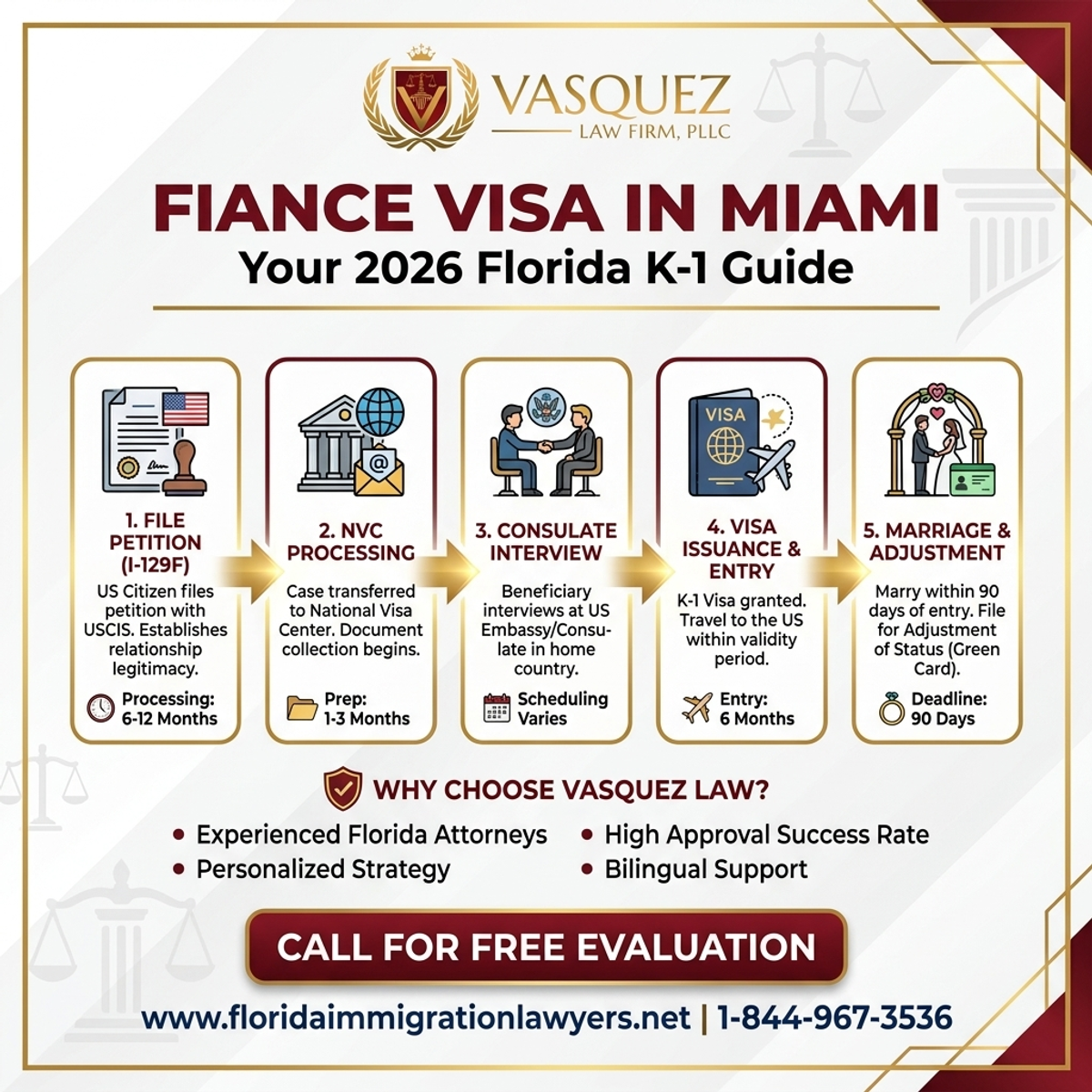
Step-by-Step Process — Fiance Visa in Miami: Your 2026 Florida K-1 Guide
- Passport valid for at least six months beyond the intended period of stay
- Form DS-160 confirmation page
- Two U.S. passport-style photos
- Birth certificate
- Police certificates from all countries where the beneficiary has lived for certain periods
- Medical examination report from an authorized panel physician
- Evidence of financial support (e.g., Form I-134, Affidavit of Support, with supporting financial documents from the U.S. citizen)
- Evidence of bona fide relationship (can be similar to what was submitted for I-129F)
- Proof of termination of any previous marriages
It is crucial to provide certified translations for any foreign-language documents. Organizing these documents meticulously and ensuring their accuracy is key to preventing delays in the K-1 visa process. Our attorneys can assist you in compiling a strong and complete application package.
What is the K-1 Fiance Visa Timeline and Cost in 2026?
Understanding the expected timeline and potential costs associated with the K-1 fiance visa process is vital for planning your future. As of 2026, processing times can fluctuate significantly based on USCIS workload, the specific U.S. Embassy or Consulate involved, and the completeness of your application. Similarly, costs are multi-faceted, encompassing government filing fees, medical exams, and potential legal fees. Being prepared for both the duration and the financial investment will help you navigate this journey with greater confidence and fewer surprises.
Typical K-1 Fiance Visa Timeline (as of 2026):
The timeline for a K-1 fiance visa can vary widely, but here's a general overview of what to expect:
| Stage | Typical Timeframe | Notes |
|---|---|---|
| USCIS Form I-129F Processing | 8-15 months | Varies by service center; check USCIS processing times. |
| National Visa Center (NVC) Processing | 1-2 months | Case transfer and initial administrative processing. |
| Consular Processing & Interview Scheduling | 2-6 months | Depends on embassy/consulate backlog and applicant's responsiveness. |
| Medical Examination | 1-2 weeks | Must be performed by an embassy-approved physician. |
| Visa Interview & Issuance | Few days to a few weeks | If approved, visa typically issued shortly after interview. |
| Travel to U.S. & Marriage | Within 90 days of entry | Mandatory period for marriage after K-1 visa holder's arrival. |
| Adjustment of Status (I-485) | 10-24 months | Post-marriage green card application; includes potential interview at a Florida USCIS field office. |
K-1 Fiance Visa Cost Factors (as of 2026):
The total cost for a K-1 fiance visa can range significantly. Here are the typical fee categories:
| Item | Typical Fee (USD) | Notes |
|---|---|---|
| USCIS Form I-129F Filing Fee | Varies; see USCIS website | Subject to change; check official USCIS fee schedule. |
| DS-160 Nonimmigrant Visa Application Fee | Varies; see State Dept. website | Paid to the U.S. Department of State. |
| Medical Examination Fee | Varies by country and physician | Paid directly to the authorized panel physician. |
| Translation & Document Fees | Varies | Costs for obtaining birth certificates, police records, and certified translations. |
| Attorney Legal Fees | Varies widely | Depends on complexity of case and firm's fee structure. |
| Post-Marriage Adjustment of Status (I-485) Filing Fee | Varies; see USCIS website | Separate fee for green card application after marriage. |
It is important to budget for all these expenses, as well as potential travel costs for the foreign fiance(e) and any unforeseen administrative fees. Fees are subject to change, so always verify the most current amounts on the official government websites. For specific guidance on managing costs and understanding financial requirements, consult with an immigration attorney.
What Happens After K-1 Visa Approval in Florida?
Once the K-1 fiance visa is approved and issued by the U.S. Embassy or Consulate, the foreign national is granted a single-entry visa valid for six months. This allows them to travel to the United States. Upon arrival at a U.S. port of entry, a Customs and Border Protection (CBP) officer will inspect their documents and, if all is in order, admit them as a K-1 nonimmigrant. This admission starts a crucial 90-day period during which the marriage must legally take place. This short timeframe underscores the importance of careful planning and preparation even before the visa is issued, especially for couples residing in Florida where local marriage license requirements must be met.
After the foreign fiance(e) arrives in Florida with their K-1 visa, the couple must marry within 90 days. This is a strict statutory requirement under 8 U.S.C. § 1184(d)(1). The marriage must be legally recognized in the state of Florida. Once married, the foreign spouse can then apply for Adjustment of Status (Form I-485) to become a lawful permanent resident (Green Card holder). This application is filed with USCIS and includes supporting documents, a medical examination, and typically an interview at a local USCIS field office. For Florida residents, this might be the USCIS Field Office in Orlando for those in Central Florida, or the Miami Field Office for those in South Florida. The interview is a critical step where a USCIS officer will verify the authenticity of the marriage and the eligibility for a Green Card. During this period, the foreign spouse can also apply for work authorization (Employment Authorization Document - EAD) and travel permission (Advance Parole) using Forms I-765 and I-131, respectively, which can be filed concurrently with Form I-485. The entire post-arrival process, from marriage to Green Card approval, requires continued diligence and adherence to immigration regulations. Having an attorney assist with the Adjustment of Status application can significantly streamline the process and prevent common errors.
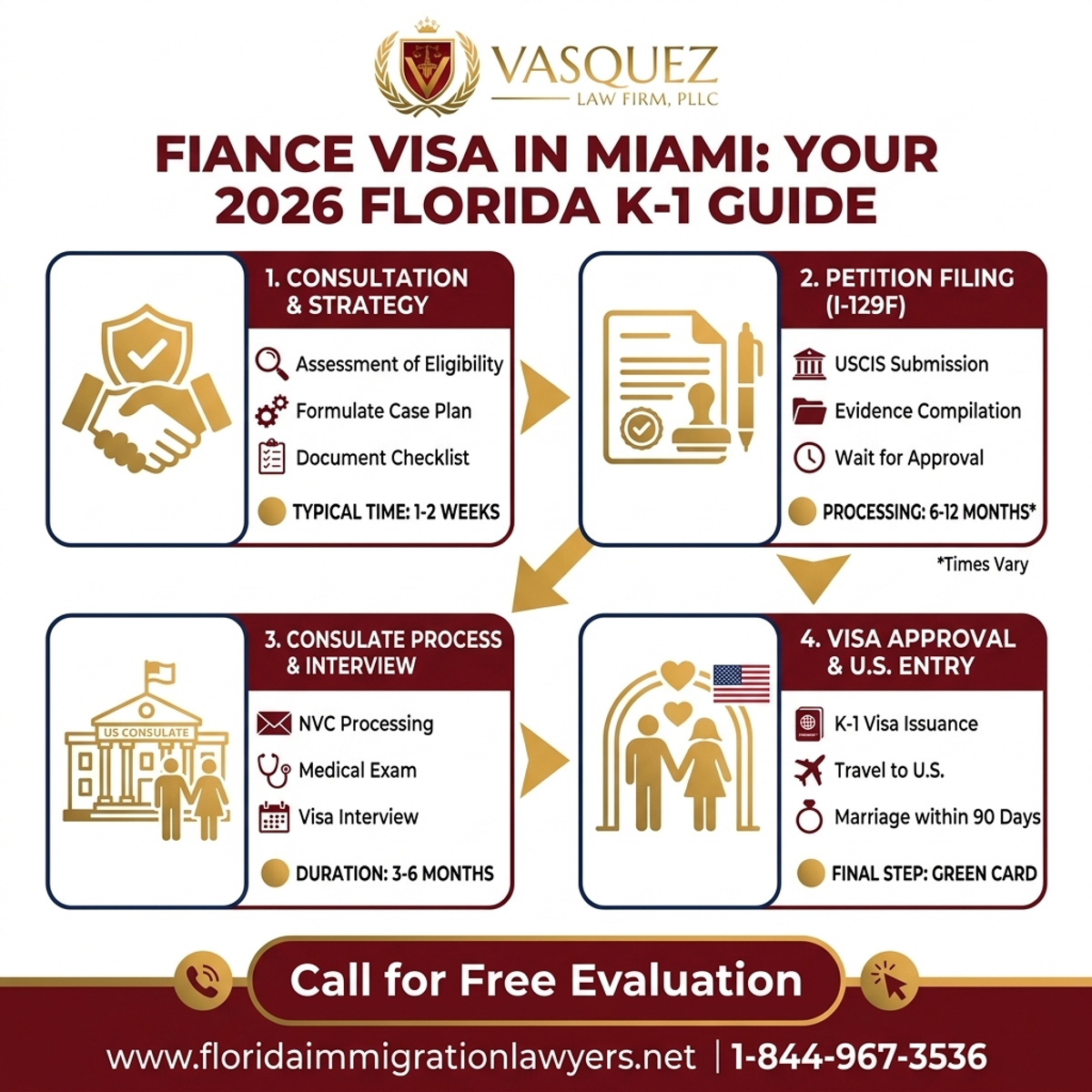
Key Statistics — Fiance Visa in Miami: Your 2026 Florida K-1 Guide
Common Mistakes to Avoid in the Fiance Visa Process
Navigating the K-1 fiance visa process can be challenging, and even minor errors can lead to significant delays or denials. Being aware of these common pitfalls can help you avoid unnecessary stress and ensure a smoother application.
- Failing to Prove a Bona Fide Relationship: USCIS and consular officers scrutinize relationships. Insufficient evidence of a genuine, ongoing relationship (e.g., lack of photos, communication, shared experiences) is a frequent reason for denial.
- Not Meeting the In-Person Meeting Requirement: The law generally requires the couple to have met in person within two years before filing Form I-129F. Failing to meet this or provide adequate evidence of an exception can halt the process.
- Incomplete or Inaccurate Documentation: Submitting an I-129F petition or DS-160 application with missing documents, incorrect information, or unsigned forms will lead to requests for evidence (RFEs) or outright rejection.
- Providing Uncertified Translations: Any document not in English must be accompanied by a certified English translation. Failing to provide this renders the document unusable and can cause delays.
- Ignoring Financial Sponsorship Requirements: The U.S. citizen petitioner must demonstrate sufficient income to support their fiance(e) using Form I-134. Not meeting the poverty guidelines or providing insufficient evidence of financial capacity can lead to denial.
- Missing the 90-Day Marriage Deadline: After the K-1 visa holder arrives in the U.S., the couple must marry within 90 days. Failure to do so results in the foreign national falling out of status and facing potential deportation.
- Applying for the Wrong Visa: Some couples mistakenly apply for a K-3 spouse visa before marriage, which is generally not an option for those who plan to marry in the U.S. on a K-1 visa.
- Not Disclosing All Prior Marriages/Divorces: Both parties must fully disclose all previous marriages and provide proof of their legal termination. Hiding this information is considered misrepresentation.
- Failing to Update USCIS of Address Changes: Moving without notifying USCIS via Form AR-11 can cause you to miss important notices, RFEs, or interview appointments, jeopardizing your application.
- Lack of Preparation for the Interview: Both the K-1 visa interview and the Adjustment of Status interview require the couple to answer questions about their relationship. Inconsistent or evasive answers can raise red flags.
- Overlooking Criminal or Immigration History Issues: Undisclosed criminal convictions, prior immigration violations, or misrepresentations can lead to ineligibility or permanent bars without proper waivers.
When to Call a Florida Immigration Lawyer for Your K-1 Visa
While the K-1 fiance visa process appears straightforward on paper, real-world applications often present unique complexities. Knowing when to seek professional legal assistance can be the difference between a smooth approval and a frustrating denial. If you are a U.S. citizen in Orlando, Miami, or anywhere in Central Florida, considering a K-1 visa for your foreign fiance(e), Florida Immigration Lawyers is ready to provide the expert guidance you need.
You should consider calling an experienced immigration attorney if your situation involves any of the following scenarios: a complex immigration history for either party, including prior visa overstays, deportations, or criminal records; challenges in meeting the financial sponsorship requirements; difficulty proving a bona fide relationship due to cultural differences or limited in-person meetings; a previous K-1 or K-3 petition that was denied; or if you simply feel overwhelmed by the extensive documentation and legal jargon. Our firm specializes in family immigration matters and can help you avoid common mistakes, prepare a robust petition, represent you during interviews, and address any potential legal obstacles. We stay current with all immigration law changes, including those impacting K-1 visa applicants in Florida. Don't let uncertainty jeopardize your future together. Contact our dedicated team for assistance with your K-1 visa petition and subsequent Adjustment of Status application. We are committed to providing personalized and compassionate legal support.
About Florida Immigration Lawyers
Florida Immigration Lawyers is a leading law firm dedicated to providing exceptional immigration legal services across the entire state of Florida. With a deep understanding of U.S. immigration law and a commitment to our clients, we strive to make the complex immigration process as clear and stress-free as possible. Our experienced attorneys specialize in a wide array of immigration practice areas, including family-based visas, K-1 fiance visas, asylum, deportation defense, and naturalization. We are proud to serve individuals and families from Orlando and throughout Central Florida, offering personalized strategies tailored to each unique case.
We understand the profound impact immigration matters have on individuals and families, and we approach every case with empathy, diligence, and unwavering advocacy. Our firm offers 24/7 availability and free case reviews, ensuring that you can access expert legal advice when you need it most. We are dedicated to delivering positive outcomes and helping our clients achieve their American dream. When you choose Florida Immigration Lawyers, you choose a partner who will stand by your side, fighting for your rights and guiding you through every step of your immigration journey. Call us today at 1-844-YO-PELEO or schedule a free consultation to discuss your immigration needs. We are here to help you achieve your goals, serving all of Florida with integrity and expertise.
Sources and References
- U.S. Citizenship and Immigration Services (USCIS)
- U.S. Department of State
- Executive Office for Immigration Review (EOIR)
- 8 U.S.C. Chapter 12 - Immigration and Nationality Act (INA)
- 8 U.S.C. § 1184(d)(1) - Conditions for Issuance of K-1 Visa
- 8 CFR Part 214 - Nonimmigrant Classes
- USCIS Policy Manual, Volume 6 - Immigrants: Part B - Spouses, Widows, and Fiance(e)s of U.S. Citizens
Related services: family petition process, family-based green cards, fiancé visa (K-1), marriage-based immigration.
This article provides general legal information and is not intended as legal advice. Every case is unique, and outcomes depend on specific facts and circumstances. Contact an attorney for advice about your particular situation.
Navigating the K-1 fiance visa process requires careful planning and a thorough understanding of U.S. immigration law. Don't leave your future to chance. Let the dedicated team at Florida Immigration Lawyers guide you through every step, ensuring your application is strong and complete. Contact us today at 1-844-YO-PELEO for your free case review. Se Habla Espanol - Estamos aqui para ayudarle.
Do Not Navigate This Process Alone
Our experienced immigration attorneys are ready to fight for you. Get a free, confidential case review today.
Se Habla Español
Or leave your details and we’ll call you:
Free Evaluation in 24 Hours
Or talk to us right now
AI voice assistant — available 24/7
FreeFrequently Asked Questions

William J. Vásquez
Founding Attorney · Vasquez Law Firm
U.S. Air Force veteran and immigration attorney with years of hands-on U.S. immigration experience. J.D., NCCU School of Law. AILA member. Admitted to the 4th, 5th, and 11th Circuit Courts.
Available 24/7 - Free Evaluations
Reviewed for legal accuracy by William J. Vásquez
Licensed in North Carolina; U.S. immigration is federal practice.
Related Legal Services
Our Florida immigration attorneys can help you with family immigration services, immigration lawyer cost in Florida and experienced immigration attorneys. Call today at 1-844-YO-PELEO for a free case review.
Related Links
Related Topics
Free Legal Case Review
Discuss your case with our experienced attorneys. We're available 24/7.
Se Habla Español - Estamos aquí para ayudarle.
Related Articles
EB-5 Investor Green Card in Florida: A 2026 Guide
Explore how to obtain an EB-5 investor green card in Florida. Learn about the investment requirements, processes, and benefits of participating in this program. Discover how Florida's economic landscape can be an ideal setting for your investment. Contact Florida Immigration Lawyers for a free case review.
Certificate of Eligibility for Expungement in Florida 2026
For non-U.S. citizens in Florida, understanding how a state expungement impacts immigration status is critical. A certificate of eligibility for expungement in Florida allows a criminal record to be sealed or expunged under state law. However, federal immigration agencies often disregard such state-level relief, still considering the original criminal offense as a conviction for immigration purposes. This can have severe implications for visa applications, green card eligibility, naturalization, and even lead to deportation. This guide clarifies the Florida expungement process, its limited effect on federal immigration law, and key steps to protect your status in 2026. Learn about common mistakes, required documents, timelines, and when to seek expert legal counsel from Florida Immigration Lawyers to navigate these complex issues effectively.
Immigration Lawyer Orlando Free Consultation in Florida
For individuals and families in Orlando, Florida, navigating the complexities of U.S. immigration law requires expert guidance. An immigration lawyer in Orlando offers crucial support for everything from visa applications and green card processes to naturalization and deportation defense. This comprehensive guide details what a free consultation covers, providing a step-by-step overview of immigration pathways, essential document checklists, and expected timelines in 2026. We also highlight common mistakes to avoid, discuss the critical role of legal counsel in deportation and asylum cases, and explain why choosing a local Orlando immigration attorney is beneficial. Florida Immigration Lawyers is dedicated to serving the diverse community of Orlando with compassionate, effective legal solutions, ensuring you receive personalized advice and robust representation for a successful immigration journey.
Immigration Interview Preparation Florida 2026 Guide
Facing an immigration interview in Florida? This comprehensive guide offers essential 2026 USCIS interview tips for green card and naturalization applicants. Learn how to meticulously prepare your documents, understand the typical timelines, and avoid common mistakes that could jeopardize your case. We cover what to expect at the Orlando USCIS Field Office, provide a detailed document checklist, and explain the various costs involved in the process. With insights into naturalization specifics and when to seek legal counsel, Florida Immigration Lawyers helps you approach your interview with confidence. Our firm is dedicated to empowering immigrants across Florida with the knowledge and support needed for a successful outcome. Get a free case review today.