Re-Entry Permits Lawyer: Protecting Your Green Card
By William J. Vásquez, immigration attorney
For lawful permanent residents (LPRs) in Florida, a re-entry permit (Form I-131) is essential to prevent green card abandonment when traveling abroad for extended periods. This document signifies your intent to maintain U.S. residency, protecting your ability to return without issues. Without it, absences exceeding one year can lead to a presumption of abandonment, potentially resulting in denied re-entry or deportation proceedings. This guide covers the I-131 application process, common pitfalls, and how an experienced re-entry permits lawyer in Florida can safeguard your LPR status. Learn about processing times, costs, and critical mistakes to avoid. Florida Immigration Lawyers offers comprehensive support for LPRs in Orlando and across Central Florida, ensuring you understand your options and travel with confidence. Schedule a free case review today.
As a lawful permanent resident (LPR) in Florida, your green card grants you the privilege to live and work permanently in the United States. However, this status comes with responsibilities, one of which is maintaining your residency. For many LPRs, the need to travel abroad for family, business, or personal reasons is inevitable. When these trips extend beyond six months, or especially beyond one year, you risk facing accusations of green card abandonment upon your return, jeopardizing your hard-earned status.
This comprehensive guide will explain the vital role of a re-entry permit (Form I-131) in protecting your permanent residency, particularly for those residing in Florida. We'll delve into the application process, potential pitfalls, and how an experienced re-entry permits lawyer can be your strongest advocate in navigating these complex immigration waters. Understanding these rules is critical to ensuring your continued ability to call Florida home.
Do not leave your immigration status to chance. If you anticipate extended travel outside the U.S. or have concerns about maintaining your green card, call Florida Immigration Lawyers at 1-844-YO-PELEO for a free case review today. Our dedicated team is here to provide the clarity and support you need.
What is a Re-Entry Permit and Why Do You Need One in Florida?
A re-entry permit is an official travel document issued by U.S. Citizenship and Immigration Services (USCIS) to lawful permanent residents. Its primary purpose is to allow LPRs to re-enter the United States after traveling abroad for more than one year without being considered to have abandoned their permanent resident status.
For Florida LPRs, especially those with strong ties to their home countries or international business interests, a re-entry permit offers peace of mind. Without it, absences exceeding one year automatically trigger a presumption of abandonment, which can be difficult to overcome at the port of entry. Even absences shorter than one year but longer than six months can raise questions from immigration officials, requiring you to prove your intent to maintain U.S. residency. The re-entry permit effectively waives this presumption for up to two years from the date of issuance, protecting your right to return.
This document is particularly beneficial if you need to care for a sick relative abroad, work for a U.S. company overseas, or pursue educational opportunities. It serves as your travel document in lieu of a visa for re-entry and is generally valid for two years. The permit clearly signals to U.S. Customs and Border Protection (CBP) officers that your absence is temporary and that you intend to maintain your permanent residence in the U.S. This is a critical distinction, as the burden of proof is on the LPR to demonstrate non-abandonment without such a permit. Under USCIS regulations, specifically 8 CFR § 211.1(a)(2), a re-entry permit allows an LPR to apply for admission to the U.S. without a visa, provided it is valid.
How Do I Apply for a Re-Entry Permit (Form I-131) in 2026?
Applying for a re-entry permit involves submitting Form I-131, Application for Travel Document, to USCIS. As of 2026, the process requires careful attention to detail and adherence to specific instructions to ensure a smooth application. The most critical requirement is that you must be physically present in the United States when you file Form I-131. You can depart after filing, but you must attend any biometrics appointment within the U.S.
Step-by-Step Guide to Filing Form I-131:
- Gather Necessary Documents: Before starting, collect all required documentation. This includes copies of your green card, passport, and any previous re-entry permits. You will also need two passport-style photos.
- Complete Form I-131 Accurately: Fill out every section of Form I-131 completely and truthfully. Ensure all information matches your official documents. Any discrepancies can cause delays or even denial.
- Prepare Supporting Evidence: Include evidence demonstrating your ties to the U.S., such as property deeds in Florida, tax returns, bank statements, and proof of family residing in the U.S. While not strictly required for the initial filing, this evidence supports your intent to return.
- Pay the Filing Fees: Submit the required filing fee for Form I-131, along with the biometrics services fee. USCIS fees are subject to change, so always check the most current fee schedule on the official USCIS website before mailing your application.
- Mail Your Application: Send your completed Form I-131, supporting documents, and fees to the designated USCIS Lockbox facility. Use certified mail with a return receipt to track delivery.
- Attend Biometrics Appointment: After filing, USCIS will send you an appointment notice for biometrics (fingerprints, photos, signature) at an Application Support Center (ASC) in Florida, such as the one in Orlando. You must attend this appointment within the U.S.
- Await Decision: USCIS will process your application. You can check the status online using the receipt number provided. If approved, the re-entry permit will be mailed to you or to a designated U.S. address.
Document Checklist for I-131:
- Completed Form I-131, Application for Travel Document
- Copy of your Permanent Resident Card (Green Card Form I-551)
- Copy of your passport's biographic page
- Two identical passport-style photographs (taken within 30 days of filing)
- Copy of government-issued identification with your photo
- Proof of payment for filing and biometrics fees
- (Optional but recommended) Evidence of U.S. ties (e.g., tax returns, property deeds, bank statements)
- (If applicable) Copy of previous re-entry permit
Understanding Green Card Abandonment: Risks for Florida LPRs
Green card abandonment is a serious concern for lawful permanent residents. It occurs when the U.S. government determines that an LPR no longer intends to make the United States their permanent home. While a re-entry permit is a strong defense, it's crucial to understand the factors that can lead to such a determination, especially for those with lives rooted in Florida.
The Immigration and Nationality Act (INA) does not explicitly define abandonment, but it is generally understood through case law and regulations (e.g., 8 CFR § 211.1(a)(3)). Several factors are considered by immigration officials, including the length of time spent outside the U.S. If you spend more than one year continuously outside the U.S. without a re-entry permit, you are presumed to have abandoned your LPR status. Absences between six months and one year can also raise questions.
Beyond the duration of absence, USCIS and CBP officers look at other indicators of intent. These include maintaining a home in the U.S. (e.g., owning property in Orlando or Central Florida), filing U.S. tax returns as a resident, maintaining U.S. bank accounts, holding a U.S. driver's license, and having family members (spouse, children) who reside in the U.S. Conversely, factors that suggest abandonment include obtaining foreign citizenship, establishing a permanent home abroad, working exclusively overseas for an extended period, or failing to file U.S. income tax returns as a resident.
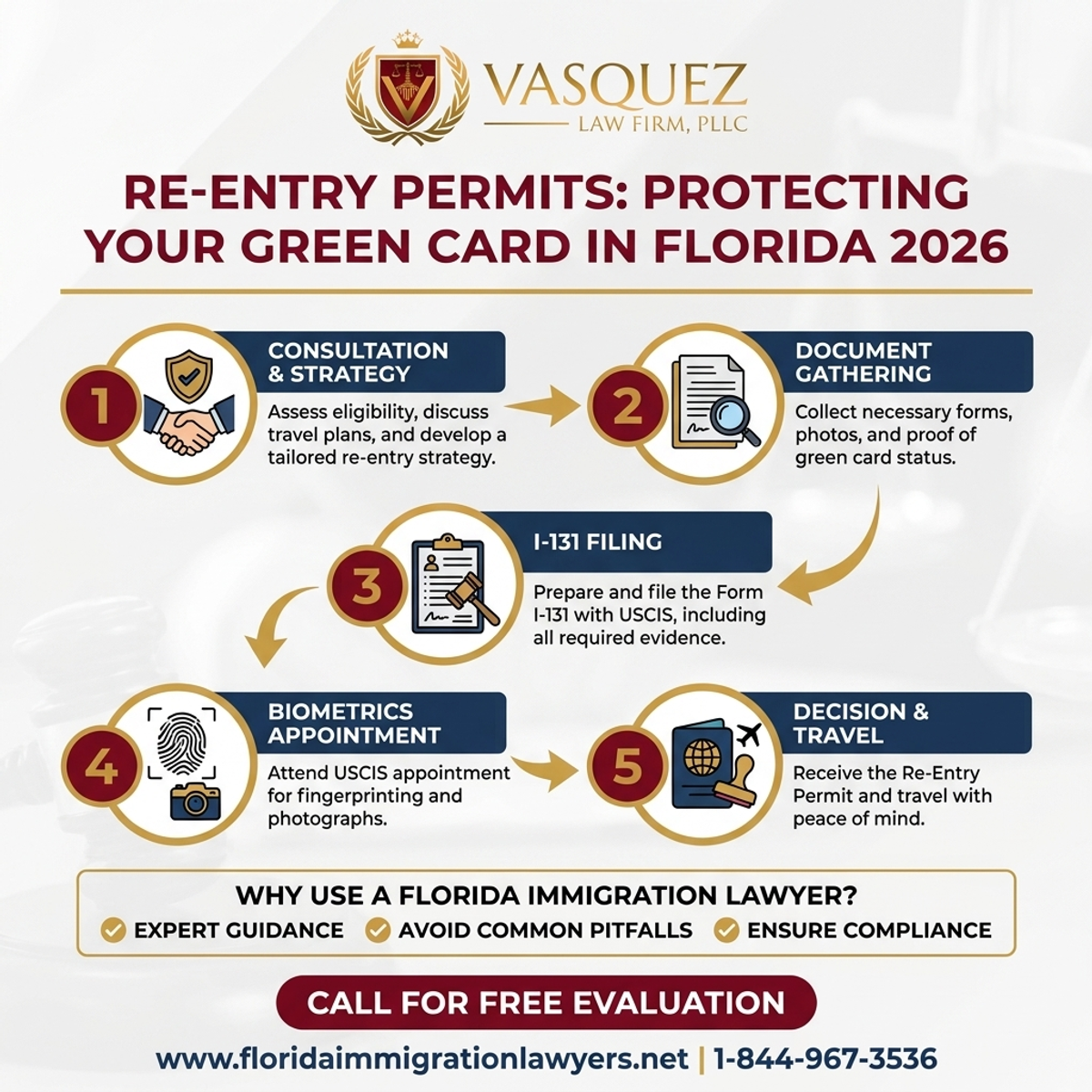
Step-by-Step Process — Re-Entry Permits Lawyer: Protecting Your Green Card in Florida 2026
For Florida LPRs, facing an accusation of abandonment at a port of entry can lead to significant stress and uncertainty. CBP officers have the authority to deny re-entry, leading to removal proceedings before an immigration judge at the Executive Office for Immigration Review (EOIR). This is where the importance of proactive planning with a qualified immigration attorney becomes clear. If you find yourself in such a situation, immediate legal counsel is paramount to mount a robust defense and protect your right to reside in Florida.
What is the Typical Processing Time and Cost for an I-131 Re-Entry Permit?
The processing time for Form I-131, Application for Travel Document, can vary significantly depending on USCIS caseloads and the specific service center handling your application. As of 2026, applicants should anticipate a considerable wait, making early application crucial for planned international travel. It is not uncommon for processing times to range from several months to over a year, so planning well in advance is essential to ensure you receive your permit before your intended departure date from Florida.
The cost associated with an I-131 re-entry permit application includes USCIS filing fees and biometrics fees. These fees are subject to change by USCIS, so it is always critical to verify the most current amounts on the official USCIS website before submitting your application. There are no fee waivers available for re-entry permits, so applicants must be prepared to pay the full amount.
Typical Timeline for I-131 Processing (As of 2026):
| Stage | Typical Timeframe | Notes |
|---|---|---|
| Application Filing | Day 1 | Must be physically present in the U.S. |
| Receipt Notice (I-797C) | 2-4 weeks | Confirms USCIS received your application. |
| Biometrics Appointment Notice | 1-3 months after filing | Scheduled at a local Application Support Center (ASC) in Florida (e.g., Orlando). Mandatory attendance. |
| Case Decision/Approval | 7-18 months after biometrics | Times vary significantly; check USCIS website for current processing times. |
| Permit Delivery | 1-2 weeks after approval | Mailed to the U.S. address provided on Form I-131. |
Cost Factors for I-131 Re-Entry Permit:
| Item | Typical Fee | Notes |
|---|---|---|
| USCIS Form I-131 Filing Fee | (Varies, check USCIS site) | Required for the application itself. |
| Biometrics Services Fee | (Varies, check USCIS site) | Required for fingerprinting and photo. |
| Attorney Fees | (Varies by firm) | For legal assistance in preparing and filing the application, and strategic advice. |
| Postage/Courier Fees | (Minor) | Cost to mail your application securely. |
Can a Re-Entry Permit Lawyer in Florida Help Prevent Green Card Abandonment?
Absolutely. Engaging a skilled re-entry permit lawyer in Florida can significantly enhance your chances of a successful application and provide crucial protection against accusations of green card abandonment. The immigration process is fraught with complexities, and even minor errors can lead to delays, denials, or more severe consequences for your LPR status.
An experienced attorney, like those at Florida Immigration Lawyers, offers invaluable guidance from the outset. We can help you determine if a re-entry permit is the appropriate solution for your specific travel plans and circumstances. Our team will meticulously prepare your Form I-131 application, ensuring all forms are accurately completed and all necessary supporting documentation is included. This attention to detail is paramount, as incomplete or incorrect applications are a leading cause of delays.
Furthermore, a lawyer can advise you on maintaining your U.S. ties while abroad, which is critical for demonstrating your intent not to abandon your green card. This includes guidance on filing U.S. tax returns, maintaining U.S. bank accounts, and other actions that strengthen your case. Should you face challenges at the port of entry or receive a Notice to Appear (NTA) for removal proceedings, your attorney can represent you, offering a robust deportation defense and advocating on your behalf.
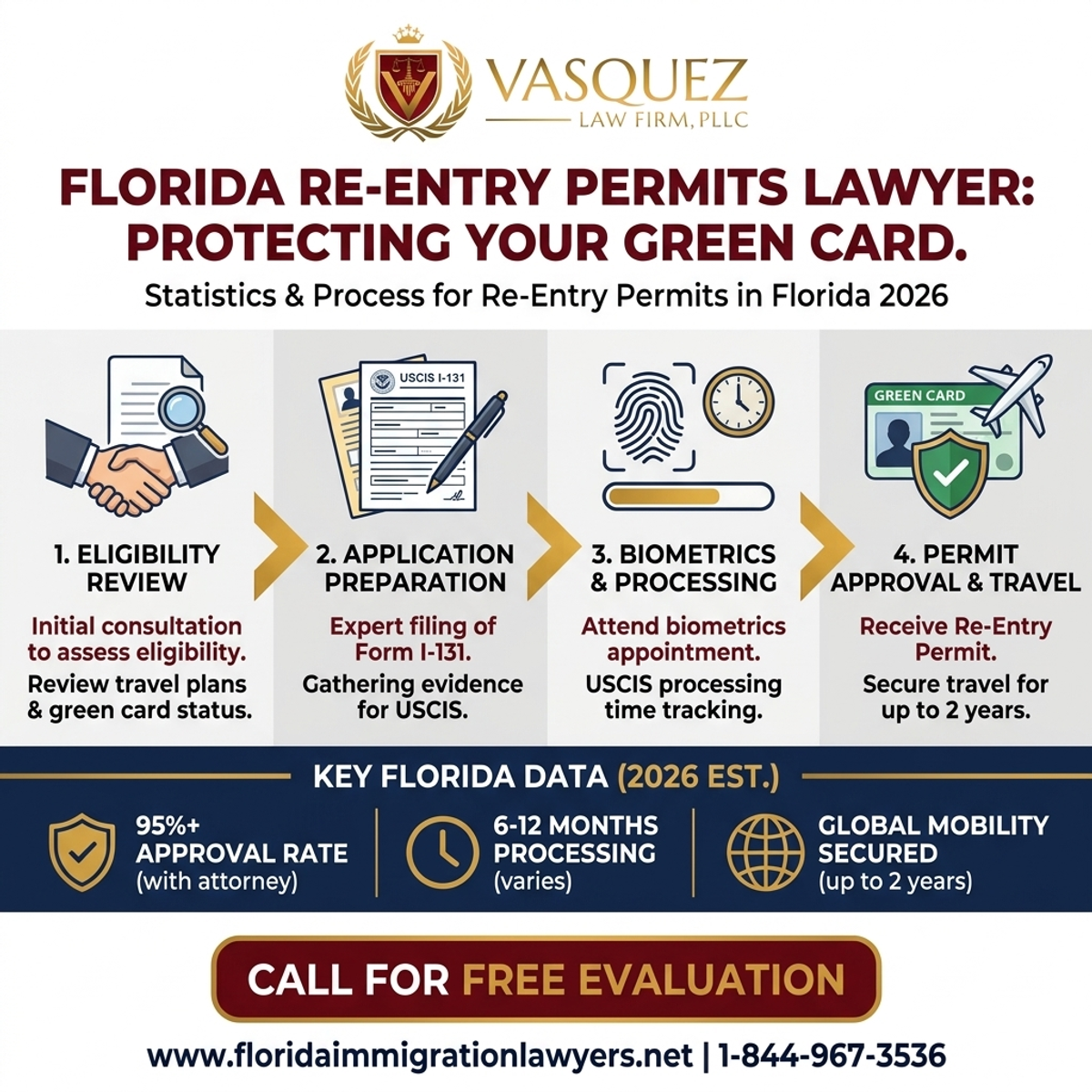
Key Statistics — Re-Entry Permits Lawyer: Protecting Your Green Card in Florida 2026
For LPRs in Orlando and across Central Florida, our firm understands the local context and the specific concerns that arise. We are adept at navigating both the administrative processes with USCIS and potential adversarial proceedings with CBP or EOIR. Our goal is to protect your permanent resident status, allowing you to travel with confidence and return to your life in Florida without undue stress.
Do not navigate this process alone. Contact Florida Immigration Lawyers today to schedule a free case review and discuss how we can assist you with your re-entry permit application and protect your green card status.
Common Mistakes to Avoid When Dealing with Re-Entry Permits and Green Card Abandonment
Navigating the complexities of re-entry permits and avoiding green card abandonment requires careful planning. Many LPRs make common mistakes that can jeopardize their status. Be aware of these pitfalls:
- Failing to File While Physically Present in the U.S.: You must be on U.S. soil when you file Form I-131. Filing from abroad will result in denial and loss of fees.
- Departing Before Biometrics Appointment: After filing, USCIS will schedule a biometrics appointment. If you leave the U.S. before attending it, your application will likely be denied, as biometrics must be completed within the U.S.
- Assuming a Re-Entry Permit Guarantees Re-Entry: While strong, a re-entry permit does not guarantee admission. You must still be admissible to the U.S. and not have committed any new immigration violations or crimes.
- Overstaying the Re-Entry Permit's Validity: A re-entry permit is typically valid for two years. Overstaying this period without applying for an extension (which is rare and difficult to obtain) or returning to the U.S. can lead to abandonment issues.
- Not Maintaining U.S. Ties: Even with a re-entry permit, immigration officers may question your intent if you sever all ties to the U.S. (e.g., selling your home, closing bank accounts, not filing U.S. taxes).
- Not Filing U.S. Tax Returns as a Resident: Failing to file U.S. income tax returns as a resident, even while abroad, can be a strong indicator of abandonment in the eyes of immigration officials.
- Relying on Outdated Information: Immigration laws and USCIS procedures, including fees and processing times, change frequently. Relying on old information can lead to errors and delays.
- Underestimating the Risk of Abandonment for Shorter Absences: While a re-entry permit is usually for absences over one year, even absences of 6-12 months can trigger scrutiny. Always be prepared to prove your intent to return.
- Ignoring Communications from USCIS: Missing a Request for Evidence (RFE) or other notices from USCIS can lead to denial of your application. Always keep your address updated and check mail regularly.
- Traveling on an Expired Green Card: An expired green card does not mean you've lost LPR status, but it can complicate re-entry. Always travel with a valid, unexpired green card or other appropriate documentation.
- Providing Inconsistent Information: Any inconsistencies between your application, travel history, and statements to CBP can raise red flags and lead to further questioning or issues.
When to Call a Lawyer for Your Re-Entry Permit or Green Card Abandonment Concerns
Navigating the intricacies of U.S. immigration law, particularly regarding re-entry permits and the risk of green card abandonment, is rarely straightforward. While some LPRs may attempt to handle these matters independently, certain situations strongly warrant the expertise of a qualified immigration attorney. If any of the following apply to you, it's time to seek professional legal guidance from Florida Immigration Lawyers:
- Complex Travel History: If you have a history of frequent or prolonged absences from the U.S., or if your travel plans are unusual.
- Prior Immigration Issues: If you've previously been questioned about your LPR status, faced abandonment accusations, or have other immigration violations.
- Criminal Record: Any criminal convictions, even minor ones, can affect your admissibility and jeopardize your LPR status upon return, even with a re-entry permit.
- Uncertainty About U.S. Ties: If you're unsure how to demonstrate strong ties to the U.S. or if your ties have weakened due to extended stays abroad.
- Denial of Re-Entry Permit: If your Form I-131 application has been denied, an attorney can help you understand the reasons and explore potential remedies.
- Facing Abandonment Accusations: If a CBP officer at a port of entry has accused you of abandoning your green card and is threatening to deny your re-entry or issue an NTA.
- Seeking Citizenship After Extended Travel: If you plan to apply for U.S. citizenship in the future, extended absences, even with a re-entry permit, can impact your continuous residency requirement. An attorney can advise on managing this.
- Need for Expedited Processing: In rare, compelling circumstances, an attorney might assist with requesting expedited processing, though this is not commonly granted for I-131s.
Florida Immigration Lawyers offers comprehensive services for LPRs in Orlando and throughout Central Florida, ensuring your rights are protected and your immigration goals are met. Our attorneys are ready to provide strategic advice and robust representation.
About Florida Immigration Lawyers
Florida Immigration Lawyers is a leading immigration law firm dedicated to serving individuals and families across the entire state of Florida. With an unwavering commitment to our clients, we provide expert legal counsel and representation in all areas of immigration law, from family-based petitions and business visas to asylum claims and deportation defense. Our experienced attorneys understand the profound impact immigration matters have on people's lives and approach each case with compassion, diligence, and a deep knowledge of U.S. immigration law.
We pride ourselves on offering personalized service, ensuring that each client receives the attention and tailored strategies their unique situation demands. Our firm is available 24/7, offering free case reviews to help you understand your options without financial obligation. Whether you're seeking to obtain a green card, prevent green card abandonment, or navigate the path to citizenship, our team is equipped to guide you through every step of the process. We proudly serve our diverse community, with offices in Orlando and a strong presence across Central Florida. Contact Florida Immigration Lawyers today at 1-844-YO-PELEO – Se Habla Espanol – estamos aquí para ayudarle.
Sources and References
- U.S. Citizenship and Immigration Services (USCIS)
- U.S. Department of State
- Executive Office for Immigration Review (EOIR)
- Immigration and Nationality Act (INA) - 8 U.S.C. Chapter 12
- 8 Code of Federal Regulations (CFR) § 211.1(a)(2) - Documentary requirements for immigrants; re-entry permits
- 8 Code of Federal Regulations (CFR) § 211.1(a)(3) - Documentary requirements for immigrants; abandonment of status
Related services: immigration practice areas, family immigration services, business immigration, experienced immigration attorneys.
This article provides general legal information and is not intended as legal advice. Every case is unique, and outcomes depend on specific facts and circumstances. Contact an attorney for advice about your particular situation.
Protecting your green card and ensuring your ability to return to your life in Florida after international travel is paramount. Do not risk your permanent resident status by navigating complex immigration rules alone. For expert guidance on re-entry permits, green card abandonment, and all your immigration needs, contact Florida Immigration Lawyers today at 1-844-YO-PELEO for a free, confidential case review. Se Habla Espanol - Estamos aqui para ayudarle.
If you need legal assistance, learn more about Florida immigration legal team, or call us at 1-844-967-3536 for a free case review.
Do Not Navigate This Process Alone
Our experienced immigration attorneys are ready to fight for you. Get a free, confidential case review today.
Se Habla Español
Or leave your details and we’ll call you:
We will call you back within 24 hours
Free evaluation · Private and confidential · Se habla español
Helping Florida immigrant families since 2011
Or talk to us right now

AI voice assistant — available 24/7
FreeFrequently Asked Questions

William J. Vásquez
Founding Attorney · Vasquez Law Firm
U.S. Air Force veteran and immigration attorney with years of hands-on U.S. immigration experience. J.D., NCCU School of Law. AILA member. Admitted to the 4th, 5th, and 11th Circuit Courts.
Available 24/7 - Free Evaluations
Reviewed for legal accuracy by William J. Vásquez
Licensed in North Carolina; U.S. immigration is federal practice.
Related Legal Services
Our Florida immigration attorneys can help you with asylum protection, citizenship and naturalization and immigration practice areas. Call today at 1-844-YO-PELEO for a free case review.
Related Links
Related Topics
Free Legal Case Review
Discuss your case with our experienced attorneys. We're available 24/7.
Se Habla Español - Estamos aquí para ayudarle.
Related Articles
EAD Advance Parole Combo Card in Florida 2026
For individuals with a pending Form I-485, Application to Register Permanent Residence or Adjust Status, the EAD Advance Parole Combo Card is an essential document. This single card combines the authorization to work legally in the U.S. (Employment Authorization Document - EAD) with permission to travel internationally and re-enter without abandoning your green card application (Advance Parole). This guide from Florida Immigration Lawyers provides a comprehensive overview for applicants in Florida in 2026, covering eligibility, the step-by-step application process, required documents, expected processing times, and associated costs. We also highlight common mistakes to avoid and when to seek legal counsel to ensure a smooth and successful immigration journey. Understanding this vital card is key to maintaining stability while awaiting your permanent residency approval.
What to Expect at Your First Immigration Consultation in Orlando
What happens at a first immigration consultation in Orlando, which documents to bring, and how to prepare for questions about visas, green cards, citizenship and court cases.
Certificate of Eligibility for Expungement in Florida: 2026
Discover how obtaining a certificate of eligibility for expungement in Florida can impact your immigration status. Learn the step-by-step process, understand the timeline, and avoid common mistakes. Contact Florida Immigration Lawyers for assistance.
H-2A Visa for Agricultural Workers in Florida 2026
Explore the H-2A visa process for agricultural workers in Florida. Learn about eligibility, application steps, and common mistakes to avoid. Florida Immigration Lawyers provide expert guidance to navigate these complexities.