Political Asylum Requirements in Florida
Learn about political asylum requirements in Florida. Our guide covers eligibility, the asylum interview, and necessary documentation. Contact Florida Immigration Lawyers for a free consultation.

Seeking political asylum in the United States can be a life-altering journey for individuals fleeing persecution in their home countries. For those residing in Florida, understanding the specific requirements and legal processes is paramount. This comprehensive guide will delve into the intricacies of political asylum in the Sunshine State, outlining eligibility criteria, application procedures, and the critical role of legal representation. Our goal is to provide clarity and empower asylum seekers with the knowledge they need to navigate this complex legal landscape.
Understanding Political Asylum in Florida
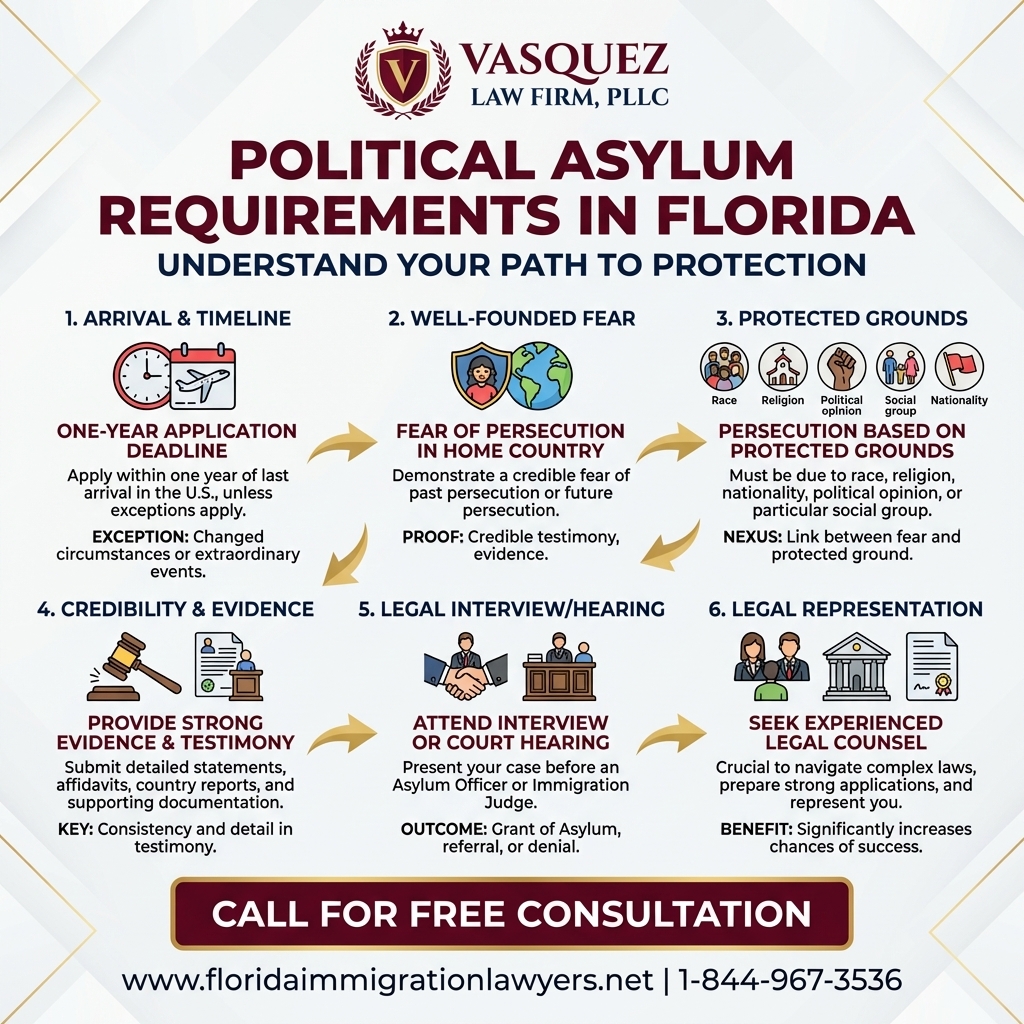
Political asylum is a form of protection granted by the U.S. government to individuals who have a well-founded fear of persecution in their home country. This fear must be based on one of five protected grounds: race, religion, nationality, membership in a particular social group, or political opinion. Florida, with its diverse population and geographical proximity to many nations experiencing political instability, frequently sees individuals seeking this vital protection. The process, while governed by federal immigration law, often involves local courts and offices, making state-specific guidance invaluable.
There are two primary ways to seek asylum: affirmative asylum and defensive asylum. Affirmative asylum is sought by individuals who are not currently in removal proceedings and proactively apply to U.S. Citizenship and Immigration Services (USCIS). Defensive asylum, on the other hand, is requested by individuals who are already in removal (deportation) proceedings before an Immigration Judge. Understanding which path applies to your situation is the first crucial step in your asylum journey. For detailed information on this specific area, you can visit our dedicated page on asylum law.
A critical aspect of asylum law is the "one-year filing deadline." Generally, you must apply for asylum within one year of your last arrival in the United States. While there are exceptions to this rule, such as changed country conditions or extraordinary circumstances, meeting this deadline is highly recommended. Failure to do so can significantly complicate your case and may require demonstrating exceptional reasons for the delay. It is essential to consult with an experienced attorney to determine if any exceptions apply to your situation.
Key Requirements for Asylum Seekers in Florida
To be granted political asylum, applicants must demonstrate a well-founded fear of persecution. This involves proving either past persecution or a reasonable possibility of future persecution if they were to return to their home country. The persecution must be severe enough to constitute a threat to life or freedom, or a pattern of harassment that, cumulatively, creates such a threat. It’s not enough to fear general violence or economic hardship; the persecution must be directly linked to one of the five protected grounds.
The "nexus requirement" is central to any asylum claim. This means there must be a direct connection (a "nexus") between the persecution you fear or have suffered and your race, religion, nationality, membership in a particular social group, or political opinion. For example, if you fear persecution because you are a journalist critical of your government, your political opinion would be the nexus. If you fear persecution because of your ethnic background, race or nationality would be the nexus. Establishing this link clearly and convincingly is vital for a successful application.
Credibility is another cornerstone of an asylum case. Immigration judges and asylum officers will scrutinize your testimony, application, and supporting documents for consistency and truthfulness. Any inconsistencies, even minor ones, can significantly undermine your case. It is crucial to be honest, thorough, and consistent in all aspects of your application and interview. Preparing meticulously for your asylum interview, often with the guidance of legal counsel, can make a significant difference in how your testimony is perceived.
Gathering robust evidence is indispensable. This includes personal affidavits detailing your experiences, witness statements, country conditions reports from reputable human rights organizations, news articles, medical records (if applicable), and any other documentation that corroborates your claim of persecution. The more comprehensive and compelling your evidence, the stronger your case will be. An attorney can help you identify and organize the necessary documentation, ensuring that all relevant information is presented effectively.
The Asylum Application Process in Florida (Form I-589)
The journey to political asylum begins with filing Form I-589, Application for Asylum and for Withholding of Removal. This detailed form requires comprehensive information about your identity, family, travel history, and, most importantly, a narrative explaining your fear of persecution. Accuracy and thoroughness are paramount when completing this document, as it forms the foundation of your entire case.
After submitting Form I-589, applicants will typically receive a notice for a biometrics appointment. This involves fingerprinting, photographing, and signature collection, which are used for background checks and identity verification. This is a standard procedure for almost all immigration applications and is a necessary step in the asylum process.
The next critical stage is the asylum interview. For affirmative asylum seekers, this interview is conducted by an Asylum Officer at a USCIS Asylum Office. In Florida, this typically occurs at the Orlando Asylum Office, which serves the entire state. During the interview, you will be asked to recount your story of persecution, provide details about your fear, and answer questions about your application. This is your opportunity to present your case directly. For defensive asylum seekers, the interview occurs in a hearing before an Immigration Judge.
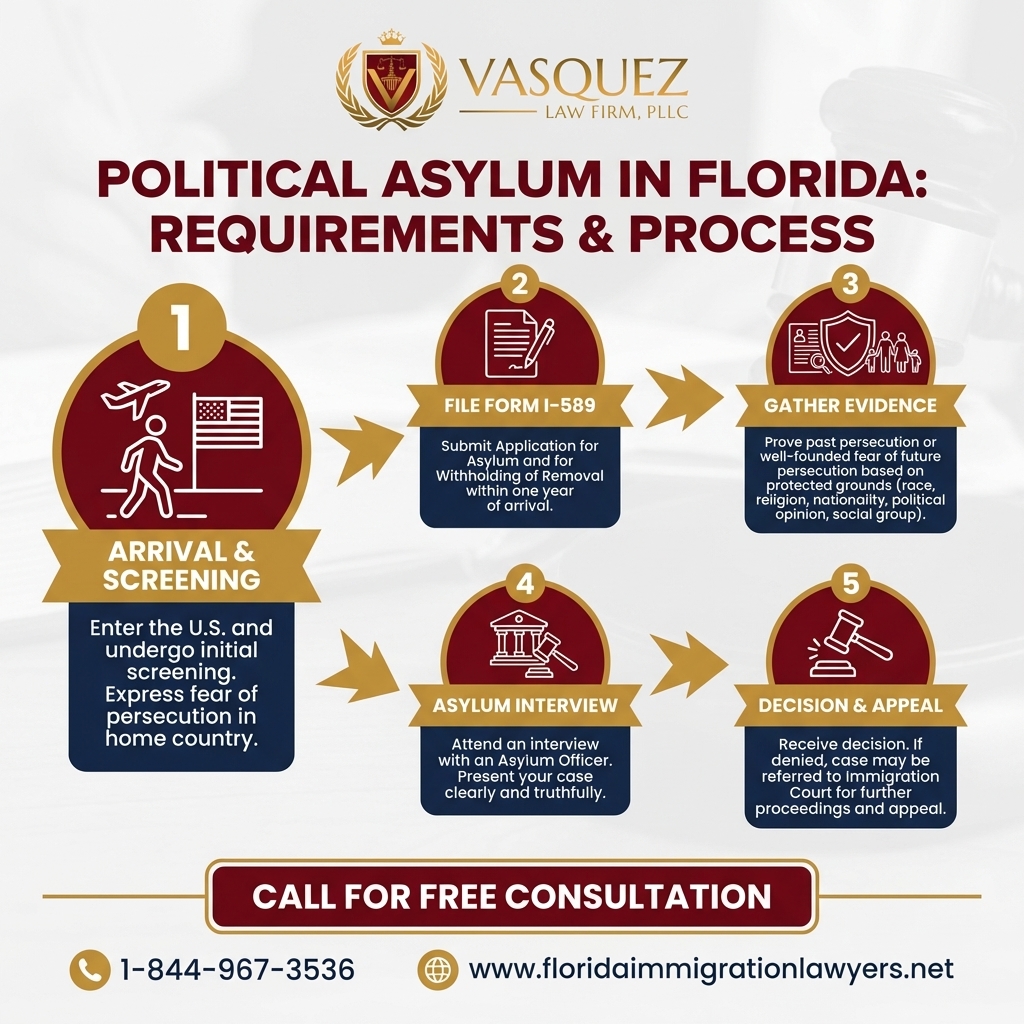
Following the interview, the Asylum Officer will make a decision. If your affirmative asylum application is approved, you will be granted asylum. If it is not approved, and you are not in lawful immigration status, your case may be referred to an Immigration Judge for removal proceedings, where you can pursue defensive asylum. If your defensive asylum application is denied by an Immigration Judge, you may have options to appeal the decision to the Board of Immigration Appeals (BIA) and potentially to federal courts. Navigating these appeals can be incredibly complex, highlighting the need for experienced legal representation.
While your asylum application is pending, you may be eligible to apply for work authorization (an Employment Authorization Document, or EAD) after 150 days from the date your asylum application was filed, provided your case has not been denied. This allows asylum seekers to legally work in the U.S. while awaiting a final decision on their case, providing crucial support and stability.
Navigating Challenges and Seeking Legal Expertise in Florida Asylum Cases
The path to political asylum is fraught with potential challenges that can derail even the most legitimate claims. One of the most common pitfalls is missing the one-year filing deadline without a valid exception. Another significant hurdle is insufficient or poorly presented evidence. Asylum officers and judges rely heavily on credible evidence to corroborate an applicant's testimony. Vague accounts, lack of supporting documents, or inconsistencies in the narrative can severely weaken a case. Furthermore, credibility issues, whether perceived or real, can lead to a denial. These might stem from minor discrepancies in dates or details, or more significant contradictions between testimony and application forms.
Florida presents its own unique set of challenges for asylum seekers. As a state with a large and diverse immigrant population, immigration courts here handle a high volume of cases. This can lead to longer processing times and a complex legal environment. Additionally, interpretations of asylum law can sometimes vary between different immigration judges, making it essential to have an attorney familiar with the local judicial landscape. The presence of numerous detention centers in Florida also means many asylum seekers are in custody, adding layers of complexity to their cases and often requiring expedited legal action.
Given these complexities, the role of an experienced immigration attorney cannot be overstated. An attorney specializing in asylum law will provide invaluable guidance throughout the entire process. This includes assisting with the meticulous preparation of Form I-589, ensuring all details are accurate and compelling. They will help you identify and gather crucial evidence, such as country conditions reports, expert affidavits, and personal statements, ensuring your case is as robust as possible. Moreover, an attorney will prepare you thoroughly for your asylum interview or court hearing, helping you anticipate questions and present your testimony clearly and consistently.
Beyond preparation, an attorney provides critical representation during the interview or in court. They can object to improper questions, present legal arguments, and ensure your rights are protected. In cases where asylum is denied, an attorney is essential for navigating the appeals process, whether to the Board of Immigration Appeals or federal courts. For individuals facing removal proceedings, an attorney specializing in deportation defense can explore all available avenues for relief, including defensive asylum, ensuring the best possible outcome. Seeking professional legal counsel is not merely an advantage; it is often a necessity for successfully navigating the intricate and high-stakes world of political asylum.
Don't hesitate to reach out for a consultation if you are considering applying for asylum or are already in the process. Our team is ready to assist you. You can contact us today to schedule your free consultation.
Life After Asylum: Rights and Responsibilities
Being granted political asylum in the United States is a monumental achievement, offering safety and a path to a new life. However, the journey doesn't end there. Asylum status provides a range of rights and responsibilities that recipients should understand.
One of the most significant benefits is the path to permanent residency. After one year of continuous physical presence in the U.S. as an asylee, you become eligible to apply for a Green Card (Lawful Permanent Resident status) using Form I-485, Application to Register Permanent Residence or Adjust Status. Obtaining a Green Card is a crucial step towards long-term stability and eventually, U.S. citizenship.
Asylees also have the right to apply for family reunification. You can petition for your spouse and unmarried children under 21 years of age to join you in the United States, even if they are currently outside the country. This process involves filing Form I-730, Refugee/Asylee Relative Petition, and requires careful documentation to prove the familial relationship.
While asylees have significant freedom, there are some travel considerations. If you need to travel outside the U.S., you must obtain a Refugee Travel Document (Form I-131, Application for Travel Document) before departing. Traveling without this document can lead to complications upon re-entry and may even result in the loss of your asylum status. It is generally not advisable to travel back to the country from which you sought asylum, as this could suggest you no longer fear persecution there.
Maintaining asylum status also comes with responsibilities. As an asylee, you are expected to abide by all U.S. laws. Your status can be terminated if it is found that you no longer have a well-founded fear of persecution, if you obtained asylum through fraud, or if you commit certain serious crimes. Understanding these responsibilities ensures that you can maintain your protected status and continue building your life in the United States.
Navigating the complex landscape of political asylum in Florida requires not only a deep understanding of the law but also meticulous preparation and often, unwavering legal support. From demonstrating a well-founded fear of persecution to successfully completing the application and interview processes, each step is critical. By understanding the requirements, preparing thoroughly, and seeking expert legal counsel, asylum seekers can significantly enhance their chances of securing the protection they desperately need. Remember, your safety and future are paramount, and professional guidance can make all the difference.
Do Not Navigate This Process Alone
Our experienced immigration attorneys are ready to fight for you. Get a free, confidential consultation today.
Se Habla Español
Frequently Asked Questions

William J. Vásquez
Founding Attorney · Vasquez Law Firm
U.S. Air Force veteran and immigration attorney with thousands of cases resolved. J.D., NCCU School of Law. AILA member. Admitted to the 4th, 5th, and 11th Circuit Courts.
Available 24/7 - Free Evaluations
Related Legal Services
Our Florida immigration attorneys can help you with deportation defense, citizenship and naturalization and family immigration services. Call today at 1-844-967-3536 for a free consultation.
Related Links
Related Topics
Free Legal Consultation
Discuss your case with our experienced attorneys. We're available 24/7.
Se Habla Español - Estamos aquí para ayudarle.
Related Articles
Immigration Lawyer Hialeah Florida: Your Trusted Legal Guide
For those in Hialeah, Florida, navigating the complexities of U.S. immigration law requires expert legal guidance. Our comprehensive guide explains why retaining an experienced immigration lawyer in Hialeah, Florida, is crucial for family-based petitions, employment visas, deportation defense, and naturalization. We cover essential services, common pitfalls, and offer a step-by-step overview of the immigration process, including timelines and cost factors. With a focus on Florida-specific challenges and local resources, this article empowers you with the knowledge to make informed decisions. Learn how Florida Immigration Lawyers can provide the dedicated support you need for a successful immigration journey.
TPS Florida Eligible Countries 2026 | FL Immigration Lawyers
Explore Temporary Protected Status (TPS) eligibility for Florida in 2026, focusing on countries facing turmoil and how to apply. Contact Florida Immigration Lawyers for personalized assistance.
Understanding the Asylum One-Year Deadline in Florida
The asylum one-year filing deadline is critical for those seeking refuge in the U.S. Understanding exceptions and preparing your application carefully can influence the outcome of your asylum case. Contact Florida Immigration Lawyers for expert guidance.
Citizenship Application Delay in Florida: What to Know
Facing citizenship application delays in Florida? Discover the key reasons behind N-400 processing backlogs in 2026 and learn how to navigate them effectively. Whether you're in Homestead or elsewhere in Florida, our guide provides actionable insights and tips to help manage your citizenship journey. Contact Florida Immigration Lawyers for personalized support.