"ina § 208(a)(2)" One-Year Filing Deadline in Florida
Discover the importance of the "ina § 208(a)(2)" one-year filing deadline for asylum seekers in Florida. Learn about exceptions, necessary documentation, and timelines. Call 1-844-YO-PELEO for a free consultation.
Introduction
Imagine fleeing your home country under threat, arriving in the U.S. seeking safety. For asylum seekers, understanding the "ina § 208(a)(2)" one-year filing deadline is crucial. Missing this deadline can result in denial of your asylum application, particularly impactful in immigrant-heavy areas like Hialeah, Florida. This article covers everything you need to know about filing for asylum on time, including exceptions and the process involved. Call Florida Immigration Lawyers at 1-844-YO-PELEO for a free consultation if you need assistance.
The journey to safety is often fraught with challenges, and navigating the U.S. immigration system can be one of the most daunting. For individuals seeking asylum, the stakes are incredibly high, as their very lives may depend on a successful application. This one-year deadline is not merely a bureaucratic hurdle; it's a critical component of the legal framework designed to process asylum claims efficiently while also preventing abuse of the system. Understanding its nuances is paramount for anyone hoping to build a new life free from persecution.
Florida, with its diverse population and significant immigrant communities, especially in bustling cities like Hialeah, sees a large number of asylum applications annually. The specific circumstances of filing in Florida, including local USCIS office procedures and the availability of legal aid, can influence an applicant's experience. Therefore, a comprehensive grasp of the deadline, its exceptions, and the detailed filing process is not just recommended, but absolutely essential for a positive outcome. Our goal here is to demystify this complex requirement and empower you with the knowledge needed to proceed confidently.
What is the One-Year Filing Deadline for Asylum?
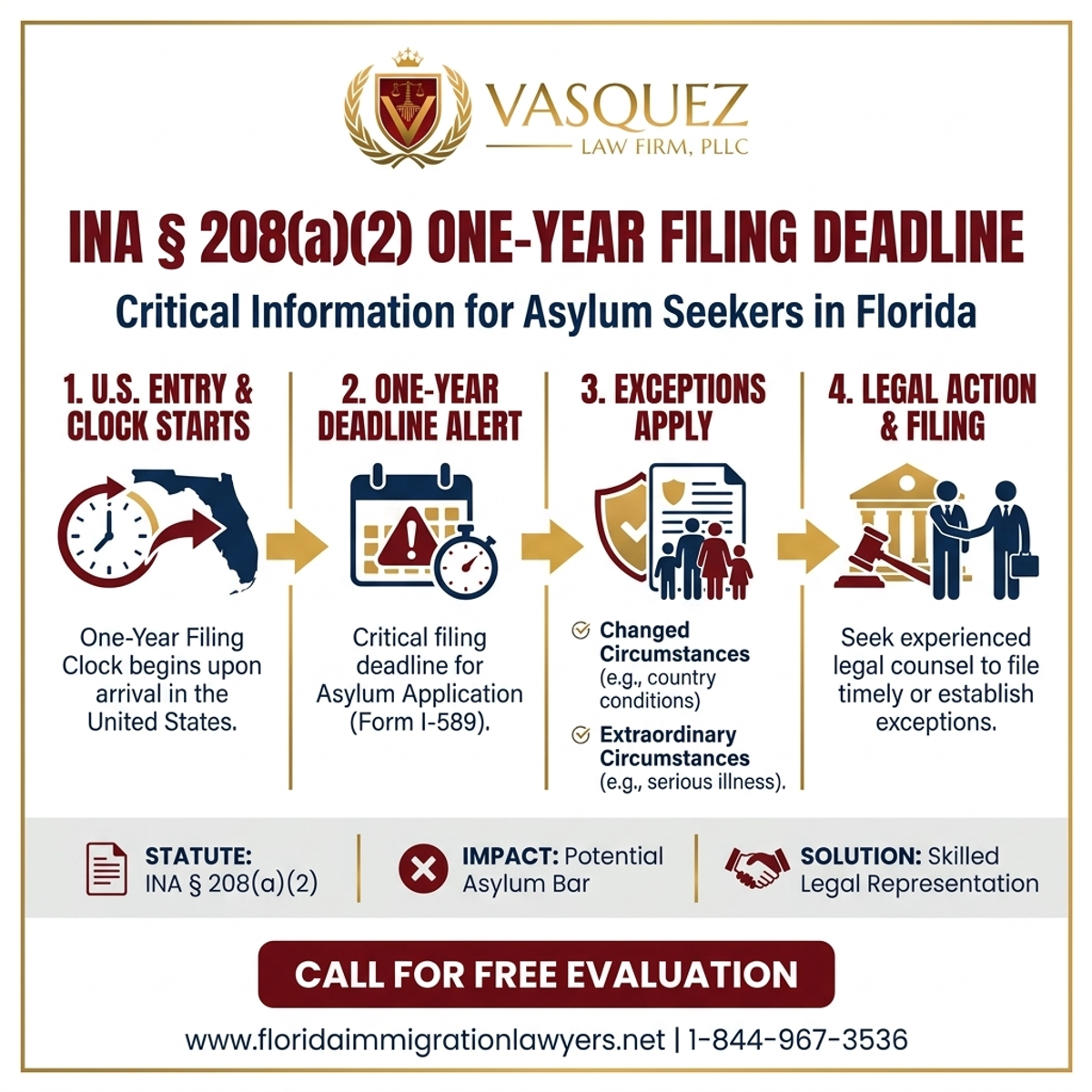
The "ina § 208(a)(2)" one-year filing deadline mandates that asylum seekers must file their application within one year of entering the U.S. Failure to comply generally results in denial unless an exception applies.
This rule is designed to encourage timely applications and ensure the integrity of the asylum system. However, exceptions exist for those who can demonstrate changed or extraordinary circumstances.
- The deadline begins the day you enter the U.S.
- Filing Form I-589 is required.
- Legal assistance is advised to navigate complex exceptions.
The Immigration and Nationality Act (INA) Section 208(a)(2) explicitly states that an asylum application "may not be maintained if the alien has not filed the application within 1 year after the date of the alien's arrival in the United States." This provision underscores the urgency with which asylum claims must be presented. The rationale behind this strict timeline is multifaceted: it helps prevent fraudulent claims, ensures that applicants genuinely fearing persecution come forward promptly, and allows immigration authorities to assess current country conditions more effectively.
It's crucial to understand that "entry into the U.S." can be interpreted in various ways, depending on whether you arrived at a port of entry, crossed a border without inspection, or adjusted status after an initial entry. The exact start date of your one-year clock is a critical detail that must be accurately determined. An experienced attorney from Florida Immigration Lawyers can help you pinpoint this date and assess any potential issues. Missing this calculation could inadvertently lead to a late filing, even if you believed you were within the timeframe.
The consequences of missing this deadline without a valid exception are severe. Generally, if an application is filed after the one-year mark and no exception applies, it will be summarily denied, and the applicant may be placed into removal proceedings. This puts immense pressure on individuals who may be unfamiliar with U.S. law, are dealing with trauma, or face language barriers. Therefore, understanding the precise requirements and proactively seeking legal counsel from firms like Florida Immigration Lawyers at 1-844-YO-PELEO is not just beneficial, but often indispensable for a successful asylum claim.
How Do Changed Circumstances Affect the One-Year Deadline?
Changed circumstances may allow you to file for asylum beyond the one-year deadline. These include significant changes in your home country or your personal circumstances.
Examples of changed circumstances can include:
- A new law or policy in your home country that affects your safety.
- Personal changes such as a conversion of religion.
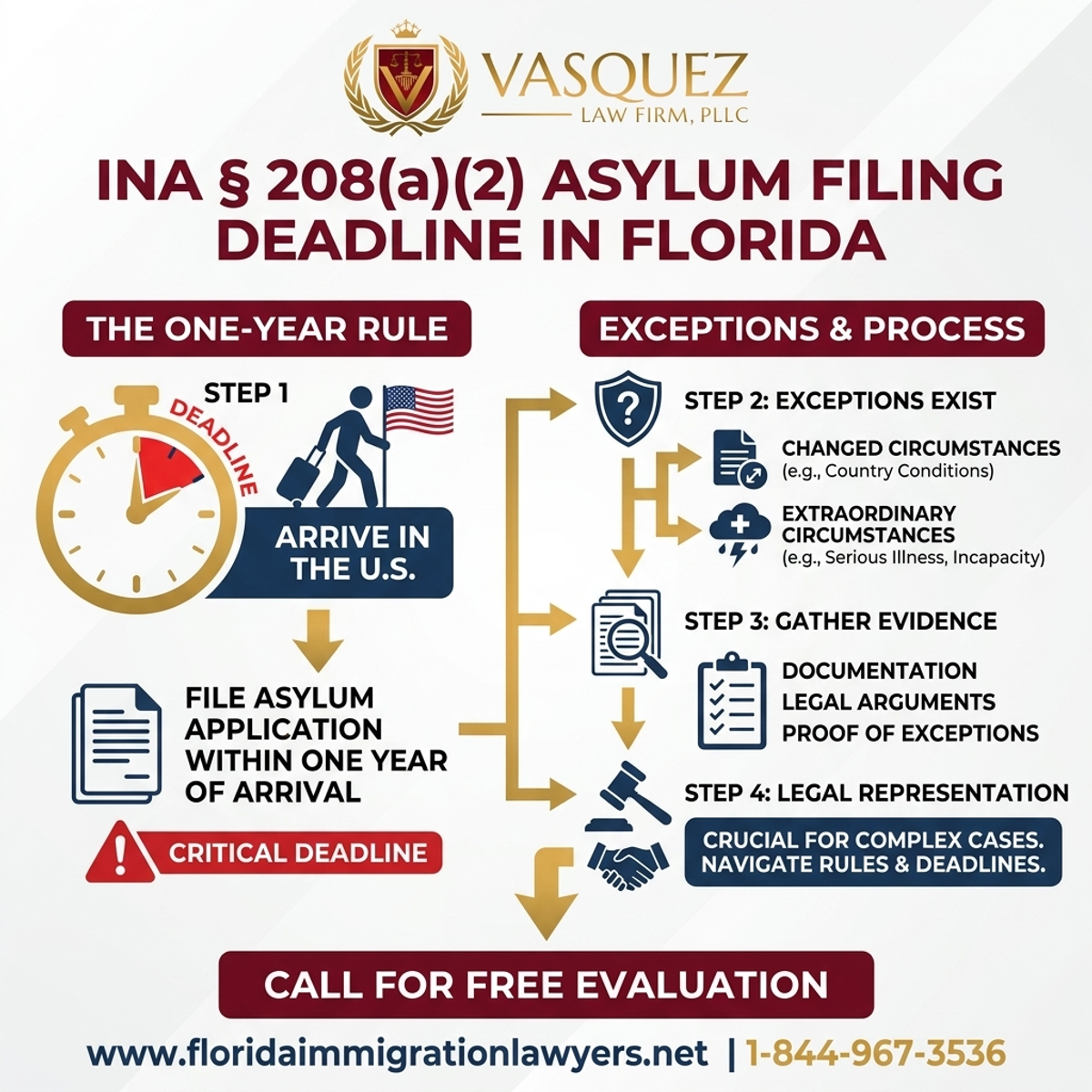
Step-by-Step Process — "ina § 208(a)(2)" One-Year Filing Deadline in Florida
Documenting these changes thoroughly is crucial. Consulting with an immigration attorney can provide clarity on your eligibility.
Beyond "changed circumstances," the law also recognizes "extraordinary circumstances" as a basis for an exception. Changed circumstances typically refer to events that make you eligible for asylum after the one-year deadline has passed, such as a coup d'état in your home country, the emergence of a new persecutory group, or a significant personal event like marriage to a U.S. citizen that impacts your eligibility or fear. Extraordinary circumstances, on the other hand, relate to events that prevented you from filing within the one-year period, such as severe illness, mental or physical disability, legal incompetence, or ineffective assistance of counsel in a prior immigration proceeding. Both categories require compelling evidence and a direct link to your inability to file on time.
To successfully claim an exception, you must not only demonstrate the existence of changed or extraordinary circumstances but also prove that you filed your application "within a reasonable period" given these circumstances. What constitutes a "reasonable period" is not explicitly defined and is often decided on a case-by-case basis by the asylum officer or immigration judge. This subjective nature makes legal representation even more vital. For instance, if a new persecutory law was enacted six months after your one-year deadline, filing your asylum application within a few months of that law taking effect would likely be considered reasonable. However, waiting another year without a compelling reason would probably not be.
Gathering robust evidence is paramount for any exception claim. For changed country conditions, this might include human rights reports, news articles, expert affidavits, and official government documents. For personal changed circumstances, you might need medical records, psychological evaluations, or affidavits from family members or religious leaders. Florida Immigration Lawyers have extensive experience in building strong cases for exceptions, ensuring that all necessary documentation is meticulously prepared and presented. Don't hesitate to reach out to us at 1-844-YO-PELEO for guidance on your specific situation.
Step-by-Step Guide to Filing for Asylum
- Enter the U.S. and note the date of entry.
- Prepare Form I-589, Application for Asylum and for Withholding of Removal.
- Gather supporting documents such as evidence of persecution.
- Submit your application to the appropriate USCIS office.
- Attend your biometric appointment and asylum interview.
- Receive a decision on your application.
Each step requires careful attention to detail. Missing documents or incorrect information can delay your case.
Let's elaborate on each crucial step to ensure a thorough understanding. Step 1: Enter the U.S. and note the date of entry. This initial step is foundational. Whether you entered legally with a visa, arrived at a port of entry seeking asylum, or crossed the border without inspection, documenting your exact date of entry is critical. This date marks the beginning of your one-year clock. Keep any travel documents, entry stamps, or other records that can corroborate this date, as it will be a key piece of information on your Form I-589.
Step 2: Prepare Form I-589, Application for Asylum and for Withholding of Removal. This is the core document of your asylum application. It's a comprehensive form requiring detailed personal information, a narrative of your persecution or fear of persecution, and information about your family and travel history. Every question must be answered truthfully and completely. Any inconsistencies or omissions can raise red flags with immigration authorities. The narrative section is particularly important, as it's your primary opportunity to tell your story in your own words, explaining why you fear returning to your home country. This narrative should be coherent, detailed, and consistent with any supporting evidence.
Step 3: Gather supporting documents such as evidence of persecution. This step is where you build the factual foundation of your claim. Evidence can include a wide range of materials: police reports, medical records documenting injuries from persecution, human rights reports from reputable organizations (like Amnesty International or Human Rights Watch), news articles about country conditions or your specific case, affidavits from witnesses to your persecution, and proof of your identity and nationality. The stronger and more credible your evidence, the better your chances of success. It's not enough to simply state you were persecuted; you must demonstrate it with verifiable facts and documents. If documents are not in English, certified translations are mandatory.
Step 4: Submit your application to the appropriate USCIS office. Once Form I-589 and all supporting documents are meticulously prepared, they must be filed with the correct USCIS Service Center. The specific filing location depends on your residential address. It is crucial to send the application via certified mail with a return receipt requested, or through a delivery service that provides tracking, to have proof of timely filing. This proof is invaluable if there are any disputes about the filing date. A copy of the entire application package should always be kept for your records.
Step 5: Attend your biometric appointment and asylum interview. After filing, you will receive a notice for a biometrics appointment, where your fingerprints, photograph, and signature will be taken for background checks. Following this, you will be scheduled for an asylum interview with a USCIS Asylum Officer. This interview is a critical stage where you will be asked to explain your claim in detail, answer questions about your narrative, and provide further clarification on your evidence. It is highly recommended to have legal representation present at this interview. An attorney from Florida Immigration Lawyers can prepare you thoroughly for the types of questions you might face and can intervene to clarify misunderstandings during the interview itself.
Step 6: Receive a decision on your application. After the interview, the asylum officer will review your case and make a recommendation. If your case is approved, you will be granted asylum. If it is denied, and you are not in removal proceedings, you may have the option to renew your application before an immigration judge. If you are already in removal proceedings, the asylum officer's decision is not final, and your case will be referred to an immigration judge for a de novo review. Understanding the potential outcomes and subsequent steps is vital, and Florida Immigration Lawyers can guide you through each possibility, ensuring you are prepared for whatever comes next.
Documents Needed for Asylum Application
- Completed Form I-589.
- Evidence of identity (passport, birth certificate).
- Proof of persecution or fear of persecution.
- Supporting affidavits from witnesses or experts.
Having a checklist ensures you don't overlook critical documents, enhancing the chances of a favorable outcome.
Beyond the basic list, understanding the type and quality of documents is essential. For Form I-589, ensure every section is filled out accurately and completely. Attach additional sheets if needed for the narrative, clearly labeling them with your name and A-number. Any question left blank without a valid reason can lead to a Request for Evidence (RFE) or even a denial. For evidence of identity, a valid passport is ideal, but if unavailable, a national ID card, birth certificate, or even school records can be used, often supplemented by affidavits explaining why primary documents are missing. Consistency across all identity documents is crucial.
Types of Evidence for Persecution
The "proof of persecution or fear of persecution" category is broad and requires meticulous compilation. This can include: Official documents such as police reports, court records, arrest warrants, or government decrees that target your particular group. Medical or psychological evaluations from licensed professionals can attest to physical injuries or mental trauma sustained due to persecution. Personal statements and affidavits from yourself, family members, or witnesses who can corroborate your story are powerful. These should be detailed, consistent, and signed under penalty of perjury.
Furthermore, country condition reports from organizations like the U.S. Department of State, Amnesty International, Human Rights Watch, or UNHCR are invaluable. These reports provide objective evidence of human rights abuses, political instability, or persecution against specific groups in your home country, lending credibility to your personal narrative. News articles, academic papers, and expert testimonies can also bolster your claim by demonstrating a pattern of persecution relevant to your case. Remember, all documents not in English must be accompanied by a certified English translation, including a statement from the translator attesting to their fluency and the accuracy of the translation. Florida Immigration Lawyers are adept at helping clients identify, gather, and organize this complex array of documentation.
Key Statistics — "ina § 208(a)(2)" One-Year Filing Deadline in Florida
Expected Timeline and Processing for Asylum
| Stage | Typical Timeframe | Notes |
|---|---|---|
| Application Filing | Immediate upon entry | Within one year |
| Biometrics Appointment | 2-3 weeks | After filing |
| Interview Scheduling | 1-2 months | Varies by location |
| Decision | 2-4 weeks | Post-interview |
Delays can occur, but understanding the typical timeline helps manage expectations and prepare accordingly.
While the table provides a general overview, it's essential to understand that asylum processing times can vary significantly based on several factors. The volume of applications at a particular USCIS Asylum Office, changes in immigration policy, and the complexity of individual cases all play a role. For instance, in high-volume offices like those serving Florida, interview scheduling can sometimes extend beyond the typical 1-2 months, potentially stretching to several months or even over a year, especially
Sources and References
- U.S. Citizenship and Immigration Services (USCIS)
- Executive Office for Immigration Review (EOIR)
- U.S. Department of State - Bureau of Consular Affairs
- Immigration and Nationality Act (INA), 8 U.S.C. Chapter 12
Do Not Navigate This Process Alone
Our experienced immigration attorneys are ready to fight for you. Get a free, confidential case review today.
Se Habla Español
Or leave your details and we’ll call you:
Free Evaluation in 24 Hours
Or talk to us right now

AI voice assistant — available 24/7
FreeFrequently Asked Questions

William J. Vásquez
Founding Attorney · Vasquez Law Firm
U.S. Air Force veteran and immigration attorney with years of hands-on U.S. immigration experience. J.D., NCCU School of Law. AILA member. Admitted to the 4th, 5th, and 11th Circuit Courts.
Available 24/7 - Free Evaluations
Reviewed for legal accuracy by William J. Vásquez
Licensed in North Carolina; U.S. immigration is federal practice.
Related Legal Services
Our Florida immigration attorneys can help you with immigration practice areas, free immigration consultation and business immigration. Call today at 1-844-YO-PELEO for a free case review.
Related Links
Related Topics
Free Legal Case Review
Discuss your case with our experienced attorneys. We're available 24/7.
Se Habla Español - Estamos aquí para ayudarle.
Related Articles
Immigration Lawyer Orlando Free Consultation in Florida
For individuals and families in Orlando, Florida, navigating the complexities of U.S. immigration law requires expert guidance. An immigration lawyer in Orlando offers crucial support for everything from visa applications and green card processes to naturalization and deportation defense. This comprehensive guide details what a free consultation covers, providing a step-by-step overview of immigration pathways, essential document checklists, and expected timelines in 2026. We also highlight common mistakes to avoid, discuss the critical role of legal counsel in deportation and asylum cases, and explain why choosing a local Orlando immigration attorney is beneficial. Florida Immigration Lawyers is dedicated to serving the diverse community of Orlando with compassionate, effective legal solutions, ensuring you receive personalized advice and robust representation for a successful immigration journey.
EAD Advance Parole Combo Card in Florida 2026
For individuals with a pending Form I-485, Application to Register Permanent Residence or Adjust Status, the EAD Advance Parole Combo Card is an essential document. This single card combines the authorization to work legally in the U.S. (Employment Authorization Document - EAD) with permission to travel internationally and re-enter without abandoning your green card application (Advance Parole). This guide from Florida Immigration Lawyers provides a comprehensive overview for applicants in Florida in 2026, covering eligibility, the step-by-step application process, required documents, expected processing times, and associated costs. We also highlight common mistakes to avoid and when to seek legal counsel to ensure a smooth and successful immigration journey. Understanding this vital card is key to maintaining stability while awaiting your permanent residency approval.
Employment Immigration Attorney in Florida: What You Need
Explore the complexities of employment immigration in Florida, including visa categories, required documents, and common pitfalls. Learn how an immigration attorney can assist you in navigating the legal landscape.
VAWA Immigration Relief for Abused Spouses in Florida
Discover how the Violence Against Women Act (VAWA) provides crucial immigration relief for abused spouses in Florida. Learn about eligibility, the application process, and how Florida Immigration Lawyers can assist you.