K-3 Visa Timeline in Florida: What to Expect in 2026
The K-3 visa offers a pathway for spouses of U.S. citizens to enter the United States while their immigrant visa petition is pending. This comprehensive guide, updated for 2026, details the K-3 visa timeline, eligibility requirements, and the step-by-step application process for Florida residents. We cover essential documentation, associated costs, and critical considerations for navigating the K-3 journey, including Florida-specific insights regarding USCIS field offices. Understanding the intricacies of Form I-129F, National Visa Center processing, consular interviews, and the subsequent Adjustment of Status is vital. Learn how to avoid common mistakes and when to seek professional legal assistance to ensure a smooth and successful outcome. Florida Immigration Lawyers provides expert guidance for families across the state.
The K-3 visa, designed for spouses of U.S. citizens awaiting immigrant visa processing, typically involves several stages, including filing Form I-129F with USCIS, National Visa Center (NVC) processing, and a consular interview. As of 2026, the overall timeline can range from 12 to 24 months or more, depending on individual case complexity, USCIS caseloads, and the efficiency of the U.S. embassy or consulate abroad. While less common than direct immigrant visas (CR1/IR1), it offers a path for foreign spouses to enter the U.S. sooner. Navigating this process, especially in Florida, requires meticulous attention to detail and understanding of current regulations.
- K-3 visa is for spouses of U.S. citizens, allowing earlier entry.
- Process involves USCIS Form I-129F, NVC, and consular stages.
- Overall timeline can be 12-24+ months as of 2026.
- Requires subsequent Adjustment of Status after U.S. entry.
- Expert legal guidance is crucial for Florida applicants.
Embarking on the journey to bring your foreign spouse to the United States can be one of life's most significant and rewarding endeavors. For many U.S. citizens living in Florida, the dream of uniting with their loved one often involves navigating complex immigration pathways. One such path is the K-3 nonimmigrant visa, specifically designed for spouses of U.S. citizens who are waiting for their immigrant visa (CR1 or IR1) to be processed abroad. While the K-3 visa has become less common over the years due to improved processing times for direct immigrant visas, it still serves as a vital option for some families facing specific circumstances or seeking to minimize separation during the lengthy immigration process.
Understanding the K-3 visa timeline in Florida is critical for managing expectations and planning your future together. This comprehensive guide, updated for 2026, will demystify the K-3 visa process, outlining eligibility, application steps, required documentation, and associated costs. We will also delve into common challenges and offer Florida-specific insights to help you and your spouse navigate this intricate journey. The goal is to provide clarity and empower you with the knowledge needed to pursue your K-3 visa successfully. If you find yourself overwhelmed or have unique aspects to your case, remember that expert legal assistance is invaluable. Call Florida Immigration Lawyers at 1-844-967-3536 for a free case review and let our experienced team guide you every step of the way.
What is a K-3 Visa and Who is Eligible in Florida?
The K-3 nonimmigrant visa allows a foreign spouse of a U.S. citizen to enter the United States while their immigrant visa petition (Form I-130) is still pending with U.S. Citizenship and Immigration Services (USCIS). Its primary purpose is to shorten the period of separation for married couples. Eligibility for a K-3 visa requires the petitioner to be a U.S. citizen, a legally valid marriage to the foreign national, and an already filed Form I-130, Petition for Alien Relative, for the foreign spouse. Additionally, a Form I-129F, Petition for Alien Fiancé(e), must be filed and approved specifically for the K-3 visa.
The K-3 visa was introduced by the Legal Immigration Family Equity (LIFE) Act in 2000 to address significant backlogs in spousal immigrant visa processing, which often led to years of separation for couples. While processing times for the CR1/IR1 immigrant visas have improved, making the K-3 less frequently utilized, it remains a statutory option under USCIS guidelines. Specifically, INA 101(a)(15)(K)(iii) (8 U.S.C. § 1101(a)(15)(K)(iii)) defines the K-3 nonimmigrant category. For Florida residents, this means that if you are a U.S. citizen married to a foreign national living abroad, and you have already filed Form I-130 on their behalf, you may consider filing for a K-3 visa. This option is particularly appealing if you anticipate a prolonged wait for your I-130 petition to be approved or if there are specific family needs requiring your spouse's presence in the U.S. sooner. The K-3 visa is a temporary, nonimmigrant visa, meaning the foreign spouse will need to adjust their status to a lawful permanent resident (green card holder) after entering the U.S. This subsequent step involves filing Form I-485, Application to Register Permanent Residence or Adjust Status. Our attorneys at Florida Immigration Lawyers frequently assist clients in Orlando and throughout Central Florida with understanding the nuances of these intertwined processes, ensuring that every step is taken correctly to avoid delays.
How Do I Apply for a K-3 Visa in 2026? A Step-by-Step Guide for Florida Residents.
Applying for a K-3 visa involves a multi-stage process that begins in the United States with USCIS and concludes with consular processing abroad. As of 2026, the general steps remain consistent, though specific filing procedures or required documentation may see minor updates. It is essential to follow each step meticulously to ensure a smooth application. For Florida residents, understanding the sequence and requirements is paramount.
The K-3 visa application process, while similar to other family-based petitions, has unique requirements due to its nonimmigrant nature preceding an immigrant visa. Here is a detailed step-by-step guide:
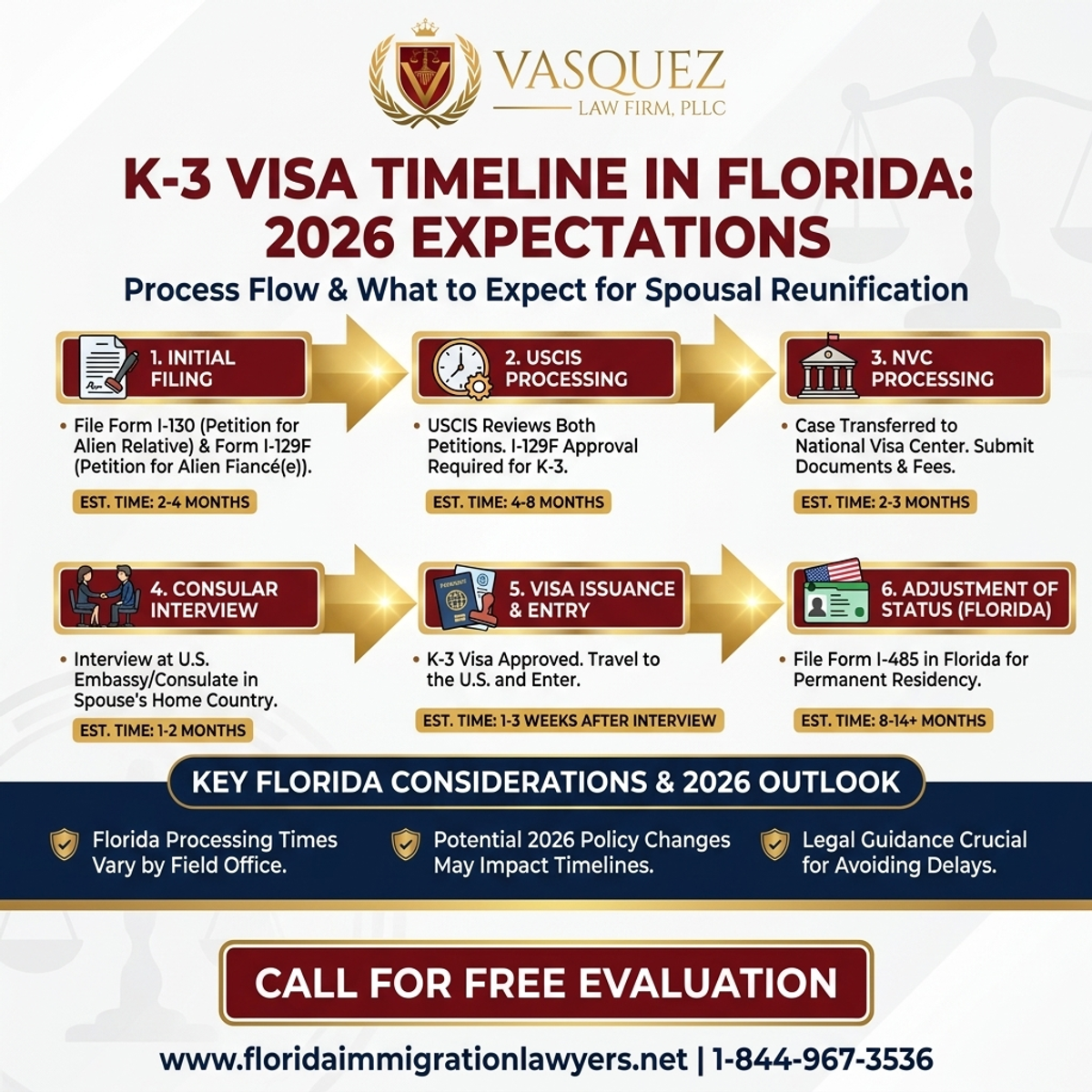
- File Form I-130, Petition for Alien Relative: The U.S. citizen petitioner must first file Form I-130 with USCIS on behalf of their foreign spouse. This petition establishes the validity of the marriage and the relationship. The I-130 is the foundational petition for all family-based immigrant visas, including the CR1/IR1 and eventually the K-3's adjustment of status. USCIS will issue a Form I-797C, Notice of Action (NOA1), acknowledging receipt.
- File Form I-129F, Petition for Alien Fiancé(e): After filing the I-130, and *before* it is approved, the U.S. citizen must file Form I-129F, Petition for Alien Fiancé(e). Although the form's title refers to fiancés, it is also used for K-3 spouses. This form specifically requests the K-3 nonimmigrant visa for the spouse. It is crucial to indicate clearly on the form that it is for a K-3 spouse and not a K-1 fiancé. USCIS will then issue an NOA1 for the I-129F. This form is filed with the USCIS Dallas Lockbox for K visas.
- USCIS Processing of Form I-129F: USCIS reviews the I-129F petition. If approved, USCIS sends an I-797, Notice of Action (NOA2), notifying the petitioner of the approval. This approval is forwarded to the National Visa Center (NVC). If the I-130 is approved *before* the I-129F, the K-3 path may be less beneficial, as the NVC will generally prioritize the immigrant visa process.
- National Visa Center (NVC) Processing: Once the I-129F is approved and sent to the NVC, the NVC will forward the petition to the U.S. embassy or consulate in the foreign spouse's country of residence. Unlike direct immigrant visas, the NVC's role for K-3 visas is primarily administrative forwarding. The NVC will send instructions to the foreign spouse regarding the next steps, including paying the visa fee and completing the online nonimmigrant visa application, Form DS-160.
- Consular Interview: The foreign spouse will attend an interview at the designated U.S. embassy or consulate. During this interview, a consular officer will verify the authenticity of the marriage and the eligibility for the K-3 visa. The spouse must bring all required supporting documents, including the completed DS-160 confirmation page, medical examination results, and police certificates. The officer will assess the applicant's intent to adjust status in the U.S.
- Visa Issuance and Entry into the U.S.: If the interview is successful, the K-3 visa will be stamped in the foreign spouse's passport. The spouse can then travel to the United States. Upon entry, they are admitted as a K-3 nonimmigrant.
- Adjustment of Status (AOS): Once in the U.S., the K-3 visa holder must file Form I-485, Application to Register Permanent Residence or Adjust Status, to become a lawful permanent resident. This step is crucial because the K-3 visa is temporary; it does not grant permanent residency. The I-485 application will include an interview at a local USCIS field office, such as the one in Orlando for Central Florida residents, or Miami for South Florida residents, where the foreign spouse's eligibility for a green card will be thoroughly reviewed.
What Documents Are Required for a K-3 Visa Application?
A successful K-3 visa application hinges on submitting a complete and accurate set of documents to both USCIS and the U.S. embassy or consulate. Missing or incorrect documentation is a leading cause of delays and Requests for Evidence (RFEs). As of 2026, applicants should prepare for a comprehensive document collection process. It is advisable to gather all necessary paperwork well in advance and ensure that all foreign language documents are accompanied by certified English translations.
For individuals in Florida sponsoring their spouse, organizing these documents can be daunting. Our legal team emphasizes meticulous preparation to prevent common pitfalls. Here is a general checklist of documents typically required for the K-3 visa process:
- For the U.S. Citizen Petitioner:
- Proof of U.S. Citizenship (e.g., U.S. birth certificate, passport, Certificate of Naturalization).
- Copy of Form I-130, Petition for Alien Relative, receipt notice (I-797C).
- Completed and signed Form I-129F, Petition for Alien Fiancé(e).
- Proof of a legally valid marriage (e.g., marriage certificate). If married in Florida, ensure you have an official certificate from the Clerk of Courts.
- Two passport-style photos.
- Proof of termination of any prior marriages for both petitioner and beneficiary (e.g., divorce decrees, death certificates).
- Evidence of bona fide marriage (e.g., joint bank accounts, property deeds, lease agreements, photos together, affidavits from friends/family).
- Form I-864, Affidavit of Support (submitted during the Adjustment of Status phase, but financial capacity is assessed throughout).
- For the Foreign Spouse (Beneficiary):
- Valid passport (valid for at least six months beyond the intended period of stay in the U.S.).
- Completed online Nonimmigrant Visa Application, Form DS-160, confirmation page.
- Two passport-style photos meeting U.S. visa requirements.
- Original birth certificate.
- Original marriage certificate.
- Police certificates from all countries where the spouse lived for specified periods after age 16.
- Medical examination results from an authorized panel physician. This must be completed before the consular interview.
- Proof of termination of any prior marriages (e.g., divorce decrees, death certificates).
- Evidence of bona fide marriage (same as petitioner's list).
- Court and prison records (if applicable).
- Military records (if applicable).
Step-by-Step Process — K-3 Visa Timeline in Florida: What to Expect in 2026
It is crucial to remember that this list is general. Specific consulates or individual case circumstances may require additional documents. Always refer to the instructions provided by the NVC and the U.S. embassy or consulate where the interview will take place. Keeping copies of all submitted documents is also a best practice.
What is the K-3 Visa Processing Timeline and What Are the Costs in 2026?
The K-3 visa processing timeline can vary significantly based on several factors, including the volume of applications, the specific USCIS service center handling the I-129F petition, and the U.S. embassy or consulate abroad. As of 2026, while the K-3 visa was designed to expedite family reunification, its timeline can still involve substantial waiting periods. It's important to note that the K-3 process often runs concurrently with the I-130 immigrant visa petition, and sometimes the I-130 processes faster, making the K-3 less advantageous. Costs also fluctuate, so always verify current fees directly with USCIS and the Department of State.
Understanding these timelines and costs is essential for financial and life planning. Our Orlando-based immigration attorneys regularly monitor these changes to provide the most current advice to our Florida clients. Here’s a general overview of what to expect:
K-3 Visa Processing Timeline and Expectations (as of 2026)
| Stage | Typical Timeframe (2026) | Notes |
|---|---|---|
| Form I-130 Filing to Approval | 10-18 months | This petition must be filed first. Approval times can vary significantly by service center. |
| Form I-129F Filing to Approval | 8-15 months | Filed after I-130. USCIS processing times for I-129F (K-3) can be found on the USCIS website. If I-130 is approved first, K-3 may be bypassed. |
| NVC Processing (after I-129F approval) | 1-3 months | Administrative forwarding to the consulate. NVC will collect fees and documents for the DS-160. |
| Consular Interview Scheduling | 2-6 months | Depends heavily on the specific U.S. embassy or consulate's backlog and efficiency. Medical exam must be completed prior. |
| Visa Issuance | 1-2 weeks after interview | Assuming successful interview and no administrative processing. |
| Adjustment of Status (after U.S. entry) | 12-24+ months | Filing I-485, I-765 (work permit), I-131 (travel permit). Includes biometrics, potential RFE, and interview at a local USCIS office (e.g., Orlando Field Office). |
The overall process from I-130 filing to K-3 visa issuance and then adjustment of status can easily span 2 to 4 years. It’s crucial to understand that these are estimates, and individual cases may be faster or slower. Factors like RFEs, administrative processing, or security checks can add significant delays.
K-3 Visa Cost Factors and Fee Breakdown (Approximate, as of 2026)
Immigration fees are subject to change. Always consult the official USCIS fee schedule and the Department of State's consular fees page for the most current information. The following are typical costs associated with the K-3 visa and subsequent Adjustment of Status:
| Item | Typical Fee (2026) | Notes |
|---|---|---|
| Form I-130 Filing Fee | $535 | Required to establish the spousal relationship. |
| Form I-129F Filing Fee | $535 | Petition for K-3 visa. |
| Form DS-160 (Nonimmigrant Visa Application) | $205 | Paid to the Department of State for consular processing. |
| Medical Examination Fee | $200-$500 | Varies by country and clinic; paid directly to the authorized panel physician. |
| Police Certificates & Document Translation | Varies | Costs depend on the number of documents and countries involved. |
| Form I-485 (Adjustment of Status) | $1,225 | Includes biometrics fee. This is the final step to get the green card. |
| Attorney Fees | Varies widely | Highly recommended for navigating complex immigration law; provides peace of mind and reduces errors. |
These costs can quickly add up, making financial planning a crucial aspect of the K-3 visa process. Beyond these official fees, applicants should also budget for travel expenses, potential overnight stays for interviews, and any unforeseen costs.
Navigating K-3 Visa Challenges: Florida-Specific Considerations.
While the K-3 visa process is federal, specific considerations and resources in Florida can impact an applicant's journey. From local USCIS field offices to the diverse demographics of the state, understanding the Florida context can be beneficial. Florida is home to a vast immigrant population, making it a hub for various immigration services and legal support.
For those residing in Orlando or elsewhere in Central Florida, the local USCIS Field Office in Orlando handles interviews for Adjustment of Status applications. This means that after your spouse enters the U.S. on a K-3 visa, their green card interview will likely take place locally. Familiarity with the procedures and expectations of this specific office can be advantageous. Similarly, the USCIS Miami Field Office serves South Florida, and the Tampa Field Office serves the greater Tampa Bay area. Each office may have slightly different scheduling patterns or local nuances in their interview processes. Our firm, Florida Immigration Lawyers, is strategically located in Orlando and serves clients across the entire state, offering localized expertise for these critical steps.
Florida's diverse population, with significant communities from Latin America, the Caribbean, and other regions, means that many K-3 applicants will be coming from countries with U.S. consulates that process a high volume of visas. This can sometimes lead to longer wait times for consular appointments or, conversely, highly efficient processing if the consulate is well-resourced. Additionally, recent news contexts, such as the focus on immigrant registration and expanded crackdowns on people entering legally, as noted by organizations like the ILRC and The Haitian Times, highlight an evolving immigration landscape. While these may not directly impact K-3 eligibility, they underscore the importance of staying informed and having expert legal counsel who can adapt to policy changes. For example, ensuring all documents are impeccably prepared and that the bona fides of the marriage are overwhelmingly clear is more critical than ever.
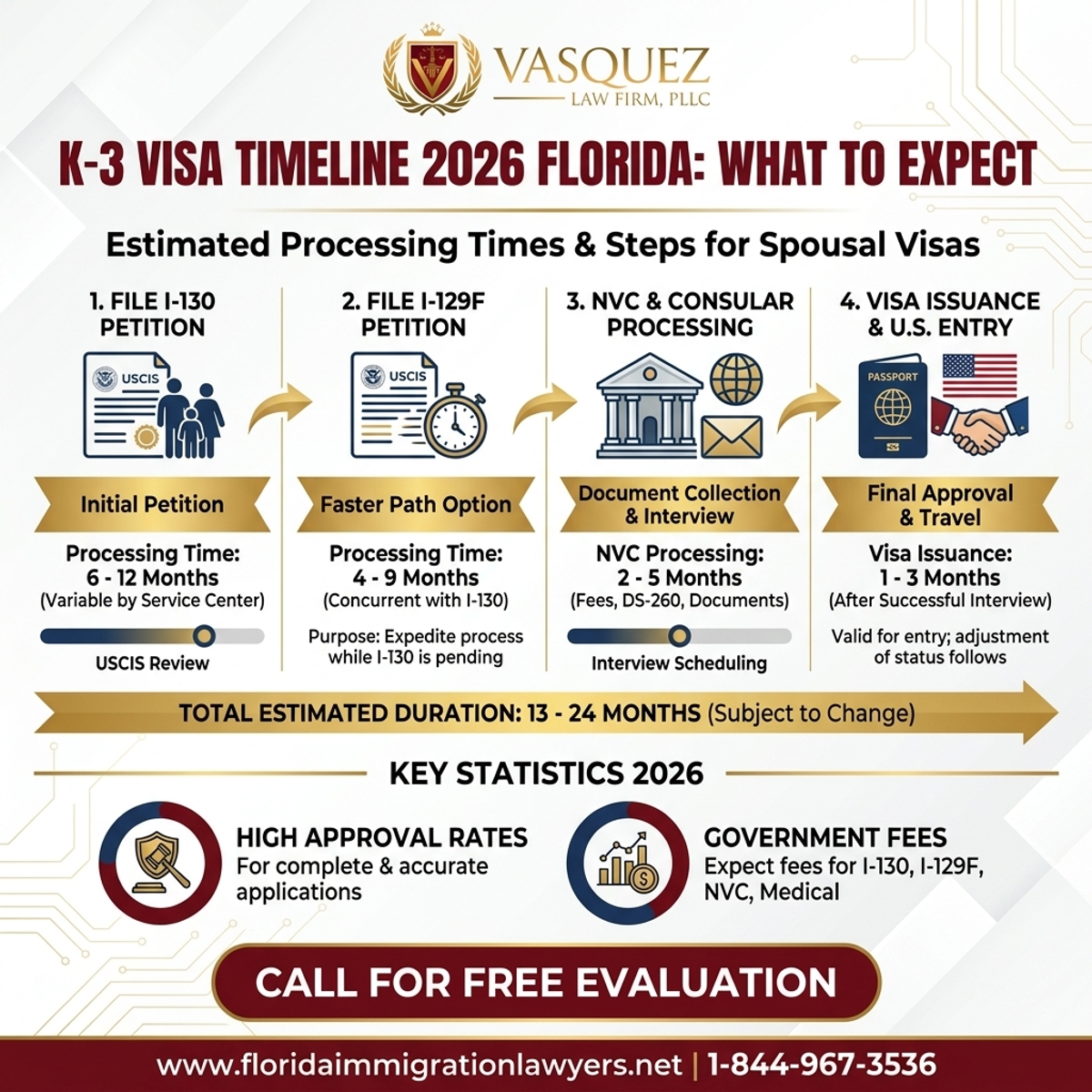
Key Statistics — K-3 Visa Timeline in Florida: What to Expect in 2026
Moreover, the K-3 visa's requirement for a subsequent Adjustment of Status means navigating the U.S. legal system once your spouse is in Florida. This includes obtaining work authorization (EAD) and travel authorization (Advance Parole) while the I-485 is pending. An experienced family immigration attorney can help ensure these applications are filed correctly and on time, minimizing any disruptions to your spouse's ability to live and work in Florida. Understanding the specific requirements of the Orlando USCIS field office for AOS interviews, including preferred evidence of shared life and marriage, can significantly enhance the chances of a smooth approval. This local knowledge is invaluable and often overlooked by applicants attempting to navigate the process alone.
Do not navigate this process alone. The complexities of the K-3 visa, coupled with the ever-changing immigration landscape, demand professional guidance. Contact Florida Immigration Lawyers today for comprehensive support tailored to your unique situation.
Common Mistakes to Avoid in the K-3 Visa Process
The K-3 visa process is fraught with potential pitfalls that can lead to significant delays, RFEs, or even denials. Avoiding these common mistakes is crucial for a smooth and successful application. Our experienced immigration attorneys in Florida have identified key areas where applicants often stumble.
- Filing Form I-129F Before Form I-130: The I-130 petition must be filed first to establish the spousal relationship. Filing the I-129F prematurely will result in rejection. Always ensure the I-130 receipt notice is obtained before proceeding with the K-3 petition.
- Incomplete or Incorrect Forms: Even minor errors or omissions on forms like I-130, I-129F, or DS-160 can trigger RFEs, substantially prolonging the process. Double-check every field, ensure all questions are answered, and sign where required.
- Insufficient Evidence of Bona Fide Marriage: USCIS and consular officers scrutinize the authenticity of marriages to prevent fraud. Failing to provide ample evidence of a genuine relationship (joint accounts, shared leases, photos, communication records) can lead to intense questioning or denial.
- Not Disclosing All Prior Marriages: Both the petitioner and beneficiary must fully disclose all previous marriages and provide proof of their legal termination (divorce decrees, death certificates). Omission can be considered misrepresentation and lead to severe consequences.
- Missing Deadlines or Ignoring RFEs: Immigration processes are time-sensitive. Failing to respond to an RFE by the specified deadline, or missing a scheduled interview, can result in the abandonment or denial of your petition.
- Failure to Update Addresses: If either the U.S. citizen petitioner or the foreign spouse changes their address, USCIS must be notified promptly using Form AR-11. Failure to do so can result in missed notices and critical communications.
- Inadequate Financial Support (I-864): The U.S. citizen petitioner must demonstrate the financial capacity to support their spouse. If income is insufficient, a joint sponsor may be needed. Failure to meet the poverty guidelines can lead to an I-485 denial.
- Not Undergoing a Medical Exam with an Approved Physician: The medical examination for the K-3 visa must be conducted by a physician authorized by the U.S. embassy or consulate. Exams from unauthorized doctors will not be accepted.
- Lack of Professional Legal Guidance: Attempting to navigate the complexities of immigration law without an attorney often leads to avoidable mistakes. An experienced lawyer can foresee issues, ensure compliance, and represent your interests effectively.
When to Call a Lawyer for Your K-3 Visa in Florida
While some applicants consider handling the K-3 visa process independently, the intricacies of immigration law, coupled with the potential for costly delays or denials, make professional legal counsel highly advisable. For residents in Orlando and across Florida, knowing when to engage an immigration attorney can be the difference between a smooth journey and a frustrating ordeal.
You should strongly consider calling Florida Immigration Lawyers if any of the following scenarios apply to your situation:
- Complex Marital History: If either spouse has been previously married multiple times, has unusual divorce circumstances, or questions about the legal validity of a prior divorce, legal expertise is crucial to ensure proper documentation and disclosure.
- Criminal History or Immigration Violations: Any criminal convictions, arrests, or past immigration violations (e.g., overstays, illegal entries, prior deportations) for either spouse can significantly complicate the case and may lead to inadmissibility. An attorney can assess waivers or defense strategies.
- Previous Visa Denials: If your spouse has had previous U.S. visa applications denied, understanding the reasons for denial and addressing them effectively is paramount.
- Financial Sponsorship Issues: If the U.S. citizen petitioner does not meet the income requirements for Form I-864, Affidavit of Support, or if there are complexities with joint sponsors, a lawyer can guide you through the financial documentation.
- Receipt of a Request for Evidence (RFE) or Notice of Intent to Deny (NOID): These notices indicate that USCIS or the consulate has concerns about your application. Responding adequately requires legal expertise to address the specific issues raised.
- Unusual Circumstances or Delays: If your case is experiencing unexplained delays, or if there are any unique family situations, an attorney can intervene, inquire, and advocate on your behalf.
- Concerns About the Interview Process: Preparing for the consular interview and subsequent Adjustment of Status interview can be stressful. A lawyer can provide mock interviews and advise on how to present your case effectively.
Florida Immigration Lawyers offers a free case review to help you understand your options and assess the complexity of your K-3 visa application. We are committed to providing empathetic, expert guidance throughout the entire process.
About Florida Immigration Lawyers
Florida Immigration Lawyers is a leading law firm dedicated to providing comprehensive and compassionate immigration legal services to individuals and families throughout Florida. Located in Orlando, our firm understands the unique challenges and opportunities that arise when navigating the complex U.S. immigration system. Our team of experienced attorneys is committed to upholding the highest standards of legal representation, offering personalized strategies tailored to each client's specific needs.
We specialize in a wide array of immigration matters, including family-based petitions, K-visas, adjustment of status, naturalization, deportation defense, and asylum cases. Our deep understanding of federal immigration laws and regulations, combined with our local insights into Florida's immigration landscape, positions us as a trusted advocate for our clients. We pride ourselves on clear communication, meticulous preparation, and unwavering dedication to achieving the best possible outcomes. Available 24/7, we offer free case reviews to help you understand your legal options without financial commitment. No matter where you are in Florida, our firm is here to provide the expert legal support you deserve. Schedule a free consultation today.
Sources and References
- U.S. Citizenship and Immigration Services (USCIS)
- U.S. Department of State
- Executive Office for Immigration Review (EOIR)
- Immigration and Nationality Act (INA) Section 101(a)(15)(K)(iii) (8 U.S.C. § 1101(a)(15)(K)(iii))
- 8 CFR Part 214.2(k) - K Nonimmigrants
- USCIS Policy Manual
Related services: family petition process, family-based green cards, fiancé visa (K-1), marriage-based immigration.
This article provides general legal information and is not intended as legal advice. Every case is unique, and outcomes depend on specific facts and circumstances. Contact an attorney for advice about your particular situation.
The K-3 visa process can be a challenging but ultimately rewarding path to family reunification. With the right information and experienced legal support, you can navigate each stage with confidence. Don't let the complexities of immigration law prevent you from being with your loved one. Contact Florida Immigration Lawyers today at 1-844-967-3536 for a free case review. Se Habla Español - Estamos aqui para ayudarle.
Do Not Navigate This Process Alone
Our experienced immigration attorneys are ready to fight for you. Get a free, confidential case review today.
Se Habla Español
Or leave your details and we’ll call you:
Free Evaluation in 24 Hours
Or talk to us right now
AI voice assistant — available 24/7
FreeFrequently Asked Questions

William J. Vásquez
Founding Attorney · Vasquez Law Firm
U.S. Air Force veteran and immigration attorney with years of hands-on U.S. immigration experience. J.D., NCCU School of Law. AILA member. Admitted to the 4th, 5th, and 11th Circuit Courts.
Available 24/7 - Free Evaluations
Reviewed for legal accuracy by William J. Vásquez
Licensed in North Carolina; U.S. immigration is federal practice.
Related Legal Services
Our Florida immigration attorneys can help you with business immigration, deportation defense and family immigration services. Call today at 1-844-967-3536 for a free case review.
Related Links
Related Topics
Free Legal Case Review
Discuss your case with our experienced attorneys. We're available 24/7.
Se Habla Español - Estamos aquí para ayudarle.
Related Articles
Immigration Lawyer Orlando Free Consultation in Florida
For individuals and families in Orlando, Florida, navigating the complexities of U.S. immigration law requires expert guidance. An immigration lawyer in Orlando offers crucial support for everything from visa applications and green card processes to naturalization and deportation defense. This comprehensive guide details what a free consultation covers, providing a step-by-step overview of immigration pathways, essential document checklists, and expected timelines in 2026. We also highlight common mistakes to avoid, discuss the critical role of legal counsel in deportation and asylum cases, and explain why choosing a local Orlando immigration attorney is beneficial. Florida Immigration Lawyers is dedicated to serving the diverse community of Orlando with compassionate, effective legal solutions, ensuring you receive personalized advice and robust representation for a successful immigration journey.
Biometrics Appointment in Florida 2026: Your USCIS Guide
For many individuals seeking to live, work, or gain permanent residency in Florida, the biometrics appointment is a critical and often misunderstood step. This comprehensive guide, tailored for applicants in Florida, will walk you through everything you need to know about your USCIS biometrics appointment in 2026. Learn its purpose, how to prepare, what to expect at an Application Support Center (ASC), and how long processing typically takes. We also cover common mistakes to avoid and when it's crucial to seek legal counsel from experienced immigration attorneys. Understanding these details is vital for a smooth process, preventing delays, and ensuring your immigration application progresses successfully. Florida Immigration Lawyers are available to provide expert guidance and support.
212(c) Waiver Legacy Relief in Florida 2026 Guide
For long-term lawful permanent residents in Florida, the 212(c) waiver offers crucial legacy relief against deportation, particularly for those whose proceedings began before April 1, 1997. This guide delves into the historical context, strict eligibility criteria, and the detailed application process for this complex discretionary waiver. Learn about the required documentation, potential timelines, and associated costs. We emphasize the vital importance of understanding the precise cutoff dates and demonstrating strong positive equities to an Immigration Judge. In an evolving immigration landscape, this legacy relief remains a powerful defense for eligible individuals seeking to protect their lives and families in the U.S. Discover common pitfalls to avoid and when expert legal counsel is indispensable for navigating Florida's immigration courts.
Immigration Services in Treasure Coast Florida 2026
For residents of Florida's Treasure Coast, navigating immigration services can be a complex and often overwhelming process. This comprehensive guide, updated for 2026, provides essential information on various immigration pathways, including family-based visas, employment opportunities, green card applications, and crucial deportation defense. Learn about the step-by-step application process, necessary documentation, typical timelines, and associated costs. Discover common pitfalls to avoid and understand when expert legal counsel is indispensable. Florida Immigration Lawyers serves individuals and families across Martin, St. Lucie, and Indian River Counties, offering personalized and compassionate legal support for all immigration matters. We are dedicated to helping you achieve your immigration goals and build a secure future in the United States. Contact us for a free case review.