212(c) Waiver Legacy Relief Florida: Your Deportation Defense
The 212(c) waiver offers crucial legacy relief for certain lawful permanent residents in Florida facing deportation due to criminal convictions that occurred before April 1, 1996. This complex area of immigration law requires a deep understanding of historical statutes and court precedents, such as the landmark <em>INS v. St. Cyr</em> decision. Eligibility hinges on strict criteria, including the conviction date, lawful permanent residency status, and years of domicile in the U.S. Successfully navigating the application process and presenting a compelling case before an Immigration Judge demands legal counsel. Florida Immigration Lawyers focuses on these intricate deportation defense strategies, guiding clients through document collection, discretionary factors, and court appearances. If you're in Kissimmee or anywhere in Florida, contact us for a free consultation to assess your eligibility for this vital defense.
The 212(c) waiver, or Section 212(c) of the Immigration and Nationality Act (INA), offers a specific form of legacy relief for certain lawful permanent residents who faced deportation or removal proceedings based on criminal convictions. This relief is generally available to individuals who pleaded guilty or were found guilty at trial before April 1, 1996, and meet strict residency requirements. Navigating the complex eligibility criteria and the historical nuances of this waiver is critical. Many individuals in Florida, including those in Kissimmee and the wider Central Florida area, may still be eligible for this crucial defense. Professional legal guidance is essential to determine if you qualify and to effectively present your case.
- 212(c) waiver is a legacy relief for pre-April 1, 1996 convictions.
- Requires specific lawful permanent residency and physical presence.
- Primarily used in deportation or removal proceedings for certain criminal grounds.
- Eligibility is highly complex and depends on conviction dates and plea agreements.
- Experienced legal counsel from Florida Immigration Lawyers is vital for success.
212(c) Waiver Legacy Relief Florida: Your Deportation Defense Guide
Facing deportation can be one of the most frightening experiences for an immigrant and their family. The fear of being separated from loved ones and a life built in the United States is profound. For many lawful permanent residents in Florida, especially those with past criminal convictions, understanding every available defense option is not just important, it is absolutely critical. One such defense, though often misunderstood due to its historical nature, is the 212(c) waiver, a vital form of legacy relief that continues to offer hope to eligible individuals.
The 212(c) waiver, rooted in Section 212(c) of the Immigration and Nationality Act (INA), predates significant changes in immigration law. It provides a unique opportunity for certain immigrants to avoid deportation or removal, even when facing serious charges. This relief is particularly relevant for those whose convictions occurred before April 1, 1996, a pivotal date in immigration law history. If you or a loved one in Kissimmee, Orlando, or anywhere in Florida is facing removal proceedings and has a qualifying conviction, exploring this legacy waiver could be your strongest defense.
At Florida Immigration Lawyers, we focus on complex deportation defense strategies, including the intricate requirements of the 212(c) waiver. We understand the nuances of these legacy laws and how they apply to modern immigration cases. Our dedicated team is committed to protecting your right to remain in the U.S. Do not navigate this challenging legal landscape alone. Call Florida Immigration Lawyers at 1-844-YO-PELEO for a free consultation to discuss your options and determine if you are eligible for this crucial relief.
Understanding the 212(c) Waiver: A Historical Perspective on Legacy Relief
The 212(c) waiver, formally known as Section 212(c) of the Immigration and Nationality Act (INA), stands as a testament to evolving immigration policies. Before its repeal by the Illegal Immigration Reform and Immigrant Responsibility Act (IIRIRA) on April 1, 1996, Section 212(c) allowed eligible lawful permanent residents (LPRs) to seek a waiver of certain grounds of deportability and inadmissibility. This discretionary relief was a lifeline for many immigrants facing removal due to criminal convictions, particularly those who had established deep roots in the United States.
While the law was repealed, its impact wasn't entirely erased. Through various legal challenges and court decisions, most notably INS v. St. Cyr, the Supreme Court affirmed that the repeal of Section 212(c) could not be retroactively applied to certain individuals. This means that LPRs who pleaded guilty or were found guilty at trial before April 1, 1996, and who would have been eligible for 212(c) relief under the law existing at the time of their plea or conviction, may still be able to apply for this legacy waiver. This critical distinction is what makes the 212(c) waiver a unique and powerful tool in specific deportation defense cases in Florida today.
For residents of Kissimmee and other Florida communities, understanding this historical context is vital. The 212(c) waiver is not a general form of relief; it is a highly specific remedy with a narrow application window. It applies to individuals who, at the time of their conviction, were LPRs and had resided in the U.S. for at least seven consecutive years. The grounds of deportability for which it could be sought were also limited. Our attorneys at Florida Immigration Lawyers possess the deep knowledge required to analyze your specific situation against these historical legal precedents, ensuring that no potential avenue for relief is overlooked.
Eligibility Criteria for 212(c) Waiver in Florida Deportation Cases
Determining eligibility for a 212(c) waiver is a complex process that demands a meticulous review of an individual's immigration and criminal history. This legacy relief is not broadly available; rather, it is reserved for a very specific subset of lawful permanent residents. The cornerstone of eligibility revolves around the date of the criminal conviction and the nature of the plea. Generally, you may be eligible if you are a lawful permanent resident who pleaded guilty or were found guilty at trial for a deportable offense before April 1, 1996, the effective date of IIRIRA.
Beyond the critical date, other stringent requirements must be met. You must have been lawfully domiciled in the United States for at least seven consecutive years at the time the deportation proceedings commenced. This means you were an LPR for at least seven years without any breaks in your lawful residency. Additionally, the conviction itself must be for an offense that, at the time of the conviction, made you deportable but not inadmissible under certain aggravated felony provisions that were later expanded by IIRIRA. The type of crime matters significantly, as certain severe aggravated felonies always barred 212(c) relief.
It is crucial to note that individuals who have served five years or more in prison for an aggravated felony are typically barred from 212(c) relief, even if their conviction predates April 1, 1996. However, the definition of an aggravated felony has also changed over time. An experienced Florida immigration attorney understands how these evolving definitions intersect with the specific date of your conviction and plea agreement. For those in Kissimmee or elsewhere in Florida facing removal, a thorough evaluation of your criminal record, including plea agreements and sentencing documents, is paramount to ascertain if you meet the precise criteria for this vital legacy waiver. We can help you gather and analyze these critical documents.
Step-by-Step Guide to Applying for 212(c) Waiver Relief
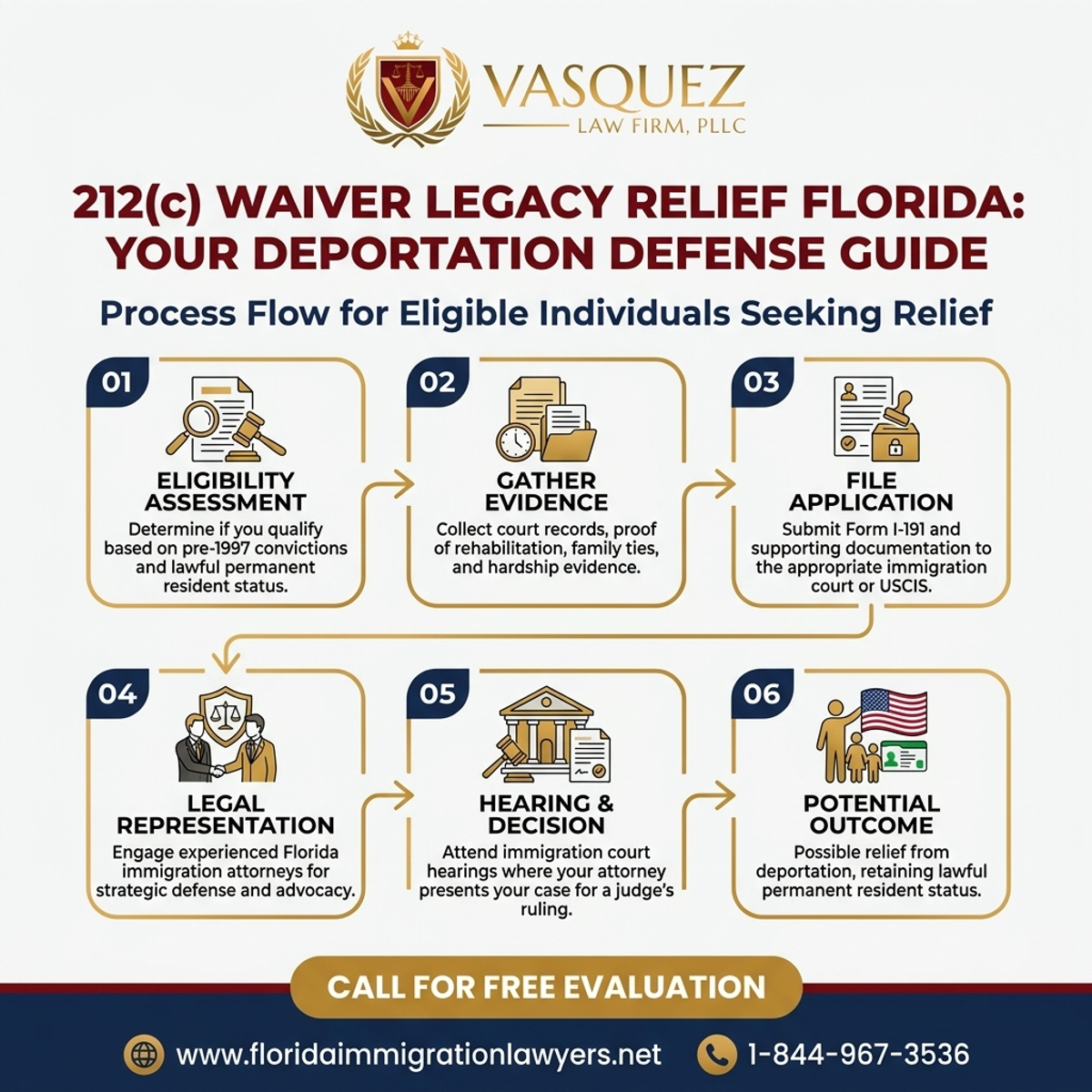
Applying for a 212(c) waiver is not a straightforward administrative process; it is typically pursued within the context of removal proceedings before an Immigration Judge at the Executive Office for Immigration Review (EOIR). This means you must already be placed in deportation or removal proceedings to seek this relief. The process is highly adversarial and requires robust legal representation. Here is a general outline of the steps involved, though each case will have unique considerations:
-
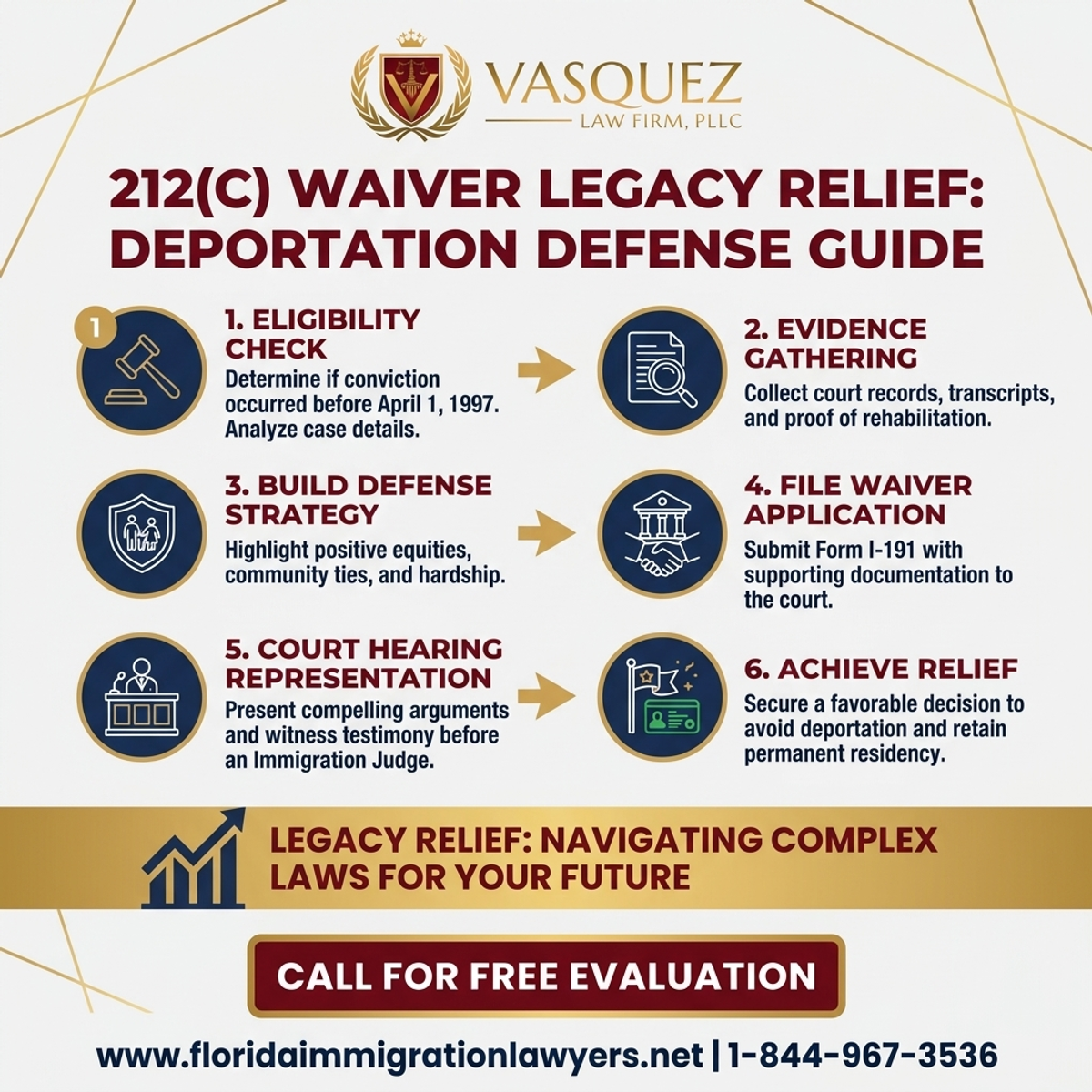
Initial Consultation and Eligibility Assessment: Your first step is to consult with an experienced immigration attorney, such as those at Florida Immigration Lawyers. We will meticulously review your entire immigration and criminal history, including conviction dates, plea agreements, and length of lawful permanent residency, to determine if you meet the specific legacy eligibility criteria for the 212(c) waiver. This includes assessing the nature of your conviction against the laws in effect at the time.
-
Filing Form I-191, Application for Discretionary Relief: If deemed eligible, your attorney will prepare and file Form I-191, Application for Discretionary Relief Under Section 212(c) of the Immigration and Nationality Act, with the Immigration Court. This form formally requests the waiver. All supporting documentation, including criminal records and evidence of rehabilitation, must be carefully compiled and submitted with the application.
-
Gathering Supporting Evidence for Discretionary Factors: Beyond legal eligibility, the Immigration Judge must grant the waiver as a matter of discretion. This involves a balancing test, weighing positive factors against negative factors. Your attorney will help you gather compelling evidence of your rehabilitation, strong family ties in the U.S., community contributions, employment history, and any hardship your removal would cause to your U.S. citizen or LPR family members. Evidence of genuine remorse and efforts to reform are crucial.
-
Preparation for Immigration Court Hearings: You will attend several master calendar hearings and eventually an individual hearing before an Immigration Judge. Your attorney will prepare you thoroughly for testimony, helping you understand the questions you may face from the judge and the government attorney. During the individual hearing, your attorney will present your case, submit evidence, call witnesses, and cross-examine government witnesses.
Step-by-Step Process — 212(c) Waiver Legacy Relief Florida: Your Deportation Defense Guide
-
Immigration Judge's Decision and Potential Appeals: After the hearing, the Immigration Judge will issue a decision. If the waiver is granted, your deportation case will be terminated, allowing you to retain your lawful permanent resident status. If denied, your attorney can discuss the possibility of appealing the decision to the Board of Immigration Appeals (BIA) and potentially to a federal circuit court. The process can be lengthy and challenging, requiring persistence and legal advocacy.
For more information on the Executive Office for Immigration Review and immigration court procedures, you can visit the official EOIR website.
Do not navigate this complex process alone. Contact Florida Immigration Lawyers today to explore your options and build a strong defense.
Essential Document Checklist for a 212(c) Waiver Application
A successful 212(c) waiver application hinges on presenting a comprehensive and well-organized package of documents. Given the discretionary nature of this relief, every piece of evidence plays a crucial role in demonstrating your eligibility and your worthiness for a favorable decision. Missing or incomplete documentation can significantly delay your case or even lead to a denial. Here is a general checklist of documents you will likely need, though your specific case may require additional items:
- Form I-191, Application for Discretionary Relief: The official application form, meticulously filled out and signed.
- Proof of Lawful Permanent Resident Status: Copies of your green card (Form I-551), passport, and any other immigration documents proving your LPR status and the date you became an LPR.
- Proof of Seven Years Lawful Domicile: Documents demonstrating continuous lawful presence in the U.S. for at least seven years prior to the initiation of removal proceedings. This can include tax returns, employment records, school records, utility bills, rental agreements, and bank statements.
- Certified Criminal Records: Official court dispositions for ALL convictions, including the plea agreement, sentencing orders, and any probation or parole documents. This is paramount for proving the conviction date and the nature of the offense.
- Evidence of Rehabilitation: Certificates of completion for drug or alcohol counseling, anger management courses, vocational training, educational degrees, and letters from employers attesting to your good character and work ethic.
- Character Reference Letters: Letters from family, friends, community leaders, and employers attesting to your good moral character, community involvement, and positive contributions since your conviction.
- Proof of Family Ties in the U.S.: Birth certificates, marriage certificates, and other documents for U.S. citizen or LPR spouses, children, and parents.
- Evidence of Hardship: Documents illustrating the extreme hardship your U.S. citizen or LPR family members would face if you were deported. This can include medical records, financial statements, and psychological evaluations detailing the impact of your absence.
- Tax Returns: Copies of federal and state tax returns for the past several years, demonstrating consistent employment and tax compliance.
- Personal Statement: A detailed, heartfelt statement from you explaining the circumstances of your conviction, your remorse, your rehabilitation efforts, and your desire to remain in the U.S. with your family.
Gathering these documents can be time-consuming and challenging. Our team at Florida Immigration Lawyers will guide you through this process, ensuring all necessary evidence is collected and presented effectively to the Immigration Court. We understand the local requirements of Florida immigration courts, including those serving Kissimmee residents.
Timeline and Processing Expectations for 212(c) Waiver Cases
The timeline for a 212(c) waiver case is often lengthy and highly variable, primarily because it is adjudicated within the context of ongoing removal proceedings. Unlike standard USCIS applications with predictable processing times, immigration court cases depend on court dockets, judicial availability, and the complexity of the specific legal arguments. For individuals in Florida, particularly those whose cases are heard at the Orlando Immigration Court, the wait times can extend for several months, or even years, from the initial filing to a final decision.
Typically, after your initial master calendar hearing, where you formally request the 212(c) waiver, the Immigration Judge will set a schedule for filing your I-191 application and supporting documents. This usually involves a deadline for your application and a later date for an individual merits hearing. The individual hearing, where evidence is presented and testimony is given, is often scheduled many months after the application is filed due to the crowded dockets of immigration courts nationwide. The Executive Office for Immigration Review (EOIR) manages these dockets, and their caseload directly impacts processing times.
Key Statistics — 212(c) Waiver Legacy Relief Florida: Your Deportation Defense Guide
Factors influencing the timeline include the specific Immigration Judge assigned to your case, the complexity of your criminal history, the volume of evidence to be reviewed, and whether the Department of Homeland Security (DHS) attorney contests your eligibility or discretion. Appeals to the Board of Immigration Appeals (BIA) can add another year or more to the process. While the wait can be frustrating, it is crucial to remain patient and continue to cooperate fully with your legal team. Our Kissimmee-area immigration attorneys will keep you informed at every stage, providing realistic expectations and proactive management of your case to ensure a strong and timely presentation.
Cost Factors and Fee Breakdown for 212(c) Waiver Applications
Pursuing a 212(c) waiver involves several cost factors, primarily legal fees for representation and government filing fees. Understanding these expenses upfront is important for planning and managing your case effectively. While we cannot provide exact filing fee amounts as they are subject to change by USCIS, we can outline the typical components of the overall cost.
The main government fee associated with the 212(c) waiver is the filing fee for Form I-191, Application for Discretionary Relief Under Section 212(c) of the Immigration and Nationality Act. This fee is paid directly to USCIS. There may also be fees for obtaining certified copies of criminal records, medical examinations if required, and other supporting documentation. These are typically third-party costs that you would incur directly.
The most significant cost component will generally be attorney fees. The complexity and historical nature of 212(c) waiver cases require specialized expertise. Lawyers charge for their time and knowledge in preparing the application, gathering evidence, representing you in multiple immigration court hearings, negotiating with DHS counsel, and potentially handling appeals. Fees can vary based on the attorney's experience, the complexity of your case, and the anticipated time commitment. Many firms, including Florida Immigration Lawyers, offer payment plans to help manage these costs.
It is vital to consider the cost of not hiring an experienced attorney. A poorly prepared 212(c) waiver application or ineffective representation in court can lead to denial, resulting in deportation and the loss of your life in the U.S. Investing in skilled legal counsel significantly increases your chances of a favorable outcome. We believe in transparency and will provide a clear breakdown of legal fees during your free consultation, ensuring you understand all financial aspects of your case. For current USCIS fees, always refer to the official USCIS website.
Common Mistakes to Avoid in 212(c) Waiver Cases
Navigating the intricacies of a 212(c) waiver is fraught with potential pitfalls. Even minor errors can have severe consequences, jeopardizing your chances of remaining in the United States. Avoiding these common mistakes is crucial for a successful outcome in your deportation defense case in Florida.
- Assuming Ineligibility Without Legal Review: Many individuals mistakenly believe they are ineligible due to the waiver's repeal. Without a thorough review by an experienced attorney, you might miss a valid claim based on your conviction date.
- Failing to Prove Seven Years of Lawful Domicile: This is a strict statutory requirement. Inadequate documentation proving continuous lawful permanent residency for seven years prior to removal proceedings will lead to denial.
- Not Obtaining Certified Criminal Dispositions: Relying on arrest records or incomplete court documents is a critical error. You must provide certified final dispositions for all convictions, including plea agreements, to accurately establish eligibility.
- Ignoring Discretionary Factors: Even if statutorily eligible, the waiver is discretionary. Failing to present compelling positive equities like family ties, rehabilitation, and community contributions can lead to a denial by the Immigration Judge.
- Misunderstanding the April 1, 1996, Cut-Off Date: This date applies specifically to the plea or conviction date, not the date of the crime or when removal proceedings began. Misinterpreting this can lead to an incorrect assessment of eligibility.
- Lack of Evidence of Rehabilitation: Merely stating you've changed is insufficient. Concrete evidence of counseling, educational achievements, stable employment, and positive community engagement is vital to demonstrate genuine rehabilitation.
- Failing to Disclose All Criminal History: Attempting to hide or omit any part of your criminal record, however minor, will severely damage your credibility and can result in immediate denial and potentially other negative immigration consequences.
- Not Preparing for Court Testimony: Testifying before an Immigration Judge is stressful. Lack of preparation can lead to inconsistent statements or an inability to articulate your case effectively, weakening your discretionary appeal.
- Filing the Application Incorrectly or Incompletely: Form I-191 must be filled out accurately and completely, with all required supporting documents attached. Errors or omissions can cause delays or outright rejection.
- Attempting to Self-Represent: The 212(c) waiver is one of the most complex areas of immigration law. Representing yourself without an attorney's expertise significantly reduces your chances of success and often leads to missed legal arguments.
- Missing Deadlines: Immigration court operates on strict deadlines. Missing a filing deadline for your application or supporting documents can result in forfeiture of your right to apply for the waiver.
- Not Addressing All Grounds of Deportability: A 212(c) waiver only waives specific grounds. If you are deportable on multiple grounds, you must ensure the waiver addresses all relevant ones, or seek other forms of relief concurrently.
When to Call a Florida Immigration Lawyer for 212(c) Waiver Assistance
Given the highly complex and nuanced nature of the 212(c) waiver, knowing when to seek legal counsel is paramount. If you are a lawful permanent resident in Florida, particularly in areas like Kissimmee, Orlando, or Tampa, and you are facing deportation or removal proceedings due to a criminal conviction, you should contact an immigration lawyer immediately. This is especially true if your conviction, or the plea leading to it, occurred before April 1, 1996.
You should call Florida Immigration Lawyers if any of the following scenarios apply to you:
- You have received a Notice to Appear (NTA) in Immigration Court, initiating removal proceedings.
- You have a criminal conviction, even an old one, and are concerned about its impact on your immigration status.
- You were a lawful permanent resident at the time of your conviction, which occurred before April 1, 1996.
- You have resided in the U.S. as an LPR for at least seven consecutive years.
- You are unsure if your specific criminal conviction makes you eligible for any form of waiver or relief.
- You have previously been denied other forms of immigration relief and need to explore every possible avenue.
- You need assistance gathering certified criminal records and extensive documentation for your case.
- You require strong advocacy and representation before an Immigration Judge.
Our firm focuses on deportation defense and understands the intricate laws surrounding the 212(c) waiver. We will provide a thorough assessment of your case, identify potential strategies, and guide you through every step of the legal process. Do not delay in seeking legal advice; early intervention can significantly impact the outcome of your case. Our experienced attorneys are here to help protect your future in Florida.
About Florida Immigration Lawyers
Florida Immigration Lawyers is an immigration law firm dedicated to serving individuals and families across the entire state of Florida. With a deep commitment to justice and client success, we provide comprehensive legal services in all areas of immigration law. Our experienced attorneys understand the profound impact immigration matters have on our clients' lives, and we approach each case with empathy, diligence, and unwavering advocacy. From our base, we proudly assist clients in Kissimmee, Orlando, Miami, Tampa, and all other Florida communities.
We focus on complex immigration challenges, including deportation defense, asylum, citizenship applications, family-based immigration, and business immigration. Our firm is particularly adept at navigating intricate legacy relief options like the 212(c) waiver, leveraging our extensive knowledge of historical and current immigration statutes. We are available 24/7 to address urgent concerns and offer free, no-obligation consultations to help you understand your legal options. When you choose Florida Immigration Lawyers, you gain a dedicated partner committed to achieving the strongest possible outcome for your immigration journey. Your future in Florida is our priority.
Sources and References
- U.S. Citizenship and Immigration Services (USCIS)
- Executive Office for Immigration Review (EOIR)
- 8 U.S.C. § 1182(c) - Immigration and Nationality Act, Section 212(c) (Repealed, but applicable to certain legacy cases)
- Illegal Immigration Reform and Immigrant Responsibility Act of 1996 (IIRIRA)
- INS v. St. Cyr, 533 U.S. 289 (2001) - Supreme Court decision affirming retroactivity for certain 212(c) cases
- 8 Code of Federal Regulations (CFR) Part 212
Related services: asylum and refugee protection, immigration waivers, humanitarian protection programs, DACA renewal and applications.
This article provides general legal information and is not intended as legal advice. Every case is unique, and outcomes depend on specific facts and circumstances. Immigration laws are subject to change. Contact an attorney for advice about your particular situation.
If you are a lawful permanent resident in Florida facing deportation, especially with a pre-1996 conviction, time is of the essence. Understanding your eligibility for a 212(c) waiver is critical to protecting your future in the United States. Do not face the complexities of immigration court alone. Our skilled attorneys at Florida Immigration Lawyers are ready to provide the compassionate and effective legal representation you deserve. Contact us today for a free consultation at 1-844-YO-PELEO. Se Habla Español - Estamos aquí para ayudarle.
Do Not Navigate This Process Alone
Our experienced immigration attorneys are ready to fight for you. Get a free, confidential case review today.
Se Habla Español
Or leave your details and we’ll call you:
Free Evaluation in 24 Hours
Or talk to us right now

AI voice assistant — available 24/7
FreeFrequently Asked Questions

William J. Vásquez
Founding Attorney · Vasquez Law Firm
U.S. Air Force veteran and immigration attorney with years of hands-on U.S. immigration experience. J.D., NCCU School of Law. AILA member. Admitted to the 4th, 5th, and 11th Circuit Courts.
Available 24/7 - Free Evaluations
Reviewed for legal accuracy by William J. Vásquez
Licensed in North Carolina; U.S. immigration is federal practice.
Related Legal Services
Our Florida immigration attorneys can help you with experienced immigration attorneys, asylum protection and citizenship and naturalization. Call today at 1-844-YO-PELEO for a free case review.
Related Links
Related Topics
Free Legal Case Review
Discuss your case with our experienced attorneys. We're available 24/7.
Se Habla Español - Estamos aquí para ayudarle.
Related Articles
EB-5 Investor Green Card in Florida: A 2026 Guide
Explore how to obtain an EB-5 investor green card in Florida. Learn about the investment requirements, processes, and benefits of participating in this program. Discover how Florida's economic landscape can be an ideal setting for your investment. Contact Florida Immigration Lawyers for a free case review.
Certificate of Eligibility for Expungement in Florida 2026
For non-U.S. citizens in Florida, understanding how a state expungement impacts immigration status is critical. A certificate of eligibility for expungement in Florida allows a criminal record to be sealed or expunged under state law. However, federal immigration agencies often disregard such state-level relief, still considering the original criminal offense as a conviction for immigration purposes. This can have severe implications for visa applications, green card eligibility, naturalization, and even lead to deportation. This guide clarifies the Florida expungement process, its limited effect on federal immigration law, and key steps to protect your status in 2026. Learn about common mistakes, required documents, timelines, and when to seek expert legal counsel from Florida Immigration Lawyers to navigate these complex issues effectively.
Immigration Lawyer Orlando Free Consultation in Florida
For individuals and families in Orlando, Florida, navigating the complexities of U.S. immigration law requires expert guidance. An immigration lawyer in Orlando offers crucial support for everything from visa applications and green card processes to naturalization and deportation defense. This comprehensive guide details what a free consultation covers, providing a step-by-step overview of immigration pathways, essential document checklists, and expected timelines in 2026. We also highlight common mistakes to avoid, discuss the critical role of legal counsel in deportation and asylum cases, and explain why choosing a local Orlando immigration attorney is beneficial. Florida Immigration Lawyers is dedicated to serving the diverse community of Orlando with compassionate, effective legal solutions, ensuring you receive personalized advice and robust representation for a successful immigration journey.
Immigration Interview Preparation Florida 2026 Guide
Facing an immigration interview in Florida? This comprehensive guide offers essential 2026 USCIS interview tips for green card and naturalization applicants. Learn how to meticulously prepare your documents, understand the typical timelines, and avoid common mistakes that could jeopardize your case. We cover what to expect at the Orlando USCIS Field Office, provide a detailed document checklist, and explain the various costs involved in the process. With insights into naturalization specifics and when to seek legal counsel, Florida Immigration Lawyers helps you approach your interview with confidence. Our firm is dedicated to empowering immigrants across Florida with the knowledge and support needed for a successful outcome. Get a free case review today.