Biometrics Appointment in Florida 2026: Your USCIS Guide
For many individuals seeking to live, work, or gain permanent residency in Florida, the biometrics appointment is a critical and often misunderstood step. This comprehensive guide, tailored for applicants in Florida, will walk you through everything you need to know about your USCIS biometrics appointment in 2026. Learn its purpose, how to prepare, what to expect at an Application Support Center (ASC), and how long processing typically takes. We also cover common mistakes to avoid and when it's crucial to seek legal counsel from experienced immigration attorneys. Understanding these details is vital for a smooth process, preventing delays, and ensuring your immigration application progresses successfully. Florida Immigration Lawyers are available to provide expert guidance and support.
A biometrics appointment is a mandatory step in most U.S. immigration applications, where the U.S. Citizenship and Immigration Services (USCIS) collects your fingerprints, photograph, and digital signature. This data is used for identity verification and comprehensive background and security checks by the FBI. In Florida, these appointments take place at designated Application Support Centers (ASCs) across the state. Timely attendance and proper preparation are essential to avoid delays or potential denial of your immigration petition.
- Purpose: Identity verification, background checks, national security.
- Location: USCIS Application Support Centers (ASCs) in Florida.
- Preparation: Bring your appointment notice (Form I-797C) and valid photo ID.
- Importance: Crucial for your immigration case to proceed.
- Support: Legal counsel can help navigate complexities and ensure compliance.
Navigating the complex landscape of U.S. immigration law can often feel overwhelming, with each step presenting its own set of requirements and potential challenges. For many individuals seeking to live, work, or gain permanent residency in Florida, the biometrics appointment stands as a critical and often misunderstood hurdle. This seemingly simple procedure—the collection of fingerprints, a photograph, and a digital signature—is, in fact, a cornerstone of the USCIS security and identification process, directly impacting the progression of your immigration application.
Whether you are applying for adjustment of status, naturalization, DACA, or other immigration benefits, a biometrics appointment is almost certainly in your future. Understanding its purpose, knowing how to prepare, and being aware of potential pitfalls are vital for a smooth process. This comprehensive guide, tailored for applicants in Florida, will walk you through everything you need to know about your USCIS biometrics appointment in 2026, from receiving your notice to what happens after your visit to an Application Support Center (ASC).
Do not let uncertainty jeopardize your immigration journey. If you have questions or need assistance preparing for your appointment, call Florida Immigration Lawyers at 1-844-967-3536 for a free case review. Our experienced attorneys are here to provide the guidance and support you need.
What is a USCIS Biometrics Appointment and Why is it Necessary?
A biometrics appointment is a mandatory session where the U.S. Citizenship and Immigration Services (USCIS) collects unique physical characteristics—specifically fingerprints, a photograph, and a digital signature—from immigration applicants. This data is primarily used for verifying identity and conducting thorough background and security checks through the Federal Bureau of Investigation (FBI) and other federal agencies. Without this crucial step, USCIS cannot complete the necessary security clearances required for almost all immigration benefits, potentially leading to significant delays or even the denial of your application.
The necessity of biometrics is rooted in national security and immigration integrity. By collecting this data, USCIS can confirm the applicant's identity, detect any criminal history, verify previous immigration applications, and ensure there are no national security concerns. This process helps uphold the integrity of the U.S. immigration system, protecting both applicants and the nation. According to the Immigration and Nationality Act (INA), specifically 8 U.S.C. § 1103, the Department of Homeland Security (DHS) is authorized to collect biometrics for identity management and national security purposes. For applicants in Florida, where there is a large and diverse immigrant population, these security measures are consistently applied across all Application Support Centers (ASCs).
Various immigration applications require biometrics, including but not limited to, Form I-485 (Application to Register Permanent Residence or Adjust Status), Form N-400 (Application for Naturalization), Form I-765 (Application for Employment Authorization), and Form I-589 (Application for Asylum and for Withholding of Removal). The biometrics fee, if applicable, is typically included in the primary application filing fee for most forms as of 2026. Understanding that this appointment is not just a formality but a critical security component is the first step toward a successful immigration process. You can find more information about the biometrics process on the official USCIS website.
How Do I Prepare for My Biometrics Appointment in Florida?
To ensure a smooth and successful biometrics appointment in Florida, you must bring your official appointment notice (Form I-797C) and a valid government-issued photo identification. Be prepared to have your fingerprints, photograph, and digital signature captured efficiently by USCIS staff at the Application Support Center (ASC).
Proper preparation is key to avoiding delays or needing to reschedule your appointment. The process begins when you receive your Form I-797C, Notice of Action, from USCIS. This notice will specify the date, time, and location of your biometrics appointment. It is crucial to review this document thoroughly and ensure all details are correct. If any information is incorrect, or if you cannot attend on the scheduled date, you must contact USCIS immediately to request a rescheduling, providing a valid reason and supporting documentation.
Step-by-Step Guide for Preparation:
- Receive Your Appointment Notice: USCIS will mail Form I-797C after you submit your immigration application. Keep this document safe.
- Review All Details: Carefully check the date, time, and address of the Application Support Center (ASC) in Florida. Note any specific instructions provided.
- Gather Required Documents: The most important documents are your Form I-797C appointment notice and a valid, government-issued photo identification. This could be your passport, driver's license, state ID, or another acceptable form of identification. Ensure your ID is not expired.
- Dress Appropriately: While there is no strict dress code, wearing comfortable, presentable clothing is advisable. Avoid wearing hats, scarves, or anything that might obscure your face for the photograph, unless for religious reasons.
- Plan Your Travel: Account for Florida traffic, especially in metropolitan areas like Orlando, Miami, or Tampa. Arrive at least 15-30 minutes early to allow for check-in and any unexpected delays.
- Follow ASC Instructions: Once at the ASC, follow the instructions of the staff. The process is typically quick, involving digital fingerprinting, a photo, and a digital signature.
Document Checklist:
- Your original USCIS Biometrics Appointment Notice (Form I-797C)
- Valid government-issued photo identification (e.g., passport, driver's license, state identification card, Permanent Resident Card)
- Any other documents specifically requested on your Form I-797C
- If applicable, documentation related to any previous arrests or citations, even if expunged, as these may require clarification during background checks
- If represented by an attorney, a copy of the G-28 (Notice of Entry of Appearance as Attorney or Accredited Representative) may be useful, though not strictly required for the appointment itself
What to Expect at a USCIS Application Support Center (ASC) in Florida?
At an Application Support Center (ASC) in Florida, you will provide your fingerprints, a photograph, and a digital signature, which are then used by USCIS for identity verification and background checks. The process is generally straightforward and efficient, usually lasting no more than 15 to 30 minutes once you are called.
Florida is home to several USCIS ASCs, strategically located to serve the state's large population. For instance, residents in Central Florida typically attend the Orlando ASC, while those in South Florida might visit the Miami or Hialeah offices, and individuals in North Florida may use the Jacksonville ASC. These centers are designed to handle a high volume of applicants. Upon arrival at your scheduled time, you will check in with the staff, present your appointment notice and identification, and possibly wait briefly. The staff will then guide you through the collection process. You will place your fingers on a digital scanner for fingerprinting, have a digital photograph taken, and provide an electronic signature. No interviews or case-specific questions are typically asked during this appointment; its sole purpose is data collection. After your biometrics are collected, you will be given a stamp on your appointment notice, confirming your attendance. You are then free to leave, and your data will be electronically submitted to the FBI and USCIS for processing.
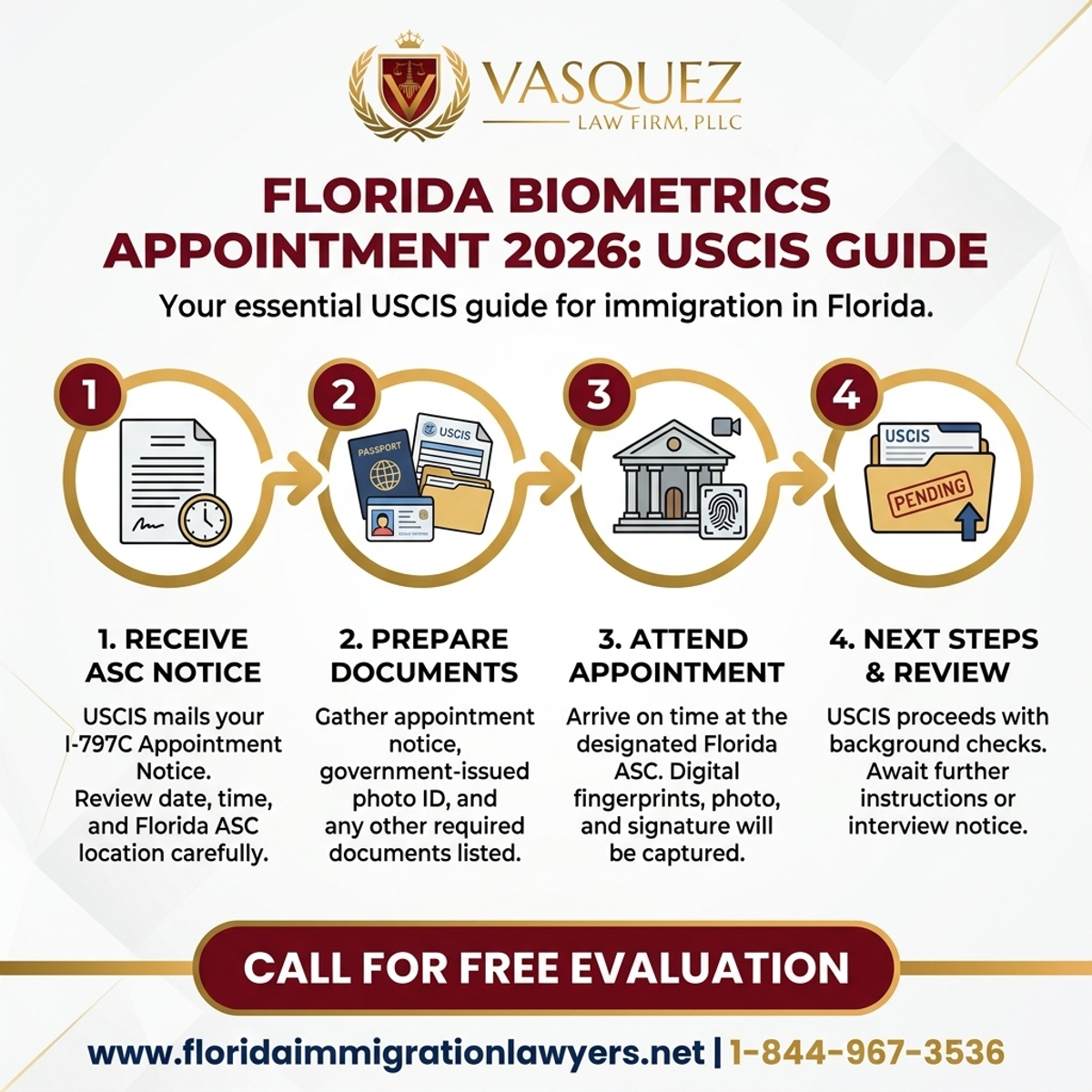
Step-by-Step Process — Biometrics Appointment in Florida 2026: Your USCIS Guide
How Long Does It Take for Biometrics to Be Processed by USCIS in 2026?
As of 2026, USCIS typically processes biometrics data within a few weeks to a few months after your appointment, though specific timelines vary based on application type and the complexity of background checks. The crucial element is that your case cannot move forward until these checks are completed and cleared.
After your biometrics appointment at an ASC in Florida, the collected data is electronically transmitted to the FBI for criminal background checks and to other federal agencies for national security clearances. The processing time for these checks can vary significantly. While some applicants may see their case status update within a few weeks, others might experience delays lasting several months. Factors such as FBI backlogs, the nature of the application (e.g., naturalization vs. employment authorization), or any past criminal history can influence how long it takes for your biometrics to be fully processed. It is important to note that USCIS will not provide updates on the FBI background check status directly; you will only see an update on your overall case status when the biometrics are cleared and linked to your application.
If you notice an unusually long delay, you can check your case status online using the receipt number provided on your Form I-797C. While there is no direct way to expedite the biometrics processing itself, ensuring all other aspects of your application are accurate and complete can prevent further holdups. For individuals involved in immigration court proceedings, the Executive Office for Immigration Review (EOIR) also relies on these background checks, further emphasizing their importance. More information on immigration court processes can be found at justice.gov/eoir.
Timeline and Processing Expectations:
| Stage | Typical Timeframe | Notes |
|---|---|---|
| Application Filing to Appointment Notice | 4-8 weeks | Varies by application type and service center workloads. |
| Biometrics Appointment Itself | 15-30 minutes | Actual time spent at the ASC. |
| Biometrics Data Processing & Background Checks | 2-12 weeks, possibly longer | Data sent to FBI; case cannot proceed until cleared. |
| Case Status Update Post-Biometrics | Varies | USCIS case status will update once biometrics are applied to your file. |
What Happens If I Miss My Biometrics Appointment or Have Issues?
Missing your biometrics appointment without a valid, documented reason can lead to significant delays in your immigration case or, in severe instances, the denial of your application. If you genuinely cannot attend, you must contact USCIS immediately to request a rescheduling, providing compelling evidence for your absence.
USCIS takes biometrics appointments very seriously, as they are a fundamental part of the security screening process. If you miss your scheduled appointment, USCIS may consider your application abandoned and proceed to deny it. However, USCIS understands that unforeseen circumstances can arise. If you have a legitimate reason for missing your appointment, such as a medical emergency, a death in the family, or unavoidable travel, you must notify USCIS as soon as possible. You should send a letter to the address on your appointment notice, explaining your situation and providing any supporting documentation (e.g., doctor's note, death certificate, travel itinerary). USCIS will then review your request and may issue a new appointment notice. It is crucial not to simply miss the appointment and wait for a new one; proactive communication is vital. Similarly, if you arrive at the ASC and encounter technical issues, such as unreadable fingerprints, you may be asked to return for a second appointment, known as a re-fingerprinting. This is a common occurrence and not usually a cause for alarm, but it does add to your processing time.
Beyond missing the appointment, other issues can arise. Sometimes, the appointment notice may contain incorrect information, or you might have changed your address since filing your application. Always inform USCIS of any address changes promptly using the online change of address tool or by mail. Failure to do so could result in you missing critical notices, including your biometrics appointment. Understanding these potential challenges and knowing how to respond effectively can safeguard your immigration journey. Remember, while there isn't a direct fee to reschedule, the time and effort involved can be substantial, and attorney fees may apply if you seek legal assistance for the rescheduling process.
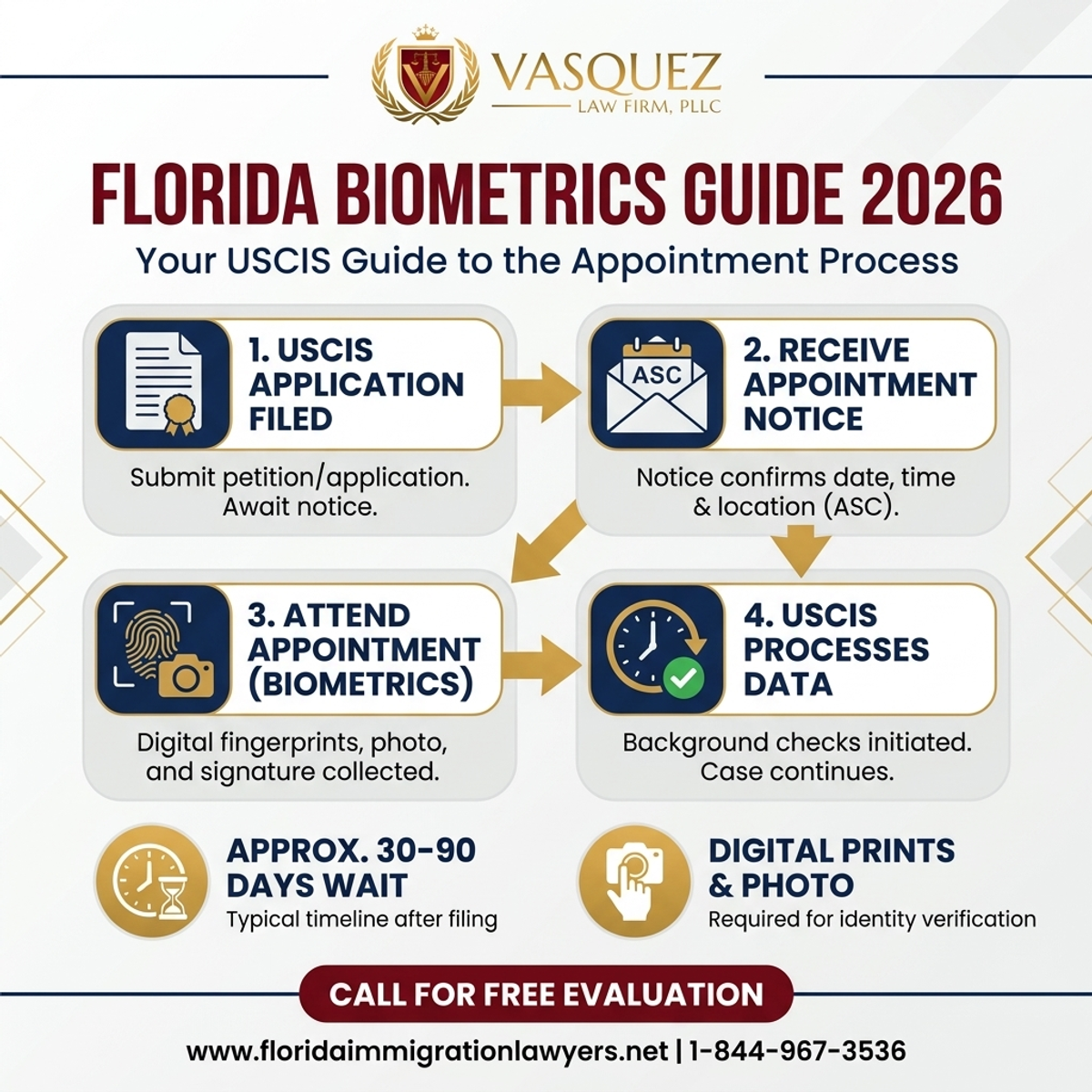
Key Statistics — Biometrics Appointment in Florida 2026: Your USCIS Guide
Cost Factors and Fee Breakdown:
| Item | Typical Fee | Notes |
|---|---|---|
| Biometrics Fee (for I-485, N-400, etc.) | Included in main application fee | Not a separate fee for most forms as of 2026. |
| Rescheduling Fee | Typically none | However, delays can incur additional costs (e.g., legal fees for assistance, lost work). |
| Travel Costs to ASC | Varies | Depending on your location in Florida and transportation method. |
| Attorney Fees for Consultation/Assistance | Varies by firm and complexity | Recommended for complex cases or rescheduling requests. |
Do not navigate this process alone. Contact Florida Immigration Lawyers today for expert guidance and peace of mind.
Common Mistakes to Avoid During Your Biometrics Appointment
Avoiding common errors can significantly streamline your immigration process and prevent unnecessary delays or complications. Be vigilant and prepared.
- Missing the Appointment Without Notification: Failing to attend your scheduled appointment and not informing USCIS with a valid reason can lead to the denial of your entire application, requiring you to refile and pay new fees.
- Not Bringing the Appointment Notice (Form I-797C): This document is your official invitation and proof of appointment. Without it, the ASC staff may refuse to process your biometrics, forcing you to reschedule.
- Forgetting Valid Photo Identification: You must present a current, government-issued photo ID. An expired ID or no ID at all will result in being turned away, causing delays.
- Arriving Late: ASCs operate on a strict schedule. Arriving late, even by a few minutes, may lead to your appointment being canceled or requiring you to wait for a slot, which is not guaranteed.
- Providing Incomplete or Inaccurate Information: While the biometrics appointment itself doesn't involve an interview, any discrepancies in your identity or background uncovered through the biometric checks can lead to Requests for Evidence (RFEs) or even denial.
- Not Informing USCIS of an Address Change: If your address changes after filing your application, and you don't update USCIS, your appointment notice might be mailed to the wrong address, causing you to miss it.
- Attempting to Reschedule Without a Valid Reason or Documentation: USCIS requires a legitimate reason for rescheduling, supported by evidence. Without this, your request may be denied, and your original missed appointment could negatively impact your case.
- Assuming Biometrics Clear Automatically: After the appointment, you must monitor your USCIS case status online. Do not assume that because you attended, everything is automatically processed and cleared.
- Wearing Obstructive Headwear or Facial Coverings: Unless for religious reasons, avoid wearing hats, sunglasses, or anything that obscures your face during the photo capture. This can lead to your photo being rejected.
- Bringing Unauthorized Individuals: Generally, only the applicant is allowed into the biometrics area. Bringing friends or family members who are not essential (e.g., an attorney or interpreter) may cause issues.
- Not Seeking Legal Advice for Complex Situations: If you have a criminal record, a previous deportation, or other complex issues, attending the biometrics appointment without prior legal counsel can expose you to unforeseen problems.
- Failing to Understand the Purpose: Viewing the appointment as a mere formality can lead to complacency. It's a critical security step; treat it with the seriousness it deserves.
When to Call a Lawyer for Your Biometrics Appointment
While a biometrics appointment might seem straightforward, certain situations warrant the expertise of an immigration attorney. Consulting Florida Immigration Lawyers can provide invaluable assistance, ensuring your case proceeds without complications and protecting your rights throughout the process.
You should consider contacting an attorney if you:
- Missed Your Appointment: If you missed your biometrics appointment or anticipate missing it, an attorney can help you draft a compelling request for rescheduling with proper documentation.
- Have a Criminal History: Any past arrests or convictions, even minor ones or those expunged, can complicate background checks. An attorney can advise you on how to address these issues proactively.
- Received a Request for Evidence (RFE): If USCIS sends an RFE related to your biometrics or identity, legal counsel can help you understand and respond appropriately.
- Have Concerns About Identity Verification: If there are discrepancies in your records, or you have changed your name, an attorney can help ensure your identity is correctly established with USCIS.
- Require Re-fingerprinting: If your fingerprints were rejected, an attorney can guide you through the re-fingerprinting process and address any underlying issues.
- Face Language Barriers: An attorney can help communicate with USCIS on your behalf and ensure you understand all instructions and notices.
- Are Fearful of Attending Alone: If you feel anxious or intimidated by the process, having legal representation can offer peace of mind and professional support.
Florida Immigration Lawyers serves clients across Florida, including Orlando and Central Florida, providing comprehensive legal support for all immigration matters. Our team is dedicated to helping you navigate every step of your immigration journey, including critical biometrics appointments. We offer free case reviews to assess your situation and provide clear, actionable advice.
About Florida Immigration Lawyers
Florida Immigration Lawyers is a leading law firm dedicated to providing comprehensive and compassionate immigration legal services to individuals and families throughout Florida. With a deep understanding of U.S. immigration law and its constant changes, our experienced attorneys are committed to helping clients achieve their immigration goals, from family-based petitions and employment visas to naturalization and deportation defense.
We pride ourselves on offering personalized attention, strategic legal advice, and unwavering advocacy for every client. Our services cover a wide range of practice areas, including general immigration, family immigration, business immigration, citizenship, asylum, and deportation defense. We understand the unique challenges faced by immigrants in Florida and strive to provide clarity and confidence throughout complex legal processes.
Available 24/7, we offer free case reviews to discuss your specific situation and determine the best course of action. Our team is fully bilingual, ensuring that language is never a barrier to receiving top-tier legal representation. When you choose Florida Immigration Lawyers, you choose a partner dedicated to your success. Schedule a free consultation with us today or call 1-844-967-3536 to learn how we can assist you.
Sources and References
- U.S. Citizenship and Immigration Services (USCIS)
- Executive Office for Immigration Review (EOIR)
- 8 U.S.C. Chapter 12 - Immigration and Nationality Act (INA)
- 8 CFR Part 103 - Adjudication of Applications and Petitions
- USCIS Policy Manual
Related services: immigration practice areas, experienced immigration attorneys, immigration lawyer cost in Florida.
This article provides general legal information and is not intended as legal advice. Every case is unique, and outcomes depend on specific facts and circumstances. Contact an attorney for advice about your particular situation.
Your biometrics appointment is a pivotal moment in your immigration journey. Ensure you are fully prepared and understand every aspect of the process. If you need expert legal guidance or have any concerns, do not hesitate to reach out to Florida Immigration Lawyers. We are here to help you navigate the complexities of immigration law with confidence.
Call us today for a free case review: 1-844-967-3536. Se Habla Espanol - Estamos aqui para ayudarle.
Do Not Navigate This Process Alone
Our experienced immigration attorneys are ready to fight for you. Get a free, confidential case review today.
Se Habla Español
Or leave your details and we’ll call you:
Free Evaluation in 24 Hours
Or talk to us right now

AI voice assistant — available 24/7
FreeFrequently Asked Questions

William J. Vásquez
Founding Attorney · Vasquez Law Firm
U.S. Air Force veteran and immigration attorney with years of hands-on U.S. immigration experience. J.D., NCCU School of Law. AILA member. Admitted to the 4th, 5th, and 11th Circuit Courts.
Available 24/7 - Free Evaluations
Reviewed for legal accuracy by William J. Vásquez
Licensed in North Carolina; U.S. immigration is federal practice.
Related Legal Services
Our Florida immigration attorneys can help you with experienced immigration attorneys, asylum protection and citizenship and naturalization. Call today at 1-844-967-3536 for a free case review.
Related Links
Related Topics
Free Legal Case Review
Discuss your case with our experienced attorneys. We're available 24/7.
Se Habla Español - Estamos aquí para ayudarle.
Related Articles
Immigration Lawyer Orlando Free Consultation in Florida
For individuals and families in Orlando, Florida, navigating the complexities of U.S. immigration law requires expert guidance. An immigration lawyer in Orlando offers crucial support for everything from visa applications and green card processes to naturalization and deportation defense. This comprehensive guide details what a free consultation covers, providing a step-by-step overview of immigration pathways, essential document checklists, and expected timelines in 2026. We also highlight common mistakes to avoid, discuss the critical role of legal counsel in deportation and asylum cases, and explain why choosing a local Orlando immigration attorney is beneficial. Florida Immigration Lawyers is dedicated to serving the diverse community of Orlando with compassionate, effective legal solutions, ensuring you receive personalized advice and robust representation for a successful immigration journey.
212(c) Waiver Legacy Relief in Florida 2026 Guide
For long-term lawful permanent residents in Florida, the 212(c) waiver offers crucial legacy relief against deportation, particularly for those whose proceedings began before April 1, 1997. This guide delves into the historical context, strict eligibility criteria, and the detailed application process for this complex discretionary waiver. Learn about the required documentation, potential timelines, and associated costs. We emphasize the vital importance of understanding the precise cutoff dates and demonstrating strong positive equities to an Immigration Judge. In an evolving immigration landscape, this legacy relief remains a powerful defense for eligible individuals seeking to protect their lives and families in the U.S. Discover common pitfalls to avoid and when expert legal counsel is indispensable for navigating Florida's immigration courts.
Immigration Services in Treasure Coast Florida 2026
For residents of Florida's Treasure Coast, navigating immigration services can be a complex and often overwhelming process. This comprehensive guide, updated for 2026, provides essential information on various immigration pathways, including family-based visas, employment opportunities, green card applications, and crucial deportation defense. Learn about the step-by-step application process, necessary documentation, typical timelines, and associated costs. Discover common pitfalls to avoid and understand when expert legal counsel is indispensable. Florida Immigration Lawyers serves individuals and families across Martin, St. Lucie, and Indian River Counties, offering personalized and compassionate legal support for all immigration matters. We are dedicated to helping you achieve your immigration goals and build a secure future in the United States. Contact us for a free case review.
Investor Visa Immigration Services in Florida 2026
Discover the ins and outs of investor visa immigration services in Florida for 2026. Learn about the application process, required documents, typical timelines, and common mistakes to avoid. Ensure a smooth transition with expert legal guidance from Florida Immigration Lawyers.