J-1 Visa Cost and Florida Physician Placement Explained
Explore the cost of a J-1 visa and the Conrad 30 program for physician placement in Florida's underserved areas like Tallahassee. Learn about fees, processes, and legal guidance.
- J-1 visa fees vary based on application specifics.
- Conrad 30 waivers allow waiver of the 2-year home residency requirement.
- Physicians can work in underserved areas like Tallahassee.
- Legal guidance is crucial for navigating the process.
Introduction
Securing a J-1 visa can be a complex process, especially for physicians seeking to practice in Florida. This article provides a detailed look at the costs involved in obtaining a J-1 visa and how the Conrad 30 program facilitates physician placements in underserved areas like Tallahassee. Call Florida Immigration Lawyers at 1-844-YO-PELEO for a free consultation to explore your options.
For many international medical graduates, the J-1 visa serves as a crucial gateway to gain advanced medical training and experience in the United States. However, this opportunity often comes with a significant two-year home residency requirement, which can delay or complicate future immigration plans. Understanding the nuances of this visa and potential waivers is paramount for a smooth transition into the U.S. healthcare system.
Florida, with its diverse population and growing healthcare needs, presents unique opportunities and challenges for J-1 physicians. The state actively participates in programs designed to attract medical talent to areas critically lacking medical professionals. This guide will not only break down the financial aspects but also illuminate the strategic pathways available through initiatives like the Conrad 30 program, helping physicians fulfill their professional aspirations while serving vital community needs.
What is the Cost of a J-1 Visa in 2026?
As of 2026, the cost of obtaining a J-1 visa includes various fees such as the SEVIS fee, DS-160 form fee, and potential attorney fees. These fees can vary, so it’s essential to plan accordingly.
The SEVIS fee is mandatory for all J-1 visa applicants and is used to maintain the Student and Exchange Visitor Information System. Additionally, applicants must pay the DS-160 form fee, which is required for nonimmigrant visas. Legal fees may also apply if you choose to hire an attorney for assistance.
Beyond these primary government fees, applicants should budget for several other potential expenses that contribute to the overall cost. These can include medical examination fees, which are often required for visa processing and can range significantly depending on the physician and location. Travel expenses for interviews, document translation services if your academic credentials are not in English, and courier fees for submitting documents are also common. While some of these costs might seem minor individually, they can quickly accumulate, making a comprehensive financial plan crucial for every applicant.
It's also important to consider the potential for unexpected costs, such as reapplying for a visa if there are errors or denials, or expedited processing fees if available and necessary. Given the dynamic nature of immigration policies and fees, staying informed about the most current fee schedules is vital. Consulting with experienced professionals like Florida Immigration Lawyers can provide clarity on all anticipated costs and help you avoid unforeseen financial burdens during your J-1 visa application process.
How Does the Conrad 30 Program Work for Physicians?
The Conrad 30 program allows J-1 visa holders to waive the two-year home residency requirement if they agree to work in a medically underserved area. In Florida, this includes cities like Tallahassee.
The program aims to improve healthcare access in areas lacking sufficient medical professionals. Physicians must commit to working full-time in these areas for at least three years.
The two-year home residency requirement, codified under Section 212(e) of the Immigration and Nationality Act, mandates that J-1 exchange visitors return to their home country for at least two years after their program concludes before they can apply for certain other nonimmigrant visas (like H-1B) or permanent residency. For many international medical graduates, this requirement poses a significant hurdle to continuing their medical careers in the U.S. The Conrad 30 program offers a critical exemption, allowing states to recommend up to 30 J-1 physicians annually for a waiver, provided they serve in Health Professional Shortage Areas (HPSAs) or Medically Underserved Areas (MUAs).
Florida's participation in the Conrad 30 program is instrumental in addressing the state's physician shortages, particularly in rural and low-income communities. Physicians who successfully obtain a Conrad 30 waiver not only bypass the home residency requirement but also gain a pathway to adjust their status to an H-1B visa, and potentially, to permanent residency. This creates a win-win situation: physicians can continue their professional journey in the U.S., and underserved communities receive much-needed medical care. The commitment to three years of full-time service is rigorously enforced, ensuring that the program's primary goal of improving healthcare access is met.
For a physician considering this path, understanding the specific criteria and application process for Florida is essential. The Florida Department of Health oversees the state's Conrad 30 program, setting forth guidelines and priorities for physician placement. Successful applicants often demonstrate a strong commitment to public service and a clear plan for integrating into the designated community. Florida Immigration Lawyers can provide invaluable assistance in navigating these state-specific requirements and preparing a compelling waiver application.
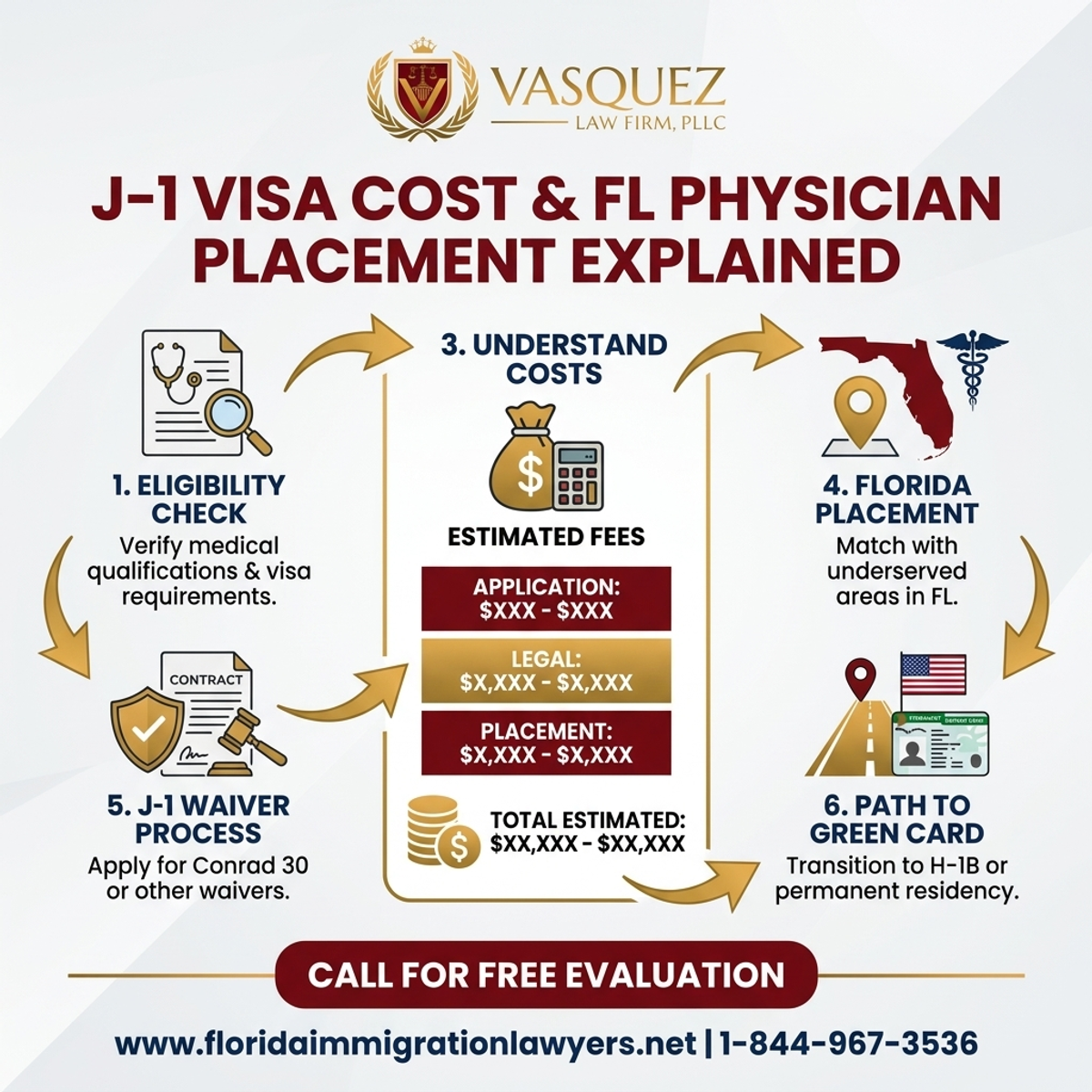
Step-by-Step Process — J-1 Visa Cost and Florida Physician Placement Explained
Steps to Apply for a J-1 Visa and Conrad 30 Waiver
Navigating the application process for a J-1 visa and subsequently a Conrad 30 waiver requires meticulous attention to detail and a strategic approach. Each step is critical and interconnected, influencing the overall success and timeline of your journey to practice medicine in Florida.
- Obtain a J-1 Visa Sponsor: Secure a sponsor approved by the U.S. Department of State.
This initial step is foundational. Your sponsor will issue the Form DS-2019, Certificate of Eligibility for Exchange Visitor (J-1) Status, which is essential for your visa application. Approved sponsors are typically academic institutions, medical centers, or designated exchange visitor programs. It's crucial to select a sponsor with a strong track record and clear communication protocols, as they will be your primary point of contact for program-related matters.
- File DS-160 and Pay Fees: Complete the DS-160 form and pay the required fees.
The DS-160, Online Nonimmigrant Visa Application, must be filled out accurately and completely. This form collects personal, educational, and professional information. After submission, you will receive a confirmation page, which you'll need for your visa interview. The associated fee is non-refundable, so double-check all entries before submission. This step is followed by scheduling your visa interview at a U.S. Embassy or Consulate in your home country.
- Apply for Conrad 30 Waiver: Submit an application to the Florida Department of Health.
This is a separate, state-specific application that requires a comprehensive package of documents, including a formal job offer from a facility in a designated HPSA or MUA, a statement from your home country's government (a "no objection" statement, if applicable), and a personal statement. The Florida Department of Health reviews these applications competitively, often prioritizing specialties most needed in the state's underserved areas. Florida Immigration Lawyers can help you prepare a robust application that addresses all state-specific requirements.
- Secure Employment: Find a job in an underserved area like Tallahassee.
Your employment must be full-time and in a facility located within a Health Professional Shortage Area (HPSA) or Medically Underserved Area (MUA) as designated by the federal government. The job offer letter is a critical component of your Conrad 30 waiver application, detailing your position, salary, and the three-year commitment. Researching and networking with healthcare providers in these areas, such as those in Tallahassee or other Florida communities, is essential before applying for the waiver.
- Legal Assistance: Consult with an attorney to ensure compliance with all requirements.
Given the intricacies of both federal immigration law and state-specific Conrad 30 program regulations, professional legal guidance is highly recommended. An experienced immigration attorney can help you understand eligibility criteria, review your documentation, prepare compelling arguments for your waiver, and represent you if any issues arise. Florida Immigration Lawyers at 1-844-YO-PELEO offer free consultations to guide you through this complex process, ensuring every detail is handled correctly.
Successfully navigating these steps requires careful planning and a thorough understanding of both federal immigration regulations and Florida’s specific requirements for the Conrad 30 program. Proactive engagement and attention to deadlines are paramount to avoiding common pitfalls and ensuring a smooth transition to practicing medicine in an underserved community.
Document Checklist for J-1 Visa and Waiver
A complete and meticulously organized document checklist is the cornerstone of a successful J-1 visa and Conrad 30 waiver application. Any missing or incorrect document can lead to significant delays or even denial, making thorough preparation absolutely essential.
- Valid Passport
Your passport must be valid for at least six months beyond your intended period of stay in the U.S. It serves as your primary identification and travel document.
- Completed DS-160 Form
The confirmation page of your submitted online nonimmigrant visa application is required for your interview and processing.
- SEVIS Fee Receipt
Proof that you have paid the mandatory SEVIS I-901 fee is necessary. This fee supports the Student and Exchange Visitor Information System.
- Offer Letter from Employer
A formal, signed offer of employment from a healthcare facility in a designated Health Professional Shortage Area (HPSA) or Medically Underserved Area (MUA) in Florida, outlining your three-year commitment.
- Proof of Medical Degree
Official transcripts and diplomas from your medical school, demonstrating your qualifications to practice medicine. These may need to be evaluated by a credentialing service.
- Completed Conrad 30 Waiver Application
The specific application form provided by the Florida Department of Health, along with all supporting documents such as curriculum vitae, letters of recommendation, and a personal statement explaining your commitment to serving an underserved community.
- Financial Support Evidence
Documents proving you have sufficient funds to cover your living expenses during your J-1 program, if not fully covered by your employer. This could include bank statements, scholarship letters, or employer guarantees.
- No Objection Statement (if applicable)
A formal statement from your home country's government confirming they have no objection to you not returning home for two years, often required for certain J-1 categories.
Beyond these core documents, you might also need marriage certificates, birth certificates for dependents, or other country-specific requirements. It is advisable to keep both original and photocopied versions of all documents, and ensure any foreign language documents are accompanied by certified English translations. Engaging with Florida Immigration Lawyers can help you compile a comprehensive and error-free document package, significantly increasing your chances of a successful application.
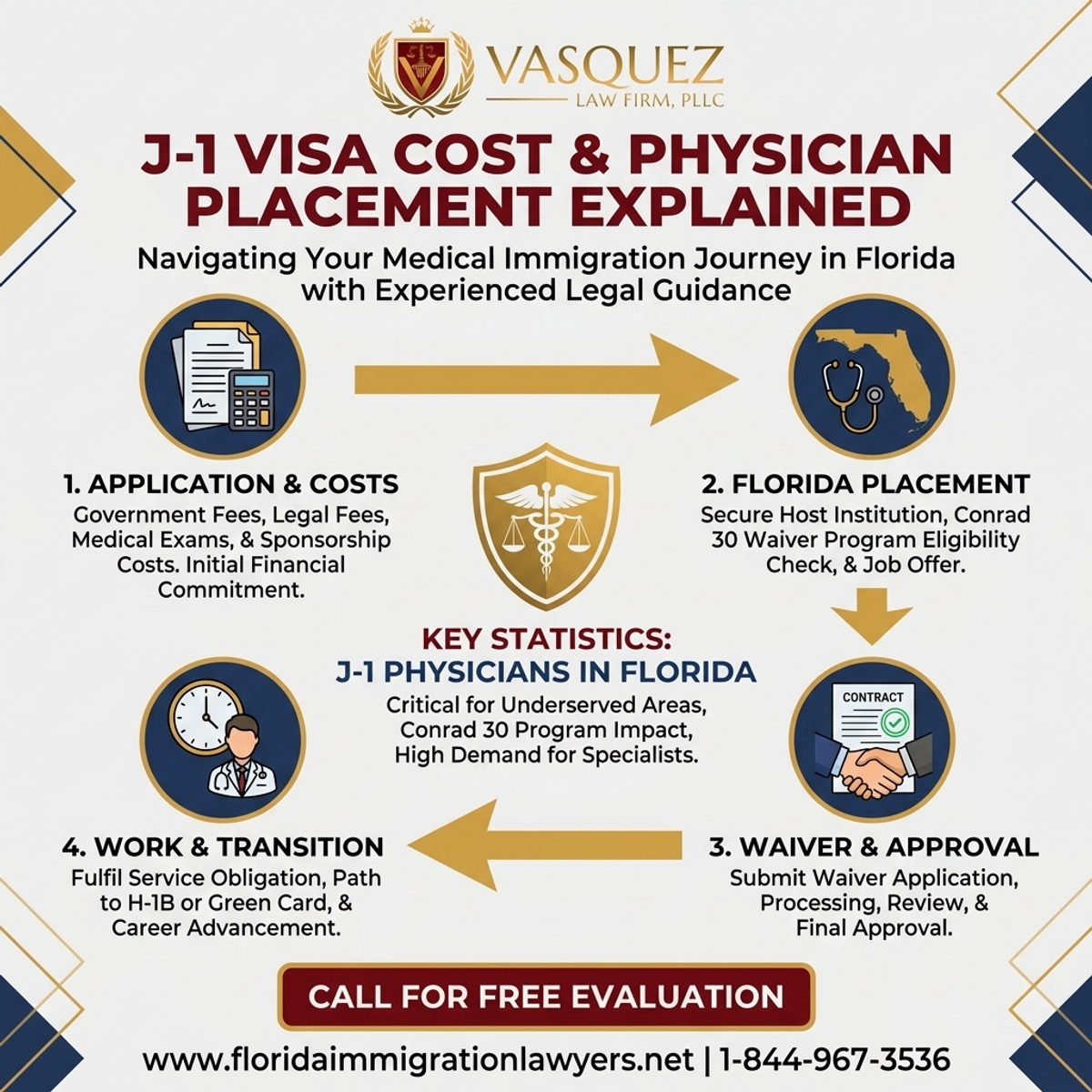
Key Statistics — J-1 Visa Cost and Florida Physician Placement Explained
Timeline and Processing Expectations
Understanding the typical timeline for a J-1 visa and Conrad 30 waiver application is crucial for planning your move and professional transition. While the following timeframes offer a general guide, it's important to remember that processing times can fluctuate significantly due to various factors, including embassy workload, state department efficiency, and the completeness of your application.
| Stage | Typical Timeframe | Notes |
|---|---|---|
| SEVIS Fee Payment | 1-2 weeks | Required before DS-160 submission. Ensure payment is processed and receipt is obtained well in advance, as delays here can push back subsequent steps. |
| DS-160 Form Processing | 2-4 weeks | Varies by embassy and consulate location. This includes the time to complete the form, pay the fee, and schedule your interview. Interview wait times can be substantial in some countries. |
| J-1 Visa Interview & Issuance | 1-4 weeks | After a successful interview, the visa stamp is typically placed in your passport within this timeframe. Some cases may require additional administrative processing, which can extend this period. |
| Conrad 30 Waiver Application (State Level) | 3-6 months | Depends on state processing times and the volume of applications. Florida’s Department of Health reviews applications on a rolling basis or during specific windows, often involving a competitive selection process. |
| Conrad 30 Waiver Approval (Federal Level) | 2-4 months | Once the state recommends your waiver, it goes to the USCIS for final federal approval. This stage involves a thorough review of your eligibility and documentation. |
Several factors can influence these timelines, including national holidays, government shutdowns, requests for additional evidence (RFEs), and the sheer volume of applications. To mitigate potential delays, submitting a thoroughly prepared application with all required documentation from the outset is paramount. Proactive communication with your sponsor and, critically, with an experienced immigration attorney from Florida Immigration Lawyers can help you stay informed and address any issues promptly, helping to keep your application on track.
Cost Factors and Fee Breakdown
A clear understanding of the financial commitment involved in pursuing a J-1 visa and a Conrad 30
Sources and References
- U.S. Citizenship and Immigration Services (USCIS)
- Executive Office for Immigration Review (EOIR)
- U.S. Department of State - Bureau of Consular Affairs
- Immigration and Nationality Act (INA), 8 U.S.C. Chapter 12
Do Not Navigate This Process Alone
Our experienced immigration attorneys are ready to fight for you. Get a free, confidential case review today.
Se Habla Español
Or leave your details and we’ll call you:
Free Evaluation in 24 Hours
Or talk to us right now
AI voice assistant — available 24/7
FreeFrequently Asked Questions

William J. Vásquez
Founding Attorney · Vasquez Law Firm
U.S. Air Force veteran and immigration attorney with years of hands-on U.S. immigration experience. J.D., NCCU School of Law. AILA member. Admitted to the 4th, 5th, and 11th Circuit Courts.
Available 24/7 - Free Evaluations
Reviewed for legal accuracy by William J. Vásquez
Licensed in North Carolina; U.S. immigration is federal practice.
Related Legal Services
Our Florida immigration attorneys can help you with immigration practice areas, free immigration consultation and business immigration. Call today at 1-844-YO-PELEO for a free case review.
Related Links
Related Topics
Free Legal Case Review
Discuss your case with our experienced attorneys. We're available 24/7.
Se Habla Español - Estamos aquí para ayudarle.
Related Articles
Immigration Lawyer Orlando Free Consultation in Florida
For individuals and families in Orlando, Florida, navigating the complexities of U.S. immigration law requires expert guidance. An immigration lawyer in Orlando offers crucial support for everything from visa applications and green card processes to naturalization and deportation defense. This comprehensive guide details what a free consultation covers, providing a step-by-step overview of immigration pathways, essential document checklists, and expected timelines in 2026. We also highlight common mistakes to avoid, discuss the critical role of legal counsel in deportation and asylum cases, and explain why choosing a local Orlando immigration attorney is beneficial. Florida Immigration Lawyers is dedicated to serving the diverse community of Orlando with compassionate, effective legal solutions, ensuring you receive personalized advice and robust representation for a successful immigration journey.
EAD Advance Parole Combo Card in Florida 2026
For individuals with a pending Form I-485, Application to Register Permanent Residence or Adjust Status, the EAD Advance Parole Combo Card is an essential document. This single card combines the authorization to work legally in the U.S. (Employment Authorization Document - EAD) with permission to travel internationally and re-enter without abandoning your green card application (Advance Parole). This guide from Florida Immigration Lawyers provides a comprehensive overview for applicants in Florida in 2026, covering eligibility, the step-by-step application process, required documents, expected processing times, and associated costs. We also highlight common mistakes to avoid and when to seek legal counsel to ensure a smooth and successful immigration journey. Understanding this vital card is key to maintaining stability while awaiting your permanent residency approval.
Employment Immigration Attorney in Florida: What You Need
Explore the complexities of employment immigration in Florida, including visa categories, required documents, and common pitfalls. Learn how an immigration attorney can assist you in navigating the legal landscape.
VAWA Immigration Relief for Abused Spouses in Florida
Discover how the Violence Against Women Act (VAWA) provides crucial immigration relief for abused spouses in Florida. Learn about eligibility, the application process, and how Florida Immigration Lawyers can assist you.