Immigration Court Proceedings Florida: Your Guide | VLF Flor
Facing immigration court proceedings in Florida can be overwhelming, with high stakes involving potential deportation. This guide from Florida Immigration Lawyers clarifies the complex process, from understanding removal proceedings overseen by an immigration judge within the EOIR, to navigating hearings, identifying defense options like asylum or cancellation of removal, and preparing essential documentation. We also cover timelines, cost factors, and crucial mistakes to avoid, emphasizing the critical role of legal representation for individuals in Coral Springs, Miami, Orlando, and throughout Florida. Learn how our dedicated team can help protect your rights and fight for your future.

Immigration court proceedings in Florida, overseen by the Executive Office for Immigration Review (EOIR), determine whether non-citizens can remain in the U.S. These complex legal processes, often called removal proceedings, involve hearings before an immigration judge to address issues of inadmissibility or deportability. Navigating the system requires a deep understanding of immigration law, evidence presentation, and defense strategies. Individuals facing court in Florida, including those in Coral Springs, Miami, or Orlando, should seek experienced legal counsel immediately to protect their rights and explore all available forms of relief.
- Immigration court proceedings are formal legal processes determining a non-citizen's right to remain in the U.S.
- These cases fall under the jurisdiction of the Executive Office for Immigration Review (EOIR) and involve an immigration judge.
- Common reasons for court appearances include visa violations, criminal offenses, or unlawful entry.
- Individuals may be eligible for various forms of relief, such as asylum, cancellation of removal, or adjustment of status.
- Legal representation is crucial for understanding complex laws and effectively presenting a defense.
Finding yourself in immigration court proceedings Florida can be an incredibly daunting and stressful experience. The stakes are undeniably high, with potential outcomes ranging from securing legal status to facing deportation from the United States. Many individuals in Coral Springs and across Florida are unfamiliar with the intricate legal framework that governs these cases, leaving them feeling overwhelmed and uncertain about their future. Understanding the process, your rights, and the available defenses is paramount to navigating this challenging journey successfully.
At Florida Immigration Lawyers, we understand the profound impact that these proceedings have on individuals and families. Our dedicated team is committed to providing compassionate and effective legal representation to those facing removal. This comprehensive guide will demystify the immigration court system in Florida, explain what removal proceedings entail, and outline the critical steps involved. We will cover everything from initial notices to potential appeals, ensuring you are well-informed. Call Florida Immigration Lawyers at 1-844-967-3536 for a free consultation and take the first step toward securing your future.
Understanding Immigration Court and Removal Proceedings in Florida
The immigration court system in Florida is a branch of the Executive Office for Immigration Review (EOIR), an agency within the U.S. Department of Justice. Unlike federal criminal or civil courts, immigration courts deal exclusively with administrative matters concerning the admissibility and deportability of non-citizens. When an individual is placed into removal proceedings, it means the Department of Homeland Security (DHS) believes they are subject to deportation and has issued a Notice to Appear (NTA). This document formally charges the individual with violating U.S. immigration law and initiates their case before an immigration judge.
Florida hosts several key immigration courts, including those in Miami, Orlando, and Pompano Beach, serving diverse populations from cities like Coral Springs, Fort Lauderdale, and Tampa. These courts handle a significant volume of cases, reflecting Florida's large immigrant community. An immigration judge, an attorney appointed by the Attorney General, presides over these hearings, making decisions based on U.S. immigration law, including the Immigration and Nationality Act (INA), found at 8 U.S.C. Chapter 12. The judge's role is to ensure due process, hear evidence from both the government and the respondent, and apply relevant statutes and regulations, such as those detailed in 8 CFR. Understanding the specific court where your case will be heard and its local procedures is a critical initial step.
Removal proceedings can be initiated for various reasons, including overstaying a visa, entering the U.S. without inspection, committing certain criminal offenses, or violating terms of admission. The government bears the burden of proving deportability or inadmissibility, while the respondent has the opportunity to present defenses or apply for forms of relief that would allow them to remain in the country. This adversarial process underscores the importance of having knowledgeable legal counsel who can articulate your case effectively and challenge the government's allegations. Without proper representation, individuals often miss critical deadlines or fail to present compelling evidence that could lead to a favorable outcome.
The Step-by-Step Guide to Navigating Immigration Court
Navigating immigration court proceedings Florida can feel like traversing a labyrinth without a map. However, understanding the typical steps involved can provide much-needed clarity. While each case is unique, the general procedural flow remains consistent. From receiving your Notice to Appear (NTA) to a final decision, every stage requires careful attention to detail and adherence to strict deadlines. Missing a deadline or failing to appear can lead to an order of removal in absentia, making it even harder to fight your case.
- Receipt of Notice to Appear (NTA): This is the official document from the Department of Homeland Security (DHS) that initiates removal proceedings. It specifies the charges against you and the date for your first court appearance, known as the Master Calendar Hearing. It is crucial to immediately contact an attorney upon receiving an NTA, as this marks the beginning of your legal timeline.
- Master Calendar Hearing (MCH): This is typically a brief, preliminary hearing where you, or your attorney, appear before an immigration judge. The judge confirms your identity, ensures you understand the charges, and asks if you admit or deny the allegations. This is also the stage where you inform the court if you intend to seek legal representation and identify any forms of relief you plan to apply for. The judge will then set a schedule for future filings and hearings.
- Filing Applications for Relief: Following the MCH, if you are eligible for relief from removal (e.g., asylum, cancellation of removal, adjustment of status), your attorney will prepare and submit the necessary applications and supporting documentation to the court and DHS. This period involves extensive evidence gathering and affidavit preparation.
- Individual Hearing (Merits Hearing): This is the substantive hearing where the immigration judge hears testimony and reviews all evidence related to your case. Both the government attorney (representing DHS) and your attorney will present their arguments, question witnesses, and cross-examine. This hearing can be lengthy, often lasting several hours or even days, depending on the complexity of your case.
- Decision by the Immigration Judge: After the Individual Hearing, the judge will issue a decision, either orally in court or in writing at a later date. The judge will determine if you are removable and, if so, whether you qualify for any forms of relief. If relief is granted, your removal proceedings will be terminated, and you may receive legal status. If relief is denied, the judge will issue an order of removal.
- Appeals Process: If either you or the government disagrees with the immigration judge's decision, you have the right to appeal to the Board of Immigration Appeals (BIA) within 30 days. The BIA is the highest administrative body for interpreting and applying immigration laws. Further appeals can be made to a U.S. Circuit Court of Appeals, and in rare cases, to the U.S. Supreme Court.
Key Defenses and Relief Options in Florida Immigration Court
Facing removal proceedings in Florida does not automatically mean deportation. There are various legal defenses and forms of relief available under the Immigration and Nationality Act (INA) that, if successfully pursued, can allow individuals to remain in the U.S. These options are often complex and depend heavily on the specific facts of an individual's case, their immigration history, and their ties to the United States. An experienced immigration lawyer in Florida can assess your situation and determine the most viable path forward.
One of the most common forms of relief is Asylum and Withholding of Removal. Individuals who fear persecution in their home country based on race, religion, nationality, political opinion, or membership in a particular social group may be eligible. This requires demonstrating a well-founded fear of persecution. Another significant avenue is Cancellation of Removal, available for certain non-permanent residents (under INA § 240A(b)) and permanent residents (under INA § 240A(a)). Non-permanent residents must show continuous physical presence in the U.S. for ten years, good moral character, and that removal would cause exceptional and extremely unusual hardship to a qualifying U.S. citizen or LPR spouse, parent, or child. Permanent residents typically need five years as an LPR and seven years continuous residence in any status.
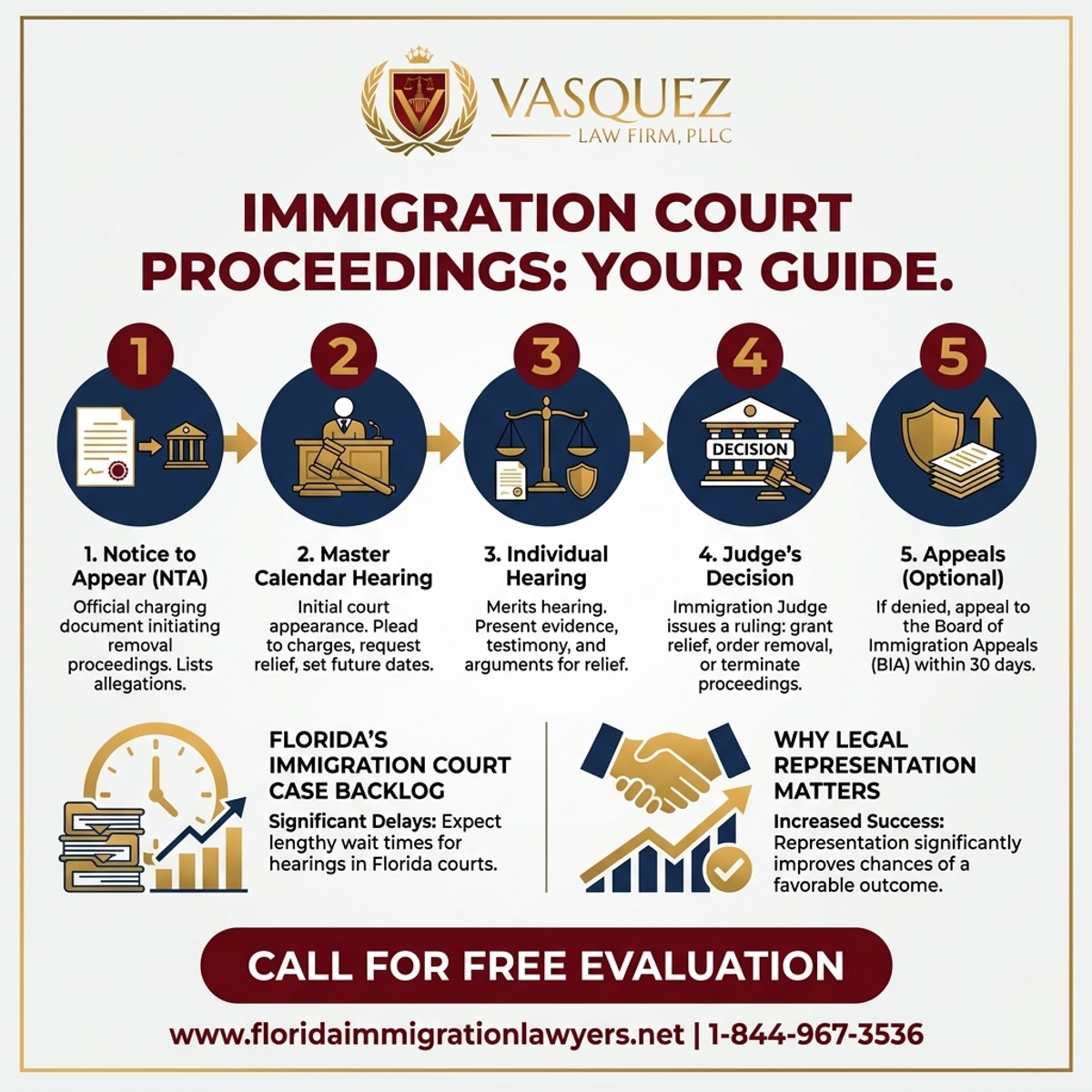
Step-by-Step Process — Immigration Court Proceedings Florida: Your Guide
Adjustment of Status (INA § 245) is another critical relief option, allowing eligible individuals to obtain lawful permanent resident (green card) status without leaving the U.S. This is often pursued by those who have an immediate relative petition filed on their behalf and meet other eligibility criteria, such as lawful entry or specific waivers. Furthermore, various Waivers of Inadmissibility or Deportability (e.g., I-601, I-212) can forgive certain immigration violations or criminal offenses, enabling an individual to adjust status or re-enter the U.S. after previous removal. For example, a waiver under INA § 212(h) might be available for certain criminal convictions. The complexity of these options, coupled with specific eligibility requirements and stringent deadlines, highlights why expert legal counsel from Florida Immigration Lawyers is indispensable.
Essential Documents and Evidence Checklist for Court
Preparing for immigration court proceedings Florida requires meticulous organization and the strategic collection of documents and evidence. The success of your case often hinges on your ability to present compelling proof to the immigration judge to support your eligibility for relief or to challenge the government's allegations. A robust document checklist ensures that you do not overlook any critical pieces of information that could sway the outcome in your favor. Begin gathering these documents as soon as possible, as some may take time to obtain.
- Personal Identification Documents: Valid passport, birth certificate, national identity card, driver's license, or any government-issued photo ID.
- Immigration Documents: Notice to Appear (NTA), I-94 arrival/departure record, previous visa stamps, green card (if applicable), asylum application (Form I-589), or any other applications filed with USCIS.
- Proof of Relationship: Marriage certificates, birth certificates of children, adoption decrees, divorce decrees, and affidavits from family members confirming relationships.
- Financial Documents: Tax returns (recent 5-10 years), employment letters, pay stubs, bank statements, property deeds, and any evidence of financial support or hardship.
- Medical Records: Records of any significant medical conditions, psychological evaluations, or proof of ongoing treatment, especially if relevant to hardship claims or asylum.
- Police Records: Certified copies of all arrest records, court dispositions, and sentencing documents, even for minor offenses. Failure to disclose these can be detrimental.
- Character Evidence: Letters of recommendation from employers, community leaders, teachers, or religious figures attesting to your good moral character and contributions to the community.
- Proof of Residence: Utility bills, lease agreements, mortgage statements, school records for children, and any documents showing continuous physical presence in the U.S. (if applicable for cancellation of removal).
- Country Conditions Evidence (for Asylum): News articles, human rights reports, expert testimony, and personal affidavits detailing conditions in your home country and why you fear persecution.
- Expert Witness Reports: Psychological evaluations, country conditions expert reports, or other professional assessments that support your claims.
Organizing these documents clearly and chronologically will significantly aid your attorney in preparing your case and presenting it effectively to the immigration judge. Always keep original documents in a safe place and provide your legal team with copies.
Timeline and Processing Expectations in Immigration Court
The timeline for immigration court proceedings Florida can be notoriously unpredictable and lengthy, often stretching over several months or even years. This extended duration is due to various factors, including the high volume of cases, court backlogs, the complexity of individual cases, and scheduling availability of immigration judges and government attorneys. Understanding these processing expectations is crucial for managing your stress and planning your future, especially for families in areas like Coral Springs who rely on stability.
Typically, after receiving a Notice to Appear (NTA), your first Master Calendar Hearing might be scheduled anywhere from a few weeks to several months later. In some high-volume courts like Miami, initial hearings can take longer to schedule. Subsequent Individual Hearings, which are the substantive trials, are often set months apart, sometimes a year or more after the initial Master Calendar Hearing. The time between hearings allows both parties to gather evidence, file applications for relief, and prepare their legal arguments. These delays, while frustrating, can sometimes be strategically utilized by experienced attorneys to build a stronger case or explore alternative avenues for relief.
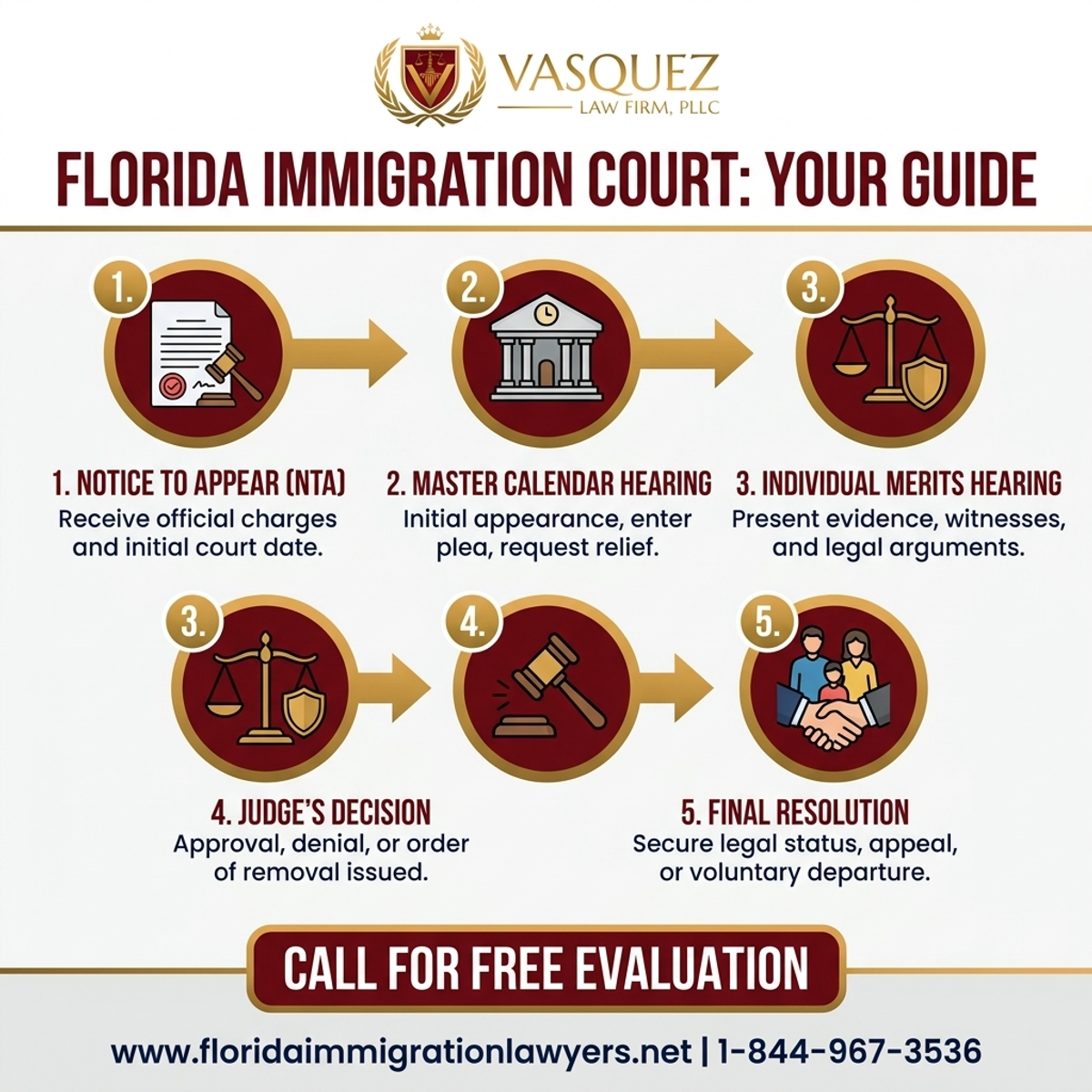
Key Statistics — Immigration Court Proceedings Florida: Your Guide
The appeals process further extends the timeline. If an appeal is filed with the Board of Immigration Appeals (BIA), it can take anywhere from six months to over a year for a decision. Further appeals to a U.S. Circuit Court of Appeals add even more time, potentially several years. It is important to remember that during this entire process, you typically remain in the U.S. unless ordered removed and detained. While awaiting a decision, you may be eligible for work authorization, especially if you have an asylum application pending for more than 150 days. The best way to manage these timelines is to maintain consistent communication with your Florida Immigration Lawyers team, respond promptly to all requests for information, and ensure all filings are submitted accurately and on time to avoid unnecessary delays. For official processing times and statistics, you can refer to the Executive Office for Immigration Review (EOIR) website.
Cost Factors and Fee Breakdown in Immigration Court Cases
Understanding the financial aspects of immigration court proceedings Florida is a critical concern for many individuals and families. The costs involved can vary significantly depending on the complexity of the case, the specific forms of relief sought, and the duration of the proceedings. While direct court filing fees are generally minimal for removal proceedings themselves, other expenses, particularly legal fees, can be substantial. Being aware of these potential costs upfront can help you plan and make informed decisions.
Firstly, the Executive Office for Immigration Review (EOIR) generally does not charge a fee for appearing before an immigration judge in removal proceedings. However, if you apply for certain forms of relief, such as an application for adjustment of status (Form I-485) or a waiver of inadmissibility (Form I-601), there will be associated filing fees payable to U.S. Citizenship and Immigration Services (USCIS). These fees are subject to change, so it's always best to check the official USCIS website for the most current amounts. Fee waivers may be available for eligible low-income individuals, but strict criteria apply. It is important to discuss these potential fees with your attorney.
The most significant cost factor in immigration court cases is typically legal representation. Immigration law is highly specialized, and the amount of work required for a removal defense case is extensive, involving legal research, document preparation, court appearances, and communication with government agencies. Legal fees can be structured in various ways, including flat fees for specific stages of the case or hourly rates. The total cost will depend on the experience of the attorney, the complexity of your case (e.g., whether it involves criminal issues, asylum claims, or multiple forms of relief), and how many hearings are required. At Florida Immigration Lawyers, we strive to offer transparent fee structures and discuss all costs clearly during your free consultation. Investing in experienced legal counsel is often the most cost-effective decision in the long run, as it significantly increases your chances of a favorable outcome and avoids the potentially devastating financial and personal costs of deportation.
Common Mistakes to Avoid in Immigration Court
Navigating immigration court proceedings Florida is fraught with potential pitfalls. Even seemingly small errors can have significant, long-lasting consequences, jeopardizing your ability to remain in the U.S. Being aware of these common mistakes can help you avoid them and strengthen your case before an immigration judge.
- Failing to Appear for Court Hearings: This is perhaps the most critical error. Missing a scheduled Master Calendar or Individual Hearing without proper notification to the court will almost certainly result in an in absentia order of removal, meaning you are ordered deported without your presence. Reopening such an order is extremely difficult.
- Lying or Misrepresenting Facts: Providing false information or misrepresenting facts to an immigration officer or judge can lead to charges of fraud or misrepresentation, making you inadmissible or deportable and potentially barring you from future immigration benefits. Honesty is always the best policy, even if the truth is unfavorable.
- Not Disclosing Criminal History: Attempting to hide past arrests or convictions, no matter how minor, will almost always be discovered by DHS. Undisclosed criminal history can lead to severe penalties, including denials of relief and findings of bad moral character. Always provide your attorney with a complete and accurate criminal record.
- Missing Filing Deadlines: Immigration court operates on strict deadlines for submitting applications, evidence, and motions. Missing these deadlines, even by a day, can result in the denial of your application for relief or the striking of your evidence. An experienced attorney ensures all documents are filed promptly.
- Failing to Seek Legal Counsel: Representing yourself in immigration court is highly discouraged. Immigration law is incredibly complex, constantly evolving, and requires a deep understanding of statutes, regulations, and case law (8 CFR, INA). Pro se litigants are at a significant disadvantage against trained government attorneys.
- Not Gathering Sufficient Evidence: A weak case is often one with insufficient supporting evidence. Whether it's proving hardship, fear of persecution, or good moral character, failing to collect comprehensive documentation, affidavits, and expert reports can severely undermine your claims.
- Assuming All Cases are the Same: Every immigration case is unique. What worked for a friend or family member may not apply to your situation. Relying on anecdotal advice instead of personalized legal counsel can lead to incorrect strategies and detrimental outcomes.
- Leaving the U.S. Without Permission: If you are in removal proceedings, departing the U.S. without an explicit grant of voluntary departure or other permission from the immigration judge can be considered a self-deportation and may trigger a permanent bar to re-entry.
- Not Updating Your Address with EOIR: It is your responsibility to keep the immigration court (EOIR) informed of your current mailing address. Failure to do so means you may not receive critical hearing notices, which can lead to an in absentia order of removal.
- Signing Documents You Don't Understand: Never sign any immigration document without fully understanding its contents and implications. This includes waivers of rights, stipulations of facts, or agreements with DHS. Always consult with your attorney first.
When to Call a Florida Immigration Lawyer
The decision to seek legal counsel is one of the most crucial steps you can take when facing immigration court proceedings Florida. While some administrative immigration matters might be manageable on your own, removal proceedings are inherently adversarial and complex, requiring specialized legal expertise. You should always consult with an experienced immigration lawyer from Florida Immigration Lawyers if you receive a Notice to Appear (NTA) or believe you may be placed into removal proceedings. Early intervention allows your attorney to begin strategizing your defense immediately.
Specific scenarios that unequivocally call for legal representation include:
- Receipt of a Notice to Appear (NTA): This is the official start of your court case. Do not delay in contacting an attorney.
- Arrest by ICE or CBP: If you or a loved one is detained by immigration authorities, an attorney can help secure release, advise on bond hearings, and begin preparing a defense.
- Criminal History: Any past arrests or convictions, even minor ones, can significantly complicate your immigration case and may lead to deportability. A lawyer can assess the immigration consequences of your criminal record.
- Asylum Claims: Asylum law is highly intricate and requires a strong understanding of international and domestic law, as well as compelling evidence.
- Previous Orders of Removal: If you have been previously ordered removed, fighting a new removal order or reopening an old one is exceptionally challenging and requires expert legal strategy.
- Complex Family Immigration Issues: If your case involves family petitions, waivers, or issues related to your spouse or children, a lawyer can help navigate these complexities.
- Language Barriers: If English is not your primary language, having an attorney who can communicate effectively and ensure you understand all proceedings is vital. Our firm offers bilingual services.
Florida Immigration Lawyers has a proven track record of successfully representing clients in removal proceedings across the state, including in Coral Springs, Miami, and Orlando. We are here to provide the dedicated and knowledgeable advocacy you need. Visit our attorneys page to learn more about our team and contact us for support. We can help you understand your options, present a compelling case to the immigration judge, and fight for your right to remain in the United States. Your future is too important to leave to chance.
About Florida Immigration Lawyers
Florida Immigration Lawyers is a leading law firm dedicated to providing exceptional legal representation to immigrants across the Sunshine State. With a deep understanding of the complexities of U.S. immigration law, our experienced attorneys are committed to helping individuals and families navigate their most challenging legal journeys. We proudly serve clients in all of Florida, including Coral Springs, Miami, Orlando, Tampa, and beyond, offering personalized and compassionate guidance through every step of their immigration process.
Our practice areas include comprehensive support for immigration court proceedings, deportation defense, asylum claims, family-based immigration, citizenship and naturalization, business immigration, and visa applications. We believe that everyone deserves high-quality legal representation, regardless of their background or circumstances. Our team is available 24/7 to address urgent concerns, and we offer free, confidential consultations to discuss your case and explore your options. We are proud to offer bilingual services, with a dedicated team that is fluent in both English and Spanish, ensuring effective communication and culturally sensitive support. When you choose Florida Immigration Lawyers, you gain a trusted advocate committed to protecting your rights and achieving the best possible outcome for your future. Call us today at 1-844-967-3536 or visit https://www.floridaimmigrationlawyers.net to learn more.
Sources and References
- U.S. Citizenship and Immigration Services (USCIS)
- Executive Office for Immigration Review (EOIR)
- 8 U.S.C. Chapter 12 - Immigration and Nationality Act (INA)
- 8 CFR § 1003 - Executive Office for Immigration Review
- INA § 240 (8 U.S.C. § 1229a) - Removal Proceedings
- INA § 240A (8 U.S.C. § 1229b) - Cancellation of Removal
- INA § 245 (8 U.S.C. § 1255) - Adjustment of Status
Related services: immigration waivers, humanitarian protection programs, DACA renewal and applications, temporary protected status (TPS).
This article provides general legal information and is not intended as legal advice. Every case is unique, and outcomes depend on specific facts and circumstances. Contact an attorney for advice about your particular situation. Immigration laws are subject to change.
Secure Your Future: Call Florida Immigration Lawyers Today
The path through immigration court proceedings Florida can be complex and intimidating, but you do not have to walk it alone. With Florida Immigration Lawyers by your side, you gain a powerful advocate dedicated to defending your rights and pursuing every available option for your case. Our experienced team is ready to provide the strategic legal counsel and compassionate support you deserve. Don't let uncertainty dictate your future.
Contact Florida Immigration Lawyers for a free consultation at 1-844-967-3536. Se Habla Espanol - Estamos aqui para ayudarle.
Do Not Navigate This Process Alone
Our experienced immigration attorneys are ready to fight for you. Get a free, confidential consultation today.
Se Habla Español
Frequently Asked Questions
Florida Immigration Lawyers
Immigration Attorney | Founder, Vasquez Law Firm
U.S. Air Force veteran and immigration attorney with thousands of cases resolved. J.D., NCCU School of Law. AILA member. Admitted to the 4th, 5th, and 11th Circuit Courts.
Available 24/7 - Free Evaluations
Related Legal Services
Our Florida immigration attorneys can help you with asylum protection, deportation defense and citizenship and naturalization. Call today at 1-844-967-3536 for a free consultation.
Related Links
Related Topics
Free Legal Consultation
Discuss your case with our experienced attorneys. We're available 24/7.
Se Habla Español - Estamos aquí para ayudarle.
Related Articles
Fiance Visa K-1 Process in Florida | FL Immigration Lawyers
Explore the comprehensive guide to obtaining a K-1 Fiance Visa in Florida. Learn about the process, requirements, and common pitfalls. Contact Florida Immigration Lawyers for expert assistance.
Immigration Services in Jacksonville, Florida | VLF Florida
Explore immigration services in Jacksonville, Florida, with expert guidance from Florida Immigration Lawyers. From visas to citizenship, our experienced attorneys are here to help you navigate the complex immigration system. Contact us for a free consultation.
Immigration Lawyer Hialeah Florida: Expert Guidance
Finding an immigration lawyer in Hialeah, Florida, is crucial for navigating complex immigration laws. Our experienced team offers bilingual support and personalized guidance. Discover key factors, common mistakes, and when to call an expert.
TPS to Green Card Pathway in Florida | VLF Florida
Navigating the pathway from TPS to a green card in Florida involves understanding eligibility and the adjustment of status process. Contact Florida Immigration Lawyers for guidance.
