Fiance Visa K-1 Process in Florida | FL Immigration Lawyers
Explore the comprehensive guide to obtaining a K-1 Fiance Visa in Florida. Learn about the process, requirements, and common pitfalls. Contact Florida Immigration Lawyers for expert assistance.

Navigating the K-1 Fiance Visa Process in Florida
The journey to unite with your beloved in the United States through marriage is a deeply personal and often complex endeavor. For couples where one partner is a U.S. citizen and the other resides abroad, the K-1 Fiance Visa offers a pathway to bring the foreign fiancé to the U.S. specifically for marriage. In Florida, a state known for its diverse communities and international connections, navigating the K-1 visa process requires meticulous attention to detail and a thorough understanding of U.S. immigration law. This comprehensive guide will walk you through the essential steps, stringent requirements, and potential challenges of securing a K-1 Fiance Visa, ensuring your journey towards marital bliss begins on solid legal ground. Our experienced Florida immigration lawyers are dedicated to providing expert guidance, transforming what can be an overwhelming process into a manageable and successful reality.
Understanding K-1 Visa Eligibility Requirements
The K-1 visa, often referred to as the fiancé visa, is designed for foreign citizens who intend to marry a U.S. citizen within 90 days of entering the United States. Both the U.S. citizen petitioner and the foreign beneficiary must meet specific, non-negotiable criteria set forth by U.S. Citizenship and Immigration Services (USCIS).
For the U.S. Citizen Petitioner:
- U.S. Citizenship: The petitioner must unequivocally be a U.S. citizen. It is crucial to note that Lawful Permanent Residents (green card holders) are not eligible to petition for a K-1 visa.
- Genuine Intent to Marry: Both parties must demonstrate a sincere and genuine intent to marry each other within 90 days of the foreign fiancé's arrival in the U.S. This is a cornerstone of the K-1 visa.
- Prior Meeting: The couple must have physically met in person at least once within the two years immediately preceding the filing of the K-1 petition. There are extremely limited exceptions to this rule, such as extreme hardship for the petitioner to travel or cultural/religious customs where meeting before marriage is forbidden.
- Legal Capacity to Marry: Both individuals must be legally free to marry. This means any previous marriages for either party must have been legally terminated through divorce, annulment, or death, with verifiable documentation.
- Financial Sponsorship: The U.S. citizen petitioner must demonstrate the financial ability to support their fiancé and prevent them from becoming a public charge. This involves submitting an Affidavit of Support (Form I-134) and meeting specific income thresholds, which we will delve into further in a dedicated section.
For the Foreign Beneficiary (Fiancé):
- Genuine Intent to Marry: Must genuinely intend to marry the U.S. citizen petitioner within 90 days of entry, aligning with the petitioner's intent.
- Legal Capacity to Marry: Must be legally free to marry, with all prior marriages properly terminated and documented.
- Admissibility: The foreign fiancé must be admissible to the United States. Certain factors, such as a criminal history, past immigration violations, or specific health conditions, can render an individual inadmissible. It's crucial to address any potential inadmissibility issues early in the process, as they can significantly complicate or even derail the visa application. Our comprehensive immigration services can help assess and mitigate these risks.
The K-1 Visa Application Process: From I-129F to Interview
The K-1 visa process involves several distinct and sequential stages, beginning with the U.S. citizen filing a petition with USCIS.
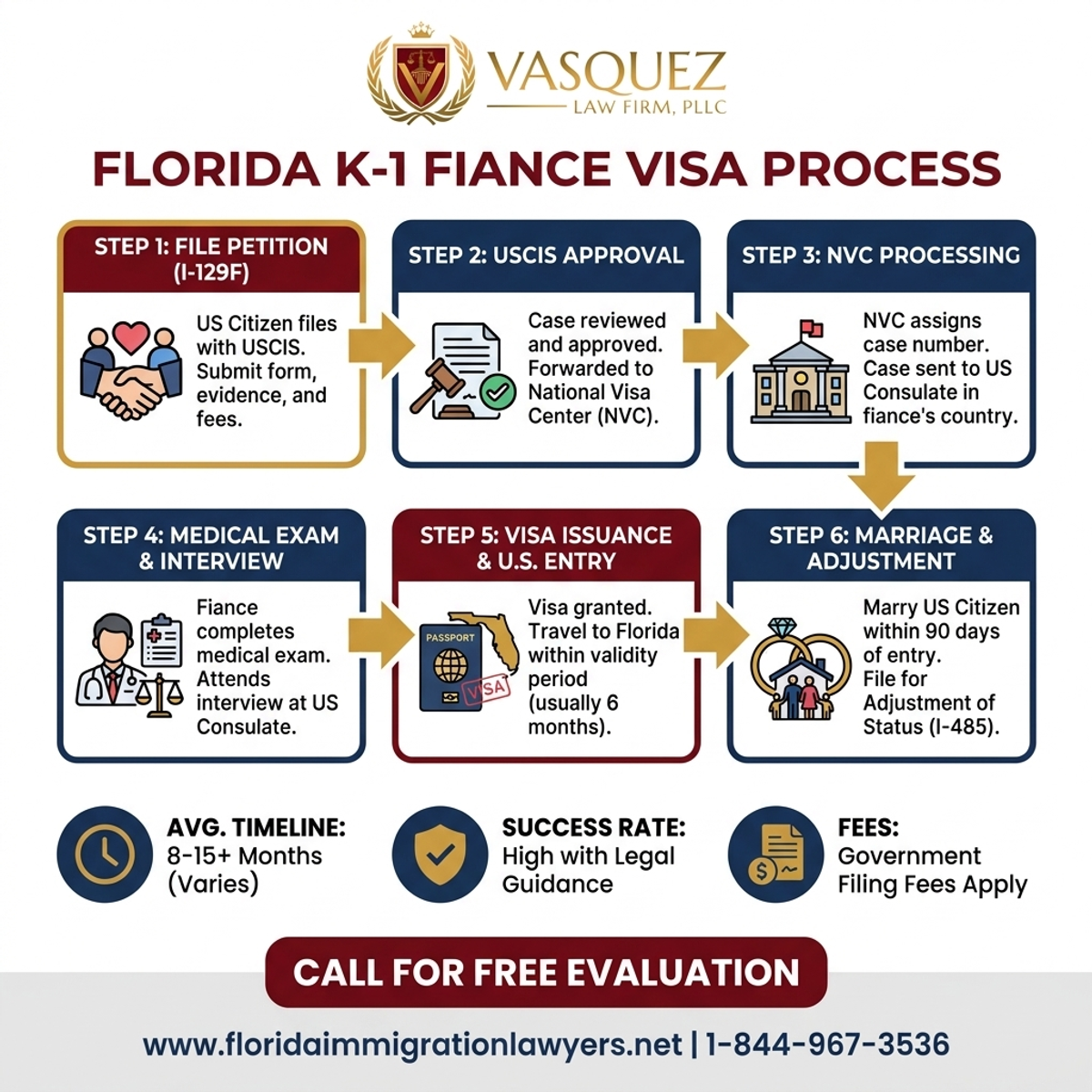
Step 1: Filing Form I-129F, Petition for Alien Fiancé(e)
The U.S. citizen petitioner initiates the process by filing Form I-129F with USCIS. This petition serves to establish the bona fides (genuineness) of the relationship and the intent to marry. Required supporting documents typically include:
- Proof of U.S. citizenship (e.g., birth certificate, valid U.S. passport)
- Proof of intent to marry (e.g., sworn statements from both parties, wedding plans)
- Proof of having met in person within two years (e.g., flight itineraries, hotel receipts, passport stamps, extensive photos together)
- Proof of legal termination of any prior marriages for both parties (e.g., divorce decrees, death certificates)
- Passport-style photos of both the petitioner and beneficiary
Once filed, USCIS reviews the petition for completeness and eligibility. If approved, USCIS sends an approval notice (Form I-797) and electronically forwards the petition to the National Visa Center (NVC).
Step-by-Step Process — Fiance Visa K-1 Process in Florida | FL Immigration Lawyers
Step 2: National Visa Center (NVC) Processing
Upon receiving the approved petition from USCIS, the NVC assigns a unique case number. The NVC's role at this stage is primarily administrative; they will forward the case to the appropriate U.S. Embassy or Consulate in the foreign fiancé's home country. At this juncture, the NVC will instruct the beneficiary on how to proceed with the next steps, which typically involve paying required fees and submitting additional civil documents.
Step 3: Embassy/Consulate Interview and Medical Examination
Once the case arrives at the U.S. Embassy or Consulate, the foreign fiancé will be scheduled for a mandatory visa interview. Prior to this interview, the beneficiary must undergo a comprehensive medical examination by an authorized panel physician. This examination screens for certain communicable diseases, specified physical or mental disorders, and other health-related grounds of inadmissibility.
The visa interview is a critical stage where a Consular Officer will meticulously assess the genuineness of the relationship and the beneficiary's overall admissibility to the U.S. The officer will ask detailed questions about the relationship's history, future plans, and ensure all eligibility criteria are met. It's vital to be prepared, honest, and provide consistent information. If the interview is successful and all requirements are met, the K-1 visa will be issued, typically valid for six months.
Understanding the Financial Requirements and Affidavit of Support
One of the most critical aspects of the K-1 visa application, and indeed most family-based immigration processes, is demonstrating that the foreign fiancé will not become a "public charge" in the United States. This is primarily addressed through the Affidavit of Support, specifically Form I-134, "Affidavit of Support Under Section 213A of the INA." While Form I-134 is typically used for non-immigrant visas like the K-1, it serves a similar purpose to the more stringent Form I-864 used for adjustment of status, assuring the government of financial stability.
The U.S. citizen petitioner must prove they have an income at or above 100% of the U.S. poverty guidelines for their household size. The "household size" for K-1 purposes includes the petitioner, their dependents (if any), and the incoming fiancé. This financial requirement is crucial because it assures the U.S. government that the foreign fiancé will be financially supported by the petitioner and will not rely on public assistance. The poverty guidelines are updated annually and vary based on the number of people in the household.
To demonstrate financial capability, the petitioner will need to provide various documents, including:
- Tax returns (most recent three years, including all schedules)
- W-2s or 1099s (for all income sources)
- Recent pay stubs (typically for the last six months)
- Employment verification letter from their employer
- Bank statements (to show available funds)
- Proof of assets (if income alone is insufficient, such as real estate deeds, stock certificates, or bonds, which must be readily convertible to cash within one year)
If the petitioner's income alone does not meet the poverty guidelines, a joint sponsor (co-sponsor) may be required. A joint sponsor must also be a U.S. citizen or lawful permanent resident, be at least 18 years old, and meet the income requirements independently for their own household plus the K-1 beneficiary. The joint sponsor takes on the legal obligation to support the fiancé, just as the primary petitioner does. Understanding these financial obligations and accurately compiling the necessary documentation can be complex, and errors can lead to significant delays or even denials. Our team can meticulously review your financial documents to ensure full compliance with all USCIS requirements.
Common Challenges and Pitfalls in the K-1 Visa Journey
While the K-1 visa offers a direct path to marriage and residency, the process is not without its hurdles. Many couples encounter challenges that can lead to delays, Requests for Evidence (RFEs), or even outright denials.
- Incomplete or Inaccurate Documentation: This is perhaps the most common reason for delays. Missing signatures, outdated forms, or insufficient evidence of a bona fide relationship can trigger RFEs, prolonging the process by several months.
- Failure to Prove Bona Fide Relationship: USCIS and consular officers are vigilant in detecting fraudulent relationships. Lack of sufficient evidence (photos, communication logs, travel history, joint activities, witness statements) can raise serious red flags.
- Financial Inadmissibility: As discussed, if the petitioner cannot meet the financial requirements, or if the Affidavit of Support is improperly prepared or lacks sufficient evidence, the visa can be denied.
- Criminal History or Prior Immigration Violations: Both the petitioner and beneficiary are subject to thorough background checks. A history of certain crimes (e.g., domestic violence, drug offenses, sexual assault) or previous immigration violations (e.g., overstaying a visa, illegal entry, misrepresentation) can lead to inadmissibility. In such complex cases, waivers may be available, but they are highly intricate and require expert legal assistance. If you or your fiancé have a complex history, it's crucial to seek legal counsel immediately to understand potential impacts and explore all available options, including deportation defense if past issues could lead to removal proceedings.
- Misrepresentation or Fraud: Providing false information or attempting to conceal facts at any stage of the application can result in severe penalties, including a permanent bar from entering the U.S.
- Medical Inadmissibility: Failure to pass the medical examination due to certain communicable diseases or other health conditions can also be a ground for denial, although waivers may sometimes be available.
Key Statistics — Fiance Visa K-1 Process in Florida | FL Immigration Lawyers
Addressing these challenges proactively with the guidance of an experienced immigration attorney can significantly improve your chances of a successful outcome and prevent costly delays.
Life After the K-1 Visa: Adjusting Status to Permanent Resident
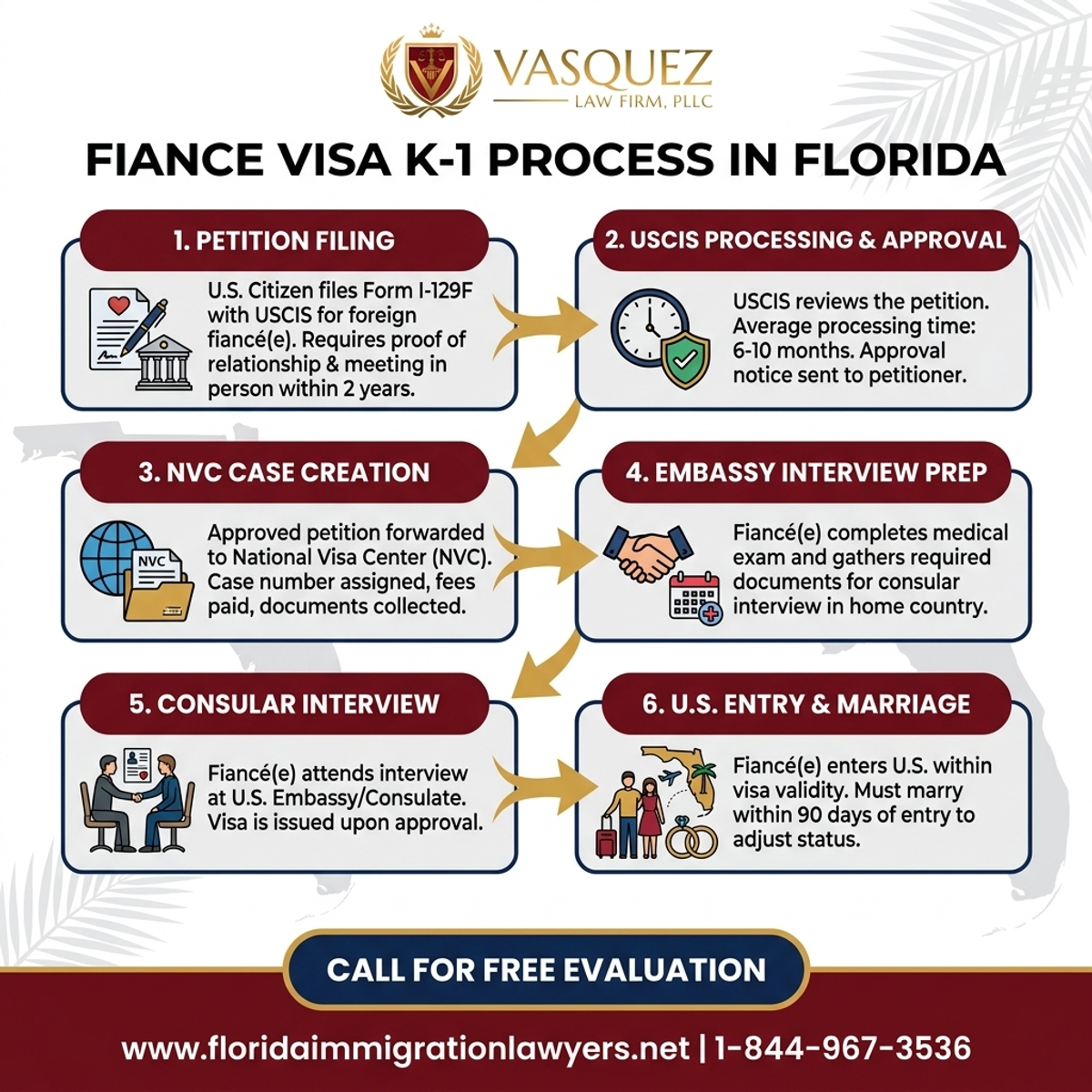
The K-1 visa is a temporary, non-immigrant visa. Its primary purpose is to allow the foreign fiancé to enter the U.S. specifically to marry the U.S. citizen petitioner. Once the K-1 visa holder enters the U.S., the clock starts ticking: they have a strict 90-day window to get married.
Marriage Within 90 Days:
It is absolutely imperative that the marriage takes place within this 90-day window. If the couple fails to marry within this period, the K-1 visa holder will fall out of status and must depart the U.S. Failure to depart can lead to serious immigration consequences, including accrual of unlawful presence and potential bars to future immigration benefits.
Adjustment of Status (Form I-485):
After the marriage, the K-1 visa holder (now spouse) must apply to adjust their status to that of a Lawful Permanent Resident (Green Card holder). This involves filing Form I-485, "Application to Register Permanent Residence or Adjust Status," along with various supporting documents, including:
- Proof of valid marriage (official marriage certificate)
- Proof of the petitioner's U.S. citizenship
- Medical examination results (if not submitted with K-1 or if expired)
- Affidavit of Support (Form I-864), which is more stringent and legally binding than the I-134 used for the K-1
- Birth certificates, passport copies, and other biographical documents
- Extensive evidence of a bona fide marriage (e.g., joint bank accounts, joint leases or property deeds, joint insurance policies, utility bills in both names, shared financial responsibilities, photos together, affidavits from friends and family)
The Adjustment of Status Interview:
Most couples will be scheduled for an interview with a USCIS officer. This interview is designed to confirm the legitimacy and ongoing nature of the marriage and ensure all eligibility requirements for permanent residency are met. The officer will ask detailed questions about your relationship, daily life, and future plans. It's highly advisable to attend this interview with your spouse and be prepared to present additional, compelling evidence of your genuine marriage.
Conditional Permanent Residence:
If the marriage is less than two years old at the time the green card is approved, the foreign spouse will receive a conditional green card valid for two years. Before this two-year period expires, the couple must file Form I-751, "Petition to Remove Conditions on Residence," to prove the marriage is still
Sources and References
- U.S. Citizenship and Immigration Services (USCIS)
- Executive Office for Immigration Review (EOIR)
- U.S. Department of State - Bureau of Consular Affairs
- Immigration and Nationality Act (INA), 8 U.S.C. Chapter 12
Do Not Navigate This Process Alone
Our experienced immigration attorneys are ready to fight for you. Get a free, confidential consultation today.
Se Habla Español
Frequently Asked Questions
Florida Immigration Lawyers
Immigration Attorney | Founder, Vasquez Law Firm
U.S. Air Force veteran and immigration attorney with thousands of cases resolved. J.D., NCCU School of Law. AILA member. Admitted to the 4th, 5th, and 11th Circuit Courts.
Available 24/7 - Free Evaluations
Related Legal Services
Our Florida immigration attorneys can help you with free immigration consultation, experienced immigration attorneys and business immigration. Call today at 1-844-967-3536 for a free consultation.
Related Links
Related Topics
Free Legal Consultation
Discuss your case with our experienced attorneys. We're available 24/7.
Se Habla Español - Estamos aquí para ayudarle.
Related Articles
Immigration Court Proceedings Florida: Your Guide | VLF Florida
Facing immigration court proceedings in Florida can be overwhelming, with high stakes involving potential deportation. This guide from Florida Immigration Lawyers clarifies the complex process, from understanding removal proceedings overseen by an immigration judge within the EOIR, to navigating hearings, identifying defense options like asylum or cancellation of removal, and preparing essential documentation. We also cover timelines, cost factors, and crucial mistakes to avoid, emphasizing the critical role of legal representation for individuals in Coral Springs, Miami, Orlando, and throughout Florida. Learn how our dedicated team can help protect your rights and fight for your future.
Immigration Services in Jacksonville, Florida | VLF Florida
Explore immigration services in Jacksonville, Florida, with expert guidance from Florida Immigration Lawyers. From visas to citizenship, our experienced attorneys are here to help you navigate the complex immigration system. Contact us for a free consultation.
Immigration Lawyer Hialeah Florida: Expert Guidance
Finding an immigration lawyer in Hialeah, Florida, is crucial for navigating complex immigration laws. Our experienced team offers bilingual support and personalized guidance. Discover key factors, common mistakes, and when to call an expert.
TPS to Green Card Pathway in Florida | VLF Florida
Navigating the pathway from TPS to a green card in Florida involves understanding eligibility and the adjustment of status process. Contact Florida Immigration Lawyers for guidance.