F-1 Reinstatement Process for Students in Florida | VLF Flor
Learn about the F-1 reinstatement process for students in Florida who have fallen out of status. Discover necessary steps, common pitfalls, and when to seek legal help. Call Florida Immigration Lawyers for a free consultation.

F-1 Reinstatement Process for Students in Florida | VLF Florida
Maintaining lawful immigration status is paramount for international students in the United States. For those holding an F-1 student visa, falling “out of status” can lead to severe consequences, including the potential for deportation and future bars from re-entering the country. If you find yourself in this precarious situation in Florida, understanding the F-1 reinstatement process is critical. At VLF Florida, we specialize in guiding students through the complexities of U.S. immigration law, helping them navigate the path to regaining their lawful F-1 status.
The F-1 reinstatement process is designed to offer a lifeline to eligible students who have inadvertently violated their F-1 status. It’s a complex application that requires meticulous attention to detail, a thorough understanding of immigration regulations, and compelling evidence to demonstrate that the violation was not willful. Our experienced immigration attorneys are here to provide the expert legal assistance you need to present the strongest possible case to U.S. Citizenship and Immigration Services (USCIS).
What is F-1 Reinstatement?
F-1 reinstatement is an application filed with USCIS (Form I-539, Application to Extend/Change Nonimmigrant Status) that allows an F-1 student who has fallen out of lawful status to regain that status without having to leave the United States. When an F-1 student violates the terms of their visa, such as by failing to maintain a full course of study, engaging in unauthorized employment, or letting their I-20 expire without proper action, they are considered “out of status.” This means they are no longer legally present in the U.S. under their F-1 visa.
The purpose of reinstatement is to allow eligible students to continue their academic programs in the U.S. without interruption, provided they can demonstrate that their violation was due to circumstances beyond their control or that the violation was minor and not willful. Successfully reinstating your F-1 status means that you will once again be considered lawfully present in the U.S. as an F-1 student, able to continue your studies, and maintain eligibility for benefits like Optional Practical Training (OPT) or Curricular Practical Training (CPT).
Eligibility Criteria for F-1 Reinstatement
To be eligible for F-1 reinstatement, you must meet several strict criteria set forth by USCIS. Failing to meet even one of these requirements can lead to a denial of your application. Key eligibility requirements include:
- No Willful Violation: You must demonstrate that your violation of F-1 status was due to circumstances beyond your control, or that the violation was minor and not willful. Examples of circumstances beyond your control might include serious illness, an accident, or an error by your Designated School Official (DSO).
- No Unauthorized Employment: You must not have engaged in unauthorized employment. Any work performed without proper authorization from USCIS or your DSO will likely disqualify you from reinstatement.
- Currently Pursuing or Intending to Pursue a Full Course of Study: You must be currently pursuing, or intend to pursue, a full course of study at a SEVP-approved school. You will need a new I-20 from your school, recommending reinstatement.
- No Previous Deportation Proceedings: You must not have been served with an Order to Show Cause (OSC) or a Notice of Intent to Deny (NOID) for a previous immigration violation, nor be currently in deportation proceedings.
- Not Accrued Unlawful Presence: You must not have accrued more than 5 months of unlawful presence in the U.S. since the date you fell out of status, unless you can prove exceptional circumstances.
- No Other Immigration Violations: You must not have committed any other violations of immigration laws, such as criminal offenses or misrepresentation.
Understanding these criteria and preparing a compelling case is where the expertise of an immigration attorney becomes invaluable. We can help you assess your eligibility and gather the necessary documentation.
Common Reasons for Falling Out of F-1 Status
Students can fall out of F-1 status for various reasons, often unintentionally. Some of the most common include:
- Failing to Maintain a Full Course of Study: F-1 students are generally required to be enrolled full-time. Dropping below the required credit hours without prior authorization from your DSO is a common violation.
- Unauthorized Employment: Working off-campus without CPT or OPT authorization, or working more hours than permitted on-campus, constitutes unauthorized employment.
- Expired I-20: Failing to extend your I-20 before its expiration date, or not transferring to a new school in a timely manner.
- Failure to Report Changes: Not informing your DSO of changes to your name, address, or program of study.
- Withdrawal from School: Withdrawing from your program without proper notification or transfer procedures.
- Academic Suspension: Being suspended or expelled from your academic institution.
It's crucial to address these issues promptly. The longer you remain out of status, the more complex and difficult the reinstatement process becomes.
The F-1 Reinstatement Application Process
The F-1 reinstatement process is detailed and requires careful preparation. Here’s a general overview of the steps involved:
- Obtain a New I-20 Recommending Reinstatement: Your first step is to contact your Designated School Official (DSO) at your academic institution. You will need to explain your situation and request a new Form I-20, “Certificate of Eligibility for Nonimmigrant Student Status,” with the box checked indicating that reinstatement is being recommended. This I-20 is crucial as it officially acknowledges your school's support for your continued studies.
- Prepare Form I-539, Application to Extend/Change Nonimmigrant Status: This is the primary form for your application. It must be filled out accurately and completely. Any errors or omissions can lead to delays or a Request for Evidence (RFE).
- Draft a Detailed Letter of Explanation: This is arguably the most critical component of your application. You must write a compelling letter explaining in detail how and why you fell out of status, demonstrating that the violation was not willful and was due to circumstances beyond your control. You must also explain why you believe you are eligible for reinstatement and why USCIS should approve your application. Supporting documentation for your explanation (e.g., medical records, letters from advisors, financial statements) should be included.
- Gather Supporting Documents: Collect all necessary documentation, which typically includes:
- Your current passport and visa.
- Copies of all previous I-20s.
- Your academic transcripts and enrollment history.
- Proof of financial ability to cover your tuition and living expenses.
- I-94 Arrival/Departure Record.
- Any other evidence supporting your explanation letter (e.g., medical certificates, letters from school officials, police reports if applicable).
- Pay the Filing Fee: The Form I-539 requires a filing fee, which must be submitted with your application.
- Submit the Application to USCIS: Once all documents are prepared, reviewed, and organized, the complete application package is mailed to the appropriate USCIS service center.
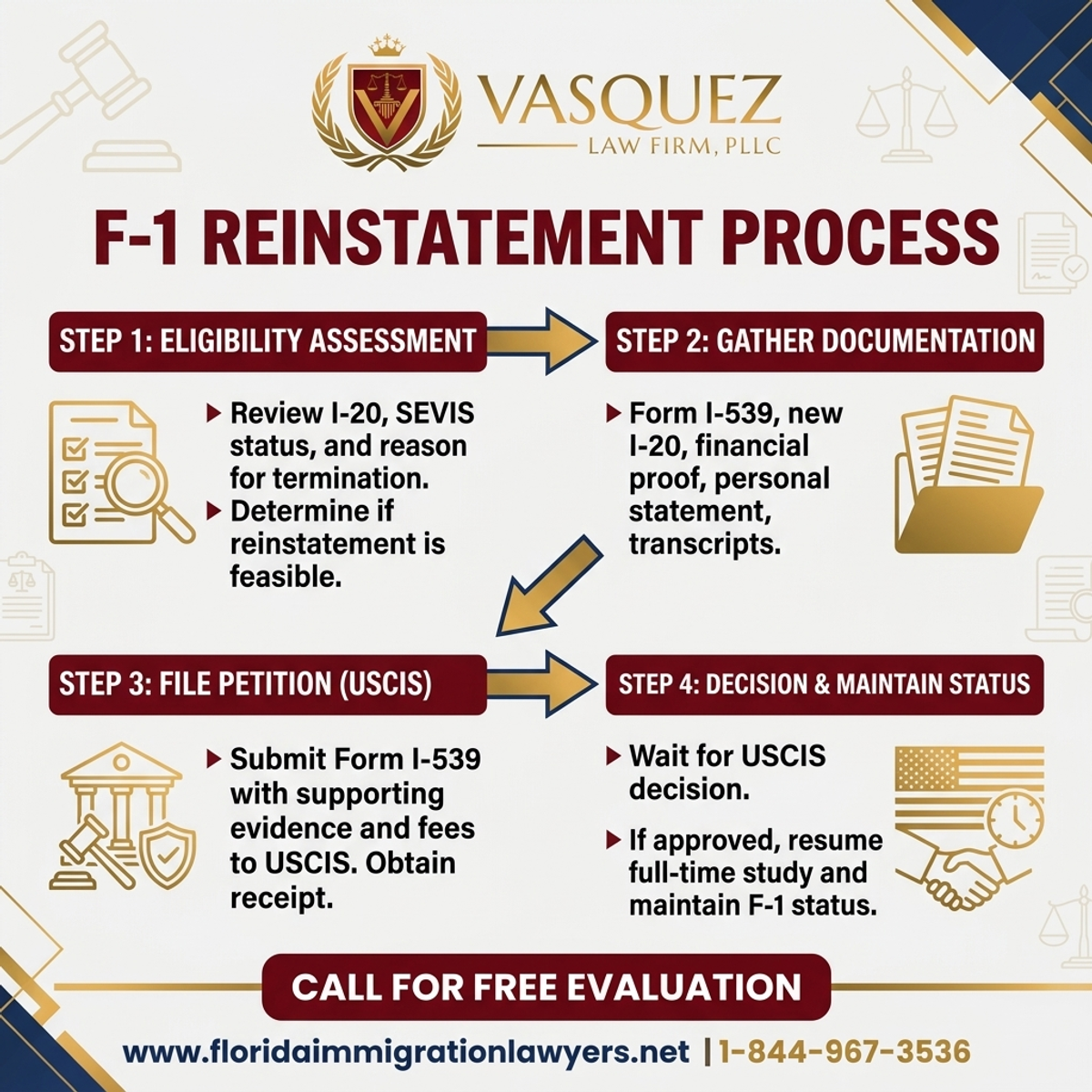
Step-by-Step Process — F-1 Reinstatement Process for Students in Florida | VLF Florida
Due to the complexity and the high stakes involved, it is highly recommended to seek legal counsel from an experienced immigration lawyer to assist you with preparing and filing your reinstatement application.
Consequences of Not Reinstating F-1 Status and Potential Alternatives
Failing to successfully reinstate your F-1 status can have severe and long-lasting consequences for your immigration future. The most immediate risk is accruing unlawful presence. If you remain in the U.S. out of status for more than 180 days, you could face a 3-year bar from re-entering the U.S. If you accrue more than one year of unlawful presence, you could face a 10-year bar. This can significantly impact your ability to obtain future visas or green cards.
Furthermore, without lawful status, you become vulnerable to deportation proceedings. USCIS may issue a Notice to Appear (NTA), initiating removal proceedings against you. This is a stressful and complex legal battle that requires immediate and skilled legal intervention. Our firm has extensive experience in deportation defense and can represent you should your situation escalate to this level.
While F-1 reinstatement is often the best path, in certain situations, it might not be feasible or advisable. Alternatives are limited but could include:
- Departing the U.S. and Applying for a New Visa: This is a common but risky alternative. You would leave the U.S. and apply for a new F-1 visa at a U.S. consulate or embassy in your home country. However, the consulate will scrutinize your previous overstay or violation, and there's no guarantee of approval.
- Exploring Other Visa Options: In rare cases, if you qualify for another nonimmigrant or immigrant visa (e.g., through marriage to a U.S. citizen, or an employment-based visa), you might be able to change your status. This is highly dependent on individual circumstances and eligibility.
- Asylum: In extremely rare and dire circumstances, if returning to your home country poses a significant threat to your safety or freedom, you might consider applying for asylum. This is a complex and entirely different legal process, typically not related to F-1 status violations, and should only be pursued if you genuinely fear persecution.
It's crucial to discuss all potential options with a qualified immigration attorney before making any decisions that could jeopardize your future in the U.S.
What Happens After Filing?
Once your F-1 reinstatement application (Form I-539) is filed with USCIS, you will typically receive a receipt notice confirming that your application has been received. This receipt notice is important as it provides proof of your pending application.
The processing times for I-539 applications can vary significantly, often taking several months to over a year. During this time, you are generally permitted to remain in the U.S. while your application is pending, provided you have not accrued significant unlawful presence prior to filing. USCIS may also send a Request for Evidence (RFE) if they require additional information or clarification regarding your application. Responding to an RFE promptly and thoroughly is critical to the success of your case.
Possible outcomes include:
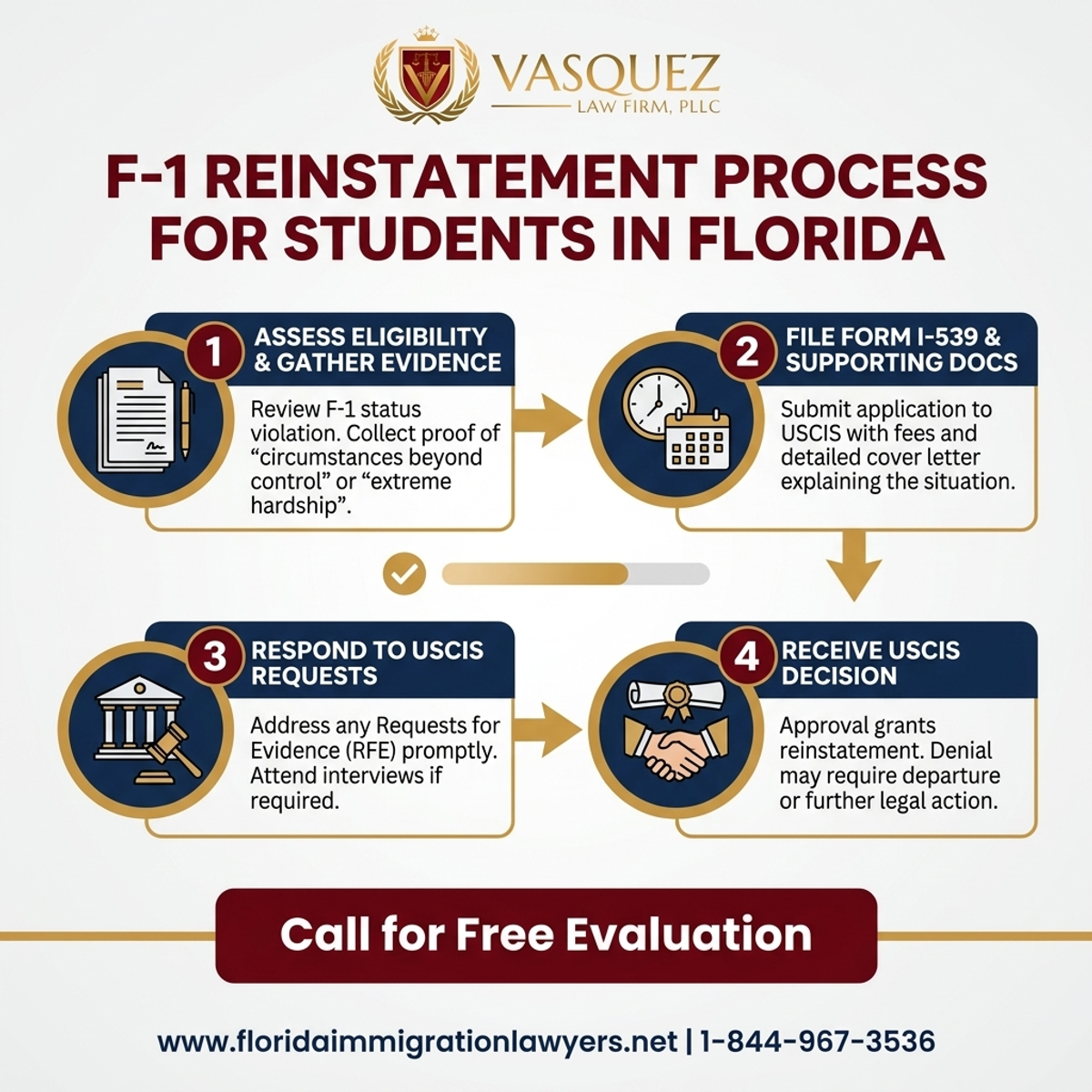
Key Statistics — F-1 Reinstatement Process for Students in Florida | VLF Florida
- Approval: If approved, you will receive an I-797 approval notice, and your F-1 status will be reinstated. You will then be able to continue your studies lawfully.
- Denial: If denied, you will receive a denial notice explaining the reasons. A denial means you are once again out of status and may be required to leave the U.S. immediately. In such cases, consulting with an attorney about potential appeals or other options is vital.
Maintaining F-1 Status Proactively
Prevention is always better than cure, especially when it comes to immigration status. Proactively maintaining your F-1 status can help you avoid the stressful and complicated reinstatement process altogether. Here are key practices to ensure you remain in good standing:
- Enroll Full-Time: Always maintain a full course of study as required by your program and school. If you need to drop below full-time for any reason (e.g., medical condition, final semester), always obtain prior written authorization from your DSO.
- Avoid Unauthorized Employment: Never work off-campus without proper authorization (CPT or OPT) or exceed the permitted hours for on-campus employment. Unauthorized work is a serious violation.
- Keep Your I-20 Valid: Monitor the expiration date on your Form I-20. If you need more time to complete your program, apply for an I-20 extension well in advance of its expiration.
- Report Changes Promptly: Inform your DSO immediately of any changes to your personal information (name, address), academic program, or funding sources.
- Understand Your Grace Period: Know that you have a 60-day grace period after completing your program or OPT to either depart the U.S., transfer to another school, or change to another immigration status. Plan accordingly.
- Attend All Required Sessions: Participate in any mandatory international student orientations or workshops offered by your school, as these often provide crucial information about maintaining your status.
By diligently following these guidelines and staying in close communication with your DSO, you can significantly reduce the risk of falling out of F-1 status.
Seeking Legal Assistance for F-1 Reinstatement in Florida
The F-1 reinstatement process is intricate, demanding a precise understanding of immigration law and meticulous attention to detail. A single error or omission in your application can lead to significant delays or even outright denial, jeopardizing your academic future in the U.S.
At VLF Florida, our dedicated team of immigration attorneys possesses extensive experience in handling F-1 reinstatement cases for students across Florida. We understand the unique challenges international students face and are committed to providing compassionate, effective legal representation. We can help you:
- Assess your eligibility for reinstatement.
- Gather and organize all necessary documentation.
- Draft a compelling and persuasive letter of explanation.
- Respond to Requests for Evidence (RFEs) from USCIS.
- Navigate the complexities of immigration regulations.
- Represent you in any necessary interactions with USCIS.
Don't face this challenging process alone. Protect your academic future and your ability to remain in the U.S. lawfully. Contact VLF Florida today for a confidential consultation to discuss your F-1 reinstatement options. We are here to provide the expert legal guidance you need to achieve a successful outcome.
Frequently Asked Questions About F-1 Reinstatement
1. How long does the F-1 reinstatement process take?
Processing times vary significantly based on the USCIS service center and current caseloads, but it can typically take anywhere from 6 months to over a year. It's crucial to file as soon as possible after falling out of status.
2. Can I continue studying while my reinstatement application is pending?
Generally, yes. If you filed a timely and properly documented I-539 application for reinstatement, you are usually permitted to continue your studies while your application is pending with USCIS.
3. What if my F-1 reinstatement application is denied?
If your application is denied, you will be considered out of status and may need to leave the U.S. promptly to avoid accruing further unlawful presence. You should consult with an immigration attorney immediately to discuss potential options, such as filing a motion to reconsider or departing the U.S. and applying for a new F-1 visa abroad.
4. Can I travel outside the U.S. while my reinstatement application is pending?
It is generally not advisable to travel outside the U.S. while your F-1 reinstatement application is pending. Leaving the country typically constitutes an abandonment of your application. If you must travel, consult with an attorney first.
5. What is the difference between F-1 reinstatement and applying for a new F-1 visa?
F-1 reinstatement allows you to regain lawful status within the U.S. without leaving. Applying for a new F-1 visa requires you to depart the U.S. and apply at a U.S. embassy or consulate in your home country, which can be risky if you have a history of status violations.
6. What role does my DSO play in the reinstatement process?
Your Designated School Official (DSO) is crucial. They must issue a new I-20 recommending reinstatement and can provide guidance on your academic standing and school policies. They cannot, however, provide legal advice on the immigration process itself.
7. Do I need an attorney for F-1 reinstatement?
While not legally required, hiring an experienced immigration attorney is highly recommended. The process is complex, and an attorney can help you navigate the legal requirements, prepare a strong case, and respond to any USCIS inquiries, significantly increasing your chances of approval.
8. What if my I-20 expired more than 5 months ago?
If you have been out of status for more than 5 months, you may still be eligible for reinstatement if you can prove that the delay was due to exceptional circumstances and that you filed the application as soon as possible. This is a more challenging scenario and definitely warrants legal counsel.
Sources and References
- U.S. Citizenship and Immigration Services (USCIS)
- Executive Office for Immigration Review (EOIR)
- U.S. Department of State - Bureau of Consular Affairs
- Immigration and Nationality Act (INA), 8 U.S.C. Chapter 12
Do Not Navigate This Process Alone
Our experienced immigration attorneys are ready to fight for you. Get a free, confidential consultation today.
Se Habla Español
Frequently Asked Questions
Florida Immigration Lawyers
Immigration Attorney | Founder, Vasquez Law Firm
U.S. Air Force veteran and immigration attorney with thousands of cases resolved. J.D., NCCU School of Law. AILA member. Admitted to the 4th, 5th, and 11th Circuit Courts.
Available 24/7 - Free Evaluations
Related Legal Services
Our Florida immigration attorneys can help you with citizenship and naturalization, family immigration services and immigration practice areas. Call today at 1-844-967-3536 for a free consultation.
Related Links
Related Topics
Free Legal Consultation
Discuss your case with our experienced attorneys. We're available 24/7.
Se Habla Español - Estamos aquí para ayudarle.
Related Articles
Immigration Lawyer in Hialeah: Your Guide | VLF Florida
Looking for an immigration lawyer in Hialeah, Florida? Discover how to choose the right legal expert to navigate your immigration journey. Call Florida Immigration Lawyers at 1-844-967-3536 for a free consultation.
Credible Fear Interview Preparation in Florida | VLF Florida
Prepare for your credible fear interview in Florida with expert guidance. Learn what to expect and how to enhance your chances of success. Call Florida Immigration Lawyers for a free consultation today.
DACA Renewal Guide for Florida Dreamers 2026 | VLF Florida
Learn how to renew your DACA in Florida for 2026. This comprehensive guide covers eligibility, document preparation, and processing timelines. Contact Florida Immigration Lawyers for assistance.
Understanding Special Immigrant Juvenile Status in Florida
Special Immigrant Juvenile Status (SIJS) provides a lifeline for minors in Florida facing abuse or neglect. Learn about eligibility, the application process, and common pitfalls to avoid. Contact Florida Immigration Lawyers for a free consultation.