Understanding Special Immigrant Juvenile Status in Florida
Special Immigrant Juvenile Status (SIJS) provides a lifeline for minors in Florida facing abuse or neglect. Learn about eligibility, the application process, and common pitfalls to avoid. Contact Florida Immigration Lawyers for a free consultation.
Special Immigrant Juvenile Status (SIJS) is a pathway for minors in the U.S. who have been abused, neglected, or abandoned to obtain lawful permanent residence. Key points include:
- SIJS is designed for minors under the age of 21.
- Eligibility requires a juvenile court order.
- Florida offers specific resources and legal support.
- Consulting with an immigration attorney is crucial.
Introduction
In the heart of Florida, Naples is a city that welcomes diverse cultures and offers a supportive community for immigrants. Yet, for minors facing the challenges of abuse, neglect, or abandonment, navigating U.S. immigration laws can be daunting. This is where Special Immigrant Juvenile Status (SIJS) becomes essential, offering a lifeline to vulnerable youth seeking safety and stability. This article will guide you through the intricacies of SIJS in Florida, covering eligibility, the application process, and common pitfalls to avoid. Call Florida Immigration Lawyers at 1-844-967-3536 for a free consultation.
What is Special Immigrant Juvenile Status (SIJS)?
Special Immigrant Juvenile Status (SIJS) is a classification under U.S. immigration law that provides certain undocumented minors with the opportunity to apply for lawful permanent residency. To qualify, the juvenile must be present in the United States and a court must determine that reunification with one or both parents is not viable due to abuse, neglect, or abandonment.
In Florida, the SIJS process involves collaboration with both state juvenile courts and federal immigration authorities, typically the USCIS. It's a vital option for those minors who, due to their circumstances, cannot return to their home countries safely.
According to the U.S. Citizenship and Immigration Services (USCIS), SIJS is part of the Immigration and Nationality Act (INA) and helps protect eligible immigrant minors from deportation, allowing them to integrate into American society.
How to Apply for SIJS: A Step-by-Step Guide
- Obtain a Juvenile Court Order: The first step in the SIJS process is to secure an order from a Florida juvenile court. This order must state that the minor is dependent on the court or in the custody of a state agency or individual appointed by the court.
- File Form I-360: Once the court order is obtained, the next step is to file Form I-360, Petition for Amerasian, Widow(er), or Special Immigrant, with the USCIS. This form must be filed before the minor turns 21.
- Adjustment of Status: After the I-360 is approved, the minor can apply for adjustment of status to become a lawful permanent resident. This is done by filing Form I-485.
- Attend Biometrics Appointment: The USCIS will schedule a biometrics appointment to collect fingerprints and photos of the applicant.
- Interview and Decision: An interview with USCIS may be required, after which a decision on the application will be made.
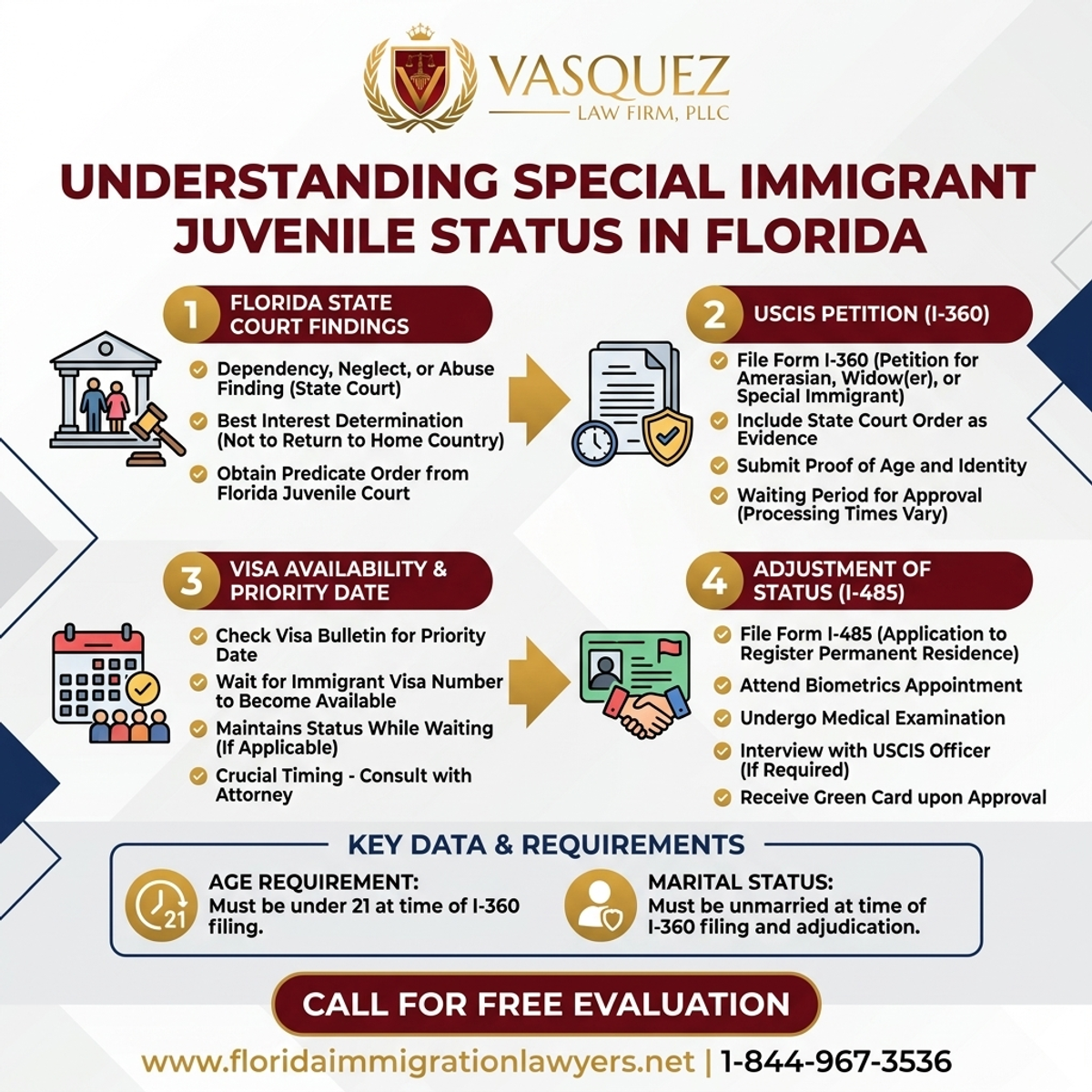
Step-by-Step Process — Understanding Special Immigrant Juvenile Status in Florida
Document Checklist for SIJS
- Juvenile court order
- Birth certificate or other proof of age
- Form I-360
- Form I-485 (for adjustment of status)
- Proof of dependency or custody
- Evidence of abuse, neglect, or abandonment
- Biometrics appointment notice
Timeline and Processing Expectations
The timeline for obtaining SIJS can vary significantly depending on individual circumstances and the caseload of the courts and USCIS. Typically, the initial juvenile court proceedings may take several months, while the processing of the I-360 form can take additional months.
Once the I-360 is approved, the adjustment of status process can begin, which may take another 8 to 14 months. In total, from start to finish, the SIJS process often spans 1 to 2 years. It's crucial to begin the process as early as possible to ensure all steps are completed before the applicant turns 21.
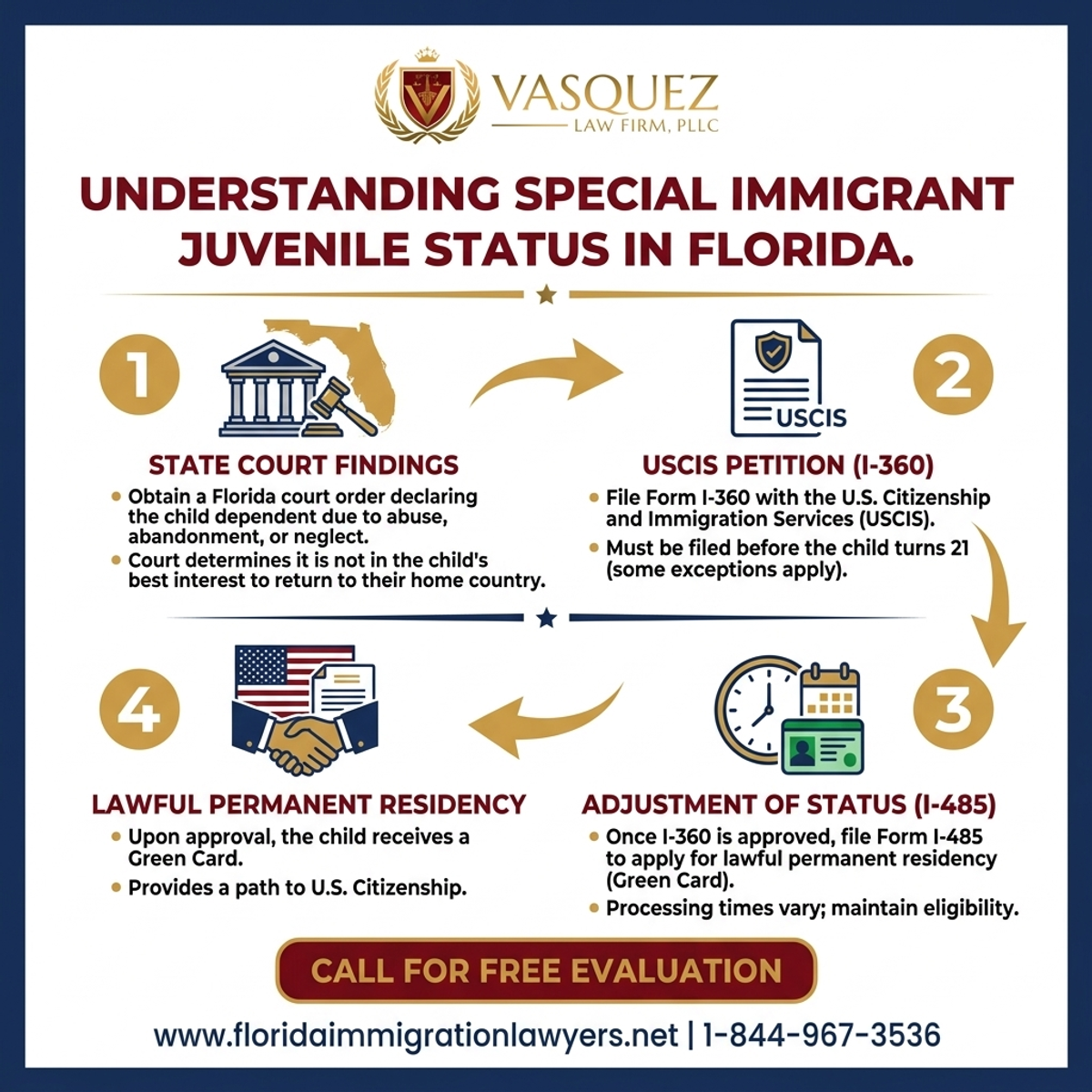
Key Statistics — Understanding Special Immigrant Juvenile Status in Florida
Cost Factors and Fee Breakdown
The cost of applying for SIJS includes various fees associated with court filings, USCIS applications, and legal assistance. While some fees may be waived for those who cannot afford them, others are standard parts of the process.
Court fees in Florida for obtaining a juvenile order can vary. USCIS fees for filing Form I-360 and Form I-485 must also be considered. Additionally, legal representation costs should be accounted for, as having an experienced immigration attorney can significantly increase the likelihood of a successful outcome.
Common Mistakes to Avoid
- Filing after age 21: Ensure all forms are submitted before the applicant turns 21.
- Incomplete court orders: Court orders must address all required findings explicitly.
- Incorrect form submissions: Double-check forms for accuracy and completeness.
- Failure to attend court hearings: Missing hearings can delay or derail the process.
- Lack of supporting evidence: Provide thorough documentation of the minor's situation.
- Mistakes in biometrics: Ensure all appointments are attended and correct information is provided.
- Not consulting with an attorney: Professional guidance can prevent costly errors.
- Overlooking fee waivers: If eligible, apply for fee waivers to reduce costs.
When to Call a Lawyer
Given the complexity of immigration law, it's advisable to consult with a lawyer if you're considering applying for SIJS. Scenarios requiring legal help include difficulties obtaining the necessary court orders, complications in filing applications, or if the minor has a criminal record.
Florida Immigration Lawyers specialize in helping clients navigate these challenges, offering personalized guidance to ensure all legal requirements are met. If you have questions or need assistance, contact us for a consultation.
About Florida Immigration Lawyers
Florida Immigration Lawyers is a leading firm providing expert advice and representation for immigration matters across Florida. Our experienced attorneys are dedicated to helping clients achieve successful outcomes by offering personalized legal solutions. We are available 24/7 at 1-844-967-3536 for free consultations. Visit us at floridaimmigrationlawyers.net.
Sources and References
- U.S. Citizenship and Immigration Services (USCIS)
- Executive Office for Immigration Review (EOIR)
- 8 U.S.C. Chapter 12 - Immigration and Nationality Act
Related services: immigration practice areas, family immigration services, citizenship and naturalization, deportation defense.
This article provides general legal information and is not intended as legal advice. Every case is unique, and outcomes depend on specific facts and circumstances. Contact an attorney for advice about your particular situation.
Do Not Navigate This Process Alone
Our experienced immigration attorneys are ready to fight for you. Get a free, confidential consultation today.
Se Habla Español
Or leave your details and we’ll call you:
Free Evaluation in 24 Hours
Or talk to us right now
AI voice assistant — available 24/7
FreeFrequently Asked Questions

William J. Vásquez
Founding Attorney · Vasquez Law Firm
U.S. Air Force veteran and immigration attorney with years of hands-on U.S. immigration experience. J.D., NCCU School of Law. AILA member. Admitted to the 4th, 5th, and 11th Circuit Courts.
Available 24/7 - Free Evaluations
Reviewed for legal accuracy by William J. Vásquez
Licensed in North Carolina; U.S. immigration is federal practice.
Related Legal Services
Our Florida immigration attorneys can help you with free immigration consultation, experienced immigration attorneys and business immigration. Call today at 1-844-967-3536 for a free consultation.
Related Links
Related Topics
Free Legal Consultation
Discuss your case with our experienced attorneys. We're available 24/7.
Se Habla Español - Estamos aquí para ayudarle.
Related Articles
Military Naturalization Expedited in Florida Bases
Explore military naturalization options for families at Florida bases, including parole in place benefits in Miami. Learn how to expedite your application with expert guidance from Florida Immigration Lawyers.
Immigration Lawyer Orlando Free Consultation 2026
Explore the cost of an immigration lawyer in Orlando in 2026. Understand attorney fees, what to expect during a consultation, and how to make the best choice for your immigration needs.
Credible Fear Interview Lawyer in Florida: What You Need to
Facing a credible fear interview can be daunting. This post provides a comprehensive guide to help you prepare for this critical step in the asylum process. Understand the interview process, gather necessary documentation, and learn when to seek legal assistance. Call Florida Immigration Lawyers at 1-844-967-3536 for a free consultation and expert guidance.
F-1 Reinstatement Process for Students in Florida 2026
The F-1 reinstatement process is vital for students in Florida who have fallen out of status. Learn how to navigate this procedure, complete necessary forms, and avoid common mistakes. For personalized assistance, call Florida Immigration Lawyers at 1-844-967-3536.