I-601A Provisional Waiver Plantation: Your 2026 Guide
For many in Florida, the I-601A Provisional Waiver is a vital pathway to lawful permanent residency, specifically addressing inadmissibility due to unlawful presence. This stateside waiver allows eligible individuals to seek a waiver while still in the U.S., significantly reducing family separation during the immigrant visa process. Key to its success is demonstrating "extreme hardship" to a qualifying U.S. citizen or LPR spouse or parent, a complex legal standard requiring robust evidence. This comprehensive guide, tailored for 2026, covers eligibility, the step-by-step application process, required documentation, and current processing times and fees. We also highlight common pitfalls to avoid and emphasize when to seek professional legal assistance. Florida Immigration Lawyers offers expert guidance to families in Plantation, Hollywood, and across Florida, ensuring meticulous preparation and strong representation for your I-601A application.

The I-601A Provisional Waiver allows certain immediate relatives of U.S. citizens or lawful permanent residents to waive grounds of inadmissibility related to unlawful presence before leaving the United States for their immigrant visa interview abroad. This crucial option helps keep families together by minimizing the time spent separated during the visa process. To qualify, applicants in Florida must demonstrate extreme hardship to a U.S. citizen or LPR spouse or parent, have an approved I-130 petition, and meet other specific criteria. Understanding this complex process is vital for success.
- The I-601A waiver addresses inadmissibility due to unlawful presence.
- Applicants must prove "extreme hardship" to a qualifying U.S. citizen or LPR relative.
- The application is filed while the applicant is physically present in the U.S.
- Approval allows the applicant to attend their visa interview abroad with the waiver pre-approved.
- Expert legal guidance is highly recommended for navigating the I-601A process effectively.
Navigating the complex landscape of U.S. immigration law can feel overwhelming, especially when the future of your family hangs in the balance. For many individuals in Florida, particularly those in areas like Plantation, Hollywood, and Fort Lauderdale, the dream of obtaining lawful permanent residency is often complicated by past unlawful presence in the United States. This issue can trigger significant bars to admissibility, making it challenging to adjust status or return to the U.S. after an immigrant visa interview abroad.
Fortunately, the I-601A Provisional Waiver offers a lifeline, allowing eligible individuals to address and waive these unlawful presence bars before departing the U.S. for their consular interview. This "stateside waiver" is designed to reduce the period of family separation, providing a more streamlined and less stressful path to a green card. Understanding the intricacies of this waiver, from eligibility requirements to the critical demonstration of extreme hardship, is paramount for a successful application.
At Florida Immigration Lawyers, we understand the profound impact immigration challenges have on families across the Sunshine State. Our dedicated team is committed to guiding you through every step of the I-601A process, ensuring your application is meticulously prepared and strongly presented. If you or a loved one in Florida is considering the I-601A provisional waiver, do not face this journey alone. Call Florida Immigration Lawyers at 1-844-967-3536 for a free consultation and let us help you explore your options. You can also learn more about our comprehensive immigration services on our website.
What is the I-601A Provisional Waiver and Who is Eligible in Florida?
The I-601A Provisional Waiver, often called the "stateside waiver," allows certain immediate relatives of U.S. citizens or lawful permanent residents to provisionally waive bars to admissibility due to unlawful presence before leaving the U.S. for their immigrant visa interview abroad. As of 2026, eligibility primarily extends to those who are physically present in the U.S., are at least 17 years old, and can demonstrate extreme hardship to a qualifying U.S. citizen or LPR spouse or parent. This pathway helps families in Florida avoid lengthy separation.
The I-601A waiver specifically addresses the 3-year and 10-year unlawful presence bars under Section 212(a)(9)(B) of the Immigration and Nationality Act (INA). These bars apply to individuals who have accrued more than 180 days or one year of unlawful presence, respectively, and then depart the U.S. without a waiver. Without an I-601A, these individuals would face lengthy bans from re-entering the country, causing significant disruption to families.
To be eligible for an I-601A waiver, you must meet several key criteria. First, you must be the beneficiary of an approved Form I-130, Petition for Alien Relative, filed by a U.S. citizen or lawful permanent resident (LPR) spouse, parent, or adult child. You must be physically present in the United States at the time of filing the I-601A and at least 17 years old. Importantly, your immigrant visa case must be pending with the Department of State, and you must be scheduled for an interview at a U.S. embassy or consulate abroad.
Furthermore, you must demonstrate that your refusal of admission to the U.S. would result in "extreme hardship" to a qualifying U.S. citizen or LPR spouse or parent. This is a critical and often challenging aspect of the application. It is important to note that the I-601A waiver only covers unlawful presence bars. If you have other grounds of inadmissibility, such as criminal history, fraud, or prior deportation orders, you may require additional waivers or may not be eligible for the I-601A. Consulting with an experienced immigration attorney in Florida, especially one familiar with the specific nuances of cases in areas like Hollywood, can help determine your comprehensive eligibility.
How Do I Prove Extreme Hardship for an I-601A Waiver Application?
Proving "extreme hardship" for an I-601A waiver in 2026 involves demonstrating that your qualifying U.S. citizen or lawful permanent resident spouse or parent would suffer exceptional and unusual hardship if you were denied admission to the U.S. This goes beyond normal economic or emotional difficulties. USCIS considers a range of factors, including health, financial stability, education, and family ties in the U.S. and abroad, with a strong emphasis on the cumulative effect of these factors.
The burden of proof for extreme hardship is high, and USCIS adjudicators analyze each case on its individual merits, weighing various factors. These factors can be broadly categorized into several areas. Medical hardship might include a qualifying relative's serious health condition requiring the applicant's care or financial support, or the inability to obtain adequate medical care in the applicant's home country. For example, a U.S. citizen spouse in Plantation with a chronic illness might rely entirely on the applicant for daily assistance and income generation.
Financial hardship could involve significant loss of income, inability to pay debts, or reliance on the applicant's financial contributions to maintain a household in Florida. Consider a scenario where an LPR parent in Fort Lauderdale depends on their adult child applicant for mortgage payments and support for other dependents. Educational hardship might arise if a qualifying child's education would be severely disrupted by relocation or if the qualifying relative would be forced to abandon their own educational pursuits.
Psychological or emotional hardship is also considered, particularly if the separation or relocation would have a severe impact on the qualifying relative's mental health. This often requires evaluations from licensed mental health professionals. Social and cultural factors, such as the qualifying relative's inability to assimilate into the applicant's home country due to language barriers, lack of family support, or safety concerns, are also relevant. The key is to present a compelling narrative, supported by robust evidence, that illustrates how the hardship is truly extreme and beyond what would typically be expected from family separation. A skilled attorney understands how to weave these elements into a persuasive case.
What is the Step-by-Step Process for Filing an I-601A Provisional Waiver?
The process for filing an I-601A Provisional Waiver in 2026 begins after USCIS approves your underlying Form I-130, Petition for Alien Relative, and the immigrant visa case is opened by the National Visa Center (NVC). You then file Form I-601A, Application for Provisional Unlawful Presence Waiver, with USCIS, providing extensive documentation of extreme hardship. If approved, you attend your immigrant visa interview at a U.S. embassy or consulate abroad, typically in your home country, with the waiver already in place.
Here is a detailed breakdown of the typical steps involved:
- File Form I-130, Petition for Alien Relative: The U.S. citizen or LPR qualifying relative (spouse, parent, or adult child) must first file Form I-130 with U.S. Citizenship and Immigration Services (USCIS). This petition establishes the qualifying family relationship.
- I-130 Approval and National Visa Center (NVC) Processing: Once the I-130 is approved, USCIS forwards the case to the NVC. The NVC assigns a case number and begins the immigrant visa pre-processing, collecting necessary forms and fees for the immigrant visa application (Form DS-260). Your priority date must be current for your visa category before the NVC will schedule your interview.
- File Form I-601A, Application for Provisional Unlawful Presence Waiver: While your immigrant visa case is pending at the NVC and you are still in the U.S., you file Form I-601A directly with USCIS. This application must include comprehensive evidence of extreme hardship to your qualifying U.S. citizen or LPR relative. You will also attend a biometrics appointment at a local Application Support Center, such as the one in Oakland Park, Florida, where your fingerprints and photograph will be taken.
- USCIS Decision on I-601A: USCIS reviews your I-601A application and supporting documentation. If approved, you will receive an approval notice. If denied, you may need to consult with an attorney to assess options, which could include refiling or pursuing a traditional I-601 waiver abroad.
- Immigrant Visa Interview Abroad: If your I-601A is approved, you will then travel to your home country for your immigrant visa interview at a U.S. embassy or consulate. Because the waiver is provisionally approved, the consular officer can generally issue your immigrant visa after confirming eligibility and that no new inadmissibility grounds have arisen.
- Admission to U.S. as Lawful Permanent Resident: Upon successful interview and visa issuance, you can return to the U.S. as a lawful permanent resident, receiving your green card shortly thereafter.
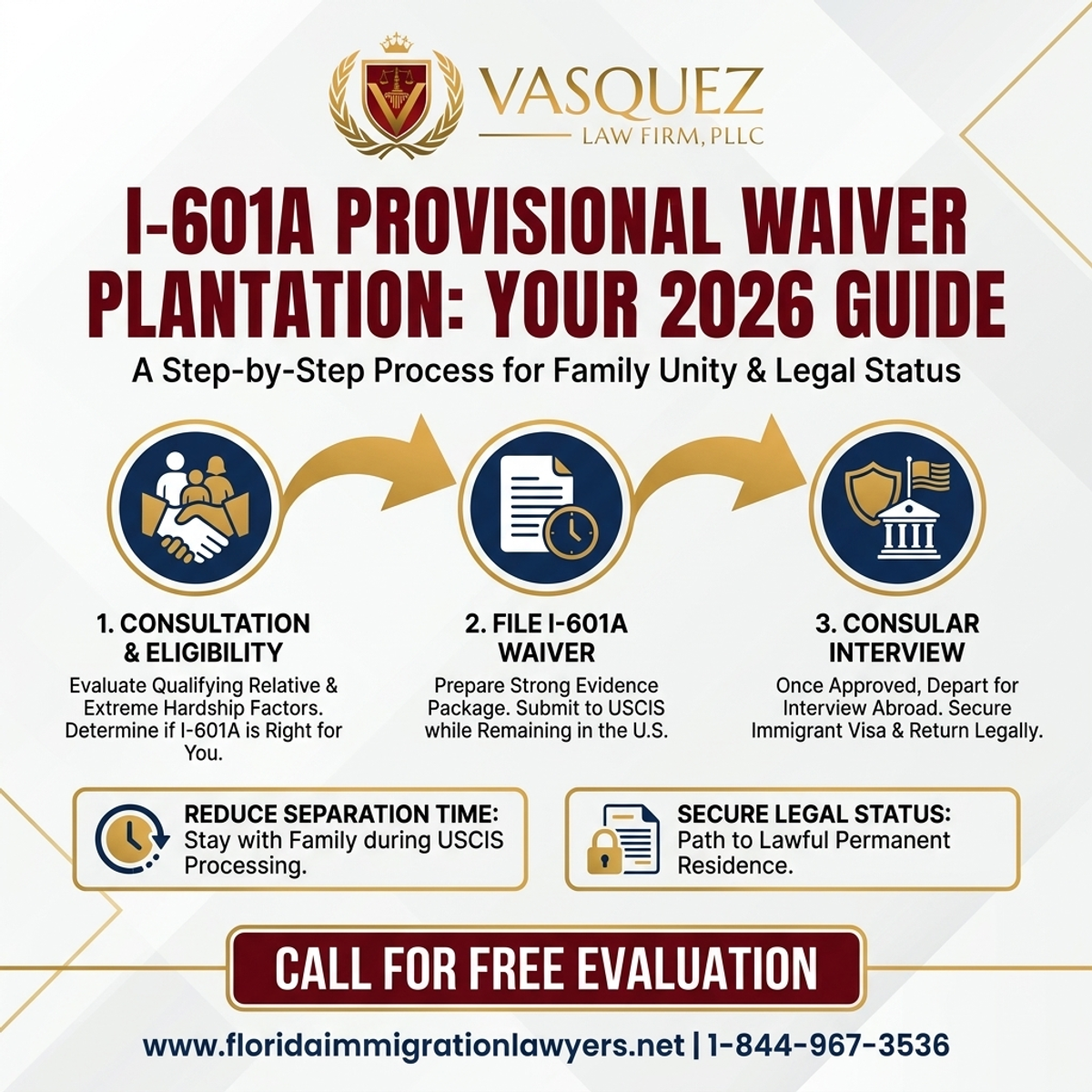
Step-by-Step Process — I-601A Provisional Waiver Plantation: Your 2026 Guide
Throughout this entire process, meticulous attention to detail and adherence to all instructions are critical. Any misstep can lead to delays or even denial, making professional legal guidance invaluable.
What Documents Do I Need for an I-601A Provisional Waiver Application?
For an I-601A provisional waiver application in 2026, you will need a comprehensive set of documents to prove your eligibility and the extreme hardship to your qualifying relative. This includes proof of the approved I-130 petition, your identity and nationality, your qualifying relative's U.S. citizenship or LPR status, and extensive evidence supporting the extreme hardship claim. Gathering all necessary records accurately is crucial for a successful outcome.
The documentation for an I-601A waiver is extensive and must be well-organized. Here is a general checklist of essential documents:
- Proof of Approved Form I-130: A copy of the I-130 approval notice (Form I-797).
- Proof of Qualifying Relationship: Marriage certificates, birth certificates, adoption decrees to establish the relationship between the applicant and the U.S. citizen/LPR qualifying relative.
- Proof of Qualifying Relative's Status: Copy of U.S. citizen's passport, birth certificate, naturalization certificate, or LPR's green card.
- Applicant's Identity and Nationality: Copy of applicant's passport, birth certificate, and any previous visas or entry stamps.
- Proof of Physical Presence in the U.S.: Records like utility bills, leases, employment records, school records, or bank statements showing continuous presence in the U.S. since a certain date.
- Evidence of Extreme Hardship: This is the most crucial section and requires robust documentation. It may include:
- Medical Records: Doctor's notes, diagnoses, treatment plans, and prognoses for the qualifying relative's physical or mental health conditions.
- Psychological Evaluations: Reports from licensed psychologists or psychiatrists detailing the emotional or psychological impact of separation or relocation on the qualifying relative.
- Financial Documents: Tax returns, bank statements, employment letters, property deeds, mortgage statements, and evidence of significant debts demonstrating financial dependence or severe financial impact.
- Educational Records: School enrollment, transcripts, or letters from school officials if relocation would disrupt a qualifying child's education.
- Affidavits: Sworn statements from the qualifying relative, family members, friends, or community leaders attesting to the hardship.
- Country Conditions Information: Evidence of dangerous or unstable conditions, lack of medical care, or limited educational/economic opportunities in the applicant's home country, particularly if the qualifying relative would have to relocate.
- Other Relevant Documents: Any other evidence that supports the claim of extreme hardship, such as involvement in community organizations in Florida, or unique family circumstances.
- Form I-601A and Biometrics Fee: The properly completed and signed Form I-601A, along with the required filing fee and biometrics fee.
- Police Clearances/Court Documents: If you have any criminal history, even minor offenses, you must provide certified copies of all police and court records.
- Translation of Foreign Documents: Any document not in English must be accompanied by a certified English translation.
Organizing these documents thoroughly and presenting them clearly is essential. A missing document or an unclear piece of evidence can significantly delay or jeopardize your application. This is where the expertise of an immigration lawyer becomes invaluable, helping you compile a complete and persuasive package.
I-601A Provisional Waiver Processing Times and Fees in 2026
As of 2026, I-601A provisional waiver processing times can vary significantly, often ranging from several months to over a year, depending on USCIS caseloads and policy changes. While USCIS does not provide premium processing for I-601A, applicants should plan for an extended wait. The filing fee is typically a fixed amount, but it is subject to change, so always verify the current fee on the official USCIS website before filing.
The overall timeline for obtaining lawful permanent residency through the I-601A provisional waiver process involves several stages, each with its own processing duration. It's crucial to understand that these are estimates, and actual times can fluctuate based on specific circumstances, the volume of applications, and policy shifts at USCIS and the Department of State. For the most current information, always refer to the official government websites.
Typical I-601A Processing Timeline (as of 2026)
| Stage | Typical Timeframe | Notes |
|---|---|---|
| I-130 Petition Processing | 6-18+ months | Varies significantly by USCIS service center and visa category. |
| NVC Processing (after I-130 approval) | 1-3 months | Case setup, fee payments, and document submission to NVC. |
| I-601A Waiver Processing | 12-24+ months | Highly variable; check USCIS processing times for current estimates. |
| Consular Interview Scheduling | 1-2 months after I-601A approval | Depends on embassy/consulate availability in the applicant's home country. |
| Visa Issuance and Entry | Days to weeks after interview | Assuming successful interview and no further issues. |
The I-601A waiver processing time itself is a significant component of the overall timeline. USCIS provides estimated processing times on its website, which are updated regularly. These estimates are for cases filed at the Potomac Service Center, which handles all I-601A applications. It is vital to check these updates frequently to manage expectations.
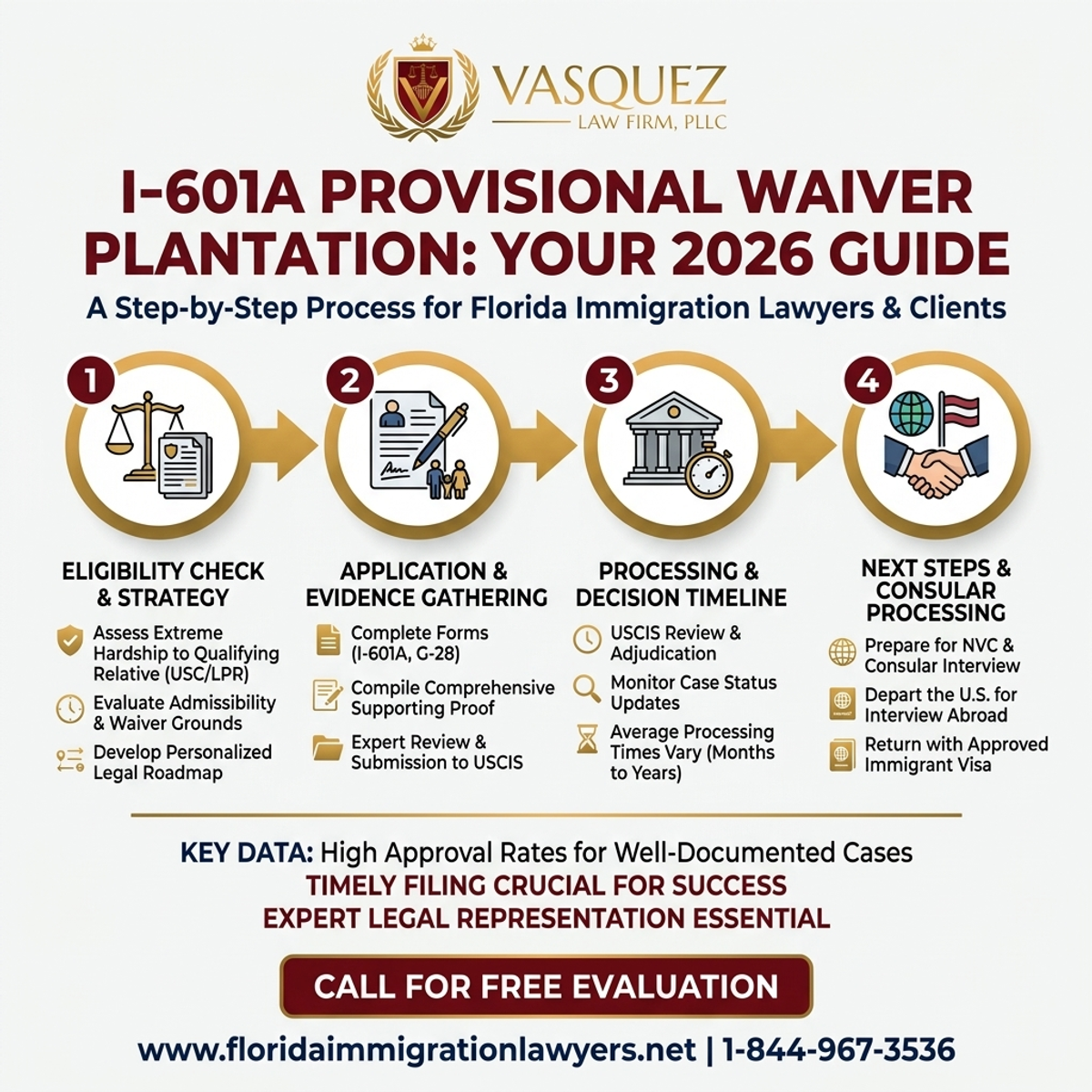
Key Statistics — I-601A Provisional Waiver Plantation: Your 2026 Guide
I-601A Provisional Waiver Cost Factors (as of 2026)
| Item | Typical Fee | Notes |
|---|---|---|
| Form I-130 Filing Fee | (Check USCIS website) | Required for the underlying petition; paid to USCIS. |
| Form I-601A Filing Fee | (Check USCIS website) | Required for the waiver application; paid to USCIS. |
| Biometrics Fee | (Check USCIS website) | Included with the I-601A filing fee for fingerprinting and photos. |
| Immigrant Visa Application Processing Fee (DS-260) | (Check State Department website) | Paid to the National Visa Center (NVC). |
| Medical Examination Fee | Varies by country/physician | Paid directly to the authorized panel physician abroad. |
| Attorney Fees | Varies significantly | Highly recommended for expert guidance and case preparation. |
It is crucial to remember that all government filing fees are subject to change without prior notice. Always consult the official USCIS and Department of State websites for the most current fee schedules before preparing and submitting your application. Failing to pay the correct fee can lead to rejection or significant delays in processing.
Do not navigate this complex process alone. Contact Florida Immigration Lawyers today at 1-844-967-3536 for expert guidance and a free consultation. Our team is ready to assist families throughout Florida, from Plantation to Miami, with their I-601A waiver applications.
Common Mistakes to Avoid in Your I-601A Provisional Waiver Application
The I-601A provisional waiver process is fraught with potential pitfalls that can lead to delays, requests for evidence, or even outright denial. Avoiding these common mistakes is critical for a successful outcome.
-
Filing Without an Approved I-130 Petition: A foundational requirement for the I-601A is an approved Form I-130, Petition for Alien Relative. Filing the waiver before this petition is approved will result in rejection of the I-601A application. Always ensure your underlying family petition is approved and your priority date is current before proceeding.
-
Insufficient Evidence of Extreme Hardship: This is perhaps the most common reason for denial. Applicants often underestimate what constitutes "extreme hardship" and submit general statements instead of concrete, well-documented evidence. USCIS requires proof that the qualifying relative would suffer beyond the normal emotional and financial difficulties of family separation. Failing to provide detailed medical records, psychological evaluations, financial statements, or compelling affidavits can jeopardize your case.
-
Failing to Disclose All Grounds of Inadmissibility: The I-601A waiver only covers unlawful presence. If you have other inadmissibility grounds, such as criminal convictions, fraud, or prior deportation orders, the I-601A will not waive them. Failing to disclose these issues, or assuming the I-601A covers them, can lead to denial and even more severe immigration consequences. A thorough review of your entire immigration history is essential.
-
Incorrectly Calculating Unlawful Presence: Accurately determining your period of unlawful presence is critical. Errors in calculation can lead to a mistaken belief of eligibility or, conversely, a failure to address the correct inadmissibility bar. Complex rules govern when unlawful presence begins and ends, making this a common area for mistakes without legal guidance.
-
Departing the U.S. Before I-601A Approval: The provisional waiver is specifically for individuals physically present in the U.S. at the time of filing and approval. If you depart the U.S. before your I-601A is approved, the application will be considered abandoned, and you will likely trigger the very unlawful presence bars you sought to waive, preventing your return.
-
Submitting Incomplete or Poorly Organized Documentation: USCIS adjudicators review thousands of applications. A disorganized submission, missing forms, or uncertified translations can lead to delays or a Request for Evidence (RFE), prolonging the process. Ensure all documents are clearly labeled, indexed, and translated correctly.
-
Not Seeking Legal Counsel for Complex Cases: While it is technically possible to file without an attorney, the I-601A process is highly complex, especially for cases involving multiple inadmissibility issues, prior immigration violations, or nuanced extreme hardship claims. Attempting to navigate such cases alone significantly increases the risk of denial and potentially irreversible consequences. An experienced attorney can identify potential issues, strengthen your hardship claim, and avoid critical errors.
When to Call a Florida Immigration Lawyer for Your I-601A Waiver
The I-601A provisional waiver process is undeniably intricate, and while some individuals may consider handling it themselves, the stakes are simply too high to risk common mistakes. It is almost always advisable to consult with an experienced Florida immigration lawyer, especially if your case presents any complexities. Our attorneys at Florida Immigration Lawyers are adept at handling these nuanced applications.
You should immediately consider calling a lawyer if you:
- Are unsure whether you meet all eligibility requirements for the I-601A waiver.
- Have a difficult time proving "extreme hardship" to your U.S. citizen or LPR spouse or parent, or if your qualifying relative has complex medical or psychological conditions.
- Have any past criminal history, even minor offenses, or prior immigration violations such as a previous deportation order.
- Have previously been denied an immigration benefit or have a complex immigration history.
- Are confused about calculating your period of unlawful presence or if you have multiple periods of unlawful presence.
- Need assistance gathering and organizing the extensive documentation required for the application.
- Are concerned about the potential risks of leaving the U.S. for your interview without a pre-approved waiver.
At Florida Immigration Lawyers, we specialize in helping families throughout Florida, including Hollywood, Plantation, and Miami, navigate the I-601A waiver process. We can assess your unique situation, help you gather compelling evidence, prepare a strong legal argument for extreme hardship, and meticulously file your application with USCIS. Our goal is to maximize your chances of approval and minimize the stress and uncertainty associated with this critical step towards a green card. Learn more about our family immigration services at /practice-areas/family-immigration.
About Florida Immigration Lawyers
Florida Immigration Lawyers is a leading immigration law firm dedicated to serving individuals and families across the entire state of Florida. With a deep understanding of U.S. immigration laws and a compassionate approach, our experienced attorneys are committed to providing exceptional legal representation. We specialize in a wide range of immigration matters, including family-based petitions, waivers, deportation defense, asylum claims, and citizenship applications.
Our firm prides itself on its client-centered philosophy, offering personalized strategies tailored to each unique case. We understand the emotional and practical challenges our clients face and strive to provide clear communication, transparent processes, and unwavering support. We are available 24/7 to address your concerns and offer free, confidential consultations to help you understand your legal options. Choose Florida Immigration Lawyers for dedicated advocacy and a steadfast commitment to achieving your immigration goals. Visit our website at https://www.floridaimmigrationlawyers.net or call us at 1-844-967-3536 to speak with an attorney today.
Sources and References
- U.S. Citizenship and Immigration Services (USCIS)
- U.S. Department of State (travel.state.gov)
- Executive Office for Immigration Review (EOIR)
- 8 U.S.C. Chapter 12 - Immigration and Nationality Act (INA)
- INA Section 212(a)(9)(B) - Unlawful Presence
- 8 CFR 212.7(e) - Provisional Unlawful Presence Waivers
Related services: immigration practice areas, citizenship and naturalization, asylum protection.
This article provides general legal information and is not intended as legal advice. Every case is unique, and outcomes depend on specific facts and circumstances. Contact an attorney for advice about your particular situation.
The journey to lawful permanent residency can be long and challenging, but with the right legal guidance, it is achievable. If you are in Florida and believe you may be eligible for an I-601A provisional waiver, or if you have questions about your immigration options, don't hesitate to reach out. Our experienced attorneys are here to provide the support and expertise you need.
Contact Florida Immigration Lawyers today for a free consultation. Call us at 1-844-967-3536. Se Habla Español - Estamos aqui para ayudarle.
Do Not Navigate This Process Alone
Our experienced immigration attorneys are ready to fight for you. Get a free, confidential consultation today.
Se Habla Español
Or leave your details and we’ll call you:
Free Evaluation in 24 Hours
Or talk to us right now

AI voice assistant — available 24/7
FreeFrequently Asked Questions

William J. Vásquez
Founding Attorney · Vasquez Law Firm
U.S. Air Force veteran and immigration attorney with years of hands-on U.S. immigration experience. J.D., NCCU School of Law. AILA member. Admitted to the 4th, 5th, and 11th Circuit Courts.
Available 24/7 - Free Evaluations
Reviewed for legal accuracy by William J. Vásquez
Licensed in North Carolina; U.S. immigration is federal practice.
Related Legal Services
Our Florida immigration attorneys can help you with free immigration consultation, experienced immigration attorneys and business immigration. Call today at 1-844-967-3536 for a free consultation.
Related Links
Related Topics
Free Legal Consultation
Discuss your case with our experienced attorneys. We're available 24/7.
Se Habla Español - Estamos aquí para ayudarle.
Related Articles
Military Naturalization Expedited in Florida Bases
Explore military naturalization options for families at Florida bases, including parole in place benefits in Miami. Learn how to expedite your application with expert guidance from Florida Immigration Lawyers.
Immigration Lawyer Orlando Free Consultation 2026
Explore the cost of an immigration lawyer in Orlando in 2026. Understand attorney fees, what to expect during a consultation, and how to make the best choice for your immigration needs.
USCIS Application Support Center Jacksonville Guide 2026
For many immigrants in Florida, a visit to the USCIS Application Support Center (ASC) in Jacksonville is a mandatory step for biometrics collection. This comprehensive guide from Florida Immigration Lawyers explains what an ASC does, how to prepare for your appointment, and what to expect after your visit in 2026. Learn about the required documents, common mistakes to avoid, and when to seek legal counsel to ensure your immigration application proceeds smoothly. Understanding these crucial steps is vital for applicants seeking Green Cards, work permits, or naturalization. Our firm provides expert assistance across all of Florida to help you navigate these complex processes.
L-1 Visa Attorneys in Central Florida: 2026 Insights
Explore the intricacies of the L-1 visa for intracompany transfers in Florida. Discover application steps, common mistakes, and when to seek legal advice.