DACA Renewal Guide for Florida Dreamers 2026 | VLF Florida
Learn how to renew your DACA in Florida for 2026. This comprehensive guide covers eligibility, document preparation, and processing timelines. Contact Florida Immigration Lawyers for assistance.

Renewing your DACA status in Florida for 2026 involves understanding the eligibility criteria, preparing necessary documents, and adhering to timelines. Key takeaways include:
- Check your renewal eligibility early.
- Prepare all required documents meticulously.
- File your renewal application on time to avoid lapses in status.
Introduction
For many Dreamers, Deferred Action for Childhood Arrivals (DACA) provides a vital lifeline, offering protection and work authorization. With 2026 here, it’s crucial to understand the renewal process, especially for those residing in Miami, Florida. This guide covers all you need to know about renewing your DACA status, from eligibility requirements to document preparation and processing timelines. Call Florida Immigration Lawyers at 1-844-967-3536 for a free consultation today!
The DACA program has been a cornerstone for hundreds of thousands of young people across the United States, allowing them to pursue higher education, build careers, and contribute meaningfully to their communities without the constant fear of deportation. In a state as diverse as Florida, with a significant immigrant population, DACA recipients play an integral role in the social and economic fabric, particularly in vibrant cities like Miami, Orlando, and Tampa.
Navigating the DACA renewal process can seem daunting, especially with the ever-evolving landscape of immigration policies. However, being proactive and well-informed can make all the difference. This comprehensive guide aims to demystify the renewal steps, providing clarity on what is required, common pitfalls to avoid, and when to seek professional legal assistance. Our goal is to empower you to maintain your DACA status seamlessly and continue building your future in Florida.
Understanding DACA and Its Importance
DACA, established in 2012, offers eligible undocumented immigrants who arrived as children a chance to defer deportation and obtain work permits. In Florida, especially in cities like Miami, DACA has been a beacon of hope for many young immigrants. As of 2026, staying informed about renewal processes is essential due to recent federal changes impacting immigration policies as reported by major news outlets.
The importance of DACA extends far beyond individual protection; it fosters stability for families and contributes significantly to local economies. DACA recipients are integral members of the workforce, taxpayers, and active participants in their communities. Losing DACA status can have devastating consequences, including loss of employment, inability to drive, and the constant threat of deportation, which underscores the critical need for timely and accurate renewals.
Despite ongoing legal challenges and political debates surrounding its future, DACA remains a crucial program for eligible individuals. The ability to legally work, pursue higher education, and obtain a driver's license opens doors to opportunities that would otherwise be inaccessible. For Dreamers in Florida, understanding the current requirements and potential changes is paramount to safeguarding their futures and continuing their contributions to the Sunshine State.
Step-by-Step Guide to DACA Renewal
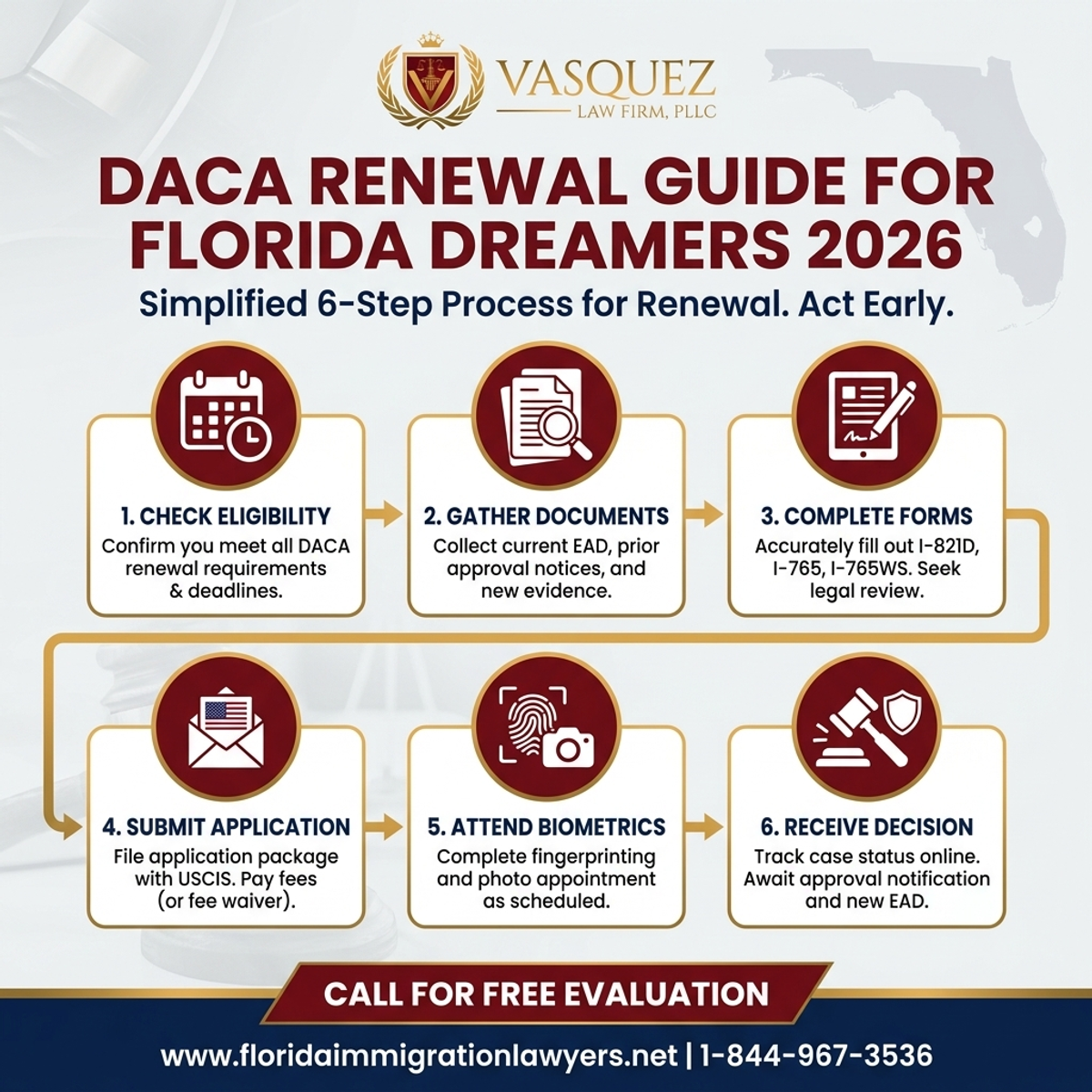
- Determine Eligibility: Ensure you meet all criteria, such as no serious criminal records and continuous residency in the U.S.
- Prepare Your Application: Complete Form I-821D, Form I-765, and Form I-765WS. Double-check for accuracy.
- Gather Required Documents: Collect evidence of identity, continuous residence, and educational or military status.
- Submit Your Application: File your application with the USCIS well before your current DACA expires. Include the correct filing fees.
- Await Decision: Monitor your case status online through the USCIS website and prepare for possible requests for additional information.
Let's delve deeper into each step. When determining eligibility, it's crucial to understand that even minor infractions can sometimes raise red flags. While DACA generally permits minor non-traffic offenses, any arrests or convictions, especially for felonies or significant misdemeanors, must be disclosed and thoroughly explained. Continuous residency means you have maintained your primary home in the U.S. since your last DACA approval, and any significant travel abroad could impact this.
Preparing your application requires meticulous attention to detail. Form I-821D (Consideration of Deferred Action for Childhood Arrivals), Form I-765 (Application for Employment Authorization), and Form I-765WS (Worksheet) are the core components. Ensure all sections are filled out completely and accurately. Any discrepancies between your current and previous applications, or missing information, can lead to delays or even denial. A common practical tip is to make a copy of your entire application package before mailing it.
When gathering required documents, remember that USCIS is looking for clear, consistent evidence. For identity, a passport from your home country or a birth certificate with photo ID is usually sufficient. For continuous residence, utility bills, bank statements, school transcripts, employment records, and lease agreements are excellent proofs. If you're a student, recent transcripts or enrollment letters work; if you're in the military, relevant service records are needed. Always submit copies, not originals, unless specifically requested by USCIS.
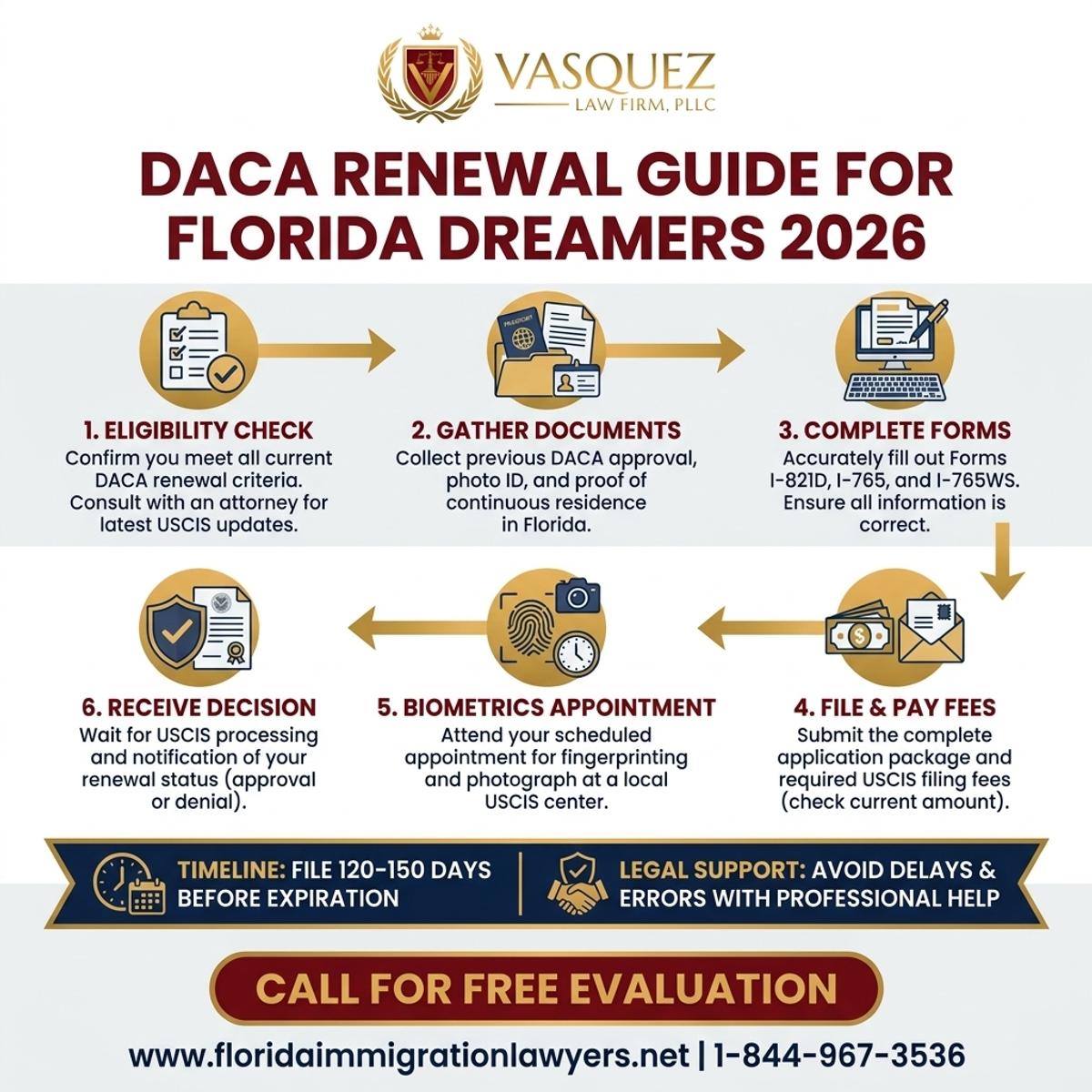
Submitting your application on time is perhaps the most critical step. USCIS recommends filing between 120 and 150 days before your current DACA expiration date. This window allows ample time for processing and helps prevent any lapse in your work authorization. Sending your application via certified mail with a return receipt provides proof of submission, a valuable record in case of any issues. Ensure you have the correct filing fees, which can change, so always verify on the USCIS website.
Finally, awaiting a decision can be a period of anxiety. Regularly checking your case status online using the receipt number provided by USCIS is advisable. Be prepared for a Request for Evidence (RFE), which means USCIS needs more information to make a decision. Responding promptly and thoroughly to an RFE is essential. If you receive an RFE or experience significant delays, consulting with Florida Immigration Lawyers at 1-844-967-3536 can provide much-needed clarity and assistance.
Step-by-Step Process — DACA Renewal Guide for Florida Dreamers 2026
Document Checklist for DACA Renewal
- Completed Form I-821D
- Completed Form I-765 and Form I-765WS
- Proof of identity (e.g., passport or national ID from your home country)
- Proof of continuous residence in the U.S. since your last DACA approval
- Proof of current educational or military enrollment
Beyond simply listing the documents, understanding the specifics for each category is crucial. For the forms (I-821D, I-765, and I-765WS), ensure you are using the absolute latest versions available on the USCIS website. Outdated forms will lead to rejection and significant delays. Double-check that all questions are answered, and if a question does not apply, write "N/A" rather than leaving it blank.
When proving continuous residence, think broadly about what documents can establish your presence in the U.S. since your last DACA approval. This could include bank statements, utility bills, school records, employment pay stubs, medical records, or even dated photographs with verifiable locations. The key is consistency and covering the entire period. For example, if you moved within Florida, provide documents from both your old and new addresses to show uninterrupted residency.
For proof of identity, a valid passport from your country of origin is generally the strongest evidence. If you do not have a passport, a birth certificate accompanied by a government-issued photo ID (like a state ID or driver's license from Florida) can also work. For educational or military status, recent school transcripts, diplomas, GED certificates, or military discharge papers (Form DD-214) are acceptable. If you are not currently enrolled in school or the military, you may need to provide evidence of prior enrollment or graduation. If you have any doubts about what constitutes sufficient proof, do not hesitate to contact Florida Immigration Lawyers for personalized advice.
Timeline and Processing Expectations
Typically, DACA renewal processing can take several months, so it's vital to apply at least 120 to 150 days before your current DACA expires. In Florida, especially Miami, processing times can vary due to the volume of applications and the specific USCIS office handling your case.
A critical reason for filing within the recommended 120-150 day window is to prevent a lapse in your employment authorization. If your DACA expires before your renewal is processed, you will temporarily lose your ability to work legally, which can have severe financial implications. This lapse can also affect your driver's license status in Florida, as it is often tied to your work authorization. Planning ahead is your best defense against such disruptions.
Processing times are influenced by various factors, including the national volume of applications, staffing levels at USCIS, and whether your application is complete or requires a Request for Evidence (RFE). While USCIS provides estimated processing times on its website, these are just estimates and can fluctuate. If your application falls outside the normal processing time, you can submit an inquiry to USCIS, but it's often more effective to have an experienced attorney from Florida Immigration Lawyers follow up on your behalf, especially if you're approaching your expiration date without a decision.
Key Statistics — DACA Renewal Guide for Florida Dreamers 2026
Cost Factors and Fee Breakdown
Renewing your DACA involves specific fees for form processing, biometrics, and other potential costs. While fee amounts can change, it's essential to check the latest fees on the USCIS website before submitting your application. Additional costs may include hiring legal assistance or obtaining translations of documents.
Currently, the total fee for DACA renewal is comprised of two parts: the Form I-765 (Application for Employment Authorization) fee and the biometrics services fee. These fees are subject to change, so always consult the USCIS website or an immigration attorney for the most up-to-date figures. It is crucial to submit the correct fee amount; an incorrect payment will result in your application being rejected and returned, causing significant delays.
For individuals facing financial hardship, USCIS does offer fee waivers or exemptions in very limited circumstances. However, DACA renewal applications are generally not eligible for fee waivers. Instead, some non-profit organizations and legal aid groups may offer financial assistance or interest-free loans to help cover the application fees. Exploring these options can be vital for Dreamers in Florida who may struggle to afford the renewal costs. Additionally, remember to budget for potential legal fees if you choose to hire an attorney, as well as costs for document translation if any of your supporting documents are not in English.
Middle CTA
Do not navigate this process alone. Contact Florida Immigration Lawyers today for expert guidance and support.
Common Mistakes to Avoid
- Missing the renewal deadline, leading to a lapse in protection.
- Failing to update your address with USCIS, causing delays in receiving correspondence.
- Submitting incomplete forms, resulting in application rejection.
- Not providing sufficient proof of continuous residence.
- Ignoring USCIS requests for additional information or documentation.
- Misunderstanding fee waivers or exemptions, leading to incomplete submissions.
- Not checking application status regularly on the USCIS website.
- Using outdated forms which can lead to application denial.
- Providing incorrect or inconsistent information across forms.
- Failing to seek legal advice when eligibility or document preparation is unclear.
Avoiding these common errors is paramount to a successful DACA renewal. A lapse in DACA status, even for a short period, can interrupt employment, education, and expose you to the risk of deportation. Forgetting to update your address with USCIS, for instance, means you could miss critical notices or RFEs, which could lead to your application being denied without your knowledge.
The complexity of immigration law means that even seemingly minor mistakes can have significant consequences. For example, providing inconsistent information across forms, or failing to adequately explain any gaps in your continuous residence, can trigger an RFE or even a denial. If you find yourself unsure about any aspect of your application, or if your situation has become more complex since your last renewal, it is always best to consult with an experienced legal professional like Florida Immigration Lawyers to ensure your application is flawless.
When to Call a Lawyer
Consider consulting a lawyer if you face complex situations such as previous criminal charges, difficulty proving continuous residence, or if you receive a request for evidence from USCIS. Legal assistance is crucial for navigating these challenges and ensuring a successful renewal application. Florida Immigration Lawyers are here to help, providing expertise and support for your DACA renewal process.
Beyond the situations mentioned, a lawyer's expertise becomes invaluable if you have had any encounters with law enforcement, even if charges were dropped or expunged. The nuances of immigration law often classify certain offenses differently than state criminal law, and a seemingly minor issue could impact your DACA eligibility. Similarly, if you have traveled outside the U.S. without advance parole, this could jeopardize your continuous residence requirement, necessitating expert legal review.
A DACA renewal application is more than just filling out forms; it's about presenting a clear, compelling case to USCIS. If you've received a Notice of Intent to Deny (NOID), or if your previous DACA application was denied, immediate legal intervention is critical. An attorney can help you understand the reasons for the denial, prepare a robust response, and ensure all legal avenues are explored. Don't wait until it's too late; proactive legal counsel from Florida Immigration Lawyers can safeguard your future. Call 1-844-967-3536 for a free consultation.
About Florida Immigration Lawyers
Florida Immigration Lawyers are dedicated to serving the diverse immigrant community across Florida, including Miami. Our experienced attorneys offer comprehensive services in immigration law, including DACA renewals, asylum, deportation defense, and family immigration. Contact us at 1-844-967-3536 or visit our website for more information. We offer free consultations and are available 24/7 to assist you with your immigration needs.
Our commitment extends to providing compassionate and effective legal representation, understanding the unique challenges faced by immigrant families and individuals. We pride ourselves on clear communication, ensuring our clients in Miami and throughout Florida are fully informed and confident at every stage of their DACA renewal or other immigration processes. When you choose Florida Immigration Lawyers, you choose a partner dedicated to protecting your rights and securing your future.
Sources and References
- U.S. Citizenship and Immigration Services (USCIS)
- Executive Office for Immigration Review (EOIR)
- 8 U.S.C. Chapter 12 - Immigration and Nationality Act
Related services: immigration practice areas, family immigration services, citizenship and naturalization.
This article provides general legal information and is not intended as legal advice. Every case is unique, and outcomes depend on specific facts and circumstances. Contact an attorney for advice about your particular situation.
Final CTA
Ready to renew your DACA in Florida? Call Florida Immigration Lawyers at 1-844-967-3536 for a free consultation. Se Habla Español - Estamos aquí para ayudarle.
If you need legal assistance, learn more about immigration lawyers in Florida, or call us at 1-844-967-3536 for a free consultation.
Do Not Navigate This Process Alone
Our experienced immigration attorneys are ready to fight for you. Get a free, confidential consultation today.
Se Habla Español
Frequently Asked Questions
Florida Immigration Lawyers
Immigration Attorney | Founder, Vasquez Law Firm
U.S. Air Force veteran and immigration attorney with thousands of cases resolved. J.D., NCCU School of Law. AILA member. Admitted to the 4th, 5th, and 11th Circuit Courts.
Available 24/7 - Free Evaluations
Related Legal Services
Our Florida immigration attorneys can help you with business immigration, asylum protection and deportation defense. Call today at 1-844-967-3536 for a free consultation.
Related Links
Related Topics
Free Legal Consultation
Discuss your case with our experienced attorneys. We're available 24/7.
Se Habla Español - Estamos aquí para ayudarle.
Related Articles
Understanding Special Immigrant Juvenile Status in Florida
Special Immigrant Juvenile Status (SIJS) provides a lifeline for minors in Florida facing abuse or neglect. Learn about eligibility, the application process, and common pitfalls to avoid. Contact Florida Immigration Lawyers for a free consultation.
F-1 Reinstatement Process for Students in Florida | VLF Florida
Learn how to navigate the F-1 reinstatement process if you're a student out of status in Florida. Discover step-by-step guidance, document checklists, and when to seek legal help.
DACA Renewal Florida 2026: Guide for Dreamers | VLF Florida
Learn about DACA renewal in Florida in 2026. Our comprehensive guide covers everything from eligibility to common mistakes. Contact Florida Immigration Lawyers for expert assistance.
Immigration Lawyer in Fort Lauderdale, Florida | VLF Florida
Seeking immigration help in Fort Lauderdale? Discover how an immigration lawyer can assist you with visa applications, deportation defense, and more. Contact Florida Immigration Lawyers at 1-844-967-3536 for a free consultation.