DACA Renewal Florida 2026: Guide for Dreamers | VLF Florida
Learn about DACA renewal in Florida in 2026. Our comprehensive guide covers everything from eligibility to common mistakes. Contact Florida Immigration Lawyers for expert assistance.

Renewing your DACA status in Florida for 2026 involves several key steps. It's crucial for Dreamers to stay informed about the latest changes and requirements. Here are some important points:
- Understand the latest DACA renewal requirements
- Collect necessary documents for renewal
- Submit your application timely to avoid lapses
Introduction
In 2026, many Dreamers in St. Petersburg, Florida, are preparing to renew their Deferred Action for Childhood Arrivals (DACA) status. With recent changes in immigration policies, it's more important than ever to ensure your renewal is processed smoothly. This guide will walk you through the process, from documentation to submission, helping you avoid common pitfalls. Call Florida Immigration Lawyers at 1-844-967-3536 for a free consultation.
The DACA program offers a lifeline to thousands of young individuals across Florida, providing temporary protection from deportation and the ability to work legally. As 2026 approaches, the landscape surrounding DACA remains dynamic, making meticulous preparation and timely submission paramount. Understanding the intricacies of the renewal process is not just about filling out forms; it's about safeguarding your future and maintaining your ability to contribute to your community.
This comprehensive guide is designed to empower you with the knowledge needed to navigate your DACA renewal with confidence. We'll delve into everything from eligibility criteria and required documents to potential challenges and the critical role of legal assistance. Our goal is to ensure that Dreamers in St. Petersburg and throughout Florida can continue to live and work without unnecessary fear or interruption.
Understanding DACA and Its Importance
DACA, or Deferred Action for Childhood Arrivals, provides temporary protection from deportation and work authorization for eligible immigrant youth who came to the United States as children. As of 2026, it's vital to understand the current landscape of DACA, especially in light of recent judicial rulings and policy changes.
In Florida, and specifically in St. Petersburg, Dreamers make up a significant portion of the immigrant community. Staying informed about DACA's status and renewal processes is crucial for maintaining your ability to work and live without fear of deportation.
Initiated in 2012, DACA has allowed hundreds of thousands of young people to pursue education, build careers, and contribute significantly to the U.S. economy and society. For many, DACA is not just a legal status; it's a foundation for their lives, enabling them to obtain driver's licenses, attend college, and financially support their families. The program acknowledges the unique circumstances of individuals who were brought to the U.S. as children and know no other home.
However, DACA has faced continuous legal challenges, leading to periods of uncertainty. While renewals are currently being processed, new initial applications have largely been halted due to court injunctions. This makes the renewal process even more critical for existing DACA recipients, as a lapse in status could have severe consequences. Staying abreast of these legal developments and understanding how they might impact your status is a responsibility that no DACA recipient can afford to overlook. Florida Immigration Lawyers are dedicated to keeping our clients informed about these complex changes.
Step-by-Step Guide to DACA Renewal in Florida
- Check your eligibility: Ensure you meet the DACA renewal criteria, including continuous residence in the U.S. since the last approval.
- Gather required documents: This includes proof of identity, proof of DACA status, and updated personal information.
- Complete the renewal application: Fill out the necessary forms, such as Form I-821D and Form I-765.
- Pay the required fees: Be aware that fees may change. Always check the latest fee information on the USCIS website.
- Submit your application: Ensure you file your renewal application at least 120 days before your current DACA expires. Late submissions can lead to lapses in protection and work authorization.
Renewing your DACA status requires a methodical approach to ensure all requirements are met and your application is processed efficiently. Each step is critical, and overlooking even a minor detail can lead to significant delays or even denial. Let's elaborate on each point to provide you with a clearer roadmap.
When checking your eligibility, pay close attention to the continuous residence requirement. This means you must have continuously resided in the United States since you last received DACA. Any significant travel outside the U.S. or certain criminal offenses could jeopardize your eligibility. If you have any doubts about your continuous residence or have had any interactions with law enforcement, it is highly advisable to consult with Florida Immigration Lawyers at 1-844-967-3536 before proceeding.
Completing the renewal application forms, specifically Form I-821D (Consideration of Deferred Action for Childhood Arrivals) and Form I-765 (Application for Employment Authorization), along with the I-765 Worksheet, demands precision. Ensure all fields are accurately filled out, and that your responses are consistent with previous applications and supporting documents. Any discrepancies could trigger a Request for Evidence (RFE) or even a denial. It's a good practice to make copies of all forms and supporting documents for your records before mailing them.
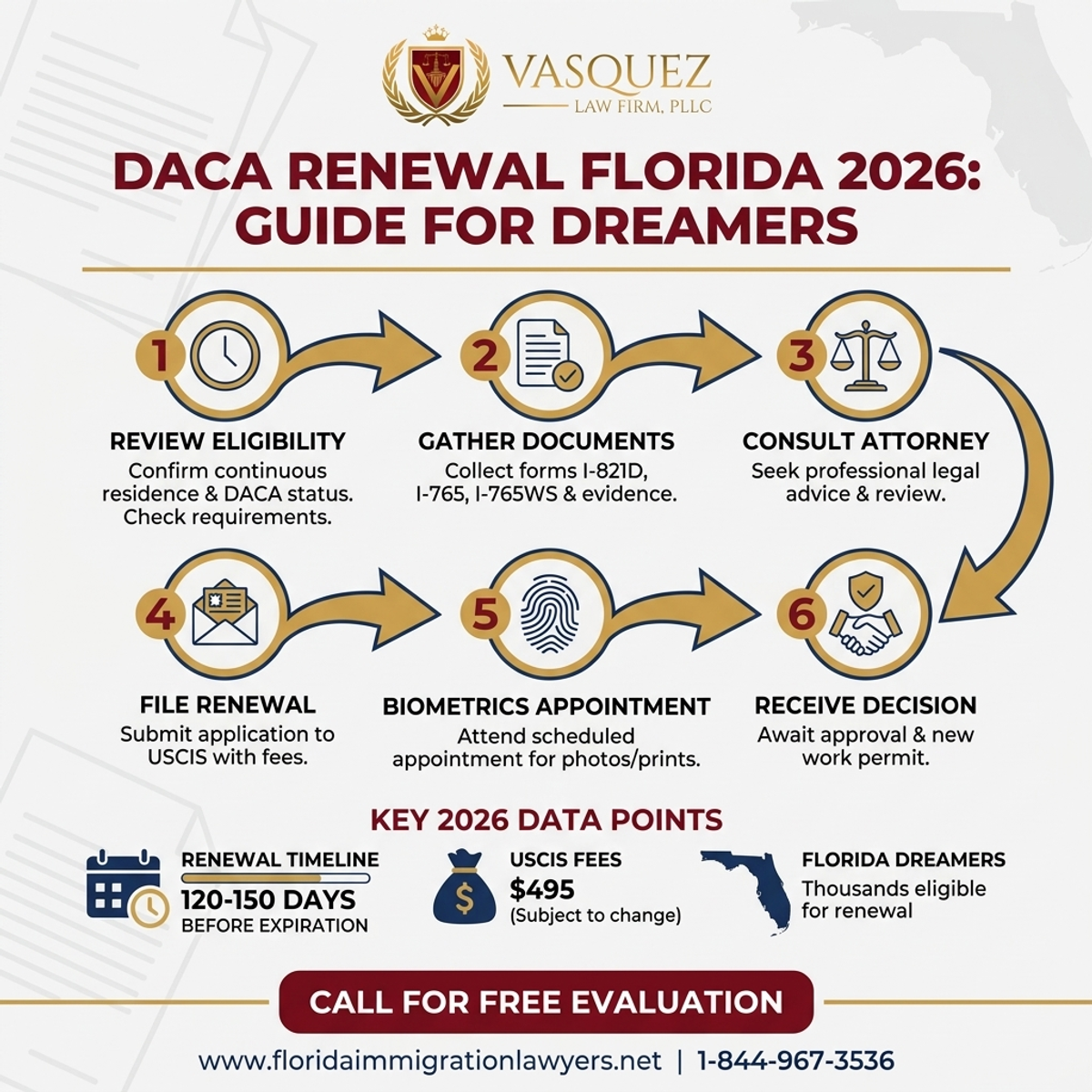
Step-by-Step Process — DACA Renewal Florida 2026: Guide for Dreamers
Document Checklist for DACA Renewal
- Proof of identity (e.g., passport, government-issued ID)
- Proof of DACA status (e.g., prior DACA approval notices)
- Evidence of continuous residence in the U.S.
- Updated employment authorization documents
A thorough and accurate document collection is the backbone of a successful DACA renewal application. USCIS relies heavily on the evidence you provide to verify your eligibility and ensure you meet all criteria. Organizing these documents meticulously will not only streamline your application process but also reduce the likelihood of requests for additional evidence.
For evidence of continuous residence, think broadly about documents that can demonstrate your physical presence in the U.S. over time. This can include school transcripts, medical records, employment records (pay stubs, W-2s), bank statements, rental agreements, utility bills, and even dated photographs or letters. The key is to provide a clear, unbroken timeline of your residence from your last DACA approval to the present. If there are any gaps in your documentation, consider consulting with Florida Immigration Lawyers to strategize how best to address them.
It's also crucial to include copies of your most recent DACA approval notice (Form I-797) and your current Employment Authorization Document (EAD). These documents serve as direct proof of your existing DACA status and help USCIS quickly verify your previous approvals. Always submit copies, never originals, unless specifically requested by USCIS. Keeping a complete set of copies for your own records is a vital step in protecting your application.
Timeline and Processing Expectations
Typically, the DACA renewal process takes 3 to 5 months, but times can vary based on application volume and USCIS processing capacity. It's advisable to submit your renewal application as early as possible to avoid any gaps in your status.
Keep track of your application's status through the USCIS online portal. If there are delays, consult with an immigration attorney to explore your options.
Several factors can influence the processing time for your DACA renewal. These include the specific USCIS service center handling your case, the volume of applications they are receiving, and whether your application requires additional review or a Request for Evidence (RFE). While the 3-5 month window is a general guideline, it's not uncommon for some applications to take longer, especially during periods of high demand or policy changes.
To mitigate the risk of a lapse in your work authorization and protection from deportation, USCIS recommends filing your renewal application between 120 and 150 days before your current DACA status expires. Filing within this window provides ample time for processing and helps ensure continuity. If your application is still pending as your current DACA nears expiration, you can check the status online using your receipt number. If you notice significant delays beyond the typical processing times, contacting Florida Immigration Lawyers at 1-844-967-3536 can help you explore options like filing an inquiry with USCIS or seeking assistance from a congressional representative.
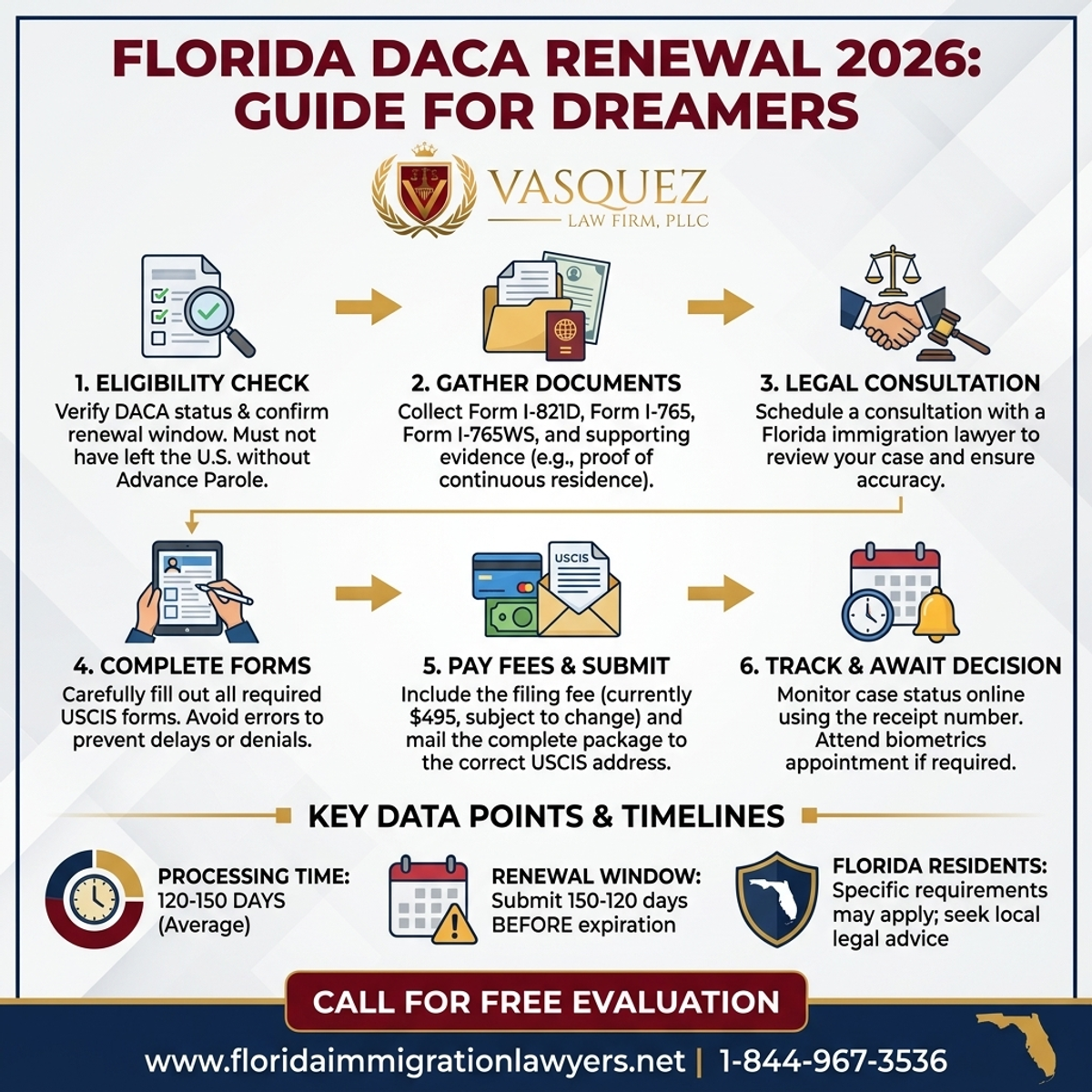
Key Statistics — DACA Renewal Florida 2026: Guide for Dreamers
Cost Factors and Fee Breakdown
The cost of renewing DACA includes application fees for Form I-821D and Form I-765. While specific amounts can change, ensure you have the latest information from the USCIS website. Consider additional costs such as legal fees if you decide to work with an attorney.
As of recent updates, the total fee for DACA renewal typically covers both the Form I-821D (no fee) and the Form I-765 (Application for Employment Authorization) fee, which includes the biometric services fee. It is absolutely essential to verify the current fee schedule on the USCIS website before preparing your payment, as these amounts are subject to change without extensive prior notice. Sending an incorrect fee amount is a common reason for applications being rejected and returned, causing significant delays.
Payment for the USCIS fees can usually be made by money order, personal check, cashier's check, or even by credit card using Form G-1450, Authorization for Credit Card Transactions. Ensure your check or money order is made payable to "U.S. Department of Homeland Security" and clearly includes the correct amount. While fee waivers are generally not available for DACA applications, understanding all associated costs, including potential legal fees, allows for better financial planning. Investing in legal assistance from Florida Immigration Lawyers can provide peace of mind and help ensure your application is flawless, potentially saving you from costly mistakes or delays in the long run.
Common Mistakes to Avoid
- Missing submission deadlines: Late submissions can lead to a loss of DACA status.
- Incomplete applications: Missing documents or incorrect forms can delay processing.
- Not updating personal information: Failing to provide current information can result in application denial.
- Ignoring fee changes: Always confirm the latest fees before submitting your application.
- Failing to track your application: Not checking your application's status can lead to missed updates or requests for additional information.
- Not consulting an attorney when needed: Legal guidance can prevent costly mistakes.
- Misunderstanding eligibility requirements: Ensure you understand the current criteria for renewal.
Avoiding common pitfalls is just as important as following the correct steps. Diligence and attention to detail are your best allies in the DACA renewal process. Let's expand on how to proactively prevent these mistakes.
To avoid missing submission deadlines, create a reminder system well in advance of your DACA expiration date. Aim to mail your application at least 150 days before it expires, giving yourself a buffer. For incomplete applications, double-check every field on Forms I-821D and I-765, and use the USCIS checklist for required documents. Make sure all supporting evidence is clearly labeled and organized. Regarding not updating personal information, always inform USCIS of any address changes using Form AR-11, Alien's Change of Address Card, and ensure your application reflects your most current details.
For fee changes, make it a habit to visit the USCIS website for the latest fee schedule immediately before preparing your payment. To prevent issues from failing to track your application, register for a USCIS online account and link your case to receive electronic updates. Finally, if you're unsure about any aspect of your renewal, especially if your circumstances have changed or you have a criminal record, consulting with Florida Immigration Lawyers at 1-844-967-3536 can provide the expert guidance needed to navigate complex situations and avoid costly errors.
When to Call a Lawyer
Consider reaching out to an immigration lawyer if you encounter any issues with your DACA renewal. Red flags include receiving a Request for Evidence (RFE) or if there are changes in your personal circumstances that might affect your eligibility. Florida Immigration Lawyers are here to help navigate these complexities and provide personalized advice.
There are several critical scenarios where the expertise of an immigration lawyer becomes invaluable. Receiving a Request for Evidence (RFE) from USCIS, for instance, indicates that the agency needs more information or clarification on your application. Responding to an RFE accurately and comprehensively is crucial, as an insufficient response can lead to denial. An attorney can help you understand what information is being requested and how to provide the strongest possible evidence.
Furthermore, any changes in your personal circumstances since your last DACA approval warrant legal review. This includes, but is not limited to, arrests or convictions (even minor ones), significant travel outside the U.S., or changes in your marital status. These events can impact your DACA eligibility and may require careful legal analysis to determine the best course of action. Proactive consultation with Florida Immigration Lawyers can help you understand potential implications and strategize how to present your case effectively, ensuring your renewal process is handled with the utmost care and expertise.
About Florida Immigration Lawyers
At Florida Immigration Lawyers, we specialize in helping Dreamers and immigrants navigate the complexities of U.S. immigration law. Our experienced team is dedicated to providing compassionate and effective legal assistance. Contact us at 1-844-967-3536 or visit our website at Florida Immigration Lawyers for a free consultation. We serve all of Florida and offer 24/7 support, including bilingual services.
Our commitment extends beyond just processing paperwork; we are dedicated advocates for the Dreamer community. We understand the anxieties and uncertainties that come with navigating immigration processes, especially with the evolving nature of DACA. Our team stays current with the latest legal developments and policy changes to provide the most accurate and effective advice. We pride ourselves on offering personalized attention, ensuring that each client's unique situation is thoroughly understood and addressed with tailored strategies.
Choosing Florida Immigration Lawyers means partnering with a team that genuinely cares about your future. We offer comprehensive services, from initial consultations to full application preparation and representation, ensuring you have expert guidance every step of the way. Our bilingual staff ensures that language is never a barrier to receiving the legal support you need. Don't face the DACA renewal process alone; let our expertise provide you with peace of mind and a clear path forward.
Sources and References
- U.S. Citizenship and Immigration Services (USCIS)
- Executive Office for Immigration Review (EOIR)
- 8 U.S.C. Chapter 12 - Immigration and Nationality Act
Frequently Asked Questions About DACA Renewal
Can I travel outside the U.S. with DACA?
Generally, DACA recipients cannot travel outside the U.S. without an approved Advance Parole document. Advance Parole is rarely granted for DACA holders and typically only for humanitarian, educational, or employment purposes. Traveling without it can lead to your DACA status being terminated and potentially prevent your re-entry into the U.S. Always consult Florida Immigration Lawyers before planning any international travel.
What if my DACA expires while my renewal is pending?
If your DACA expires while your renewal application is still pending, you will temporarily lose your protection from deportation and your work authorization. This means you cannot legally work during this gap, and you could be subject to removal proceedings. This underscores the critical importance of filing your renewal application well within the recommended 120- to 150-day window before your current DACA expires to avoid any lapse in status.
What if I have a minor criminal offense on my record?
Any criminal offense, even a minor one, can significantly impact your DACA renewal eligibility. USCIS reviews all criminal records, and certain offenses can lead to denial. It is crucial to consult with an experienced immigration attorney like Florida Immigration Lawyers immediately if you have any criminal history. We can assess your specific situation, advise on potential risks, and help determine the best strategy for your renewal application.
Are there any changes to DACA eligibility for 2026?
While the core eligibility criteria for DACA renewals have remained relatively stable, the program is subject to ongoing legal challenges and potential policy changes. It's essential to stay informed through official USCIS announcements and reliable legal sources. For the most up-to-date and personalized information regarding any changes that might affect your 2026 renewal, always consult with Florida Immigration Lawyers.
Can I apply for a fee waiver for DACA renewal?
Historically, USCIS has stated that fee waivers are generally not available for DACA applications, including renewals. While there might be extremely limited exceptions in rare cases of severe hardship, it's not a common option. You should plan to pay the full application fees. If you have concerns about the cost, discuss potential solutions or payment plans with Florida Immigration Lawyers during your consultation.
Related services: immigration practice areas, family immigration services, citizenship and naturalization, deportation defense.
This article provides general legal information and is not intended as legal advice. Every case is unique, and outcomes depend on specific facts and circumstances. Contact an attorney for advice about your particular situation.
Ready to renew your DACA status? Contact Florida Immigration Lawyers at 1-844-967-3536 for a free consultation. Se Habla Espanol - Estamos aqui para ayudarle.
If you need legal assistance, learn more about immigration lawyers in Florida, or call us at 1-844-967-3536 for a free consultation.
Do Not Navigate This Process Alone
Our experienced immigration attorneys are ready to fight for you. Get a free, confidential consultation today.
Se Habla Español
Frequently Asked Questions
Florida Immigration Lawyers
Immigration Attorney | Founder, Vasquez Law Firm
U.S. Air Force veteran and immigration attorney with thousands of cases resolved. J.D., NCCU School of Law. AILA member. Admitted to the 4th, 5th, and 11th Circuit Courts.
Available 24/7 - Free Evaluations
Related Legal Services
Our Florida immigration attorneys can help you with asylum protection, deportation defense and citizenship and naturalization. Call today at 1-844-967-3536 for a free consultation.
Related Links
Related Topics
Free Legal Consultation
Discuss your case with our experienced attorneys. We're available 24/7.
Se Habla Español - Estamos aquí para ayudarle.
Related Articles
Immigration Lawyer in Fort Lauderdale, Florida | VLF Florida
Seeking immigration help in Fort Lauderdale? Discover how an immigration lawyer can assist you with visa applications, deportation defense, and more. Contact Florida Immigration Lawyers at 1-844-967-3536 for a free consultation.
Citizenship Test Florida: Your Guide to Naturalization Success
Achieving U.S. citizenship through naturalization is a life-changing milestone for many Florida residents. This comprehensive guide details the citizenship test, including its English and civics components, and provides a step-by-step walkthrough of the N-400 application process. Learn about eligibility, required documents, processing timelines, and associated costs. We also highlight common mistakes to avoid and explain when seeking legal counsel can be invaluable, especially for those in Gainesville and surrounding areas. Florida Immigration Lawyers offers expert guidance to help you prepare for your naturalization interview and civics test, ensuring you navigate this crucial journey with confidence and achieve your dream of becoming a U.S. citizen.
DACA Renewal Florida 2026 Guide for Dreamers | VLF Florida
Navigating DACA renewal in Florida for 2026 requires meticulous preparation and awareness of evolving immigration policies. This guide provides a detailed roadmap for Florida Dreamers, covering essential forms, documentation, and critical deadlines to ensure a successful renewal. We emphasize the importance of timely filing, accurate information, and avoiding common mistakes that could jeopardize your deferred action status and employment authorization. Given the program's uncertain legal landscape, understanding the process and knowing when to seek professional legal assistance is paramount. Florida Immigration Lawyers offer expert guidance to help you protect your DACA status and continue building your life in Florida.
Immigration Documents Checklist Florida: Your Essential Guide
Compiling an accurate immigration documents checklist for Florida is essential for a successful application. This guide details crucial USCIS forms, supporting evidence, and common pitfalls to avoid for applicants in 2026. From birth certificates to financial records, every piece of Florida immigration paperwork must be meticulously prepared. Learn about processing times, cost factors, and Florida-specific considerations, especially for those in Orlando. Florida Immigration Lawyers offers expert guidance to ensure your application is complete and accurate, helping you navigate the complexities of U.S. immigration law with confidence. Don't risk delays or denials; get professional legal support.
