DACA Renewal Florida 2026 Guide for Dreamers | VLF Florida
Navigating DACA renewal in Florida for 2026 requires meticulous preparation and awareness of evolving immigration policies. This guide provides a detailed roadmap for Florida Dreamers, covering essential forms, documentation, and critical deadlines to ensure a successful renewal. We emphasize the importance of timely filing, accurate information, and avoiding common mistakes that could jeopardize your deferred action status and employment authorization. Given the program's uncertain legal landscape, understanding the process and knowing when to seek professional legal assistance is paramount. Florida Immigration Lawyers offer expert guidance to help you protect your DACA status and continue building your life in Florida.

Renewing DACA (Deferred Action for Childhood Arrivals) in Florida for 2026 requires careful attention to deadlines and documentation. Eligible individuals must submit Form I-821D, I-765, and I-765WS to USCIS well before their current DACA and Employment Authorization Document (EAD) expire. Given the program's ongoing legal challenges, staying informed about policy updates and seeking expert legal guidance is crucial. Florida Dreamers should prepare all necessary proofs of continuous residence, identity, and any updated criminal history to ensure a smooth renewal process.
- Submit renewal applications 120-150 days before expiration.
- Gather all required documents, including previous DACA approval notices.
- Be prepared for biometrics appointments at a local USCIS Application Support Center.
- Consult with an experienced immigration attorney, especially if your circumstances have changed.
- Stay updated on USCIS policy changes and legal developments affecting DACA.
For many young individuals in Florida, the Deferred Action for Childhood Arrivals (DACA) program represents a pathway to live, work, and pursue educational opportunities without constant fear of deportation. As we look towards DACA renewal Florida 2026, understanding the nuances of this process is more critical than ever. The landscape of immigration law, particularly concerning DACA, is subject to ongoing legal scrutiny and potential changes, making informed action paramount for all Florida Dreamers.
This comprehensive guide is designed to provide clarity on the DACA renewal process specifically for residents across Florida, from Tampa to Miami, Orlando to Jacksonville. We will cover eligibility, required documentation, timelines, and common pitfalls to avoid. Our goal is to empower you with the knowledge needed to successfully renew your deferred action status and employment authorization. Do not navigate this complex journey alone; call Florida Immigration Lawyers at 1-844-967-3536 for a free consultation to discuss your specific situation.
Understanding DACA and Its Importance in Florida (2026 Context)
The Deferred Action for Childhood Arrivals (DACA) program, established in 2012, offers temporary protection from deportation and work authorization to eligible undocumented young people who came to the United States as children. For thousands of individuals in Florida, DACA has been a lifeline, enabling them to contribute to our communities, build careers, and pursue higher education. The program's future has been a subject of significant legal debate and uncertainty, particularly following various federal court decisions. While new DACA applications have largely been paused, renewals for existing recipients continue to be processed, making the DACA renewal Florida 2026 guide exceptionally relevant.
Despite the ongoing legal challenges, which have seen federal courts weigh in on various immigration restrictions as reported by Jurist.org and The New York Times, DACA remains a vital program for its current beneficiaries. For Florida Dreamers, understanding that the protection is not permanent and requires timely renewal is essential. The process safeguards your ability to legally work and reside in the U.S., allowing you to continue contributing to Florida's vibrant economy and culture. Staying informed about the latest legal developments and how they might affect DACA is crucial for planning your renewal strategy. Our firm closely monitors these changes to provide the most current advice.
The DACA program, as outlined in policies stemming from the Department of Homeland Security, allows recipients to request deferred action for a period of two years, subject to renewal. This deferred action does not grant lawful status or a path to citizenship, but it provides a temporary reprieve. For those in Tampa and other Florida cities, maintaining this status means continued access to employment and the peace of mind that comes with temporary protection from removal. Renewing on time is not merely a bureaucratic step; it is a critical action to preserve your ability to live and thrive in the only home many have ever known.
Step-by-Step DACA Renewal Process for Florida Residents
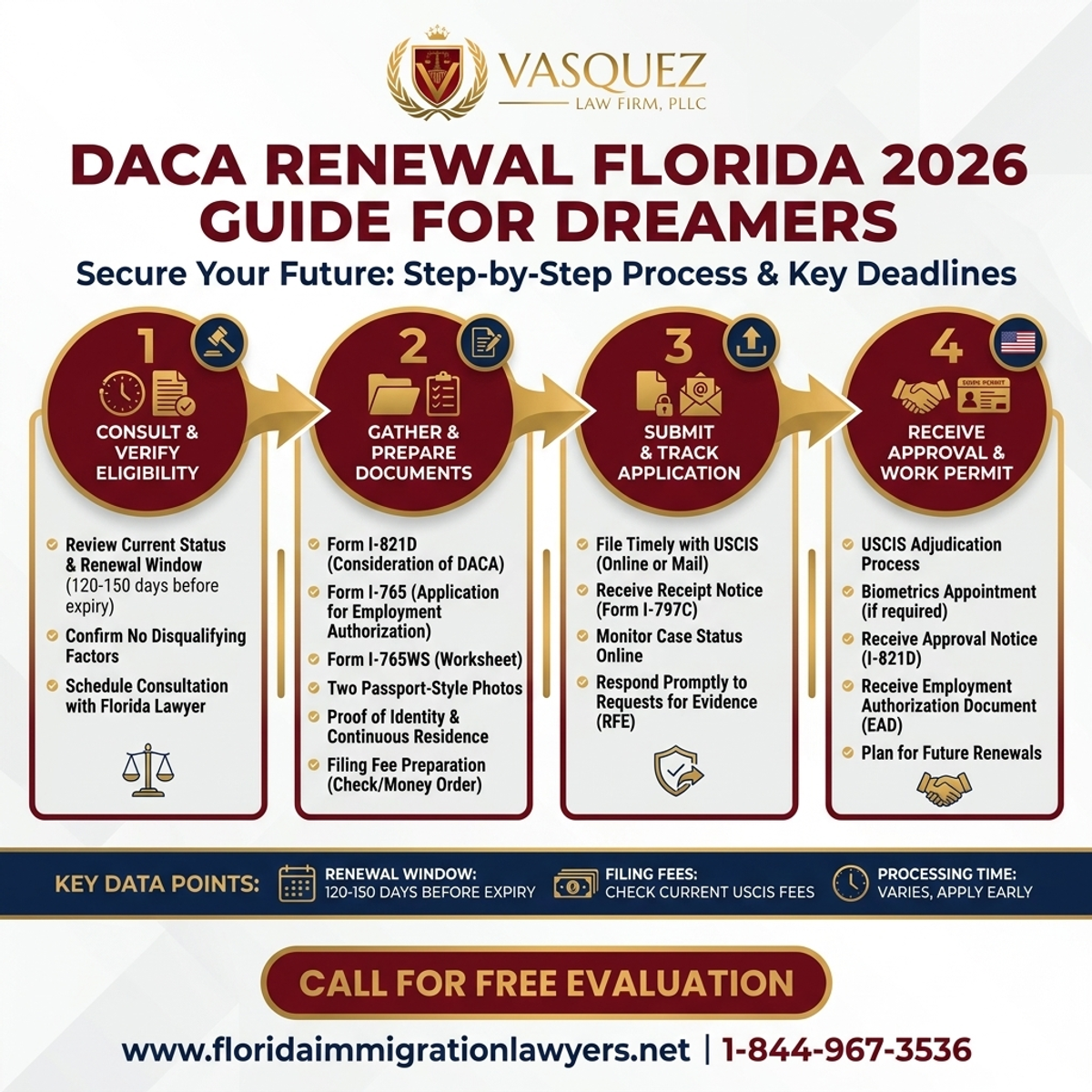
The DACA renewal process, while seemingly straightforward, demands meticulous attention to detail and strict adherence to deadlines. For Florida residents, initiating your DACA renewal Florida 2026 application 120 to 150 days before your current DACA and Employment Authorization Document (EAD) expire is highly recommended. This timeframe allows USCIS sufficient time to process your application and avoids any lapses in your work authorization or deferred action status. Here is a detailed step-by-step guide:
- Gather Necessary Forms: You will need to complete three forms: Form I-821D, Consideration of Deferred Action for Childhood Arrivals; Form I-765, Application for Employment Authorization; and Form I-765WS, Worksheet for Form I-765. Ensure you use the most current versions available on the USCIS website.
- Complete Forms Accurately: Fill out all sections of each form completely and accurately. Any omissions or inconsistencies can lead to delays or even a denial. Pay close attention to questions regarding your continuous residence in the U.S. and any criminal history since your last DACA approval.
- Collect Supporting Documentation: Assemble all required supporting documents. This typically includes copies of your previous DACA approval notice, EAD card, identification documents, and proof of continuous residence in the U.S. since your last DACA approval. Refer to the official USCIS instructions for a comprehensive list.
- Prepare Filing Fees: Calculate the correct filing fees for Form I-765 and the biometrics services fee. While specific amounts are subject to change, these fees are mandatory. USCIS does not accept fee waivers for DACA applications, though limited fee exemptions may be available under very specific circumstances.
- Mail Your Application: Send your complete application package to the appropriate USCIS Lockbox Facility. The mailing address depends on your state of residence, which for Florida is typically the USCIS Dallas Lockbox. Always use a trackable mailing service for proof of submission.
- Attend Biometrics Appointment: After filing, you will receive an appointment notice for biometrics (fingerprints, photograph, and signature) at a local USCIS Application Support Center (ASC), such as those located in Orlando, Miami, or Tampa. Attending this appointment is mandatory.
- Monitor Application Status: You can track the status of your application online using the receipt number provided by USCIS. Be prepared for potential requests for additional evidence (RFE) or even an interview, though interviews for DACA renewals are less common.
Essential Documents Checklist for DACA Renewal
A complete and well-organized set of documents is paramount for a successful DACA renewal Florida 2026 application. Missing or improperly submitted documents are among the leading causes of delays and denials. Before mailing your application, ensure you have gathered all of the following:
- Copies of Your Previous DACA Approval Notices: Include copies of all I-797 approval notices for Form I-821D and Form I-765.
- Copy of Your Current Employment Authorization Document (EAD): Both front and back.
- Proof of Identity: A copy of your birth certificate with a translation (if not in English), passport, or national identity document from your country of origin.
- Proof of Continuous Residence: Documentation showing you have continuously resided in the U.S. since your last DACA approval. This can include:
- School records (transcripts, diplomas, attendance records)
- Employment records (pay stubs, W-2 forms, employment letters)
- Medical records (doctor's visits, hospital records)
- Rental agreements, utility bills, bank statements
- Tax returns
- Any other dated documents showing your physical presence in the U.S.
- Proof of Any Travel Outside the U.S.: If you traveled outside the U.S. with Advance Parole since your last DACA approval, include copies of your Form I-131 approval notice and your travel stamps.
- Criminal History Records: If you have been arrested, charged, or convicted of any crime, or had any interaction with law enforcement since your last DACA application, you must provide certified court dispositions and arrest records, even if charges were dismissed or expunged. This is a critical area where legal advice is often necessary.
- Two Passport-Style Photos: Taken within 30 days of filing, meeting USCIS specifications.
- Payment for Filing Fees: Check or money order payable to the U.S. Department of Homeland Security for the exact amount.
Step-by-Step Process — DACA Renewal Florida 2026 Guide for Dreamers
DACA Renewal Timeline and Processing Expectations in 2026
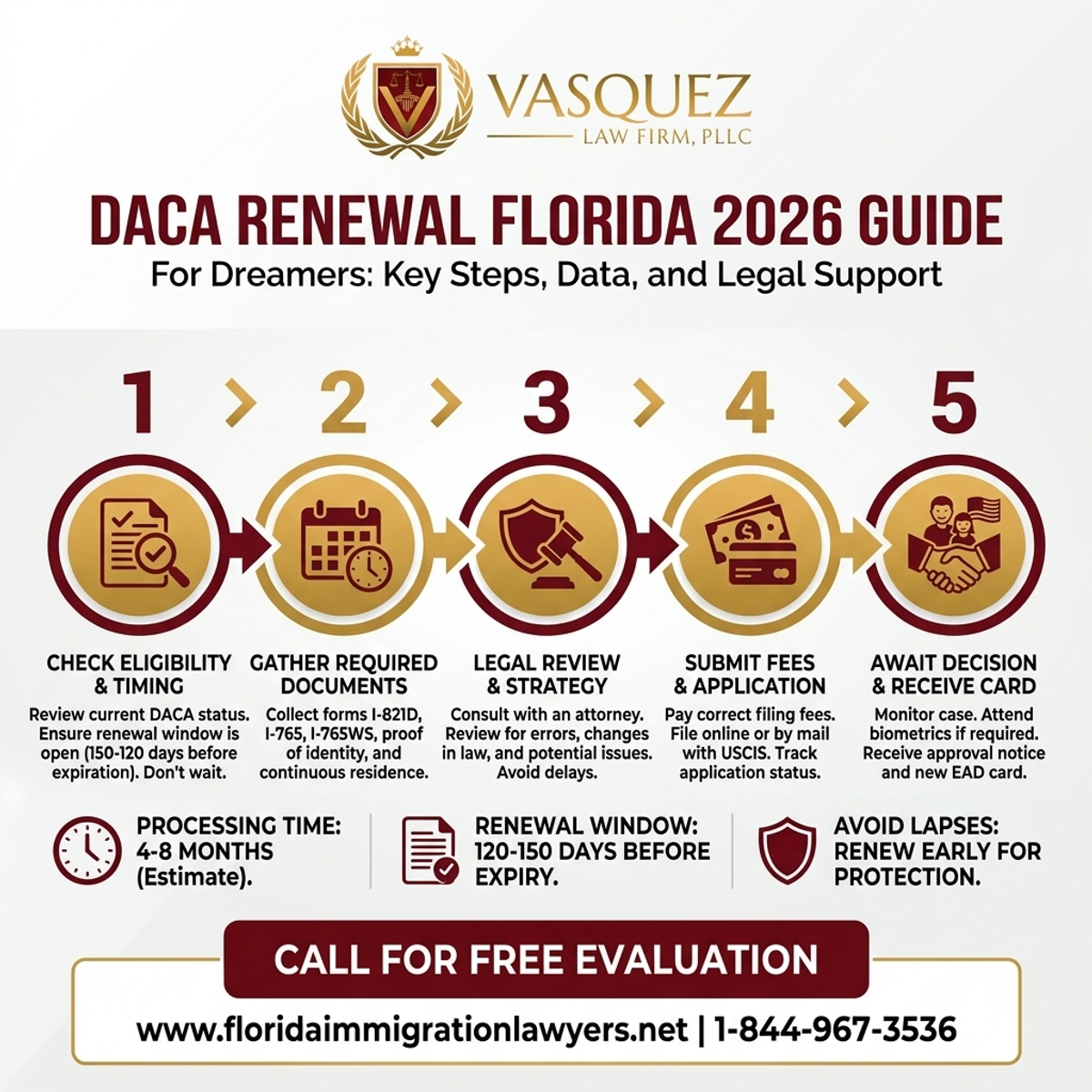
Understanding the typical timeline for DACA renewal Florida 2026 is essential for avoiding a lapse in your status. USCIS generally recommends filing your renewal application 120 to 150 days before your current DACA and EAD expire. This window provides a buffer against potential delays and ensures continuous work authorization. However, actual processing times can vary significantly based on several factors, including the volume of applications, the complexity of individual cases, and current USCIS operational capacities.
After you submit your application, you can expect to receive a receipt notice from USCIS within a few weeks. This notice confirms that your application has been received and provides a receipt number you can use to track your case online via the USCIS Case Status Online tool. Typically, within 2-4 weeks of receiving your receipt notice, you will receive an appointment letter for biometrics at a local Application Support Center (ASC) in Florida. These ASCs are located throughout the state, including in major metropolitan areas like Miami, Orlando, and Tampa. The biometrics appointment itself is usually quick, involving fingerprinting and a photograph.
Following the biometrics appointment, the waiting period for a decision can range from a few weeks to several months. USCIS aims to process DACA renewals efficiently, but unforeseen backlogs or requests for additional evidence (RFEs) can extend this timeline. It is not uncommon for individuals to experience processing times of 3 to 6 months. If your DACA is nearing expiration and you have not received an approval, or if you receive an RFE, it is crucial to act promptly. Consulting with an experienced immigration attorney at Florida Immigration Lawyers can help you understand your options and potentially expedite your case if necessary. Staying ahead of the curve is key to maintaining uninterrupted protection.
Cost Factors and Fee Breakdown for DACA Renewal
The financial aspect of DACA renewal Florida 2026 is an important consideration for many applicants. While the legal services fees for an attorney can vary based on the complexity of your case, there are mandatory government filing fees that all DACA renewal applicants must pay. It is crucial to be aware of these costs and budget accordingly, as USCIS does not typically grant fee waivers for DACA applications. Understanding the fee structure helps ensure your application is complete and avoids potential rejections due to incorrect payment.
The primary government fees associated with DACA renewal consist of two components: the fee for Form I-765, Application for Employment Authorization, and the biometrics services fee. These two fees are combined into a single payment. It is important to note that specific fee amounts are subject to change by USCIS. You should always check the most current fees listed on the official USCIS website before preparing your payment. Payment typically must be made by check or money order payable to the U.S. Department of Homeland Security. Cash payments are generally not accepted.
Key Statistics — DACA Renewal Florida 2026 Guide for Dreamers
Beyond the government filing fees, you should also account for potential costs related to gathering supporting documents. These might include fees for obtaining certified court records, school transcripts, or professional translations of documents not in English. While some organizations offer assistance with DACA renewals, many individuals choose to retain an immigration attorney. Legal fees cover the expertise, guidance, and peace of mind that come with having a professional review and submit your application. An attorney can help identify potential issues, ensure all documents are correct, and represent you if complications arise. Investing in legal counsel can often prevent costly delays or denials in the long run.
Navigating Complex DACA Renewal Scenarios in Florida
While many DACA renewal applications in Florida are straightforward, certain circumstances can introduce significant complexity. It is in these situations that the guidance of an experienced immigration attorney becomes invaluable for DACA renewal Florida 2026. Understanding how to address these complexities effectively can mean the difference between approval and denial of your deferred action.
Arrests or Criminal History
Any arrest, charge, or conviction, even if minor or expunged, since your last DACA approval must be fully disclosed to USCIS. This includes traffic citations beyond a minor infraction. Failure to disclose can lead to severe consequences, including denial and potential placement in removal proceedings. Providing certified court dispositions and arrest records is mandatory. An attorney can help assess the impact of your criminal history on your DACA eligibility under INA § 237 and advise on the best course of action, ensuring all necessary documentation is presented correctly.
Travel Outside the U.S. without Advance Parole
If you traveled outside the United States without first obtaining Advance Parole (Form I-131) after August 15, 2012, you likely lost your eligibility for DACA. This is a critical rule, and any such travel could lead to a denial of your renewal. However, there may be very specific exceptions or legal arguments depending on the exact circumstances of your departure and re-entry. Consulting with a lawyer is essential to determine if any such exceptions apply to your case.
Changes in Personal Information or Residence
It is crucial to update USCIS about any change of address within 10 days of moving, using Form AR-11. Failure to do so can result in missed notices, including biometrics appointments or Requests for Evidence, leading to delays or denials. Similarly, changes in name, marital status, or other significant personal details should be accurately reflected in your renewal application and supported by relevant documentation.
Previous DACA Denial or Termination
If your DACA was previously denied or terminated, renewing can be significantly more challenging. The reasons for the prior denial must be thoroughly understood and addressed in the new application. This often requires a detailed legal analysis and the presentation of new evidence or arguments. An attorney can help you understand the specific reasons for the previous decision and craft a strategy for a successful renewal.
Do not navigate this process alone. Contact Florida Immigration Lawyers today.
Common Mistakes to Avoid in DACA Renewal
Renewing your DACA status is a critical process, and even minor errors can lead to significant delays or a denial. For DACA renewal Florida 2026 applicants, being aware of these common pitfalls can save you time, stress, and potential immigration complications.
- Late Filing: Submitting your application too close to the expiration date of your current DACA and EAD is a major mistake. USCIS recommends filing 120-150 days in advance. Late filing can result in a lapse in your work authorization and deferred action, potentially impacting employment and driving privileges in Florida.
- Incomplete Forms: Failing to answer all questions on Forms I-821D, I-765, and I-765WS, or leaving sections blank without appropriate notation, can lead to a rejection of your application. Ensure every field is addressed.
- Incorrect Filing Fees: Submitting the wrong fee amount or an invalid payment method will cause your application to be rejected. Always verify the current fees on the USCIS website and ensure checks are properly made out to the U.S. Department of Homeland Security.
- Not Disclosing All Criminal History: Even minor arrests, charges, or interactions with law enforcement must be disclosed, regardless of whether they resulted in a conviction or were expunged. Omission can be considered misrepresentation and lead to denial and potential removal proceedings.
- Failing to Provide Certified Court Dispositions: If you have any criminal history, simply mentioning it is not enough. You must provide certified court dispositions for every incident. Without these, USCIS cannot fully assess your eligibility.
- Lack of Proof of Continuous Residence: You must demonstrate continuous residence in the U.S. since your last DACA approval. Insufficient or weak evidence can raise doubts about your eligibility.
- Mailing to the Wrong Address: USCIS has specific lockbox facilities for different types of applications and states. Sending your DACA renewal to the incorrect address will cause significant delays. Verify the correct mailing address on the USCIS website.
- Not Attending Biometrics Appointment: Missing your scheduled biometrics appointment at a local Florida ASC without rescheduling can lead to a denial of your application. This step is mandatory.
- Failure to Update Change of Address: If you move, you must notify USCIS using Form AR-11 within 10 days. Failure to do so can mean you miss critical notices regarding your application, including RFEs or approval notices.
- Not Seeking Legal Advice for Complex Cases: Attempting to renew DACA with a criminal record, significant travel history, or a previous denial without legal counsel is highly risky. An attorney can help navigate these complexities.
When to Call a Lawyer for Your DACA Renewal
While some DACA renewals are straightforward, many situations warrant the expertise of an experienced immigration attorney. If you are a Florida Dreamer considering your DACA renewal Florida 2026, knowing when to seek legal counsel can protect your future. Florida Immigration Lawyers are dedicated to helping individuals navigate the complexities of immigration law, offering personalized support and strategic advice.
You should strongly consider contacting an attorney if:
- You have been arrested, charged, or convicted of any crime since your last DACA approval, even if the charges were dismissed or expunged. This falls under 8 U.S.C. § 1227 and INA § 237, which can impact eligibility.
- You have traveled outside the U.S. without Advance Parole after August 15, 2012.
- Your previous DACA application was denied or your DACA status was terminated.
- You have concerns about proving continuous residence in the U.S.
- You are unsure about any questions on the application forms or how to gather specific supporting documents.
- You receive a Request for Evidence (RFE) from USCIS or a Notice of Intent to Deny (NOID).
- You have any other complex immigration history or believe your case presents unique challenges.
Our team at Florida Immigration Lawyers understands the specific challenges faced by DACA recipients across Florida, including those in Tampa, Orlando, and Miami. We offer comprehensive services, from reviewing your eligibility and preparing your application to representing you in communication with USCIS. Our goal is to minimize risks and maximize the chances of a successful renewal, providing peace of mind during an often stressful process.
About Florida Immigration Lawyers
Florida Immigration Lawyers is a leading law firm dedicated to serving the immigration needs of individuals and families across the entire state of Florida. With a deep understanding of U.S. immigration laws and their specific applications within our state, we provide compassionate, effective, and results-driven legal representation. Our team is committed to guiding clients through every step of their immigration journey, from DACA renewals to asylum claims, deportation defense, and family-based petitions.
We pride ourselves on offering accessible and client-focused services. Our attorneys are available 24/7 to address urgent concerns and offer free consultations to help you understand your legal options without financial obligation. We believe that everyone deserves high-quality legal representation, regardless of their background or circumstances. Whether you are in Tampa, Miami, Orlando, or any other city in Florida, our firm is equipped to assist you. We understand the importance of your immigration goals and work tirelessly to achieve favorable outcomes for our clients. Contact us today to learn how we can help with your immigration needs, including deportation defense, asylum, or citizenship applications. Se Habla Espanol - Estamos aqui para ayudarle.
Sources and References
- U.S. Citizenship and Immigration Services (USCIS)
- Executive Office for Immigration Review (EOIR)
- U.S. Department of State (travel.state.gov)
- 8 U.S.C. Chapter 12 - Immigration and Nationality Act (INA)
- 8 U.S.C. § 1227 - Deportable aliens
- 8 CFR 274a.12 - Classes of aliens authorized to accept employment
- Form I-821D, Consideration of Deferred Action for Childhood Arrivals, Instructions
Related services: immigration practice areas, family immigration services, citizenship and naturalization.
This article provides general legal information and is not intended as legal advice. Every case is unique, and outcomes depend on specific facts and circumstances. Contact an attorney for advice about your particular situation.
Do not let the complexities of the DACA renewal Florida 2026 process overwhelm you. Our dedicated team at Florida Immigration Lawyers is here to provide the expert guidance and support you need. Protect your future and ensure your DACA status is maintained. Call us today for a free, confidential consultation at 1-844-967-3536. Se Habla Espanol - Estamos aqui para ayudarle.
Do Not Navigate This Process Alone
Our experienced immigration attorneys are ready to fight for you. Get a free, confidential consultation today.
Se Habla Español
Frequently Asked Questions
Florida Immigration Lawyers
Immigration Attorney | Founder, Vasquez Law Firm
U.S. Air Force veteran and immigration attorney with thousands of cases resolved. J.D., NCCU School of Law. AILA member. Admitted to the 4th, 5th, and 11th Circuit Courts.
Available 24/7 - Free Evaluations
Related Legal Services
Our Florida immigration attorneys can help you with immigration practice areas, free immigration consultation and experienced immigration attorneys. Call today at 1-844-967-3536 for a free consultation.
Related Links
Related Topics
Free Legal Consultation
Discuss your case with our experienced attorneys. We're available 24/7.
Se Habla Español - Estamos aquí para ayudarle.
Related Articles
Citizenship Test Florida: Your Guide to Naturalization Success
Achieving U.S. citizenship through naturalization is a life-changing milestone for many Florida residents. This comprehensive guide details the citizenship test, including its English and civics components, and provides a step-by-step walkthrough of the N-400 application process. Learn about eligibility, required documents, processing timelines, and associated costs. We also highlight common mistakes to avoid and explain when seeking legal counsel can be invaluable, especially for those in Gainesville and surrounding areas. Florida Immigration Lawyers offers expert guidance to help you prepare for your naturalization interview and civics test, ensuring you navigate this crucial journey with confidence and achieve your dream of becoming a U.S. citizen.
Immigration Documents Checklist Florida: Your Essential Guide
Compiling an accurate immigration documents checklist for Florida is essential for a successful application. This guide details crucial USCIS forms, supporting evidence, and common pitfalls to avoid for applicants in 2026. From birth certificates to financial records, every piece of Florida immigration paperwork must be meticulously prepared. Learn about processing times, cost factors, and Florida-specific considerations, especially for those in Orlando. Florida Immigration Lawyers offers expert guidance to ensure your application is complete and accurate, helping you navigate the complexities of U.S. immigration law with confidence. Don't risk delays or denials; get professional legal support.
CR-1 and IR-1 Visa Process for Florida Spouses | VLF Florida
Learn about the CR-1 and IR-1 spouse visas for Florida residents. Understand the application process, avoid common mistakes, and discover when to seek legal help. Call Florida Immigration Lawyers at 1-844-967-3536 for a free consultation.
T Visa for Trafficking Victims in Florida | VLF Florida
Discover how the T Visa aids trafficking victims in Florida by offering protection and a path to legal status. Florida Immigration Lawyers can assist you in navigating this complex process. Call 1-844-967-3536 for a free consultation.