CR-1 and IR-1 Visa Process for Florida Spouses
Learn about the CR-1 and IR-1 spouse visas for Florida residents. Understand the application process, avoid common mistakes, and discover when to seek legal help. Call Florida Immigration Lawyers at 1-844-YO-PELEO for a free consultation.
For many U.S. citizens in Florida, the dream of bringing a foreign spouse to live permanently in the United States is a deeply personal and significant journey. The process, however, can be complex, filled with specific requirements, extensive paperwork, and multiple government agencies. Understanding the nuances of the CR-1 (Conditional Resident) and IR-1 (Immediate Relative) spouse visas is the first critical step.
At VLF Florida, we focus on guiding families through the intricate landscape of U.S. immigration law, ensuring that your path to spousal reunification is as smooth and efficient as possible. This comprehensive guide will demystify the CR-1 and IR-1 visa process, highlighting key stages, potential challenges, and how our experienced team can provide invaluable support right here in Florida.
Understanding the CR-1 and IR-1 Spouse Visas
The CR-1 and IR-1 visas are both immigrant visas designed for the foreign spouses of U.S. citizens. The primary distinction between the two lies in the duration of the marriage at the time the visa is issued:
- CR-1 Visa (Conditional Resident Visa): This visa is issued when the marriage between the U.S. citizen petitioner and the foreign spouse beneficiary is less than two years old on the day the spouse enters the U.S. with the immigrant visa. The "CR" stands for "Conditional Resident," meaning the spouse receives a two-year conditional green card. Before these two years expire, the couple must file Form I-751, Petition to Remove Conditions on Residence, to prove their marriage is still bona fide and convert the conditional status to permanent residency.
- IR-1 Visa (Immediate Relative Visa): If the marriage is two years old or older when the foreign spouse enters the U.S. with the immigrant visa, they will receive an IR-1 visa. The "IR" stands for "Immediate Relative," and spouses entering on an IR-1 visa are granted a 10-year permanent resident green card immediately, bypassing the conditional status and the need to file Form I-751.
Eligibility Requirements
To qualify for either a CR-1 or IR-1 visa, both the U.S. citizen petitioner and the foreign spouse beneficiary must meet specific criteria:
- U.S. Citizen Petitioner: Must be a U.S. citizen (not a Legal Permanent Resident, which requires a different visa category) and must be able to prove a bona fide marriage to the foreign spouse. They must also meet minimum income requirements to financially support their spouse, preventing them from becoming a public charge.
- Foreign Spouse Beneficiary: Must be legally married to the U.S. citizen. They must also be admissible to the United States, meaning they must not have certain criminal records, immigration violations, or health issues that would make them ineligible for a visa.
The core of both visa types is establishing a legitimate, "bona fide" marriage – one entered into for love and companionship, not solely for immigration benefits. Evidence of a bona fide marriage can include shared financial accounts, joint leases or property deeds, birth certificates of children born to the marriage, photos together, and affidavits from friends and family.
The Step-by-Step CR-1/IR-1 Visa Application Process
Navigating the spouse visa process involves several distinct stages, each with its own set of forms, fees, and waiting periods. Understanding these steps is crucial for a successful application.
Step 1: Filing the I-130 Petition (Petition for Alien Relative)
The journey begins when the U.S. citizen spouse files Form I-130, Petition for Alien Relative, with U.S. Citizenship and Immigration Services (USCIS). This petition establishes the qualifying relationship between the U.S. citizen and their foreign spouse. Along with the I-130, supporting documents must be submitted, including:
- Proof of U.S. citizenship (e.g., birth certificate, passport)
- Marriage certificate
- Proof of termination of any prior marriages for both spouses (e.g., divorce decrees, death certificates)
- Evidence of a bona fide marriage (as mentioned above)
- Passport-style photos of both spouses
USCIS will review the petition, and if approved, they will send an I-797 Approval Notice. The processing times for I-130 petitions can vary significantly, often taking several months to over a year.
Step 2: National Visa Center (NVC) Processing
Once the I-130 petition is approved by USCIS, the case is forwarded to the National Visa Center (NVC), a division of the U.S. Department of State. This is a critical phase known as NVC processing, where the NVC collects all necessary documents and fees before scheduling an interview at a U.S. embassy or consulate abroad.
During NVC processing, the foreign spouse (beneficiary) and the U.S. citizen (petitioner) will need to submit:
- Immigrant Visa Application (DS-260): The foreign spouse completes this online form.
- Affidavit of Support (I-864): The U.S. citizen petitioner must file this form, demonstrating their financial ability to support their spouse. This involves providing tax returns, W-2s, and other financial documents. If the petitioner's income is insufficient, a joint sponsor may be required.
- Civil Documents: These include birth certificates, marriage certificates, police certificates from all countries lived in, military records, and court records (if applicable). All documents not in English must be translated by a certified translator.
- Fees: Various government fees are required throughout this stage, including the NVC processing fees for the immigrant visa application and the Affidavit of Support.
The NVC will review all submitted documents. If everything is complete and correct, they will notify the applicant that their case is "documentarily qualified" and ready for an interview. This stage can also take several months, depending on how quickly documents are submitted and reviewed.
Step 3: Consular Interview
After NVC processing is complete, the NVC will schedule an interview for the foreign spouse at the U.S. embassy or consulate in their home country. Before the interview, the applicant must undergo a medical examination by an authorized physician. The interview itself is a crucial step where a consular officer will review the application, verify the submitted documents, and ask questions to determine the legitimacy of the marriage and the applicant's admissibility to the U.S.
Preparation is key for the interview. Applicants should bring all original documents, copies of all submitted documents, and any additional evidence of their bona fide marriage. Common questions revolve around how the couple met, their relationship timeline, daily life, and future plans. Honesty and consistency are paramount.
Step 4: Visa Issuance and Entry to the U.S.
If the interview is successful and the consular officer approves the visa, the foreign spouse will receive an immigrant visa packet. It is crucial NOT to open this packet. The visa will be stamped in their passport. Upon entering the U.S., the spouse will present this packet to a Customs and Border Protection (CBP) officer. The CBP officer will then process their admission as a lawful permanent resident.
For CR-1 visa holders, the conditional green card is typically mailed within a few weeks after entry. For IR-1 visa holders, the 10-year green card is mailed. Remember, CR-1 holders must file Form I-751 within the 90-day window before their two-year conditional residency expires.
Navigating Common Challenges and Delays
While the step-by-step process seems straightforward, real-world applications often encounter hurdles that can cause significant delays and stress. Understanding these potential challenges can help applicants prepare and mitigate their impact.
One of the most common issues is Requests for Evidence (RFEs) from USCIS or NVC. An RFE is issued when the reviewing officer determines that additional information or documentation is needed to make a decision on your case. This could be due to insufficient proof of a bona fide marriage, incomplete financial documents for the Affidavit of Support, or missing civil documents. Responding thoroughly and promptly to an RFE is critical to avoid further delays or even denial.
Administrative Processing is another frequent cause of delays, particularly after the consular interview. This occurs when the consular officer requires additional time to review the case, conduct background checks, or resolve specific issues. While frustrating, it's often a standard procedure, but it can extend the overall processing time by weeks or even months. Cases involving national security concerns, complex criminal histories, or previous immigration violations are more likely to undergo extensive administrative processing.
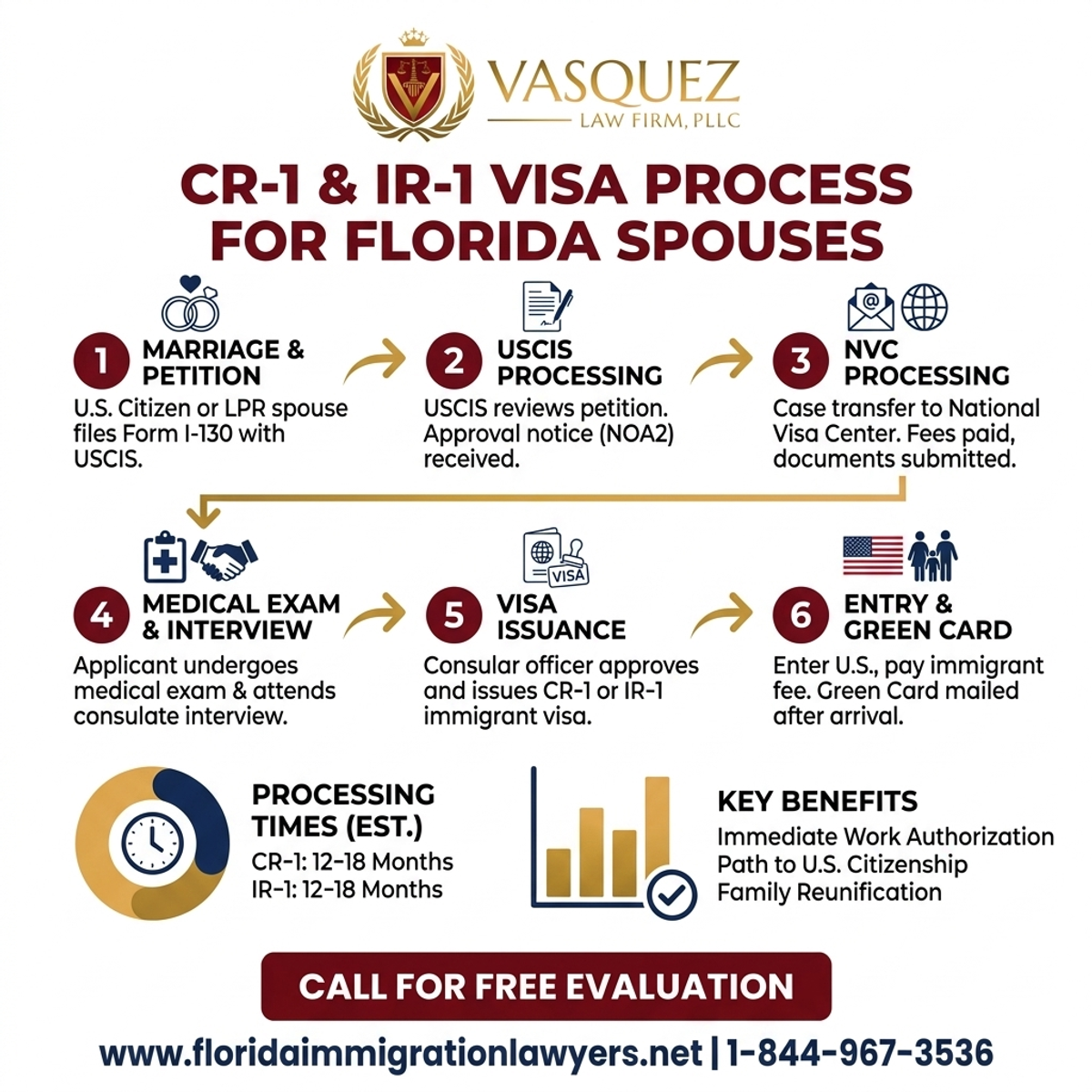
Step-by-Step Process — CR-1 and IR-1 Visa Process for Florida Spouses | VLF Florida
Furthermore, issues related to inadmissibility can halt the process entirely. These can include certain criminal convictions, past immigration fraud, overstays, or specific health-related grounds. In some cases, waivers of inadmissibility may be available, but these are complex applications themselves and require strong legal arguments and supporting evidence. For instance, if a spouse has a history that might lead to deportation defense issues, addressing this proactively is essential.
Ensuring the accuracy and completeness of all submitted documents from the outset is paramount. Even minor errors or inconsistencies can trigger RFEs or administrative processing. The sheer volume of paperwork and the precise requirements of each agency (USCIS, NVC, Consulates) can be overwhelming for individuals navigating the system alone. This is where experienced legal counsel becomes invaluable, helping to identify potential issues early and prepare a robust application package.
Why Choose VLF Florida for Your Spouse Visa Journey
Embarking on the CR-1 or IR-1 visa process is a significant undertaking. Partnering with a knowledgeable and compassionate legal team can make all the difference, especially when dealing with the complexities of U.S. immigration law. VLF Florida stands out as a trusted ally for Florida families.
Our firm brings extensive experience in all facets of spouse visa applications. We understand the specific requirements of USCIS and the NVC, and we stay updated on the latest policy changes that could impact your case. From meticulously preparing your I-130 petition and gathering compelling evidence of your bona fide marriage to guiding you through the NVC processing stage and preparing you for the consular interview, we provide comprehensive support every step of the way.
We pride ourselves on offering personalized attention to each client. We know that every family's situation is unique, and we tailor our strategies to address your specific needs and challenges. Our goal is not just to process paperwork but to provide peace of mind, knowing that your case is in capable hands. We are adept at handling even the most challenging immigration scenarios, including those that might involve complex issues like asylum claims or strategies for deportation defense, showcasing the breadth of our experience.
Our commitment to our clients extends beyond just the visa application. We are here to answer your questions, alleviate your concerns, and advocate vigorously on your behalf. We believe in transparent communication and keeping you informed throughout the entire process. You can learn more about our dedicated legal professionals by visiting our attorneys page, where you'll find profiles detailing their experience and commitment to justice.
Don't navigate the intricate spouse visa process alone. Let the experienced team at VLF Florida be your guide. We are dedicated to helping you achieve your dream of family reunification in the United States. For a free consultation and to discuss your specific situation, please don't hesitate to contact us today. We are ready to assist you.
Frequently Asked Questions (FAQs) About CR-1 and IR-1 Visas
(Original 8 FAQs content goes here, unchanged as per instructions.)
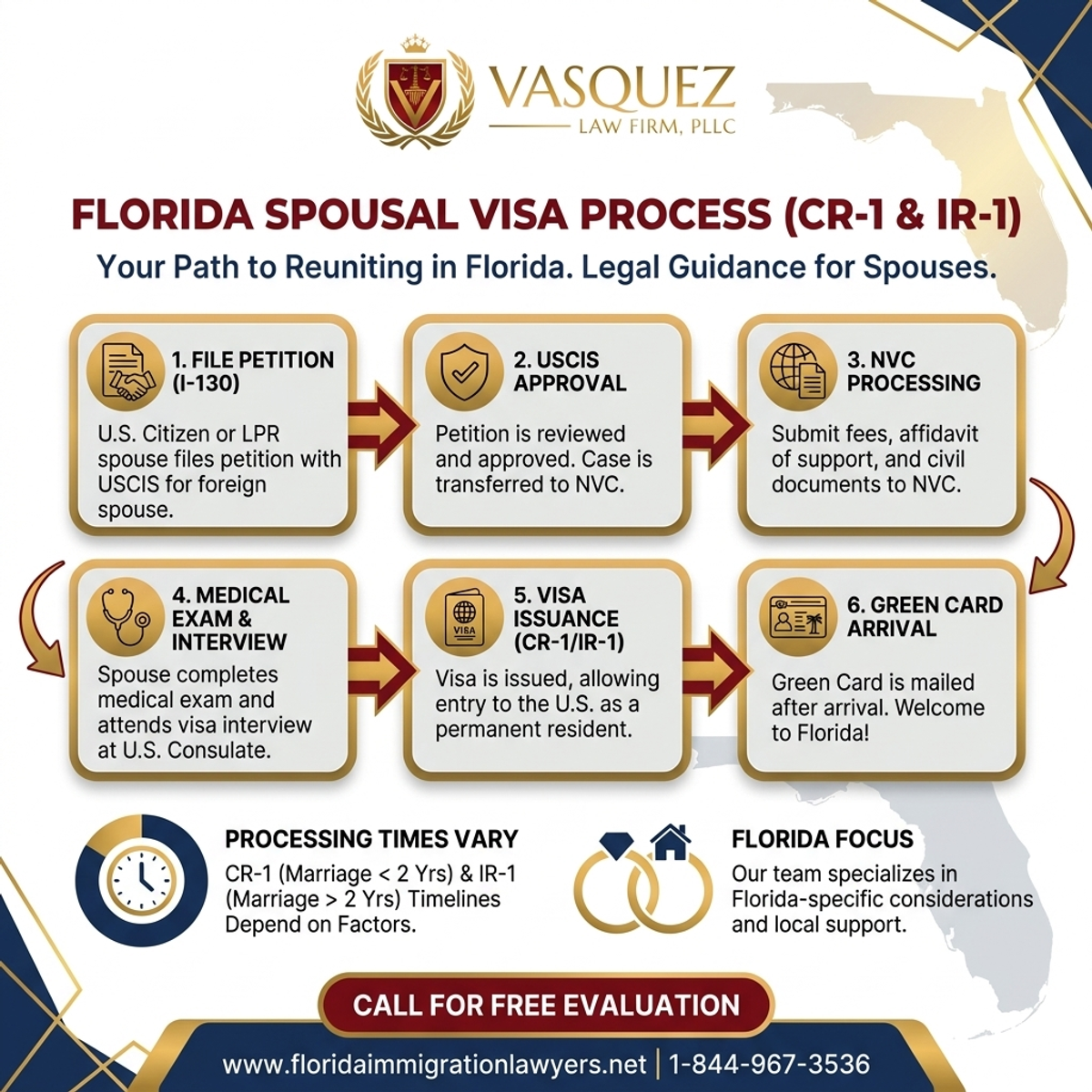
Key Statistics — CR-1 and IR-1 Visa Process for Florida Spouses | VLF Florida
Sources and References
- U.S. Citizenship and Immigration Services (USCIS)
- Executive Office for Immigration Review (EOIR)
- U.S. Department of State - Bureau of Consular Affairs
- Immigration and Nationality Act (INA), 8 U.S.C. Chapter 12
Do Not Navigate This Process Alone
Our experienced immigration attorneys are ready to fight for you. Get a free, confidential case review today.
Se Habla Español
Or leave your details and we’ll call you:
Free Evaluation in 24 Hours
Or talk to us right now
AI voice assistant — available 24/7
FreeFrequently Asked Questions

William J. Vásquez
Founding Attorney · Vasquez Law Firm
U.S. Air Force veteran and immigration attorney with years of hands-on U.S. immigration experience. J.D., NCCU School of Law. AILA member. Admitted to the 4th, 5th, and 11th Circuit Courts.
Available 24/7 - Free Evaluations
Reviewed for legal accuracy by William J. Vásquez
Licensed in North Carolina; U.S. immigration is federal practice.
Related Legal Services
Our Florida immigration attorneys can help you with immigration practice areas, free immigration consultation and business immigration. Call today at 1-844-YO-PELEO for a free case review.
Related Links
Related Topics
Free Legal Case Review
Discuss your case with our experienced attorneys. We're available 24/7.
Se Habla Español - Estamos aquí para ayudarle.
Related Articles
Certificate of Eligibility for Expungement in Florida 2026
For non-U.S. citizens in Florida, understanding how a state expungement impacts immigration status is critical. A certificate of eligibility for expungement in Florida allows a criminal record to be sealed or expunged under state law. However, federal immigration agencies often disregard such state-level relief, still considering the original criminal offense as a conviction for immigration purposes. This can have severe implications for visa applications, green card eligibility, naturalization, and even lead to deportation. This guide clarifies the Florida expungement process, its limited effect on federal immigration law, and key steps to protect your status in 2026. Learn about common mistakes, required documents, timelines, and when to seek expert legal counsel from Florida Immigration Lawyers to navigate these complex issues effectively.
Immigration Lawyer Orlando Free Consultation in Florida
For individuals and families in Orlando, Florida, navigating the complexities of U.S. immigration law requires expert guidance. An immigration lawyer in Orlando offers crucial support for everything from visa applications and green card processes to naturalization and deportation defense. This comprehensive guide details what a free consultation covers, providing a step-by-step overview of immigration pathways, essential document checklists, and expected timelines in 2026. We also highlight common mistakes to avoid, discuss the critical role of legal counsel in deportation and asylum cases, and explain why choosing a local Orlando immigration attorney is beneficial. Florida Immigration Lawyers is dedicated to serving the diverse community of Orlando with compassionate, effective legal solutions, ensuring you receive personalized advice and robust representation for a successful immigration journey.
TN Visa for Florida Professionals in 2026
The TN visa, under the USMCA, offers a unique opportunity for Canadian and Mexican professionals to work in the United States, particularly in Florida's thriving economy. This detailed guide for 2026 covers everything from eligibility requirements and the specific list of designated professions to the step-by-step application process for both Canadian citizens at ports of entry and Mexican citizens through consular processing. We delve into essential documentation, processing timelines, and associated costs, providing tables for clarity. Additionally, we highlight common mistakes to avoid during the application to ensure a smooth journey. For those considering a professional move to Central Florida, understanding these intricacies is crucial. Florida Immigration Lawyers offers expert guidance to navigate these processes, ensuring compliance and maximizing your chances of success. Discover how to leverage the TN visa for your career in Florida.
Green Card Renewal Process in Florida 2026
Renewing your 10-year green card in Florida is essential to maintain your status as a permanent resident. Learn how to file Form I-90, gather the necessary documents, and avoid common mistakes. Florida Immigration Lawyers can help guide you through the process.