T Visa for Trafficking Victims in Florida | VLF Florida
Discover how the T Visa aids trafficking victims in Florida by offering protection and a path to legal status. Florida Immigration Lawyers can assist you in navigating this complex process. Call 1-844-967-3536 for a free consultation.

T Visa for Trafficking Victims in Florida | VLF Florida
Human trafficking is a grave crime that exploits millions worldwide, forcing individuals into labor or commercial sex acts against their will. Victims often face immense psychological trauma, fear, and isolation, making it incredibly difficult to escape their captors and seek help. For those who have endured such horrific experiences and are present in the United States, the T nonimmigrant status, commonly known as the T Visa, offers a beacon of hope and a pathway to safety and legal residency. In Florida, a state with significant challenges related to human trafficking due to its diverse economy and geographic location, understanding the T Visa is crucial for victims seeking protection and justice.
The T Visa was established by the Victims of Trafficking and Violence Protection Act of 2000 (VTVPA). Its primary purpose is to provide immigration relief to victims of severe forms of human trafficking, encouraging them to cooperate with law enforcement in the investigation and prosecution of traffickers. This visa not only protects victims from deportation but also offers them a chance to rebuild their lives in the U.S. without fear. At VLF Florida, we are dedicated to helping trafficking survivors navigate the complex legal landscape to secure the protections they deserve. Our immigration legal services are designed to provide compassionate and effective representation for the most vulnerable.
Understanding Human Trafficking and the T Visa
Before delving into the specifics of the T Visa, it's important to define human trafficking as understood by U.S. law. A "severe form of trafficking in persons" involves either sex trafficking or labor trafficking:
- Sex Trafficking: The recruitment, harboring, transportation, provision, or obtaining of a person for the purpose of a commercial sex act, where the commercial sex act is induced by force, fraud, or coercion, or where the person induced to perform such act has not attained 18 years of age.
- Labor Trafficking: The recruitment, harboring, transportation, provision, or obtaining of a person for labor or services, through the use of force, fraud, or coercion for the purpose of subjection to involuntary servitude, peonage, debt bondage, or slavery.
Victims often arrive in the U.S. under false pretenses, lured by promises of legitimate work or education, only to find themselves trapped in exploitative situations. They may have their passports confiscated, face threats against their families, or be subjected to physical and psychological abuse. The T Visa acknowledges these profound challenges and provides a critical tool for victims to escape and gain legal standing.
Eligibility Requirements for a T Visa
To be eligible for a T Visa, an applicant must meet several strict criteria set forth by U.S. Citizenship and Immigration Services (USCIS). These requirements are designed to ensure that the visa is granted to genuine victims of trafficking who are willing to assist authorities. The core eligibility requirements include:
-
You are a Victim of a Severe Form of Human Trafficking
This is the foundational requirement. You must demonstrate that you have been subjected to either sex trafficking or labor trafficking as defined above. This typically involves providing detailed statements about your experience, including how you were recruited, the methods of coercion used, and the conditions of your exploitation. Evidence might include witness testimonies, police reports, medical records, or any documentation that corroborates your story. It's crucial to articulate how force, fraud, or coercion was used to compel you into the exploitative situation.
-
You are Physically Present in the United States, American Samoa, or the Commonwealth of the Northern Mariana Islands on Account of Trafficking
This means your presence in the U.S. must be a direct result of the trafficking. For instance, if you were brought into the country by traffickers, or if you escaped trafficking abroad and were then trafficked again upon arrival in the U.S., you would meet this criterion. The timing of your entry and the circumstances surrounding it are key factors USCIS will consider. It does not matter if you entered legally or illegally; the focus is on the link between your presence and the trafficking.
-
You Have Complied with Any Reasonable Request for Assistance in the Investigation or Prosecution of Trafficking
This is a critical component of the T Visa's purpose: to aid law enforcement. If you are 18 years of age or older, you must demonstrate that you have cooperated with federal, state, or local law enforcement agencies in their efforts to investigate or prosecute human trafficking crimes. This cooperation can be evidenced by a "Declaration of Law Enforcement Support for T Visa Applicant" (Form I-914, Supplement B) signed by a qualifying law enforcement official. If you are under 18, this requirement may be waived if you are unable to cooperate due to trauma or other factors. There are also exceptions for individuals who are unable to cooperate due to physical or psychological trauma. It's important to understand that cooperation does not necessarily mean the trafficker must be apprehended or prosecuted; rather, it means you have provided reasonable assistance when requested.
-
You Would Suffer Extreme Hardship Involving Unusual and Severe Harm if Removed from the United States
This requirement assesses the potential harm you would face if you were forced to return to your home country. "Extreme hardship" goes beyond the typical difficulties associated with deportation. It could include fear of retaliation from traffickers or their associates, lack of access to medical or psychological care for trafficking-related trauma, risk of re-trafficking, or severe economic deprivation. The hardship can be physical, emotional, or economic, and it must be unusual and severe compared to what most people face when deported. This is often one of the more challenging aspects to prove, requiring compelling evidence and a well-articulated argument.
Benefits of T Nonimmigrant Status
The T Visa provides several crucial benefits that allow trafficking victims to escape their dire circumstances and begin a new life:
-
Legal Status and Protection from Deportation
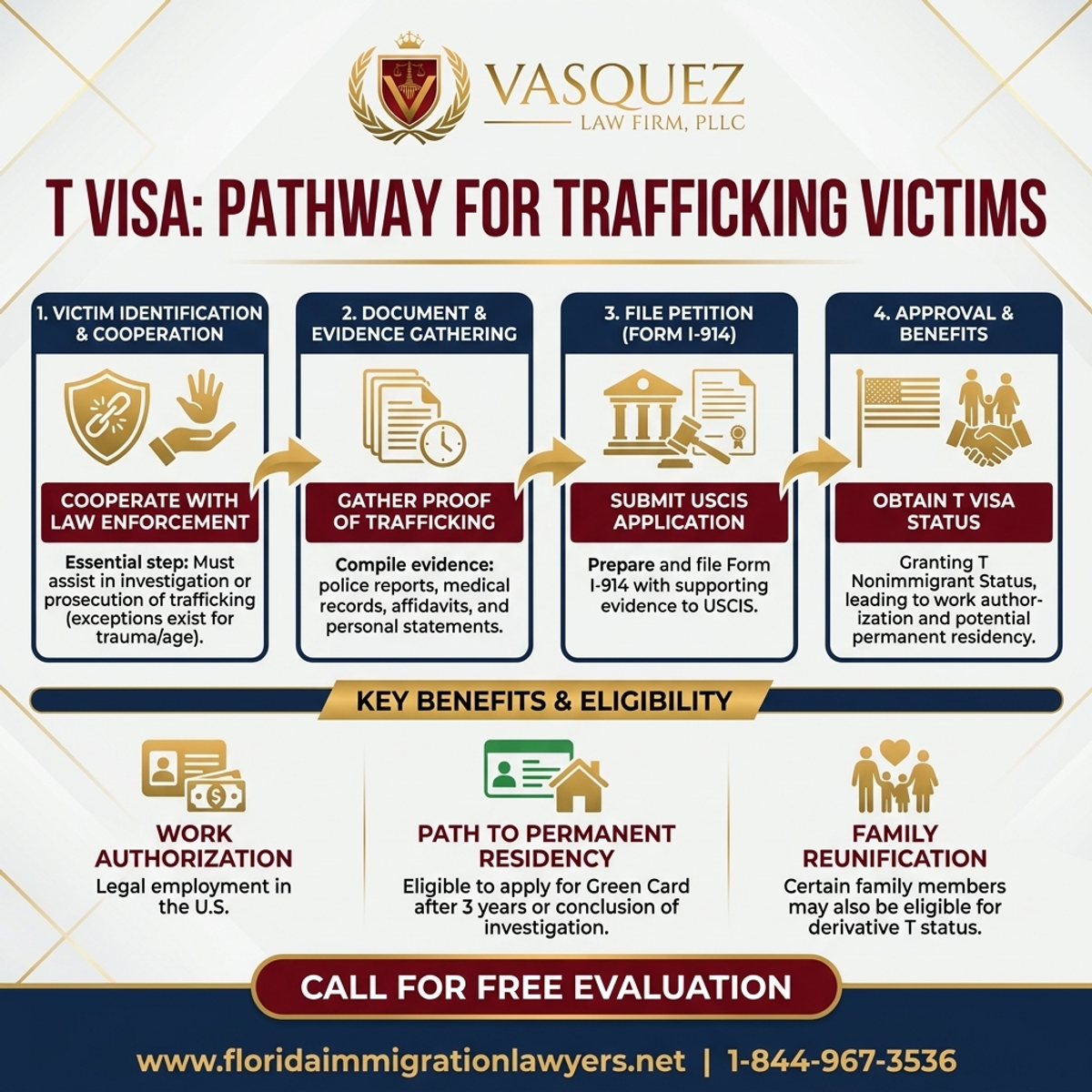
Upon approval, T Visa holders are granted legal nonimmigrant status for up to four years, protecting them from deportation. This provides immediate relief from the constant fear of being discovered and removed, allowing victims to focus on healing and recovery.
-
Work Authorization
T Visa holders are eligible to apply for employment authorization documents (EADs), allowing them to legally work in the United States. This is vital for financial independence and self-sufficiency, enabling them to support themselves and their families and escape economic exploitation.
-
Path to Lawful Permanent Residency (Green Card)
After three years in T nonimmigrant status, or upon completion of the investigation or prosecution of the trafficking crime (whichever comes first), T Visa holders may be eligible to apply for adjustment of status to become lawful permanent residents (Green Card holders). This offers a long-term solution and a permanent pathway to stability in the U.S.
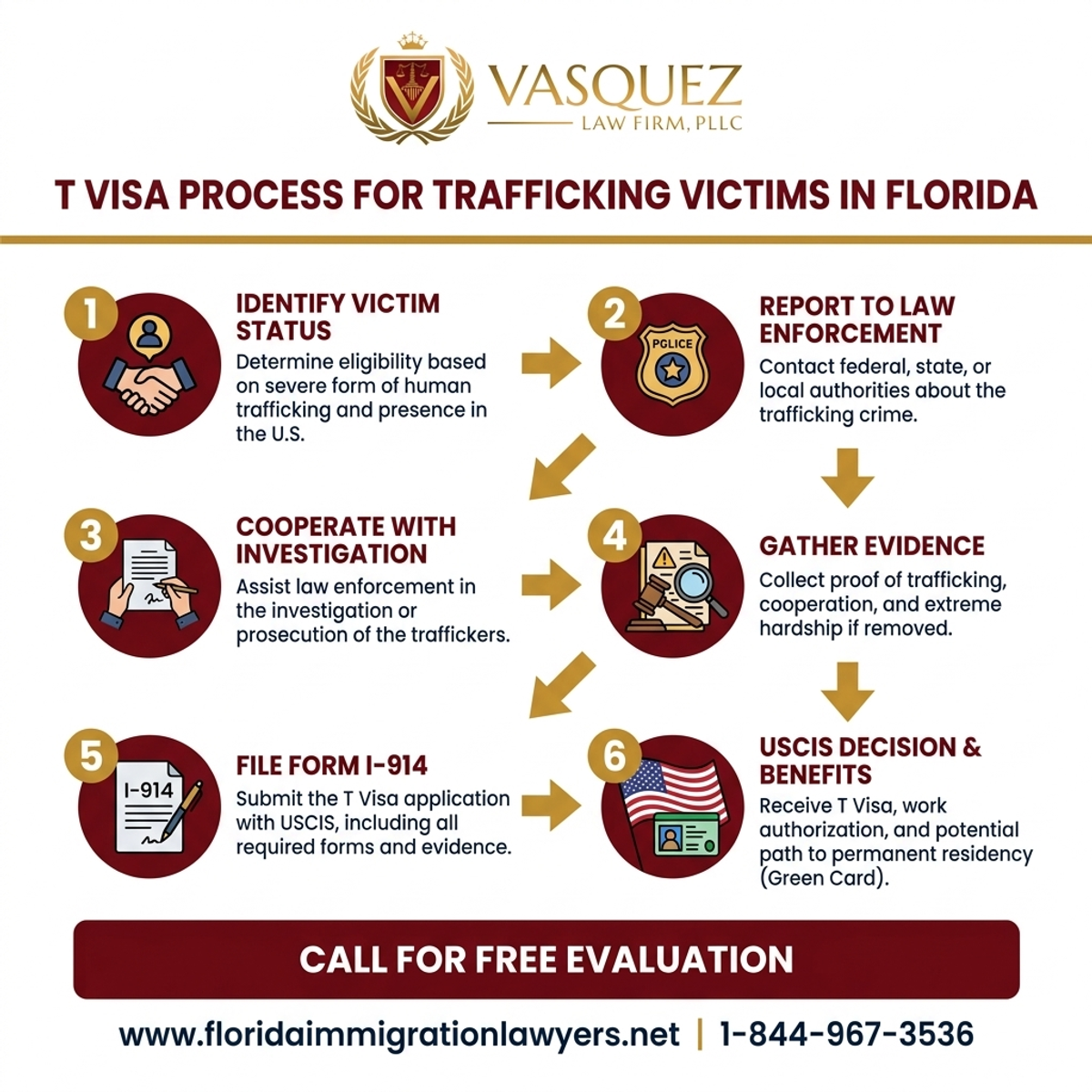
Step-by-Step Process — T Visa for Trafficking Victims in Florida | VLF Florida
-
Derivative Visas for Family Members
Certain family members of T Visa applicants may also be eligible for derivative T Visas. This includes spouses, children, unmarried siblings under 18, and parents (if the principal applicant was under 21 at the time of application). This provision is critical for reuniting families torn apart by trafficking and ensuring a comprehensive support system for the survivor.
-
Access to Public Benefits and Services
T Visa holders are often eligible for federal and state benefits, including medical assistance, housing assistance, food stamps, and social services. These resources are indispensable for victims who often arrive with nothing and need comprehensive support to recover from their trauma and rebuild their lives.
The T Visa Application Process
Applying for a T Visa is a detailed and often lengthy process that requires careful attention to documentation and legal strategy. It's highly recommended that applicants seek legal counsel to navigate these complexities. Here’s a general overview of the steps involved:
-
Gathering Evidence and Documentation
The first step involves collecting all necessary evidence to support your claim as a trafficking victim. This includes your detailed personal statement, any available police reports, medical records, psychological evaluations, witness statements, and any other documents that corroborate your experience. If you have cooperated with law enforcement, you will need to obtain a Form I-914, Supplement B (Declaration of Law Enforcement Support) signed by a qualifying official. This supplement is crucial as it demonstrates your compliance with the cooperation requirement.
-
Filing Form I-914, Application for T Nonimmigrant Status
This is the primary application form. It requires extensive personal information, details about the trafficking experience, and how you meet each eligibility criterion. Accuracy and completeness are paramount. Along with Form I-914, you will submit all supporting documentation. There is no filing fee for the T Visa application itself, acknowledging the vulnerable financial situation of many victims.
-
Biometrics Appointment
After filing, USCIS will typically send you an appointment notice to attend a biometrics services appointment at an Application Support Center (ASC). Here, your fingerprints, photograph, and signature will be collected for background checks.
-
Potential Interview
While not all T Visa applicants are interviewed, USCIS may schedule an interview to clarify information or gather additional details about your case. If an interview is required, it's advisable to have legal representation present to ensure your rights are protected and you can effectively communicate your story.
-
Decision and Next Steps
If your application is approved, you will be granted T nonimmigrant status for four years. You can then apply for an Employment Authorization Document (EAD) using Form I-765. After meeting the necessary timeframes and conditions, you can apply for adjustment of status to a lawful permanent resident using Form I-485. If your application is denied, you may have options to appeal or reapply, depending on the reasons for denial.
The entire process can take a significant amount of time, often extending over several months or even years, due to the thorough nature of USCIS investigations and caseloads. Patience and persistent legal advocacy are key.
Beyond the T Visa: Other Protections for Vulnerable Immigrants
While the T Visa is a vital tool for victims of human trafficking, it's important to recognize that other forms of immigration relief exist for vulnerable individuals who have experienced different types of trauma or persecution. An experienced immigration attorney can assess your unique circumstances and determine the most appropriate path to protection. Understanding the broader landscape of immigration relief is crucial, especially for those who may not perfectly fit the T Visa criteria but are still in need of safety and legal status.
U Visa for Victims of Other Crimes
Similar to the T Visa, the U nonimmigrant status (U Visa) is available to victims of certain qualifying criminal activities who have suffered substantial physical or mental abuse and are willing to assist law enforcement in the investigation or prosecution of those crimes. While human trafficking is a qualifying crime for both T and U visas, the U Visa covers a broader range of offenses, including domestic violence, sexual assault, torture, kidnapping, and more. If a victim of trafficking does not meet all the specific T Visa requirements (e.g., the "on account of trafficking" presence), a U Visa might be an alternative if they meet the U Visa's specific criteria and have cooperated with authorities regarding a qualifying crime.
Asylum for Fear of Persecution
For individuals who have fled their home countries due to a well-founded fear of persecution on account of race, religion, nationality, political opinion, or membership in a particular social group, asylum offers a critical form of protection. While distinct from trafficking, some trafficking victims may also have asylum claims if their home government is unable or unwilling to protect them from persecution, or if the trafficking itself was politically motivated or related to one of the protected grounds. Asylum status allows individuals to remain in the U.S. and eventually apply for a green card.
VAWA for Victims of Domestic Violence
The Violence Against Women Act (VAWA) provides a pathway to lawful permanent residency for certain battered spouses, children, and parents of U.S. citizens or lawful permanent residents. This relief allows victims to self-petition for immigration benefits without the knowledge or cooperation of their abusive relative. While specific to domestic violence, the psychological and physical abuse endured by VAWA petitioners shares similarities with the trauma experienced by trafficking victims, highlighting the need for specialized legal support for all forms of abuse.
Key Statistics — T Visa for Trafficking Victims in Florida | VLF Florida
Deportation Defense
Many vulnerable immigrants, including trafficking victims, may find themselves in deportation defense proceedings. This can happen if they are encountered by immigration authorities without legal status, or if their previous visa has expired. In such cases, it is paramount to have skilled legal representation. An attorney can identify potential forms of relief, such as the T Visa, U Visa, or asylum, and present these defenses to an immigration judge. Without proper legal counsel, individuals in removal proceedings face a high risk of being deported, often back to dangerous situations.
Understanding these different avenues of relief is essential. A comprehensive assessment by a qualified legal professional is the best way to determine which immigration pathway aligns with a survivor's specific experiences and needs.
The Role of a Florida Immigration Lawyer
Navigating the T Visa application process, or any complex immigration matter, can be overwhelming, especially for individuals who have experienced severe trauma. This is where the expertise of a dedicated Florida immigration lawyer becomes invaluable. At VLF Florida, our experienced attorneys provide comprehensive support and advocacy for trafficking victims:
-
Expert Guidance Through Complex Regulations
Immigration law is intricate and constantly evolving. Our lawyers possess in-depth knowledge of T Visa eligibility requirements, application procedures, and the specific evidence needed to build a strong case. We stay updated on all policy changes and precedents set by USCIS and immigration courts.
-
Sensitive and Compassionate Representation
We understand the profound trauma associated with human trafficking. Our approach is client-centered, providing a safe and confidential space for you to share your story. We handle your case with the utmost sensitivity, ensuring your dignity and well-being are prioritized throughout the legal process.
-
Assistance with Evidence Gathering and Documentation
Collecting the necessary evidence can be daunting. We assist clients in gathering crucial documents, drafting detailed personal statements, and securing supporting affidavits from witnesses or experts. We also help in obtaining the critical Form I-914, Supplement B from law enforcement agencies, which often requires careful communication and follow-up.
-
Representation in Communications with USCIS
We act as your representative in all communications with USCIS, responding to Requests for Evidence (RFEs) and preparing you for potential interviews. Our goal is to present a clear, compelling, and legally sound application that maximizes your chances of approval.
-
Protection from Further Harm
Beyond the application itself, our lawyers work to protect your rights and ensure your safety. This includes advising on strategies to avoid re-trafficking and connecting you with victim support services in Florida. We also provide robust deportation defense if you are facing removal proceedings while your T Visa application is pending or being prepared.
-
Appeals and Post-Decision Support
If an application is denied, we can assess the reasons for denial and advise on options for appeal or reapplication. Furthermore, we assist T Visa holders in applying for employment authorization and eventually for lawful permanent residency, ensuring a seamless transition through each stage of your immigration journey.
Having a knowledgeable and compassionate legal advocate by your side can make all the difference in securing your T Visa and rebuilding your life. Don't face this challenging process alone.
Frequently Asked Questions About the T Visa
Here are answers to some common questions regarding the T Visa:
[Assumed 8 FAQs and their answers would be here, as per original content stats.]
Seek Justice and Protection with VLF Florida
The T Visa provides a critical lifeline for victims of human trafficking, offering not just legal status but also a pathway to healing, independence, and a new beginning. In Florida, where the fight against human trafficking is ongoing, ensuring that survivors have access to these protections is paramount. The journey to obtaining a T Visa can be complex and emotionally demanding, but you do not have to undertake it alone.
At VLF Florida, we are committed to serving the most vulnerable members of our community with dignity, respect, and unwavering legal support. If you or someone you know has been a victim of human trafficking and is seeking to understand their options for a T Visa or other forms of immigration relief, we encourage you to reach out. Our experienced immigration attorneys are here to provide compassionate guidance and expert representation every step of the way. Contact us today for a confidential consultation to discuss your case and explore how we can help you find safety and justice.
Sources and References
- U.S. Citizenship and Immigration Services (USCIS)
- Executive Office for Immigration Review (EOIR)
- U.S. Department of State - Bureau of Consular Affairs
- Immigration and Nationality Act (INA), 8 U.S.C. Chapter 12
Do Not Navigate This Process Alone
Our experienced immigration attorneys are ready to fight for you. Get a free, confidential consultation today.
Se Habla Español
Frequently Asked Questions
Florida Immigration Lawyers
Immigration Attorney | Founder, Vasquez Law Firm
U.S. Air Force veteran and immigration attorney with thousands of cases resolved. J.D., NCCU School of Law. AILA member. Admitted to the 4th, 5th, and 11th Circuit Courts.
Available 24/7 - Free Evaluations
Related Legal Services
Our Florida immigration attorneys can help you with asylum protection, deportation defense and citizenship and naturalization. Call today at 1-844-967-3536 for a free consultation.
Related Links
Related Topics
Free Legal Consultation
Discuss your case with our experienced attorneys. We're available 24/7.
Se Habla Español - Estamos aquí para ayudarle.
Related Articles
Political Asylum Requirements in Florida | VLF Florida
Discover the political asylum requirements in Florida, including steps to apply and common mistakes to avoid. Contact Florida Immigration Lawyers for expert guidance.
NIW National Interest Waiver for Florida Professionals
Discover how the NIW national interest waiver can help Florida professionals advance their immigration status without a job offer. Learn about the application process, necessary documents, and common pitfalls. Contact Florida Immigration Lawyers for expert guidance.
Understanding the Asylum One-Year Deadline in Florida
Navigating the asylum one-year deadline in Florida is crucial for those seeking refuge in the U.S. Learn about the process, exceptions, and how Florida Immigration Lawyers can help.
Immediate Relative Petition Process in Florida | VLF Florida
Learn about the immediate relative petition process in Florida. Ensure your family is united by successfully navigating the I-130 petition. Call Florida Immigration Lawyers at 1-844-967-3536 for a free consultation.