Immediate Relative Petition Tampa: Your 2026 Guide
Navigating an immediate relative petition in Florida requires a thorough understanding of U.S. immigration law and meticulous attention to detail. This guide, tailored for U.S. citizens in Florida, explains the step-by-step process of sponsoring immediate relatives—spouses, unmarried children under 21, and parents—for a Green Card. Learn about filing Form I-130, required documentation, estimated processing times for 2026, and associated costs. We also highlight common mistakes to avoid and crucial scenarios where legal counsel from Florida Immigration Lawyers becomes indispensable. With no annual visa limits for immediate relatives, this path offers a faster route to permanent residency, but expert guidance can ensure a smooth, successful journey.
Quick Answer: Immediate Relative Petitions in Florida
An immediate relative petition allows U.S. citizens to sponsor their closest family members – spouses, unmarried children under 21, and parents – for a U.S. Green Card. Unlike other family preference categories, there is no annual limit on immediate relative visas, often leading to a faster processing time once the petition is approved. The process typically begins with filing Form I-130, Petition for Alien Relative, with USCIS. Navigating the complex requirements, documentation, and interviews, especially within Florida's specific USCIS field offices and immigration courts, necessitates careful preparation. Seeking legal guidance from experienced Florida immigration lawyers can significantly streamline this crucial family immigration journey.
- U.S. citizens can petition for spouses, unmarried children under 21, and parents.
- No annual visa limits, potentially faster processing than other categories.
- Starts with Form I-130, filed with USCIS.
- Requires meticulous documentation and preparation for interviews.
- Florida-specific considerations for USCIS processing and interviews.
Embarking on the journey of family immigration can be both exciting and daunting. For U.S. citizens in Florida, sponsoring an immediate relative for a Green Card is a profound step towards uniting your family permanently in the United States. Whether you're in Orlando, Tampa, or elsewhere in Central Florida, understanding the nuances of an immediate relative petition florida is crucial for a successful outcome. This comprehensive guide will walk you through the entire process, from initial filing to securing a Green Card, highlighting Florida-specific considerations and crucial legal insights.
The U.S. immigration system prioritizes immediate relatives of U.S. citizens, offering a unique path to lawful permanent residency without the lengthy visa backlogs faced by other family categories. This means spouses, unmarried children under 21, and parents of U.S. citizens can often obtain their Green Cards more quickly. However, the process is still complex, requiring precise documentation, adherence to strict deadlines, and careful navigation of USCIS policies. Don't let the intricacies of immigration law overwhelm your family's future. Call Florida Immigration Lawyers at 1-844-YO-PELEO for a free case review and let our experienced team guide you every step of the way.
Understanding the Immediate Relative Petition: What is it?
An immediate relative petition, primarily initiated through Form I-130, Petition for Alien Relative, is the cornerstone of family-based immigration for specific close relatives of U.S. citizens. This category is distinct because it is not subject to numerical quotas, meaning a visa number is always immediately available once the petition is approved. This significantly reduces the waiting times often associated with other family preference categories. The qualifying relationships include spouses of U.S. citizens, unmarried children under 21 years of age of U.S. citizens, and parents of U.S. citizens (provided the U.S. citizen petitioner is at least 21 years old). For many families in Florida, this pathway represents the most direct route to permanent residency.
The purpose of the I-130 petition is to establish a legitimate qualifying relationship between the U.S. citizen petitioner and the foreign national beneficiary. USCIS scrutinizes these petitions rigorously to prevent fraud and ensure compliance with the Immigration and Nationality Act (INA). For instance, in spousal petitions, evidence of a bona fide marriage is paramount, often requiring extensive documentation such as joint bank accounts, property deeds, marriage certificates, and sworn affidavits. The process also differentiates between beneficiaries who are already in the U.S. and may be eligible for Adjustment of Status (AOS), and those abroad who will undergo Consular Processing. Understanding these distinctions is vital, especially when considering the specific USCIS field offices or consulates involved for applicants from Florida.
What is the Step-by-Step Process for an Immediate Relative Petition in Florida?
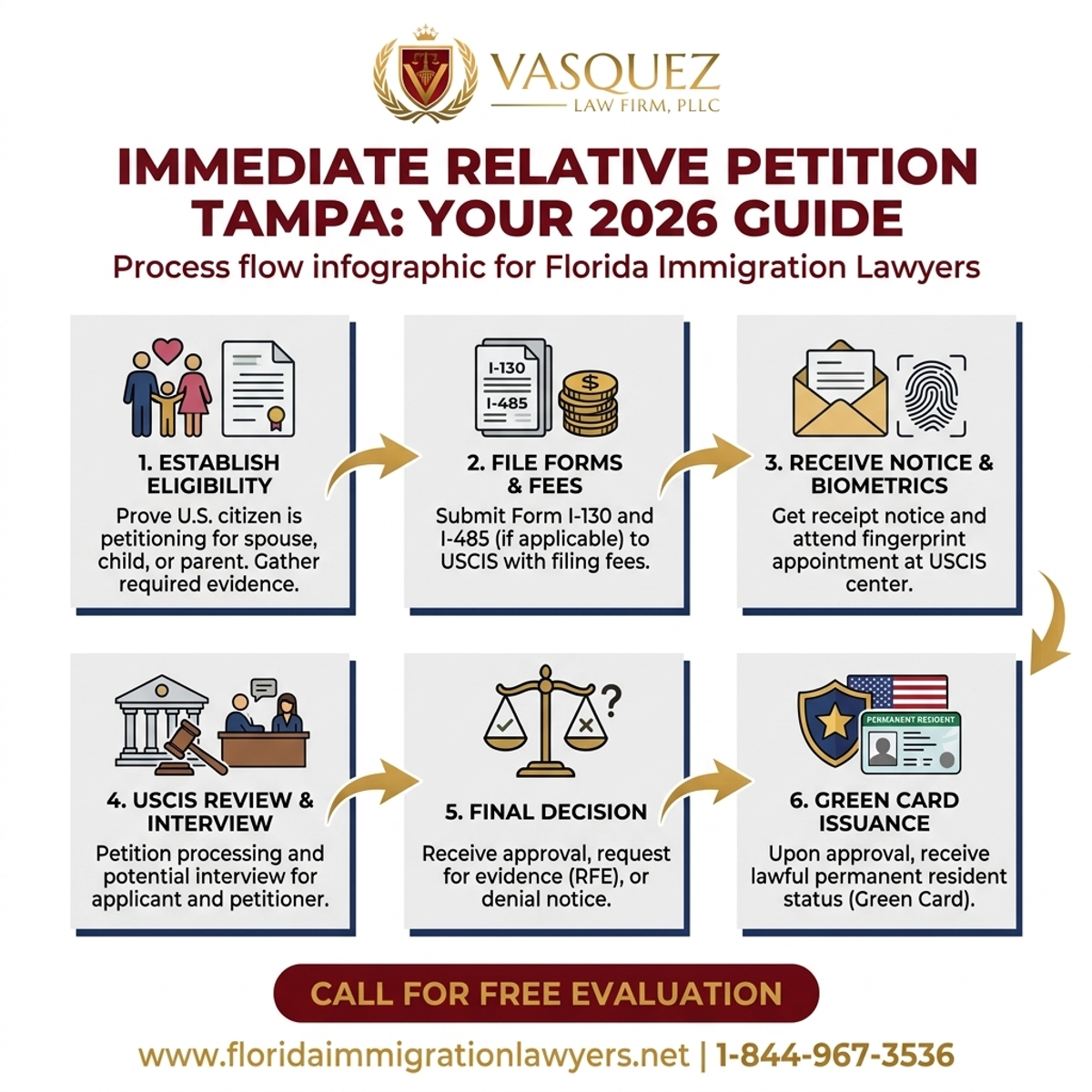
The immediate relative petition process involves several critical stages, beginning with establishing the qualifying relationship and culminating in the issuance of a Green Card. Each step demands careful attention to detail and adherence to specific USCIS and Department of State guidelines. For families in Florida, understanding these steps is key to a smooth process.
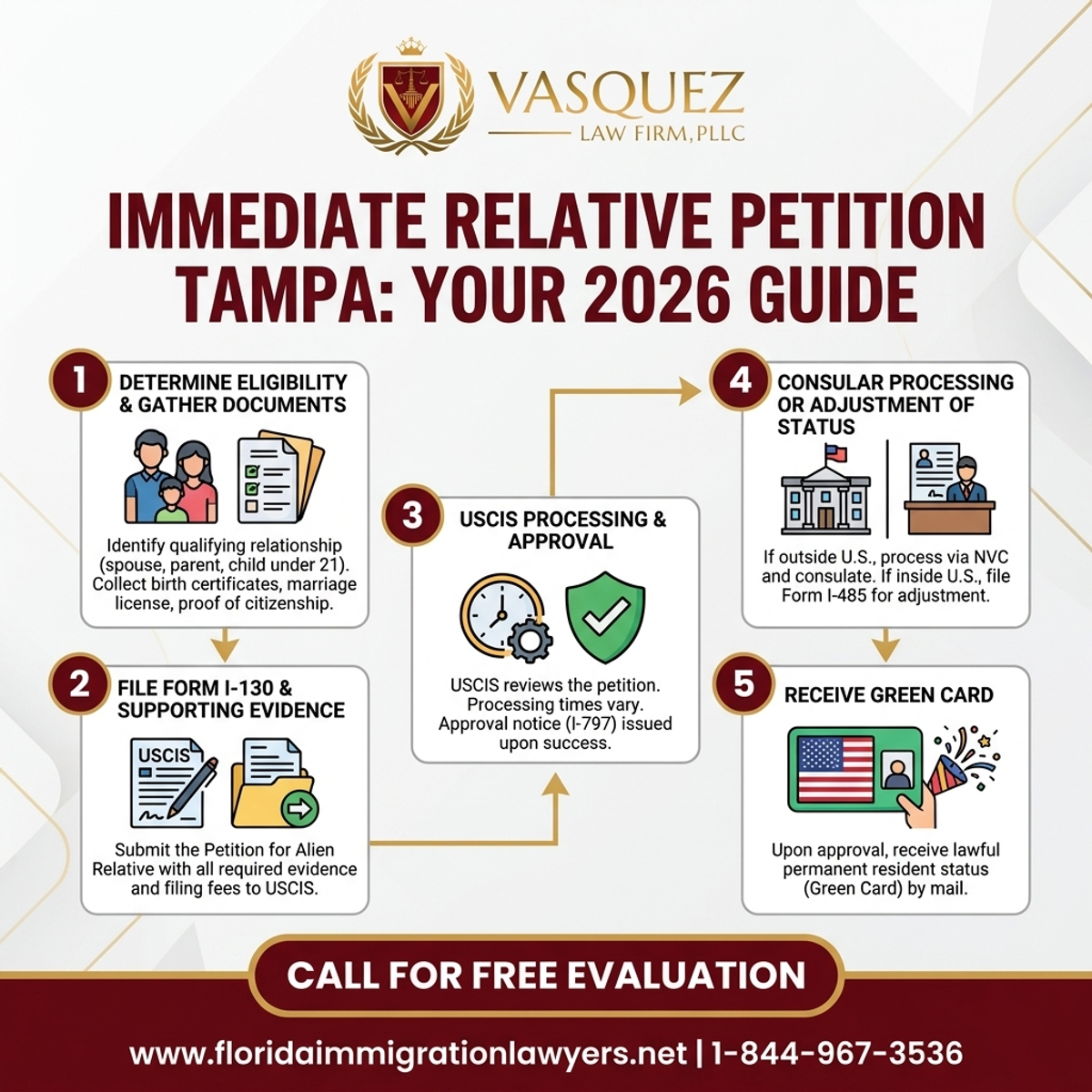
The process generally begins with the U.S. citizen filing Form I-130, Petition for Alien Relative, with U.S. Citizenship and Immigration Services (USCIS). Once this petition is approved and a visa is available (which is immediate for immediate relatives), the beneficiary will either apply for Adjustment of Status if they are in the U.S. or undergo Consular Processing if they are abroad. This multi-stage journey requires meticulous preparation and can be significantly impacted by the specific circumstances of the petitioner and beneficiary, including their current location and immigration history.
- File Form I-130, Petition for Alien Relative: The U.S. citizen petitioner initiates the process by filing Form I-130 with the appropriate USCIS service center. This form establishes the qualifying family relationship. Along with the form, you must submit proof of U.S. citizenship (e.g., birth certificate, naturalization certificate, U.S. passport) and evidence of the relationship (e.g., marriage certificate for spouses, birth certificate for children/parents). All supporting documents must be accurate and complete, as any discrepancies can lead to delays or Requests for Evidence (RFEs).
- USCIS Processing and Approval: After submission, USCIS reviews the I-130 petition. Processing times can vary, but generally range from 10-18 months as of 2026. USCIS may issue an RFE if more information is needed. Upon approval, USCIS sends an I-797, Notice of Action, to the petitioner. This approval signifies that the familial relationship has been established for immigration purposes.
- Determine Adjustment of Status vs. Consular Processing: The next step depends on the beneficiary's location. If the beneficiary is lawfully present in the U.S. and meets eligibility criteria (e.g., entered legally, no disqualifying bars), they may file Form I-485, Application to Register Permanent Residence or Adjust Status. If the beneficiary is outside the U.S., their case is sent to the National Visa Center (NVC) for Consular Processing.
- Adjustment of Status (AOS) – If in U.S.: For beneficiaries in Florida eligible for AOS, they file Form I-485 concurrently with or after the I-130 approval. This package typically includes forms I-864 (Affidavit of Support), I-693 (Report of Medical Examination), and I-765 (Application for Employment Authorization), among others. After filing, the beneficiary attends a biometrics appointment at a local USCIS Application Support Center (ASC), such as the one in Orlando. An interview at a USCIS field office, like the Orlando Field Office, is usually scheduled, followed by a decision.
- Consular Processing – If Abroad: For beneficiaries outside the U.S., the approved I-130 is sent to the NVC. The NVC collects required documents, immigrant visa application fees, and Form DS-260, Immigrant Visa Application. Once complete, the NVC schedules an interview at the appropriate U.S. embassy or consulate in the beneficiary's home country. After a successful interview and medical exam, the immigrant visa is issued, allowing the beneficiary to enter the U.S. as a lawful permanent resident.
- Green Card Issuance: Upon successful adjustment of status or entry into the U.S. with an immigrant visa, the beneficiary receives their physical Green Card (Form I-551) by mail. For conditional Green Cards (issued if the marriage is less than two years old at the time of approval), a separate petition (Form I-751) to remove conditions must be filed within 90 days before the Green Card expires.
What Documents Do I Need for an I-130 Petition?
Filing an I-130 petition requires a comprehensive set of documents to prove both the U.S. citizenship of the petitioner and the legitimate family relationship with the beneficiary. Missing or incorrect documentation is a primary cause of delays and denials. It is critical to gather all necessary records before submission. USCIS requires original documents or certified copies, along with English translations for any foreign-language documents.
The specific documents needed vary slightly depending on the relationship (spouse, child, parent), but core requirements remain. For instance, all petitioners must provide proof of their U.S. citizenship, and all relationships must be legally established. Beyond the initial I-130 filing, subsequent stages like Adjustment of Status or Consular Processing will demand additional documentation, including financial affidavits, medical examination results, and police clearances. Organizing these documents meticulously is a cornerstone of a successful immediate relative petition florida.
- Proof of U.S. Citizenship for Petitioner:
- Copy of U.S. birth certificate
- Copy of U.S. passport
- Copy of Certificate of Naturalization
- Copy of Certificate of Citizenship
- Proof of Relationship:
- For Spouses: Copy of marriage certificate, birth certificates of any children born to the marriage, joint bank statements, joint utility bills, joint leases/mortgages, affidavits from friends/family attesting to the bona fide marriage, photos together.
- For Children: Copy of child's birth certificate showing names of both parents, copy of marriage certificate for parents (if applicable), proof of legal legitimation (if applicable).
- For Parents: Copy of U.S. citizen's birth certificate showing names of both parents, copy of parents' marriage certificate (if applicable).
- Proof of Name Changes (if applicable): Marriage certificates, divorce decrees, court orders.
- Copies of Passports and Visas (Beneficiary): If applicable, especially for Adjustment of Status.
- Photographs: Passport-style photos for both petitioner and beneficiary.
- Previous Marriage Termination Documents (if applicable): Divorce decrees, death certificates for any prior spouses for both petitioner and beneficiary.
- Translations: Certified English translations for any documents not in English.
Step-by-Step Process — Immediate Relative Petition Tampa: Your 2026 Guide
How Long Does an Immediate Relative Petition Take in 2026?
The processing time for an immediate relative petition florida can vary based on several factors, including the specific USCIS service center handling the case, the completeness of the application, and the current USCIS workload. As of 2026, while immediate relatives are exempt from visa backlogs, the administrative processing of the I-130 petition and subsequent Green Card application still takes time. It's important to differentiate between I-130 approval times and the total time until a Green Card is issued.
For example, the initial I-130 petition generally takes between 10 to 18 months for approval. Following this, if the beneficiary is adjusting status in the U.S., the I-485 application can take an additional 12-24 months for adjudication, including biometrics and interviews at local Florida USCIS offices like Orlando. If the beneficiary is undergoing consular processing abroad, the National Visa Center (NVC) and embassy/consulate processing can add another 6-12 months. These are typical timeframes, and individual cases can be faster or slower depending on RFEs, background checks, and interview scheduling. Consulting with an immigration attorney can help manage expectations and address potential delays.
| Stage | Typical Timeframe (As of 2026) | Notes |
|---|---|---|
| Form I-130 Filing & Receipt | 1-2 Weeks | Confirmation of submission from USCIS. |
| Form I-130 Processing & Approval | 10-18 Months | Varies by USCIS service center workload. May include RFEs. |
| NVC Processing (Consular) | 2-6 Months | Document collection, fee payment, DS-260 submission. |
| Embassy/Consulate Interview Scheduling (Consular) | 2-6 Months | Depends on consulate's availability. |
| Adjustment of Status (AOS) Filing & Receipt | 1-2 Weeks | For beneficiaries in the U.S. after I-130 approval or concurrently. |
| Biometrics Appointment (AOS) | 3-5 Weeks after Filing | At a local USCIS Application Support Center (e.g., Orlando ASC). |
| Employment Authorization Document (EAD) & Advance Parole (AP) (AOS) | 5-12 Months | If requested concurrently with I-485. |
| AOS Interview Scheduling & Decision | 12-24 Months | At a USCIS Field Office (e.g., Orlando Field Office). |
| Green Card Issuance | 1-2 Months after Approval | Mailed to the beneficiary. |
What are the Costs Associated with an Immediate Relative Petition?
The financial aspect of an immediate relative petition florida is a significant consideration for many families. The overall cost is comprised of several distinct fees, including government filing fees, medical examination fees, and potential legal fees if you choose to hire an attorney. It's important to budget for these expenses, as they are a mandatory part of the immigration process. USCIS fees, in particular, are subject to change, so it's always advisable to check the most current fee schedule on the official USCIS website before filing. As of 2026, the fees listed below are general estimates and should be verified.
Beyond the core government fees, other costs may arise. For instance, obtaining certified copies of documents, professional translations, or travel expenses for interviews can add up. The medical examination, a mandatory part of both Adjustment of Status and Consular Processing, is conducted by USCIS-approved civil surgeons in the U.S. or panel physicians abroad, and their fees are separate from USCIS. While legal fees represent an additional cost, the expertise of an immigration lawyer can often save time and prevent costly mistakes, making it a valuable investment in the long run for families in Central Florida and beyond.
| Item | Typical Fee (As of 2026, subject to change) | Notes |
|---|---|---|
| Form I-130, Petition for Alien Relative | $525 | Paid to USCIS by the U.S. citizen petitioner. |
| Form I-485, Application to Register Permanent Residence or Adjust Status (AOS) | $1,225 (includes biometrics fee) | Paid to USCIS by the beneficiary for Adjustment of Status. |
| Form DS-260, Immigrant Visa Application (Consular Processing) | $325 | Paid to the Department of State by the beneficiary. |
| Affidavit of Support Fee (Consular Processing) | $120 | Paid to the National Visa Center (NVC). |
| Biometrics Services Fee (separate from I-485) | $85 | If not included in the primary application fee (e.g., for certain standalone forms). |
| Medical Examination Fee | $200-$500 | Paid directly to the civil surgeon or panel physician. Varies by provider. |
| Translation Fees | Varies | For documents not in English, typically per page or per document. |
| Attorney Fees | Varies widely | Depends on the complexity of the case and the services provided. |
Key Statistics — Immediate Relative Petition Tampa: Your 2026 Guide
Do not navigate this process alone. Contact Florida Immigration Lawyers today for a free case review.
Common Mistakes to Avoid in Your Immediate Relative Petition
Navigating an immediate relative petition can be complex, and even minor errors can lead to significant delays or even denial. Being aware of common pitfalls can help you avoid them and ensure a smoother process for your immediate relative petition florida.
- Incomplete or Incorrect Forms: One of the most frequent mistakes is submitting forms with missing information or errors. USCIS is strict about accuracy. Always double-check every field and ensure all questions are answered truthfully and completely.
- Insufficient Supporting Documentation: Failing to provide all required evidence, or submitting documents that don't adequately prove the relationship, can trigger RFEs or denials. For spousal petitions, robust evidence of a bona fide marriage is crucial.
- Lack of Certified English Translations: Any document not in English must be accompanied by a complete and certified English translation. Failing to provide this will result in the document not being considered.
- Ignoring Deadlines: Missing deadlines for RFEs, biometrics appointments, or interview notices can lead to case abandonment or denial. Keep track of all communications from USCIS and the NVC.
- Failure to Update Addresses: If you move during the processing of your petition, you must inform USCIS and the NVC of your new address promptly using Form AR-11. Failure to do so can result in missed notices and delays.
- Not Disclosing All Immigration History: Attempting to conceal past immigration violations, arrests, or deportations can lead to severe consequences, including findings of misrepresentation and permanent bars from the U.S. Always be truthful and disclose all relevant history to your attorney.
- Entering into a Fraudulent Marriage: Marriage fraud is a serious federal offense with severe penalties for both parties, including imprisonment, fines, and permanent bars from immigration benefits. USCIS is highly adept at detecting fraudulent marriages.
- Poor Interview Preparation: Whether for an Adjustment of Status interview at the Orlando Field Office or a consular interview abroad, inadequate preparation can lead to misunderstandings or inconsistencies that raise red flags. Understand your petition and be ready to answer questions about your relationship.
- Missing the Medical Examination: Both Adjustment of Status and Consular Processing require a medical examination by an approved physician. Failing to complete this or submitting an outdated report will delay the process.
- Insufficient Financial Support (I-864 Issues): The petitioner must demonstrate the financial ability to support the beneficiary. Errors on Form I-864, Affidavit of Support, or insufficient income/assets can lead to denials. A joint sponsor may be needed in some cases.
When to Call a Florida Immigration Lawyer
While an immediate relative petition florida may seem straightforward on the surface, the underlying legal complexities, ever-changing regulations, and potential for errors make professional legal guidance invaluable. You should consider contacting Florida Immigration Lawyers if you encounter any of the following scenarios or simply wish to ensure the smoothest possible process for your family's immigration journey.
Our attorneys regularly assist clients with immediate relative petitions, family immigration, and Green Card applications across Central Florida, including Orlando and surrounding areas. We can help you understand the latest policy changes, prepare a strong petition, and represent you throughout the process. Specific situations where legal assistance is highly recommended include:
- Previous Immigration Violations: If either the petitioner or beneficiary has any past immigration violations, deportations, criminal history, or overstays, an attorney can assess potential waivers or bars to admissibility.
- Complex Marital History: If either party has multiple prior marriages, or if divorce decrees are not easily accessible, legal counsel can help navigate documentation challenges.
- Issues with Proof of Relationship: If your relationship documentation is unconventional or sparse (e.g., no joint finances for a married couple), an attorney can help gather alternative evidence and build a compelling case.
- Beneficiary is Out of Status: While immediate relatives have more flexibility, certain unlawful presence issues can still create complications. An attorney can determine eligibility for Adjustment of Status or advise on the safest path forward.
- Requests for Evidence (RFEs): If USCIS sends an RFE, it indicates they need more information. An attorney can help you understand the request and provide a comprehensive, timely response.
- Interview Preparation: An attorney can thoroughly prepare you for your USCIS or consular interview, helping you anticipate questions and present your case confidently.
- Concerns about Fraud Allegations: If there's any risk of your relationship being questioned as fraudulent, legal representation is crucial to protect your rights and prove the bona fide nature of your marriage or family tie.
- Expedited Processing Needs: In rare, compelling circumstances, an attorney may be able to help request expedited processing for your petition.
Florida Immigration Lawyers has extensive experience in all facets of family-based immigration. We are dedicated to providing compassionate, effective legal representation to families throughout Florida, helping them achieve their dreams of living together in the U.S. Our team understands the local USCIS offices and immigration court procedures in Central Florida, offering tailored advice for your unique situation. We are here to simplify the process and advocate on your behalf.
About Florida Immigration Lawyers
Florida Immigration Lawyers is a leading immigration law firm dedicated to serving individuals and families across the entire state of Florida. With a deep understanding of U.S. immigration law and a commitment to our clients, we provide comprehensive legal services for a wide range of immigration matters. Our team of experienced attorneys, based in Central Florida, is passionate about helping immigrants achieve their American dreams, offering personalized attention and strategic guidance through every step of the legal process. We pride ourselves on our empathetic approach, ensuring that every client feels heard, understood, and confidently represented.
We specialize in family immigration, including immediate relative petitions, Green Card applications, citizenship and naturalization, asylum, and deportation defense. Our firm is equipped to handle complex cases, offering robust advocacy in immigration court and before USCIS. We understand the unique challenges faced by immigrant communities in Florida, from Orlando to every corner of the state. We offer free case reviews, are available 24/7, and are proud to offer bilingual services (Se Habla Español) to ensure clear communication and support for all our clients. When your family's future is on the line, choose a firm that fights for you. Explore our family immigration services or schedule a free consultation today. Call us at 1-844-YO-PELEO.
Sources and References
- U.S. Citizenship and Immigration Services (USCIS)
- Executive Office for Immigration Review (EOIR)
- U.S. Department of State
- Immigration and Nationality Act (INA) - 8 U.S.C. Chapter 12
- 8 CFR Part 204 - Petitions for Alien Relatives; 8 CFR Part 245 - Adjustment of Status
- USCIS Policy Manual - Volume 7, Part B - Immigrant Petitions
Related services: family petition process, family-based green cards, fiancé visa (K-1), marriage-based immigration.
This article provides general legal information and is not intended as legal advice. Every case is unique, and outcomes depend on specific facts and circumstances. Contact an attorney for advice about your particular situation.
Don't leave your family's future to chance. Secure expert legal representation for your immediate relative petition today. Call Florida Immigration Lawyers at 1-844-YO-PELEO for a free, confidential case review. Se Habla Espanol - Estamos aqui para ayudarle.
Do Not Navigate This Process Alone
Our experienced immigration attorneys are ready to fight for you. Get a free, confidential case review today.
Se Habla Español
Or leave your details and we’ll call you:
Free Evaluation in 24 Hours
Or talk to us right now
AI voice assistant — available 24/7
FreeFrequently Asked Questions

William J. Vásquez
Founding Attorney · Vasquez Law Firm
U.S. Air Force veteran and immigration attorney with years of hands-on U.S. immigration experience. J.D., NCCU School of Law. AILA member. Admitted to the 4th, 5th, and 11th Circuit Courts.
Available 24/7 - Free Evaluations
Reviewed for legal accuracy by William J. Vásquez
Licensed in North Carolina; U.S. immigration is federal practice.
Related Legal Services
Our Florida immigration attorneys can help you with citizenship and naturalization, immigration practice areas and free immigration consultation. Call today at 1-844-YO-PELEO for a free case review.
Related Links
Related Topics
Free Legal Case Review
Discuss your case with our experienced attorneys. We're available 24/7.
Se Habla Español - Estamos aquí para ayudarle.
Related Articles
DUI Immigration Consequences in Florida 2026
A DUI conviction in Florida can have severe immigration consequences, potentially leading to inadmissibility, deportation, or denial of immigration benefits. For non-citizens, a DUI is not just a traffic offense but a serious criminal matter that federal immigration law scrutinizes closely. Factors like multiple offenses, injury, or property damage can escalate a simple DUI to a Crime Involving Moral Turpitude (CIMT) or even an aggravated felony, triggering mandatory detention and removal proceedings. Understanding the specific nature of your Florida conviction and its interpretation under the Immigration and Nationality Act (INA) is crucial. This article outlines how DUIs impact immigration status, the grounds for inadmissibility and deportation, a step-by-step guide to navigating the process, essential documentation, and expected timelines for 2026. We also highlight common mistakes to avoid and when to seek legal counsel from an experienced immigration attorney. Florida Immigration Lawyers offers comprehensive support for individuals facing these challenging situations, providing expert guidance through complex legal landscapes.
PERM Labor Certification in Florida: A 2026 Guide
Learn all about the PERM labor certification process in Florida, essential for employers sponsoring green card applicants. Understand the steps, document requirements, and common mistakes to avoid in this 2026 guide.
Dual Citizenship Lawyer in Florida: What You Need to Know
For Florida residents, the concept of dual citizenship, or holding two passports, offers a compelling blend of opportunities and challenges. While the U.S. generally permits dual nationality, the path to achieving this status requires a meticulous understanding of both U.S. immigration laws and the citizenship policies of your country of origin. This guide explores the definition of dual citizenship, the detailed step-by-step process for U.S. naturalization, and the significant benefits and potential pitfalls involved. We cover essential documentation, typical timelines, and cost considerations for 2026, providing crucial insights for anyone in Orlando, Miami, or across Florida considering this important legal step. Learn about common mistakes to avoid and understand when to seek professional legal counsel to navigate this complex process successfully. Florida Immigration Lawyers is here to provide expert, bilingual support for your dual citizenship journey.
Immigration Lawyer Orlando Free Consultation in Florida
For individuals and families in Orlando, Florida, navigating the complexities of U.S. immigration law requires expert guidance. An immigration lawyer in Orlando offers crucial support for everything from visa applications and green card processes to naturalization and deportation defense. This comprehensive guide details what a free consultation covers, providing a step-by-step overview of immigration pathways, essential document checklists, and expected timelines in 2026. We also highlight common mistakes to avoid, discuss the critical role of legal counsel in deportation and asylum cases, and explain why choosing a local Orlando immigration attorney is beneficial. Florida Immigration Lawyers is dedicated to serving the diverse community of Orlando with compassionate, effective legal solutions, ensuring you receive personalized advice and robust representation for a successful immigration journey.