I-360 Widow Self-Petition in Florida: Your Path to a Green C
For non-citizen widows and widowers of U.S. citizens in Florida, the I-360 self-petition offers a crucial path to permanent residency. This guide from Florida Immigration Lawyers details eligibility requirements, the step-by-step application process, essential documentation, and processing timelines. We cover common pitfalls to avoid, the costs involved, and when professional legal assistance is indispensable. Understanding this complex immigration avenue is key to securing your future in the U.S. after such a profound loss. Our firm provides compassionate, expert guidance to ensure your petition is strong and compliant with all USCIS regulations. Learn how to navigate your I-360 widow self-petition effectively.

The I-360 widow self-petition allows certain non-citizen widows or widowers of U.S. citizens to petition for a Green Card independently, even after their spouse's passing. This crucial provision offers a pathway to permanent residency for individuals in Florida who have lost their U.S. citizen spouse, ensuring they are not unfairly penalized by tragedy. Eligibility typically requires the marriage to have been legitimate, the petition filed within two years of the spouse's death, and the petitioner not to have remarried. Understanding the specific requirements and navigating the USCIS process can be complex, making legal guidance invaluable for Florida residents.
- File Form I-360 within two years of your U.S. citizen spouse's death.
- You must not have remarried since your spouse's passing.
- The marriage must have been bona fide (entered in good faith).
- Legal assistance is highly recommended to avoid common pitfalls.
- This self-petition offers a path to a Green Card without a U.S. citizen sponsor.
Losing a loved one is an incredibly difficult experience, and when your spouse was a U.S. citizen and your pathway to immigration relied on that relationship, the grief can be compounded by uncertainty about your future in the United States. Many non-citizen widows and widowers in Florida find themselves in this challenging situation, concerned about their ability to remain in the country they now call home. Fortunately, U.S. immigration law provides a critical provision: the I-360 widow self-petition. This allows eligible individuals to seek permanent residency independently, offering a beacon of hope during a dark time.
At Florida Immigration Lawyers, we understand the emotional and legal complexities involved in such cases. Our dedicated team is here to guide you through every step of the process, ensuring your rights are protected and your petition is filed accurately and efficiently. This comprehensive guide will explore the eligibility requirements, the step-by-step application process, necessary documentation, and potential challenges specific to filing an I-360 widow self-petition in Florida. We aim to empower you with the knowledge needed to pursue your Green Card with confidence. Do not face this complex legal journey alone. Call Florida Immigration Lawyers at 1-844-967-3536 for a free consultation today.
Understanding the I-360 Widow Self-Petition in Florida
The I-360 self-petition for widows and widowers is a vital immigration benefit designed to protect individuals who were married to U.S. citizens at the time of their spouse's death. This provision prevents a non-citizen spouse from losing their eligibility for a Green Card simply because their U.S. citizen spouse passed away. For many in Florida, especially those who have built lives and families here, this self-petition can be the only viable path to securing their immigration status and avoiding deportation. It acknowledges the legitimate marital relationship and the petitioner's ties to the U.S.
The Immigration and Nationality Act (INA) Section 204(a)(1)(A)(ii) specifically outlines the criteria for this type of self-petition. It allows a widow or widower of a U.S. citizen to file Form I-360, Petition for Amerasian, Widow(er), or Special Immigrant, on their own behalf. This is distinct from other family-based petitions where a U.S. citizen or lawful permanent resident typically acts as the petitioner. The intent is to ensure that genuine marriages that end in tragedy do not result in the automatic loss of immigration benefits for the surviving spouse. Understanding these nuances is paramount for a successful application, particularly given the dynamic immigration landscape in Florida.
Who is Eligible to File an I-360 Widow Self-Petition?
Eligibility for an I-360 widow self-petition is strict and specific. First, you must have been legally married to a U.S. citizen at the time of their death. The marriage must have been entered into in good faith, meaning it was a bona fide relationship and not solely for immigration purposes. Second, you must file Form I-360 within two years of your U.S. citizen spouse's death. This deadline is critical and missing it can severely impact your eligibility. Third, you must not have remarried since your spouse's death. Remarriage typically disqualifies you from this specific self-petition, although other immigration options might exist.
Additionally, you must demonstrate that you have not been involved in any disqualifying criminal activity or other grounds of inadmissibility. If you have dependent children who are also seeking immigration benefits, they can often be included in your I-360 petition. This provision extends to children who were under 21 and unmarried at the time of your spouse's death, even if they turn 21 during the process. Proving these elements requires thorough documentation and a clear understanding of USCIS requirements. Navigating these complex rules, especially for individuals residing in Tampa or other Florida cities, often requires the expertise of an experienced immigration attorney.
Step-by-Step Guide to Filing Your I-360 Petition in Florida
Filing an I-360 widow self-petition is a multi-step process that demands careful attention to detail. For Florida residents, understanding each phase can help manage expectations and reduce stress. The journey typically begins with meticulous preparation and ends with an interview, potentially leading to a Green Card. This process is designed to verify the legitimacy of your marriage and your eligibility, ensuring that only qualified individuals receive this benefit. Each step is crucial, and a misstep can lead to delays or even denial, making professional legal guidance highly advisable.
-
Gathering Essential Documentation
The initial and perhaps most critical step is to collect all necessary documents. This includes proof of your spouse's U.S. citizenship (e.g., birth certificate, naturalization certificate, passport), your marriage certificate, and your spouse's death certificate. You will also need extensive evidence that your marriage was bona fide. This can include joint bank statements, joint leases or mortgages, utility bills in both names, photographs, affidavits from friends and family, and any other documents demonstrating a shared life. The more evidence you provide, the stronger your case for a legitimate marriage. For those in Florida, compiling these documents diligently from local records or personal archives is vital.
-
Completing and Filing Form I-360
Once your documents are organized, you must accurately complete Form I-360. This form requires detailed personal information, a history of your marriage, and specific declarations about your eligibility. It is crucial to answer every question truthfully and completely. Any omissions or inaccuracies can lead to Requests for Evidence (RFEs) or even denial. The completed form, along with all supporting documentation and the required filing fee (or a fee waiver request, if eligible), should be mailed to the appropriate USCIS Lockbox facility. Ensure you make copies of everything you submit for your records. USCIS provides detailed instructions on where to send your petition; always refer to the latest guidance on USCIS.gov.
-
Receiving Your Receipt Notice and Biometrics Appointment
After USCIS receives your I-360 petition, they will send you a Form I-797C, Notice of Action, which serves as your receipt notice. This notice will include your case number, which you can use to track the status of your application online. Shortly after, you will typically receive an appointment notice for biometrics (fingerprints, photos, and signature) at a local Application Support Center (ASC). For applicants in Florida, this usually means an ASC in cities like Orlando, Miami, or Tampa. Attending this appointment is mandatory and critical for background checks. Missing it without rescheduling can cause significant delays.
-
Responding to Requests for Evidence (RFEs) and Interview Preparation
During the processing of your I-360 petition, USCIS may issue an RFE if they require additional information or clarification on your submitted documents. It is vital to respond to an RFE promptly and thoroughly within the given deadline. Failure to do so can lead to a denial. Once your I-360 is approved, and if you are in the U.S. and eligible, you may then proceed to file Form I-485, Application to Register Permanent Residence or Adjust Status. This typically involves an interview at a USCIS field office, such as the one in Tampa or Orlando, where an immigration officer will review your application and ask questions about your marriage and eligibility. Preparing for this interview with an attorney can significantly improve your chances of success.
Essential Document Checklist for I-360 Filers
A comprehensive document checklist is crucial for a successful I-360 widow self-petition. Missing even one piece of evidence can cause delays or trigger Requests for Evidence (RFEs), prolonging your journey to a Green Card. Gathering these documents meticulously is a significant undertaking, but it lays the foundation for a strong petition. For those in Florida, collecting all necessary records from various sources, including local government offices and personal files, is an important first step.
Here is a general checklist of documents you will typically need to include:
- Form I-360, Petition for Amerasian, Widow(er), or Special Immigrant: Completed and signed.
- Filing Fee: Check the current fee on USCIS.gov or include a fee waiver request (Form I-912) if applicable.
- Proof of U.S. Citizen Spouse's Citizenship: Copy of birth certificate, naturalization certificate, or U.S. passport.
- Marriage Certificate: Official copy proving your legal marriage to the U.S. citizen.
- Death Certificate: Official copy of your U.S. citizen spouse's death certificate.
- Proof of Bona Fide Marriage: Extensive evidence demonstrating your marriage was real and not solely for immigration purposes. This can include:
- Joint bank account statements.
- Joint property deeds, leases, or mortgage documents.
- Utility bills, insurance policies, or tax returns filed jointly.
- Birth certificates of children born to both spouses.
- Photographs of the couple together over time, especially with family and friends.
- Affidavits from friends, family, or employers attesting to the legitimacy of the marriage.
- Correspondence, emails, or text messages exchanged between spouses.
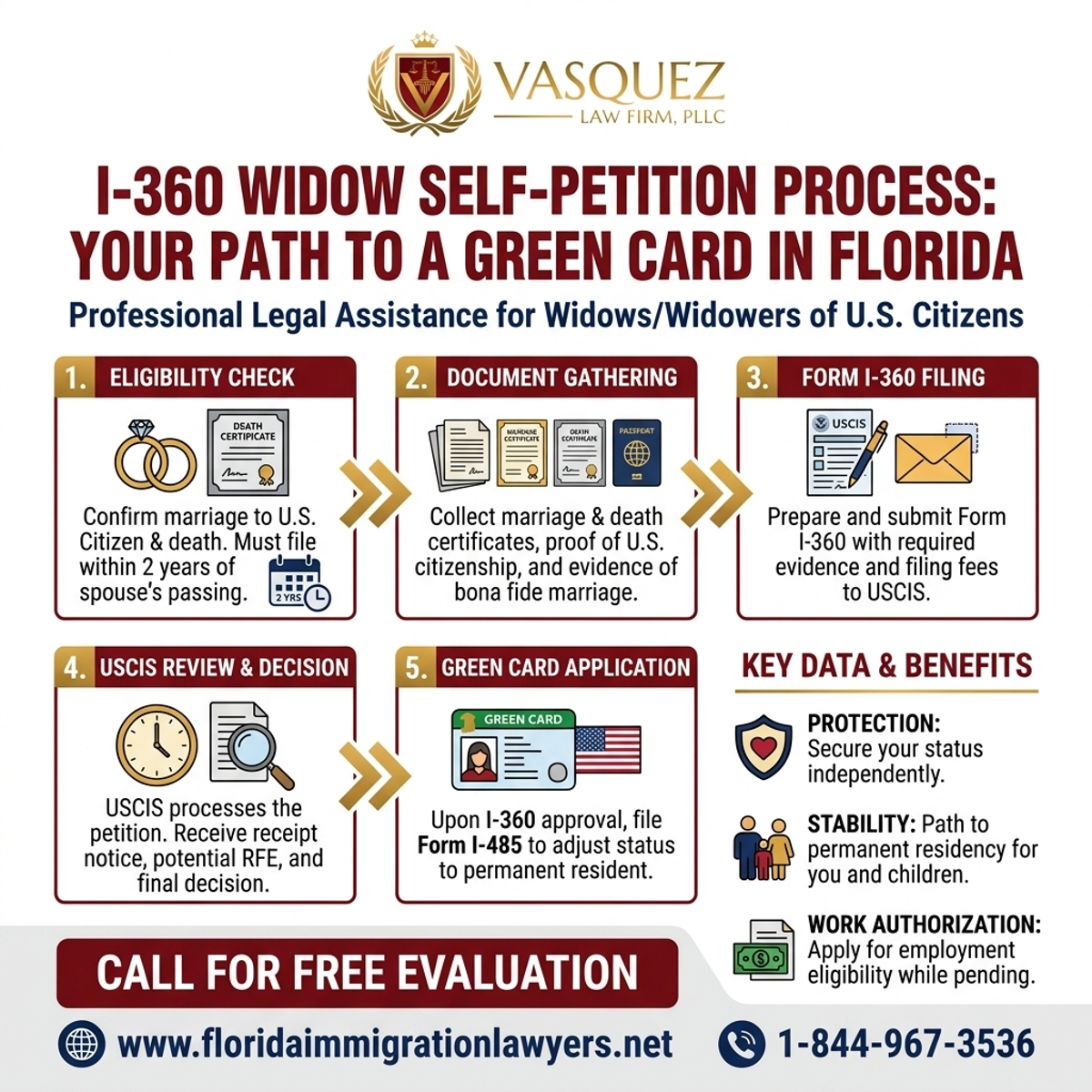
Step-by-Step Process — I-360 Widow Self-Petition in Florida: Your Path to a Green Card
- Proof of Your Identity and Nationality: Copy of your birth certificate, passport, or other national identity document.
- Proof of Any Prior Marriages (for both you and your deceased spouse): Divorce decrees or death certificates for all previous marriages that were legally terminated.
- Proof of Non-Remarriage: A sworn statement from you affirming that you have not remarried since your spouse's death.
- If you have dependent children included: Their birth certificates and proof of your relationship to them.
Organizing these documents thoroughly and presenting them clearly can significantly expedite the review process by USCIS. Missing or incomplete documentation is one of the primary reasons for delays or denials. Our attorneys at Florida Immigration Lawyers can help you compile a comprehensive and compelling packet of evidence.
Timeline and Processing Expectations for Florida Applicants
Understanding the timeline for an I-360 widow self-petition is essential for managing expectations, especially for individuals residing in Florida. Immigration processes are rarely quick, and the time it takes for USCIS to process petitions can vary significantly based on caseloads, policy changes, and the specific service center handling your case. While there is no guaranteed timeframe, knowing what to expect can help you prepare for the journey ahead. USCIS provides estimated processing times online, which are updated regularly and can be a useful, though not definitive, guide.
Typically, after you submit your Form I-360 to the appropriate USCIS Lockbox facility, you will receive a receipt notice (Form I-797C) within a few weeks. Following this, a biometrics appointment at a local Application Support Center in Florida (such as those in Tampa, Orlando, or Miami) usually occurs within 1-2 months. The actual processing of the I-360 petition itself can take anywhere from 6 months to over 2 years, depending on the service center's workload and the complexity of your case. For instance, the Nebraska Service Center and the Vermont Service Center often handle I-360 petitions, and their processing times can differ. You can check current estimates on the USCIS website by selecting Form I-360 and the relevant service center.
If your I-360 is approved, and you are eligible to adjust your status in the U.S. (meaning you entered lawfully and are not subject to certain bars), you would then file Form I-485. The processing of Form I-485, including a potential interview at a Florida USCIS field office, can add another 6-18 months to the overall timeline. The entire journey from filing the I-360 to receiving a Green Card can easily span 1.5 to 3 years or more. It is important to remember that these are estimates, and unforeseen delays, such as RFEs, background check issues, or changes in immigration policy, can extend the process further. Staying informed and having experienced legal counsel in Florida can help you navigate these fluctuating timelines effectively.
Cost Factors and Fee Breakdown for the I-360 Process
Understanding the financial implications of an I-360 widow self-petition is an important aspect of preparing for the immigration journey. The costs involved typically include government filing fees, potential fees for medical examinations, and legal fees if you choose to hire an attorney. While government fees are standardized across the United States, the total cost can vary based on individual circumstances and the complexity of your case. It is crucial to budget for these expenses to avoid unexpected financial burdens during this already challenging time.
The primary government fee is for filing Form I-360 itself. This fee is set by USCIS and is subject to change, so always check the most current fee schedule on USCIS.gov before filing. In some cases, petitioners may be eligible for a fee waiver if they can demonstrate financial hardship. If you are applying for adjustment of status (Form I-485) concurrently or after your I-360 approval, there will be additional USCIS fees for that application, including biometrics services. Furthermore, a medical examination by a USCIS-approved civil surgeon is required for adjustment of status, and the cost of this exam is paid directly to the doctor and can range from a few hundred dollars to over a thousand, depending on the provider and necessary vaccinations.
Beyond government and medical fees, legal fees for retaining an experienced immigration attorney represent a significant, yet often invaluable, investment. An attorney can ensure your petition is prepared accurately, all necessary documentation is included, and you are properly represented throughout the process, including during interviews or if you receive RFEs. While some individuals attempt to file without legal counsel, the complexities of immigration law, especially for a self-petition like the I-360, often make professional assistance a wise choice. Florida Immigration Lawyers offers transparent fee structures and free consultations to discuss your specific case and provide a clear understanding of potential costs involved.
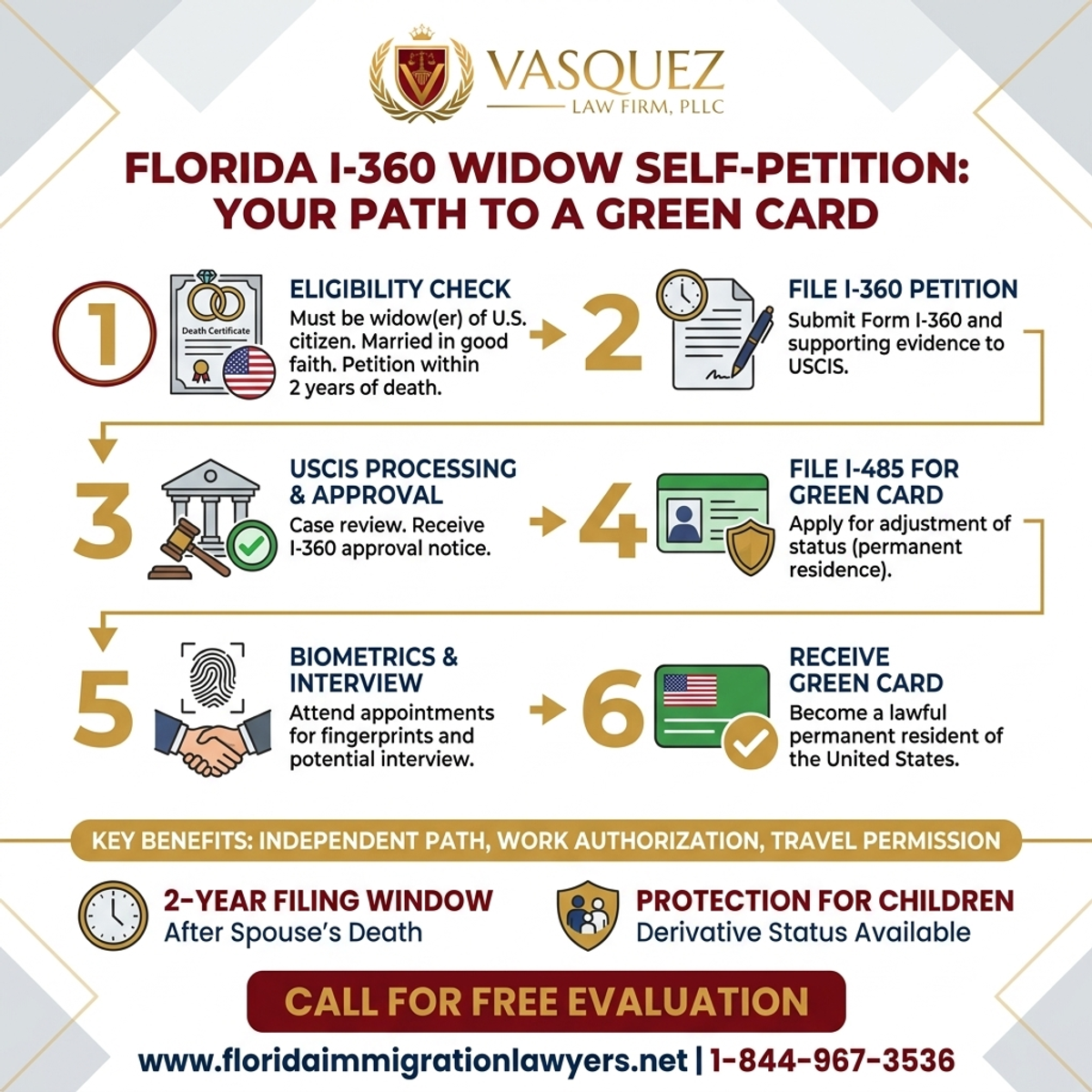
Key Statistics — I-360 Widow Self-Petition in Florida: Your Path to a Green Card
Do not navigate this complex process alone. The stakes are too high to risk errors or delays. Contact Florida Immigration Lawyers today at 1-844-967-3536 to schedule a free consultation and ensure your I-360 widow self-petition is handled with the expertise it deserves.
Common Mistakes to Avoid in Your I-360 Application
The I-360 widow self-petition process is fraught with potential pitfalls that can lead to significant delays, Requests for Evidence (RFEs), or even outright denial. Avoiding these common mistakes is critical for a successful outcome, especially for those in Florida who are already facing emotional challenges. Diligence and attention to detail are paramount when dealing with USCIS.
- Missing the Two-Year Filing Deadline: You must file Form I-360 within two years of your U.S. citizen spouse's death. Missing this deadline is often an absolute bar to eligibility, unless there are very rare, exceptional circumstances. Do not delay in seeking legal advice.
- Remarrying Before Filing: Remarrying after your U.S. citizen spouse's death typically disqualifies you from filing an I-360 widow self-petition. Ensure you understand this rule before making any decisions that could impact your eligibility.
- Insufficient Evidence of a Bona Fide Marriage: Simply having a marriage certificate is not enough. USCIS requires substantial evidence to prove your marriage was genuine and not entered into solely for immigration purposes. Lack of joint documents, shared finances, or credible affidavits can lead to an RFE or denial.
- Incomplete or Inaccurate Forms: Failing to answer all questions truthfully, leaving sections blank, or providing inconsistent information on Form I-360 can raise red flags for USCIS and result in processing delays or denials. Double-check every entry.
- Not Including All Required Supporting Documents: Submitting a petition without all the necessary supporting evidence, such as birth certificates, death certificates, or proof of citizenship, is a common error that almost always leads to an RFE.
- Failure to Respond to RFEs Promptly: If USCIS issues a Request for Evidence, you must respond within the specified timeframe with all requested information. Ignoring an RFE or submitting an incomplete response will almost certainly lead to a denial.
- Lack of Professional Legal Review: Attempting to navigate the complexities of immigration law, especially a self-petition, without the guidance of an experienced attorney is a significant risk. An attorney can identify potential issues, strengthen your case, and ensure compliance with all regulations.
- Not Disclosing All Immigration History: Any prior immigration applications, entries, or issues must be fully disclosed. Hiding information, even seemingly minor details, can be considered misrepresentation and lead to severe consequences.
- Failing to Update USCIS on Address Changes: If you move during the processing of your petition, you must inform USCIS of your new address promptly using Form AR-11. Failure to do so can result in missed notices, appointments, or even a denial if USCIS cannot contact you.
- Improper Filing Location: Sending your I-360 petition to the wrong USCIS Lockbox or service center can cause significant delays. Always verify the correct mailing address on the USCIS website based on your form type and residence.
When to Call Florida Immigration Lawyers for Your I-360 Petition
While the I-360 widow self-petition offers a crucial pathway to permanent residency, the process is inherently complex and often emotionally taxing. Knowing when to seek professional legal assistance can make a significant difference in the outcome of your case. Florida Immigration Lawyers specializes in family-based immigration and self-petitions, offering tailored guidance to individuals across Florida, including Tampa, Orlando, and Miami. We understand the unique challenges faced by our clients and are committed to providing compassionate and effective legal representation.
You should consider contacting an attorney if you:
- Are unsure about your eligibility requirements or the two-year filing deadline.
- Have received a Request for Evidence (RFE) from USCIS and need assistance in responding comprehensively.
- Have a complicated marital history, such as prior divorces or marriages that occurred outside the U.S.
- Are concerned about proving the bona fide nature of your marriage due to a lack of traditional joint documents.
- Have any criminal history or past immigration violations that might affect your admissibility.
- Are facing language barriers or feel overwhelmed by the extensive documentation and legal terminology.
- Wish to include dependent children in your petition and need guidance on their eligibility.
- Are preparing for an interview with USCIS and want to ensure you are fully prepared and represented.
- Have had a previous I-360 petition denied and need help understanding your options for appeal or re-filing.
Our experienced team at Florida Immigration Lawyers is here to provide clarity, support, and expert legal strategy. We can help you navigate the intricacies of the I-360 widow self-petition, ensuring your application is strong and complete, maximizing your chances of a successful outcome.
About Florida Immigration Lawyers
Florida Immigration Lawyers is a leading immigration law firm dedicated to serving individuals and families across the entire state of Florida. With a deep understanding of U.S. immigration law and a compassionate approach, we provide comprehensive legal services to clients navigating complex immigration challenges. Our attorneys are committed to helping you achieve your American dream, whether it involves obtaining a Green Card through an I-360 widow self-petition, securing asylum, defending against deportation, or pursuing U.S. citizenship. We pride ourselves on our client-focused approach, offering personalized attention and strategic advice tailored to your unique circumstances.
We understand that immigration matters can be life-changing, which is why we are available 24/7 to address your concerns. Our firm offers free consultations to discuss your case and explore your legal options without obligation. We proudly offer bilingual services, with a team fluent in both English and Spanish, ensuring clear communication and understanding for all our clients. From our offices, we serve communities from Tampa to Miami, Orlando to Jacksonville, and everywhere in between. When you choose Florida Immigration Lawyers, you gain a dedicated advocate committed to protecting your rights and fighting for your future in the United States. Call us today at 1-844-967-3536 or visit our website at Florida Immigration Lawyers to learn more about how we can assist you.
Sources and References
- U.S. Citizenship and Immigration Services (USCIS)
- Executive Office for Immigration Review (EOIR)
- U.S. Department of State - Bureau of Consular Affairs
- Immigration and Nationality Act (INA), 8 U.S.C. Chapter 12
Related services: family petition process, family-based green cards, fiancé visa (K-1), marriage-based immigration.
This article provides general legal information and is not intended as legal advice. Every case is unique, and outcomes depend on specific facts and circumstances. Immigration laws are complex and subject to change. Contact an attorney for advice about your particular situation and to ensure your petition complies with current regulations.
Your journey to permanent residency after the loss of your U.S. citizen spouse does not have to be a solitary one. Florida Immigration Lawyers is here to offer the expert legal support and compassionate guidance you need during this challenging time. We are committed to helping you navigate the complexities of the I-360 widow self-petition process in Florida with confidence and peace of mind. Do not hesitate to reach out for professional assistance. Call us for a free consultation at 1-844-967-3536. Se Habla Espanol - Estamos aqui para ayudarle.
If you need legal assistance, learn more about family immigration consultation, or call us at 1-844-967-3536 for a free consultation.
Do Not Navigate This Process Alone
Our experienced immigration attorneys are ready to fight for you. Get a free, confidential consultation today.
Se Habla Español
Frequently Asked Questions
Florida Immigration Lawyers
Immigration Attorney | Founder, Vasquez Law Firm
U.S. Air Force veteran and immigration attorney with thousands of cases resolved. J.D., NCCU School of Law. AILA member. Admitted to the 4th, 5th, and 11th Circuit Courts.
Available 24/7 - Free Evaluations
Related Legal Services
Our Florida immigration attorneys can help you with asylum protection, deportation defense and citizenship and naturalization. Call today at 1-844-967-3536 for a free consultation.
Related Links
Related Topics
Free Legal Consultation
Discuss your case with our experienced attorneys. We're available 24/7.
Se Habla Español - Estamos aquí para ayudarle.
Related Articles
Citizenship Test Preparation Florida: Your 2026 Guide
Achieving U.S. citizenship through naturalization is a significant milestone, and mastering the citizenship test is a crucial step. This comprehensive guide from Florida Immigration Lawyers provides essential insights for those preparing in Florida for 2026. Learn about eligibility requirements, the step-by-step application process, and detailed strategies for acing the civics and English tests. We cover everything from N-400 preparation and document checklists to understanding processing timelines and cost factors. Discover common mistakes to avoid and when to seek professional legal assistance to ensure a smooth journey to becoming a U.S. citizen. Our firm offers free consultations and serves clients throughout Florida, including Hollywood, Miami, and Orlando.
Immigration Services Jacksonville Florida: Expert Legal Help
Discover comprehensive immigration services in Jacksonville, Florida. This guide covers everything from visa applications and green card processes to naturalization and deportation defense. Learn about common pitfalls to avoid, understand timelines, and explore cost factors. Florida Immigration Lawyers offers expert legal assistance to navigate the complex U.S. immigration system, providing personalized support for individuals and families across Florida. Contact us for a free consultation and let our dedicated team help you achieve your immigration goals with confidence.
Find USCIS Office Locations in Florida | VLF Florida
Discover USCIS field office locations in Tampa, Florida, and learn how to schedule appointments. Contact Florida Immigration Lawyers for expert assistance and ensure a smooth immigration process.
Military Naturalization: Expedited Path for Florida Service
For non-citizen service members in Florida, military naturalization offers an expedited path to U.S. citizenship, recognizing their dedication and sacrifice. This special process, governed by INA sections 328 and 329, waives many standard residency and fee requirements, allowing service members to apply while serving, even if deployed. Whether you are stationed at MacDill AFB, Naval Air Station Jacksonville, or living in Pembroke Pines, understanding these unique provisions is crucial. Our guide details eligibility, the N-400 military application process, required documents, and what to expect regarding timelines. Florida Immigration Lawyers provides expert legal assistance to ensure a smooth and successful journey to citizenship. Contact us today for a free consultation.