Military Naturalization: Expedited Path for Florida Service
For non-citizen service members in Florida, military naturalization offers an expedited path to U.S. citizenship, recognizing their dedication and sacrifice. This special process, governed by INA sections 328 and 329, waives many standard residency and fee requirements, allowing service members to apply while serving, even if deployed. Whether you are stationed at MacDill AFB, Naval Air Station Jacksonville, or living in Pembroke Pines, understanding these unique provisions is crucial. Our guide details eligibility, the N-400 military application process, required documents, and what to expect regarding timelines. Florida Immigration Lawyers provides expert legal assistance to ensure a smooth and successful journey to citizenship. Contact us today for a free consultation.

Military naturalization offers a significantly expedited path to U.S. citizenship for eligible service members, often waiving typical residency requirements. This process, governed by specific sections of the Immigration and Nationality Act (INA), recognizes the profound sacrifice and service of military personnel. For those serving in Florida, particularly near bases like MacDill AFB or Naval Air Station Jacksonville, understanding these special provisions is crucial. It allows them to apply for citizenship while serving, sometimes even overseas, ensuring they and their families can fully integrate into American society with all the rights and benefits of citizenship. This includes waiving application fees and certain English language requirements.
- Expedited path to U.S. citizenship for service members.
- Waives many standard residency and physical presence requirements.
- Eligibility includes honorable service in the U.S. Armed Forces.
- Can apply while serving, even if deployed abroad.
- Fees and certain language requirements may be waived.
Serving in the United States Armed Forces is a profound act of patriotism and sacrifice. For non-citizen service members and their families in Florida, this dedication opens a special, expedited pathway to U.S. citizenship: military naturalization. Unlike the standard naturalization process, which can be lengthy and complex, military personnel are often eligible for significant waivers and faster processing, recognizing their invaluable contributions to national security. Whether you are stationed at MacDill Air Force Base, Naval Air Station Pensacola, or any other military installation across the Sunshine State, understanding these unique provisions is vital for securing your future in America.
This comprehensive guide from Florida Immigration Lawyers will walk you through the intricacies of military naturalization, detailing eligibility, the expedited N-400 application process, required documentation, and what to expect regarding timelines and costs. We will also highlight common pitfalls to avoid and explain when seeking experienced legal counsel can make a critical difference. Our goal is to empower you with the knowledge needed to navigate this important journey, ensuring you can focus on your service while we handle the complexities of your immigration case. For personalized guidance on your military naturalization journey, call Florida Immigration Lawyers at 1-844-967-3536 for a free consultation.
Understanding Military Naturalization: A Special Pathway to Citizenship
Military naturalization is a distinct and highly advantageous route to U.S. citizenship specifically designed for individuals who have served or are currently serving in the U.S. Armed Forces. This special pathway acknowledges the unique circumstances and sacrifices of military personnel, offering waivers for many of the standard naturalization requirements. It is a testament to the nation's gratitude for their commitment to defending the United States, providing a swift path to full civic participation for those who protect our freedoms.
The legal framework for military naturalization is primarily found in the Immigration and Nationality Act (INA) sections 328 and 329, codified at 8 U.S.C. § 1439 and § 1440, respectively. These sections outline the specific conditions under which a service member can naturalize, often bypassing the typical residency and physical presence requirements. For example, a service member may be eligible to apply for citizenship after just one year of honorable service, regardless of where they are stationed globally. This contrasts sharply with civilian naturalization, which generally requires five years of continuous residency in the U.S.
For service members and their families living in Florida, a state with a significant military presence, understanding these provisions is particularly relevant. Whether you are based in Pembroke Pines, near Miami, or closer to military hubs like MacDill AFB in Tampa or Naval Station Mayport in Jacksonville, the opportunity for expedited citizenship is a crucial benefit. Military naturalization ensures that those who serve our country can quickly gain the full rights and protections of U.S. citizenship, offering stability and security for their futures and their loved ones. This includes the right to vote, hold certain federal jobs, and receive enhanced benefits.
The process is designed to be as streamlined as possible, recognizing that service members may be deployed or frequently relocated. USCIS works closely with the Department of Defense to facilitate applications, often conducting interviews and oath ceremonies at military installations or U.S. embassies abroad. This commitment to supporting our service members underscores the importance of military naturalization as a cornerstone of U.S. immigration policy, honoring those who dedicate their lives to protecting the nation.
Eligibility and Requirements for Military Naturalization in Florida
To qualify for military naturalization, service members must meet specific criteria that are distinct from those for civilian applicants. These requirements are tailored to reflect the unique nature of military service and are designed to make the path to citizenship more accessible for those who serve. Understanding these conditions is the first critical step in your application journey, especially for those stationed at Florida bases like MacDill AFB, Eglin AFB, or Naval Air Station Key West.
Honorable Service Defined: What It Means for Your Application
The cornerstone of military naturalization eligibility is honorable service in the U.S. Armed Forces. This includes the Army, Navy, Marine Corps, Air Force, Coast Guard, and certain reserve components. For service members applying under INA 328 (8 U.S.C. § 1439), you must have completed at least one year of honorable service and be a lawful permanent resident at the time of your interview. For those applying under INA 329 (8 U.S.C. § 1440) during designated periods of hostilities, the requirements are even more flexible, often allowing applications without prior lawful permanent residency, provided you were lawfully admitted to the U.S. and enlisted. Your service must be verified by a Certificate of Military Service (Form N-426) signed by a superior officer.
Beyond honorable service, applicants must also demonstrate good moral character for the statutory period relevant to their application. This generally means that for the period of service and up to the oath ceremony, you have not committed certain crimes or engaged in activities that would disqualify you. While minor infractions might not be an issue, serious offenses like felony convictions or multiple DUIs could jeopardize your application. USCIS examines your entire record, including any disciplinary actions taken during your service. It is crucial to be fully transparent about your history to avoid complications.
Good Moral Character: Beyond the Basics for Service Members
While the general definition of good moral character applies, the military context introduces specific nuances. For example, certain military disciplinary actions, if they do not rise to the level of a criminal conviction, might be viewed differently. However, any involvement with drugs, fraud, or false statements could be detrimental. You must also be able to take an oath of allegiance to the U.S. Constitution, demonstrating your commitment to the principles of the nation you serve. This includes understanding the oath and being willing to defend the U.S. if required. The English language and civics knowledge requirements are generally waived for those applying under INA 329, and for those under INA 328, certain waivers may apply based on age or disability. However, demonstrating a basic understanding of English and U.S. government and history is usually expected unless waived.
For service members stationed in Florida, such as those at Homestead Air Reserve Base, your physical location does not restrict your ability to apply. The law allows you to apply for naturalization from anywhere in the world where you are serving. This flexibility ensures that deployment or frequent transfers do not hinder your path to citizenship. Consulting with an immigration attorney from Florida Immigration Lawyers can help you confirm your specific eligibility and prepare a robust application, ensuring all requirements are met and any potential issues are addressed proactively. We understand the unique situations faced by military families in communities like Pembroke Pines and throughout Florida.
The Expedited Application Process for N-400 Military Applicants
The application process for military naturalization, while similar to civilian naturalization in its core steps, incorporates several expedited procedures and waivers specifically for service members. This streamlined approach reflects the government's priority to grant citizenship to those who serve. It begins with careful preparation and submission of Form N-400, Application for Naturalization, a document that requires precision and thoroughness to avoid delays. For service members in Florida, navigating this process efficiently can lead to swift citizenship.
-
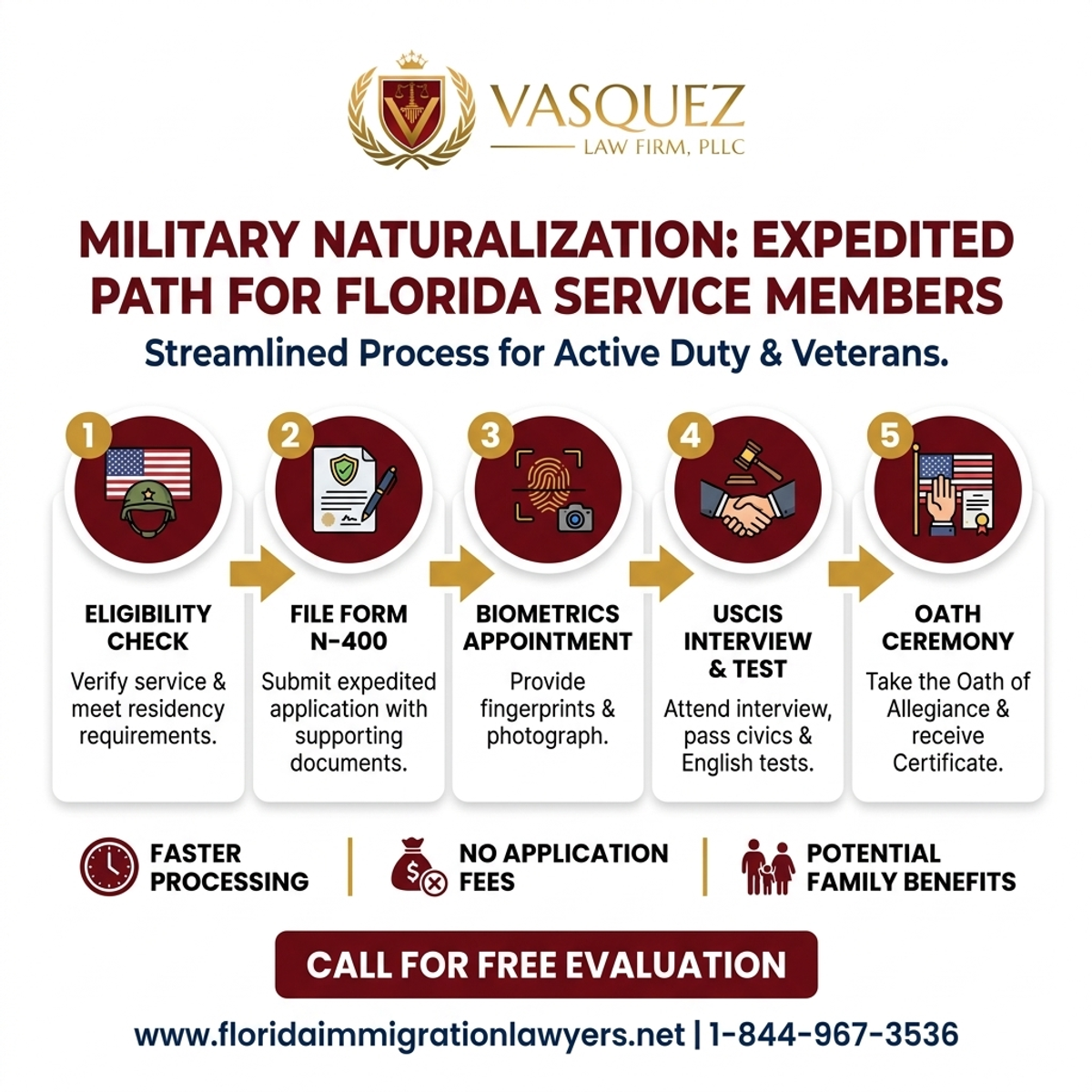
Determine Eligibility: Before anything else, confirm you meet the specific requirements for military naturalization under INA 328 or 329. This includes honorable service, good moral character, and other criteria. Verify your service dates and ensure you have all necessary military documentation. If you have any doubts about your eligibility, especially concerning prior immigration issues or criminal records, consulting an attorney is highly recommended.
-
Gather Required Documents: Collect all necessary supporting documents. This typically includes your military service records (DD-214 or equivalent), a certified Form N-426 (Request for Certification of Military or Naval Service) signed by your commanding officer, your green card (if applicable), birth certificate, marriage certificate (if applicable), and passport-style photographs. Ensuring these documents are complete and accurate is crucial for a smooth process.
-
Complete Form N-400: Fill out Form N-400, Application for Naturalization, carefully and completely. There are specific sections for military applicants. Be honest and accurate in all responses. You will generally not need to pay the filing fee for military naturalization, as it is typically waived under INA 328 and 329. If you are applying from overseas, follow the instructions for overseas filing. Florida Immigration Lawyers can assist with reviewing your N-400 to prevent errors.
-
Attend Biometrics Appointment: After filing, USCIS will send you a notice for a biometrics appointment. This involves fingerprinting and photographing for background checks. For service members, this appointment may be expedited or even completed at a military facility, depending on your location and circumstances. Ensure you attend this appointment promptly, bringing the required identification.
Step-by-Step Process — Military Naturalization: Expedited Path for Florida Service Members
-
Interview with USCIS: You will be scheduled for an interview with a USCIS officer. During this interview, the officer will review your N-400 application, verify your documents, and ask questions about your eligibility, military service, and good moral character. For military applicants, the English and civics tests may be waived, particularly for those serving during hostilities. Interviews can sometimes be conducted at military bases or U.S. embassies abroad if you are deployed. Be prepared to answer truthfully and clearly. USCIS field offices in Florida, such as those in Miami, Orlando, or Tampa, regularly conduct these interviews.
-
Receive Decision and Attend Oath Ceremony: If your application is approved, you will receive a notice for an Oath of Allegiance ceremony. This is the final step where you formally become a U.S. citizen. Oath ceremonies for military members are often expedited and can even be held at military installations, sometimes immediately following the interview. This is a momentous occasion, culminating your journey to U.S. citizenship.
Throughout this process, attention to detail is paramount. Missing information or errors can lead to delays or even denials. Florida Immigration Lawyers has extensive experience assisting service members across Florida, from Jacksonville to Pembroke Pines, ensuring their applications are meticulously prepared and submitted. We provide comprehensive support, from document preparation to interview coaching, to help you achieve your citizenship goals.
Essential Document Checklist for Military Naturalization
A thoroughly prepared set of documents is critical for a successful military naturalization application. Missing or incorrect paperwork can cause significant delays or even lead to a denial, disrupting your path to U.S. citizenship. For service members in Florida, ensuring all required forms and supporting evidence are accurately compiled is a key step in the process. This checklist provides a comprehensive overview of the documents you will typically need to submit with your Form N-400.
- Form N-400, Application for Naturalization: The primary application form, completed accurately and signed. Ensure all sections relevant to military service are properly filled out.
- Form N-426, Request for Certification of Military or Naval Service: This form must be completed by your commanding officer or a designated military official. It certifies your honorable service and is crucial for demonstrating eligibility.
- Photocopy of your Permanent Resident Card (Green Card): If you are a lawful permanent resident applying under INA 328. Even if not required for INA 329, it's good to include if you have one.
- Photocopies of your military identification card (front and back): To prove your current service status.
- Photocopies of all Forms DD-214, Certificate of Release or Discharge from Active Duty: If you have prior periods of service or have been discharged and re-enlisted.
- Photocopies of all Forms NGB-22, Report of Separation and Record of Service: For National Guard members.
- Photocopies of Forms I-94, Arrival/Departure Record: If applicable, to show lawful entry.
- Two U.S. passport-style color photographs: Taken within 30 days of filing, with a white background.
- Photocopies of marriage certificate(s) and divorce decree(s): If you are or were married, to establish marital status.
- Photocopies of birth certificates for your children: If you have children, even if they are not applying with you.
- Court disposition documents for any arrests, citations, or convictions: Even if charges were dismissed, you must provide certified copies of all court records.
- Proof of payment of any outstanding child support or alimony: If applicable, with certified copies of court orders.
- Tax returns or IRS tax transcripts: Especially if you have lived outside the U.S. or have complex financial history.
It is important to provide photocopies of all documents unless USCIS specifically requests originals. Always keep the originals for your records and bring them to your interview. For service members stationed at bases like Tyndall AFB or Naval Support Activity Orlando, gathering all these documents can be a logistical challenge, especially if you are deployed. Our team at Florida Immigration Lawyers can assist you in organizing your documentation, ensuring everything is correctly prepared and submitted. We understand the unique circumstances of military families in areas like Pembroke Pines and are here to provide comprehensive support for your immigration journey.
Understanding Timelines, Fees, and Waivers for Service Members
One of the most appealing aspects of military naturalization is the potential for significantly expedited processing, along with substantial fee waivers. These benefits are designed to alleviate financial burdens and reduce the waiting period for service members, allowing them to achieve U.S. citizenship more quickly than civilian applicants. Understanding these aspects is crucial for managing expectations and planning your future, particularly for those serving in Florida.
Expedited Processing and Timelines
While standard naturalization can take anywhere from 8 to 14 months or even longer, military naturalization often has a much shorter timeline. USCIS prioritizes these applications, recognizing the unique circumstances of service members. Processing times can vary depending on the USCIS field office (e.g., Miami, Orlando, Tampa) and the complexity of the individual case, but many military applicants see their applications processed within 4-6 months, sometimes even faster. For those deployed overseas, interviews and oath ceremonies can be arranged at U.S. embassies or consulates, further streamlining the process. You can check the current processing times on the USCIS website by selecting Form N-400 and the relevant field office or service center. It is important to note that these are estimates, and individual cases may differ.
Fee Waivers for Form N-400 Military Applicants
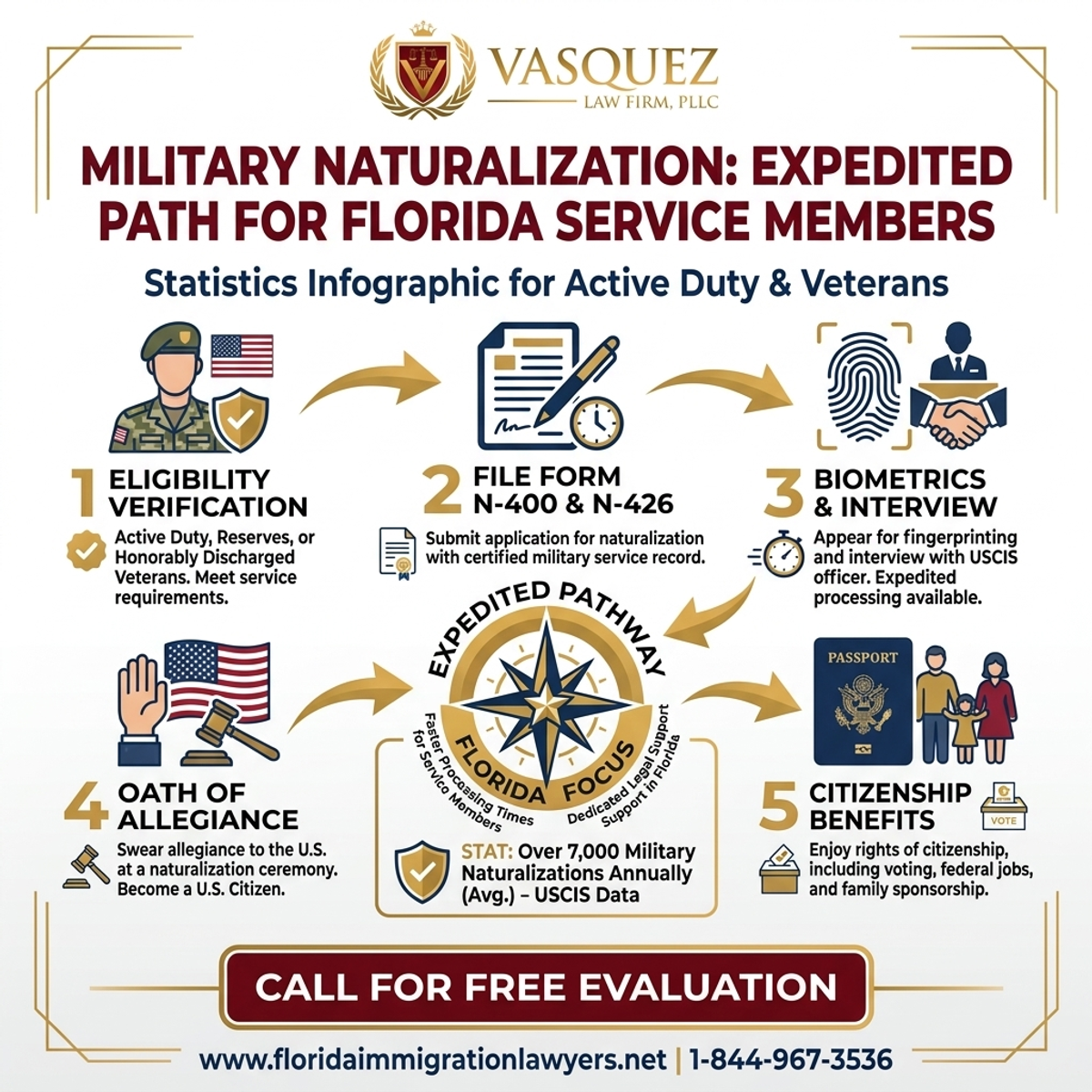
A significant benefit for military naturalization applicants is the waiver of the Form N-400 filing fee and the biometrics services fee. Under INA 328 and 329, service members are generally exempt from paying these fees, which can amount to several hundred dollars. This financial relief acknowledges the sacrifices made by military personnel and ensures that cost is not a barrier to citizenship. To take advantage of this waiver, ensure your Form N-426, Certificate of Military or Naval Service, is properly completed and submitted with your N-400 application. This form serves as official proof of your honorable service, which triggers the fee waiver.
Key Statistics — Military Naturalization: Expedited Path for Florida Service Members
Beyond the primary application fees, military naturalization can also offer waivers for certain English language and civics requirements. For service members applying under INA 329 (during periods of hostilities), these waivers are often automatic. For those under INA 328, waivers may be granted based on age, length of service, or certain medical conditions. This flexibility ensures that language barriers do not unduly prevent dedicated service members from becoming citizens. However, it is always beneficial to prepare for these components, as a basic understanding is generally helpful for the interview process. Our team at Florida Immigration Lawyers can help clarify which waivers you may be eligible for, ensuring you receive all the benefits available to you as a service member.
Benefits of Military Naturalization and Life as a Citizen in Florida
Achieving U.S. citizenship through military naturalization unlocks a multitude of benefits that profoundly impact a service member's life and the lives of their family. These advantages extend far beyond simply having a new document; they provide enhanced security, opportunity, and full integration into American society. For those serving in Florida, becoming a U.S. citizen amplifies the stability and prospects available within this vibrant state, from Pembroke Pines to Pensacola.
Enhanced Security and Opportunities
One of the most significant benefits is the enhanced security against deportation. As a U.S. citizen, you are no longer subject to deportation proceedings, providing immense peace of mind for yourself and your family. This protection is especially critical in an ever-changing immigration landscape. Citizenship also opens doors to a wider range of job opportunities, particularly within federal government positions and certain sectors that require U.S. citizenship for security clearances. This can lead to career advancement both during and after military service, providing a stronger foundation for your post-military life in Florida.
Family Unity and Civic Participation
U.S. citizens can more easily petition for certain family members to immigrate to the United States, including spouses, children, parents, and siblings. This ability to unite your family is a powerful advantage, ensuring your loved ones can join you and build a life in America. As a citizen, you also gain the right to vote in federal, state, and local elections, allowing you to fully participate in the democratic process and have your voice heard on issues that matter to you and your community in Florida. You can also run for public office, serve on a jury, and obtain a U.S. passport, which facilitates international travel with greater ease and protection.
For service members and their families living in Florida, citizenship brings even more tangible benefits. It solidifies your roots in communities like Pembroke Pines, offering access to various state-level benefits, educational opportunities, and resources without the complexities sometimes faced by non-citizens. The sense of belonging and full integration into American society is invaluable, complementing your honorable service to the nation. Florida Immigration Lawyers is dedicated to helping service members and their families realize these profound benefits, guiding them through every step of the naturalization process. We understand the importance of family unity and the desire for a secure future, and we are committed to helping you achieve these goals as a U.S. citizen.
Common Mistakes to Avoid in Military Naturalization
Navigating the military naturalization process requires careful attention to detail. Even small errors can lead to significant delays, requests for additional evidence, or even a denial of your application. Service members in Florida must be particularly vigilant to avoid these common pitfalls, ensuring a smooth and successful path to U.S. citizenship.
-
Failing to Disclose All Information: One of the most critical mistakes is omitting information about past arrests, citations, or even minor infractions, regardless of whether charges were dismissed or expunged. USCIS will uncover this information during background checks. Any omission, even unintentional, can be perceived as an attempt to deceive and may lead to a finding of lack of good moral character, jeopardizing your application.
-
Not Obtaining Certified Form N-426: The Form N-426, Certification of Military or Naval Service, is paramount. Without proper certification from your commanding officer or a designated official, USCIS cannot verify your honorable service, which is the basis for military naturalization. Ensure this form is accurately completed and signed before submission.
-
Submitting an Incomplete or Inaccurate Form N-400: Errors, omissions, or inconsistencies on the N-400 application can cause major delays. Double-check every section, especially those pertaining to your military service, travel history, and good moral character questions. Using an outdated form version can also lead to rejection.
-
Missing Deadlines or Appointments: Failing to respond to Requests for Evidence (RFEs) by the deadline, missing biometrics appointments, or not appearing for your interview can result in your application being denied or administratively closed. Always keep track of all correspondence from USCIS and respond promptly.
-
Not Maintaining Good Moral Character: While serving, it is essential to continue to uphold good moral character standards. Any criminal activity, even after submitting your N-400, can lead to denial. This includes actions that might not be considered serious in a civilian context but could impact your immigration status.
-
Failing to Update USCIS on Address Changes: Service members frequently relocate, especially those stationed at various Florida bases. Failing to notify USCIS of every address change within 10 days can lead to missed notices and important communications, potentially derailing your application. Use Form AR-11 or update online.
-
Attending the Interview Unprepared: Even with waivers, you should be prepared to discuss your application, military service, and answers on the N-400. Bring all original documents you submitted copies of. Being nervous is natural, but being unprepared can raise concerns for the interviewing officer.
-
Not Seeking Legal Counsel for Complex Cases: If you have a criminal record, prior immigration violations, periods of separation from service, or any other complicating factor, attempting to navigate the process alone can be risky. An experienced immigration attorney can identify potential issues and strategize the best approach.
When to Call a Lawyer for Military Naturalization
While the military naturalization process is designed to be streamlined, certain situations warrant the expertise of an experienced immigration attorney. Attempting to navigate these complexities alone can lead to unnecessary delays, denials, or even jeopardized immigration status. Florida Immigration Lawyers is dedicated to assisting service members and their families across Florida, offering essential legal guidance when you need it most.
You should consider contacting an attorney if your eligibility is unclear, especially if you have had any breaks in service, a less than honorable discharge from a previous enlistment, or questions about what constitutes honorable service. Similarly, if you have a criminal record, even minor infractions, or any history of interactions with law enforcement, an attorney can assess the impact on your good moral character requirement and help prepare the necessary documentation and explanations. Even a simple traffic ticket can sometimes raise questions if not properly disclosed and explained.
Furthermore, if you have any prior immigration violations, such as overstaying a visa, unlawful entry, or previous denials of immigration benefits, seeking legal counsel is crucial. These issues can significantly complicate your naturalization application, and an attorney can help determine if waivers are available or how best to present your case. For service members who are deployed overseas or have complex travel histories, an attorney can assist with coordinating interviews at U.S. embassies or consulates and ensuring all logistical requirements are met.
If you receive a Request for Evidence (RFE) from USCIS or a Notice of Intent to Deny (NOID), it is imperative to seek legal help immediately. These notices indicate that USCIS has concerns about your application, and a timely, well-reasoned response is critical to prevent a denial. An attorney can help craft a comprehensive response, providing the necessary legal arguments and supporting documentation. Ultimately, if you simply feel overwhelmed by the paperwork, regulations, and uncertainty of the process, a lawyer can provide peace of mind and ensure your application is handled with the utmost care and professionalism. Our attorneys at Florida Immigration Lawyers are here to offer dedicated support for your military naturalization journey.
About Florida Immigration Lawyers
Florida Immigration Lawyers is a leading immigration law firm dedicated to serving the brave men and women of the U.S. Armed Forces and their families throughout Florida. With a deep understanding of the unique challenges faced by service members, our firm provides comprehensive and compassionate legal representation for all immigration matters, including military naturalization. Our experienced attorneys are committed to securing your future in the United States, allowing you to focus on your vital service to our nation.
We offer a wide range of services, including assistance with military naturalization applications, family-based immigration petitions, adjustment of status, and deportation defense. Our team is well-versed in the specific provisions of the Immigration and Nationality Act that apply to military personnel, ensuring that your case is handled with the expertise it deserves. We pride ourselves on our client-focused approach, providing clear communication, strategic advice, and unwavering support from your initial consultation to the successful resolution of your case.
Choosing Florida Immigration Lawyers means partnering with a firm that understands the intricacies of military immigration law and the importance of your service. We are available 24/7 to answer your questions and provide support, offering free, confidential consultations to discuss your specific needs. Serving all of Florida, from Pembroke Pines to the panhandle, we are here to help you achieve your American dream. Contact us today at 1-844-967-3536 or visit www.floridaimmigrationlawyers.net to learn how we can assist you.
Sources and References
- U.S. Citizenship and Immigration Services (USCIS) - Military Members and Their Families
- Executive Office for Immigration Review (EOIR)
- 8 U.S.C. Chapter 12 - Immigration and Nationality Act (INA)
- 8 U.S.C. § 1439 (INA 328) - Naturalization through service in the Armed Forces of the United States
- 8 U.S.C. § 1440 (INA 329) - Naturalization through active-duty service in the Armed Forces during specified periods of hostilities
- 8 CFR Part 328 - Naturalization based upon active duty service in the U.S. Armed Forces during specified periods of military hostilities
- USCIS Policy Manual, Volume 12 - Citizenship and Naturalization
Related services: citizenship test preparation, dual citizenship guidance.
This article provides general legal information and is not intended as legal advice. Every case is unique, and outcomes depend on specific facts and circumstances. Contact an attorney for advice about your particular situation.
Your service to our country is invaluable, and achieving U.S. citizenship is a well-deserved recognition of your dedication. Do not let the complexities of immigration law stand in the way of your American dream. Florida Immigration Lawyers is here to provide the expert legal guidance and support you need every step of the way. We are committed to helping service members and their families successfully navigate the military naturalization process. Call us today at 1-844-967-3536 for a free, confidential consultation. Se Habla Español - Estamos aquí para ayudarle.
Do Not Navigate This Process Alone
Our experienced immigration attorneys are ready to fight for you. Get a free, confidential consultation today.
Se Habla Español
Frequently Asked Questions
Florida Immigration Lawyers
Immigration Attorney | Founder, Vasquez Law Firm
U.S. Air Force veteran and immigration attorney with thousands of cases resolved. J.D., NCCU School of Law. AILA member. Admitted to the 4th, 5th, and 11th Circuit Courts.
Available 24/7 - Free Evaluations
Related Legal Services
Our Florida immigration attorneys can help you with deportation defense, citizenship and naturalization and family immigration services. Call today at 1-844-967-3536 for a free consultation.
Related Links
Related Topics
Free Legal Consultation
Discuss your case with our experienced attorneys. We're available 24/7.
Se Habla Español - Estamos aquí para ayudarle.
Related Articles
Find USCIS Office Locations in Florida | VLF Florida
Discover USCIS field office locations in Tampa, Florida, and learn how to schedule appointments. Contact Florida Immigration Lawyers for expert assistance and ensure a smooth immigration process.
Child Status Protection Act (CSPA) & Aging Out Florida
The Child Status Protection Act (CSPA) is a vital U.S. immigration law designed to prevent children from "aging out" of green card eligibility due to long processing times. For families in Florida, understanding CSPA's complex age calculations and strict one-year deadlines is crucial to preserving a child's pathway to permanent residency. This guide from Florida Immigration Lawyers explains who qualifies, how CSPA age is calculated, the step-by-step application process, and common mistakes to avoid. We provide essential information for derivative beneficiaries in Naples, Fort Myers, and across Florida, ensuring families can navigate this critical immigration provision effectively. Don't risk your child's future; learn how CSPA can protect their eligibility and secure their place in the U.S.
I-601 Waiver Guide for Florida Immigrants | VLF Florida
The I-601 waiver is essential for overcoming inadmissibility in the U.S. Learn about the process, requirements, and how Florida Immigration Lawyers can help you. Call 1-844-967-3536 for a free consultation.
212(c) Waiver Legacy Relief Florida: Your Deportation Defense
The 212(c) waiver offers crucial legacy relief for certain lawful permanent residents in Florida facing deportation due to criminal convictions that occurred before April 1, 1996. This complex area of immigration law requires a deep understanding of historical statutes and court precedents, such as the landmark <em>INS v. St. Cyr</em> decision. Eligibility hinges on strict criteria, including the conviction date, lawful permanent residency status, and years of domicile in the U.S. Successfully navigating the application process and presenting a compelling case before an Immigration Judge demands expert legal counsel. Florida Immigration Lawyers specializes in these intricate deportation defense strategies, guiding clients through document collection, discretionary factors, and court appearances. If you're in Kissimmee or anywhere in Florida, contact us for a free consultation to assess your eligibility for this vital defense.