CR-1 IR-1 Spouse Visa Consular Florida | VLF Florida
Explore the CR-1 and IR-1 spouse visa process for Florida residents. Learn about application steps, document requirements, and common pitfalls. Contact Florida Immigration Lawyers for personalized assistance.

Securing a CR-1 or IR-1 spouse visa involves multiple steps, from petitioning with USCIS to attending a consular interview. Key takeaways include:
- CR-1 and IR-1 visas are for spouses of U.S. citizens.
- The process includes USCIS, NVC, and consular processing stages.
- Processing times vary and can be affected by individual circumstances.
Introduction
Navigating the CR-1 and IR-1 spouse visa process can be overwhelming, especially for residents of Homestead, Florida. These visas allow U.S. citizens to bring their foreign spouses to the United States. This article outlines the steps involved, from initial applications to consular interviews, providing vital information to ensure a smoother process. Call Florida Immigration Lawyers at 1-844-967-3536 for a free consultation.
The journey to reunite with your spouse in the United States is a significant life event, often filled with anticipation and complex legal requirements. For U.S. citizens residing in Homestead, Florida, sponsoring a foreign spouse through the CR-1 or IR-1 visa pathway is a common but intricate process. This guide aims to demystify the various stages, offering clarity and practical advice to help you navigate the system successfully.
Understanding each step, from the initial petition with U.S. Citizenship and Immigration Services (USCIS) to the final consular interview abroad, is paramount. Incorrect filings or missed deadlines can lead to frustrating delays or even denials, impacting your family's future. Our goal is to provide a comprehensive overview, highlighting critical considerations and offering insights into potential challenges. Remember, for personalized guidance, Florida Immigration Lawyers are available at 1-844-967-3536 for a free consultation.
This article specifically addresses the consular processing route, which applies when the foreign spouse is living outside the United States. It’s designed to be a valuable resource for U.S. citizens and their foreign spouses, ensuring they are well-prepared for each phase of this life-changing immigration journey. We will cover everything from eligibility criteria and required documentation to processing timelines and common pitfalls to avoid, with a special focus on practical tips for families in Florida.
Understanding CR-1 and IR-1 Spouse Visas
The CR-1 and IR-1 visas are essential for U.S. citizens who wish to bring their foreign spouses to live in the United States. The CR-1 visa is for couples married for less than two years, while the IR-1 visa is for those married for two years or more. Both visas require a thorough review process by the United States Citizenship and Immigration Services (USCIS), followed by the National Visa Center (NVC), and finally, a consular interview for the spouse abroad.
For residents in Homestead, Florida, understanding these distinctions is crucial. The CR-1 visa grants conditional permanent residence, requiring the couple to apply for the removal of conditions after two years. In contrast, the IR-1 visa provides immediate permanent resident status. The choice between these visas depends on the duration of the marriage at the time of the USCIS petition filing.
The distinction between the CR-1 (Conditional Resident) and IR-1 (Immediate Relative) visas primarily hinges on the length of your marriage at the time USCIS approves your Form I-130 petition. If you have been married for less than two years when the visa is issued, your spouse will receive a CR-1 visa, granting them conditional permanent resident status. This condition is imposed by immigration law to deter marriage fraud and requires the couple to demonstrate the bona fide nature of their marriage again after two years.
Conversely, if your marriage has lasted two years or more by the time the visa is issued, your spouse will be granted an IR-1 visa, which confers immediate, unconditional permanent resident status. This means they will receive a 10-year green card directly, without the need for an additional petition to remove conditions. For families in Homestead, Florida, this difference is significant, as it impacts future immigration filings and the long-term stability of the foreign spouse's status in the U.S.
Both visa categories underscore the U.S. government's commitment to family reunification. However, the conditional nature of the CR-1 visa means that approximately 21-24 months after the foreign spouse enters the U.S., the couple must file Form I-751, Petition to Remove Conditions on Residence. This process involves submitting further evidence of a continuing, bona fide marriage. Failing to file Form I-751 can lead to the termination of the spouse's permanent resident status, making it a critical step for CR-1 visa holders. Understanding these nuances is vital for a smooth transition and long-term success in the United States.
Step-by-Step Guide to the CR-1 and IR-1 Visa Process
Embarking on the CR-1 or IR-1 visa journey involves a series of carefully orchestrated steps, each with its own set of requirements and potential complexities. A clear understanding of this multi-stage process is essential for all applicants, especially those managing their case from Homestead, Florida. Below is a detailed breakdown of what to expect from the initial filing to the final visa issuance.
- Filing the Petition (Form I-130): The U.S. citizen spouse initiates the process by filing Form I-130, Petition for Alien Relative, with the USCIS. This crucial step establishes the legitimate marital relationship between the petitioner and the foreign spouse. Accompanying documents typically include the marriage certificate, proof of U.S. citizenship (e.g., birth certificate, passport), and evidence of a bona fide marriage, such as joint bank accounts, shared leases, photos, and affidavits from friends and family. A well-prepared petition minimizes the risk of Requests for Evidence (RFEs) and potential delays.
- USCIS Processing and Approval: After filing, USCIS reviews the I-130 petition. This stage involves background checks and verification of the relationship. If USCIS determines the marriage is legitimate and all requirements are met, they will approve the petition. The approval notice is a significant milestone, indicating that USCIS acknowledges the validity of the spousal relationship. The processing times for this stage can vary significantly, often ranging from several months to over a year, depending on USCIS caseloads and policy changes.
- NVC Processing: Upon USCIS approval, the case is automatically forwarded to the National Visa Center (NVC). The NVC acts as a liaison between USCIS and the U.S. embassy or consulate abroad. Here, the focus shifts to collecting all necessary civil documents (e.g., birth certificates, police certificates, marriage certificates, divorce decrees) and financial documents, primarily the Affidavit of Support (Form I-864), from the U.S. citizen petitioner. The NVC also collects all required visa fees and ensures all documents are scanned and uploaded to their online system. Efficiently submitting these documents in the correct format is crucial to avoid delays.
- Consular Processing: Once the NVC deems the case "documentarily qualified," they will schedule an interview for the foreign spouse at the U.S. embassy or consulate in their home country. Before the interview, the foreign spouse must undergo a mandatory medical examination by an NVC-approved panel physician. The consular interview is a critical step where a consular officer assesses the eligibility of the foreign spouse for the visa, reviewing all submitted documents and asking questions about the marriage and background. Honesty and consistency in answers are paramount.
- Visa Issuance: If the consular officer approves the application, the spouse receives a visa stamp in their passport and a sealed visa packet, which must not be opened. This packet contains important immigration documents that the spouse will present to a U.S. Customs and Border Protection (CBP) officer upon entry into the United States. The visa typically has a validity period, usually six months, within which the spouse must travel to the U.S.
- Entry to the U.S. and Green Card Issuance: Upon successful entry into the U.S. with the CR-1 or IR-1 visa, the foreign spouse officially becomes a lawful permanent resident. The physical green card is usually mailed to the U.S. address provided in the application within a few weeks after entry. For CR-1 visa holders, this is a conditional green card valid for two years.
- Adjustment of Status (for CR-1 visas): For those who entered on a CR-1 visa, the final step is to apply for the removal of conditions on permanent residence. This involves filing Form I-751, Petition to Remove Conditions on Residence, jointly with the U.S. citizen spouse, within the 90-day period before the conditional green card expires. This filing provides further evidence that the marriage is genuine and ongoing. Successful removal of conditions leads to a 10-year, unconditional green card.
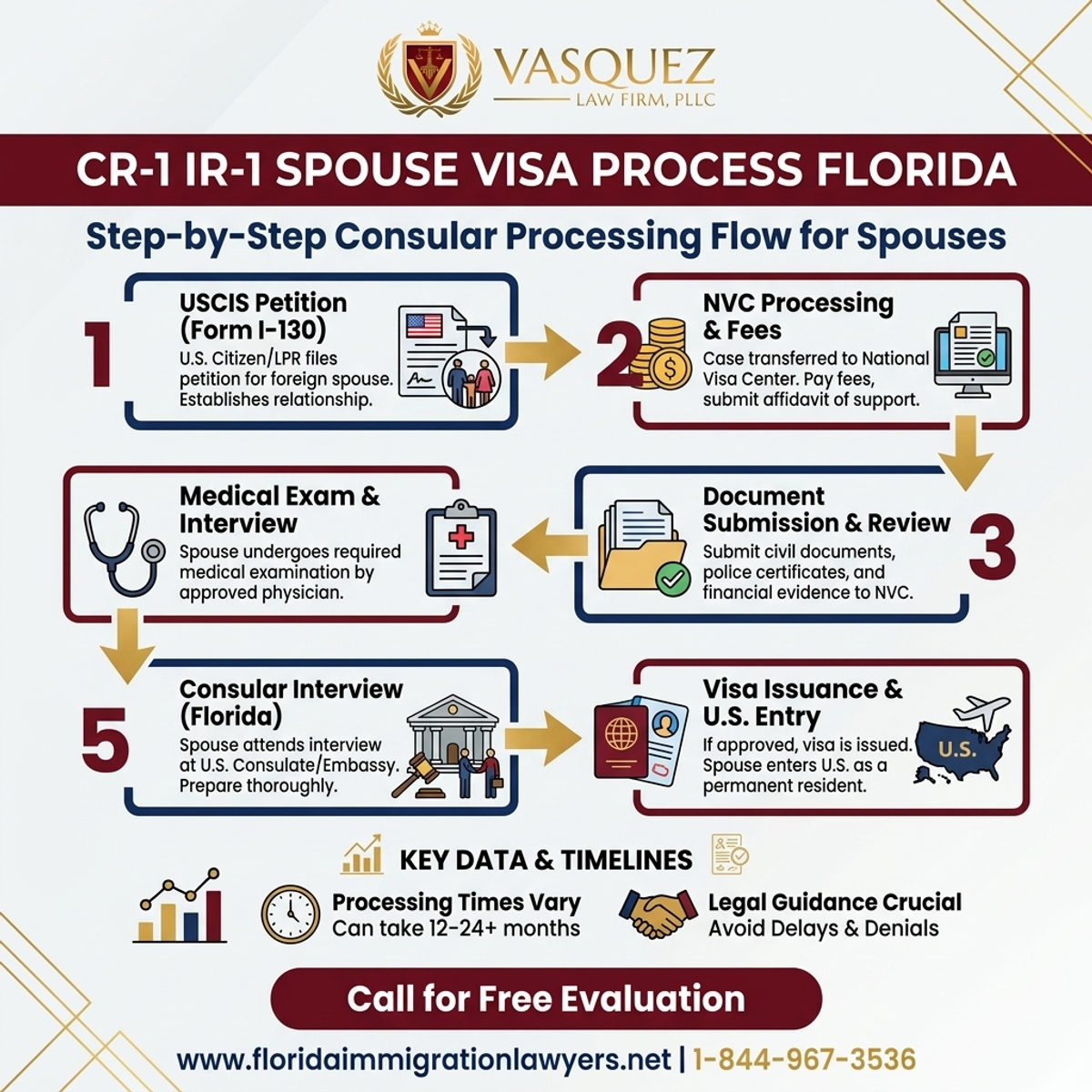
Step-by-Step Process — CR-1 IR-1 Spouse Visa Consular Florida
Each stage of this process requires meticulous attention to detail and adherence to specific guidelines. Seeking guidance from experienced immigration professionals, such as Florida Immigration Lawyers, can significantly streamline the process and help you avoid common pitfalls. Our team is well-versed in these procedures and ready to assist families in Homestead, Florida, every step of the way.
Document Checklist for CR-1 and IR-1 Visas
The success of your CR-1 or IR-1 visa application heavily relies on the completeness and accuracy of your submitted documentation. Any missing or incorrect documents can lead to significant delays, Requests for Evidence (RFEs), or even denial. It is crucial to gather and organize all required paperwork meticulously from the outset. Below is a comprehensive checklist of essential documents, but always be prepared for additional requests based on individual circumstances.
- A completed Form I-130 and supporting documents
- Proof of U.S. citizenship of the petitioner
- Marriage certificate
- Proof of termination of prior marriages, if applicable
- Proof of financial support (Form I-864)
- Police certificates and medical examination results
- Visa fee receipts
All foreign language documents must be accompanied by a certified English translation. It is highly recommended to make copies of all documents submitted for your records. Organizing your documents in a clear, labeled manner can significantly aid the NVC and consular officers in processing your case efficiently. For residents of Homestead, Florida, ensuring every detail is correct can prevent unnecessary delays. When in doubt about any specific document, consulting with Florida Immigration Lawyers can provide clarity and ensure your submission is complete and accurate.
Processing Timelines and Expectations
The processing time for CR-1 and IR-1 visas can vary. Generally, the USCIS takes several months to approve the initial petition. Once the case reaches the NVC, document processing and consular interviews add additional time, potentially extending the process to over a year. Factors such as backlogs at the Homestead, Florida USCIS office or the specific consulate can influence these timelines.
Real-world examples show that applicants from Homestead, Florida, might experience different waiting periods based on the volume of applications at local USCIS offices or consular posts. It's advisable to check the USCIS and State Department websites for current processing times.
Understanding the potential processing timelines for CR-1 and IR-1 visas is crucial for managing expectations and planning your future. The journey is often divided into three main phases: USCIS processing, NVC processing, and consular processing, each with its own variable duration. While the overall process can range from 10 months to over 2 years, individual cases can differ significantly based on factors like the country of origin, the specific U.S. consulate, and the completeness of your application.
The initial USCIS I-130 petition approval typically takes several months, sometimes extending beyond a year. For instance, a common scenario for a couple from Homestead, Florida, might involve filing the I-130 and waiting 8-15 months for approval. Following this, the NVC stage, where documents are collected and reviewed, can add another 2-6 months, depending on how quickly applicants respond to requests and submit all necessary paperwork. Any Request for Evidence (RFE) from USCIS or NVC can significantly prolong these stages, underscoring the importance of submitting a thorough and accurate petition from the start.
Finally, the consular interview scheduling and visa issuance can take an additional 1-4 months, influenced by the specific embassy's workload and appointment availability. Applicants should regularly check the USCIS and Department of State websites for the most up-to-date processing times, as these figures are subject to change. While it’s natural to hope for a swift resolution, preparing for a lengthy process and maintaining open communication with your legal team at Florida Immigration Lawyers can help alleviate stress. Our attorneys can provide insights into current trends and help you monitor your case progress effectively.
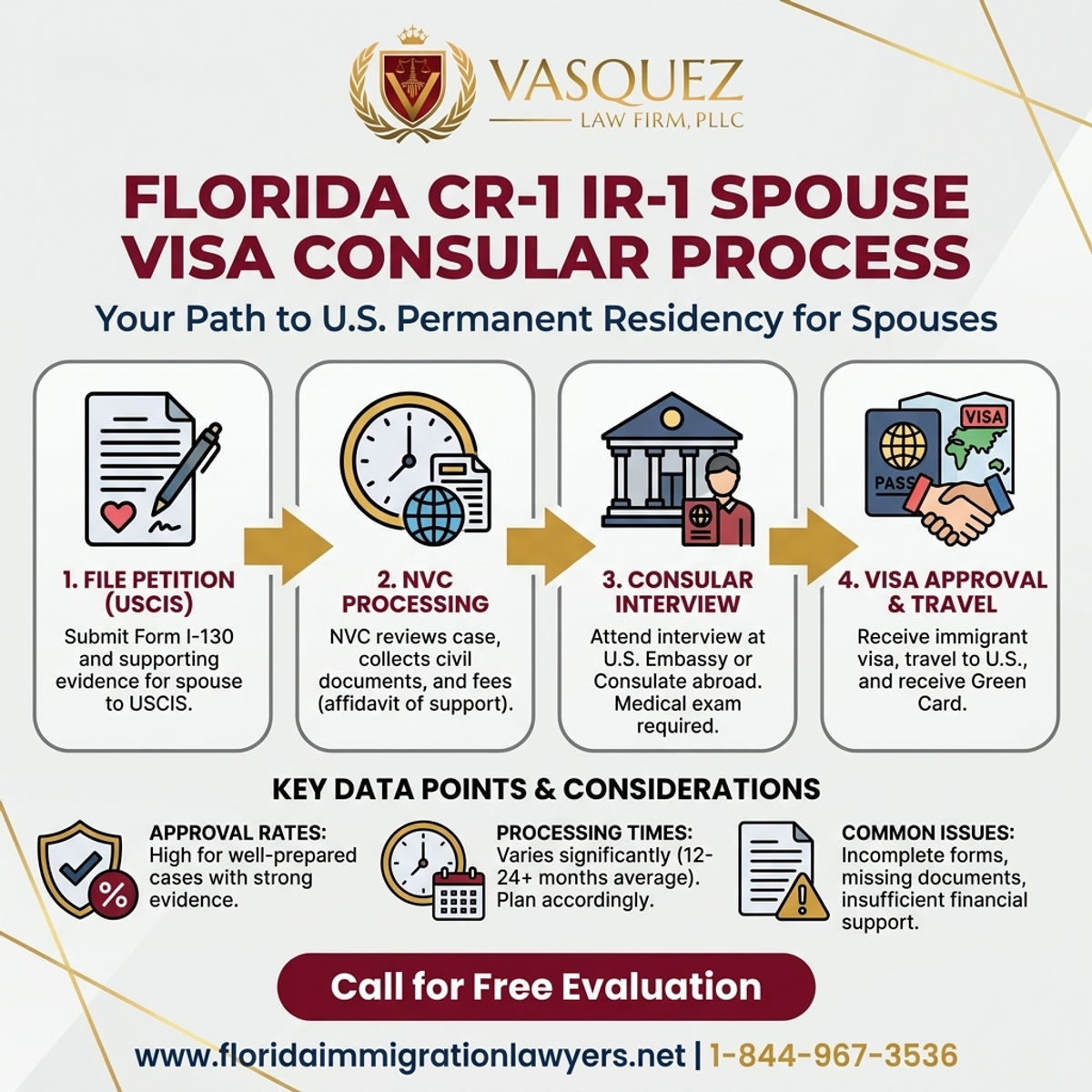
Key Statistics — CR-1 IR-1 Spouse Visa Consular Florida
Cost Factors and Fee Breakdown
The financial aspect of applying for a CR-1 or IR-1 visa includes several fees. While exact amounts can vary over time, applicants should prepare for USCIS filing fees for Form I-130, NVC processing fees, and fees for the medical examination and visa issuance. These costs can accumulate, making it crucial to budget accordingly.
For those in Homestead, Florida, understanding the potential financial commitment is important. While the fees may seem daunting, they are necessary for advancing through the visa process. Consider consulting with Florida Immigration Lawyers to understand the financial implications better.
Beyond the emotional investment, the CR-1 and IR-1 visa process also requires a significant financial commitment. It’s essential to budget carefully for the various fees involved, as these are non-refundable and can add up. While specific amounts are subject to change by government agencies, applicants should anticipate several key expenses throughout the journey. These fees are statutory and must be paid to proceed with the application.
The primary costs include the USCIS filing fee for Form I-130, which establishes the spousal relationship. After USCIS approval, the National Visa Center (NVC) assesses two main fees: the Affidavit of Support processing fee and the Immigrant Visa Application processing fee. Additionally, the foreign spouse must pay for a mandatory medical examination by an authorized panel physician, and this cost varies by country and clinic. Finally, there's a USCIS Immigrant Fee paid after visa approval but before traveling to the U.S., which covers the cost of producing the green card.
Beyond these government-mandated fees, applicants should also consider other potential expenses. These might include costs for obtaining civil documents (birth certificates, marriage certificates, police records), certified translations of foreign documents, travel expenses for the consular interview, and postage for mailing applications. While it’s possible to navigate the process independently, engaging an experienced immigration attorney like Florida Immigration Lawyers can be a valuable investment, potentially saving you from costly mistakes and delays. Our team can provide a detailed breakdown of anticipated costs and help you plan your finances for a smoother process. Call us at 1-844-967-3536 for a consultation.
Frequently
Do Not Navigate This Process Alone
Our experienced immigration attorneys are ready to fight for you. Get a free, confidential consultation today.
Se Habla Español
Frequently Asked Questions
Florida Immigration Lawyers
Immigration Attorney | Founder, Vasquez Law Firm
U.S. Air Force veteran and immigration attorney with thousands of cases resolved. J.D., NCCU School of Law. AILA member. Admitted to the 4th, 5th, and 11th Circuit Courts.
Available 24/7 - Free Evaluations
Related Legal Services
Our Florida immigration attorneys can help you with citizenship and naturalization, family immigration services and immigration practice areas. Call today at 1-844-967-3536 for a free consultation.
Related Links
Related Topics
Free Legal Consultation
Discuss your case with our experienced attorneys. We're available 24/7.
Se Habla Español - Estamos aquí para ayudarle.
Related Articles
212(c) Waiver Legacy Relief Florida: Your Deportation Defense
The 212(c) waiver offers crucial legacy relief for certain lawful permanent residents in Florida facing deportation due to criminal convictions that occurred before April 1, 1996. This complex area of immigration law requires a deep understanding of historical statutes and court precedents, such as the landmark <em>INS v. St. Cyr</em> decision. Eligibility hinges on strict criteria, including the conviction date, lawful permanent residency status, and years of domicile in the U.S. Successfully navigating the application process and presenting a compelling case before an Immigration Judge demands expert legal counsel. Florida Immigration Lawyers specializes in these intricate deportation defense strategies, guiding clients through document collection, discretionary factors, and court appearances. If you're in Kissimmee or anywhere in Florida, contact us for a free consultation to assess your eligibility for this vital defense.
VAWA Immigration Relief for Abuse Victims in Florida
VAWA provides essential immigration relief for abuse victims in Florida, enabling them to apply for legal status independently. Learn how to navigate this process effectively.
Immigration Lawyer in Hialeah Florida | VLF Florida
Discover how finding the right immigration lawyer in Hialeah, Florida, can help you navigate complex immigration processes. Contact Florida Immigration Lawyers for a free consultation today!
F-1 Visa for Florida University International Students
Explore the process of obtaining an F-1 visa to study at Florida universities, with specific insights for international students in Fort Lauderdale. Understand requirements, avoid common pitfalls, and learn when to seek legal help. Contact Florida Immigration Lawyers for personalized assistance.
