Citizenship Test Preparation Florida: Your 2026 Guide
Achieving U.S. citizenship through naturalization is a significant milestone, and mastering the citizenship test is a crucial step. This comprehensive guide from Florida Immigration Lawyers provides essential insights for those preparing in Florida for 2026. Learn about eligibility requirements, the step-by-step application process, and detailed strategies for acing the civics and English tests. We cover everything from N-400 preparation and document checklists to understanding processing timelines and cost factors. Discover common mistakes to avoid and when to seek professional legal assistance to ensure a smooth journey to becoming a U.S. citizen. Our firm offers free consultations and serves clients throughout Florida, including Hollywood, Miami, and Orlando.
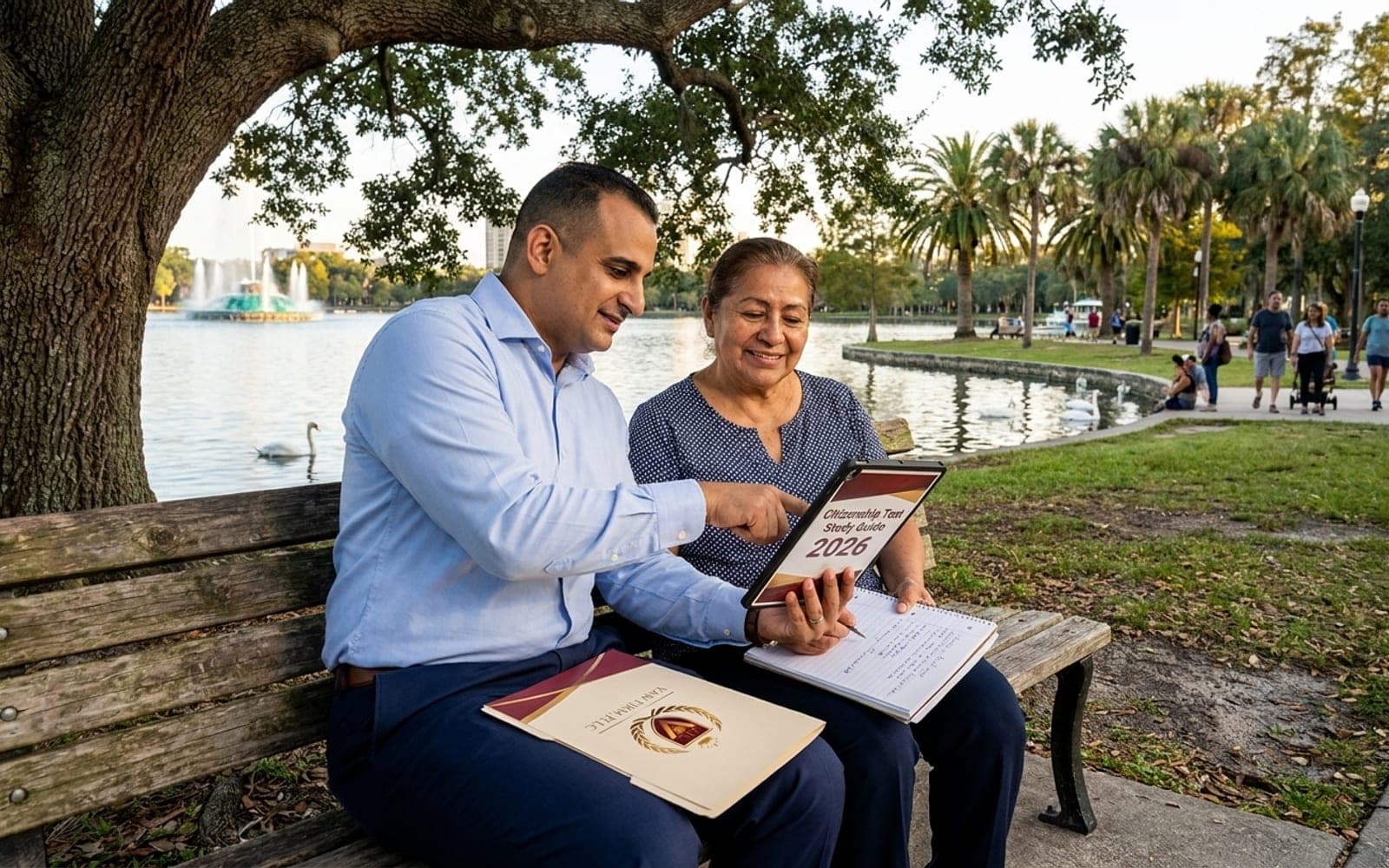
Preparing for the citizenship test in Florida for 2026 involves understanding the naturalization process, mastering the civics and English components, and meticulously preparing your N-400 application. The civics test requires knowledge of U.S. government and history, while the English test assesses your ability to read, write, and speak basic English. Success hinges on thorough study, accurate document submission, and a clear understanding of eligibility requirements. Many applicants in Hollywood and across Florida find professional legal guidance invaluable for navigating this complex journey.
- Thoroughly study the 100 civics questions and practice English skills.
- Ensure all eligibility criteria for naturalization are met before applying.
- Gather all necessary documents for your N-400 application.
- Prepare for the interview by reviewing your application and practicing answers.
- Consider consulting with an experienced immigration attorney in Florida.
For many individuals and families across Florida, the dream of becoming a U.S. citizen represents the culmination of years of hard work, dedication, and a deep commitment to their new home. The journey to naturalization, however, culminates in a crucial step: the citizenship test. This test, along with the interview process, can seem daunting, especially with specific requirements and a need for precise preparation for the year 2026.
Whether you reside in Hollywood, Miami, Orlando, or any other vibrant community in the Sunshine State, understanding the requirements and preparing effectively is paramount. This comprehensive guide from Florida Immigration Lawyers is designed to demystify the naturalization process, offer actionable advice for excelling on the civics and English tests, and help you navigate the path to U.S. citizenship with confidence. We aim to provide you with the knowledge needed to successfully prepare for your citizenship interview and test.
Don't face this significant step alone. If you have questions about your eligibility or need assistance with your application, call Florida Immigration Lawyers at 1-844-YO-PELEO for a free consultation. Our experienced team is here to help you achieve your American dream.
Understanding the Naturalization Process and the Citizenship Test in Florida
Becoming a U.S. citizen through naturalization is a multi-step process governed by federal law, specifically the Immigration and Nationality Act (INA). The citizenship test is a critical component of this journey, designed to confirm an applicant's understanding of English and their knowledge of U.S. history and government, often referred to as civics. In Florida, thousands of residents pursue naturalization each year, reflecting the state's diverse immigrant population. The process typically begins with filing Form N-400, Application for Naturalization, with USCIS.
The test itself consists of two main parts: an English proficiency test and a civics test. The English test evaluates your ability to read, write, and speak basic English. The civics test requires you to answer a certain number of questions correctly from a predetermined list of 100 questions. These requirements are outlined in INA § 312 (8 U.S.C. § 1423), which sets forth the English language and civics knowledge requirements for naturalization. Understanding these components is the first step toward successful preparation, particularly for those in Florida's dynamic communities like Hollywood, where many aspire to become citizens.
Preparing for the citizenship test in Florida means understanding not just the questions, but the underlying principles of U.S. democracy and history. Many resources are available, but personalized guidance can make a significant difference. Florida Immigration Lawyers is dedicated to helping individuals throughout Florida understand each step, from initial eligibility checks to the final oath ceremony. We provide tailored support to ensure you are well-prepared for every aspect of your naturalization journey, including the crucial civics test and English interview.
For individuals residing in South Florida, the Miami Field Office of USCIS is typically where interviews and tests are conducted, while those in Central Florida may go to the Orlando Field Office, and West Florida residents to the Tampa Field Office. Knowing your local USCIS office and their specific procedures is an important part of your preparation. Our firm helps clients in all these areas, offering localized insights and support.
Eligibility Requirements for U.S. Naturalization in Florida
Before you even begin to prepare for the citizenship test, it's essential to confirm your eligibility for naturalization. USCIS has strict criteria that all applicants must meet. These requirements are designed to ensure that new citizens are committed to the United States and understand their responsibilities. For those living in Florida, these federal requirements apply universally, regardless of your specific city or county.
The primary eligibility criteria include:
- Age: You must be at least 18 years old at the time of filing your Form N-400.
- Lawful Permanent Residency: You must be a lawful permanent resident (green card holder) for at least 5 years. This period can be reduced to 3 years if you are married to a U.S. citizen and meet specific conditions, such as living in marital union with the citizen spouse.
- Continuous Residence: You must have resided continuously in the U.S. as a lawful permanent resident for at least 5 years (or 3 years if married to a U.S. citizen) immediately preceding the date of filing your N-400. You must also be physically present in the U.S. for at least half of that time.
- Residence in State/USCIS District: You must have resided for at least 3 months in the state or USCIS district where you file your application. For many in Hollywood, this means meeting the Florida residency requirement.
- Good Moral Character: USCIS assesses your good moral character during the statutory period (5 or 3 years). This involves reviewing your criminal record, if any, and other aspects of your conduct. Certain criminal offenses can bar you from naturalization.
- Attachment to the U.S. Constitution: You must demonstrate an attachment to the principles and ideals of the U.S. Constitution and be willing to take the Oath of Allegiance.
- English Language and Civics Knowledge: This is where the citizenship test comes in. You must demonstrate the ability to read, write, and speak basic English, and have a fundamental understanding of U.S. history and government (civics). There are some exceptions for age and disability, which an attorney can help you explore.
Understanding these requirements is crucial. Any discrepancies or complexities in your background, such as extensive travel, prior arrests, or tax issues, can significantly impact your eligibility. Consulting with an immigration attorney at Florida Immigration Lawyers can help you assess your unique situation and ensure you meet all criteria before proceeding with your naturalization application. Our team assists clients throughout Florida, from the Panhandle to the Keys, ensuring every detail is thoroughly reviewed.
Step-by-Step Guide to the Naturalization Application and Test
The path to U.S. citizenship via naturalization involves several distinct steps, each requiring careful attention to detail. For residents of Florida preparing for their citizenship test in 2026, understanding this sequence is vital for a smooth process.
-
Determine Eligibility: As discussed, confirm you meet all the basic requirements, including age, continuous residence, physical presence, and good moral character. This initial assessment is critical to avoid unnecessary delays or denials. An attorney can help you review your unique circumstances.
-
Prepare and File Form N-400: Complete the Application for Naturalization, Form N-400, accurately and thoroughly. This form collects extensive personal information, residency history, employment details, and criminal background, if any. Attach all required supporting documents and pay the filing fees. Ensure the form is correctly signed and dated before submission to the appropriate USCIS Lockbox facility. The accuracy of your N-400 is paramount.
-
Attend Biometrics Appointment: After USCIS accepts your N-400, you will receive an appointment notice for biometrics. This typically takes place at a local Application Support Center (ASC) in Florida, such as those in Hollywood, Miami, or Orlando. At this appointment, your fingerprints, photograph, and signature will be taken for background checks.
-
Prepare for the Interview and Citizenship Test: This is where your dedicated preparation for the civics test and English assessment comes into play. Study the 100 civics questions, practice speaking English, and review your N-400 application thoroughly. USCIS provides study materials on its website. Consider joining a study group or utilizing online resources. For Florida residents, numerous community organizations and libraries offer free citizenship preparation classes.
-
Attend the Naturalization Interview: You will receive an interview notice detailing the date, time, and location (e.g., Miami Field Office). During the interview, a USCIS officer will review your N-400 application with you, ask questions about your eligibility, and administer the English and civics tests. Be honest and straightforward in your responses. Having an attorney present can provide peace of mind and ensure your rights are protected.
Step-by-Step Process — Citizenship Test Preparation Florida: Your 2026 Guide
-
Receive a Decision: After the interview, the USCIS officer may approve, deny, or continue your application. If approved, you will likely receive a notice for the Oath of Allegiance ceremony. If continued, it means USCIS needs more information or you need to re-take a portion of the test.
-
Take the Oath of Allegiance: This is the final step where you formally become a U.S. citizen. You will attend a ceremony and take the Oath of Allegiance to the United States. Upon taking the oath, you will receive your Certificate of Naturalization, officially marking your new status. This ceremony is a joyous occasion for new citizens and their families across Florida.
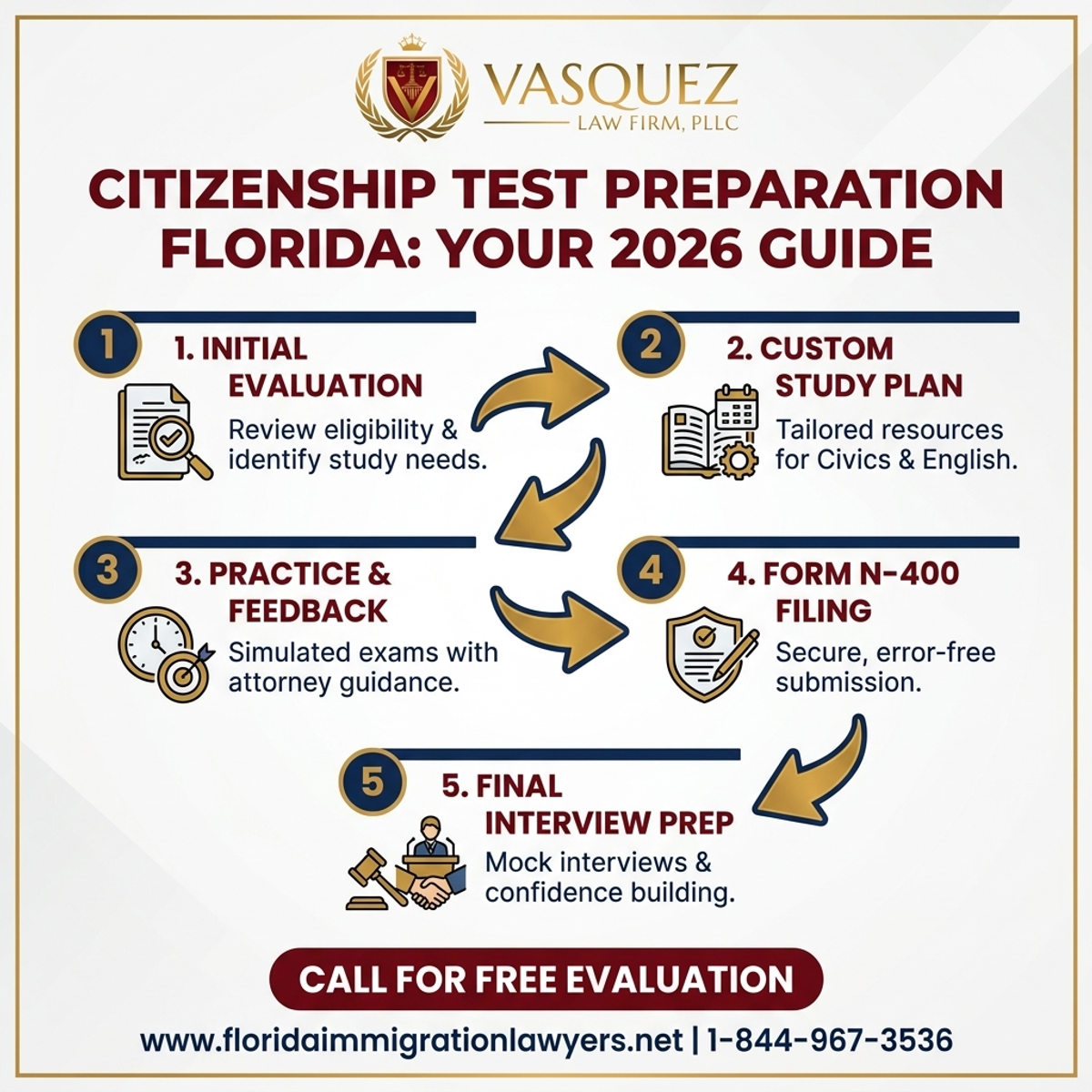
Each step in this process is important. Missing deadlines, submitting incomplete forms, or failing to prepare adequately for the interview and tests can lead to delays or even denial. Our team at Florida Immigration Lawyers can guide you through this entire process, ensuring you are well-informed and prepared at every turn.
Mastering the Civics and English Tests for Naturalization
Succeeding on the citizenship test is a primary goal for every naturalization applicant in Florida. The test has two distinct components: the English test and the civics test. Each requires different preparation strategies, but both are crucial for your application's success. Understanding what to expect for 2026 is key to effective study.
The English Test: Reading, Writing, and Speaking
The English portion of the naturalization interview assesses your ability to understand, speak, read, and write basic English. The USCIS officer will evaluate your speaking ability throughout the interview by asking questions about your N-400 application. For the reading test, you will be asked to read one out of three sentences correctly. For the writing test, you will be asked to write one out of three sentences accurately. The vocabulary for these tests typically comes from the official USCIS vocabulary lists, which are readily available online.
Practice is essential for this part of the test. Engage in daily conversations, read English newspapers or simple books, and practice writing basic sentences. Many community centers and libraries in Florida, including those in Hollywood and surrounding areas, offer free English as a Second Language (ESL) classes that can significantly improve your proficiency.
The Civics Test: U.S. History and Government
The civics test is where your knowledge of U.S. history, government, and geography is assessed. You will be asked up to 10 questions from a list of 100 official civics questions. To pass, you must answer at least 6 out of 10 questions correctly. For applicants aged 65 or older who have been a lawful permanent resident for at least 20 years, a simplified test is available where only 20 questions are studied, and 6 out of 10 must be answered correctly.
The 100 civics questions cover topics like American government (principles, system of government, rights and responsibilities) and American history (colonial period, 1800s, recent American history, geography, symbols, holidays). USCIS provides all 100 questions and their answers online, which is the official study guide. Memorizing these answers is a critical part of your preparation. However, understanding the context behind the answers can help you retain the information better and answer follow-up questions from the officer.
For those in Florida, resources like online flashcards, mobile apps, and local study groups are excellent tools. Florida Immigration Lawyers can also provide guidance on effective study techniques and resources to help you confidently approach the civics test. We emphasize not just memorization, but a genuine understanding of the material, which can be particularly helpful if the officer asks a variation of a question.
Essential Document Checklist for Your N-400 Application
A complete and well-organized set of supporting documents is critical for a successful naturalization application and interview in Florida. Missing or incorrect documents can lead to delays, requests for evidence (RFEs), or even a denial of your Form N-400. Being prepared for your citizenship test interview means having all your paperwork in order for 2026.
While the exact list of documents can vary based on your individual circumstances, here is a general checklist of what you should prepare:
- Form N-400, Application for Naturalization: The original signed form.
- Photocopies of your Green Card: Both front and back.
- Two Passport-Style Photos: Taken within 30 days of filing, with a white background.
- Copy of your State-Issued Identification: Such as your Florida driver's license or state ID.
- Proof of Continuous Residence and Physical Presence:
- Tax returns for the past 5 (or 3) years.
- Lease agreements or mortgage statements.
- Utility bills.
- Employment records (pay stubs, W-2s).
- Bank statements.
- Proof of Marital Status (if applicable):
- Marriage certificate.
- Divorce decrees (for all prior marriages of you and your spouse).
- Death certificates (for any deceased spouses).
Key Statistics — Citizenship Test Preparation Florida: Your 2026 Guide
- Travel Records: Copies of passport pages showing entry/exit stamps for all trips outside the U.S. during the statutory period.
- Court and Arrest Records (if applicable): Certified copies of all arrest reports, court dispositions, probation records, and sentencing information, even if charges were dismissed or expunged. This includes traffic violations if they involved an arrest or fine over $500.
- Selective Service Registration Proof (for males 18-26): If applicable.
- Child Support/Alimony Orders (if applicable): Proof of compliance.
- Any Previous USCIS Correspondence: Notices, receipts, approval letters.
- Medical Documentation for Disability Waivers (if applicable): Form N-648, Medical Certification for Disability Exemptions.
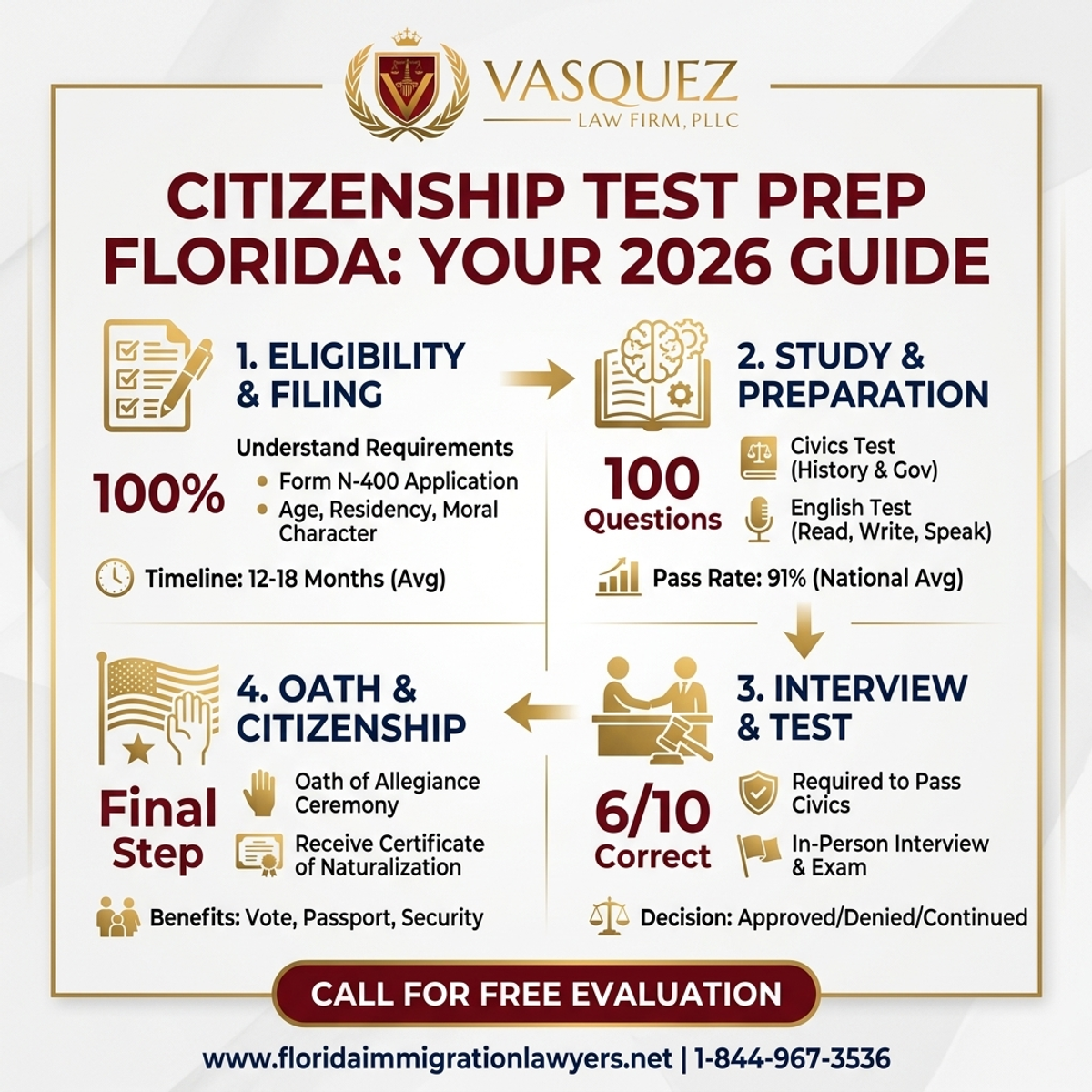
Organize these documents neatly, preferably in a binder or folder, making them easy to access during your interview. Do not submit original documents with your N-400 unless specifically requested; bring originals to your interview. Florida Immigration Lawyers can help you compile this crucial checklist, review your documents for completeness, and ensure you are fully prepared for your naturalization interview in Hollywood or any other Florida location.
Do not navigate this process alone. The complexities of immigration law require guidance. Contact Florida Immigration Lawyers today for a free consultation and let us help you with your citizenship application.
Timelines and Processing Expectations in Florida (2026)
Understanding the processing times for your naturalization application, Form N-400, is crucial for managing expectations. While USCIS strives for efficiency, timelines can fluctuate based on national caseloads, policy changes, and the specific USCIS field office processing your application. For those in Florida preparing for their citizenship test in 2026, it's important to monitor current processing times.
Generally, the naturalization process from filing Form N-400 to taking the Oath of Allegiance can take anywhere from 8 to 24 months, or even longer in some complex cases. These are approximate figures, and specific times can be checked on the USCIS website's processing times tool. For Florida residents, the processing times can vary slightly between the Miami, Orlando, and Tampa Field Offices.
- Form N-400 Filing to Biometrics Appointment: Typically 3-5 weeks after filing.
- Biometrics to Interview Scheduling: This is often the longest waiting period, ranging from 6 to 18 months, depending on the field office and current backlogs.
- Interview to Decision: Often, a decision is made at the interview or within a few weeks. If your case is complex or requires additional evidence, it could take longer.
- Decision to Oath Ceremony: If approved, the Oath of Allegiance ceremony is usually scheduled within 1-4 weeks after your interview. Sometimes, the oath can be administered on the same day as the interview, especially if your case is straightforward.
Factors that can influence your specific timeline include the completeness and accuracy of your N-400 application, your response time to any Requests for Evidence (RFEs), the volume of applications at your specific USCIS Field Office (e.g., Miami, Orlando, Tampa), and any complexities in your background. For example, if you have a criminal record or extensive travel history, your case might require additional review, leading to longer processing times. USCIS processing times are subject to change, so regular checks on their official website are recommended. Our legal team stays updated on these developments to provide the most current advice to our clients in Hollywood and across Florida.
Cost Factors and Fee Breakdown for Naturalization
Pursuing U.S. citizenship through naturalization involves various costs, and it's essential for applicants in Florida to understand these financial commitments. While legal fees can vary, the government filing fees are standard across the United States for the citizenship test application.
USCIS Filing Fees
The primary cost is the fee for filing Form N-400, Application for Naturalization. This fee typically includes the application processing fee and the biometrics services fee. It is crucial to check the most current fee schedule on the USCIS website, as these amounts are subject to change annually. USCIS offers fee waivers for eligible applicants who demonstrate an inability to pay. An attorney can help you determine if you qualify for a fee waiver and assist with the application.
Attorney Fees
While it is possible to apply for naturalization on your own, many applicants, especially those with complex cases or who prefer professional guidance, choose to hire an immigration attorney. Attorney fees for naturalization services can vary based on the complexity of the case, the firm's experience, and the scope of services provided. Hiring an attorney can be a valuable investment, as they can:
- Assess your eligibility and identify potential issues.
- Help you accurately complete Form N-400.
- Prepare you thoroughly for the interview and civics test.
- Accompany you to the interview (if permitted).
- Respond to Requests for Evidence (RFEs).
- Represent you in case of a denial or appeal.
Florida Immigration Lawyers offers transparent fee structures and provides initial free consultations to discuss your case. We believe in making quality legal representation accessible to all aspiring citizens in Hollywood and throughout Florida.
Other Potential Costs
Beyond the main filing and attorney fees, you might encounter other costs, such as:
- Document Translation Fees: If any of your supporting documents are not in English, they must be translated by a certified translator.
- Document Photocopying and Mailing Fees: Costs associated with gathering and sending your application package.
- Medical Examination Fees: If you are seeking a disability waiver for the English or civics test, you will need to pay for a medical examination by a USCIS-approved civil surgeon (Form N-648).
- Travel Expenses: To and from your biometrics appointment, interview, and oath ceremony.
Careful financial planning is an important part of your naturalization journey. Discussing all potential costs with your attorney during your free consultation can help you prepare comprehensively.
Common Mistakes to Avoid During Your Naturalization Process
The naturalization process, culminating in the citizenship test, is filled with potential pitfalls that can delay or even derail your application. Avoiding these common mistakes is crucial for aspiring citizens in Florida.
-
Filing Without Meeting All Eligibility Requirements: Many applicants prematurely file Form N-400 without fully verifying their continuous residence, physical presence, or good moral character. This can lead to an automatic denial and loss of filing fees. Always double-check all criteria.
-
Inaccurate or Incomplete Form N-400: Errors, omissions, or inconsistencies on your N-400 application can trigger Requests for Evidence (RFEs) or even a denial. Ensure every question is answered truthfully and completely. Even minor mistakes, like an incorrect date, can cause issues.
-
Failing to Disclose All Travel or Criminal History: Applicants often believe that minor offenses or short trips abroad don't need to be disclosed. It is imperative to disclose ALL travel outside the U.S. and ALL arrests, citations, or criminal history, no matter how minor or old. USCIS conducts thorough background checks, and non-disclosure is a serious issue that can lead to accusations of misrepresentation.
-
Insufficient Document Submission: Submitting an N-400 without all necessary supporting documents, or submitting uncertified copies when certified ones are required, will cause delays. Always refer to the USCIS instructions and your attorney's checklist.
-
Inadequate Preparation for the English and Civics Tests: Underestimating the difficulty of the civics test or the English proficiency requirement is a common mistake. Many assume they know enough, only to struggle during the interview. Dedicated study and practice are essential for both components.
-
Not Reviewing Your N-400 Before the Interview: The USCIS officer will ask questions based on your application. If your answers during the interview contradict what's on your N-400, it can raise concerns about your credibility. Always review your submitted form thoroughly before your interview.
-
Missing Appointments or Deadlines: Failing to attend biometrics appointments, interviews, or responding to RFEs by the specified deadline can lead to your application being denied or abandoned. Keep track of all correspondence from USCIS.
-
Not Seeking Legal Advice for Complex Cases: If you have a criminal record, long absences from the U.S., previous immigration denials, or other unusual circumstances, attempting to navigate the process alone is risky. An attorney can identify potential issues and strategize solutions.
When to Call a Florida Immigration Lawyer for Naturalization
While some naturalization cases are straightforward, many aspiring citizens in Florida encounter complexities that warrant professional legal assistance. Navigating the intricate federal immigration laws and preparing for the citizenship test can be overwhelming, and an experienced attorney can provide invaluable support. You should consider contacting Florida Immigration Lawyers if any of the following scenarios apply to you:
- Complex Eligibility Issues: If you have questions about your continuous residence, physical presence, or good moral character, especially due to extensive travel, past immigration violations, or a criminal record (even minor offenses), an attorney can assess your eligibility accurately.
- Prior Criminal History: Any arrests, convictions, or charges, regardless of how minor or old, can impact your naturalization application. An attorney can help you gather necessary court documents, understand their implications, and present your case effectively to USCIS.
- Long Absences from the U.S.: If you have spent significant time outside the United States during your permanent residency, it could affect your continuous residence requirement. An attorney can help determine if your absences break continuity and advise on potential remedies.
- Previous Denials or Deportation Proceedings: If you have had previous immigration applications denied, or if you have been in removal (deportation) proceedings, your naturalization case will be more complicated. An attorney can review your history and develop a strategy.
- Need for Waivers or Accommodations: If you believe you qualify for an exemption from the English or civics test due to age or a medical disability (Form N-648), an attorney can help you prepare and submit the necessary documentation.
- Difficulty with English or Study Materials: If you struggle with the English language or find the civics study materials overwhelming, an attorney can connect you with appropriate resources and help you prepare more effectively for the interview.
- Concerns About the Interview Process: Feeling anxious about the interview itself is normal. An attorney can prepare you for potential questions, explain the process, and in many cases, accompany you to the interview at the USCIS Field Office in Miami, Orlando, or Tampa, offering peace of mind.
- Any Doubts or Uncertainty: Even if your case seems simple, any doubt or uncertainty about the process, required documents, or potential outcomes is a valid reason to seek legal counsel.
At Florida Immigration Lawyers, we are committed to providing personalized and compassionate legal assistance to clients throughout Florida, including Hollywood and the greater South Florida area. Our attorneys have a deep understanding of naturalization law and are dedicated to protecting your rights and helping you achieve your dream of U.S. citizenship. Don't leave your future to chance; contact us today.
About Florida Immigration Lawyers
Florida Immigration Lawyers is an immigration law firm dedicated to serving individuals and families across the entire state of Florida. With a deep understanding of U.S. immigration laws and a passion for helping our clients achieve their dreams, we offer comprehensive legal services tailored to your unique needs. Our experienced attorneys focus on a wide range of immigration matters, including naturalization, family immigration, asylum, deportation defense, and business immigration.
We pride ourselves on our client-focused approach, providing empathetic and effective representation. Our firm is committed to guiding you through every step of your immigration journey, from initial consultations to complex court proceedings. We understand the challenges and anxieties that often accompany immigration processes, and we strive to provide clear communication, diligent advocacy, and peace of mind. Our team is fluent in both English and Spanish, ensuring that language is never a barrier to quality legal assistance.
Choosing Florida Immigration Lawyers means choosing a partner who will stand by you. We offer free consultations to discuss your case and are available 24/7 to address your urgent needs. Let us put our experience to work for you. Visit our website at floridaimmigrationlawyers.net or call us directly at 1-844-YO-PELEO to schedule your free consultation today. We are here to help you navigate the complexities of immigration law with confidence.
Sources and References
- U.S. Citizenship and Immigration Services (USCIS)
- Executive Office for Immigration Review (EOIR)
- Immigration and Nationality Act (INA) § 312, 8 U.S.C. § 1423 - English Language and Civics Requirements
- 8 CFR Part 312 - Examinations on applications for naturalization
- USCIS Form N-400, Application for Naturalization Instructions
- USCIS Policy Manual - Citizenship and Naturalization
Related services: citizenship test preparation, dual citizenship guidance, family-based immigration.
This article provides general legal information and is not intended as legal advice. Every case is unique, and outcomes depend on specific facts and circumstances. Contact an attorney for advice about your particular situation. Immigration laws are subject to change.
Ready to take the next step toward U.S. citizenship? Don't let the complexities of the citizenship test or the naturalization process overwhelm you. Our dedicated attorneys at Florida Immigration Lawyers are ready to provide the guidance and support you need. Call us now at 1-844-YO-PELEO for a free consultation. Se Habla Español - Estamos aquí para ayudarle.
Do Not Navigate This Process Alone
Our experienced immigration attorneys are ready to fight for you. Get a free, confidential case review today.
Se Habla Español
Or leave your details and we’ll call you:
Free Evaluation in 24 Hours
Or talk to us right now
AI voice assistant — available 24/7
FreeFrequently Asked Questions
William J. Vásquez
Founding Attorney · Vasquez Law Firm
U.S. Air Force veteran and immigration attorney with years of hands-on U.S. immigration experience. J.D., NCCU School of Law. AILA member. Admitted to the 4th, 5th, and 11th Circuit Courts.
Available 24/7 - Free Evaluations
Reviewed for legal accuracy by William J. Vásquez
Licensed in North Carolina; U.S. immigration is federal practice.
Related Legal Services
Our Florida immigration attorneys can help you with deportation defense, family immigration services and immigration lawyer cost in Florida. Call today at 1-844-YO-PELEO for a free case review.
Related Links
Related Topics
Free Legal Case Review
Discuss your case with our experienced attorneys. We're available 24/7.
Se Habla Español - Estamos aquí para ayudarle.
Related Articles
EB-5 Investor Green Card in Florida: A 2026 Guide
Explore how to obtain an EB-5 investor green card in Florida. Learn about the investment requirements, processes, and benefits of participating in this program. Discover how Florida's economic landscape can be an ideal setting for your investment. Contact Florida Immigration Lawyers for a free case review.
Certificate of Eligibility for Expungement in Florida 2026
For non-U.S. citizens in Florida, understanding how a state expungement impacts immigration status is critical. A certificate of eligibility for expungement in Florida allows a criminal record to be sealed or expunged under state law. However, federal immigration agencies often disregard such state-level relief, still considering the original criminal offense as a conviction for immigration purposes. This can have severe implications for visa applications, green card eligibility, naturalization, and even lead to deportation. This guide clarifies the Florida expungement process, its limited effect on federal immigration law, and key steps to protect your status in 2026. Learn about common mistakes, required documents, timelines, and when to seek expert legal counsel from Florida Immigration Lawyers to navigate these complex issues effectively.
Immigration Lawyer Orlando Free Consultation in Florida
For individuals and families in Orlando, Florida, navigating the complexities of U.S. immigration law requires expert guidance. An immigration lawyer in Orlando offers crucial support for everything from visa applications and green card processes to naturalization and deportation defense. This comprehensive guide details what a free consultation covers, providing a step-by-step overview of immigration pathways, essential document checklists, and expected timelines in 2026. We also highlight common mistakes to avoid, discuss the critical role of legal counsel in deportation and asylum cases, and explain why choosing a local Orlando immigration attorney is beneficial. Florida Immigration Lawyers is dedicated to serving the diverse community of Orlando with compassionate, effective legal solutions, ensuring you receive personalized advice and robust representation for a successful immigration journey.
Florida Refugee Immigration Help: Resettlement Guide
Navigating refugee resettlement in Florida can be challenging. Learn about the process, required documents, and common mistakes to avoid. Florida Immigration Lawyers are here to help with personalized legal assistance. Contact us today for more information.