Work Permit: Navigating PERM Labor Certification in Florida
Navigating the PERM labor certification process is crucial for obtaining a work permit and employer-sponsored green card in Florida. Learn the steps, requirements, and common pitfalls in this comprehensive guide. Florida Immigration Lawyers are here to help.
- PERM is essential for many employment-based green cards.
- Employers must prove no qualified U.S. workers are available.
- The process involves multiple steps and can take several months.
- Legal guidance is recommended to navigate complexities.
Introduction
Imagine you're living in Pembroke Pines, Florida, and you've found an employer willing to sponsor you for a green card. The next step involves navigating the complex world of PERM labor certification. In this guide, we'll explore what PERM is, how it works, and why it's a crucial component for obtaining a work permit and employer-sponsored green card in Florida. Call Florida Immigration Lawyers at 1-844-YO-PELEO for a free consultation to get personalized assistance.
The PERM process, officially known as Program Electronic Review Management, serves as a gatekeeper to protect the U.S. labor market by ensuring that foreign workers are not taking jobs that qualified U.S. citizens or permanent residents are willing and able to perform. This meticulous process is a cornerstone of the U.S. employment-based immigration system, impacting countless individuals and businesses across the state of Florida.
Understanding each phase of PERM is vital for both employers and foreign nationals. From determining the prevailing wage to executing a comprehensive recruitment campaign, every detail matters. Errors or omissions can lead to significant delays or even outright denial, making expert guidance from a firm like Florida Immigration Lawyers invaluable throughout this intricate journey.
What is PERM Labor Certification?
As of 2026, PERM labor certification is the initial step in the employment-based green card process, requiring employers to demonstrate that no qualified U.S. workers are available for the job offered to a foreign national.
The process involves detailed job advertising and recruitment efforts to prove the necessity of hiring a foreign worker. Employers must adhere to strict guidelines set by the Department of Labor to ensure compliance.
USCIS guidelines detail the precise requirements for the PERM process, including prevailing wage determination and recruitment efforts.
The core principle behind PERM is to protect the job market for U.S. workers. This means the Department of Labor (DOL) scrutinizes employer applications to ensure that the foreign national is truly needed because no qualified, willing, and available U.S. worker could be found through good faith recruitment efforts. This isn't just a formality; it's a rigorous test of the employer's genuine need to hire from abroad.
Specifically, PERM is a prerequisite for most employment-based second preference (EB-2) and third preference (EB-3) green card categories. These categories are popular pathways for professionals, skilled workers, and those with advanced degrees. Without an approved PERM certification, an employer cannot file the subsequent I-140 Immigrant Petition for Alien Worker, effectively halting the green card process before it truly begins. This makes PERM the foundational block upon which many employer-sponsored green card applications are built.
Employers in Florida, from tech startups in Miami to agricultural businesses in the panhandle, must understand that the burden of proof rests entirely on them. They must not only conduct the required recruitment but also maintain meticulous records of all efforts, including resumes received, interview notes, and reasons for rejecting U.S. applicants. The DOL can audit any PERM application, and a lack of thorough documentation is a primary reason for denial. Florida Immigration Lawyers can help employers navigate these stringent requirements to ensure compliance.
How to Apply for PERM in Florida
To apply for PERM in Florida, the employer must follow these steps:
The PERM application process is a systematic journey designed to demonstrate an employer's genuine need for a foreign worker. Each step is interconnected and must be executed with precision and adherence to strict DOL regulations. Rushing or overlooking any detail can lead to significant setbacks, making careful planning and execution paramount for employers in Florida.
- Prevailing Wage Determination: Request a prevailing wage determination from the Department of Labor (DOL) to ensure the offered wage meets industry standards.
This initial step is crucial. The employer must obtain a prevailing wage determination from the DOL's National Prevailing Wage Center (NPWC) to ensure the offered salary for the position is not less than the average wage paid to similarly employed workers in the geographic area of intended employment. This protects both U.S. workers from wage depression and foreign workers from exploitation. The request specifies the job duties, minimum requirements, and work location. An inaccurate wage determination can invalidate the entire PERM process.
- Recruitment: Conduct a recruitment process, including job postings and advertisements, to prove that no qualified U.S. workers are available.
The recruitment phase is arguably the most critical and complex part of the PERM process. Employers must conduct a series of mandatory and additional recruitment steps over a specific period, typically 30 to 180 days before filing. Mandatory steps usually include placing a job order with the State Workforce Agency (SWA) and two Sunday newspaper advertisements. Additional steps may involve internal notices, employer's website postings, job search website postings, on-campus recruiting, trade or professional organizations, or employee referral programs. All recruitment efforts must clearly state the job requirements and be conducted in good faith to test the U.S. labor market.
- Filing the ETA Form 9089: Submit the PERM application electronically to the DOL.
After completing the recruitment period and concluding that no qualified, willing, and available U.S. workers were found, the employer can then file ETA Form 9089, Application for Permanent Employment Certification, with the DOL. This form contains detailed information about the employer, the foreign national, the job opportunity, and the recruitment efforts. It's an attestation-based form, meaning the employer certifies under penalty of perjury that all information is true and accurate, and all recruitment steps were properly followed. Any misrepresentation or error can lead to an audit or denial, making meticulous review essential before submission.
- Approval and Filing I-140: Once the PERM is approved, the employer files the I-140 petition with USCIS.
Upon receiving an approved ETA Form 9089, the employer moves to the next critical stage: filing Form I-140, Immigrant Petition for Alien Worker, with U.S. Citizenship and Immigration Services (USCIS). This petition establishes the foreign national's eligibility for the employment-based immigrant visa category. The I-140 requires evidence of the employer's ability to pay the offered wage, the foreign national's qualifications, and the approved PERM certification. Approval of the I-140 is a major milestone, paving the way for the final step: either adjustment of status within the U.S. or consular processing abroad for the green card.
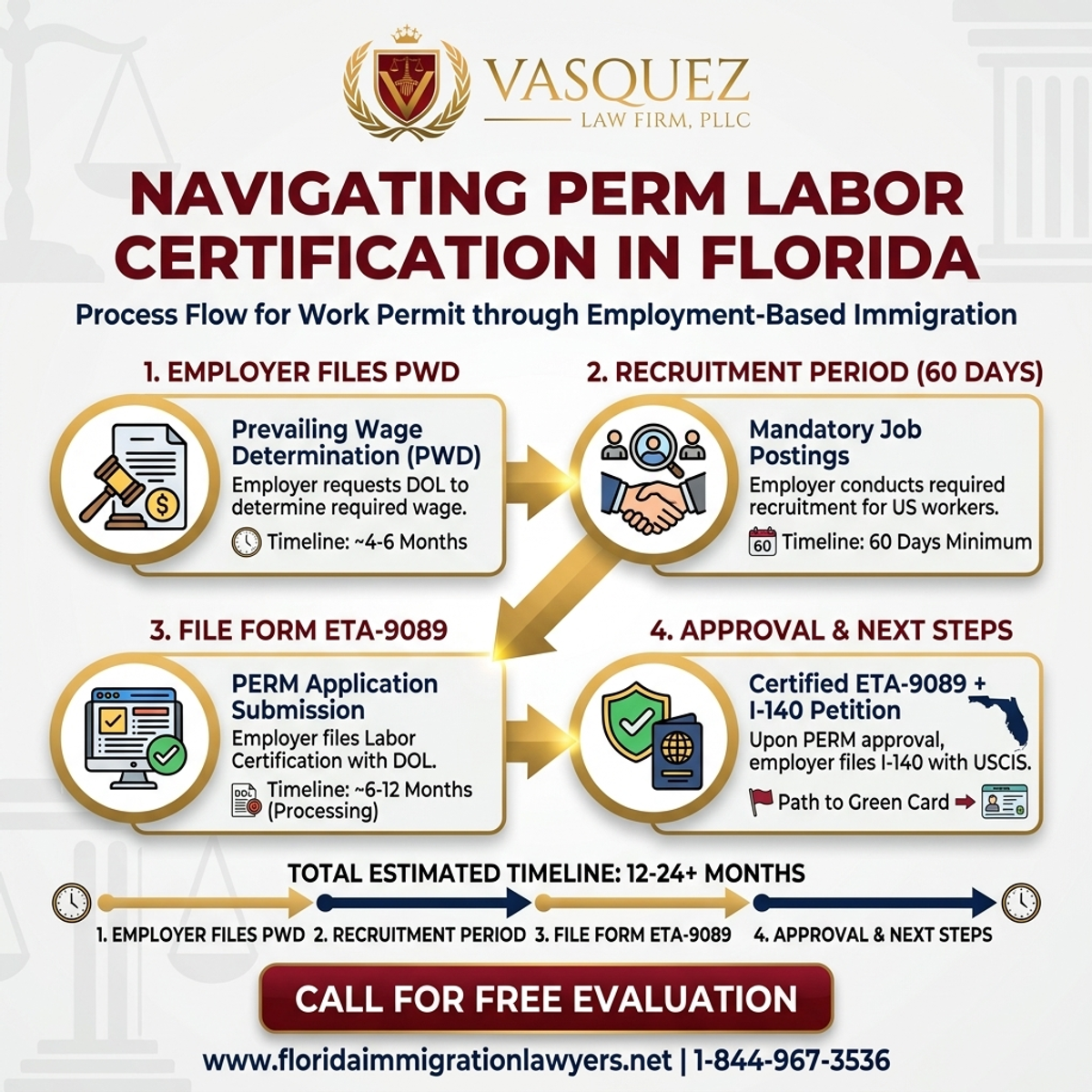
Step-by-Step Process — Work Permit: Navigating PERM Labor Certification in Florida
Document Checklist for PERM Application
A comprehensive and well-organized set of documents is critical for a successful PERM application. The DOL expects employers to maintain detailed records of every step in the process, especially regarding recruitment efforts and prevailing wage determinations. Failure to produce requested documentation during an audit can lead to immediate denial.
- Prevailing Wage Determination: This document, issued by the NPWC, confirms that the proposed wage meets the required standards for the occupation in the specific geographic area. It's foundational to proving the job offers fair compensation.
- Job Advertisements and Recruitment Documentation: This includes copies of all advertisements (newspaper tearsheets, website screenshots), proof of posting (e.g., internal notice), and a detailed recruitment report summarizing all applicants, interview notes, and legitimate, job-related reasons for rejecting U.S. workers.
- ETA Form 9089: The completed and signed electronic application form, which serves as the official submission to the Department of Labor. Accuracy is paramount here.
- Employer's Financial Statements: While not submitted with the initial PERM application, these are crucial for the subsequent I-140 petition to demonstrate the employer's ability to pay the offered wage from the priority date forward. Keep them readily accessible.
Maintaining a meticulously organized file throughout the entire PERM process is a practical tip that cannot be overstated. From the moment you initiate the prevailing wage request to the final submission of Form 9089, keep all correspondence, advertisements, and applicant responses in a structured manner. This will prove invaluable if your application is selected for an audit, allowing you to quickly provide the necessary evidence and avoid delays or potential denials. Florida Immigration Lawyers can assist in establishing such robust record-keeping systems.
Timeline and Processing Expectations
Understanding the timeline and processing expectations can help manage your application efficiently. It's important to remember that PERM processing times are estimates and can fluctuate significantly based on the Department of Labor's workload, the complexity of the case, and whether the application is selected for an audit.
| Stage | Typical Timeframe | Notes |
|---|---|---|
| Prevailing Wage Determination | 2-3 months | Depends on DOL workload |
| Recruitment | 2-3 months | Includes advertising and waiting periods |
| PERM Approval | 6-8 months | May vary based on case specifics |
While the table provides general timeframes, it's crucial for employers in Florida to plan for potential variations. For instance, some prevailing wage requests might be processed faster, while others could take longer during peak filing seasons. Similarly, recruitment must adhere to strict waiting periods (e.g., 30 days for SWA job orders), which are non-negotiable. The overall PERM approval time can extend significantly if the application is selected for an audit, which can add several months or even over a year to the process.
Proactive monitoring and communication with your legal team, such as Florida Immigration Lawyers, are essential during these waiting periods. While you cannot expedite the government's processing, being prepared for the next steps and promptly responding to any requests for information can help minimize self-imposed delays. Patience is key, but so is diligent follow-up to ensure your application remains on track.
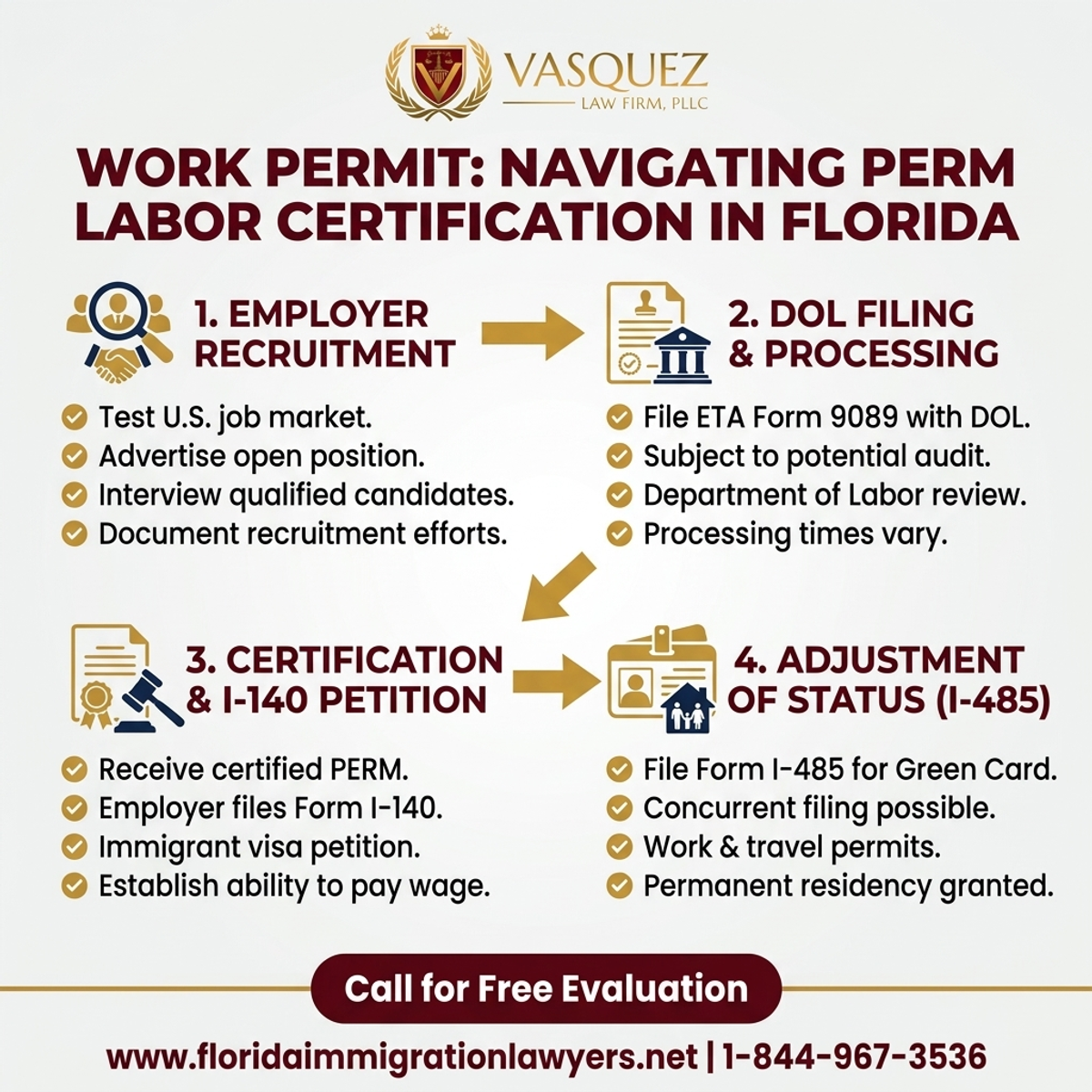
Key Statistics — Work Permit: Navigating PERM Labor Certification in Florida
Cost Factors and Fee Breakdown
Costs associated with PERM can vary. Here's a general breakdown:
It's important to note that the Department of Labor does not charge a filing fee for the PERM application itself. However, employers should anticipate various associated expenses throughout the process. These costs are a necessary investment in securing a crucial talent for their workforce and navigating the complex immigration landscape.
| Item | Typical Fee | Notes |
|---|---|---|
| Prevailing Wage Request | Variable | Varies by industry |
| Recruitment Costs | Variable | Depends on advertising venues |
| Attorney Fees | Variable | Depends on complexity |
While there's no direct government fee for the prevailing wage request, employers might incur indirect costs related to gathering job description details or internal administrative efforts. Recruitment costs, however, can be substantial. These typically include expenses for mandatory newspaper advertisements, online job board postings, and other recruitment methods. For example, placing two Sunday ads in a major metropolitan newspaper can range from hundreds to thousands of dollars, depending on the publication and ad size. Choosing cost-effective but compliant advertising venues is a strategic decision for employers.
Attorney fees are perhaps the most significant variable cost but represent an invaluable investment. Navigating the intricate PERM regulations, ensuring compliance with recruitment requirements, drafting detailed responses to audits, and preparing the ETA Form 9089 accurately demands specialized legal expertise. The complexity of the case, the employer's industry, and the attorney's experience level all influence these fees. Engaging experienced immigration counsel like Florida Immigration Lawyers can prevent costly mistakes and delays, ultimately saving resources in the long run.
Common Mistakes to Avoid
The PERM labor certification process is highly scrutinized by the Department of Labor, and even minor errors can lead to significant delays, audits, or outright denials. Employers must approach each step with meticulous attention to detail to ensure compliance and a smooth application process. Avoiding these common pitfalls is crucial for success.
- Incorrect Prevailing Wage: Failing to obtain an accurate wage can lead to denial. This often happens when the job duties or minimum requirements are misclassified, resulting in a wage that is too low or too high for the actual position.
- Insufficient Recruitment: Not following proper recruitment procedures may invalidate the application. This includes failing to run all required ads, not waiting the mandated periods, or not maintaining thorough documentation of all recruitment efforts and applicant responses.
- Errors on Form 9089: Mistakes on the form can cause delays or rejections. Simple typographical errors, inconsistent dates, or incorrect attestations can trigger an audit or denial. Every field must be reviewed for absolute accuracy.
- Inadequate Documentation: Lack of supporting documents can lead to a denial. For instance, not having tear sheets for newspaper ads, screenshots of online postings, or detailed recruitment reports makes it impossible to prove compliance during an audit.
- Missed Deadlines: Not adhering to timelines can jeopardize the process. There are strict deadlines for filing after recruitment, and missing these can require restarting the entire recruitment phase, causing significant delays.
- Non-compliance with Advertising Requirements: Improper job postings can result in denial. Advertisements must accurately reflect the job duties and minimum requirements specified on the ETA Form 9089, without being unduly restrictive or tailored to the foreign national.
- Ignoring Legal Advice: Not consulting an attorney can lead to critical errors. The complexities of PERM regulations are vast, and attempting to navigate them without expert guidance significantly increases the risk of mistakes.
- Lack of Follow-up: Failing to track the application status can cause missed opportunities. While the DOL provides updates, proactive monitoring ensures prompt responses to audits or requests for information, preventing unnecessary delays.
A practical tip for employers is to create a detailed timeline and checklist at the outset of the PERM process. Assign clear responsibilities for each task, from requesting the prevailing wage to placing advertisements and documenting applicant responses. Regular check-ins and cross-referencing against DOL guidelines can help catch potential issues before they become critical problems. When in doubt, always consult with experienced immigration attorneys like those at Florida Immigration Lawyers at 1-844-YO-PELEO.
When to Call a Lawyer
If you're considering a PERM application in Pembroke Pines, Florida, legal guidance is essential. Consult an attorney if:
- You face complex case issues.
- You need assistance with recruitment compliance.
- You encounter delays or denials.
- You're unsure about the application process.
Florida Immigration Lawyers can provide expert assistance to navigate these challenges.
Engaging an experienced immigration attorney is not just a recommendation; it's often a necessity for a successful PERM application. The regulatory landscape is constantly evolving, and a skilled lawyer can provide up-to-date advice, anticipate potential pitfalls, and strategize the most effective approach for your specific situation. This is particularly true when dealing with unique job requirements, foreign language skills, or advanced degrees that might trigger additional scrutiny from the DOL.
Beyond initial application preparation, an attorney becomes indispensable if your PERM application is selected for an audit. Audits require detailed and often voluminous responses, backed by meticulously organized documentation and compelling legal arguments. Without expert legal representation, employers often find themselves overwhelmed and unprepared, leading to potential denials. Florida Immigration Lawyers are adept at handling audits and ensuring robust responses that maximize the chances of approval.
Furthermore, an attorney can help streamline the entire process, saving valuable time and resources. They can ensure all recruitment efforts are compliant, all forms are accurately completed, and all deadlines are met. This proactive approach minimizes the risk of costly errors and allows employers and foreign nationals to focus on their core responsibilities, knowing their immigration process is in capable hands. Don't hesitate to call Florida Immigration Lawyers at 1-844-YO-PELEO for a free consultation.
About Florida Immigration Lawyers
Florida Immigration Lawyers is dedicated to assisting clients with all their immigration needs across Florida. Our team of experienced attorneys offers personalized services in employment-based immigration, asylum, deportation defense, and more. Contact us at 1-844-YO-PELEO or visit our website for a free consultation. We are available 24/7 to serve you.
Our firm understands that immigration matters are deeply personal and often life-changing. That's why we commit to providing compassionate, comprehensive, and effective legal representation. Whether you are an employer seeking to sponsor a talented foreign worker or an individual pursuing an employment-based green card, our attorneys leverage their extensive knowledge and experience to guide you through every step of the process with clarity and confidence. We pride ourselves on transparent communication and unwavering advocacy for our clients' best interests.
Sources and References
- U.S. Citizenship and Immigration Services (USCIS)
- Executive Office for Immigration Review (EOIR)
- 8 U.S.C. Chapter 12 - Immigration and Nationality Act
Related services: H-1B specialty occupation visas, L-1 intracompany transfer visas, work visas for professionals.
This article provides general legal information and is not intended as legal advice. Every case is unique, and outcomes depend on specific facts and circumstances. Contact an attorney for advice about your particular situation.
Don't navigate the PERM process alone. Contact Florida Immigration Lawyers for expert guidance. Call 1-844-YO-PELEO for a free consultation. Se Habla Español - Estamos aquí para ayudarle.
If you need legal assistance, learn more about how our business immigration attorneys can help, or call us at 1-844-YO-PELEO for a free consultation.
Do Not Navigate This Process Alone
Our experienced immigration attorneys are ready to fight for you. Get a free, confidential case review today.
Se Habla Español
Or leave your details and we’ll call you:
Free Evaluation in 24 Hours
Or talk to us right now

AI voice assistant — available 24/7
FreeFrequently Asked Questions

William J. Vásquez
Founding Attorney · Vasquez Law Firm
U.S. Air Force veteran and immigration attorney with years of hands-on U.S. immigration experience. J.D., NCCU School of Law. AILA member. Admitted to the 4th, 5th, and 11th Circuit Courts.
Available 24/7 - Free Evaluations
Reviewed for legal accuracy by William J. Vásquez
Licensed in North Carolina; U.S. immigration is federal practice.
Related Legal Services
Our Florida immigration attorneys can help you with deportation defense, family immigration services and immigration lawyer cost in Florida. Call today at 1-844-YO-PELEO for a free case review.
Related Links
Related Topics
Free Legal Case Review
Discuss your case with our experienced attorneys. We're available 24/7.
Se Habla Español - Estamos aquí para ayudarle.
Related Articles
EAD Advance Parole Combo Card in Florida 2026
For individuals with a pending Form I-485, Application to Register Permanent Residence or Adjust Status, the EAD Advance Parole Combo Card is an essential document. This single card combines the authorization to work legally in the U.S. (Employment Authorization Document - EAD) with permission to travel internationally and re-enter without abandoning your green card application (Advance Parole). This guide from Florida Immigration Lawyers provides a comprehensive overview for applicants in Florida in 2026, covering eligibility, the step-by-step application process, required documents, expected processing times, and associated costs. We also highlight common mistakes to avoid and when to seek legal counsel to ensure a smooth and successful immigration journey. Understanding this vital card is key to maintaining stability while awaiting your permanent residency approval.
Immigration Lawyer Orlando Free Consultation in Florida
For individuals and families in Orlando, Florida, navigating the complexities of U.S. immigration law requires expert guidance. An immigration lawyer in Orlando offers crucial support for everything from visa applications and green card processes to naturalization and deportation defense. This comprehensive guide details what a free consultation covers, providing a step-by-step overview of immigration pathways, essential document checklists, and expected timelines in 2026. We also highlight common mistakes to avoid, discuss the critical role of legal counsel in deportation and asylum cases, and explain why choosing a local Orlando immigration attorney is beneficial. Florida Immigration Lawyers is dedicated to serving the diverse community of Orlando with compassionate, effective legal solutions, ensuring you receive personalized advice and robust representation for a successful immigration journey.
Fraud Prevention and Detection Fee in Florida
Understand the fraud prevention and detection fee in Florida, crucial for maintaining immigration integrity. Learn about the fee's purpose, who needs to pay it, and how to navigate the payment process effectively. Stay informed about the latest changes and avoid common mistakes by seeking expert legal advice.
Diversity Visa: Understanding the Green Card Lottery
Explore the diversity visa program, also known as the green card lottery, and learn how it impacts residents of Florida. Discover what steps are involved, common mistakes to avoid, and when to seek legal assistance.