T Visa for Human Trafficking Victims in Florida 2026
The T visa provides crucial immigration protection for victims of human trafficking in Florida, offering a pathway to safety, work authorization, and eventual permanent residency. This comprehensive guide for 2026 details eligibility requirements, including being a victim of severe trafficking and cooperating with law enforcement. It outlines the step-by-step application process, from obtaining law enforcement certification to filing Form I-914 with USCIS. We also cover the essential documents needed, typical processing timelines, and associated costs. Crucially, the T visa shields victims from deportation, allows them to legally work, and enables family reunification. Understanding these protections and navigating the legal system can be daunting, but with expert legal assistance, victims can reclaim their lives. Florida Immigration Lawyers offers compassionate guidance and robust advocacy for human trafficking survivors throughout Florida, ensuring they receive the support needed to achieve security and build a new future.
William J. VásquezPublished on September 9, 2026
1 views
The T visa provides immigration protection for victims of human trafficking who are willing to assist law enforcement in the investigation or prosecution of trafficking crimes. In Florida, this visa offers a critical pathway to safety, stability, and potential permanent residency for individuals who have endured severe forms of trafficking, including sex trafficking and labor trafficking. Eligibility requires demonstrating that you are a victim of severe trafficking, are physically present in the U.S. due to trafficking, and have complied with reasonable requests for assistance from law enforcement. The T visa also grants work authorization and allows certain family members to obtain derivative visas, offering a comprehensive shield against exploitation and deportation for those in need.
T visa protects human trafficking victims in the U.S.
Requires cooperation with law enforcement against traffickers.
Grants work authorization and a path to a Green Card.
Available for both sex trafficking and labor trafficking victims.
Provides a pathway to safety and stability in Florida.
Human trafficking is a grave violation of human rights, exploiting vulnerable individuals for forced labor or commercial sex. In Florida, a state with significant international travel and diverse industries, victims often find themselves trapped in unimaginable circumstances, fearing for their lives and safety. If you or someone you know has been a victim of this heinous crime, it is crucial to know that legal protections exist. The T visa offers a beacon of hope, providing a pathway to safety, recovery, and a new life in the United States. This specialized visa is designed to protect victims, allowing them to escape their captors and assist law enforcement without fear of deportation.
Navigating the complexities of immigration law, especially under the trauma of human trafficking, can be overwhelming. This comprehensive guide, updated for 2026, aims to demystify the T visa application process for victims in Florida. We will cover eligibility requirements, the step-by-step application process, necessary documentation, expected timelines, and the significant benefits this visa provides, including a path to permanent residency. Understanding your rights and the available legal avenues is the first step towards reclaiming your freedom and building a secure future. Do not face this challenging journey alone. Call Florida Immigration Lawyers at 1-844-YO-PELEO for a free, confidential case review today.
What is a T Visa and Who is Eligible for Protection in Florida?
The T nonimmigrant status, commonly known as the T visa, is a humanitarian immigration benefit established by the Victims of Trafficking and Violence Protection Act (VTVPA) of 2000. It offers legal immigration status to victims of severe forms of human trafficking who are willing to assist law enforcement authorities in the investigation or prosecution of such crimes. For victims in Florida, this means a chance to escape exploitation and rebuild their lives with protection from deportation and access to vital resources. As of 2026, the core eligibility criteria for a T visa remain consistent with the Immigration and Nationality Act (INA) Section 101(a)(15)(T), specifically 8 U.S.C. § 1101(a)(15)(T).
To be eligible for a T visa, an applicant must demonstrate several key factors. First, they must be a victim of a “severe form of human trafficking.” This term encompasses both sex trafficking, where a commercial sex act is induced by force, fraud, or coercion, or if the person performing the act is under 18 years of age; and labor trafficking, which involves the recruitment, harboring, transportation, provision, or obtaining of a person for labor or services through the use of force, fraud, or coercion for the purpose of subjection to involuntary servitude, peonage, debt bondage, or slavery. Many cases in Florida involve exploitation within agricultural sectors, hospitality, or domestic work. Second, the victim must be physically present in the United States, American Samoa, or the Commonwealth of the Northern Mariana Islands, or at a port of entry, on account of such trafficking. This presence does not need to be lawful; undocumented presence due to trafficking is permissible. Third, the victim must have complied with any reasonable request for assistance in the investigation or prosecution of the trafficking crime. This cooperation is critical, though exceptions can be made for victims under 18 years old or those who have experienced severe trauma making cooperation impossible. Finally, the victim must show that they would suffer extreme hardship involving unusual and severe harm upon removal from the United States. This condition acknowledges the deep trauma and danger many trafficking victims face if forced to return to their home country or the environment from which they were rescued.
How Do I Apply for a T Visa in Florida? A Step-by-Step Guide
Applying for a T visa involves a detailed process designed to verify eligibility and ensure victim protection. For individuals in Florida, understanding each step is crucial for a successful application. The primary application form is Form I-914, Application for T Nonimmigrant Status, which is filed with U.S. Citizenship and Immigration Services (USCIS). This process typically begins with securing official recognition of your victim status from a certifying agency.
Step 1: Obtain a Law Enforcement Certification (Form I-914, Supplement B). This is often the most critical initial step. You must obtain a certification from a federal, state, or local law enforcement agency that is investigating or prosecuting human trafficking. Agencies such as the FBI, Homeland Security Investigations (HSI), the Florida Department of Law Enforcement (FDLE), or local police departments in cities like Orlando or Miami can provide this. This certification confirms that you have been identified as a victim of a severe form of trafficking and have complied with reasonable requests for assistance. While not strictly mandatory to file Form I-914, it significantly strengthens your application. If you cannot obtain a certification, you must provide a detailed explanation and other credible evidence of your cooperation.
Step 2: Prepare and File Form I-914, Application for T Nonimmigrant Status. Once you have a certification or are ready to present other compelling evidence, you will complete Form I-914. This form requires comprehensive personal information, details about the trafficking experience, and evidence supporting all eligibility criteria. It is essential to include a personal statement describing your experience and how you meet each requirement. All supporting documents must be submitted with your application.
Step 3: Attend Biometrics Appointment. After USCIS receives your application, you will typically receive an appointment notice for a biometrics services appointment at an Application Support Center (ASC) in Florida. Common ASC locations include Orlando, Miami, and Jacksonville. At this appointment, your fingerprints, photograph, and signature will be collected for background and security checks.
Step 4: Potential Interview. While not all T visa applicants are interviewed, USCIS may schedule an interview at a local field office, such as the USCIS Orlando Field Office, to gather more information or clarify aspects of your application. An attorney can prepare you for this interview and may accompany you.
Step 5: Receive a Decision. USCIS will review all submitted evidence, biometrics, and interview results (if applicable) to make a decision. If approved, you will be granted T nonimmigrant status for up to four years, along with work authorization. If denied, you may have options to appeal or reapply, depending on the reasons for denial.
Key Documents Required for Your T Visa Application
A successful T visa application hinges on providing comprehensive and compelling evidence. Gathering the correct documents can be challenging, especially for trafficking victims, but it is a crucial step in demonstrating your eligibility and securing protection. It is highly recommended to work with an experienced immigration attorney who can help you identify, collect, and organize all necessary documentation. All documents not in English must be accompanied by a certified English translation.
Form I-914, Application for T Nonimmigrant Status: The primary application form, accurately and completely filled out.
Form I-914, Supplement B, Declaration of Law Enforcement Officer for Victim of Trafficking in Persons: If obtained, this certification from a qualifying law enforcement agency is strong evidence of your victim status and cooperation.
Personal Statement: A detailed narrative written by you, describing your trafficking experience, how you meet the eligibility criteria (e.g., force, fraud, coercion, extreme hardship), and your cooperation with law enforcement.
Evidence of Severe Form of Trafficking: This can include police reports, court documents, affidavits from witnesses, medical records documenting injuries, psychological evaluations, photos, videos, or communications with traffickers.
Proof of Physical Presence: Documents showing you were in the U.S. due to trafficking, such as travel records, witness statements, or evidence of your location during the trafficking period.
Evidence of Extreme Hardship: Documentation illustrating the severe harm you would face if removed from the U.S. This could include evidence of threats from traffickers, lack of safety in your home country, medical conditions requiring U.S. care, or psychological reports.
Identity Documents: Passport, birth certificate, national identity card, or other official identification documents.
Proof of Relationship for Derivative Family Members: If applying for derivative T visas for qualifying family members (spouse, children, parents), you will need marriage certificates, birth certificates, and other evidence of relationship.
Photographs: Passport-style photographs as specified by USCIS.
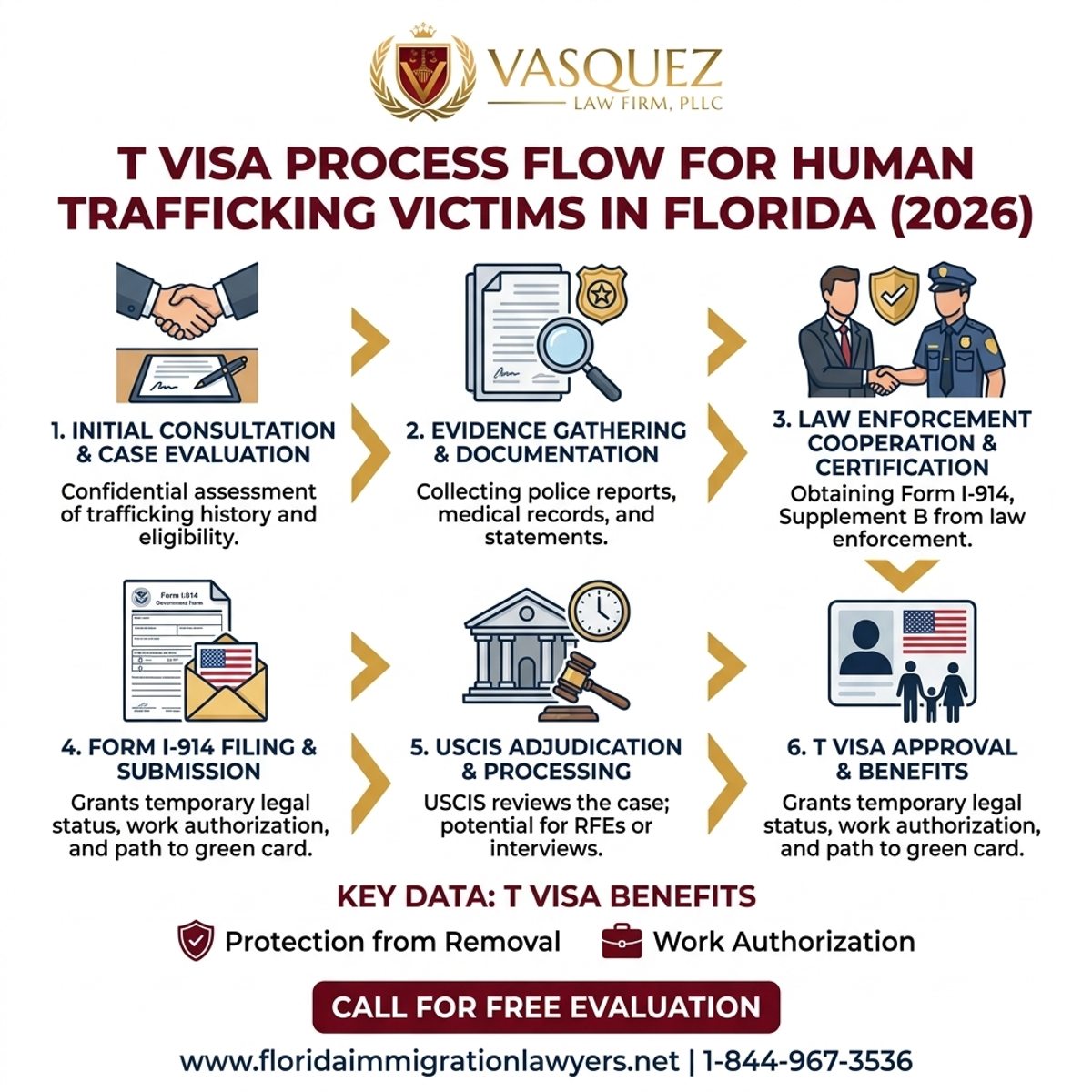
Step-by-Step Process — T Visa for Human Trafficking Victims in Florida 2026
What is the T Visa Processing Timeline and Cost in 2026?
The processing timeline for a T visa can vary significantly depending on individual circumstances, the complexity of the case, and current USCIS caseloads. As of 2026, applicants should anticipate a lengthy process, often extending over several months or even years from initial filing to final decision. While there is no direct filing fee for Form I-914 itself, other associated costs, primarily legal fees, can accumulate. It is essential to have realistic expectations regarding both time and financial commitments.
T Visa Processing Timeline (As of 2026)
Understanding the typical stages and their durations can help you prepare for the journey ahead. USCIS provides estimated processing times on its website, which can fluctuate. The following table offers general expectations:
Stage
Typical Timeframe
Notes
Law Enforcement Certification (Supplement B)
3-12 months
Depends on agency's investigation pace and responsiveness.
Form I-914 Initial Review & Receipt
1-3 months
USCIS acknowledges receipt and sends I-797C Notice of Action.
Biometrics Appointment
2-5 months after receipt
Scheduled at a local Application Support Center (ASC) in Florida.
Request for Evidence (RFE) / Interview (if needed)
Variable (1-6+ months)
If more information is needed, adds significant time.
Adjudication (Final Decision)
12-24+ months from receipt
Overall processing time, subject to backlogs at the Vermont Service Center.
Work Authorization (EAD)
Issued concurrently with T visa approval or separately after a prima facie determination.
Allows legal employment while T visa application is pending or approved.
T Visa Application Cost Factors
While the I-914 application itself does not have a USCIS filing fee, applicants should be aware of other potential expenses. These costs can vary widely, particularly attorney fees, which depend on the complexity of the case and the services required.
Item
Typical Fee (As of 2026)
Notes
USCIS Filing Fee (Form I-914)
$0
No fee is required for the T visa application itself.
Biometrics Fee
$0 (included with I-914)
No separate fee for biometrics for T visa applicants.
Attorney Fees
Variable ($3,000 - $10,000+)
Highly dependent on case complexity, attorney experience, and services. Many firms offer payment plans or pro bono for trafficking victims.
Translation Fees
Variable ($25 - $100+ per document)
For any documents not in English.
Medical Examination Fees
Variable ($200 - $500+)
Required for adjustment of status to a Green Card, not typically for initial T visa.
Postal/Shipping Fees
Minor
Costs for mailing documents to USCIS.
Do not navigate this complex and sensitive process alone. The stakes are incredibly high for human trafficking victims seeking protection and a new beginning. Contact Florida Immigration Lawyers today at 1-844-YO-PELEO for compassionate and expert legal guidance. Our team is ready to assist you through every step of your T visa application.
Benefits and Path to Permanent Residency with a T Visa
The T visa offers victims of human trafficking more than just temporary legal status; it provides a comprehensive suite of protections and a crucial pathway to long-term stability in the United States. Upon approval, a T visa holder is granted several significant benefits that are designed to facilitate their recovery and integration into society. These include protection from deportation, which is paramount for individuals who may face severe danger if returned to their country of origin or to their traffickers. They also receive employment authorization, allowing them to legally work in the U.S. and achieve financial independence, a critical step away from exploitation. This work authorization is typically granted for the duration of their T visa status and is renewable.
Beyond immediate protection and work authorization, the T visa also enables qualifying family members to obtain derivative T visas, allowing them to join the principal applicant in the U.S. This includes spouses, children, and in some cases, parents or unmarried siblings under 18. This provision acknowledges the importance of family reunification in the healing process for trafficking victims. Crucially, after maintaining T nonimmigrant status for three years, or upon the completion of the investigation or prosecution of the trafficking crime (whichever occurs earlier), T visa holders may be eligible to apply for adjustment of status to become lawful permanent residents (Green Card holders). This path to permanent residency, outlined in 8 CFR Part 245, is a life-changing opportunity, offering true long-term security and the full rights of a resident. The T visa truly represents a comprehensive framework for protection, recovery, and a secure future for those who have endured the horrors of human trafficking.
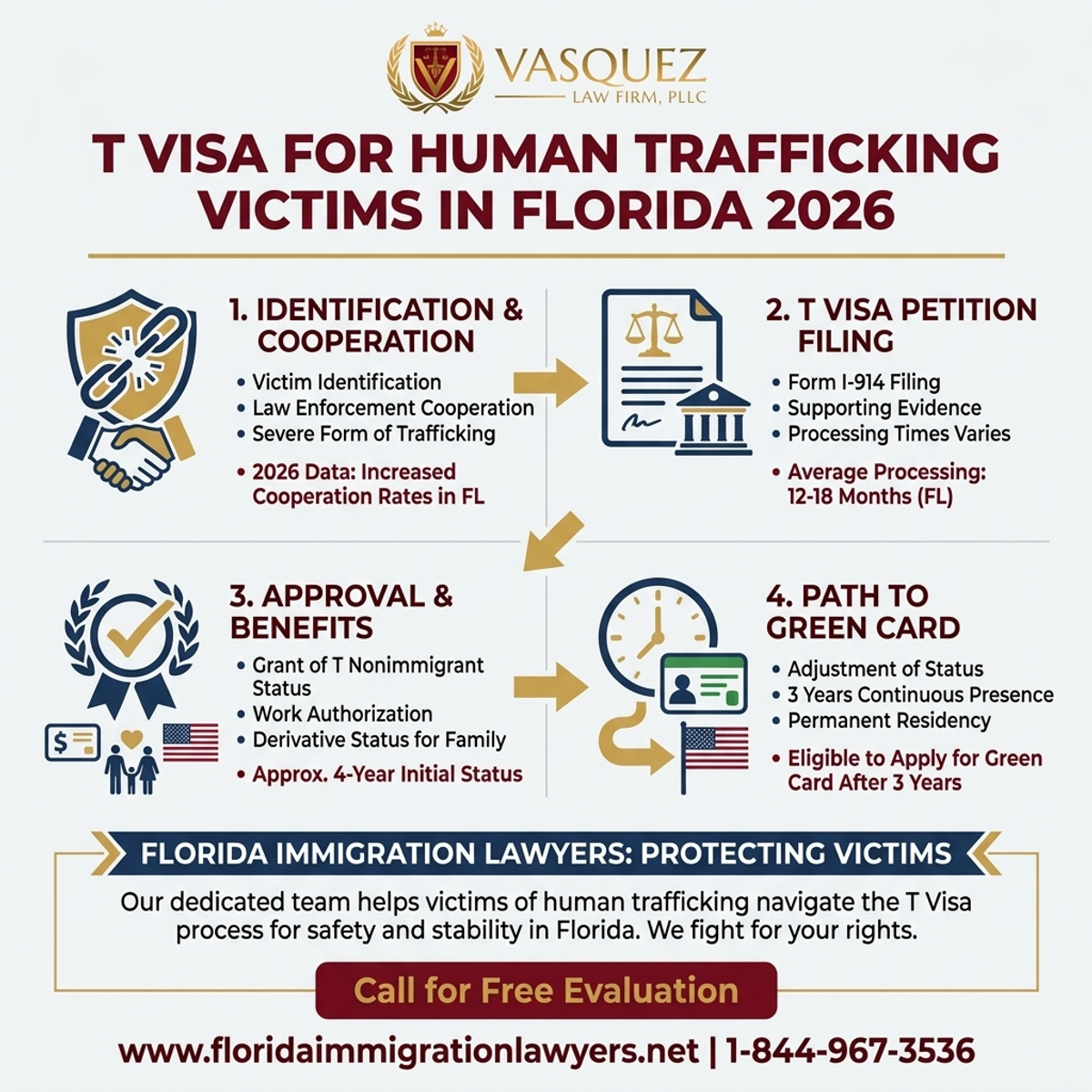
Key Statistics — T Visa for Human Trafficking Victims in Florida 2026
Protecting T Visa Holders: Rights and Resources in Florida
Florida, unfortunately, is a significant hub for human trafficking, making the protections and resources for T visa holders particularly vital in the state. Victims of trafficking, regardless of their immigration status, have certain fundamental rights under U.S. law, and the T visa reinforces these by providing legal status and a framework for support. T visa holders are protected from being forced into involuntary servitude, peonage, debt bondage, or slavery, and they have the right to report crimes without fear of retaliation related to their immigration status. Confidentiality is also a key aspect of T visa protections; information provided by victims to law enforcement or USCIS is generally protected from disclosure to traffickers or other unauthorized parties, ensuring their safety and encouraging cooperation.
In Florida, several state and local resources exist to support trafficking victims, complementing the federal protections offered by the T visa. The Florida Department of Children and Families (DCF) coordinates efforts to combat human trafficking and provides services to victims, including safe housing, counseling, and medical assistance. Numerous non-governmental organizations (NGOs) and shelters across Central Florida, including the Orlando area, specialize in assisting trafficking survivors, offering culturally sensitive support, legal aid referrals, and assistance with integration. These organizations play a crucial role in helping T visa holders navigate their new lives, access education, healthcare, and employment opportunities. Furthermore, the U.S. Department of Health and Human Services (HHS) offers a certification process for T visa recipients, which grants access to public benefits and services similar to those available to refugees. These combined resources and rights are essential for T visa holders in Florida to heal from their trauma and build independent, secure lives.
Common Mistakes to Avoid in Your T Visa Application
Applying for a T visa is a complex process, and even minor errors can lead to significant delays or even denial. Victims of human trafficking are already in a vulnerable position, making it even more critical to avoid common pitfalls. Here are some key mistakes to watch out for:
Failing to Cooperate with Law Enforcement: The T visa requires a willingness to assist in the investigation or prosecution of trafficking. Lack of cooperation, or inability to prove it, can be a major hurdle, unless specific exceptions apply (e.g., age or severe trauma).
Submitting an Incomplete Application: Missing forms, unsigned documents, or insufficient evidence are common reasons for Requests for Evidence (RFEs) or denials. Ensure every section of Form I-914 and all supporting supplements are thoroughly completed.
Not Providing a Detailed Personal Statement: A compelling and consistent personal statement is vital. Failing to clearly articulate the elements of trafficking (force, fraud, coercion) and extreme hardship can weaken your case significantly.
Missing Key Deadlines: While T visa applications don't have strict deadlines for initial filing, responding to RFEs or appeal notices within the specified timeframe is critical. Missing these deadlines can lead to abandonment or final denial.
Misrepresenting Facts or Providing Inconsistent Information: Any inconsistencies in your story or false statements can severely damage your credibility and lead to a denial, potentially with severe immigration consequences. Always be truthful and provide consistent information.
Lack of Evidence for Each Eligibility Criterion: Each T visa requirement (victim of severe trafficking, physical presence due to trafficking, cooperation, extreme hardship) must be supported by credible evidence. Relying on only one piece of evidence or neglecting a criterion is a common mistake.
Traveling Outside the U.S. Without Permission: Leaving the United States while your T visa application is pending or after approval without obtaining advance parole can lead to the abandonment of your application or even render your T visa invalid.
Not Seeking Legal Counsel: Navigating the T visa process alone, especially as a trafficking victim, is incredibly difficult. An experienced immigration attorney can provide crucial guidance, prepare documents, and represent your interests.
Ignoring the “Extreme Hardship” Requirement: While proving trafficking is central, demonstrating that you would suffer “extreme hardship involving unusual and severe harm” if removed from the U.S. is equally important and often overlooked or insufficiently documented.
Not Addressing All Grounds of Inadmissibility: Many trafficking victims have entered the U.S. without inspection or have other immigration violations. These need to be identified and potentially waived through the T visa process; failure to do so can lead to denial.
When to Call a Lawyer for Your T Visa Application
The decision to seek legal counsel is paramount when considering a T visa application, particularly for victims of human trafficking who are often in vulnerable and traumatic circumstances. An experienced immigration attorney from Florida Immigration Lawyers can provide invaluable support and expertise throughout this complex process. You should call a lawyer if you are unsure whether you meet the eligibility criteria for a T visa. An attorney can assess your unique situation, help identify if your experience constitutes a “severe form of human trafficking,” and determine if you can demonstrate the necessary cooperation with law enforcement and extreme hardship.
Immediate legal assistance is also critical if you have received a Request for Evidence (RFE) from USCIS, indicating that your initial application lacked sufficient documentation or clarity. An attorney can help formulate a comprehensive and timely response, preventing potential denial. Furthermore, if you are currently in deportation proceedings or have a criminal history, consulting a lawyer is essential. These factors can complicate your T visa application significantly, and an attorney can advise on potential waivers or strategies to mitigate these issues. If you wish to include family members in your application (derivative T visas), an attorney can ensure all relationships are properly documented and all family members meet their respective eligibility criteria. Finally, if you have faced threats or intimidation from traffickers, or if you fear for your safety, a lawyer can help you understand your rights and connect you with appropriate protective services in Central Florida and beyond. Florida Immigration Lawyers specializes in these sensitive cases and offers compassionate, client-focused representation.
Florida Immigration Lawyers is a leading immigration law firm dedicated to serving individuals and families across the entire state of Florida. With a deep understanding of the unique challenges faced by immigrants, especially victims of human trafficking, our experienced attorneys are committed to providing compassionate, effective, and results-driven legal representation. We specialize in a wide range of immigration matters, including T visas, asylum, deportation defense, family-based petitions, and citizenship. Our firm is built on a foundation of empathy and relentless advocacy, ensuring that every client receives personalized attention and a robust defense of their rights. We understand the urgency and sensitivity of your situation, offering free case reviews and being available 24/7 to address your concerns. With offices conveniently located in Orlando, we are strategically positioned to assist clients throughout Central Florida and beyond, always striving to achieve the best possible outcomes. Se Habla Español. Contact us today to schedule a free consultation and let us fight for your future.
This article provides general legal information and is not intended as legal advice. Every case is unique, and outcomes depend on specific facts and circumstances. Contact an attorney for advice about your particular situation. Immigration laws are subject to change.
If you or a loved one has been a victim of human trafficking and are seeking the protection and opportunities a T visa offers, do not hesitate to reach out for help. Florida Immigration Lawyers is here to guide you with expertise and compassion. Call us now for a free case review at 1-844-YO-PELEO. Se Habla Español - Estamos aquí para ayudarle.
If you need legal assistance, learn more about immigration lawyers in Florida, or call us at 1-844-967-3536 for a free case review.
Do Not Navigate This Process Alone
Our experienced immigration attorneys are ready to fight for you. Get a free, confidential case review today.
A severe form of human trafficking includes sex trafficking, defined as inducing a commercial sex act by force, fraud, or coercion, or if the victim is under 18. It also includes labor trafficking, which involves using force, fraud, or coercion to obtain a person for involuntary servitude, peonage, debt bondage, or slavery. Both forms are recognized under U.S. law for T visa eligibility.
No, you do not need to be a U.S. citizen or legal resident to apply for a T visa. The T visa is specifically designed for individuals who are physically present in the United States on account of being a victim of severe human trafficking, regardless of their prior immigration status. This protection extends to undocumented individuals.
While cooperation with law enforcement is a key requirement, USCIS understands the extreme trauma and fear victims face. Exceptions to the cooperation requirement exist for victims under 18 years old or those who can demonstrate that they are unable to cooperate due to physical or psychological trauma. An attorney can help document these circumstances and advocate on your behalf.
A T visa is typically granted for an initial period of up to four years. It can be renewed if the victim demonstrates continued need for protection or is cooperating with ongoing investigations or prosecutions. The ultimate goal for many T visa holders is to adjust their status to a lawful permanent resident (Green Card) after meeting specific criteria, usually after three years.
Yes, certain immediate family members of a T visa principal applicant may be eligible for derivative T visas. This includes spouses and children of the principal applicant. In some cases, parents or unmarried siblings under 18 may also qualify if the principal applicant is under 21. This provision helps keep families together and supports the victim's recovery.
Strong evidence for 'extreme hardship' includes documentation of threats from traffickers, lack of safety or support in your home country, severe medical or psychological conditions requiring U.S. care, evidence of political instability or violence in your home country, or proof that you would be ostracized or harmed upon return. Personal statements, medical records, and expert testimonies are valuable.
There is no USCIS filing fee for Form I-914, Application for T Nonimmigrant Status, nor for the biometrics appointment associated with it. However, applicants may incur other costs, such as attorney fees for legal representation, translation fees for non-English documents, or fees for obtaining supporting evidence. Fee waivers might be available for certain related forms later.
Florida has various organizations and state agencies dedicated to assisting human trafficking victims. The Florida Department of Children and Families (DCF) coordinates services. Numerous non-governmental organizations (NGOs) and shelters across the state, including in Central Florida cities like Orlando, offer safe housing, counseling, medical aid, and legal referrals. Your attorney can help connect you with local resources.
If your T visa application is denied, you may have options depending on the reason for denial. These could include filing a motion to reopen or reconsider with USCIS, or in some cases, filing an appeal. It is crucial to consult with an experienced immigration attorney immediately to understand the denial's basis and explore the best course of action for your specific situation.
William J. Vásquez
Founding Attorney · Vasquez Law Firm
U.S. Air Force veteran and immigration attorney with years of hands-on U.S. immigration experience. J.D., NCCU School of Law. AILA member. Admitted to the 4th, 5th, and 11th Circuit Courts.
Available 24/7 - Free Evaluations
Reviewed for legal accuracy by William J. Vásquez
Licensed in North Carolina; U.S. immigration is federal practice.