Choosing an Immigration Firm for L-1 Transfers in Florida
Navigating the L-1 visa process for intracompany transfers in Florida can be complex. Learn how Florida Immigration Lawyers can assist with your application, ensuring compliance and a smooth transition for your business.
For companies seeking to transfer executives or managers to an Orlando, Florida location, the L-1 visa is a critical tool. Florida Immigration Lawyers focus on handling L-1 intracompany transfers, offering experience in navigating the complex immigration landscape. Contact us to streamline your L-1 visa process and ensure compliance with the latest regulations.
- Assistance with L-1 visa applications
- Focused on Orlando and Central Florida businesses
- Comprehensive support for intracompany transfers
Introduction
Immigration can be a complex and daunting process, especially for businesses looking to transfer employees across borders. The L-1 visa is a crucial option for intracompany transfers, allowing multinational companies to bring their talented executives and managers to the U.S. If you're navigating this process in Florida, particularly in Orlando, understanding the nuances is vital. This guide will explore what you need to know about L-1 visa transfers in Florida, including the steps involved, common mistakes to avoid, and when to seek legal assistance. Call Florida Immigration Lawyers at 1-844-YO-PELEO for a free case review.
Orlando, with its burgeoning tech scene, robust tourism industry, and strategic location as a gateway to Latin America, presents unique opportunities for multinational corporations. The ability to seamlessly transfer key personnel is not just a logistical advantage but a a strategic imperative. The L-1 visa serves as the cornerstone for such transfers, enabling companies to leverage their global talent pool to drive growth and innovation in the U.S. market.
Navigating the intricacies of U.S. immigration law, particularly for business visas like the L-1, requires specialized knowledge and meticulous attention to detail. Companies seeking to establish or expand their presence in Florida rely on legal guidance to ensure compliance and efficiency. Florida Immigration Lawyers stands ready to assist, offering tailored solutions that address the specific needs of businesses operating within this dynamic economic landscape. Our team understands the nuances of both federal immigration policy and local business realities.
What is the L-1 Visa?
The L-1 visa is a non-immigrant visa that allows multinational companies to transfer executives or managers from a foreign office to a U.S. office. As of 2026, it remains a popular choice for businesses expanding their operations into the U.S. This visa is specifically designed for employees in managerial or executive roles, and it requires that the employee has worked for the company abroad for at least one continuous year within the three years preceding the application.
Obtaining an L-1 visa involves proving the relationship between the foreign and U.S. offices, and that the employee's role is managerial or executive. It's essential to submit the correct documentation and follow precise legal procedures to ensure a successful application.
The L-1 visa category is further divided into two primary classifications: L-1A for executives and managers, and L-1B for individuals with specialized knowledge. The L-1A visa is typically granted to those who will primarily direct the management of the organization or a major component or function, establishing goals and policies, and exercising wide latitude in discretionary decision-making. This classification is particularly beneficial for companies looking to establish a strong leadership presence in their U.S. operations.
For companies establishing a new U.S. office, the L-1A "new office" petition is a vital pathway. This initial petition is usually granted for one year, during which time the company must demonstrate its ability to support an executive or managerial position through a comprehensive business plan, financial projections, and evidence of sufficient physical premises. This initial year is crucial for laying the groundwork for sustained U.S. operations, and proper planning is paramount to secure extensions.
A common pitfall in L-1 applications is failing to adequately define the employee's managerial or executive role in the U.S. It's not enough to simply label someone as a "manager"; USCIS scrutinizes the actual duties, the number of employees supervised (if any), and the level of decision-making authority. Providing detailed organizational charts, job descriptions, and a clear explanation of how the role contributes to the U.S. entity's success is critical for a strong petition.
How to Apply for an L-1 Visa in Florida
Applying for an L-1 visa involves several steps, starting with filing the appropriate forms with USCIS. As of 2026, the process includes:
- Determine Eligibility: Verify that both the foreign company and U.S. office meet the criteria, and that the employee has held a qualifying position.
- File Form I-129: The U.S. employer must complete and submit Form I-129, Petition for a Nonimmigrant Worker, to USCIS.
- Gather Documentation: Collect evidence of the qualifying relationship between the offices, the employee's role, and the business plan for the U.S. operation.
- Attend Visa Interview: If the petition is approved, the employee may need to attend an interview at a U.S. consulate or embassy for visa issuance.
Each step requires careful attention to detail to avoid delays or denial. Immigration attorneys can provide invaluable assistance in preparing the application and ensuring all requirements are met.
The journey begins with the U.S. employer, often referred to as the petitioner, meticulously preparing and filing Form I-129. This form serves as the foundation of the L-1 petition and must be accompanied by extensive supporting documentation that unequivocally proves the qualifying relationship between the foreign and U.S. entities, the employee's eligibility, and the legitimacy of the U.S. operation. For businesses in Orlando, ensuring all local and federal requirements are met is a critical first step.
Companies often consider premium processing for Form I-129, which guarantees USCIS will take action on the petition within 15 calendar days for an additional fee. While this can significantly shorten initial waiting times, it also means any Requests for Evidence (RFEs) will arrive sooner, requiring a swift and comprehensive response. For new offices, a detailed business plan outlining market analysis, financial projections, and staffing plans is indispensable, demonstrating the U.S. entity's viability and its capacity to support the transferred executive or manager.
Consider a tech startup in Brazil looking to open its first U.S. office in Orlando. Their CEO, with over a decade of experience, is the ideal candidate for the L-1A. Florida Immigration Lawyers would guide them through developing a robust business plan, detailing how the CEO will establish the U.S. subsidiary, hire local staff, and penetrate the U.S. market. This proactive approach minimizes the risk of RFEs and ensures a smoother path to approval, highlighting the strategic advantage of expert legal partnership.
Document Checklist for L-1 Visa Application
A meticulously prepared document checklist is the backbone of a successful L-1 visa application. USCIS requires comprehensive evidence to validate every claim made in the petition. Missing or inadequate documentation is a leading cause of delays, Requests for Evidence (RFEs), and even denials.
- Completed Form I-129
- Proof of employment relationship and business plan: This includes corporate organizational charts, articles of incorporation, business licenses, and share certificates demonstrating the qualifying relationship (parent, subsidiary, affiliate, branch). For new offices, the business plan should be exhaustive, covering market strategy, financial projections for at least three years, and a detailed hiring plan for the U.S. entity.
- Evidence of qualifying managerial or executive role: This is crucial. Provide detailed job descriptions for both the foreign and U.S. positions, organizational charts showing the employee's position within the hierarchy, and evidence of supervisory responsibilities over professional staff or management of an essential function. Letters from previous supervisors or colleagues attesting to the employee's executive or managerial duties can strengthen the case.
- Financial statements and annual reports: These are vital for demonstrating the financial viability of both the foreign and U.S. entities. For new offices, evidence of sufficient capital investment and the ability to fund U.S. operations for the initial year is critical.
- Photocopies of passport and prior visas
- Letter from foreign employer confirming employment and role
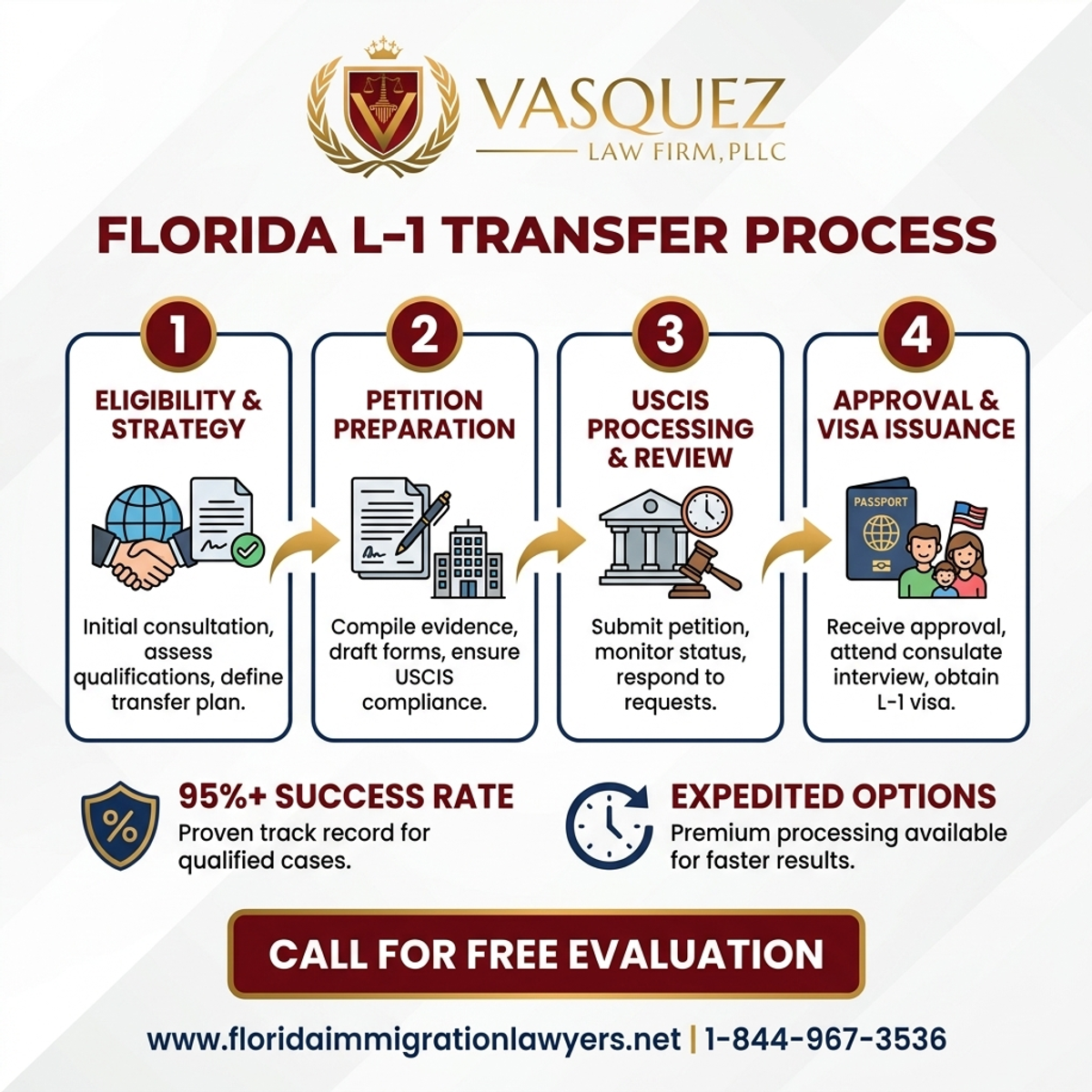
Step-by-Step Process — Choosing an Immigration Firm for L-1 Transfers in Florida
Processing Times and Expectations for L-1 Visa in 2026
Understanding the timeline for L-1 visa processing can help manage expectations. As of 2026, typical processing times may vary based on USCIS workload and specific case details. Below is an estimate:
| Stage | Typical Timeframe | Notes |
|---|---|---|
| USCIS Petition Approval | 2-4 months | Processing times can fluctuate |
| Consular Processing | 1-2 months | Depends on consulate appointment availability |
| Visa Issuance | 1-2 weeks | After successful interview |
While the table provides a general overview, actual L-1 visa processing times can be highly variable, influenced by factors such as the specific USCIS service center handling the petition, the complexity of the case, and the volume of applications. It's important for companies to factor in potential fluctuations when planning their employee transfers to Orlando or other Florida locations.
For employers with urgent needs, utilizing premium processing for Form I-129 can significantly expedite the initial USCIS petition approval. However, this option only accelerates the petition review; consular processing times for the visa interview itself remain dependent on the specific U.S. embassy or consulate's schedule, which can vary widely. Florida Immigration Lawyers advises clients on the best strategy, weighing urgency against cost implications.
Managing expectations is key. Even with premium processing, unforeseen Requests for Evidence (RFEs) can add several weeks or months to the timeline. A well-prepared petition, free of ambiguities and supported by robust documentation, is the best defense against RFEs. Our team at Florida Immigration Lawyers proactively addresses potential issues to minimize delays and provide realistic timelines for your L-1 transfer.
Cost Factors and Fee Breakdown: Choosing an Immigration Firm for L-1 Transfers in Florida
The cost of obtaining an L-1 visa includes several components. While fees can change, understanding the typical expenses can assist in budgeting:
| Item | Typical Fee | Notes |
|---|---|---|
| Filing Fee | Varies | Check the latest USCIS fee schedule |
| Legal Fees | Varies | Depends on attorney's services |
| Consular Fees | Varies | Charged by the consulate |
The total cost of an L-1 visa involves more than just the government filing fees; it encompasses a range of expenses that companies should budget for. These costs can vary based on the complexity of the case, the chosen processing options, and the scope of legal services required.
Beyond the mandatory USCIS filing fees (which include the base I-129 fee, the Fraud Prevention and Detection Fee, and potentially the American Competitiveness and Workforce Improvement Act (ACWIA) fee for certain employers), companies might opt for premium processing, adding a substantial expedite fee. Legal fees, which form a significant portion of the total cost, depend on the attorney's experience and the services provided, often ranging from flat fees for standard petitions to hourly rates for more complex cases or RFE responses.
Other potential costs include translation services for foreign documents, courier fees for secure document delivery, and travel expenses for the employee to attend their consular interview. It's crucial to obtain a clear fee breakdown from your legal counsel upfront. Florida Immigration Lawyers provides transparent pricing structures and a comprehensive understanding of all anticipated costs during your free case review, ensuring no hidden surprises as you navigate your L-1 visa application.
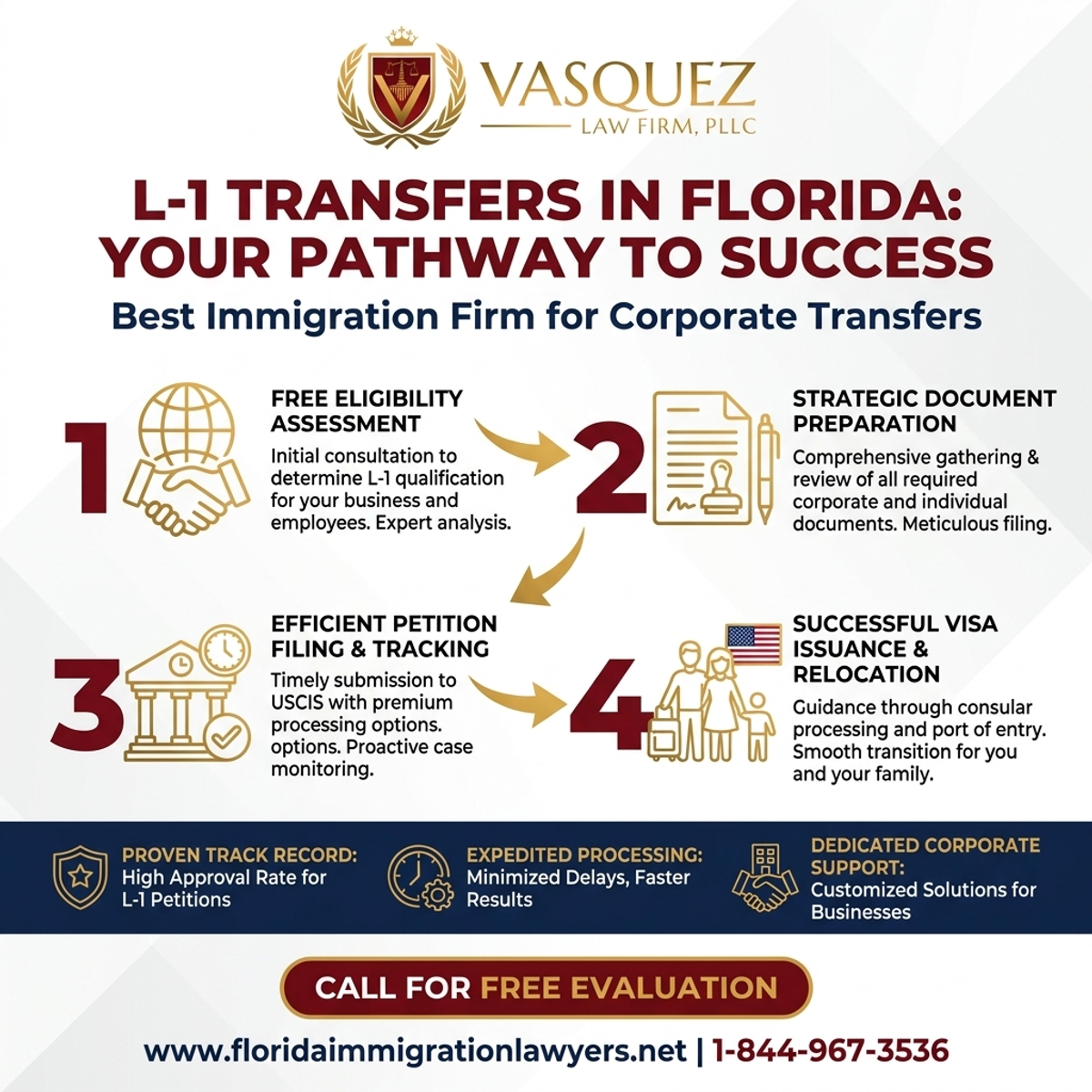
Key Statistics — Choosing an Immigration Firm for L-1 Transfers in Florida
Do not navigate this process alone. Contact Florida Immigration Lawyers today.
Common Mistakes to Avoid: Choosing an Immigration Firm for L-1 Transfers in Florida
The L-1 visa process is fraught with potential pitfalls that can lead to significant delays or outright denial. Understanding and actively avoiding these common mistakes is as crucial as knowing the application steps themselves. Many companies underestimate the stringent requirements and the level of detail USCIS expects.
- Insufficient Documentation: Failing to provide adequate proof of the qualifying relationship can lead to denial.
- Incorrect Form Filing: Errors on Form I-129 can cause delays and require resubmission.
- Overlooking Deadlines: Missing application deadlines can result in significant setbacks.
- Ignoring Changes in Policy: Not staying updated with current immigration laws can lead to non-compliance.
- Inconsistent Information: Discrepancies in documentation can raise red flags.
- Failure to Demonstrate Business Need: Not clearly outlining the rationale for the transfer can result in denial.
- Neglecting Interview Preparation: Failing to prepare the employee for the visa interview can lead to a poor outcome.
- Miscommunication with USCIS: Poor communication can lead to misunderstandings and delays.
Insufficient Documentation & Failure to Demonstrate Business Need: These two often go hand-in-hand. For example, a company might submit a basic organizational chart without clear job descriptions, or a business plan lacking specific financial projections or market analysis. USCIS needs to see a clear, tangible need for the transferred executive or manager, and robust documentation, including detailed financial statements, contracts, and marketing materials, is essential to prove this. A weak business plan, especially for a new office, is a red flag.
Incorrect Form Filing & Inconsistent Information: Simple clerical errors on Form I-129, such as incorrect dates or misspelled names, can lead to RFEs. More critically, discrepancies between the information provided in the petition, supporting letters, and the employee's interview can raise serious doubts about the application's veracity. Every piece of information submitted must be consistent and verifiable. This is where the meticulous eye of an experienced immigration attorney from Florida Immigration Lawyers becomes invaluable.
When to Call a Lawyer: Choosing an Immigration Firm for L-1 Transfers in Florida
Engaging a qualified immigration attorney is crucial when handling complex L-1 visa applications. Situations warranting legal assistance include:
- Uncertainty about eligibility or documentation
- Changes in company structure or employee role
- Previous visa denials or complications
- Need for expedited processing
Florida Immigration Lawyers offer comprehensive services to navigate these challenges, ensuring clients meet all legal requirements and deadlines. Our experience in L-1 visa transfers can help streamline the process and mitigate risks.
While the L-1 visa process might appear straightforward on the surface, its underlying complexities often demand the expertise of a seasoned immigration attorney. Engaging legal counsel isn't merely a reactive measure when problems arise; it's a proactive strategy to ensure efficiency, compliance, and ultimately, success.
Beyond the obvious scenarios of uncertainty or previous denials, legal assistance is invaluable when facing corporate restructuring, mergers, acquisitions, or when planning multiple L-1 transfers. These situations introduce additional layers of complexity regarding corporate relationships and employee eligibility that only an expert can navigate effectively. An attorney can also help proactively prepare for potential RFEs, strengthening the initial petition to minimize delays.
Imagine a growing multinational firm in Orlando experiencing rapid expansion. They need to transfer several executives and managers from their European headquarters. Rather than handling each case individually and risking inconsistencies, partnering with Florida Immigration Lawyers ensures a unified, compliant, and streamlined approach. Our firm offers a free case review, providing an initial assessment and outlining a clear path forward, making the decision to seek advice both easy and beneficial. Call us at 1-844-YO-PELEO.
About Florida Immigration Lawyers: Choosing an Immigration Firm for L-1 Transfers in Florida
Florida Immigration Lawyers is an immigration law firm based in Orlando, serving all of Florida. Our experienced attorneys focus on L-1 visa applications, offering personalized support to multinational companies and individuals. We provide 24/7 availability and free case reviews to help you navigate the complexities of immigration law. Schedule a free consultation with us today to learn more about our immigration practice areas.
As a cornerstone of the legal community in Orlando, Florida Immigration Lawyers prides itself on its deep understanding of both federal immigration statutes and the unique business environment of Central Florida. Our attorneys are not just legal practitioners; they are strategic partners committed to facilitating the growth and success of multinational companies operating in the region. We understand that each L-1 transfer represents a critical step in our clients' global strategy.
Our client-centric approach means providing personalized support from the initial consultation through to visa approval and beyond. We are dedicated to demystifying the often-intimidating immigration process, offering clear communication and proactive guidance. The benefit of our 24/7 availability and free case reviews ensures that businesses and individuals can access advice precisely when they need it, without initial financial commitment.
Whether you're a burgeoning startup or an established enterprise, our team is equipped to handle the nuances of your L-1 visa petition with precision and care. We are committed to securing the strongest possible outcome for your intracompany transfer needs. To learn how we can assist your business in navigating the complexities of U.S. immigration law, schedule your free consultation with Florida Immigration Lawyers today or call 1-844-YO-PELEO for immediate assistance.
Sources and References: Choosing an Immigration Firm for L-1 Transfers in Florida
- U.S. Citizenship and Immigration Services (USCIS)
- Executive Office for Immigration Review (EOIR)
- 8 U.S.C. Chapter 12 - Immigration and Nationality Act
Related services: H-1B specialty occupation visas, work visas for professionals, investment and entrepreneur visas.
This article provides general legal information and is not intended as legal advice. Every case is unique, and outcomes depend on specific facts and circumstances. Contact an attorney for advice about your particular situation.
Se Habla Español - Estamos aquí para ayudarle.
If you need legal assistance, learn more about speak with a business immigration lawyer, or call us at 1-844-967-3536 for a free case review.
Do Not Navigate This Process Alone
Our experienced immigration attorneys are ready to fight for you. Get a free, confidential case review today.
Se Habla Español
Or leave your details and we’ll call you:
Free Evaluation in 24 Hours
Or talk to us right now

AI voice assistant — available 24/7
FreeFrequently Asked Questions

William J. Vásquez
Founding Attorney · Vasquez Law Firm
U.S. Air Force veteran and immigration attorney with years of hands-on U.S. immigration experience. J.D., NCCU School of Law. AILA member. Admitted to the 4th, 5th, and 11th Circuit Courts.
Available 24/7 - Free Evaluations
Reviewed for legal accuracy by William J. Vásquez
Licensed in North Carolina; U.S. immigration is federal practice.
Related Legal Services
Our Florida immigration attorneys can help you with free immigration consultation, business immigration and deportation defense. Call today at 1-844-YO-PELEO for a free case review.
Related Links
Related Topics
Free Legal Case Review
Discuss your case with our experienced attorneys. We're available 24/7.
Se Habla Español - Estamos aquí para ayudarle.
Related Articles
EB-5 Investor Green Card in Florida: A 2026 Guide
Explore how to obtain an EB-5 investor green card in Florida. Learn about the investment requirements, processes, and benefits of participating in this program. Discover how Florida's economic landscape can be an ideal setting for your investment. Contact Florida Immigration Lawyers for a free case review.
Certificate of Eligibility for Expungement in Florida 2026
For non-U.S. citizens in Florida, understanding how a state expungement impacts immigration status is critical. A certificate of eligibility for expungement in Florida allows a criminal record to be sealed or expunged under state law. However, federal immigration agencies often disregard such state-level relief, still considering the original criminal offense as a conviction for immigration purposes. This can have severe implications for visa applications, green card eligibility, naturalization, and even lead to deportation. This guide clarifies the Florida expungement process, its limited effect on federal immigration law, and key steps to protect your status in 2026. Learn about common mistakes, required documents, timelines, and when to seek expert legal counsel from Florida Immigration Lawyers to navigate these complex issues effectively.
Immigration Lawyer Orlando Free Consultation in Florida
For individuals and families in Orlando, Florida, navigating the complexities of U.S. immigration law requires expert guidance. An immigration lawyer in Orlando offers crucial support for everything from visa applications and green card processes to naturalization and deportation defense. This comprehensive guide details what a free consultation covers, providing a step-by-step overview of immigration pathways, essential document checklists, and expected timelines in 2026. We also highlight common mistakes to avoid, discuss the critical role of legal counsel in deportation and asylum cases, and explain why choosing a local Orlando immigration attorney is beneficial. Florida Immigration Lawyers is dedicated to serving the diverse community of Orlando with compassionate, effective legal solutions, ensuring you receive personalized advice and robust representation for a successful immigration journey.
Fiance Visa in Miami: Your 2026 Florida K-1 Guide
For U.S. citizens in Florida, including Miami and Orlando, who wish to bring their foreign fiance(e) to the U.S. for marriage, the K-1 fiance visa is the primary immigration pathway. This comprehensive guide details the K-1 visa process for 2026, covering eligibility requirements for both the petitioner and beneficiary, the necessary documentation, expected timelines, and associated costs. We break down the stages from filing Form I-129F with USCIS to consular processing and the subsequent Adjustment of Status after marriage. Learn about common mistakes to avoid and understand when to seek professional legal assistance. Florida Immigration Lawyers offers expert guidance to help you navigate this complex journey, ensuring a smooth and successful application. Call us for a free case review.