F-1 to H-4 Change of Status Texas Processing Time 2026
Considering an F-1 to H-4 visa status change at the Texas Service Center in 2026? Discover processing timelines, document requirements, and expert tips to navigate the immigration process effectively. Call Florida Immigration Lawyers for a free consultation today.

The process for changing status from an F-1 student visa to an H-4 dependent visa using Form I-539 at the Texas Service Center in 2026 generally involves several months of processing time. Key takeaways include:
- Form I-539 is required for changing visa status.
- Processing times vary, typically ranging from a few months up to a year.
- Consultation with an immigration attorney is recommended.
- Stay informed about current USCIS policies and updates.
Introduction
In 2026, many international students in Florida universities, particularly in Tampa, are considering transitioning from an F-1 student visa to an H-4 visa. This transition can be complex, and understanding the process is critical to avoid delays. F-1 visas are popular among international students attending Florida's esteemed institutions, but life changes may require a shift to an H-4 visa, typically for dependents of H-1B visa holders. This article provides a comprehensive guide on how to navigate this change and what to expect from the Texas Service Center’s processing times.
The decision to transition from an F-1 student visa to an H-4 dependent visa is often driven by significant life events, such as marriage to an H-1B visa holder or a spouse securing an H-1B employment visa. For students who have built their lives around academic pursuits in vibrant cities like Tampa, this change represents a pivotal moment. Understanding the intricacies of this process is not just about filing forms; it’s about securing your future in the United States and ensuring continuity in your immigration journey.
Navigating the U.S. immigration system can be daunting, especially when dealing with status changes that impact your ability to live and potentially work in the country. This guide aims to demystify the F-1 to H-4 change of status, offering clarity on requirements, procedures, and what to anticipate from the Texas Service Center. We'll also highlight how expert legal guidance from Florida Immigration Lawyers can make this transition smoother and more secure.
Call Florida Immigration Lawyers at 1-844-YO-PELEO for a free consultation and personalized assistance with your immigration needs.
What is an F-1 Student Visa?
The F-1 visa allows international students to study at accredited institutions in the United States. This visa type is critical for those seeking to attend universities such as the University of South Florida in Tampa. As of 2026, F-1 visas are essential for students worldwide pursuing higher education in the U.S.
Students must maintain a full-time course load and adhere to visa regulations to remain in good standing. The F-1 visa also permits some on-campus employment and offers Optional Practical Training (OPT) opportunities post-graduation.
Beyond academic enrollment, F-1 visa holders have specific responsibilities, including regular communication with their Designated School Official (DSO), maintaining a valid passport, and adhering to strict limits on off-campus employment. Falling out of status, even unintentionally, can have severe consequences for future immigration applications. Many students initially plan to transition from F-1 to an employment-based visa like H-1B after graduation, but personal circumstances often lead them to consider the H-4 dependent visa instead.
The F-1 visa offers a pathway to educational and cultural enrichment, enabling students to gain valuable skills and experiences in the U.S. However, it is a non-immigrant visa with a temporary purpose. The shift to an H-4 visa signifies a change in immigration intent from an independent student to a dependent family member. This transition requires careful planning to ensure all F-1 requirements are met up to the point of filing the change of status application, and that the applicant understands the different privileges and limitations associated with H-4 status.
How to Transition from F-1 to H-4 Visa?
Changing from an F-1 to an H-4 visa involves filing Form I-539. The H-4 visa is for dependents of H-1B visa holders, making it a suitable option for F-1 visa holders who are family members of H-1B workers.
Here is a step-by-step guide:
- Gather necessary documents: passport, current I-94, and proof of relationship to the H-1B holder.
- Complete Form I-539 and pay the required fee.
- Submit the application to the Texas Service Center.
- Await the receipt notice which confirms the application is under review.
- Monitor the processing status through the USCIS online system.
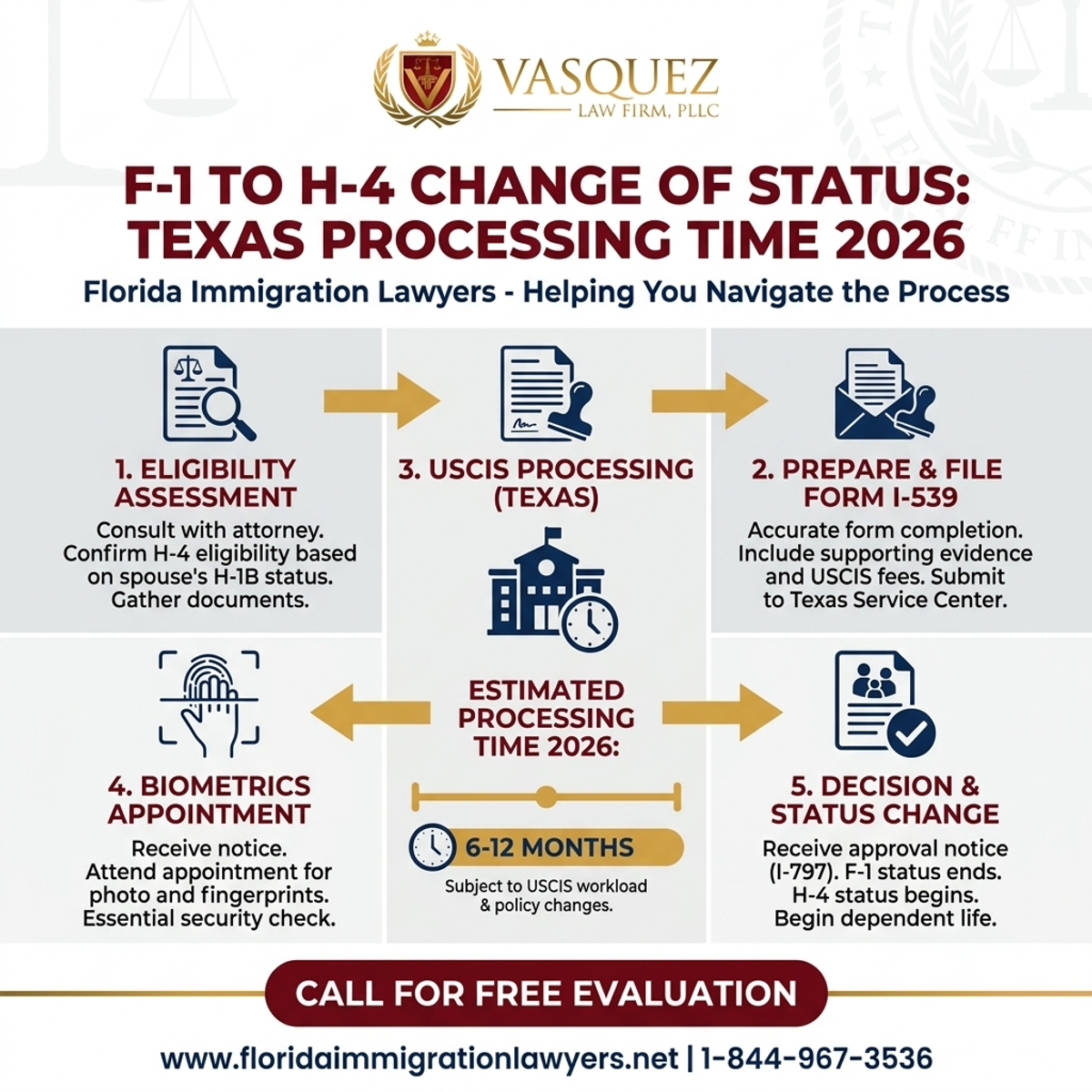
Step-by-Step Process — F-1 to H-4 Change of Status Texas Processing Time 2026
Processing times can vary, and it’s important to stay updated with USCIS announcements.
Let's delve deeper into each step. When gathering documents, ensure your passport is valid for at least six months beyond your intended stay, and obtain your most recent I-94 arrival record online from the CBP website. For proof of relationship, an official marriage certificate is paramount. If you have children also applying for H-4 status, their birth certificates will be required. It’s advisable to make multiple copies of all documents before submission.
Completing Form I-539, Application to Extend/Change Nonimmigrant Status, requires meticulous attention to detail. Any errors or omissions can lead to delays or even denial. Always use the most current version of the form available on the USCIS website and carefully read all instructions. The filing fee must be paid with a check or money order, or through a credit card using Form G-1450, Authorization for Credit Card Transactions. Incorrect fees are a common reason for application rejection.
Once your application is submitted to the Texas Service Center, USCIS will issue a receipt notice (Form I-797C, Notice of Action). This notice confirms that your application has been received and provides a receipt number, which is essential for tracking your case online. While your application is pending, you are generally authorized to remain in the U.S. under "period of authorized stay," provided you filed before your F-1 I-94 expired. However, it's critical to maintain your F-1 student status (e.g., full-time enrollment) up until the point your H-4 status is approved, or at least until your F-1 grace period ends, to avoid accruing unlawful presence.
Document Checklist for F-1 to H-4 Change
- Completed Form I-539
- Copy of current F-1 visa and I-20 form
- Copy of the H-1B holder's visa and approval notice
- Proof of relationship to the H-1B holder (e.g., marriage certificate)
- Recent passport-sized photographs
To ensure a smooth application process, it is essential to prepare a comprehensive set of documents. For Form I-539, double-check that all sections are filled out accurately and completely, including your contact information and the reason for your change of status. For your F-1 visa and I-20, make sure to include copies of *all* I-20 forms issued to you, especially the most recent one showing your current program and status. This helps USCIS trace your academic history and confirm your compliance with F-1 regulations.
Regarding the H-1B holder's documents, you will need a copy of their H-1B visa stamp from their passport, their I-797 H-1B approval notice, and potentially their most recent pay stubs to demonstrate their valid H-1B employment. Proof of relationship is critical; a certified copy of your marriage certificate is usually sufficient. For children, certified birth certificates are required. Additionally, consider including a copy of your current I-94 record, educational transcripts, and a brief cover letter outlining your application and the enclosed documents. Consulting with Florida Immigration Lawyers can help you compile an airtight application package, minimizing the chances of RFEs.
Processing Time and Expectations in 2026
As of 2026, the processing times for an F-1 to H-4 change of status at the Texas Service Center varies significantly depending on the caseload and other factors. Generally, it can take anywhere from three to nine months.
| Stage | Typical Timeframe | Notes |
|---|---|---|
| Receipt Notice | 2-4 weeks | Confirmation of application receipt |
| Initial Review | 1-3 months | Preliminary evaluation of documents |
| Decision | 3-6 months | Final decision on the application |
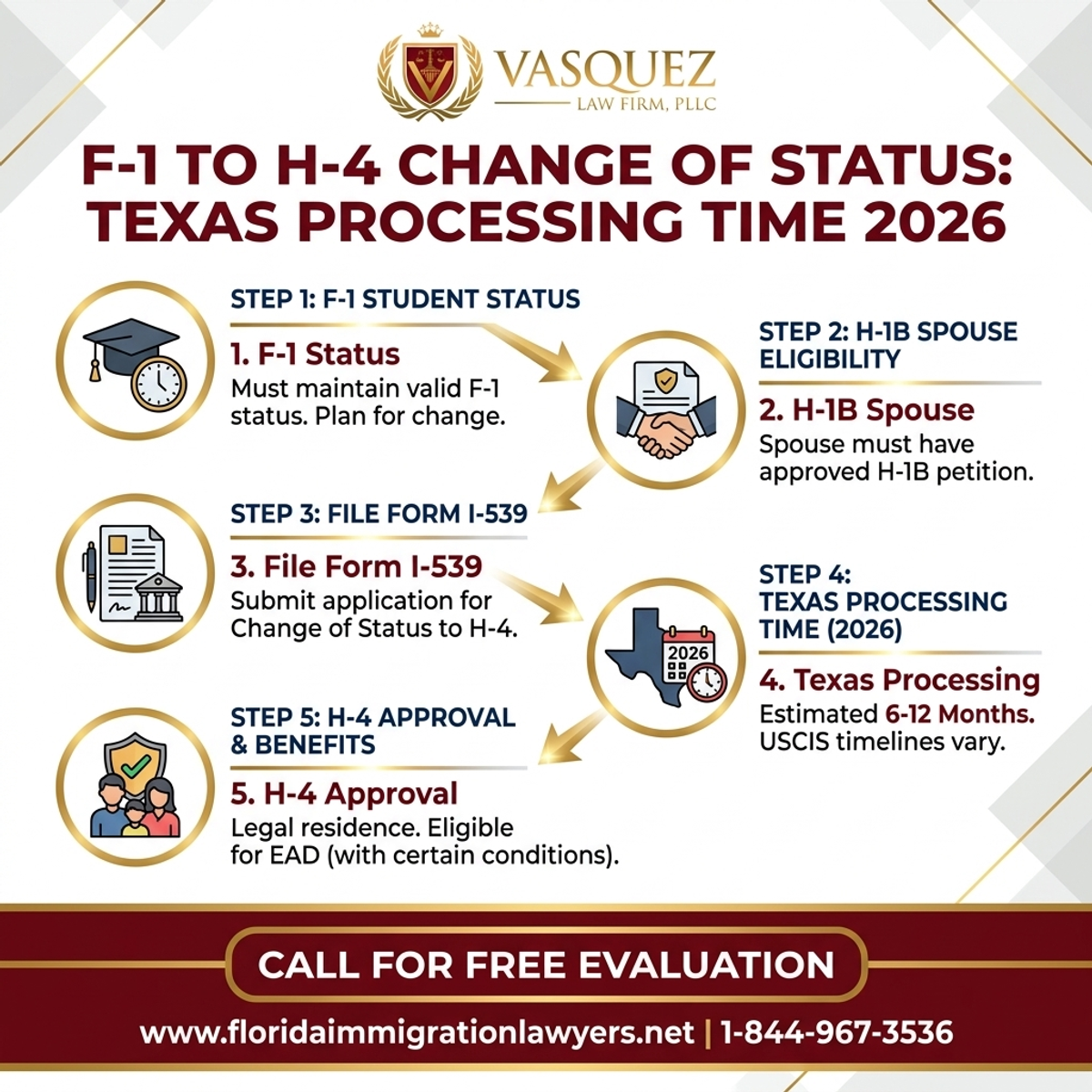
Key Statistics — F-1 to H-4 Change of Status Texas Processing Time 2026
Several factors can influence these processing times. USCIS workload, changes in immigration policies, the completeness of your application, and whether a Request for Evidence (RFE) is issued can all extend the waiting period. While the table provides a general timeframe, it’s crucial to check the official USCIS website's "Check Case Processing Times" tool for the most up-to-date information specific to the Texas Service Center and Form I-539. This tool allows you to input your form type and service center to get a more accurate estimate.
During the waiting period, it is vital to continue complying with your F-1 visa requirements if your I-94 has not yet expired. Avoid international travel if possible, as departing the U.S. while a change of status application is pending generally constitutes abandonment of the application. If you absolutely must travel, consult with an immigration attorney beforehand to understand the risks and potential need to reapply for an H-4 visa at a U.S. consulate abroad. Unfortunately, premium processing is not available for Form I-539 filed for an F-1 to H-4 change of status, meaning applicants must prepare for standard processing durations.
Cost and Fee Breakdown
Understanding the cost involved in changing your visa status is essential for planning. Below is a typical breakdown of fees:
| Item | Typical Fee | Notes |
|---|---|---|
| Form I-539 Filing Fee | Varies | Depends on current USCIS fee schedule |
| Biometrics Fee | Varies | Required for some applicants |
| Attorney Fees | Varies | Depends on complexity of the case |
USCIS fees are subject to change, so always verify the current amounts on the official USCIS website before submitting your application. The Form I-539 filing fee can vary based on whether you are applying alone or with other dependents. The biometrics fee, if required, covers the cost of collecting your fingerprints and photograph, which is a standard security measure. You will receive an appointment notice for biometrics at a local Application Support Center (ASC) after your application is filed.
Attorney fees, while an additional cost, represent an invaluable investment in the success and peace of mind of your application. An experienced immigration lawyer, such as those at Florida Immigration Lawyers, will ensure your application is meticulously prepared, all necessary documents are included, and any potential issues are addressed proactively. This can significantly reduce the risk of RFEs or denials, ultimately saving you time and stress. They can also advise on the overall strategy, especially if you have unique circumstances or other immigration goals.
Do not navigate this process alone. Contact Florida Immigration Lawyers today to ensure your journey from F-1 to H-4 is smooth and compliant.
Common Mistakes to Avoid
Transitioning from an F-1 to an H-4 visa requires careful attention to detail. Even minor errors can lead to significant delays, requests for evidence (RFEs), or even denial of your application. Being aware of common pitfalls can help you avoid unnecessary complications and ensure a smoother process.
- Not maintaining F-1 status until the change is approved. *This is crucial; falling out of status can lead to denial and potential bars from future immigration benefits. Always ensure you are enrolled full-time and compliant with F-1 rules until you receive the H-4 approval or your F-1 grace period ends.*
- Filing incomplete or incorrect forms, leading to delays. *Double-check every field on Form I-539 and ensure all supporting documents are included as per the USCIS instructions. An incomplete application will likely be rejected or result in an RFE.*
- Ignoring updates or requests for additional information from USCIS. *Respond promptly and thoroughly to any RFEs. Failure to do so within the specified timeframe will almost certainly lead to a denial.*
- Not consulting an attorney for complex situations. *If you have any prior immigration issues, a criminal record, or unique circumstances, legal counsel is not just recommended but often essential to navigate the complexities.*
- Missing deadlines for submission of required documents. *Adhere strictly to all deadlines, especially for RFE responses or biometrics appointments. Missing them can jeopardize your application.*
- Misunderstanding eligibility requirements for H-4 status. *Ensure you genuinely qualify as a dependent spouse or child of a valid H-1B holder. For instance, common-law marriages are not recognized for H-4 status in many states.*
- Failing to provide sufficient proof of relationship to the H-1B holder. *A certified marriage certificate for spouses or birth certificates for children are mandatory. Supplementary evidence like joint bank accounts, lease agreements, or family photos can strengthen your case.*
- Not keeping copies of all submitted documents. *Always retain a complete copy of your entire application package, including all forms, supporting documents, and proof of mailing. This is vital for your records and if USCIS requests duplicates.*
- Neglecting to track the application status online. *Regularly use the USC
Sources and References
- U.S. Citizenship and Immigration Services (USCIS)
- Executive Office for Immigration Review (EOIR)
- U.S. Department of State - Bureau of Consular Affairs
- Immigration and Nationality Act (INA), 8 U.S.C. Chapter 12
Do Not Navigate This Process Alone
Our experienced immigration attorneys are ready to fight for you. Get a free, confidential case review today.
Se Habla Español
Or leave your details and we’ll call you:
Free Evaluation in 24 Hours
Or talk to us right now

AI voice assistant — available 24/7
FreeFrequently Asked Questions

William J. Vásquez
Founding Attorney · Vasquez Law Firm
U.S. Air Force veteran and immigration attorney with years of hands-on U.S. immigration experience. J.D., NCCU School of Law. AILA member. Admitted to the 4th, 5th, and 11th Circuit Courts.
Available 24/7 - Free Evaluations
Reviewed for legal accuracy by William J. Vásquez
Licensed in North Carolina; U.S. immigration is federal practice.
Related Legal Services
Our Florida immigration attorneys can help you with immigration lawyer cost in Florida, experienced immigration attorneys and asylum protection. Call today at 1-844-YO-PELEO for a free case review.
Related Links
Related Topics
Free Legal Case Review
Discuss your case with our experienced attorneys. We're available 24/7.
Se Habla Español - Estamos aquí para ayudarle.
Related Articles
EAD Advance Parole Combo Card in Florida 2026
For individuals with a pending Form I-485, Application to Register Permanent Residence or Adjust Status, the EAD Advance Parole Combo Card is an essential document. This single card combines the authorization to work legally in the U.S. (Employment Authorization Document - EAD) with permission to travel internationally and re-enter without abandoning your green card application (Advance Parole). This guide from Florida Immigration Lawyers provides a comprehensive overview for applicants in Florida in 2026, covering eligibility, the step-by-step application process, required documents, expected processing times, and associated costs. We also highlight common mistakes to avoid and when to seek legal counsel to ensure a smooth and successful immigration journey. Understanding this vital card is key to maintaining stability while awaiting your permanent residency approval.
Immigration Lawyer Orlando Free Consultation in Florida
For individuals and families in Orlando, Florida, navigating the complexities of U.S. immigration law requires expert guidance. An immigration lawyer in Orlando offers crucial support for everything from visa applications and green card processes to naturalization and deportation defense. This comprehensive guide details what a free consultation covers, providing a step-by-step overview of immigration pathways, essential document checklists, and expected timelines in 2026. We also highlight common mistakes to avoid, discuss the critical role of legal counsel in deportation and asylum cases, and explain why choosing a local Orlando immigration attorney is beneficial. Florida Immigration Lawyers is dedicated to serving the diverse community of Orlando with compassionate, effective legal solutions, ensuring you receive personalized advice and robust representation for a successful immigration journey.
Diversity Visa: Understanding the Green Card Lottery
Explore the diversity visa program, also known as the green card lottery, and learn how it impacts residents of Florida. Discover what steps are involved, common mistakes to avoid, and when to seek legal assistance.
T Visa for Human Trafficking Victims in Florida 2026
The T visa provides crucial immigration protection for victims of human trafficking in Florida, offering a pathway to safety, work authorization, and eventual permanent residency. This comprehensive guide for 2026 details eligibility requirements, including being a victim of severe trafficking and cooperating with law enforcement. It outlines the step-by-step application process, from obtaining law enforcement certification to filing Form I-914 with USCIS. We also cover the essential documents needed, typical processing timelines, and associated costs. Crucially, the T visa shields victims from deportation, allows them to legally work, and enables family reunification. Understanding these protections and navigating the legal system can be daunting, but with expert legal assistance, victims can reclaim their lives. Florida Immigration Lawyers offers compassionate guidance and robust advocacy for human trafficking survivors throughout Florida, ensuring they receive the support needed to achieve security and build a new future.