I-360 Widow Self-Petition in Florida: A Complete Guide
Learn how to navigate the I-360 widow self-petition process in Florida. This comprehensive guide covers eligibility, documentation, and common mistakes. Call Florida Immigration Lawyers for expert assistance.

I-360 Widow Self-Petition in Florida: A Complete Guide to Securing Your Future
Losing a spouse is an incredibly painful experience, a period marked by grief, uncertainty, and immense emotional strain. For non-U.S. citizens married to U.S. citizens, this tragedy can be compounded by the fear of losing their legal status in the United States. Fortunately, U.S. immigration law offers a compassionate pathway for surviving spouses: the I-360 Widow Self-Petition. This guide provides a comprehensive overview of the I-360 process specifically for individuals in Florida, helping you understand your rights and navigate this complex journey.
Navigating the complex world of immigration law can be daunting, especially during a time of personal loss. The I-360 self-petition allows eligible widows and widowers of U.S. citizens to apply for a Green Card independently, without the need for a sponsoring spouse. This crucial provision offers a lifeline, ensuring that your future in the U.S. is not solely dependent on your spouse's continued life. Understanding the eligibility requirements, the application process, and potential challenges is the first step toward securing your future.
Understanding the I-360 Widow Self-Petition
The I-360 petition, officially known as the Petition for Amerasian, Widow(er), or Special Immigrant, is a vital immigration benefit. For widows and widowers, it provides a unique opportunity to self-petition for lawful permanent residency (a Green Card) after the death of their U.S. citizen spouse. Unlike most family-based petitions, which require a living U.S. citizen or lawful permanent resident sponsor, the I-360 widow(er) petition allows you to be your own petitioner.
This provision recognizes the profound impact of spousal loss and aims to prevent the surviving spouse from being penalized due to circumstances beyond their control. It's designed to offer stability and a path forward, acknowledging the legitimate marital relationship that existed.
Eligibility Requirements for an I-360 Widow Self-Petition
To be eligible for an I-360 Widow Self-Petition, you must meet several strict criteria established by U.S. Citizenship and Immigration Services (USCIS). It is imperative to understand each of these requirements to ensure a successful application:
- Valid Marriage to a U.S. Citizen: You must have been legally married to a U.S. citizen at the time of their death. This means your marriage must be recognized as valid under the laws of the place where it took place. Common-law marriages may be recognized in certain jurisdictions, but specific proof is required.
- U.S. Citizen Spouse: Your deceased spouse must have been a U.S. citizen. Proof of citizenship, such as a birth certificate, U.S. passport, or naturalization certificate, will be required.
- Death of Spouse: Your U.S. citizen spouse must have passed away. A certified death certificate is a mandatory piece of evidence. Crucially, you must file your I-360 petition within two years of your spouse's death. There are limited exceptions to this deadline, such as if your spouse died while a prior petition (like an I-130) was pending and had not yet been approved.
- Not Remarried: You must not have remarried at the time of filing your I-360 petition. Remarriage before the I-360 is filed will disqualify you. If you remarry after the I-360 is approved but before your Green Card is issued, it can also lead to denial.
- Good Moral Character: You must demonstrate that you are a person of good moral character. This generally means you have not committed certain crimes or engaged in activities that would make you inadmissible to the U.S. USCIS will review your criminal history, if any, and other aspects of your background.
- Bona Fide Marriage: You must prove that your marriage to the deceased U.S. citizen was entered into in good faith, not solely for immigration purposes. This is a critical component of the petition and requires substantial evidence.
- Physical Presence (for Adjustment of Status): If you are applying for adjustment of status (Form I-485) concurrently with or after your I-360, you must be physically present in the United States. If you are outside the U.S., you would typically pursue consular processing.
Each of these requirements is carefully scrutinized by USCIS. Any discrepancies or lack of sufficient evidence can lead to delays or even denial of your petition. Therefore, thorough preparation and understanding are paramount.
The Application Process: Step-by-Step Guide
The I-360 Widow Self-Petition process involves several key steps, from gathering documentation to potential interviews. Here’s a detailed breakdown:
1. Gathering Documentation
This is perhaps the most critical stage. You will need to collect a comprehensive set of documents to prove your eligibility. Key documents include:
- Proof of Your Spouse's U.S. Citizenship: A certified copy of their birth certificate, U.S. passport, or naturalization certificate.
- Certified Death Certificate: This document confirms the date and cause of your spouse's passing.
- Certified Marriage Certificate: Proof of your legal marriage to the deceased U.S. citizen.
- Proof of Bona Fide Marriage: This is crucial. USCIS wants to ensure your marriage was legitimate. Evidence can include:
- Joint bank account statements, credit card statements, or utility bills.
- Lease agreements or property deeds showing joint ownership.
- Birth certificates of any children born to the marriage.
- Affidavits from friends, family, or employers attesting to the legitimacy of your relationship.
- Photographs of your wedding, family events, and daily life together.
- Life insurance policies, wills, or other documents naming each other as beneficiaries.
- Correspondence, emails, or text messages between you and your spouse.
- Your Birth Certificate and Passport: Or other government-issued identification.
- Evidence of Good Moral Character: This may include police clearances from all places you have lived, court disposition records for any arrests or convictions, and a personal statement.
- Form I-360, Petition for Amerasian, Widow(er), or Special Immigrant: This is the primary form you will file.
- Form I-485, Application to Register Permanent Residence or Adjust Status (if applicable): If you are in the U.S. and eligible to adjust your status, you can often file this concurrently with your I-360.
- Form I-765, Application for Employment Authorization (optional): If you want to work while your application is pending.
- Form I-131, Application for Travel Document (optional): If you need to travel outside the U.S. while your application is pending.
2. Filing the Petition
Once all documentation is meticulously gathered, you will file Form I-360 with USCIS. If you are simultaneously applying for adjustment of status, you will file Form I-485 and other related forms (I-765, I-131) along with your I-360. Ensure all forms are correctly filled out, signed, and include the required filing fees.
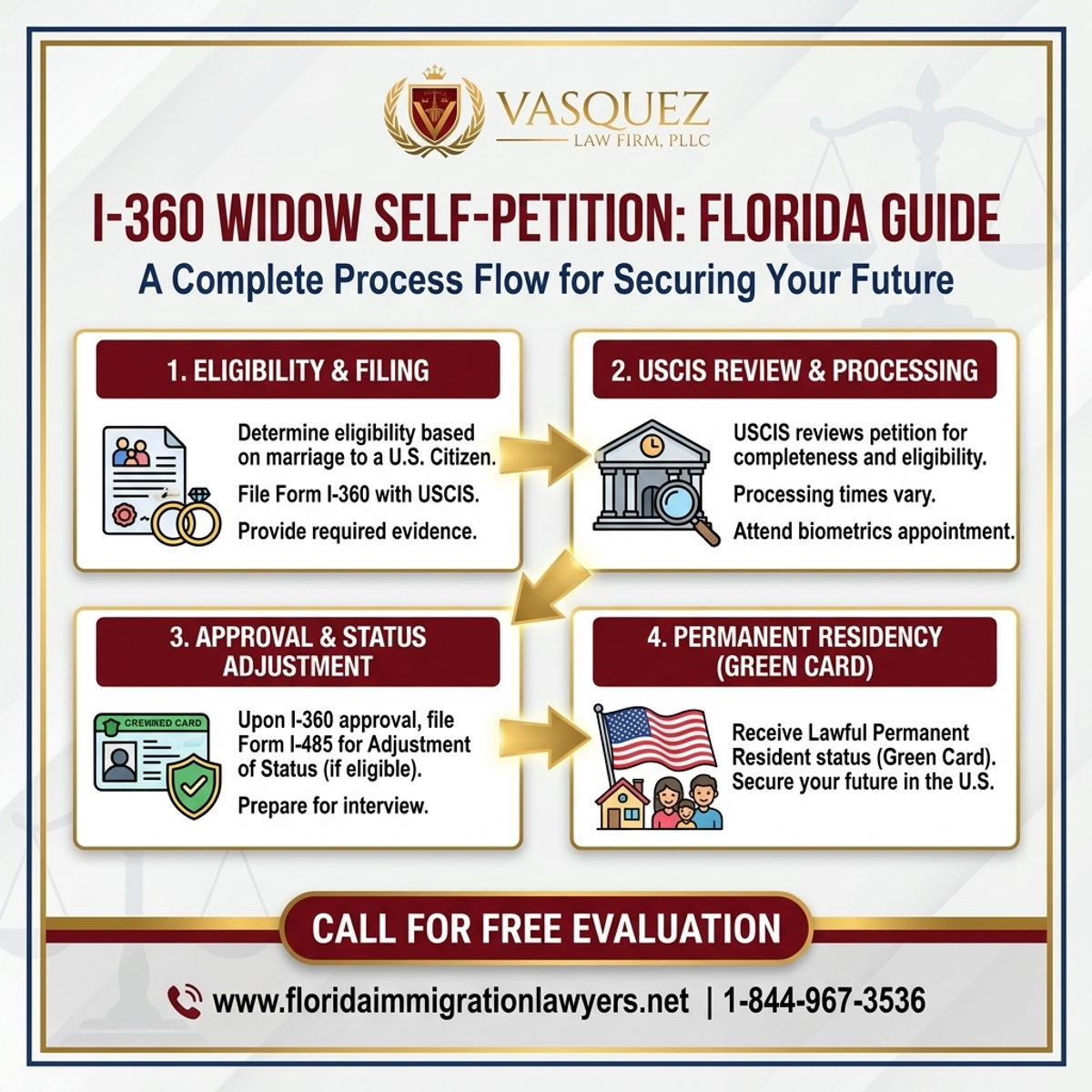
Step-by-Step Process — I-360 Widow Self-Petition in Florida: A Complete Guide
3. Biometrics Appointment
After filing, USCIS will send you an appointment notice for a biometrics screening. This involves taking your fingerprints, photograph, and signature, which are used for background checks and identity verification.
4. Request for Evidence (RFE) or Interview
USCIS may issue a Request for Evidence (RFE) if they determine that your initial submission lacks sufficient documentation or clarity. Responding promptly and thoroughly to an RFE is crucial. In some cases, you may be called for an interview with a USCIS officer to discuss your petition and the legitimacy of your marriage. This is an opportunity to clarify any doubts and reinforce your case.
5. Decision and Adjustment of Status or Consular Processing
If your I-360 petition is approved, you will then proceed to the next stage of obtaining your Green Card. If you filed Form I-485 concurrently and are in the U.S., your adjustment of status application will be adjudicated. If you are outside the U.S. or choose to pursue consular processing, you will attend an interview at a U.S. embassy or consulate in your home country.
Common Pitfalls and How to Avoid Them in Your I-360 Petition
The I-360 self-petition process, while offering a compassionate path, is not without its complexities. Many applicants encounter common pitfalls that can lead to delays or even outright denial. Being aware of these challenges and proactively addressing them can significantly improve your chances of success.
One of the most frequent issues is **insufficient proof of a bona fide marriage**. USCIS is highly vigilant about marriage fraud, and even in genuine cases, applicants may fail to provide enough compelling evidence. To avoid this, gather a wide variety of documents spanning the entire duration of your marriage. Don't rely on just one or two types of evidence; combine financial records, shared property, joint insurance, photographs, travel itineraries, and affidavits from people who knew you as a couple. The more comprehensive and diverse your evidence, the stronger your case.
Another critical mistake is **filing after the two-year deadline**. The rule is strict: you must file your I-360 petition within two years of your spouse's death. Missing this deadline, except in very rare circumstances, will result in a denial. It is essential to act swiftly after your spouse's passing, even while grieving, to ensure your petition is submitted on time. If you're nearing the deadline, seek immediate legal advice.
**Remarriage before filing** is an absolute disqualifier. Even if you remarry out of necessity or emotional support, it will invalidate your I-360 eligibility. You must remain unmarried until your I-360 petition is filed. If you remarry after the I-360 is filed but before your Green Card is approved, this can also lead to a denial, so careful timing and understanding of the rules are paramount.
**Issues with good moral character** can also derail a petition. Any criminal history, no matter how minor it seems, must be disclosed. Failing to disclose or misrepresenting information can be more damaging than the offense itself. If you're facing potential issues like a prior criminal record or fear of removal, consulting with an attorney specializing in deportation defense is crucial. They can assess the impact of any past incidents and advise on the best course of action. For those who might have other complex needs, such as fear of returning to their home country, exploring options like asylum could be relevant, though distinct from the I-360 petition.
Finally, **incomplete or incorrect forms and missing documentation** are common administrative errors that cause significant delays. Double-check every form, ensure all questions are answered truthfully, and make sure every required supporting document is included. Organizing your documents clearly, perhaps with tabs and an index, can also help USCIS officers process your application more efficiently.
Benefits of the I-360 Self-Petition
The I-360 self-petition offers several significant benefits to eligible surviving spouses:
- Independence: You are not reliant on a U.S. citizen spouse to sponsor you, giving you control over your immigration journey.
- Path to Green Card: It provides a direct pathway to lawful permanent residency, allowing you to live and work permanently in the U.S.
- Work Authorization: While your application is pending, you can apply for an Employment Authorization Document (EAD), allowing you to work legally in the U.S.
- Protection from Deportation: Securing your Green Card offers stability and protection from potential deportation.
- Children Included: Your unmarried children under 21 can often be included in your petition, allowing them to also gain lawful permanent residency.
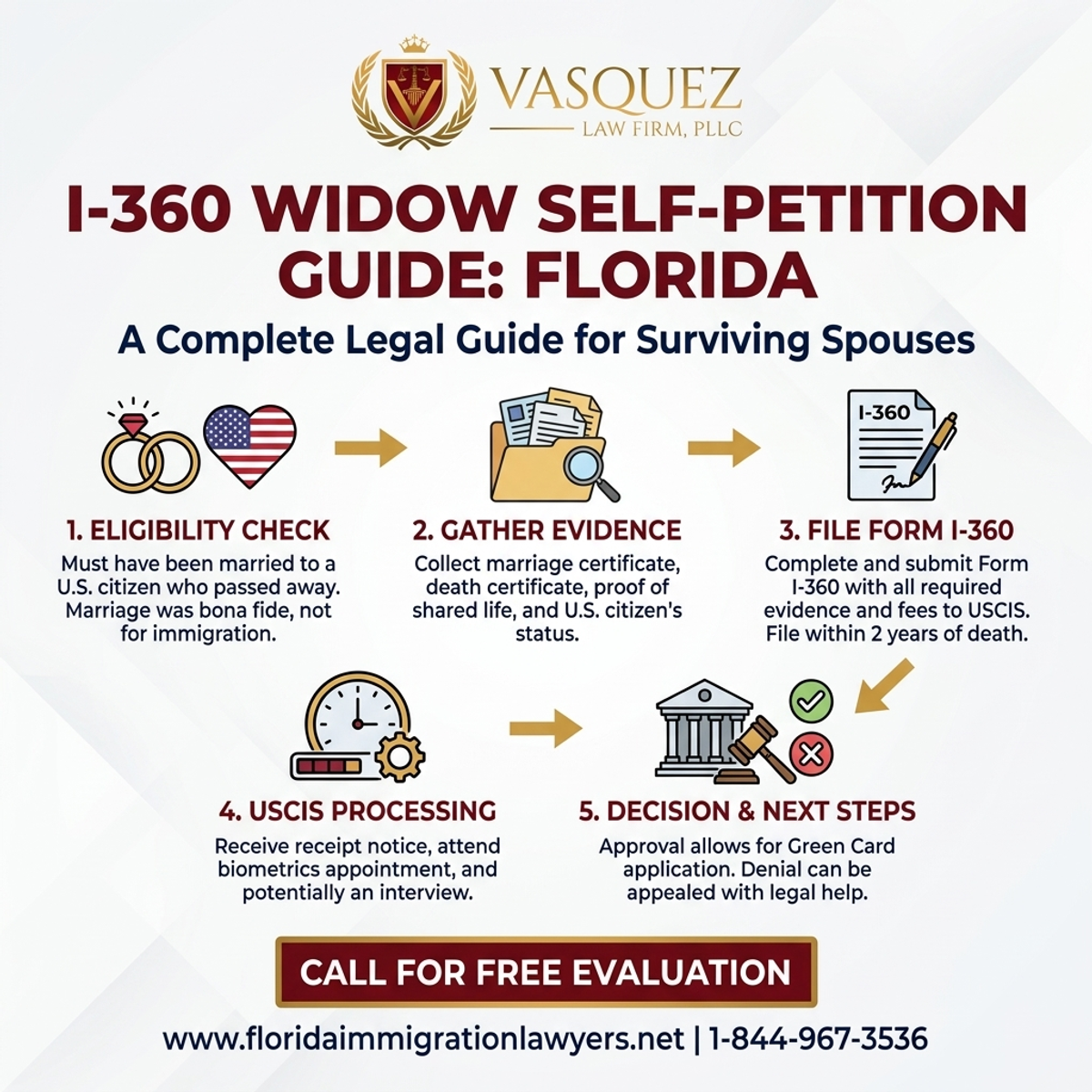
Key Statistics — I-360 Widow Self-Petition in Florida: A Complete Guide
The Crucial Role of an Immigration Attorney in Florida
Navigating the I-360 Widow Self-Petition process can be overwhelming, especially during a time of grief. An experienced immigration attorney can provide invaluable assistance:
- Expert Guidance: Attorneys understand the nuances of immigration law and can accurately assess your eligibility.
- Document Preparation: They can help you gather and organize all necessary documentation, ensuring your petition is complete and robust.
- Avoiding Pitfalls: An attorney can identify potential issues in your case and help you address them proactively, minimizing the risk of RFEs or denials.
- Representation: They can represent you during interviews with USCIS and respond effectively to any requests for evidence.
- Peace of Mind: Having a legal professional by your side allows you to focus on healing while your immigration matters are expertly handled.
Our team of experienced attorneys specializes in family-based immigration and has a deep understanding of the I-360 self-petition process. We are committed to providing compassionate and effective legal representation to help you secure your future in Florida.
Florida Specific Considerations
While U.S. immigration law is federal, having local legal representation in Florida can be highly beneficial. Florida is a state with a large and diverse immigrant population, and local attorneys are often familiar with specific USCIS field office practices and regional nuances that might impact your case. Our firm is deeply rooted in the Florida community, offering personalized attention and expertise to clients throughout the state.
Conclusion
The I-360 Widow Self-Petition offers a vital opportunity for surviving spouses of U.S. citizens to maintain their legal status and build a new life in the United States. While the process demands meticulous attention to detail and adherence to strict deadlines, it is a compassionate pathway designed to provide security during a difficult time. Don't hesitate to contact us for a confidential consultation. Our dedicated team is here to guide you through every step, ensuring your petition is as strong as possible and helping you navigate this journey toward a stable future.
Frequently Asked Questions (FAQ) About the I-360 Widow Self-Petition
1. What is the I-360 Widow Self-Petition? The I-360 Widow Self-Petition allows a surviving spouse of a U.S. citizen to apply for a Green Card independently, without a living U.S. citizen sponsor. 2. Who is eligible to file an I-360 Widow Self-Petition? You must have been legally married to a U.S. citizen at the time of their death, your spouse must have been a U.S. citizen, you must file within two years of their death, and you must not have remarried. 3. What evidence do I need to prove a bona fide marriage? Evidence includes joint bank accounts, property deeds, utility bills, birth certificates of children, photos, affidavits from friends/family, and any other documents showing a legitimate marital relationship. 4. Can I include my children in my I-360 petition? Yes, your unmarried children under the age of 21 can often be included in your I-360 petition as derivative beneficiaries. 5. What happens if I remarry after my spouse's death? If you remarry before filing your I-360 petition, you become ineligible. If you remarry after filing but before your Green Card is approved, it can also lead to denial. 6. Is there a deadline for filing the I-360 Widow Self-Petition? Yes, you must generally file your I-360 petition within two years of your U.S. citizen spouse's death. 7. Do I need an attorney to file an I-360 petition? While not legally required, hiring an experienced immigration attorney is highly recommended due to the complexity of the process, the strict deadlines, and the need for thorough documentation. 8. What if my I-360 petition is denied? If your I-360 petition is denied, you may have options to appeal the decision or refile, depending on the reasons for the denial. Consulting with an attorney is crucial in such circumstances.Sources and References
- U.S. Citizenship and Immigration Services (USCIS)
- Executive Office for Immigration Review (EOIR)
- U.S. Department of State - Bureau of Consular Affairs
- Immigration and Nationality Act (INA), 8 U.S.C. Chapter 12
Do Not Navigate This Process Alone
Our experienced immigration attorneys are ready to fight for you. Get a free, confidential consultation today.
Se Habla Español
Frequently Asked Questions
Florida Immigration Lawyers
Immigration Attorney | Founder, Vasquez Law Firm
U.S. Air Force veteran and immigration attorney with thousands of cases resolved. J.D., NCCU School of Law. AILA member. Admitted to the 4th, 5th, and 11th Circuit Courts.
Available 24/7 - Free Evaluations
Related Legal Services
Our Florida immigration attorneys can help you with free immigration consultation, experienced immigration attorneys and business immigration. Call today at 1-844-967-3536 for a free consultation.
Related Links
Related Topics
Free Legal Consultation
Discuss your case with our experienced attorneys. We're available 24/7.
Se Habla Español - Estamos aquí para ayudarle.
Related Articles
Guide to H-2B Visa for Florida Hospitality Workers
Discover how the H-2B visa supports Florida's hospitality industry, focusing on non-agricultural seasonal workers in Orlando. Learn about eligibility, application steps, and common pitfalls. Contact Florida Immigration Lawyers for assistance.
H-4 EAD Spouse Work Permit in Florida | VLF Florida
Explore the H-4 EAD spouse work permit process in Florida. Learn about eligibility, application steps, and common challenges. Contact Florida Immigration Lawyers for a free consultation.
Top Immigration Lawyer Miami Services | VLF Florida
Explore the comprehensive immigration services offered by Miami's top lawyers. From visas to deportation defense, ensure your journey is smooth with expert legal assistance. Contact us today for a free consultation.
Guide to Responding to an RFE in Florida | VLF Florida
Learn how to effectively respond to a Request for Evidence (RFE) from USCIS in Florida. This comprehensive guide covers the key steps, common mistakes, and when to seek legal help. Whether you're in Jacksonville or elsewhere in Florida, our advice can help you navigate this process confidently.