Guide to H-2B Visa for Florida Hospitality Workers
Discover how the H-2B visa supports Florida's hospitality industry, focusing on non-agricultural seasonal workers in Orlando. Learn about eligibility, application steps, and common pitfalls. Contact Florida Immigration Lawyers for assistance.

The H-2B visa program allows U.S. employers to hire foreign nationals in non-agricultural roles temporarily. This is particularly beneficial for Florida's hospitality industry, which sees seasonal surges in tourist activity. Key takeaways include:
- The H-2B visa is for non-agricultural seasonal workers.
- Florida's hospitality industry relies heavily on H-2B workers.
- Orlando is a primary location for H-2B visa employment.
- Eligibility requires a temporary or seasonal job offer.
Introduction
Picture this: the sun is shining brightly over Orlando, and tourists are flocking to Florida's famous theme parks and beaches. But who helps ensure their stay is comfortable and enjoyable? Often, it's the seasonal workers who come to Florida under the H-2B visa program. This article will explore how the H-2B visa supports the state's bustling hospitality industry, particularly around Orlando. Whether you're an employer seeking workers or an individual looking to work in Florida, understanding the H-2B visa is crucial. Call Florida Immigration Lawyers at 1-844-967-3536 for a free consultation.
Florida's economy is heavily dependent on tourism, attracting millions of visitors each year to its world-renowned attractions, pristine beaches, and vibrant cities. This influx creates a significant demand for labor in the hospitality sector, from hotels and resorts to restaurants and entertainment venues. However, many of these roles are seasonal, experiencing peak demand during specific times of the year, such as winter holidays, spring break, and summer.
The H-2B visa program provides a vital solution for Florida businesses to meet these fluctuating staffing needs, allowing them to maintain high service standards without overstaffing during off-peak seasons. These temporary workers fill critical roles such as housekeepers, cooks, landscapers, amusement park attendants, and resort staff, ensuring that Florida's tourism engine continues to run smoothly. For both employers and prospective workers, navigating the intricacies of this visa category is essential for successful employment and compliance with U.S. immigration law.
Overview of the H-2B Visa
The H-2B visa is a non-immigrant visa that allows U.S. employers to hire foreign nationals for temporary non-agricultural work. This visa is pivotal for industries like hospitality, especially in states like Florida, where tourism peaks seasonally. The U.S. Citizenship and Immigration Services (USCIS) oversees this program, and it's vital for employers to demonstrate that there are not enough U.S. workers who are able, willing, qualified, and available for the job.
The fundamental premise of the H-2B visa is to address a temporary labor shortage. Employers must prove that their need for workers is truly temporary, fitting into one of four categories: a one-time occurrence, seasonal need, peakload need, or intermittent need. For Florida's hospitality industry, the seasonal and peakload needs are most common, aligning with tourist seasons and major events. This temporary nature distinguishes the H-2B from other visa categories designed for permanent or long-term employment.
Furthermore, the H-2B program is subject to an annual numerical cap, currently set at 66,000 visas per fiscal year, split between two halves of the year. This cap means that demand often outstrips supply, making timely and accurate application crucial. Employers must not only demonstrate a temporary need but also undertake rigorous recruitment efforts to test the U.S. labor market before being certified to hire foreign workers. This dual requirement underscores the program's intent to supplement, not supplant, the U.S. workforce.
Eligibility Requirements
To qualify for an H-2B visa, the job must be temporary or seasonal, and employers must meet several criteria, including obtaining a temporary labor certification from the Department of Labor. Employers must also prove that hiring foreign workers will not adversely affect the wages and working conditions of similarly employed U.S. workers.
The temporary labor certification process is a critical hurdle. Employers must show that they have attempted to recruit U.S. workers through various means, such as job advertisements, state workforce agency postings, and contacting former employees. If, after these good-faith efforts, an insufficient number of qualified U.S. workers are available, the Department of Labor may grant certification. This step ensures that the H-2B program is used only when a genuine need for foreign workers exists.
Beyond recruitment, employers must commit to offering H-2B workers wages that are at least the prevailing wage for the occupation in the area of intended employment, or the federal minimum wage, whichever is higher. This stipulation, along with providing working conditions that do not undercut those of U.S. workers, is designed to protect both domestic and foreign workers from exploitation and to prevent the H-2B program from driving down labor standards. A common example of a temporary need in Florida is a hotel hiring extra staff for the busy winter tourist season, with the understanding that these positions will conclude once the season ends.
Step-by-Step Guide to Obtaining an H-2B Visa
Navigating the H-2B visa process requires meticulous attention to detail and adherence to strict deadlines. It's a multi-agency process involving the Department of Labor (DOL), U.S. Citizenship and Immigration Services (USCIS), and the Department of State (DOS). Employers considering this route should prepare for a comprehensive application process that, while complex, can be successfully managed with careful planning and, ideally, legal guidance from professionals like Florida Immigration Lawyers.
- Employer's Temporary Labor Certification: Employers must first file a temporary labor certification application with the U.S. Department of Labor. This process involves proving the need for temporary workers and attempting to recruit U.S. workers for the position. This step includes placing job orders with state workforce agencies, advertising in newspapers, and engaging in other recruitment efforts to ensure no qualified U.S. workers are available for the temporary positions.
- Filing Form I-129: After certification approval, the employer files Form I-129, Petition for Nonimmigrant Worker, with the USCIS. This petition includes the approved labor certification and other supporting documents proving the employer's eligibility and the worker's qualifications. Employers may opt for premium processing for an expedited decision, though this incurs an additional fee.
- Visa Application: Upon USCIS approval, the worker applies for the H-2B visa at a U.S. consulate or embassy. An interview may be required. During the consular interview, applicants will need to demonstrate their intent to return to their home country after the temporary employment concludes and provide all necessary documentation, including their passport, job offer, and DS-160 confirmation.
- Entering the U.S.: Once the visa is issued, the worker can enter the U.S. to begin employment. Upon arrival at a U.S. port of entry, Customs and Border Protection (CBP) officers will review the worker's documents and may conduct a brief interview before granting admission.
Each step in this process is critical, and a misstep at any stage can lead to significant delays or even denial. Employers should meticulously document all recruitment efforts and maintain thorough records. Workers, too, must ensure all personal documentation is current and accurate. Engaging with experienced legal counsel, such as Florida Immigration Lawyers, can provide invaluable assistance throughout this demanding journey, helping to streamline the process and mitigate potential issues.
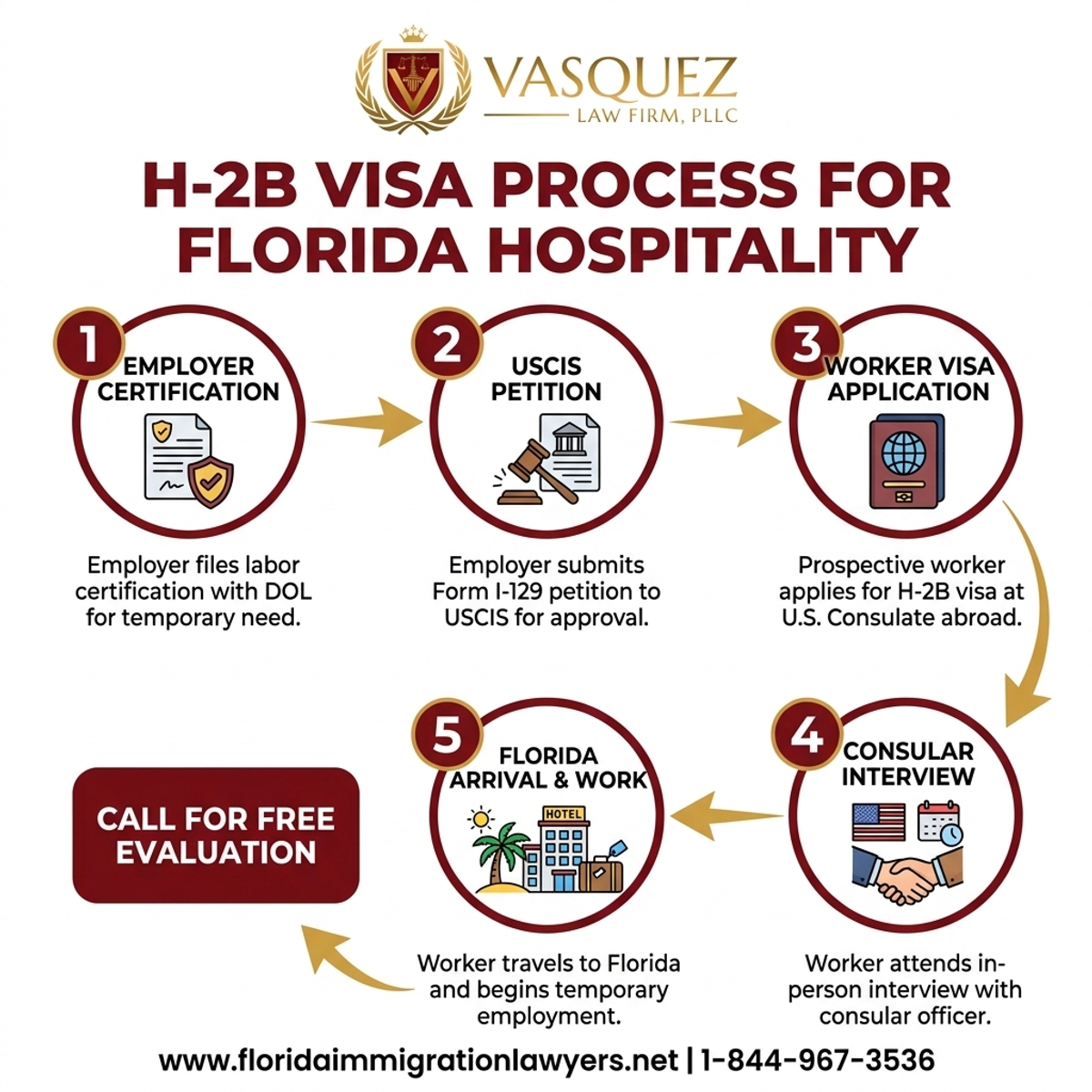
Step-by-Step Process — Guide to H-2B Visa for Florida Hospitality Workers
Document Checklist for H-2B Visa Application
A comprehensive and well-organized set of documents is paramount for a successful H-2B visa application. Any missing or incorrect information can lead to frustrating delays or even denial. Both employers and prospective workers should meticulously prepare and review all required paperwork before submission.
- Proof of temporary labor certification approval: This critical document from the Department of Labor confirms that the employer has met the temporary need and recruitment requirements.
- Form I-129 and supporting documents: This includes the petition itself, along with the employer's business documentation, proof of financial stability, and detailed job descriptions.
- Valid passport: The applicant's passport must be valid for at least six months beyond the intended period of stay in the U.S.
- Completed DS-160 form: The online Nonimmigrant Visa Application form, accurately filled out and submitted.
- Visa application fee receipt: Proof of payment for the required visa processing fees.
- Job offer letter: A formal letter from the U.S. employer detailing the temporary position, wages, and terms of employment.
It is advisable to keep multiple copies of all submitted documents and to organize them clearly for easy reference during interviews or if additional information is requested. For workers, having a physical copy of their job offer and the approved I-797 petition notice (approval notice for Form I-129) is crucial when attending their visa interview and when entering the U.S.
Timeline and Processing Expectations
The process for obtaining an H-2B visa generally takes several months. Employers should start the process as early as possible due to high demand and limited visa numbers. The timeline includes obtaining labor certification, filing Form I-129, and scheduling a visa interview. Processing times can vary based on the time of year and the specific circumstances of the application.
A typical timeline can span from 4 to 6 months, or even longer, depending on various factors. The Department of Labor's temporary labor certification process alone can take 60-90 days, including recruitment efforts. Following this, USCIS processing of Form I-129 can range from a few weeks (with premium processing) to several months. Finally, securing a consular interview appointment can add further weeks or months, especially in high-demand locations.
Employers must be acutely aware of the H-2B visa cap. USCIS typically releases new visa numbers semi-annually, and petitions often exceed the available numbers, leading to a lottery system. This makes early and strategic filing absolutely essential. For instance, employers seeking workers for the summer season in Florida should aim to initiate the DOL process almost a year in advance to ensure their petitions are submitted within the narrow filing windows and have the best chance of being selected under the cap. Missing these crucial deadlines can mean missing out on vital seasonal labor for your business, impacting your operations and profitability.
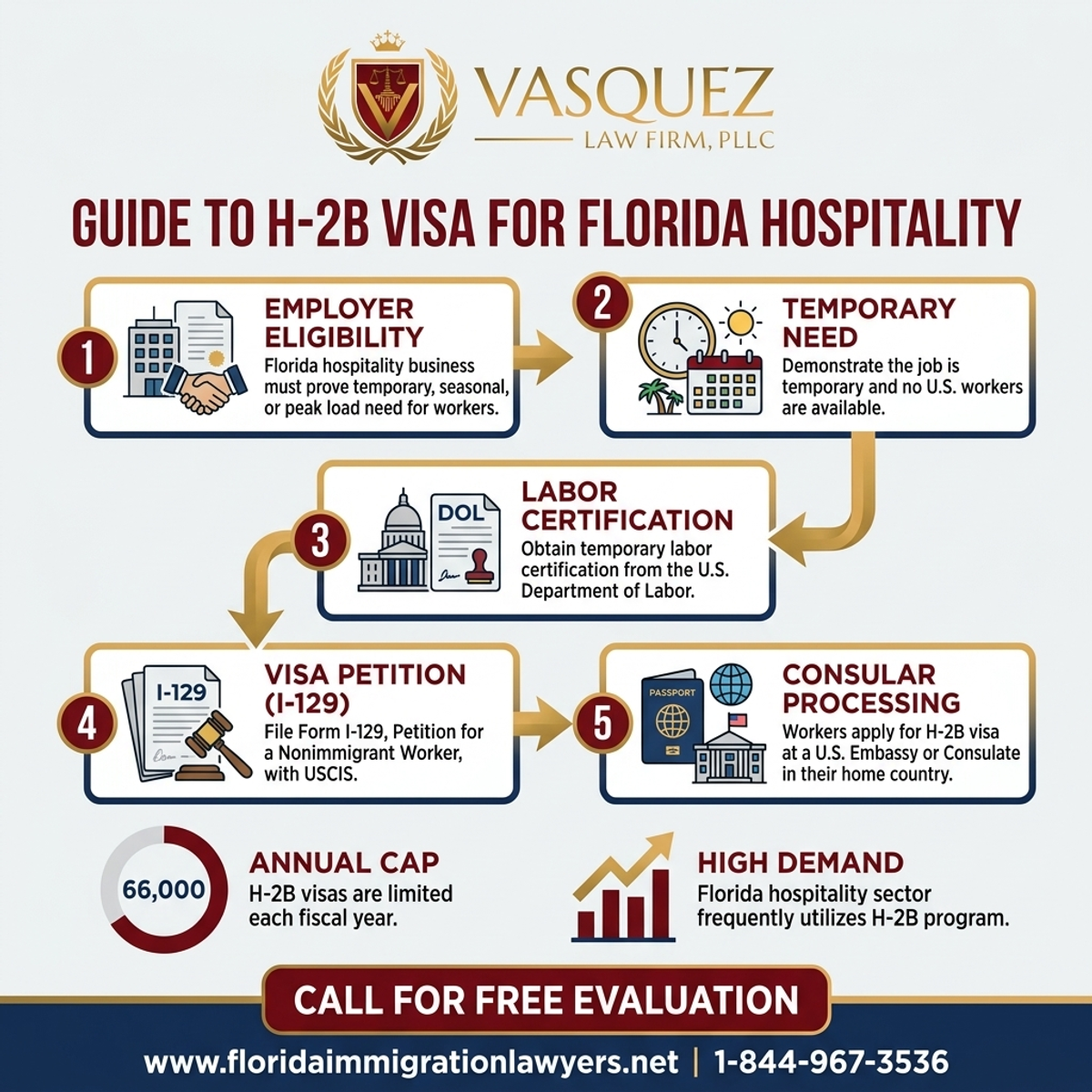
Key Statistics — Guide to H-2B Visa for Florida Hospitality Workers
Cost Factors and Fee Breakdown
While specific fees can change, costs generally include the filing fees for Form I-129, visa application fees, and any additional costs related to the labor certification process. Employers are typically responsible for many of these costs, and potential workers should check the latest fee schedules on the USCIS website.
The total cost of an H-2B visa can be substantial, primarily borne by the employer. Key expenses include the Department of Labor's temporary labor certification application fees (though some are waived), USCIS Form I-129 filing fee (currently $460, but subject to change), and the potential premium processing fee (currently $2,805) for expedited USCIS adjudication. Additionally, recruitment costs for U.S. workers, such as advertising expenses, must be factored in.
For the foreign national, the main cost is the DS-160 nonimmigrant visa application fee (currently $190). Employers are generally prohibited from passing on many of the H-2B related costs to the workers, including recruitment fees, visa petition fees, and travel expenses to the place of employment. It is crucial for both employers and workers to understand these financial responsibilities to ensure compliance and avoid legal issues. Consulting with Florida Immigration Lawyers can help clarify these financial obligations and ensure all fees are properly handled.
Do not navigate this process alone. Contact Florida Immigration Lawyers today.
Common Mistakes to Avoid
- Failing to prove a temporary need, which can result in denial. This is a foundational requirement; without clear evidence of a seasonal, peakload, intermittent, or one-time need, the petition will be rejected.
- Not adhering to recruitment requirements, leading to certification denial. Employers must meticulously document all efforts to find U.S. workers, including specific ad placements and interview records.
- Incorrectly completing Form I-129, causing delays. Even minor errors or omissions on this complex form can trigger Requests for Evidence (RFEs) or outright denials, significantly prolonging the process.
- Missing application deadlines, which can result in missing the visa cap. The H-2B cap is often met quickly, so late submissions risk being returned or denied due to unavailability of visa numbers.
- Failure to provide accurate job descriptions that meet visa criteria. Vague or overly broad job descriptions can lead to DOL questioning the temporary nature of the work or the necessity of foreign workers.
- Not maintaining compliance with wage requirements, leading to legal issues. Employers must pay H-2B workers the prevailing wage, and failure to do so can result in severe penalties, back pay, and future program bans.
- Overlooking the need for a valid job offer, which is essential for visa approval. Workers must have a concrete, temporary job offer from a U.S. employer to be eligible for the H-2B visa.
- Ignoring changes in immigration laws, risking application validity. Immigration regulations are dynamic; staying updated on new rules and policies is crucial for successful applications.
- Not seeking legal advice when issues arise, leading to avoidable complications. Attempting to resolve complex legal or procedural issues without expert guidance often exacerbates problems.
- Assuming visa approval guarantees entry, which is subject to Customs and Border Protection discretion. Even with an approved visa, CBP officers at the port of entry have final authority on admission to the U.S.
The H-2B visa program is fraught with potential pitfalls that can jeopardize an employer's ability to secure needed workers and a worker's opportunity to gain temporary employment. Each step of the process has specific requirements, and overlooking even a seemingly minor detail can have significant consequences. Proactive planning and meticulous attention to detail are your best defenses against these common errors.
For employers, a denial due to a procedural mistake can mean a loss of critical seasonal staff, impacting business operations and revenue. For workers, it can mean a missed opportunity for employment. Therefore, understanding and actively avoiding these common mistakes is not just good practice—it's essential for success. When in doubt, the expertise of Florida Immigration Lawyers can be instrumental in navigating these complexities and ensuring compliance.
When to Call a Lawyer
Navigating the H-2B visa process can be complex, and legal assistance is invaluable in many situations. Consider contacting an immigration attorney if you're unsure about eligibility requirements, face issues with labor certification, or need help with visa application discrepancies. Florida Immigration Lawyers can provide crucial support to ensure compliance and increase the chance of approval.
There are numerous scenarios where professional legal counsel becomes not just helpful, but essential. For employers, this might include initial assessments of whether your temporary need truly qualifies for H-2B, developing a robust recruitment strategy to satisfy DOL requirements, or responding to complex Requests for Evidence (RFEs) from USCIS. If your temporary labor certification is denied, or if your I-129 petition faces challenges, an experienced attorney can guide you through the appeal process or help you re-strategize.
For individuals, while the employer primarily drives the H-2B process, a lawyer can offer clarity on your rights, review your job offer, and prepare you for your consular interview. If you encounter any issues at the port of entry or have concerns about your working conditions, legal advice is critical. Don't hesitate to reach out to Florida Immigration Lawyers at 1-844-967-3536 for a free consultation. Our team is equipped to handle the nuances of H-2B applications for both employers and workers, ensuring a smoother, more compliant process.
About Florida Immigration Lawyers
Florida Immigration Lawyers is a leading law firm dedicated to serving the immigration needs of clients throughout Florida. Our experienced attorneys specialize in various immigration services, including H-2B visas, family immigration, asylum, deportation defense, and more. We offer free consultations and are available 24/7 to assist you. Contact us at 1-844-967-3536 or visit our website at floridaimmigrationlawyers.net.
Our firm prides itself on a deep understanding of the ever-evolving landscape of U.S. immigration law. We recognize that each client's situation is unique, and we are committed to providing personalized, strategic legal solutions. Whether you are a Florida business owner struggling to fill critical seasonal roles or an individual seeking temporary employment in the vibrant hospitality sector, our dedicated team is here to guide you through every step of the H-2B process.
With a strong track record of success and a client-centered approach, Florida Immigration Lawyers stands as a trusted advocate for the immigrant community. We are passionate about helping our clients achieve their immigration goals, offering comprehensive support from initial consultation to final resolution. Our multilingual staff, including Spanish speakers (Se Habla Español), ensures clear communication and compassionate service. Reach out today for a free consultation and let us put our expertise to work for you.
Sources and References
- U.S. Citizenship and Immigration Services (USCIS)
- Executive Office for Immigration Review (EOIR)
- U.S. Department of State
- 8 U.S.C. Chapter 12 - Immigration and Nationality Act
Related services: immigration practice areas, family immigration services, citizenship and naturalization.
This article provides general legal information and is not intended as legal advice. Every case is unique, and outcomes depend on specific facts and circumstances. Contact an attorney for advice about your particular situation.
Call Florida Immigration Lawyers at 1-844-967-3536 for a free consultation. Se Habla Español - Estamos aquí para ayudarle.
If you need legal assistance, learn more about speak with an immigration lawyer, or call us at 1-844-967-3536 for a free consultation.
Do Not Navigate This Process Alone
Our experienced immigration attorneys are ready to fight for you. Get a free, confidential consultation today.
Se Habla Español
Frequently Asked Questions
Florida Immigration Lawyers
Immigration Attorney | Founder, Vasquez Law Firm
U.S. Air Force veteran and immigration attorney with thousands of cases resolved. J.D., NCCU School of Law. AILA member. Admitted to the 4th, 5th, and 11th Circuit Courts.
Available 24/7 - Free Evaluations
Related Legal Services
Our Florida immigration attorneys can help you with deportation defense, citizenship and naturalization and family immigration services. Call today at 1-844-967-3536 for a free consultation.
Related Links
Related Topics
Free Legal Consultation
Discuss your case with our experienced attorneys. We're available 24/7.
Se Habla Español - Estamos aquí para ayudarle.
Related Articles
H-4 EAD Spouse Work Permit in Florida | VLF Florida
Explore the H-4 EAD spouse work permit process in Florida. Learn about eligibility, application steps, and common challenges. Contact Florida Immigration Lawyers for a free consultation.
Top Immigration Lawyer Miami Services | VLF Florida
Explore the comprehensive immigration services offered by Miami's top lawyers. From visas to deportation defense, ensure your journey is smooth with expert legal assistance. Contact us today for a free consultation.
Guide to Responding to an RFE in Florida | VLF Florida
Learn how to effectively respond to a Request for Evidence (RFE) from USCIS in Florida. This comprehensive guide covers the key steps, common mistakes, and when to seek legal help. Whether you're in Jacksonville or elsewhere in Florida, our advice can help you navigate this process confidently.
Immigration Lawyer Cost Florida 2026: Your Guide | VLF Florida
Understand immigration lawyer cost in Florida for 2026. Get a clear breakdown of attorney fees in Hollywood & statewide. Contact Florida Immigration Lawyers