H-2B Visa: Seasonal Worker Florida Hospitality Guide 2026
Florida's hospitality sector relies heavily on H-2B visas for seasonal workers. This comprehensive guide covers the H-2B visa process, from employer eligibility and temporary labor certification to USCIS petition filing and consular processing for seasonal workers in Florida. Learn about essential documents, timelines, and cost factors involved in securing this crucial temporary work visa. We also highlight common mistakes to avoid and when to seek legal counsel. Florida Immigration Lawyers provides guidance for businesses and individuals, ensuring compliance and successful outcomes in the complex H-2B program. Contact us for a free consultation.

The H-2B visa program allows U.S. employers in Florida to bring foreign nationals to the United States to fill temporary non-agricultural jobs, particularly in the thriving hospitality sector. This visa is crucial for businesses facing seasonal labor shortages, ensuring they can maintain operations and meet consumer demand during peak seasons. Eligibility requires demonstrating a temporary need, such as a seasonal, peakload, intermittent, or one-time occurrence. Both employers and prospective workers must meet specific criteria set by USCIS, the Department of Labor, and the Department of State. Navigating this complex process often benefits from experienced legal guidance to ensure compliance and successful petition approval.
- H-2B visas are for temporary, non-agricultural seasonal workers.
- Florida hospitality businesses often rely on H-2B for peak season staffing.
- Employers must prove a temporary need and obtain a labor certification.
- The process involves multiple government agencies: DOL, USCIS, and DOS.
- Legal assistance is highly recommended to manage the intricate requirements.
Florida’s vibrant hospitality industry, from the bustling resorts of Orlando to the serene beaches of the Panhandle and the dynamic city life of Tallahassee, thrives on providing exceptional service. However, meeting the demand for staff during peak tourist seasons often presents a significant challenge for businesses. Many employers, especially those in Tallahassee and surrounding areas, find themselves in need of reliable temporary workers to fill crucial roles in hotels, restaurants, and entertainment venues.
This is where the H-2B visa program becomes an invaluable resource. The H-2B visa specifically addresses the need for seasonal workers in non-agricultural sectors, providing a legal pathway for foreign nationals to fill temporary positions. Understanding the intricacies of this program is vital for both Florida employers seeking to bolster their workforce and individuals hoping to work in the Sunshine State.
Navigating the complex requirements set forth by the Department of Labor (DOL), U.S. Citizenship and Immigration Services (USCIS), and the U.S. Department of State (DOS) can be daunting. From demonstrating a genuine temporary need to ensuring compliance with wage and working condition regulations, every step demands meticulous attention to detail. This comprehensive guide will demystify the H-2B process, offering clarity on eligibility, application steps, and common challenges faced by employers and workers alike.
Whether you are a Florida business owner looking to hire seasonal staff or a prospective seasonal worker Florida hospitality professional, this article will provide essential insights. We aim to equip you with the knowledge needed to approach the H-2B visa program confidently. Do not navigate this complex immigration landscape alone. Call Florida Immigration Lawyers at 1-844-YO-PELEO for a free consultation and let our experienced team assist you.
Understanding the H-2B Visa Program for Seasonal Workers in Florida Hospitality
The H-2B visa program is specifically designed for U.S. employers who need to bring foreign nationals temporarily to the U.S. to perform non-agricultural labor or services. This temporary work visa is distinct from the H-2A visa, which is for agricultural workers. For Florida’s expansive hospitality sector, encompassing everything from hotels and restaurants to theme parks and resorts, the H-2B visa is often the lifeline that ensures operations run smoothly during high-demand periods, such as spring break, summer, or winter tourist seasons.
The core principle of the H-2B visa is the employer's temporary need. This means the employer must demonstrate that their need for the worker is not permanent or ongoing, but rather tied to a specific season, a peak workload, an intermittent occurrence, or a one-time event. This requirement is rigorously scrutinized by the Department of Labor during the labor certification process. For instance, a hotel in Tallahassee needing extra housekeeping staff during the legislative session or a restaurant in Miami Beach requiring more servers during tourist season would typically qualify under the seasonal or peakload definitions.
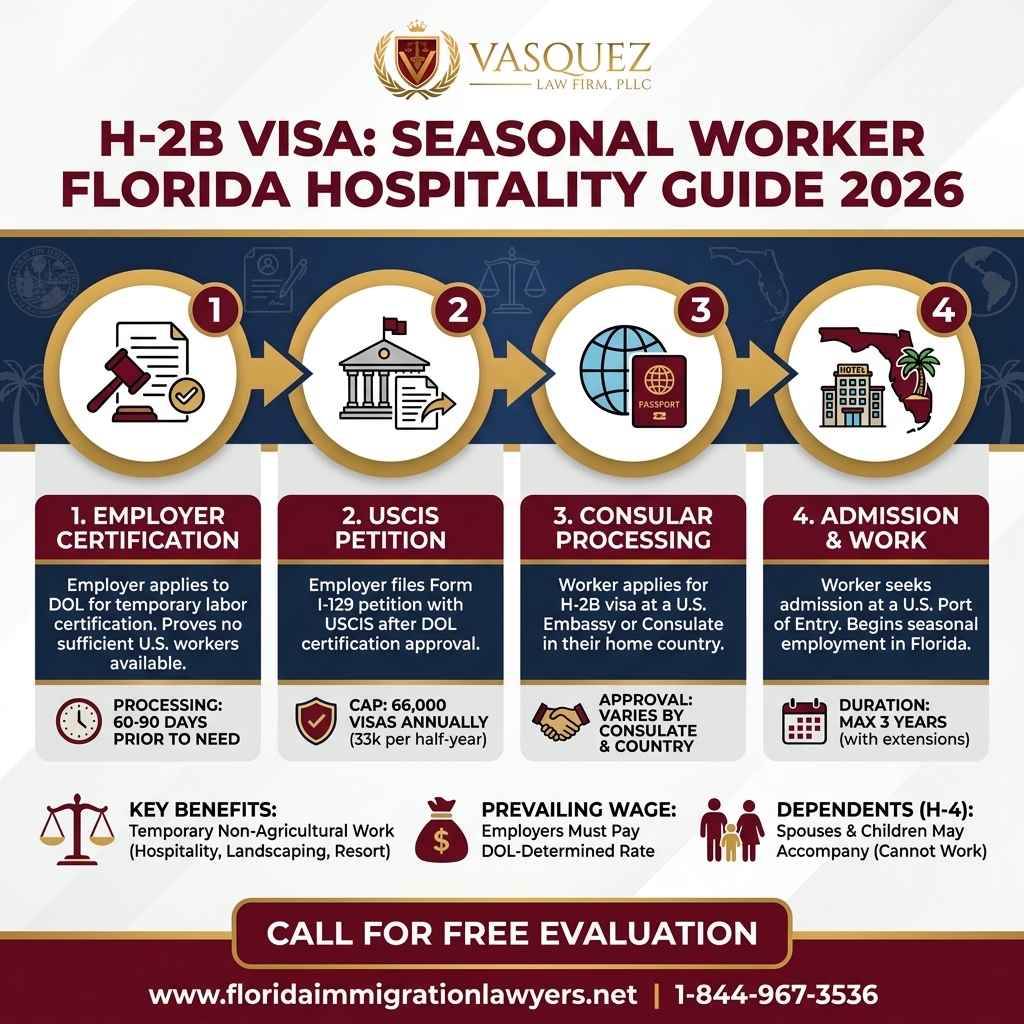
The program is subject to an annual cap, which can make securing visas competitive. Congress sets the annual cap for H-2B visas at 66,000 per fiscal year, split evenly between the first and second halves of the fiscal year. This cap often causes the program to reach its limit quickly, underscoring the importance of early and precise filing. Employers must plan well in advance to ensure they can secure their needed workforce. The H-2B program plays a crucial role in supporting Florida’s economy, allowing businesses to thrive and continue contributing to local communities.
Eligibility Requirements for Employers and H-2B Seasonal Workers
Both employers and prospective H-2B seasonal workers must meet specific criteria to qualify for the program. For employers in Florida, the primary requirement is demonstrating a legitimate temporary need for workers. This need must fall into one of four categories: seasonal (e.g., increased demand during tourist season), peakload (e.g., a temporary surge in business beyond regular staff capacity), intermittent (e.g., occasional need for workers for short, unpredictable periods), or a one-time occurrence (e.g., a single, non-recurring event).
Furthermore, the employer must prove that there are not enough U.S. workers who are able, willing, qualified, and available to perform the temporary work. This is typically established through a rigorous recruitment process, overseen by the Department of Labor (DOL). Employers must also offer wages that meet or exceed the prevailing wage for the occupation in the specific geographic area, ensuring fair compensation. They must also guarantee working conditions that do not adversely affect U.S. workers.
For the foreign national seeking an H-2B visa, the requirements are generally simpler but no less important. Applicants must possess the skills and qualifications necessary for the temporary job offered by the Florida employer. They must also demonstrate an intent to return to their home country upon the expiration of their visa. This non-immigrant intent is a critical aspect of all temporary visas. Additionally, applicants must meet general admissibility standards to the U.S., meaning they must not have any criminal record or other grounds of inadmissibility. A valid passport and relevant educational or professional certifications are also typically required.
Step-by-Step Guide to Obtaining an H-2B Visa for Florida Hospitality
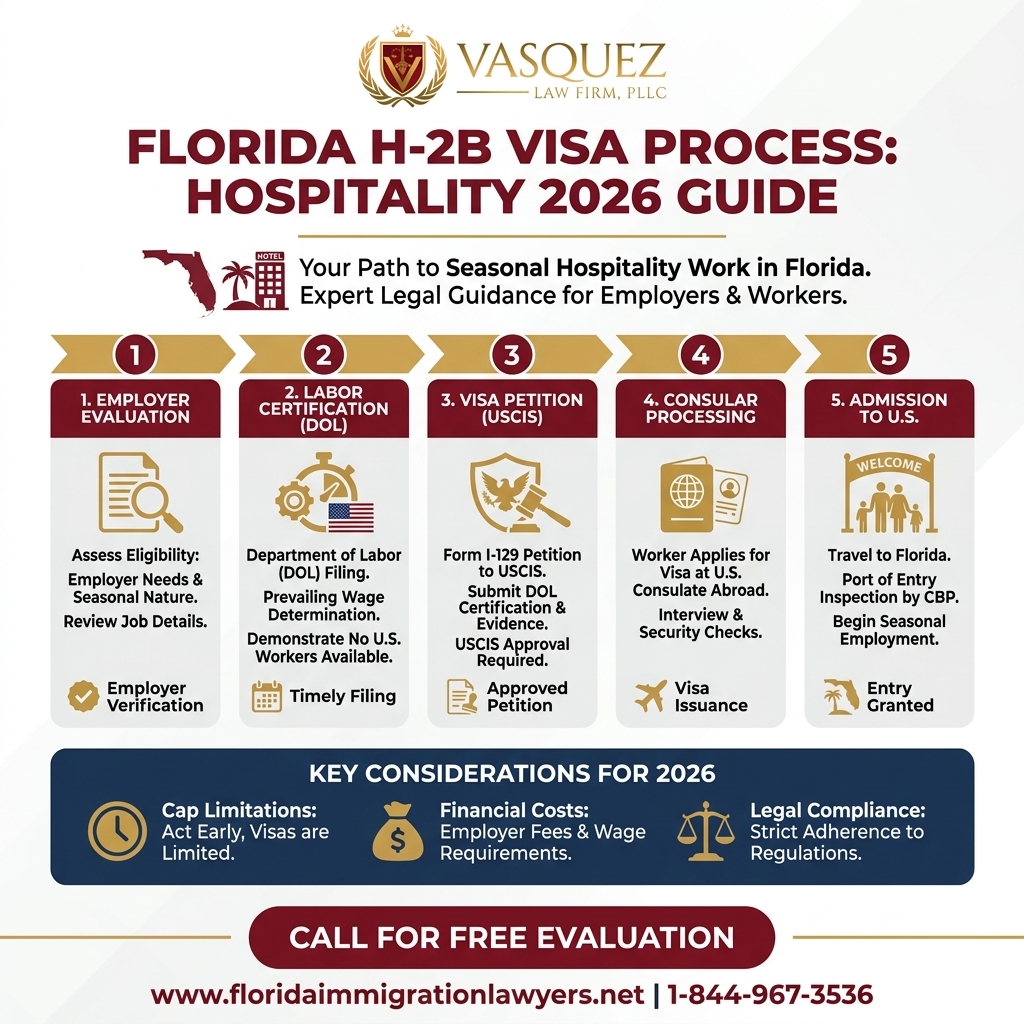
Securing an H-2B visa for your Florida hospitality business involves a multi-agency process that demands careful planning and execution. Understanding each step is crucial for a successful outcome. Here is a general outline of the process:
-
Determine Temporary Need: The employer must first establish that their need for workers is temporary, falling under seasonal, peakload, intermittent, or one-time occurrence. This is the foundation of the H-2B petition. A detailed explanation and supporting documentation are required.
-
File a Temporary Labor Certification Application (Form ETA-9142B) with DOL: The employer submits a request to the Department of Labor (DOL) for a temporary labor certification. This application outlines the job offer, wages, and working conditions. The DOL reviews the application to ensure it meets program requirements and that there are no qualified U.S. workers available. This includes a mandatory recruitment period where the employer advertises the job to U.S. workers. Employers must obtain a prevailing wage determination before filing.
-
Receive Temporary Labor Certification: If the DOL certifies that no qualified U.S. workers are available for the temporary positions, they issue a temporary labor certification. This certification is a prerequisite for filing the H-2B petition with USCIS. The DOL’s decision is crucial and can sometimes be challenged through the Executive Office for Immigration Review (EOIR) if a denial is believed to be in error.
-
File Form I-129, Petition for a Nonimmigrant Worker, with USCIS: Once the labor certification is approved, the employer files Form I-129 with U.S. Citizenship and Immigration Services (USCIS). This petition officially requests H-2B classification for the named or unnamed workers. Supporting documents include the approved labor certification, a detailed letter explaining the temporary need, and any additional evidence.
-
USCIS Petition Approval: USCIS reviews the I-129 petition. If approved, USCIS sends an approval notice (Form I-797). This approval allows the workers to apply for their visas or change/extend their status if already in the U.S.
-
Visa Interview at U.S. Embassy/Consulate (for workers abroad): Workers located outside the U.S. must attend an interview at a U.S. embassy or consulate in their home country. They will present their approved I-797 notice, passport, and other required documents. The U.S. Department of State (travel.state.gov) outlines specific requirements for visa applicants.
-
Entry into the U.S.: Upon successful interview and visa issuance, the H-2B workers can travel to the U.S. and begin their temporary employment in Florida. They will typically be admitted for the period authorized on the labor certification, plus an additional 10 days before and after the employment period.
Essential Document Checklist for H-2B Petitioners
A successful H-2B visa application hinges on providing comprehensive and accurate documentation. Both the employer and the prospective seasonal worker Florida hospitality applicant have specific sets of documents to prepare. Missing or incorrect documents can lead to significant delays or even denial. Here is a general checklist of essential documents:
For the Employer (Petitioner):
- Temporary Labor Certification (Form ETA-9142B and appendices) approved by the Department of Labor.
- Form I-129, Petition for a Nonimmigrant Worker.
- Employer’s federal tax identification number (EIN).
- Evidence of temporary need (e.g., seasonal business records, contracts, detailed business plans demonstrating peakload or one-time event).
- Copies of advertisements for U.S. workers and recruitment results.
- Business registration documents and licenses (e.g., Florida Department of State registration).
- Financial statements to demonstrate ability to pay wages.
- Organizational charts and job descriptions for the H-2B positions.
- Prevailing Wage Determination issued by the DOL.
For the H-2B Worker (Beneficiary):
- Valid passport (valid for at least six months beyond the period of intended stay).
- Nonimmigrant Visa Application, Form DS-160 confirmation page.
- Appointment confirmation for visa interview.
- Photographs meeting U.S. visa requirements.
- Copy of the approved Form I-797, Notice of Action (H-2B petition approval).
- Evidence of qualifications for the job (e.g., educational certificates, work experience letters, professional licenses).
- Proof of intent to return to home country (e.g., property deeds, family ties, bank statements, previous employment records).
- Any other documents requested by the consular officer during the interview.
Maintaining meticulous records and organizing all documentation is paramount. Our team at Florida Immigration Lawyers can help you compile and review these critical documents, ensuring your petition is as strong as possible. Visit our business immigration page for more information on how we assist employers.
H-2B Visa Timeline and Processing Expectations for Florida Businesses
The H-2B visa process is notoriously time-sensitive and can be lengthy, often taking several months from initial planning to worker arrival. Florida hospitality businesses seeking seasonal worker Florida hospitality staff must plan far in advance due to the multi-stage nature of the application and the annual visa cap. Understanding the typical timeline can help manage expectations and avoid critical delays.
The first major hurdle is the Department of Labor’s Temporary Labor Certification (TLC) process. This phase alone can take 2-4 months. It includes filing for a Prevailing Wage Determination (PWD), which can take 60-90 days, followed by the actual ETA-9142B filing and the mandatory recruitment period, which adds another 45-60 days. Employers often need to start this process almost 6-9 months before their anticipated start date for workers.
Once the TLC is certified, the employer files Form I-129 with USCIS. USCIS processing times can vary significantly, ranging from 2-5 months, depending on the service center workload and whether premium processing is utilized. Premium processing, which guarantees a 15-calendar-day processing time for an additional fee, is often a necessary investment for employers with urgent needs, especially given the competitive nature of the H-2B cap.
Finally, for workers outside the U.S., consular processing adds another layer. Visa interview wait times at U.S. embassies and consulates abroad can range from a few weeks to several months, depending on the country. After a successful interview, visa printing and passport return typically take another week or two. Overall, from the initial PWD request to the worker's arrival in Florida, the entire process can easily span 6 to 9 months, or even longer if there are Requests for Evidence (RFEs) or other complications. Proactive planning and legal guidance are essential to navigate these timelines effectively.
Cost Factors and Fee Breakdown for H-2B Visas
Obtaining an H-2B visa involves several governmental and administrative fees that both employers and workers should anticipate. These costs can add up, making financial planning an important part of the application process for seasonal worker Florida hospitality positions. While specific fees are subject to change, understanding the categories helps in budgeting.
The primary costs begin with the Department of Labor (DOL) phase. Although there is no direct filing fee for the ETA-9142B application itself, employers incur expenses related to the mandatory recruitment process. This includes advertising costs in local newspapers and online job boards to demonstrate a lack of available U.S. workers. These advertising costs can vary widely depending on the publication and duration.
Next are the USCIS fees. The main fee is for filing Form I-129, Petition for a Nonimmigrant Worker. This fee is paid by the employer. If the employer opts for premium processing to expedite USCIS review, an additional significant fee is required. There is also a fraud prevention and detection fee associated with each H-2B petition. In some cases, if the workers are named and require biometrics, a biometrics fee may also apply.
For workers applying from outside the U.S., there is a nonimmigrant visa application (DS-160) fee, which is paid to the U.S. Department of State. This fee covers the cost of processing the visa application and the consular interview. Additional costs might include travel expenses for interviews, medical examinations if required, and legal fees for immigration attorneys. While employers typically cover most of the petition costs, it's essential for both parties to understand their financial responsibilities. Seeking a free consultation with Florida Immigration Lawyers can help you understand the full scope of potential costs.
Benefits of the H-2B Visa for Florida Hospitality Businesses
The H-2B visa program offers significant advantages for Florida’s dynamic hospitality sector, which often faces acute labor shortages during peak seasons. For businesses in Tallahassee, Orlando, Miami, and coastal towns, the ability to hire seasonal worker Florida hospitality staff through this program is not just a convenience; it's often a necessity for sustained growth and service quality. This visa allows employers to reliably meet fluctuating demands without overstaffing during off-peak times.
One primary benefit is access to a dedicated and motivated workforce. H-2B workers are often highly committed to their temporary assignments, providing reliable labor during critical periods. This helps Florida businesses maintain high standards of customer service, which is paramount in the competitive hospitality industry. By filling essential roles, from hotel housekeepers and restaurant cooks to resort attendants and event staff, businesses can avoid service disruptions and negative customer experiences that could arise from understaffing.
Furthermore, the H-2B program allows Florida businesses to strategically plan their staffing needs well in advance. With proper legal guidance and timely filing, employers can have a clear expectation of their workforce availability, enabling better operational planning, training schedules, and resource allocation. This stability is crucial for businesses that rely heavily on seasonal tourism and events. Ultimately, the H-2B visa helps Florida’s hospitality sector remain competitive, ensuring that the state continues to be a premier destination for visitors worldwide, while also contributing to local economies and job creation for U.S. workers in supporting roles.
Common Mistakes to Avoid in the H-2B Visa Process
Navigating the H-2B visa process is complex, and even minor errors can lead to significant delays or denials. Florida employers and seasonal workers should be aware of common pitfalls to ensure a smooth application. Avoiding these mistakes can save considerable time, money, and stress.
-
Underestimating the Timeline: Many employers fail to start the process early enough, especially given the multi-agency coordination and potential for delays. Begin 6-9 months before the desired start date.
-
Failing to Prove Temporary Need: USCIS and DOL strictly scrutinize the temporary nature of the job. Inadequate documentation or vague explanations about seasonal or peakload demands can lead to denial. Employers must clearly articulate and provide evidence of why the job is not permanent.
-
Incomplete or Inaccurate Documentation: Missing forms, incorrect information, or insufficient supporting evidence (e.g., business records, recruitment results) are frequent reasons for Requests for Evidence (RFEs) or outright rejections. Meticulous preparation is essential.
-
Improper Recruitment of U.S. Workers: The DOL requires specific steps for U.S. worker recruitment. Failure to follow these precisely, including advertising duration, placement, and proper documentation of results, can jeopardize the labor certification.
-
Not Meeting Prevailing Wage Requirements: Employers must pay H-2B workers at least the prevailing wage for the occupation in the area of intended employment. Failure to do so, or using an incorrect wage determination, can result in penalties and denial.
-
Ignoring the H-2B Cap: The annual cap of 66,000 visas is often met quickly. Employers who file too late in the fiscal half may find no visas available, forcing them to re-plan or delay their staffing needs. Timely filing is paramount.
-
Lack of Non-Immigrant Intent (for workers): H-2B workers must demonstrate they intend to return to their home country after their temporary employment. Insufficient evidence of ties abroad (e.g., property, family) can lead to visa denial at the consulate.
-
Failure to Comply with Post-Certification Obligations: Employers have ongoing responsibilities, such as maintaining specific records, cooperating with DOL audits, and notifying DOL of certain events. Non-compliance can lead to future program disqualification.
-
Submitting an Unqualified Petition: Presenting a petition for a worker who does not meet the job requirements, or for a job that clearly does not fit the H-2B criteria, is a waste of time and resources.
When to Call a Florida Immigration Lawyer for H-2B Visas
The complexities of the H-2B visa program make professional legal guidance not just beneficial, but often essential for both Florida employers and prospective seasonal worker Florida hospitality applicants. While this guide provides a comprehensive overview, individual cases can present unique challenges that require expert legal interpretation and strategy.
You should contact Florida Immigration Lawyers if you are a Florida employer considering the H-2B program for the first time, or if you have faced challenges in previous applications. Our attorneys can help you accurately assess your temporary need, navigate the Department of Labor's intricate recruitment requirements, and prepare a robust I-129 petition for USCIS. We also provide crucial support in responding to Requests for Evidence (RFEs) or Notices of Intent to Deny (NOIDs), which often require detailed legal arguments.
Furthermore, if you are an H-2B worker encountering issues with your visa interview, or if you have questions about your rights and responsibilities while working in Florida, our team can provide clarity and representation. Recent news highlighting the complexities and 'micromanaging' of immigration courts underscores the dynamic nature of immigration law; having an experienced attorney on your side ensures you are prepared for any eventuality. Our dedicated immigration practice area handles all aspects of temporary work visas. Do not leave your immigration future to chance; our firm is here to help.
About Florida Immigration Lawyers
Florida Immigration Lawyers is an immigration law firm dedicated to serving individuals and businesses across the entire state of Florida. Our experienced team understands the profound impact immigration matters have on our clients' lives and livelihoods. We focus on a wide range of immigration services, including family-based petitions, business immigration solutions like the H-2B visa, asylum claims, and deportation defense.
We pride ourselves on providing compassionate, client-focused representation with a deep commitment to achieving the strongest possible outcomes. Our attorneys stay abreast of the latest changes in immigration law and policy, ensuring that our advice is always current and effective. We serve clients in Orlando and every community in between, offering personalized strategies tailored to each unique situation.
Choosing Florida Immigration Lawyers means partnering with a team that genuinely cares about your success. We offer free consultations to discuss your case and provide clear, actionable advice. Our firm is available 24/7, and we are proud to offer bilingual services, ensuring that language is never a barrier to quality legal representation. When your future in Florida is on the line, trust the dedicated professionals at Florida Immigration Lawyers. Visit our contact page or explore our attorneys profiles to learn more.
Sources and References
- U.S. Citizenship and Immigration Services (USCIS)
- Executive Office for Immigration Review (EOIR)
- U.S. Department of State (travel.state.gov)
- 8 U.S.C. § 1101(a)(15)(H)(ii)(b) - Immigration and Nationality Act (INA) defining H-2B Nonimmigrants
- 8 CFR § 214.2(h)(6) - Regulations governing H-2B petitions
- 20 CFR Part 655 - Temporary Employment of H-2B Foreign Workers in the United States
- U.S. Department of Labor (DOL) - Office of Foreign Labor Certification
Related services: immigration practice areas, family immigration services.
This article provides general legal information and is not intended as legal advice. Every case is unique, and outcomes depend on specific facts and circumstances. Contact an attorney for advice about your particular situation.
The path to securing an H-2B visa for seasonal workers in Florida hospitality can be challenging, but with the right legal support, it is entirely manageable. Whether you are an employer seeking to fill critical seasonal roles or a skilled individual looking for temporary work in Florida, our firm is here to guide you every step of the way. Call Florida Immigration Lawyers today at 1-844-YO-PELEO for a free consultation. Se Habla Espanol - Estamos aqui para ayudarle.
Do Not Navigate This Process Alone
Our experienced immigration attorneys are ready to fight for you. Get a free, confidential case review today.
Se Habla Español
Or leave your details and we’ll call you:
Free Evaluation in 24 Hours
Or talk to us right now
AI voice assistant — available 24/7
FreeFrequently Asked Questions

William J. Vásquez
Founding Attorney · Vasquez Law Firm
U.S. Air Force veteran and immigration attorney with years of hands-on U.S. immigration experience. J.D., NCCU School of Law. AILA member. Admitted to the 4th, 5th, and 11th Circuit Courts.
Available 24/7 - Free Evaluations
Reviewed for legal accuracy by William J. Vásquez
Licensed in North Carolina; U.S. immigration is federal practice.
Related Legal Services
Our Florida immigration attorneys can help you with asylum protection, citizenship and naturalization and immigration practice areas. Call today at 1-844-YO-PELEO for a free case review.
Related Links
Related Topics
Free Legal Case Review
Discuss your case with our experienced attorneys. We're available 24/7.
Se Habla Español - Estamos aquí para ayudarle.
Related Articles
DUI Immigration Consequences in Florida 2026
A DUI conviction in Florida can have severe immigration consequences, potentially leading to inadmissibility, deportation, or denial of immigration benefits. For non-citizens, a DUI is not just a traffic offense but a serious criminal matter that federal immigration law scrutinizes closely. Factors like multiple offenses, injury, or property damage can escalate a simple DUI to a Crime Involving Moral Turpitude (CIMT) or even an aggravated felony, triggering mandatory detention and removal proceedings. Understanding the specific nature of your Florida conviction and its interpretation under the Immigration and Nationality Act (INA) is crucial. This article outlines how DUIs impact immigration status, the grounds for inadmissibility and deportation, a step-by-step guide to navigating the process, essential documentation, and expected timelines for 2026. We also highlight common mistakes to avoid and when to seek legal counsel from an experienced immigration attorney. Florida Immigration Lawyers offers comprehensive support for individuals facing these challenging situations, providing expert guidance through complex legal landscapes.
Immigration Lawyer Orlando Free Consultation in Florida
For individuals and families in Orlando, Florida, navigating the complexities of U.S. immigration law requires expert guidance. An immigration lawyer in Orlando offers crucial support for everything from visa applications and green card processes to naturalization and deportation defense. This comprehensive guide details what a free consultation covers, providing a step-by-step overview of immigration pathways, essential document checklists, and expected timelines in 2026. We also highlight common mistakes to avoid, discuss the critical role of legal counsel in deportation and asylum cases, and explain why choosing a local Orlando immigration attorney is beneficial. Florida Immigration Lawyers is dedicated to serving the diverse community of Orlando with compassionate, effective legal solutions, ensuring you receive personalized advice and robust representation for a successful immigration journey.
EAD Advance Parole Combo Card in Florida 2026
For individuals with a pending Form I-485, Application to Register Permanent Residence or Adjust Status, the EAD Advance Parole Combo Card is an essential document. This single card combines the authorization to work legally in the U.S. (Employment Authorization Document - EAD) with permission to travel internationally and re-enter without abandoning your green card application (Advance Parole). This guide from Florida Immigration Lawyers provides a comprehensive overview for applicants in Florida in 2026, covering eligibility, the step-by-step application process, required documents, expected processing times, and associated costs. We also highlight common mistakes to avoid and when to seek legal counsel to ensure a smooth and successful immigration journey. Understanding this vital card is key to maintaining stability while awaiting your permanent residency approval.
EAD Advance Parole Combo Card in Florida: What You Need
An EAD advance parole combo card allows individuals with pending adjustment applications to both work and travel abroad without jeopardizing their green card application. Learn how to apply in Florida, what documents you need, and common mistakes to avoid.