H-4 EAD Work Permit Rules for Spouses in Florida
Explore how H-4 EAD work permits enable spouses of H-1B visa holders in Florida to gain work authorization. Learn about the application process, eligibility, and common mistakes to avoid. Florida Immigration Lawyers offer expert guidance to ensure a smooth process.
H-4 visa holders, spouses of H-1B visa holders, may be eligible for an Employment Authorization Document (EAD) in Florida. This allows them to work legally while residing in the U.S. Key details include:
- Eligibility depends on the H-1B visa holder's status.
- Application requires Form I-765 and supporting documents.
- Approval grants work authorization across various fields.
Introduction
Imagine moving to Orlando, Florida, as part of an H-1B visa family, only to find that your spouse cannot work. This is a common scenario for H-4 visa holders. However, the H-4 EAD offers a pathway for spouses to gain work authorization, providing them with an opportunity to contribute economically and enhance their careers. This article will guide you through the eligibility criteria, application process, and common pitfalls to avoid. For personalized assistance, call Florida Immigration Lawyers at 1-844-YO-PELEO for a free case review.
The H-4 EAD rule, implemented in 2015, was a significant step towards empowering H-4 spouses, many of whom are highly educated professionals. Before this rule, H-4 visa holders were generally unable to work, leading to career stagnation, financial strain, and emotional distress for many families. The ability to work not only improves family finances but also allows spouses to maintain their professional skills, pursue personal growth, and integrate more fully into American society.
Florida, with its diverse economy and growing tech sector, is a popular destination for H-1B professionals. For H-4 spouses in cities like Miami, Tampa, or Jacksonville, obtaining an EAD can open doors to numerous job opportunities, from healthcare to technology, and even entrepreneurship. Understanding the intricacies of this process is crucial, as even minor errors can lead to significant delays or denials, impacting your family's plans and financial stability. This guide aims to demystify the H-4 EAD application process specifically for those residing in the Sunshine State.
What is an H-4 EAD and Who Qualifies?
An H-4 EAD, or Employment Authorization Document, allows spouses of H-1B visa holders to work legally in the U.S. To qualify, the H-1B visa holder must have an approved I-140 petition or be granted H-1B status under AC21 sections 106(a) and (b). This enables a broader range of opportunities for families residing in Florida.
The core principle behind H-4 EAD eligibility is that the H-1B spouse is on a clear path to obtaining lawful permanent residency (a Green Card). An approved I-140 petition, also known as an Immigrant Petition for Alien Worker, signifies that USCIS has recognized the H-1B worker's qualifications for an employment-based green card. Similarly, H-1B status under AC21 sections 106(a) and (b) refers to extensions beyond the standard six-year limit for H-1B visas, typically granted when a green card application (PERM or I-140) has been pending for a certain period. This ensures that work authorization is granted to spouses whose families have a long-term future planned in the U.S.
Consider the case of Priya, an H-4 visa holder living in Orlando. Her husband, an H-1B professional, has just received approval for his I-140 petition. With this crucial step completed, Priya now qualifies to apply for her H-4 EAD, allowing her to resume her career as a software engineer. Without the approved I-140, Priya would not be eligible, highlighting the direct link between the H-1B holder's green card process and the H-4 spouse's ability to work. As of 2026, the eligibility criteria remain stringent, focusing on the H-1B visa holder's status and their path to permanent residency. The process ensures that only those who meet specific requirements can apply, maintaining the integrity of the immigration system. It's vital to remember that the H-4 EAD is always tied to the H-1B status of the primary visa holder; if the H-1B status is lost or expires without extension, the H-4 EAD also becomes invalid.
How to Apply for an H-4 EAD in Florida
To apply for an H-4 EAD, you must submit Form I-765, Application for Employment Authorization, along with the required documentation. The application process includes:
- Complete Form I-765, ensuring all personal information is accurate.
- Attach a copy of your current H-4 visa and I-94 form.
- Include evidence of the H-1B visa holder’s approved I-140 or AC21 status.
- Submit recent passport-sized photographs.
- Mail the application to the designated USCIS address for Florida residents.
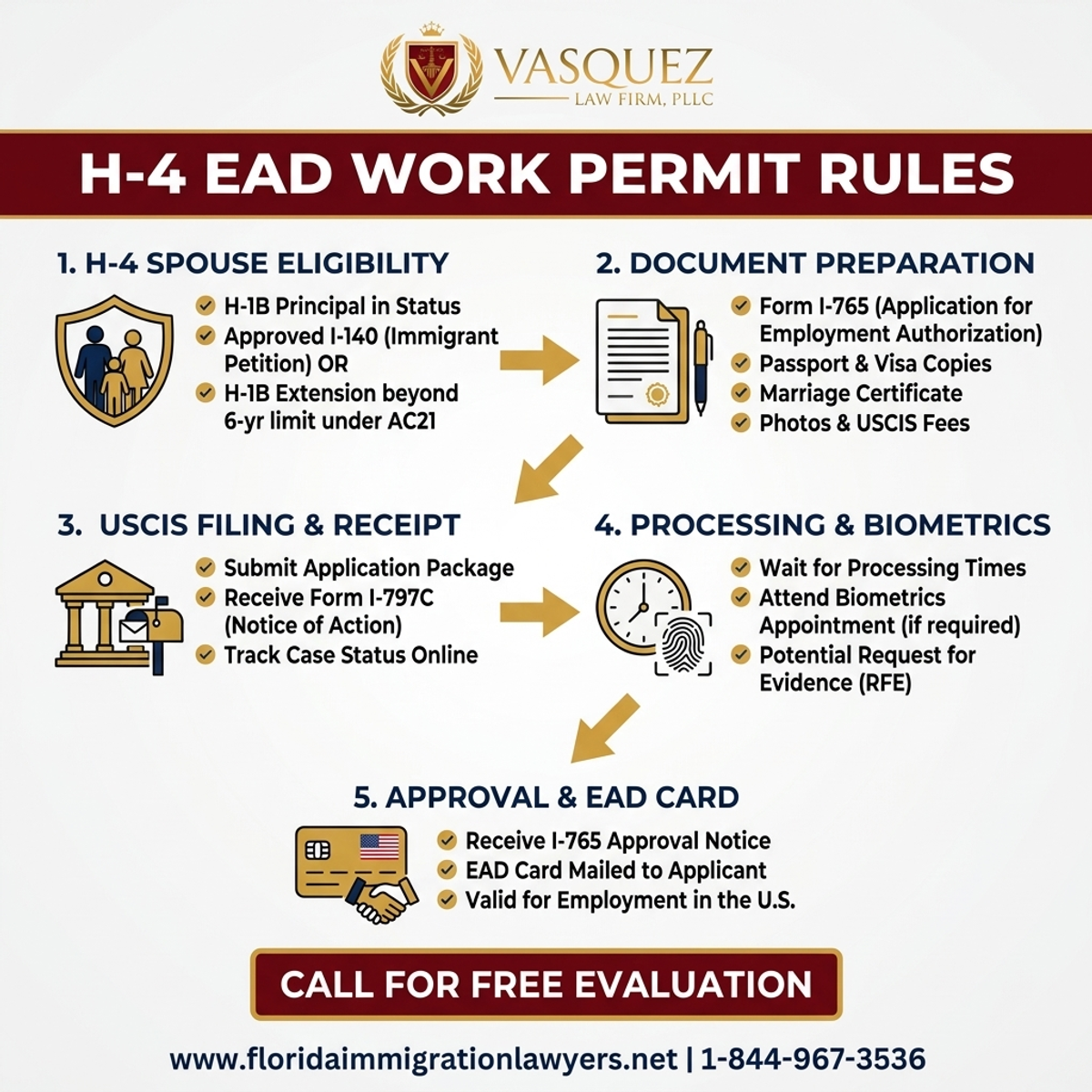
Step-by-Step Process — H-4 EAD Work Permit Rules for Spouses in Florida
When completing Form I-765, pay meticulous attention to detail. Any discrepancies between your application and previous immigration records, or simple typos, can trigger a Request for Evidence (RFE) or even a denial. It's advisable to cross-reference all personal data with your passport, visa, and I-94 records. For Florida residents, the mailing address for USCIS typically depends on the type of application and whether it's filed concurrently with another petition. Always consult the official USCIS website for the most current filing addresses to prevent misdirection and delays.
A practical tip for applicants is to organize all supporting documents clearly. Create a cover letter listing all enclosed documents and use tabs or separators to make it easy for the USCIS officer to review. Before mailing, make a complete photocopy or scan of your entire application package for your personal records. This copy can be invaluable if USCIS requests additional information or if you need to refer back to your submission. Processing times can vary, but applicants should prepare for adjustments in 2026. For the latest updates, visit USCIS. Consulting with Florida Immigration Lawyers can ensure your application is accurate and complete, minimizing potential hurdles.
Document Checklist for H-4 EAD Application
- Completed Form I-765
- Copy of H-4 visa and I-94
- Proof of H-1B visa holder’s approved I-140 or AC21 status
- Two recent passport-size photos
- Check or money order for the filing fee
Ensure all documents are current and complete to avoid processing delays. Missing documents are a common reason for application denials.
Beyond the primary list, remember to include copies of your marriage certificate to prove your relationship to the H-1B visa holder. Additionally, copies of the H-1B visa holder's most recent H-1B Approval Notice (Form I-797) and their current I-94 record are essential to establish their valid H-1B status. When providing proof of the H-1B holder's approved I-140, include the I-797 approval notice for the I-140 petition. If relying on AC21 provisions, you'll need documentation demonstrating the H-1B holder has been granted extensions beyond the six-year limit based on a pending PERM or I-140.
For the passport-sized photographs, ensure they meet USCIS specifications: 2x2 inches, color, white background, taken within the last six months, and showing a full-face view directly facing the camera. Do not staple the photos to the form; place them in a small, clear envelope and attach it to the application. Regarding the filing fee, always double-check the exact amount on the USCIS website or by calling Florida Immigration Lawyers, as fees are subject to change. Payment should be made by check or money order payable to "U.S. Department of Homeland Security," with the applicant's name and A-number (if applicable) written on the memo line.
Timeline and Processing Expectations for H-4 EAD
| Stage | Typical Timeframe | Notes |
|---|---|---|
| USCIS Receipt | 2-4 weeks | Receipt notice sent |
| Application Review | 3-5 months | Depends on workload |
| Decision Issued | 6-8 months | Includes EAD card delivery |
Processing times may fluctuate, so it's crucial to check the USCIS website for the most current information.
Several factors can influence the processing timeline, including the specific USCIS service center handling your application, the volume of applications, and whether your application is complete or requires a Request for Evidence (RFE). An RFE can add several weeks or even months to the process, making it imperative to submit a thorough and accurate application from the outset. While the table provides general estimates, it's not uncommon for processing to take longer, especially during periods of high demand or policy changes.
A practical tip for tracking your application is to use the receipt number provided on your I-797C Notice of Action. You can enter this number on the USCIS online case status tool to monitor its progress. While there is no premium processing option directly for H-4 EAD applications, if your H-1B spouse's extension is filed concurrently and premium processing is used for their H-1B, it might indirectly expedite the H-4 and H-4 EAD processing. However, this is not guaranteed, and the H-4 EAD will still follow its own processing queue. Planning ahead and submitting your renewal application well in advance of your current EAD's expiration date is highly recommended to avoid gaps in employment authorization.
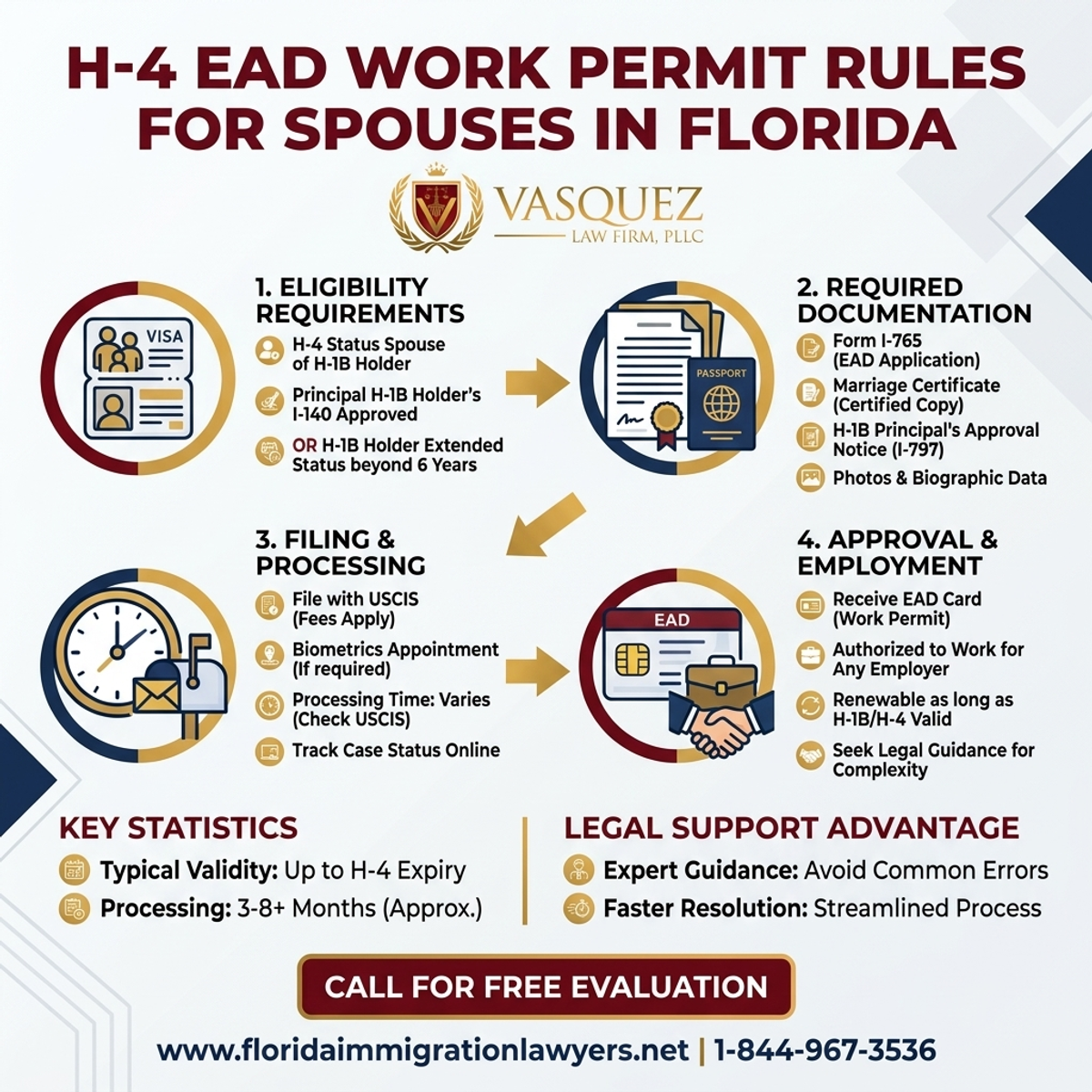
Key Statistics — H-4 EAD Work Permit Rules for Spouses in Florida
Cost Factors and Fee Breakdown for H-4 EAD
| Item | Typical Fee | Notes |
|---|---|---|
| Form I-765 Filing Fee | Varies | Check USCIS for current fees |
| Biometric Services | Varies | If applicable |
Costs can vary based on individual circumstances. Always verify current fees on the USCIS website.
The filing fee for Form I-765 is a significant component of the overall cost. USCIS periodically updates its fee schedule, sometimes with little advance notice, so it's critical to confirm the exact amount on the official website before preparing your payment. Submitting an incorrect fee, even by a small amount, will result in your application being rejected and returned, causing considerable delays. For example, if the fee is $410 and you send $400, your application will not be processed.
Biometric services, which involve fingerprinting and a photograph, are sometimes required for H-4 EAD applicants. If a biometric appointment is necessary, there will be an associated fee, which also varies and must be paid separately or included with the I-765 fee, depending on current USCIS instructions. Not all H-4 EAD applicants are required to attend a biometrics appointment, but if you receive a notice, it's mandatory to attend. Beyond these direct USCIS fees, applicants should also budget for other potential expenses, such as postal fees for certified mail, professional passport photo services, and, most importantly, legal fees if you choose to work with an experienced immigration attorney like Florida Immigration Lawyers. Investing in legal guidance can help you avoid costly mistakes and ensure a smoother application process.
Do not navigate this process alone. Contact Florida Immigration Lawyers today.
Common Mistakes to Avoid
- Filing Incorrect Forms: Ensure you submit the correct forms, like Form I-765, to avoid rejections. This often leads to immediate rejection and significant delays, requiring you to restart the entire process.
- Ignoring Deadlines: Missing submission deadlines can lead to application denial. For renewals, filing too late can result in a gap in employment authorization.
- Providing Incomplete Documentation: Double-check all documents for completeness. Even a single missing page or signature can trigger a Request for Evidence (RFE) or denial.
- Not Checking USCIS Updates: Policies can change; stay informed by visiting USCIS. Fee changes and filing address updates are common and critical.
- Misunderstanding Eligibility: Confirm your eligibility before applying to avoid wasted effort. Ensure the H-1B spouse's I-140 is approved or AC21 criteria are met.
- Incorrect Fee Payments: Check for the latest fee amounts before payment. An incorrect fee will cause your application to be returned unprocessed.
- Overlooking Legal Advice: Consult a lawyer to guide you through complex scenarios. An attorney can spot potential issues and strengthen your application.
When to Call a Lawyer
Consider consulting an attorney if you face challenges such as application denials, complex eligibility questions, or need assistance with appeals. Florida Immigration Lawyers offer expertise in navigating these processes, ensuring your application is handled efficiently and effectively. Contact us if you have questions about your specific situation.
Engaging an immigration attorney becomes particularly crucial in several scenarios. For instance, if you have any past immigration violations, a criminal record, or if your H-1B spouse's immigration status has complexities (e.g., multiple H-1B transfers, issues with previous employers), a lawyer can help assess the impact on your H-4 EAD eligibility and prepare a robust application. They can also provide invaluable assistance if you receive a Request for Evidence (RFE) from USCIS, helping you gather and present the necessary documentation to address their concerns effectively.
Another common situation where legal counsel is beneficial is during concurrent filings, such as when your H-4 EAD application is filed simultaneously with your H-1B spouse's H-1B extension or change of status. An attorney can ensure all applications are properly linked, submitted correctly, and follow the correct sequence to prevent delays or complications. The team at Florida Immigration Lawyers is well-versed in these intricate processes and can offer a free case review to discuss your specific circumstances and provide tailored advice. Don't hesitate to call us at 1-844-YO-PELEO if you feel overwhelmed or unsure about any aspect of your H-4 EAD application.
Frequently Asked Questions About H-4 EAD in Florida
Q1: Can I apply for an H-4 EAD if my H-1B spouse's I-140 is still pending?
No, unfortunately, an approved I-140 petition for your H-1B spouse is a mandatory eligibility requirement for an H-4 EAD. USCIS requires this approval to confirm the H-1B holder's clear path to a green card. If the I-140 is still pending, you will need to wait for its approval before you can submit your H-4 EAD application. This ensures the integrity of the program and focuses on those with a long-term immigration trajectory.
Q2: How long is an H-4 EAD typically valid for?
An H-4 EAD is typically valid for the same period as the H-1B visa holder's underlying H-1B status, usually between one to three years. Its validity is directly tied to the H-1B spouse's authorized period of stay. If the H-1B status is extended, you will need to apply for an H-4 EAD renewal to continue working legally. It's crucial to track both your EAD and your spouse's H-1B expiration dates to avoid any gaps in employment authorization.
Q3: Can I travel internationally while my H-4 EAD application is pending?
Yes, you can generally travel internationally while your H-4 EAD application is pending, provided your H-4 visa and I-94 status remain valid for re-entry. However, if you have a pending H-4 change of status or extension of stay application, traveling outside the U.S. could be considered abandonment of that application. Always consult with an immigration attorney like Florida Immigration Lawyers before making travel plans during a pending application to ensure your return to the U.S. will not be jeopardized.
Q4: What happens to my H-4 EAD if my H-1B spouse changes employers?
If your H-1B spouse changes employers and files a new H-1B petition, your existing H-4 EAD generally remains valid as long as your spouse maintains valid H-1B status and their new employer's I-140 is approved (or they meet AC21 criteria). However, it's a good practice to file an H-4 EAD renewal concurrently with the H-1B transfer and extension to ensure continuous work authorization and to reflect the most current H-1B status. This proactive step can prevent future complications.
Q5: Is there a premium processing option available for H-4 EAD applications?
Currently, USCIS does not offer a premium processing option specifically for H-4 EAD applications (Form I-765). While premium processing is available for certain H-1B petitions, it does not directly accelerate the processing of the associated H-4 EAD. Applicants must rely on the standard processing times, which can fluctuate. Therefore, it is highly recommended to plan ahead and submit your H-4 EAD application, especially renewals, well in advance of your desired start date or current EAD expiration.
About Florida Immigration Lawyers
Florida Immigration Lawyers, based in Orlando, provides comprehensive immigration services across the state. Our experienced attorneys specialize in family, business, asylum, and deportation defense immigration. With a commitment to personalized service and a deep understanding of Florida's unique immigration landscape, we're here to help you navigate your immigration journey. Available 24/7, we offer free case reviews to help you get started. Call us at 1-844-YO-PELEO for assistance or schedule a free consultation today.
Our team understands the profound impact immigration decisions have on individuals and families. We pride ourselves on providing clear, compassionate, and effective legal representation. Whether you are seeking to secure an H-4 EAD, navigate a complex family petition, or require defense against deportation, our dedicated attorneys are equipped with the knowledge and resources to advocate fiercely on your behalf. We serve clients throughout Florida, from Jacksonville to Miami, ensuring that expert legal guidance is accessible wherever you are.
Choosing the right legal partner is paramount to your success. At Florida Immigration Lawyers, we don't just process paperwork; we build relationships and offer strategic advice tailored to your unique circumstances. Our commitment extends to keeping you informed at every stage of your case, demystifying legal jargon, and providing peace of mind. Let us leverage our expertise to help you achieve your immigration goals in Florida. We are always ready to answer your questions and provide the support you need.
Sources and References
- U.S. Citizenship and Immigration Services (USCIS)
- Executive Office for Immigration Review (EOIR)
- U.S. Department of State
- 8 U.S.C. Chapter 12 - Immigration and Nationality Act
Related services: family petition process, family-based green cards, fiancé visa (K-1), marriage-based immigration.
This article provides general legal information and is not intended as legal advice. Every case is unique, and outcomes depend on specific facts and circumstances. Contact an attorney for advice about your particular situation.
Se Habla Español - Estamos aquí para ayudarle. Call 1-844-YO-PELEO for a free consultation today.
If you need legal assistance, learn more about our family immigration services, or call us at 1-844-967-3536 for a free case review.
Do Not Navigate This Process Alone
Our experienced immigration attorneys are ready to fight for you. Get a free, confidential case review today.
Se Habla Español
Or leave your details and we’ll call you:
Free Evaluation in 24 Hours
Or talk to us right now

AI voice assistant — available 24/7
FreeFrequently Asked Questions

William J. Vásquez
Founding Attorney · Vasquez Law Firm
U.S. Air Force veteran and immigration attorney with years of hands-on U.S. immigration experience. J.D., NCCU School of Law. AILA member. Admitted to the 4th, 5th, and 11th Circuit Courts.
Available 24/7 - Free Evaluations
Reviewed for legal accuracy by William J. Vásquez
Licensed in North Carolina; U.S. immigration is federal practice.
Related Legal Services
Our Florida immigration attorneys can help you with business immigration, deportation defense and family immigration services. Call today at 1-844-YO-PELEO for a free case review.
Related Links
Related Topics
Free Legal Case Review
Discuss your case with our experienced attorneys. We're available 24/7.
Se Habla Español - Estamos aquí para ayudarle.
Related Articles
Certificate of Eligibility for Expungement in Florida 2026
For non-U.S. citizens in Florida, understanding how a state expungement impacts immigration status is critical. A certificate of eligibility for expungement in Florida allows a criminal record to be sealed or expunged under state law. However, federal immigration agencies often disregard such state-level relief, still considering the original criminal offense as a conviction for immigration purposes. This can have severe implications for visa applications, green card eligibility, naturalization, and even lead to deportation. This guide clarifies the Florida expungement process, its limited effect on federal immigration law, and key steps to protect your status in 2026. Learn about common mistakes, required documents, timelines, and when to seek expert legal counsel from Florida Immigration Lawyers to navigate these complex issues effectively.
Immigration Lawyer Orlando Free Consultation in Florida
For individuals and families in Orlando, Florida, navigating the complexities of U.S. immigration law requires expert guidance. An immigration lawyer in Orlando offers crucial support for everything from visa applications and green card processes to naturalization and deportation defense. This comprehensive guide details what a free consultation covers, providing a step-by-step overview of immigration pathways, essential document checklists, and expected timelines in 2026. We also highlight common mistakes to avoid, discuss the critical role of legal counsel in deportation and asylum cases, and explain why choosing a local Orlando immigration attorney is beneficial. Florida Immigration Lawyers is dedicated to serving the diverse community of Orlando with compassionate, effective legal solutions, ensuring you receive personalized advice and robust representation for a successful immigration journey.
How to Apply for VAWA in Florida: A 2026 Guide
Discover how to apply for VAWA in Florida, offering crucial immigration relief for abuse victims. Learn the process, requirements, and how Florida Immigration Lawyers can assist you.
USCIS Office Near Me: Florida Locations & Appointments 2026
Navigating USCIS processes in Florida can be complex, from finding the right field office to preparing for critical appointments. This comprehensive guide provides essential information for individuals seeking immigration services in 2026, including a step-by-step process for locating your nearest USCIS office in Florida, understanding its services, and efficiently scheduling appointments. We detail the necessary documents for interviews, outline typical processing timelines, and break down associated costs. Furthermore, we highlight common pitfalls to avoid and crucial situations when consulting an experienced Florida immigration lawyer is indispensable. Whether you're in Orlando or elsewhere, empower your immigration journey with expert advice and practical strategies. Learn how Florida Immigration Lawyers can assist you.