H-2A Visa for Florida Agricultural Workers | VLF Florida
Explore how the H-2A visa program supports Florida's agricultural sector by allowing growers to hire temporary foreign workers. Understand the application process, eligibility requirements, and common pitfalls. Florida Immigration Lawyers are here to assist you.

H-2A Visa for Florida Agricultural Workers | VLF Florida
Florida's vibrant agricultural industry relies heavily on a dedicated workforce to cultivate and harvest its diverse range of crops. To meet this critical demand, many Florida agricultural businesses turn to the H-2A visa program. This essential nonimmigrant visa allows U.S. employers who anticipate a shortage of domestic workers to bring foreign nationals to the United States to perform temporary or seasonal agricultural work. At VLF Florida, our experienced immigration lawyers are dedicated to guiding both employers and agricultural workers through the complexities of the H-2A visa process, ensuring compliance and facilitating successful outcomes.
What is the H-2A Visa?
The H-2A temporary agricultural program establishes a means for agricultural employers to bring foreign nationals to the U.S. to fill temporary agricultural jobs. These are jobs for which U.S. workers are either unavailable or unwilling to perform. The program is designed to address labor shortages in the agricultural sector, which is often characterized by seasonal peaks and specific crop cycles. Unlike some other visa categories, the H-2A visa is strictly for temporary or seasonal work, meaning the employment must be for a limited period, generally less than one year, and tied to a season or a temporary event of a recurring nature.
Employers must demonstrate a legitimate temporary need for workers and comply with stringent regulations set forth by the Department of Labor (DOL), U.S. Citizenship and Immigration Services (USCIS), and the Department of State (DOS). This includes offering fair wages, providing suitable housing, and covering transportation costs. For foreign nationals, the H-2A visa offers a legal pathway to work in the U.S. agricultural sector, providing opportunities and protections that might not be available through unauthorized employment. Understanding the nuances of this program is crucial for both employers seeking to secure their workforce and workers aspiring to contribute to Florida's farms.
Eligibility Requirements for Employers
Employers seeking to utilize the H-2A program must meet several strict criteria to ensure the protection of both foreign and domestic workers. The primary requirement is demonstrating a temporary or seasonal need for agricultural labor. This means the job must be tied to a season of less than one year or a temporary event, such as a specific harvest or planting cycle. Employers cannot use the H-2A program for year-round or permanent positions.
Furthermore, employers must prove that there are not enough U.S. workers who are able, willing, qualified, and available to perform the temporary agricultural labor. This involves a rigorous recruitment process, including advertising the job domestically and offering the position to any qualified U.S. workers who apply. Crucially, the employment of H-2A workers must not adversely affect the wages and working conditions of similarly employed U.S. workers. Employers are obligated to offer H-2A workers wages that meet or exceed the Adverse Effect Wage Rate (AEWR) set by the DOL for the specific state and occupation.
Beyond recruitment and wages, employers must also commit to providing free housing for their H-2A workers, which must meet specific safety and health standards. They must also provide transportation to and from the worksite and, in most cases, reimburse workers for their inbound transportation costs from their home country or place of recruitment. Navigating these extensive requirements can be challenging, which is why legal guidance from an experienced firm like VLF Florida is invaluable.
Eligibility Requirements for Workers
For foreign nationals aspiring to work in Florida's agricultural sector under the H-2A program, the eligibility criteria are straightforward but essential. Primarily, applicants must be foreign nationals from countries designated by the Department of Homeland Security (DHS) as eligible for the H-2A program. While most countries are eligible, the list can change, so it's important to verify current designations.
Workers must demonstrate that they intend to return to their home country upon the expiration of their visa. The H-2A visa is strictly for temporary employment, and applicants must show no intent to immigrate permanently to the U.S. While prior agricultural experience is often preferred by employers, it is not always a mandatory requirement for the visa itself, though specific job offers may stipulate certain skills or experience. Applicants must also be admissible to the United States, meaning they must not have any grounds of inadmissibility, such as certain criminal convictions or prior immigration violations. Each worker must have a valid job offer from a U.S. employer that has received a certified H-2A labor certification from the Department of Labor.
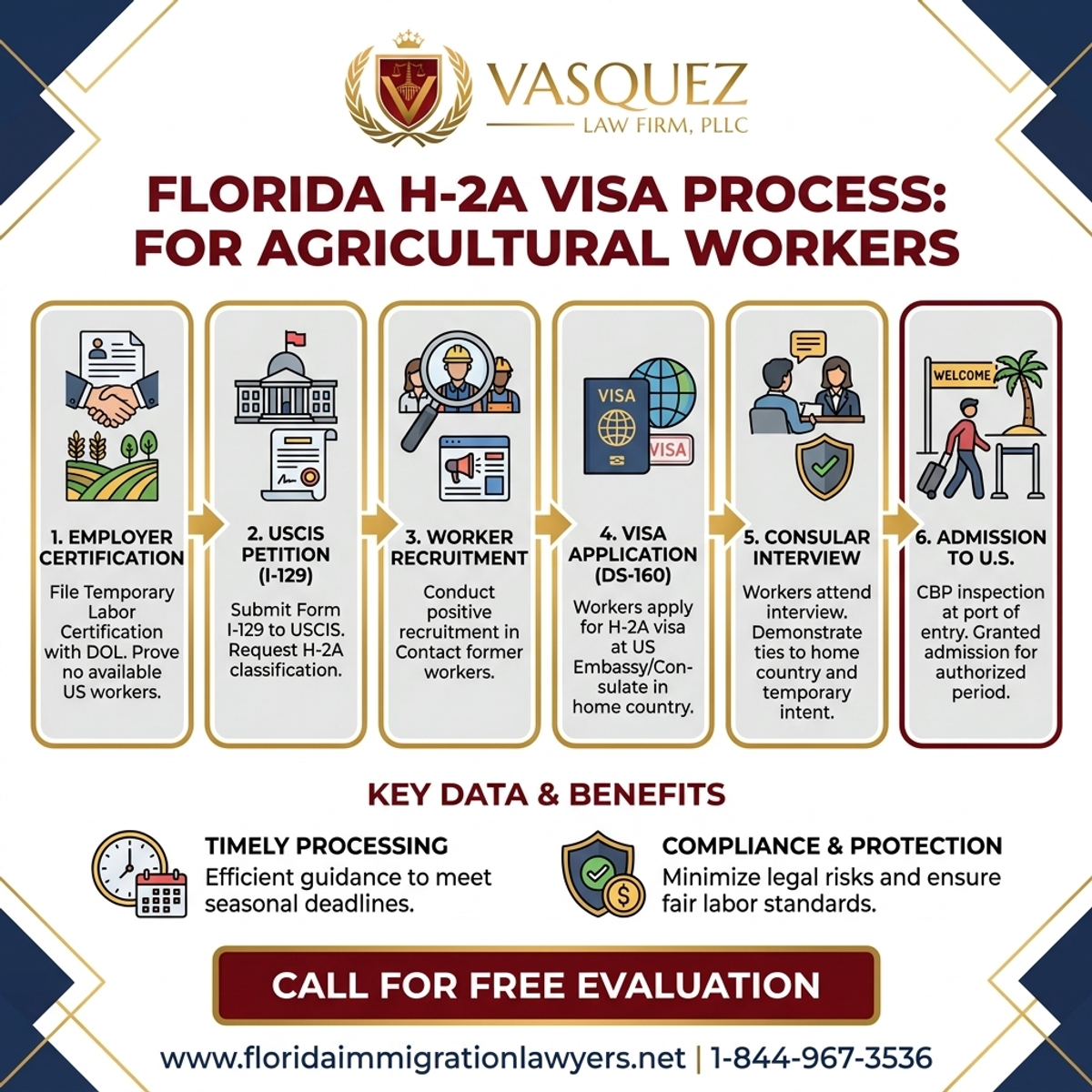
Step-by-Step Process — H-2A Visa for Florida Agricultural Workers | VLF Florida
Understanding these requirements is the first step for workers seeking to legally enter the U.S. for agricultural employment. Our team at VLF Florida can help workers understand their rights and the process once an employer has secured the necessary certification.
The H-2A Application Process: A Step-by-Step Guide
The H-2A visa application process is multi-faceted, involving several government agencies. It typically begins with the employer, who must first obtain a Temporary Labor Certification from the U.S. Department of Labor (DOL). This involves submitting Form ETA-9142A, posting job orders, and conducting recruitment efforts to test the domestic labor market. The DOL ensures that the employer's need is temporary and that hiring foreign workers will not negatively impact U.S. workers.
Once the DOL certifies the temporary labor application, the employer then files Form I-129, Petition for a Nonimmigrant Worker, with U.S. Citizenship and Immigration Services (USCIS). This petition requests approval for the specific H-2A workers. If the workers are already in the U.S. and eligible for a change of status, USCIS will process that. However, most H-2A workers are overseas.
For workers outside the U.S., the next step is the visa interview at a U.S. embassy or consulate in their home country. After the I-129 petition is approved, the National Visa Center (NVC) will process the approved petition and schedule an interview. During the interview, applicants must demonstrate their eligibility, including their intent to return home after their temporary work concludes. Upon successful interview, the visa is issued, allowing the worker to travel to the U.S. Finally, upon arrival at a U.S. port of entry, Customs and Border Protection (CBP) officers make the final decision on admission. Each stage requires meticulous attention to detail and adherence to strict deadlines, making professional legal assistance highly beneficial.
Benefits of the H-2A Visa Program
The H-2A visa program offers significant advantages for both Florida agricultural employers and the foreign nationals who come to work. For employers, the primary benefit is access to a reliable and authorized workforce to meet seasonal labor demands. This ensures that crops are planted, cultivated, and harvested efficiently, preventing potential losses due to labor shortages. The program provides a legal framework for hiring, reducing the risks associated with unauthorized employment. Furthermore, the structured nature of the H-2A program, with its clear regulations on wages, housing, and transportation, helps employers maintain fair labor practices and avoid costly disputes.
For workers, the H-2A visa provides a legitimate and protected pathway to temporary employment in the U.S. They receive fair wages, often higher than what they might earn in their home countries, and are guaranteed housing and transportation. This stability and security are invaluable. H-2A workers are also afforded specific rights and protections under U.S. labor laws, ensuring they work in safe conditions and are treated fairly. The program allows them to earn income to support their families back home and gain valuable work experience, all while being part of a regulated and lawful system. It’s a mutually beneficial arrangement when properly managed.
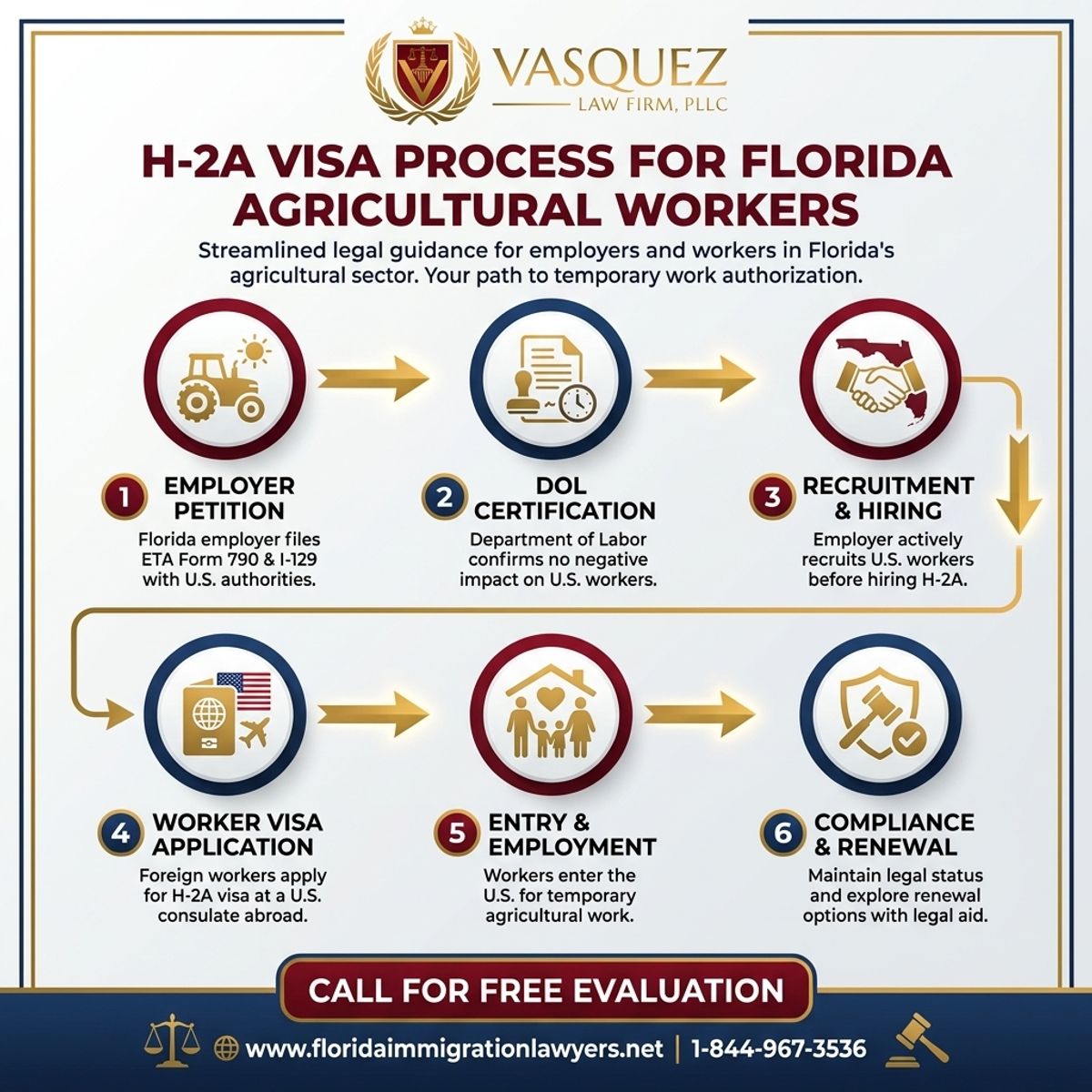
Key Statistics — H-2A Visa for Florida Agricultural Workers | VLF Florida
Worker Protections and Rights Under H-2A
A crucial aspect of the H-2A visa program is the robust set of protections and rights afforded to temporary agricultural workers. These safeguards are designed to prevent exploitation and ensure humane working conditions, reflecting the U.S. government's commitment to fair labor practices. H-2A workers are entitled to receive the Adverse Effect Wage Rate (AEWR), the prevailing wage, or the federal/state minimum wage, whichever is highest, for all hours worked. This ensures they are compensated fairly for their labor.
Employers are mandated to provide free, safe, and sanitary housing that meets specific federal and state standards. This housing must be inspected and approved prior to the workers' arrival. Additionally, employers must provide free transportation between the housing and the worksite. Workers are also protected under various U.S. labor laws, including those related to occupational safety and health (OSHA), ensuring a safe working environment free from hazardous conditions. They have the right to report unsafe conditions or violations without fear of retaliation.
Furthermore, H-2A workers are protected against discrimination and are entitled to workers' compensation insurance for job-related injuries. They have the right to organize, join, or assist a union, and to engage in concerted activities for the purpose of collective bargaining or other mutual aid or protection. Understanding these rights is paramount, and workers should know they have avenues for recourse if their rights are violated. Our firm is committed to upholding these protections and can provide guidance on these matters.
Navigating Challenges and Common Pitfalls
While the H-2A program offers significant benefits, both employers and workers can encounter various challenges. For employers, maintaining strict compliance with the myriad of federal and state regulations is a continuous task. Compliance issues, such as failing to meet housing standards, underpaying workers, or not adhering to recruitment requirements, can lead to severe penalties, including fines, debarment from the program, and legal action. Meticulous record-keeping and regular audits are essential to avoid these pitfalls.
Documentation errors are another common hurdle. Any discrepancies or omissions in the initial labor certification application or the USCIS petition can cause significant delays or even outright denials. This underscores the importance of thorough preparation and expert review of all submitted paperwork. For workers, potential challenges can include understanding their rights, navigating cultural differences, or facing unforeseen circumstances that might impact their visa status. In rare cases, workers might face issues with employers who do not fully comply with program rules.
Moreover, situations like overstaying a visa or violating the terms of employment can lead to serious immigration consequences, including future inadmissibility or even deportation defense proceedings. It is critical for both parties to seek legal counsel to proactively address potential issues and ensure a smooth, compliant H-2A experience. Proactive legal support can help mitigate risks and provide solutions when challenges arise.
The H-2A Visa in Florida's Unique Agricultural Landscape
Florida's agricultural sector is a powerhouse, contributing billions to the state's economy and providing a significant portion of the nation's fresh produce. The state's unique climate allows for year-round farming in many areas, but also creates distinct seasonal demands for labor, making the H-2A visa program particularly vital. From citrus groves in Central Florida to tomato fields in the south and strawberry farms near Plant City, the need for temporary agricultural workers is constant yet fluctuating.
Specific crops like strawberries, blueberries, bell peppers, cucumbers, and sugarcane have intensive harvest periods that require a large, temporary workforce that domestic labor often cannot fully supply. The H-2A program allows Florida farmers to secure the necessary hands to bring these crops to market, ensuring food security and economic stability. Without access to this program, many farms would struggle to meet production quotas, potentially leading to higher food prices and a decline in agricultural output.
Furthermore, Florida's agricultural landscape is diverse, encompassing everything from large corporate farms to smaller family-owned operations. Each type of operation faces its own set of challenges and opportunities within the H-2A framework. Understanding the specific regional needs, local labor market dynamics, and the precise timing of harvests across Florida is crucial for successful H-2A utilization. Our firm possesses deep insights into Florida's agricultural context, enabling us to provide tailored advice to employers navigating the H-2A process within this specific environment.
Beyond H-2A: Other Immigration Pathways and Comprehensive Legal Support
While the H-2A visa is a critical tool for Florida's agricultural sector, it represents just one facet of the broader U.S. immigration law landscape. At VLF Florida, we understand that individuals and businesses often have diverse immigration needs that extend beyond temporary agricultural work. Our firm offers comprehensive legal services across a wide spectrum of immigration matters, ensuring that our clients receive holistic support for their unique situations.
For individuals who may have entered the U.S. under different circumstances or who face complex legal challenges, we provide expert guidance on various pathways. This includes assisting those who may qualify for asylum due to persecution in their home countries, offering a beacon of hope for those seeking safety and a new beginning. We also specialize in deportation defense, vigorously representing individuals facing removal from the U.S. and fighting to protect their right to remain in the country with their families.
Our commitment to comprehensive legal support means that whether you are an employer seeking to navigate the H-2A program, a worker with questions about your rights, or an individual exploring other immigration options, our team is equipped to assist. We believe in providing clear, compassionate, and effective legal representation for all your immigration needs, ensuring you have a trusted advocate by your side.
How VLF Florida Can Help
Navigating the intricate landscape of H-2A visa regulations can be overwhelming for both employers and workers. At VLF Florida, our dedicated team of experienced immigration attorneys specializes in agricultural immigration law. We provide comprehensive legal support, from preparing and filing initial labor certification applications with the Department of Labor to petitioning USCIS and guiding workers through the consular interview process.
We understand the unique demands of Florida's agricultural industry and are committed to helping employers secure the workforce they need while ensuring full compliance with all federal and state regulations. For workers, we offer clear guidance on their rights and responsibilities, helping them understand the process and protecting them from potential exploitation. Our goal is to streamline the H-2A process, minimize delays, and provide peace of mind.
Don't let the complexities of immigration law hinder your agricultural operations or your opportunity to work legally in the U.S. Contact VLF Florida today for expert assistance. We offer a free consultation to discuss your specific H-2A visa needs and develop a tailored legal strategy. Call us at (844) 967-3536 to speak with a Florida immigration lawyer who can make a difference.
Conclusion
The H-2A visa program is an indispensable component of Florida's agricultural economy, providing a vital bridge between the labor needs of farms and the opportunities for foreign workers. While the process is complex, understanding its requirements, benefits, and potential challenges is key to successful utilization. VLF Florida stands as a trusted partner, offering expert legal guidance to ensure that both employers and workers can navigate the H-2A journey smoothly and efficiently.
Whether you are an agricultural employer seeking to secure your seasonal workforce or a foreign national looking for a legal pathway to temporary work in Florida, our firm is here to help. Reach out to VLF Florida for unparalleled legal support in all H-2A visa matters and other immigration concerns. Your success is our priority.
Sources and References
- U.S. Citizenship and Immigration Services (USCIS)
- Executive Office for Immigration Review (EOIR)
- U.S. Department of State - Bureau of Consular Affairs
- Immigration and Nationality Act (INA), 8 U.S.C. Chapter 12
Do Not Navigate This Process Alone
Our experienced immigration attorneys are ready to fight for you. Get a free, confidential consultation today.
Se Habla Español
Frequently Asked Questions
Florida Immigration Lawyers
Immigration Attorney | Founder, Vasquez Law Firm
U.S. Air Force veteran and immigration attorney with thousands of cases resolved. J.D., NCCU School of Law. AILA member. Admitted to the 4th, 5th, and 11th Circuit Courts.
Available 24/7 - Free Evaluations
Related Legal Services
Our Florida immigration attorneys can help you with business immigration, asylum protection and deportation defense. Call today at 1-844-967-3536 for a free consultation.
Related Links
Related Topics
Free Legal Consultation
Discuss your case with our experienced attorneys. We're available 24/7.
Se Habla Español - Estamos aquí para ayudarle.
Related Articles
Refugee Resettlement in Florida: A Guide | VLF Florida
Discover the essential steps for refugee resettlement in Florida with our comprehensive guide. Learn about eligibility, documentation, and local resources to aid your transition. Call Florida Immigration Lawyers at 1-844-967-3536 for expert assistance.
Understanding Immigration Lawyer Costs in Florida 2026
Discover the costs associated with hiring an immigration lawyer in Florida in 2026. Learn about the factors that influence pricing and how to choose the right attorney for your needs. Call for a free consultation today.
Immigration Lawyer Cost Florida 2026: What to Expect
Navigating immigration law in Florida, especially understanding the immigration lawyer cost for 2026, can be challenging. This comprehensive guide breaks down attorney fees, factors influencing costs, common fee structures like flat fees and hourly rates, and a step-by-step approach to engaging legal counsel. We highlight the importance of proper documentation, discuss timelines, and pinpoint common mistakes that can increase expenses. Whether you are in West Palm Beach or elsewhere in Florida, our insights aim to provide clarity. Learn when to seek legal expertise and how Florida Immigration Lawyers can offer transparent, compassionate, and effective representation for your immigration journey. Schedule a free consultation to discuss your specific needs.
USCIS Office Locations in Florida for Appointments
Discover USCIS field office locations in Florida, focusing on Jacksonville. Learn about the services offered, how to schedule appointments, and avoid common mistakes. Call Florida Immigration Lawyers at 1-844-967-3536 for a free consultation.