Green Card Renewal Florida Process 2026 Guide | VLF Florida
Renewing your green card in Florida is a critical process to maintain your permanent resident status. This comprehensive guide from Florida Immigration Lawyers details the I-90 application, required documents, processing timelines, and associated costs for residents in Tallahassee and across the state. Learn how to navigate the USCIS system, avoid common mistakes like late filing or incorrect information, and understand when legal assistance is invaluable. Ensure your future in Florida by proactively managing your green card renewal. Contact us for a free consultation to secure your residency.

Renewing your green card, officially known as your Permanent Resident Card, is a crucial step to maintain your legal status in the United States. The green card renewal Florida process primarily involves filing Form I-90, Application to Replace Permanent Resident Card, with USCIS. This applies if your 10-year card is expiring or has already expired, or if your card was lost, stolen, damaged, or contains incorrect information. Understanding the specific requirements, gathering the right documents, and submitting your application correctly are vital to avoid delays and ensure continued residency in Florida. Proactive planning is key to a smooth renewal.
- File Form I-90 with USCIS for renewal or replacement.
- Renew your 10-year green card before it expires.
- Gather essential documents like your current card and identification.
- Be prepared for a biometrics appointment at a local Application Support Center.
- Seek legal counsel from Florida Immigration Lawyers for complex cases.
Living in Florida as a permanent resident offers countless opportunities, from vibrant communities like Tallahassee to the bustling cities of Miami and Orlando. However, maintaining your legal status is paramount, and a critical part of this is ensuring your green card remains valid. If your 10-year Permanent Resident Card is nearing its expiration date, or if it has been lost, stolen, or damaged, you must initiate the green card renewal Florida process. Failing to do so can lead to significant challenges, including issues with employment, travel, and even proving your right to reside in the U.S.
Navigating the U.S. immigration system can be complex and intimidating, especially when dealing with federal agencies like USCIS. This comprehensive guide from Florida Immigration Lawyers is designed to demystify the renewal process for residents across the Sunshine State. We will walk you through each essential step, from understanding eligibility to preparing your application and what to expect during processing. Our goal is to provide you with the knowledge needed to approach your green card renewal with confidence. Do not risk your permanent residency status. Call Florida Immigration Lawyers at 1-844-967-3536 for a free consultation today, and let us help you secure your future in Florida.
Understanding Your Green Card and Renewal in Florida
Your green card serves as official proof of your permanent resident status in the United States, granting you the right to live and work indefinitely. Most green cards are issued with a 10-year validity period, as outlined in the Immigration and Nationality Act (INA) Section 264(e). While your permanent resident status itself does not expire, the physical card does. This means that even if your card has expired, your permanent residency technically continues. However, an expired card can create numerous problems and hinder your ability to prove your status. For conditional permanent residents (those with a 2-year green card), the process is different; you typically file Form I-751, Petition to Remove Conditions on Residence, rather than Form I-90 for renewal. This article focuses on the 10-year green card renewal Florida process.
The need for green card renewal or replacement can arise from various circumstances. The most common reason is the expiration of your 10-year card. USCIS recommends filing for renewal within six months of your card's expiration date. Other reasons include a lost, stolen, or damaged card, a legal name change, or if your card contains incorrect information. For Florida residents, maintaining a valid green card is crucial for everyday life, from renewing your driver's license to securing employment or applying for government benefits. Without a current card, you may face difficulties, including delays in travel, as airlines and border officials require valid proof of status. Ensuring a timely renewal is a critical responsibility for every permanent resident in Florida.
The U.S. Citizenship and Immigration Services (USCIS) is the federal agency responsible for processing green card renewals. Their regulations, found in 8 CFR 264.5, govern the application process for replacing or renewing a Permanent Resident Card. Staying informed about these regulations and any potential updates is essential. Florida Immigration Lawyers are well-versed in these requirements and can provide expert guidance specific to your situation. Whether you reside in Tallahassee, Jacksonville, Orlando, or anywhere else in Florida, understanding your obligations and rights as a permanent resident is the first step toward a successful green card renewal. We help ensure you understand every aspect of this critical process.
The I-90 Application Process: A Step-by-Step Guide for Florida Residents
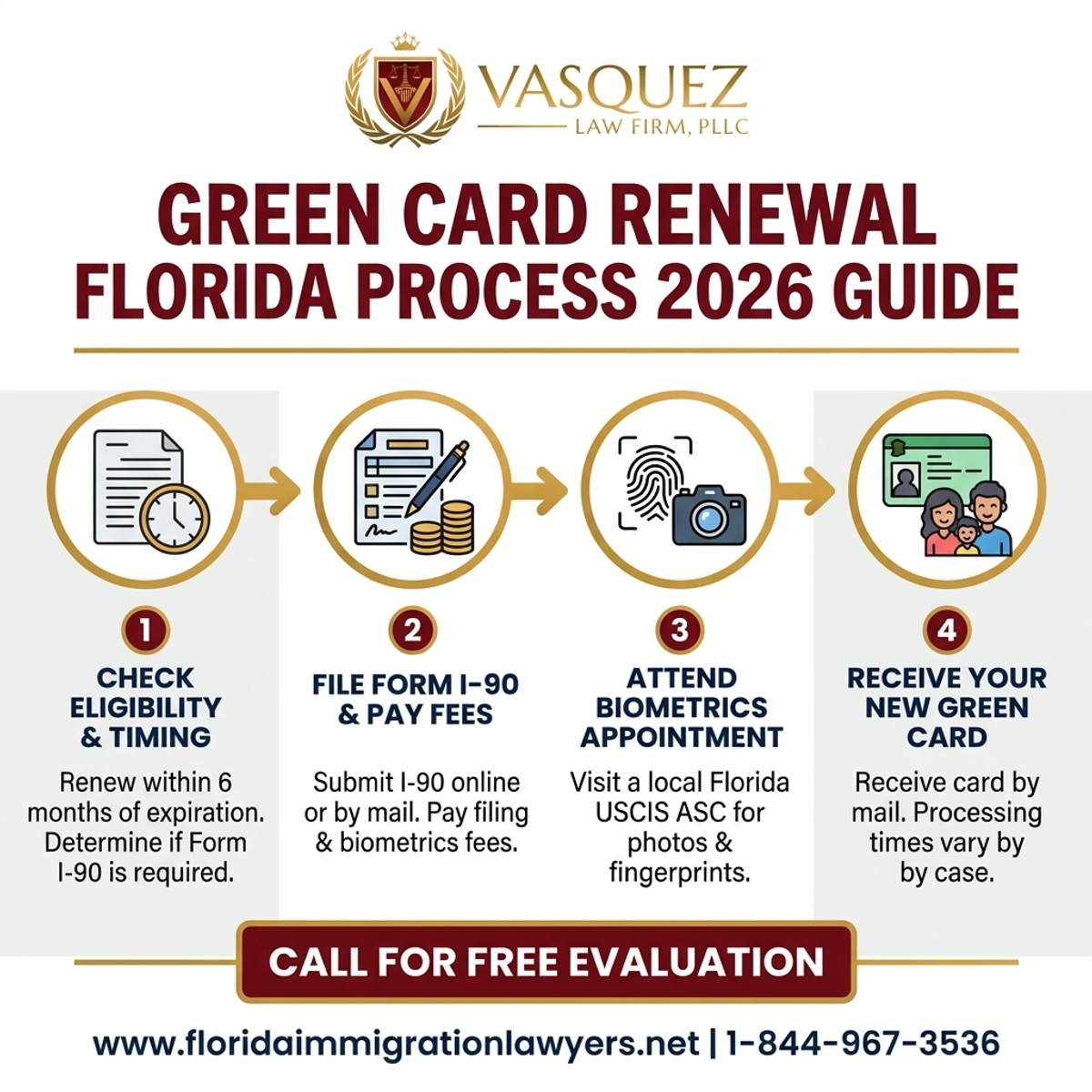
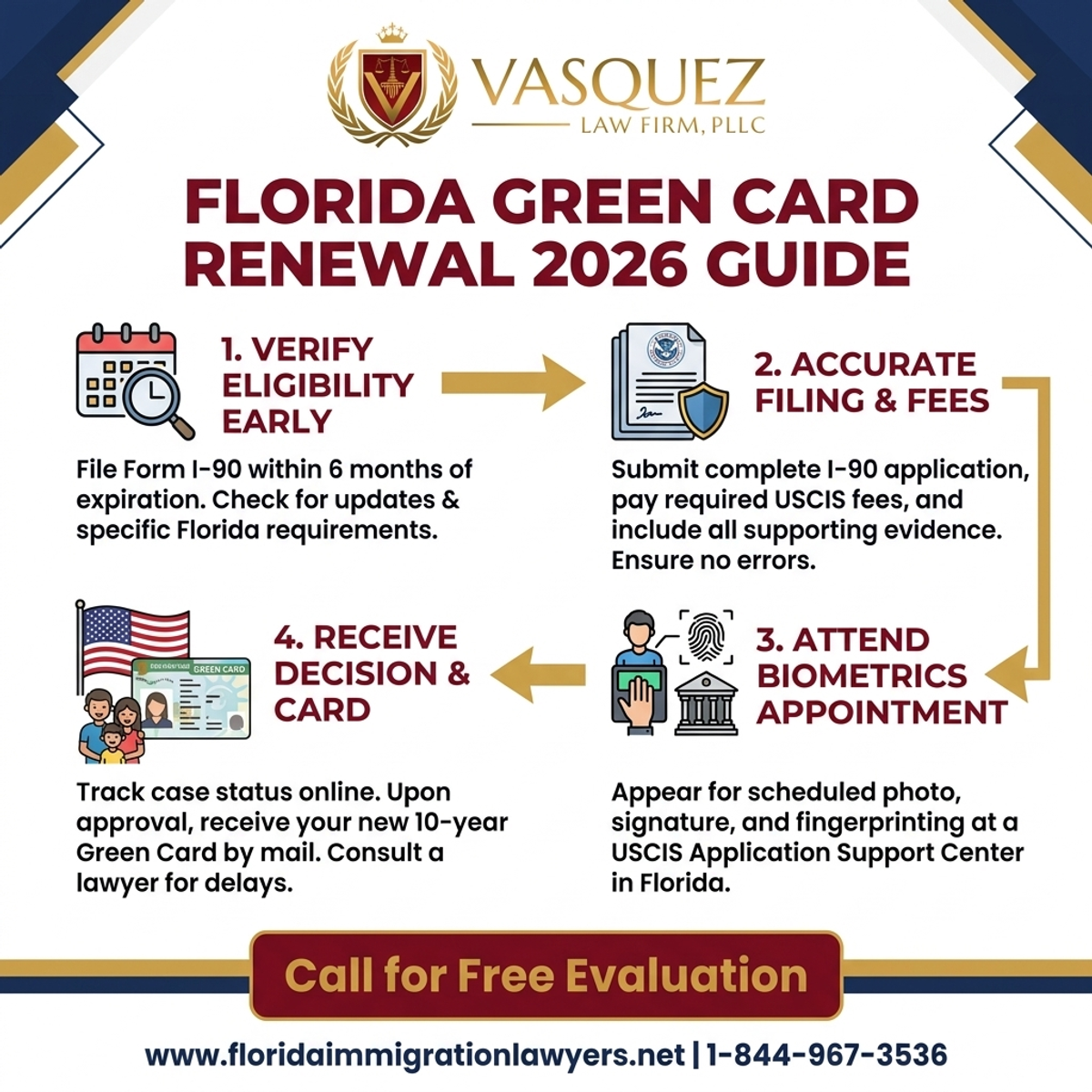
Initiating your green card renewal Florida process involves carefully following the steps for Form I-90, Application to Replace Permanent Resident Card. This form is used for both renewal of an expiring 10-year card and replacement of a lost, stolen, or damaged card. The process is federal, but Florida residents will interact with local USCIS Application Support Centers (ASCs) for biometrics. Here's a detailed breakdown of the steps:
Step 1: Determine Your Eligibility for Form I-90
Before you begin, confirm that Form I-90 is the correct application for your situation. You generally need to file Form I-90 if your 10-year green card is expiring or has already expired. You also file it if your green card was lost, stolen, mutilated, or destroyed. Other reasons include if your card was issued but never received, if it contains incorrect information due to USCIS error, or if you have legally changed your name and need a new card reflecting this. Conditional permanent residents should generally file Form I-751, not I-90, to remove conditions.
Step 2: Gather Required Documents for I-90
Thorough documentation is vital for a smooth process. You will need your current Permanent Resident Card, even if it's expired. If your card was lost or stolen, you might need a police report. For a name change, you'll need legal documentation like a marriage certificate or court order. Valid government-issued identification is also necessary. Carefully review the USCIS instructions for Form I-90 to ensure you collect all specific documents relevant to your reason for filing. Missing documents can lead to significant processing delays.
Step 3: Complete Form I-90, Application to Replace Permanent Resident Card
You can file Form I-90 online through the USCIS website or by mail. Filing online is generally recommended as it offers immediate confirmation and often faster processing. Ensure all information is accurate and matches your official records. Double-check your name, address, date of birth, and A-Number. Any discrepancies can cause delays or even a Request for Evidence (RFE). If you are uncertain about any section, it is best to consult with an experienced immigration attorney before submission.
Step 4: Pay the Filing Fees
The Form I-90 requires a filing fee and, in most cases, a biometric services fee. These fees are subject to change, so always check the most current fee schedule on the USCIS website. You can pay online if filing electronically or by money order, personal check, or cashier's check if filing by mail. Ensure your payment is correct and submitted properly, as incorrect payments can lead to your application being rejected and returned. Certain waivers may be available for those who meet specific income guidelines.
Step 5: Submit the Application
If filing online, submit your completed form and uploaded documents through your USCIS online account. If filing by mail, send your application package to the correct USCIS lockbox facility. The mailing address depends on your specific mailing carrier (USPS vs. FedEx/UPS/DHL) and is listed in the Form I-90 instructions. Keep a complete copy of your submitted application and all supporting documents for your records. This is critical for future reference or if USCIS requests additional information.
Step 6: Attend Your Biometrics Appointment
After USCIS accepts your application, you will receive an appointment notice for biometrics. This appointment typically takes place at an Application Support Center (ASC) in Florida. For residents of Tallahassee, the closest ASCs are generally located in cities like Orlando or Jacksonville. During this appointment, USCIS will collect your fingerprints, photograph, and signature. It is crucial to attend this appointment, as failure to do so can result in the denial of your application. Bring the appointment notice and a valid photo ID.
Step 7: Receive Your Decision and New Green Card
Once your biometrics are processed, USCIS will review your application. If approved, your new Permanent Resident Card will be mailed to the address on file. If USCIS needs more information, they may send a Request for Evidence (RFE) or a notice for an interview. Be prepared to respond promptly to any such requests. Your new green card will typically be valid for 10 years. Always ensure your mailing address with USCIS is current to avoid delivery issues.
Step 8: What to Do While Waiting for Your New Green Card
While your I-90 application is pending, you may need temporary proof of your permanent resident status, especially if your card has expired or was lost. USCIS can stamp your passport with an I-551 endorsement (ADIT stamp), which serves as temporary proof of status and allows you to travel internationally. You typically need to schedule an InfoPass appointment at a local USCIS field office, such as the one in Orlando or Miami, to obtain this stamp. This temporary proof is valid for one year and is often essential for employment and travel.
Essential Documents for Your Green Card Renewal in Florida
A successful green card renewal Florida process heavily relies on submitting a complete and accurate set of supporting documents. Gathering these documents early can prevent delays and ensure your application moves forward smoothly. The specific documents required depend on the reason for your I-90 filing. Always provide clear, legible copies of all documents, never originals, unless specifically requested by USCIS. Keeping organized records is a best practice throughout this entire process.
- Current Permanent Resident Card (Green Card): Even if expired, you must submit a copy of both sides of your existing card. If it was lost or stolen, you will not have this, but you should still mention this in your application.
- Government-Issued Photo Identification: A copy of your driver's license, state ID, or passport to confirm your identity. For Florida residents, a Florida driver's license is commonly used.
- Proof of Legal Name Change (if applicable): If you have legally changed your name since your last green card was issued, you must provide documentation such as a marriage certificate, divorce decree, or court order. Ensure these documents are certified copies.
- Police Report (if card was stolen): If your green card was stolen, it is advisable, though not always mandatory, to include a copy of the police report documenting the theft. This provides additional evidence for your replacement request.
- Birth Certificate: A copy of your birth certificate may be requested in certain circumstances, particularly if there are discrepancies in your identifying information.
- Passport Biographic Page: A copy of the biographic page of your valid passport can serve as additional identity verification.
- Previous I-551 Stamp (if applicable): If you previously received a temporary I-551 stamp in your passport, include a copy of that page.
- Evidence of Residency in Florida: While not typically required for I-90, having proof of your current Florida address (e.g., utility bills, lease agreements) can be helpful for your records and if USCIS sends correspondence.
Step-by-Step Process — Green Card Renewal Florida Process 2026 Guide
Ensuring that all required documents are properly gathered and submitted is a critical part of the I-90 application. Any missing or incorrect documentation can lead to a Request for Evidence (RFE) from USCIS, significantly prolonging the processing time. Our team at Florida Immigration Lawyers can help you compile a robust application package, ensuring all necessary documents are included and properly presented.
Green Card Renewal Timeline and Processing Expectations in 2026
Understanding the timeline for your green card renewal Florida process is essential for managing expectations and planning. USCIS processing times can vary significantly based on the volume of applications, the specific service center, and the complexity of individual cases. While there isn't a fixed timeline, we can outline typical expectations for 2026. It is always best to check the official USCIS Processing Times webpage for the most current information, as these are updated regularly.
Typically, the entire I-90 renewal process, from submission to receiving your new card, can take anywhere from 6 to 18 months. This estimate includes several key stages:
- Application Submission to Receipt Notice: Within a few weeks of submitting your application, USCIS will send a Form I-797C, Notice of Action, confirming receipt. This notice is important proof that your application has been accepted.
- Biometrics Appointment Scheduling: After receiving your receipt notice, USCIS will typically schedule your biometrics appointment within 1 to 3 months. This appointment will be at a local Application Support Center (ASC) in Florida, such as those serving Tallahassee residents in Orlando or Jacksonville.
- Post-Biometrics Processing: This is often the longest phase. After your biometrics are collected, your application awaits review by a USCIS officer. This stage can take several months, sometimes up to a year or more, depending on caseloads and any potential issues.
- Decision and Card Production: Once approved, USCIS will order the production of your new green card. This typically takes a few weeks, and the card will be mailed to your address on file.
Factors that can influence your processing time include the accuracy and completeness of your application, whether you receive a Request for Evidence (RFE), and the current workload at the USCIS service center processing your case. It is crucial to respond promptly and thoroughly to any RFEs to avoid further delays. While waiting, remember to maintain temporary proof of your status, such as an I-551 stamp in your passport, especially if your old card has expired and you plan to travel internationally or need to prove employment eligibility. Florida Immigration Lawyers can assist you in monitoring your case status and addressing any unforeseen delays.
Do not navigate this process alone. Contact Florida Immigration Lawyers today to ensure your green card renewal is handled with precision and care. We offer comprehensive support to permanent residents across Florida.
Cost Factors and Fee Breakdown for I-90 in Florida
Understanding the financial aspects of your green card renewal Florida process is a vital part of planning. The total cost primarily consists of USCIS filing fees, which are standardized across the U.S. but can be subject to change. It is crucial to always verify the most current fees directly on the USCIS website before submitting your application. As of 2026, the fees generally include the following components:
- Form I-90 Filing Fee: This is the primary fee for processing your application to replace or renew your Permanent Resident Card. This fee applies to most applicants, regardless of the reason for filing.
- Biometric Services Fee: In addition to the filing fee, most applicants are required to pay a separate fee for biometric services. This covers the cost of collecting your fingerprints, photograph, and signature at an Application Support Center (ASC).
It is important to note that certain individuals may be exempt from the filing fee or biometric services fee, or both, depending on the specific reason for their I-90 filing. For example, if USCIS made an error on your previous green card, you typically do not have to pay the filing fee to get a corrected card. However, this is a specific circumstance. Always consult the official Form I-90 instructions and fee schedule for detailed information regarding fee exemptions and waivers. USCIS also offers fee waivers for applicants who demonstrate an inability to pay, based on specific income guidelines or receipt of means-tested benefits. Applying for a fee waiver requires submitting Form I-912, Request for Fee Waiver, along with your I-90 application.
Key Statistics — Green Card Renewal Florida Process 2026 Guide
Beyond the USCIS fees, you should also consider potential legal fees if you choose to hire an immigration attorney. While not mandatory for all cases, legal representation can be invaluable, especially for complex situations, those with previous immigration issues, or individuals who prefer professional guidance to ensure accuracy and reduce stress. An attorney can help you prepare your application, gather documents, respond to RFEs, and represent you if an interview is required. Florida Immigration Lawyers offers transparent fee structures and free consultations to discuss your specific needs. Investing in legal assistance can save you time, stress, and potential costly errors in the long run, ensuring your green card renewal Florida process is handled correctly from the outset.
Common Mistakes to Avoid During Your Florida Green Card Renewal
The green card renewal Florida process, while seemingly straightforward, is fraught with potential pitfalls that can lead to significant delays, rejections, or even jeopardize your immigration status. Avoiding these common mistakes is crucial for a smooth and successful renewal. Pay close attention to these areas to protect your permanent residency.
-
Failing to File on Time: Many permanent residents mistakenly believe their status is permanent and the card's expiration is minor. While your status doesn't expire, an expired card can complicate employment, travel, and proving residency. File within six months of your card's expiration date to avoid issues.
-
Submitting Incomplete or Inaccurate Information: One of the most frequent reasons for delays or rejections is missing information or errors on Form I-90. Double-check every field for accuracy, ensuring it matches your official records. A simple typo can trigger an RFE or denial.
-
Not Updating Your Address with USCIS: If you move within Florida or to another state, you must inform USCIS within 10 days of your new address by filing Form AR-11, Alien's Change of Address Card. Failure to do so means you might miss critical notices, including your biometrics appointment or your new green card.
-
Ignoring Your Biometrics Appointment: After filing Form I-90, you will receive a notice for a biometrics appointment at an Application Support Center (ASC). Missing this appointment without rescheduling can lead to the denial of your application. Always prioritize and attend these appointments.
-
Traveling Internationally Without Valid Proof of Status: If your green card expires or is lost while your I-90 is pending, you need temporary proof of status (like an I-551 stamp in your passport) to re-enter the U.S. Do not travel without consulting USCIS or an attorney about valid documentation.
-
Assuming Automatic Renewal for Conditional Residents: If you are a conditional permanent resident (2-year green card holder), you must file Form I-751 to remove conditions, not Form I-90. Filing the wrong form will lead to rejection and potential loss of status.
-
Using Outdated Forms or Instructions: USCIS forms and instructions are regularly updated. Always download the latest version of Form I-90 and its instructions directly from the USCIS website to ensure compliance with current regulations.
-
Incorrectly Calculating or Submitting Fees: Fees change. Ensure you pay the exact current filing and biometric fees. Incorrect payments can cause your application to be rejected and returned, delaying your renewal significantly.
-
Not Keeping Copies of Everything: Always make and keep a complete copy of your entire application package, including the completed Form I-90, all supporting documents, and proof of payment. This serves as your personal record and can be crucial if issues arise.
-
Failing to Respond to Requests for Evidence (RFEs): If USCIS sends an RFE, it means they need more information. Failing to respond by the deadline or providing an incomplete response can lead to a denial of your application. Always take RFEs seriously and seek legal help if needed.
-
Not Seeking Legal Advice for Complex Cases: If you have a criminal record, a history of immigration violations, or other complex issues, attempting to renew your green card without legal counsel is a significant risk. An attorney can identify potential problems and strategize solutions.
-
Mailing to the Wrong Lockbox: USCIS has different lockbox facilities for different form types and mailing carriers. Sending your application to the wrong address can cause significant delays. Always verify the correct mailing address in the Form I-90 instructions.
When to Call a Lawyer for Your Green Card Renewal in Florida
While the green card renewal Florida process for a standard 10-year card may seem straightforward, certain situations warrant the expertise of an immigration attorney. Attempting to navigate complex scenarios alone can lead to severe consequences, including delays, denials, or even jeopardizing your permanent resident status. Florida Immigration Lawyers are here to provide the guidance and representation you need for a secure future in Florida.
You should strongly consider contacting an attorney if any of the following apply to your situation:
- Criminal Record: If you have any arrests, charges, or convictions, even minor ones, these can impact your eligibility for renewal. An attorney can assess your record and advise on potential inadmissibility issues.
- Extended Stays Outside the U.S.: Spending significant time outside the United States (typically more than 6 months at a time) can raise questions about your intent to maintain permanent residency. A lawyer can help explain your travel history and its implications.
- Previous Immigration Violations: Any past issues with immigration, such as previous denials, deportation proceedings, or misrepresentations, make your renewal more complex and require expert legal review.
- Lost or Stolen Green Card with Complicating Factors: While replacing a lost card is common, if you have other issues (e.g., criminal history, extensive travel, or an expired passport), an attorney can help streamline the process and address concerns.
- Received a Request for Evidence (RFE) or Notice of Intent to Deny (NOID): These notices from USCIS indicate a problem with your application. Responding correctly and comprehensively is critical, and an attorney can help formulate a strong response.
- Language Barriers or Difficulty Understanding Instructions: If you struggle with English or find the legal jargon confusing, a bilingual attorney can ensure your application is accurate and complete, preventing errors due to misunderstanding.
- Concerns About Your Eligibility: If you are unsure whether you meet all the requirements for green card renewal, or if you have any doubts about your status, a consultation with an attorney can provide clarity and peace of mind.
Florida Immigration Lawyers understands the nuances of immigration law and the specific challenges faced by permanent residents in Florida. We offer personalized legal services to help you navigate your green card renewal with confidence. Our experienced team can evaluate your case, prepare and submit your I-90 application, respond to USCIS inquiries, and represent you throughout the process, ensuring your rights are protected every step of the way.
About Florida Immigration Lawyers
Florida Immigration Lawyers is a leading law firm dedicated to providing exceptional legal services to immigrants and their families across the entire state of Florida. With a deep understanding of U.S. immigration law and a commitment to our clients, we strive to achieve the best possible outcomes for every case. Our firm is proud to serve diverse communities from Tallahassee to Key West, offering compassionate and effective legal representation.
We specialize in a wide range of immigration matters, including green card applications and renewals, family-based immigration, citizenship and naturalization, asylum claims, and deportation defense. Our attorneys are highly experienced in navigating complex USCIS procedures and immigration court proceedings. We understand the profound impact immigration issues have on individuals and families, and we approach each case with empathy, diligence, and a personalized strategy. Our commitment is to provide clear communication, transparent processes, and vigorous advocacy for your rights.
Choosing Florida Immigration Lawyers means partnering with a team that genuinely cares about your future. We offer free consultations to discuss your unique situation and provide an honest assessment of your options. Our services are available 24/7, ensuring that you can reach us when you need us most. We are proud to be a bilingual firm, with staff fluent in both English and Spanish, making legal assistance accessible to a broader community. Let us be your trusted legal partners in your journey to secure and maintain your immigration status in Florida. Visit our attorneys page to learn more about our dedicated legal team.
Sources and References
- U.S. Citizenship and Immigration Services (USCIS)
- Form I-90, Application to Replace Permanent Resident Card - USCIS
- USCIS Processing Times
- Immigration and Nationality Act (INA) Section 264(e) - Validity of Permanent Resident Card
- 8 Code of Federal Regulations (CFR) 264.5 - Application for New Card
- Executive Office for Immigration Review (EOIR)
Related services: immigration practice areas, business immigration, free immigration consultation.
This article provides general legal information and is not intended as legal advice. Every case is unique, and outcomes depend on specific facts and circumstances. Contact an attorney for advice about your particular situation.
Do not let the complexities of the green card renewal Florida process overwhelm you. Your permanent residency is too important to leave to chance. Florida Immigration Lawyers is here to offer expert guidance, compassionate support, and effective legal strategies for residents throughout Florida. We are committed to helping you maintain your legal status and achieve your immigration goals. Call us today at 1-844-967-3536 for a free, confidential consultation. Se Habla Espanol - Estamos aqui para ayudarle.
If you need legal assistance, learn more about learn about our immigration practice, or call us at 1-844-967-3536 for a free consultation.
Do Not Navigate This Process Alone
Our experienced immigration attorneys are ready to fight for you. Get a free, confidential consultation today.
Se Habla Español
Frequently Asked Questions
Florida Immigration Lawyers
Immigration Attorney | Founder, Vasquez Law Firm
U.S. Air Force veteran and immigration attorney with thousands of cases resolved. J.D., NCCU School of Law. AILA member. Admitted to the 4th, 5th, and 11th Circuit Courts.
Available 24/7 - Free Evaluations
Related Legal Services
Our Florida immigration attorneys can help you with immigration practice areas, free immigration consultation and experienced immigration attorneys. Call today at 1-844-967-3536 for a free consultation.
Related Links
Related Topics
Free Legal Consultation
Discuss your case with our experienced attorneys. We're available 24/7.
Se Habla Español - Estamos aquí para ayudarle.
Related Articles
USCIS Office Locations in Florida for Appointments
Discover USCIS field office locations in Florida, focusing on Jacksonville. Learn about the services offered, how to schedule appointments, and avoid common mistakes. Call Florida Immigration Lawyers at 1-844-967-3536 for a free consultation.
Asylum Interview Preparation in Florida | VLF Florida
Preparing for an asylum interview in Florida is crucial. Learn key steps and tips for success. Call Florida Immigration Lawyers for help.
Green Card Renewal Florida Process: Your 2026 Guide
Renewing your green card in Florida is a critical process to maintain your lawful permanent resident status. This comprehensive guide details the steps for filing Form I-90, including eligibility, required documents, and what to expect regarding processing times and costs in 2026. We cover essential tips for Florida residents, highlighting the importance of timely submission and accuracy. Learn about common mistakes to avoid, such as late filing or submitting incomplete information, which can cause significant delays or even denial. Florida Immigration Lawyers provides expert assistance for complex cases, ensuring a smooth green card renewal process and safeguarding your ability to live and work in the U.S. Contact us for a free consultation to secure your future.
DUI Immigration Consequences in Florida | VLF Florida
A DUI conviction in Florida can have serious immigration consequences, including deportation and inadmissibility. Learn how to protect your status and what steps to take. Call Florida Immigration Lawyers for a free consultation.
