Green Card Renewal Florida Process: Your 2026 Guide
Renewing your green card in Florida is a critical process to maintain your lawful permanent resident status. This comprehensive guide details the steps for filing Form I-90, including eligibility, required documents, and what to expect regarding processing times and costs in 2026. We cover essential tips for Florida residents, highlighting the importance of timely submission and accuracy. Learn about common mistakes to avoid, such as late filing or submitting incomplete information, which can cause significant delays or even denial. Florida Immigration Lawyers provides expert assistance for complex cases, ensuring a smooth green card renewal process and safeguarding your ability to live and work in the U.S. Contact us for a free consultation to secure your future.

Renewing your green card, officially known as your Permanent Resident Card, in Florida involves filing Form I-90, Application to Replace Permanent Resident Card, with USCIS. This process is crucial for maintaining your legal status in the U.S., especially if your card is expiring, lost, stolen, or you need to update information. Understanding the steps, required documents, and potential costs is vital to avoid delays and ensure continued residency. Florida residents must follow federal guidelines, and local immigration attorneys can provide invaluable assistance throughout this often complex administrative procedure.
- File Form I-90 with USCIS to renew or replace your green card.
- Ensure timely submission, ideally within six months before expiration.
- Gather all necessary supporting documents, including your current green card and identification.
- Attend your biometrics appointment as scheduled.
- Seek legal counsel from Florida Immigration Lawyers for complex cases or assistance.
As a permanent resident in Florida, maintaining your legal status is paramount. Your green card, or Form I-551, serves as official proof of your authorization to live and work permanently in the United States. When this card approaches its expiration date, or if it has been lost, stolen, or damaged, initiating the green card renewal process becomes an urgent priority. Failing to renew it can lead to significant complications, affecting your ability to travel, work, or even prove your lawful presence in the country. This comprehensive guide from Florida Immigration Lawyers will walk you through the intricate green card renewal Florida process for 2026, offering clarity on the steps involved, necessary documentation, and how our experienced team can help you navigate this critical journey. Do not risk your permanent resident status; understand your obligations and act proactively. Call Florida Immigration Lawyers at 1-844-967-3536 for a free consultation to discuss your specific situation today.
Understanding Green Card Renewal in Florida: An Overview
A green card signifies your status as a lawful permanent resident (LPR) of the United States. While it grants you immense privileges, the card itself has an expiration date, typically every ten years. It's essential to understand that the expiration of your physical green card does not mean you lose your permanent resident status. However, an expired card can create numerous problems, from difficulties re-entering the U.S. after international travel to issues with employment verification and accessing certain benefits. For those residing in Florida, a state with a vast and diverse immigrant population, staying informed about the renewal process is crucial.
The core of the renewal process involves filing Form I-90, Application to Replace Permanent Resident Card, with U.S. Citizenship and Immigration Services (USCIS). This form is used not only for renewals but also for replacing a lost, stolen, or damaged card, or if you need to update personal information such as a name change. In Florida, with USCIS field offices in cities like Orlando, Miami, and Tampa, the volume of applications can be substantial, making timely and accurate submission critical. The legal framework governing green card renewal is primarily found in the Immigration and Nationality Act (INA), specifically 8 U.S.C. § 1304, and further detailed in 8 CFR Part 264. These regulations outline the requirements for alien registration and the issuance of permanent resident cards, emphasizing the continuous obligation of LPRs to maintain valid proof of status. Our firm, Florida Immigration Lawyers, understands the nuances of these federal regulations and how they apply to residents across the state, from Jacksonville to Key West.
It's important to distinguish between a standard ten-year green card and a conditional green card. Conditional permanent residents, typically those who obtained their green card through marriage to a U.S. citizen or through an investor visa, usually receive a two-year green card. This type of card cannot be renewed using Form I-90. Instead, conditional residents must file Form I-751, Petition to Remove Conditions on Residence, or Form I-829, Petition by Investor to Remove Conditions on Permanent Resident Status, before their card expires. Misunderstanding this distinction is a common pitfall that can jeopardize your status. Our attorneys are adept at guiding clients through both standard renewal and conditions removal processes, ensuring that Florida's permanent residents comply with all federal requirements and avoid potential complications.
Step-by-Step Guide to Form I-90 Green Card Renewal in 2026
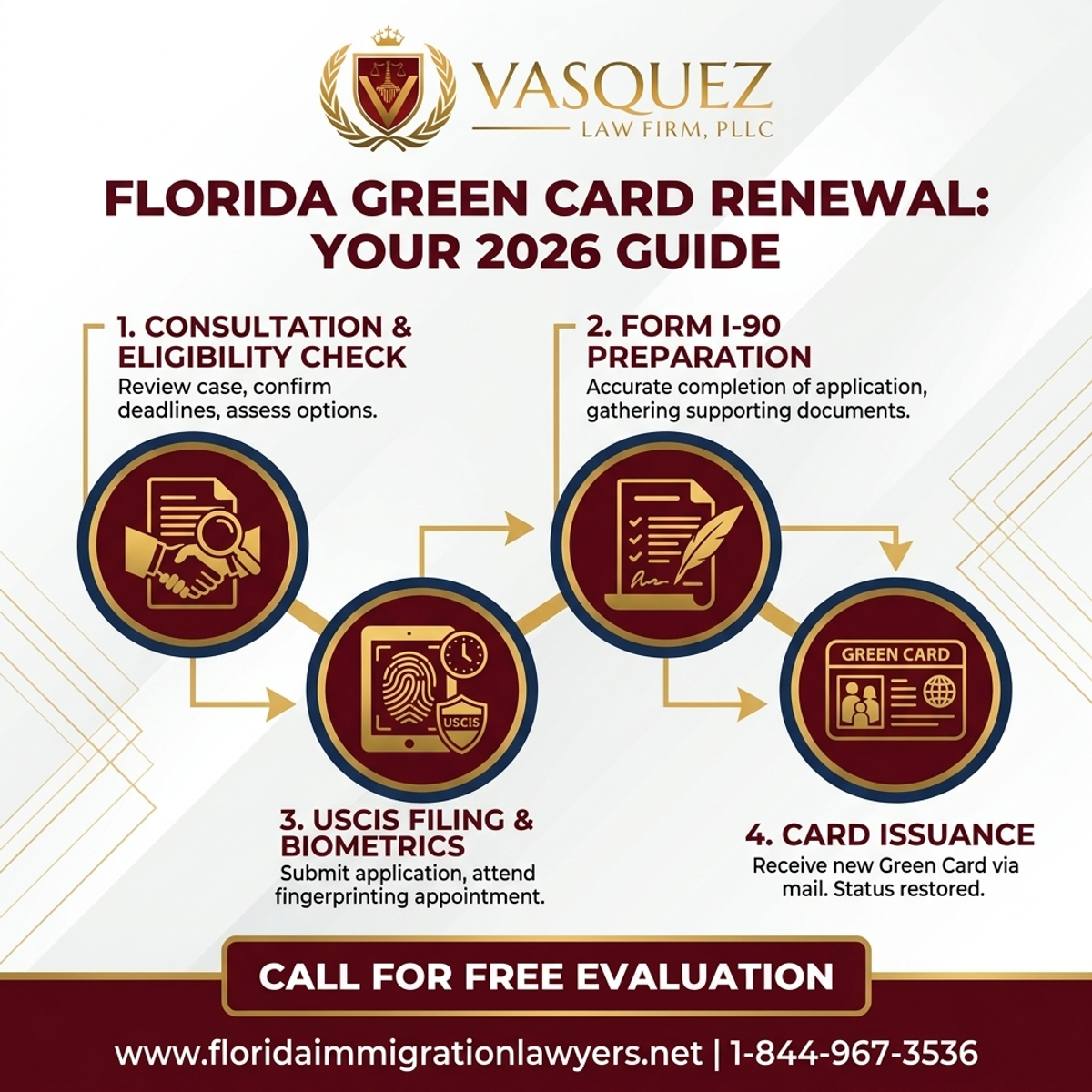
The process of renewing your permanent resident card through Form I-90 can seem daunting, but breaking it down into manageable steps can help ensure a smooth application. For Florida residents, careful attention to detail is key to navigating the federal system efficiently. Here is a detailed guide to the green card renewal Florida process:
-
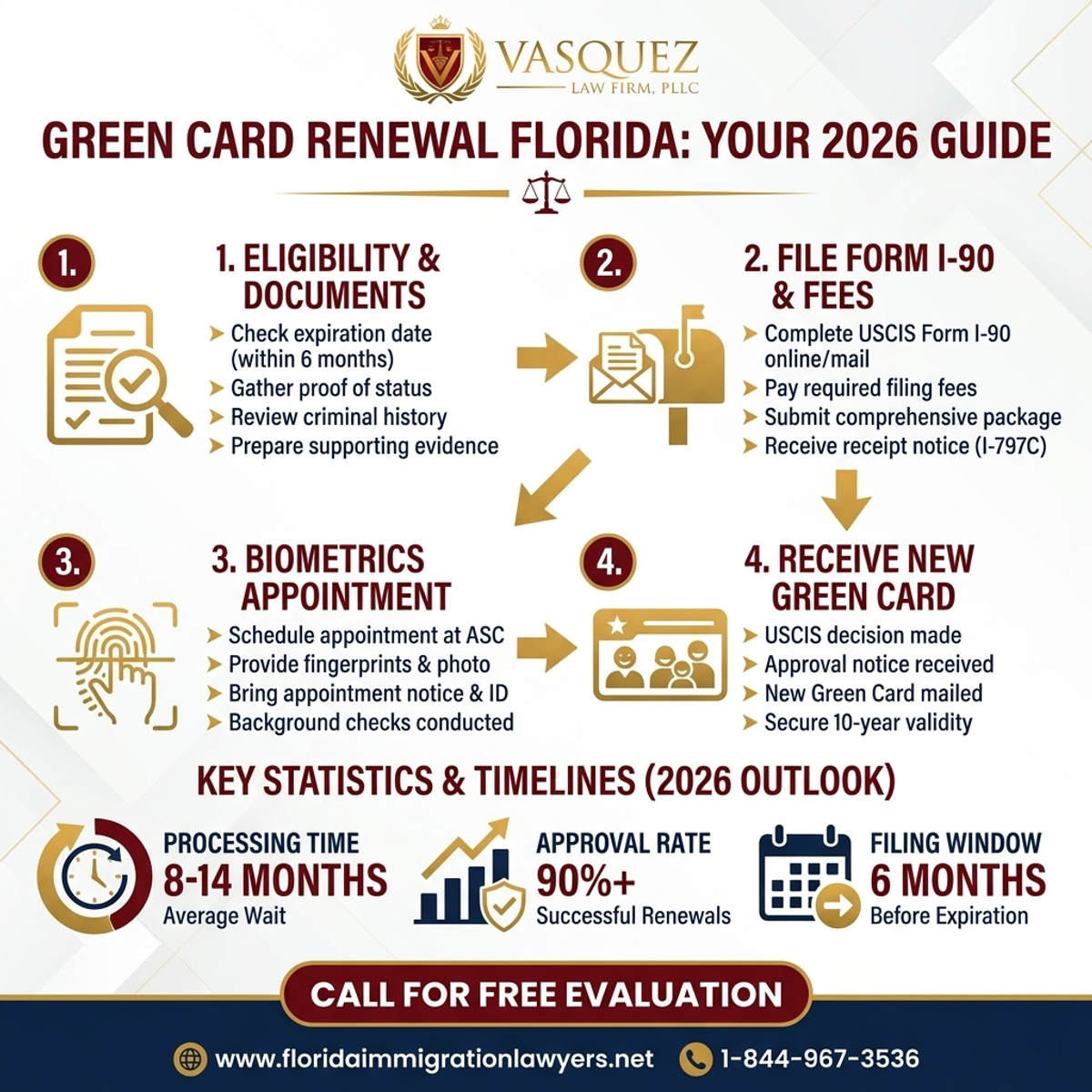
Determine Your Eligibility: Before filing, confirm you need to renew. You should apply if your 10-year card is expiring within six months or has already expired, your card was lost, stolen, or destroyed, your card was issued but never received, your card has incorrect information due to USCIS error, or you've legally changed your name and need a new card. Conditional green cards (2-year validity) require a different process (Form I-751 or I-829), not Form I-90. Ensure you clearly understand which category applies to you.
-
Complete Form I-90, Application to Replace Permanent Resident Card: You can file Form I-90 online through the USCIS website or by mail. Filing online is generally recommended for faster processing and immediate confirmation. Complete every section accurately and completely. Any missing information or errors can lead to delays or even rejection. Be prepared to provide personal details, reasons for renewal, and previous immigration history. For those in Florida who prefer or need to file by mail, ensure you use the correct USCIS lockbox facility address, which can vary based on your state of residence and the type of application. Always check the official USCIS website for the most current filing instructions.
-
Gather Supporting Documentation: Collect all necessary documents as outlined by USCIS. This typically includes a copy of your current or expired green card, government-issued identification, and any documents supporting a name change or other requested updates. For a comprehensive list, refer to the next section. Organizing these documents meticulously before submission can prevent requests for evidence (RFEs) and streamline your application. Our Florida immigration attorneys can help you compile this crucial evidence.
-
Pay the Filing Fees: USCIS charges a filing fee for Form I-90 and a biometrics service fee. These fees are subject to change, so always check the latest amounts on the USCIS website. If filing online, you can pay electronically. For mail-in applications, you must submit a check or money order. Fee waivers may be available for eligible applicants who demonstrate financial hardship. Discussing fee waiver eligibility with an attorney from Florida Immigration Lawyers can be beneficial.
-
Attend Biometrics Appointment: After USCIS accepts your application, you will receive an appointment notice (Form I-797C, Notice of Action) for a biometrics services appointment at an Application Support Center (ASC). This appointment, typically held at a location convenient to your Florida address (e.g., Orlando, Miami, Jacksonville), is where your fingerprints, photograph, and signature will be collected. These biometrics are used for background checks and identity verification. It is mandatory to attend this appointment; failure to do so without proper rescheduling can lead to your application being denied. Bring the appointment notice and a valid photo ID.
-
Receive Your New Green Card: Once your application is processed and approved, USCIS will mail your new permanent resident card to the address on file. It is crucial to keep your address updated with USCIS, especially if you move within Florida or to another state, to ensure you receive important notices and your new card. You can update your address online through the USCIS website. The new card will typically be valid for ten years from its issue date. If you do not receive your card within a reasonable timeframe after approval, contact USCIS or your attorney.
Essential Documents for Your I-90 Renewal Application
A complete and accurate application package is vital for a successful green card renewal Florida process. Missing or incorrect documentation is a leading cause of delays, requests for evidence (RFEs), or even denials. For Florida residents, preparing these documents meticulously before filing Form I-90 is a proactive step toward a smooth process. Here is a checklist of the essential documents you will generally need to provide:
-
Copy of Your Current or Expired Green Card (Form I-551): This is the most fundamental document. Even if your card is expired, lost, or stolen, you will need to provide as much information about it as possible. If it's lost or stolen, you'll describe the circumstances on Form I-90. If it's damaged, include the damaged card.
-
Government-Issued Identification: A copy of a valid photo ID, such as a driver's license (Florida driver's license is acceptable), state ID card, or passport. This helps verify your identity during the application process and at your biometrics appointment.
-
Proof of Legal Name Change (if applicable): If your name has legally changed since your last green card was issued (e.g., due to marriage, divorce, or court order), you must provide supporting documentation. This could include a marriage certificate, divorce decree, or a court order for a name change. Ensure these documents are certified copies if required.
-
Police Report or Incident Report (if applicable): If your green card was lost or stolen, it is advisable to file a police report and include a copy with your I-90 application. While not always mandatory, it provides official documentation of the incident and can strengthen your application by demonstrating due diligence.
-
Proof of Residence in Florida: While not explicitly required for I-90, having proof of your current Florida address (e.g., utility bills, lease agreements) can be helpful for your records and if USCIS requests additional information. This also ensures you receive all correspondence, including your biometrics appointment notice and new card.
Step-by-Step Process — Green Card Renewal Florida Process: Your 2026 Guide
-
Previous I-90 Application Receipts (if applicable): If you have previously applied for green card replacement or renewal, having records of those applications can be useful, especially if there were issues or if USCIS needs to reference past filings.
-
Fee Waiver Request (Form I-912, if applicable): If you are applying for a fee waiver due to financial hardship, you must include Form I-912 and all required supporting evidence of your income, assets, and expenses. Eligibility for fee waivers is strict, so careful preparation is essential.
Always remember to submit copies of your documents unless USCIS specifically requests originals. Keeping a complete copy of your entire application package for your records is also a wise practice. Florida Immigration Lawyers can assist you in preparing and organizing all necessary documentation, ensuring your application is as robust as possible.
Green Card Renewal Timeline and Processing Expectations for 2026
Understanding the timeline for your green card renewal Florida process is critical for managing expectations and planning for any potential travel or employment needs. USCIS processing times can fluctuate significantly due to various factors, including the volume of applications, staffing levels, and policy changes. While specific guarantees cannot be made, we can outline general expectations for 2026.
Typically, after you submit your Form I-90 application, you can expect to receive a receipt notice (Form I-797C) within a few weeks, acknowledging that USCIS has received your application. This notice is important as it contains your receipt number, which you can use to track your case status online via the USCIS Case Status Online tool. Following the receipt notice, you will usually receive an appointment notice for your biometrics services within a few months. This appointment is mandatory and will take place at a local Application Support Center in Florida, such as those serving Orlando, Miami, or Tampa residents. After the biometrics appointment, the processing time can vary widely, from a few months to over a year in some cases. It's not uncommon for applicants to wait 8 to 14 months for their new card, and sometimes even longer. USCIS aims to process these applications efficiently, but backlogs can occur.
Several factors can influence the processing timeline. An incomplete application or one with errors will almost certainly lead to delays, as USCIS will issue a Request for Evidence (RFE) or even deny the application, requiring you to restart the process. High application volumes at specific USCIS service centers, or changes in immigration policies, can also impact wait times. For example, recent news regarding denaturalization processes and increased fees for various immigration applications, while not directly tied to I-90 processing, can sometimes indicate broader shifts in USCIS priorities and resource allocation. If your green card expires while your I-90 application is pending, USCIS generally provides an automatic extension of your permanent resident status. The receipt notice for your Form I-90 (Form I-797C) often serves as temporary proof of status when presented with your expired green card. In some urgent cases, you may be able to request an Alien Documentation, Identification, and Telecommunication (ADIT) stamp, also known as an I-551 stamp, by scheduling an InfoPass appointment at a local USCIS field office. This stamp is placed in your passport and serves as temporary proof of your lawful permanent resident status for up to one year, allowing you to travel and work. Our Florida Immigration Lawyers can help you understand these temporary measures and advocate for you if your processing is excessively delayed.
Understanding Green Card Renewal Costs and Fees
Navigating the financial aspects of the green card renewal Florida process is an important part of your overall planning. There are two primary categories of costs associated with filing Form I-90: government filing fees and potential legal fees if you choose to hire an attorney. It's crucial to be aware of these expenses and understand how they can impact your budget.
The U.S. Citizenship and Immigration Services (USCIS) charges a mandatory filing fee for Form I-90. Additionally, there is a separate biometrics services fee, which covers the cost of collecting your fingerprints, photograph, and signature. It is vital to note that these fees are subject to change by USCIS at any time. For instance, recent discussions and proposed rules, such as those referenced in immigration news regarding increased fees for asylum seekers and other applications, highlight the dynamic nature of these costs. Therefore, always check the official USCIS website or consult with an attorney for the most current fee schedule before submitting your application. Submitting an incorrect fee amount will result in your application being rejected and returned to you, causing significant delays. For those facing financial hardship, USCIS offers the possibility of a fee waiver. To apply for a fee waiver, you must submit Form I-912, Request for Fee Waiver, along with your Form I-90 application and comprehensive supporting documentation demonstrating your inability to pay. Eligibility for fee waivers is based on specific income guidelines or receipt of certain public benefits. Our team at Florida Immigration Lawyers can assess your eligibility for a fee waiver and assist you in preparing a strong application to maximize your chances of approval.
Beyond the government fees, many Florida residents choose to hire an experienced immigration attorney to assist with their green card renewal. Legal fees cover the expertise, guidance, and support provided by your lawyer throughout the process. This includes preparing and reviewing your application, ensuring all documents are correctly gathered and submitted, responding to Requests for Evidence (RFEs), and addressing any complications that may arise. While hiring an attorney is an additional cost, it can be a valuable investment, especially for individuals with complex immigration histories, criminal records, or those who simply want peace of mind that their application is handled professionally. The cost of legal services can vary depending on the complexity of your case and the services required. Florida Immigration Lawyers offers transparent fee structures and provides initial free consultations to discuss your specific needs without obligation. We believe that professional legal assistance can significantly reduce the stress and risk associated with the green card renewal process, ultimately saving you time and preventing costly errors in the long run. Planning for both government and legal fees will allow you to approach your renewal with confidence.
Key Statistics — Green Card Renewal Florida Process: Your 2026 Guide
Do not navigate this complex process alone. Contact Florida Immigration Lawyers today for expert guidance.
Common Mistakes to Avoid During I-90 Green Card Renewal
The green card renewal Florida process, while seemingly straightforward, is rife with potential pitfalls that can lead to delays, denials, or even jeopardize your permanent resident status. Avoiding these common mistakes is crucial for a successful outcome.
-
Late Filing: Waiting until your green card has expired or is very close to expiring is a major mistake. While you can file an I-90 after expiration, it can cause issues with employment, travel, and proving your legal status. USCIS recommends filing within six months of expiration.
-
Filing the Wrong Form: Conditional permanent residents (2-year cardholders) often mistakenly file Form I-90 instead of Form I-751 (for marriage-based) or I-829 (for investor-based) to remove conditions. This error can lead to denial and potential loss of status if not corrected promptly.
-
Incomplete or Inaccurate Information: Failing to answer all questions on Form I-90 or providing inconsistent or false information can trigger Requests for Evidence (RFEs) or outright denials. Double-check every entry for accuracy.
-
Missing Supporting Documents: Not including all required supporting documents (e.g., copy of current green card, proof of name change) will lead to delays. Always review the USCIS instructions thoroughly and ensure all necessary evidence is attached.
-
Incorrect Filing Fees: Submitting the wrong filing fee or biometrics fee will result in your application being rejected and returned. Fees change periodically, so always verify the current amounts on the USCIS website.
-
Not Updating Your Address with USCIS: If you move within Florida or to another state, failing to update your address with USCIS within 10 days of moving can cause you to miss critical notices, including your biometrics appointment or your new green card. This is a common and easily avoidable error.
-
Ignoring Biometrics Appointment: Missing your scheduled biometrics appointment without proper rescheduling is a serious mistake. Failure to attend can lead to the denial of your I-90 application.
-
Assuming Automatic Renewal for Conditional Cards: Conditional green cards do not automatically convert to permanent ones. You must proactively file to remove the conditions, usually within 90 days before your 2-year card expires. Failing to do so can result in termination of your permanent resident status and even deportation proceedings.
-
Not Seeking Legal Advice for Complex Cases: If you have a criminal record, a previous denial, or other complex issues, attempting to renew your green card without legal counsel can be detrimental. These situations often require specialized legal strategies.
When to Call a Florida Immigration Lawyer for Your Green Card Renewal
While the green card renewal Florida process for a standard 10-year card might seem straightforward for some, many situations warrant the expertise of an experienced immigration attorney. Florida Immigration Lawyers are here to provide the guidance and representation you need, ensuring your permanent resident status remains secure. Knowing when to seek legal help can save you from significant stress, delays, and potential complications.
You should strongly consider contacting our firm if any of the following scenarios apply to you: your green card has been expired for an extended period, leading to concerns about your status. If you have a criminal record, even for minor offenses, this can complicate your renewal and potentially lead to inadmissibility issues. Furthermore, if you have legally changed your name but lack adequate documentation, or if your green card was lost or stolen under unusual circumstances, an attorney can help ensure proper reporting and application. For those who initially received a conditional green card through marriage or investment, and now need to remove those conditions (filing Form I-751 or I-829), our expertise is invaluable. These petitions are far more complex than a simple I-90 renewal and often require extensive documentation to prove the bona fides of your marriage or investment.
Additionally, if your I-90 application has been denied, if you've received a Request for Evidence (RFE) that you don't understand, or if you've been placed in removal (deportation) proceedings, immediate legal intervention is critical. These are serious red flags that indicate a need for professional assistance. Our attorneys at Florida Immigration Lawyers are well-versed in the intricacies of immigration law, including the Immigration and Nationality Act (INA) and relevant sections of 8 U.S.C., and can represent you before USCIS or the Executive Office for Immigration Review (EOIR). We can help you understand the specific legal requirements, prepare a robust application, respond effectively to USCIS inquiries, and advocate on your behalf, ensuring the best possible outcome for your permanent resident status in Florida. Don't leave your future to chance; secure expert legal counsel.
About Florida Immigration Lawyers
Florida Immigration Lawyers is a leading law firm dedicated to providing comprehensive and compassionate immigration legal services to individuals and families across the entire state of Florida. Our team of highly skilled and experienced attorneys understands the unique challenges and opportunities within the U.S. immigration system, particularly for those residing in our diverse state. We are committed to helping our clients achieve their immigration goals, from securing permanent residency to defending against deportation.
We offer a wide range of immigration services, including family-based immigration, deportation defense, asylum claims, citizenship applications, and, of course, green card renewals. Our attorneys are not just legal experts; they are compassionate advocates who prioritize your well-being and future. We pride ourselves on clear communication, strategic legal planning, and unwavering support throughout every step of your immigration journey. When you choose Florida Immigration Lawyers, you gain a dedicated partner who is available 24/7 to address your concerns and provide peace of mind. We offer free consultations to discuss your case and outline a path forward. Serving all of Florida, we are your trusted source for immigration legal advice. Visit our attorneys page to learn more about our team and our commitment to justice.
Sources and References
- U.S. Citizenship and Immigration Services (USCIS) - Form I-90, Application to Replace Permanent Resident Card
- U.S. Citizenship and Immigration Services (USCIS) - Case Status Online
- U.S. Citizenship and Immigration Services (USCIS) - Filing Fees
- Executive Office for Immigration Review (EOIR)
- 8 U.S.C. Chapter 12 - Immigration and Nationality Act (INA)
- 8 U.S.C. § 1304 - Forms for registration and fingerprinting
- 8 CFR Part 264 - Registration and fingerprinting of aliens
Related services: immigration practice areas, family immigration services, asylum protection, business immigration.
This article provides general legal information and is not intended as legal advice. Every case is unique, and outcomes depend on specific facts and circumstances. Contact an attorney for advice about your particular situation. Immigration laws are subject to change, and this content reflects the general understanding as of 2026.
Your permanent resident status is too important to risk. For dedicated legal assistance with your green card renewal in Florida, contact Florida Immigration Lawyers today for a free consultation at 1-844-967-3536. Se Habla Espanol - Estamos aqui para ayudarle.
Do Not Navigate This Process Alone
Our experienced immigration attorneys are ready to fight for you. Get a free, confidential consultation today.
Se Habla Español
Frequently Asked Questions
Florida Immigration Lawyers
Immigration Attorney | Founder, Vasquez Law Firm
U.S. Air Force veteran and immigration attorney with thousands of cases resolved. J.D., NCCU School of Law. AILA member. Admitted to the 4th, 5th, and 11th Circuit Courts.
Available 24/7 - Free Evaluations
Related Legal Services
Our Florida immigration attorneys can help you with immigration practice areas, free immigration consultation and experienced immigration attorneys. Call today at 1-844-967-3536 for a free consultation.
Related Links
Related Topics
Free Legal Consultation
Discuss your case with our experienced attorneys. We're available 24/7.
Se Habla Español - Estamos aquí para ayudarle.
Related Articles
Asylum Interview Preparation in Florida | VLF Florida
Preparing for an asylum interview in Florida is crucial. Learn key steps and tips for success. Call Florida Immigration Lawyers for help.
DUI Immigration Consequences in Florida | VLF Florida
A DUI conviction in Florida can have serious immigration consequences, including deportation and inadmissibility. Learn how to protect your status and what steps to take. Call Florida Immigration Lawyers for a free consultation.
USCIS Biometrics Appointment Florida: Your Guide | VLF Florida
Understanding your USCIS biometrics appointment in Florida is crucial for a smooth immigration process. This guide covers what biometrics are, the step-by-step process, essential documents, and common mistakes to avoid. Whether you're in Fort Lauderdale or elsewhere in Florida, preparing adequately for your ASC appointment is key to moving your case forward. Learn about timelines, cost factors, and when to seek legal assistance. Florida Immigration Lawyers offers expert guidance to help you navigate this important step, ensuring all requirements are met and your application remains on track. Contact us today for a free consultation.
Asylum Application Process in Florida Explained | VLF Florida
Learn the detailed steps for applying for asylum in Florida. Understand the I-589 form, timelines, and how to avoid common pitfalls. Contact Florida Immigration Lawyers for expert guidance.