Green Card Through Marriage Florida: Your 2026 Guide
For couples in Florida seeking a green card through marriage, the process involves intricate steps, extensive documentation, and careful adherence to USCIS regulations. This comprehensive 2026 guide from Florida Immigration Lawyers details eligibility, the step-by-step application, required documents, interview preparation, and potential challenges. Whether you reside in Kissimmee or elsewhere in Florida, understanding the nuances of proving a bona fide marriage and navigating federal immigration law is crucial. Our expert team provides essential insights and support to help you achieve permanent residency. Learn how to avoid common mistakes and when to seek professional legal assistance for your marriage-based green card application.

Obtaining a green card through marriage in Florida involves a multi-step process for foreign nationals marrying U.S. citizens or lawful permanent residents. This path to permanent residency requires proving a bona fide marriage, filing specific forms with USCIS, attending interviews, and submitting extensive documentation. The process typically takes 10-18 months for spouses of U.S. citizens filing concurrently in the U.S., but can vary significantly based on individual circumstances, USCIS workload, and whether the foreign spouse is inside or outside the U.S. Seeking legal guidance from an experienced Florida immigration lawyer is highly recommended to navigate this complex journey successfully.
- Prove a bona fide (real) marriage to USCIS.
- File Form I-130 and Form I-485 (if adjusting status in the U.S.).
- Gather comprehensive documentation, including financial and relationship evidence.
- Attend an interview at a local USCIS office, often in Florida.
- Consult a Florida immigration lawyer for personalized guidance.
Embarking on the journey to secure a permanent resident card, commonly known as a green card through marriage Florida, is a life-changing decision for many couples. For those living in the vibrant communities of Kissimmee, Orlando, Miami, or anywhere across the Sunshine State, understanding the specific requirements and procedures is crucial. The immigration landscape is constantly evolving, and a clear, accurate guide can make all the difference in 2026.
This comprehensive guide from Florida Immigration Lawyers is designed to demystify the process of obtaining a green card based on marriage. We will walk you through the eligibility criteria, the detailed application steps, essential documents, and what to expect during interviews and beyond. Our goal is to empower you with the knowledge needed to pursue your immigration goals confidently in Florida.
The path to legal permanent residency through marriage can be complex and fraught with potential pitfalls. It requires meticulous attention to detail and a thorough understanding of U.S. immigration law. Whether your spouse is a U.S. citizen or a lawful permanent resident, the journey begins with proving the authenticity of your relationship to the U.S. government. Do not navigate this intricate process alone.
Call Florida Immigration Lawyers at 1-844-967-3536 for a free consultation. Our experienced team serves clients throughout Florida, including Kissimmee, and is ready to provide the personalized legal support you need.
Understanding the Green Card Through Marriage Florida Process
Securing a green card through marriage in Florida is a pathway for a foreign national to become a lawful permanent resident of the United States. This process is available to spouses of U.S. citizens and lawful permanent residents (LPRs). The fundamental requirement is to demonstrate that the marriage is legitimate, or “bona fide,” and not entered into solely for immigration purposes. USCIS scrutinizes these applications carefully to prevent marriage fraud.
The specific application process depends on where the foreign spouse is located. If the foreign spouse is already in the United States, they may be eligible for adjustment of status. This allows them to apply for the green card without leaving the country. If the foreign spouse is outside the United States, they will undergo consular processing through a U.S. embassy or consulate in their home country. Both paths have distinct forms, timelines, and interview procedures.
For couples residing in Florida, such as those in Kissimmee, the local USCIS field offices play a significant role. Interviews for adjustment of status applications are typically conducted at these offices, including locations in Orlando, Miami, and Tampa. Understanding the local context and potential processing variations specific to Florida can be advantageous. Our firm has extensive experience assisting clients across Florida with these applications, ensuring compliance with all state-specific nuances and federal regulations.
It is important to remember that a green card obtained through marriage is often initially conditional if the marriage is less than two years old at the time of approval. This means the couple must file another petition (Form I-751) to remove the conditions and receive a permanent, 10-year green card. This additional step further reinforces the government's commitment to verifying the authenticity and ongoing nature of the marriage.
Eligibility Requirements for a Florida Marriage Green Card
To be eligible for a Florida marriage green card, both the petitioning spouse (U.S. citizen or LPR) and the beneficiary spouse (foreign national) must meet several crucial criteria. For the U.S. citizen or LPR spouse, they must be able to prove their status, typically through a birth certificate, passport, or green card. They also need to meet certain income requirements to sponsor their spouse, demonstrating they can financially support them and prevent them from becoming a public charge. This is often done through Form I-864, Affidavit of Support.
The foreign national spouse must generally have been lawfully admitted into the U.S. if adjusting status, or be admissible to the U.S. if consular processing. Certain past immigration violations, criminal records, or health issues can make an individual inadmissible, potentially requiring a waiver. The most critical requirement for both parties is to demonstrate that their marriage is legitimate and entered into in good faith, not solely to obtain an immigration benefit. USCIS requires substantial evidence to prove this.
Evidence of a bona fide marriage includes joint bank accounts, shared utility bills, joint leases or mortgages, photographs together, affidavits from friends and family, and evidence of commingled finances. For couples in Florida, this could include joint property deeds in Kissimmee, shared memberships to local attractions, or even joint car titles registered in the state. The more compelling and varied the evidence, the stronger your case will be. USCIS officers are trained to identify red flags and inconsistencies, making thorough preparation essential.
Furthermore, both spouses must be legally free to marry. This means any previous marriages must have been legally terminated through divorce, annulment, or death. Providing certified copies of divorce decrees or death certificates is mandatory. Failure to provide such documentation can halt the process entirely. The legal age of marriage in Florida is generally 18, and the marriage must be valid under Florida state law. Consulting with an immigration attorney ensures all these eligibility factors are adequately addressed.
Step-by-Step Guide to the Marriage Green Card Process
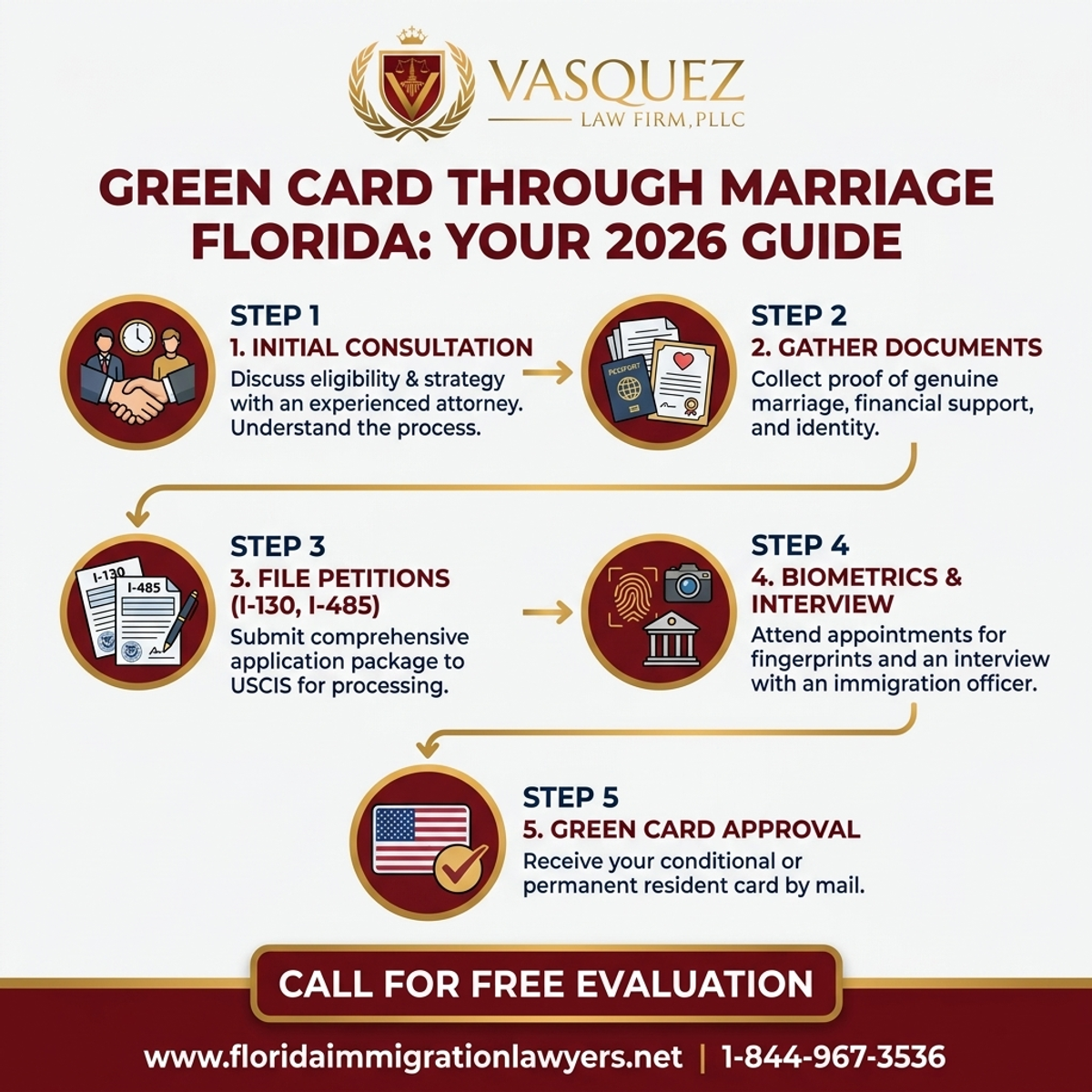
Navigating the journey to a green card through marriage Florida involves several distinct stages. While the exact forms and sequence may vary slightly depending on whether the foreign spouse is inside or outside the U.S., the core steps remain consistent. Here is a general overview of what you can expect:
-
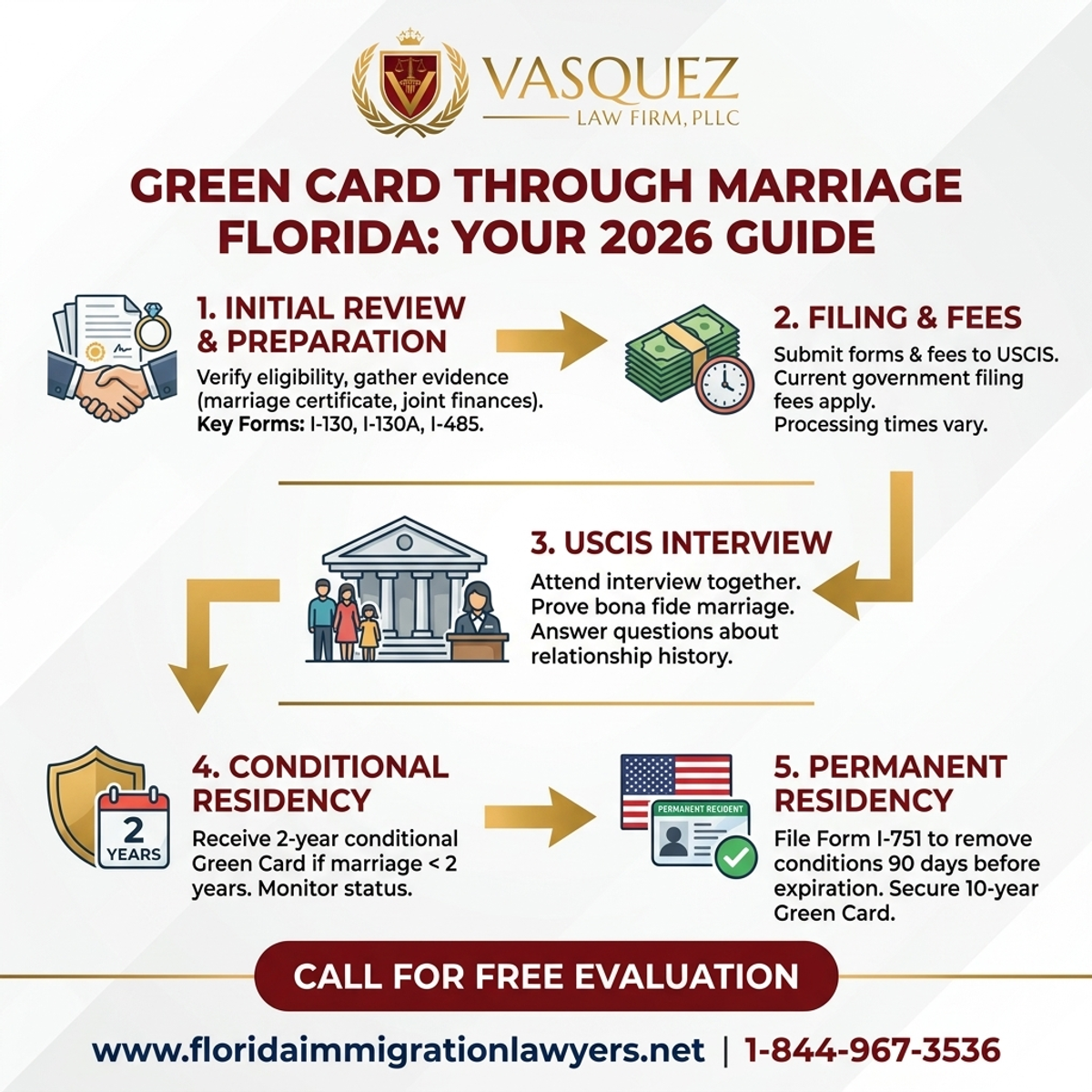
Filing Form I-130, Petition for Alien Relative: The U.S. citizen or LPR spouse initiates the process by filing Form I-130 with U.S. Citizenship and Immigration Services (USCIS). This form establishes the legitimate relationship between the petitioner and the beneficiary. It requires proof of the petitioner's status and evidence of the marriage, such as a marriage certificate.
-
Adjustment of Status (Form I-485) or Consular Processing:
- If in the U.S.: If the foreign spouse entered the U.S. legally and is eligible, they can concurrently file Form I-485, Application to Register Permanent Residence or Adjust Status, along with supporting documents (Form I-765 for work authorization, Form I-131 for travel permit). This is known as concurrent filing.
- If outside the U.S.: After I-130 approval, the case is sent to the National Visa Center (NVC). The NVC collects additional documents and fees, then schedules an interview at a U.S. embassy or consulate abroad for consular processing.
-
Biometrics Appointment: For adjustment of status applicants, USCIS will schedule a biometrics appointment at an Application Support Center (ASC) in Florida. This involves fingerprinting, photographs, and a signature for background checks.
-
Interview Scheduling: Once all preliminary steps are complete, USCIS (for adjustment of status) or the U.S. consulate (for consular processing) will schedule an interview. For Florida residents, this interview will likely take place at a local USCIS field office, such as the one in Orlando, serving areas like Kissimmee.
-
The Green Card Interview: Both spouses typically attend this interview. The purpose is for an immigration officer to determine the authenticity of the marriage. They will ask questions about your relationship, daily life, and shared history. Be prepared to present original documents and more evidence of your bona fide marriage. Honesty and consistency are paramount.
-
Decision and Green Card Issuance: Following a successful interview, USCIS will approve the application. If the marriage is less than two years old at the time of approval, a conditional green card (valid for two years) will be issued. If the marriage is older than two years, a permanent 10-year green card is issued immediately. This decision can take weeks or months after the interview.
-
Removing Conditions (Form I-751): If you received a conditional green card, you must file Form I-751, Petition to Remove Conditions on Residence, within the 90-day period before your conditional green card expires. Failure to do so can lead to the termination of your permanent resident status. This step requires further evidence that the marriage is ongoing and genuine.
Each step requires careful preparation and submission of accurate information. Any misstep can cause significant delays or even denial. Our Florida Immigration Lawyers team can guide you through each stage, ensuring all requirements are met.
Essential Document Checklist for Your Application
A successful application for a green card through marriage in Florida hinges on providing a comprehensive and accurate set of documents. Missing or incorrect documentation is a primary cause of delays and denials. Here is a general checklist of essential documents you will need:
- Petitioner (U.S. Citizen/LPR) Documents:
- Proof of U.S. citizenship (birth certificate, U.S. passport, naturalization certificate) or LPR status (green card copy).
- Proof of income (tax returns, W-2s, pay stubs) to meet poverty guidelines for Form I-864, Affidavit of Support.
- Beneficiary (Foreign National) Documents:
- Birth certificate.
- Passport and visa (if applicable).
- Form I-94, Arrival/Departure Record (if adjusting status).
- Medical examination report (Form I-693) from a USCIS-approved civil surgeon in Florida.
- Police clearances from any country where you lived for six months or more since age 16.
- Marriage-Related Documents:
- Certified copy of your marriage certificate.
- Certified copies of divorce decrees, annulment papers, or death certificates for any previous marriages of either spouse.
- Evidence of Bona Fide Marriage: This is arguably the most critical component and requires extensive documentation. The more evidence you can provide, the stronger your case. Examples include:
- Joint bank account statements.
- Joint utility bills (electricity, water, internet) at your Florida residence (e.g., Kissimmee).
- Joint lease agreements or mortgage statements.
- Shared health, life, or auto insurance policies.
- Birth certificates of children born to the marriage.
- Photographs of the couple together over time, with family and friends.
- Affidavits from friends, family, or employers attesting to the legitimacy of the marriage.
- Joint credit card statements.
- Joint tax returns.
- Correspondence addressed to both spouses.
- Evidence of shared travel or vacations.
Step-by-Step Process — Green Card Through Marriage Florida: Your 2026 Guide
- Other Forms:
- Form I-130, Petition for Alien Relative.
- Form I-485, Application to Register Permanent Residence or Adjust Status (if applicable).
- Form I-864, Affidavit of Support.
- Form I-765, Application for Employment Authorization (optional, if adjusting status).
- Form I-131, Application for Travel Document (optional, if adjusting status).
- Form I-693, Report of Medical Examination and Vaccination Record.
All foreign language documents must be accompanied by a certified English translation. Originals should not be sent unless specifically requested by USCIS. Instead, provide clear photocopies. Keeping an organized copy of your entire submission is vital. For residents of Kissimmee and other Florida cities, assembling this extensive package can feel overwhelming, but our firm can help streamline the process.
Navigating Interviews and Waivers in Florida
The interview is a pivotal stage in securing a green card through marriage Florida. For adjustment of status applicants, the interview typically takes place at a local USCIS field office. In Florida, this could be in Orlando, Miami, or Tampa. Both spouses are usually required to attend. The purpose of the interview is for the immigration officer to assess the credibility and authenticity of the marriage. They will ask detailed questions about how you met, your daily life, shared experiences, future plans, and present the evidence of your bona fide marriage.
It is crucial to be honest, consistent, and well-prepared. USCIS officers are trained to identify inconsistencies or signs of marriage fraud. They may ask probing questions, sometimes designed to catch applicants off guard. Being calm, straightforward, and having a clear understanding of your shared life is essential. If the officer has doubts about the marriage's authenticity, they might schedule a Stokes interview, where both spouses are interviewed separately to compare answers. This is a more intense scrutiny, highlighting the importance of thorough preparation from the outset.
In some cases, a foreign national may have issues that make them inadmissible to the U.S., such as certain criminal convictions, past immigration violations, or health-related issues. In such situations, a waiver may be available. For example, a waiver of inadmissibility (Form I-601 or I-601A) can sometimes overcome grounds of inadmissibility, especially if the U.S. citizen or LPR spouse would suffer extreme hardship if the foreign national were denied permanent residency. These waivers are complex and require compelling evidence, often involving detailed legal arguments.
Navigating waivers adds another layer of complexity to the immigration process. It often requires strong legal representation to present a persuasive case to USCIS. Our Florida Immigration Lawyers team has experience handling various waiver applications, helping clients in Kissimmee and throughout Florida overcome significant obstacles on their path to a green card. Understanding which waivers apply and how to successfully petition for them is critical to the overall success of your application.
Do not navigate this complex process alone. Contact Florida Immigration Lawyers today.
Timeline, Processing Expectations, and Cost Factors
The timeline for obtaining a green card through marriage Florida can vary significantly. For spouses of U.S. citizens who are filing for adjustment of status concurrently within the U.S., the process typically ranges from 10 to 18 months from filing to approval. This includes waiting for biometrics, potential work authorization approval, and the interview. However, processing times are estimates and can fluctuate based on USCIS workload, the specific USCIS field office (e.g., Orlando, Miami), and the complexity of your case. You can check current processing times on the USCIS website.
For spouses of U.S. citizens undergoing consular processing, the timeline might be similar or slightly longer, as it involves the National Visa Center (NVC) and the U.S. embassy or consulate abroad. The NVC stage can add several months, followed by waiting for an interview slot in the foreign country. For spouses of lawful permanent residents (LPRs), the process is generally much longer because their visa category (F2A) is subject to annual quotas and a visa bulletin. This means there can be a significant waiting period after the I-130 is approved before a visa number becomes available, sometimes extending to several years.
The costs associated with a marriage-based green card application include various government filing fees. These fees are subject to change, so always check the most current amounts on the USCIS website. Typically, you can expect fees for:
Key Statistics — Green Card Through Marriage Florida: Your 2026 Guide
- Form I-130, Petition for Alien Relative.
- Form I-485, Application to Register Permanent Residence or Adjust Status (includes biometrics fee).
- Form I-765, Application for Employment Authorization (often included with I-485 for concurrent filing).
- Form I-131, Application for Travel Document (often included with I-485 for concurrent filing).
- Form I-693, Report of Medical Examination and Vaccination Record (paid to the civil surgeon).
Beyond government fees, applicants should also budget for legal fees if they choose to hire an immigration attorney. While not mandatory, legal representation significantly increases the chances of a smooth and successful process, especially with the complexities involved. Other potential costs include translation services for foreign documents, travel expenses for interviews (e.g., from Kissimmee to Orlando USCIS office), and obtaining certified copies of records. A comprehensive discussion of fees and potential costs is part of our initial consultation.
Common Mistakes to Avoid
The journey to a green card through marriage Florida is filled with intricate details, and even minor errors can lead to significant delays or outright denial. Being aware of common pitfalls can help you avoid them:
-
Failing to Prove a Bona Fide Marriage: This is the most critical mistake. Simply having a marriage certificate is not enough. USCIS requires extensive evidence of a genuine, ongoing relationship. Lacking sufficient joint documents, shared finances, or a consistent narrative can raise red flags and lead to intense scrutiny, including a Stokes interview or denial.
-
Incomplete or Inaccurate Forms: Submitting forms with missing information, incorrect answers, or unsigned pages is a frequent cause of Requests for Evidence (RFEs) or outright rejection. Each field must be carefully completed and consistent with all other submitted documents.
-
Not Disclosing All Information: Attempting to hide past immigration violations, criminal history, or previous marriages can have severe consequences, including charges of misrepresentation and permanent bars from the U.S. Honesty and transparency are paramount, even if it means addressing complex issues with an attorney.
-
Missing Deadlines: Failing to respond to RFEs or appointment notices by the specified deadline will result in the denial of your application. For conditional green card holders, missing the 90-day window to file Form I-751 before expiration can lead to loss of status and potential deportation.
-
Traveling Internationally Without Advance Parole: If you are adjusting status in the U.S., leaving the country without obtaining Advance Parole (Form I-131) can be considered abandoning your adjustment of status application, even if you have a valid visa. This is a critical mistake that can prevent re-entry.
-
Ignoring Financial Sponsorship Requirements: The U.S. citizen or LPR spouse must meet specific income thresholds to sponsor their spouse via Form I-864. Failure to meet these requirements or provide sufficient documentation (e.g., tax returns) can lead to denial based on the public charge rule. A joint sponsor may be needed in some cases.
-
Not Seeking Legal Advice for Complex Cases: If you have a criminal record, previous deportations, prior visa overstays, or a history of immigration issues, attempting to navigate the process alone is highly risky. These complexities almost always require expert legal intervention to assess eligibility and apply for necessary waivers.
-
Incorrectly Assembling the Application Package: USCIS has specific guidelines for how documents should be organized, including proper tabs, coversheets, and order. Submitting a messy or disorganized package can lead to processing delays or overlooked evidence.
-
Failing to Update USCIS of Address Changes: If you move, especially within Florida (e.g., from Kissimmee to another city), you must inform USCIS of your new address within 10 days using Form AR-11. Missing notices due to an outdated address can result in missed appointments and application denial.
-
Underestimating the Interview: Many couples underestimate the rigor of the green card interview. It's not just a formality. Officers are looking for specific details and consistency. Being unprepared for questions about your relationship can jeopardize your application.
When to Call a Florida Immigration Lawyer
While some straightforward immigration cases might be attempted independently, securing a green card through marriage Florida is rarely simple. The process is filled with legal nuances, constant regulatory changes, and high stakes. There are many scenarios where the expertise of a seasoned Florida immigration lawyer is not just helpful, but absolutely essential for a successful outcome.
You should strongly consider contacting Florida Immigration Lawyers if any of the following apply to your situation:
- You or your spouse have a criminal record, even minor offenses.
- You have a history of immigration violations, such as overstaying a visa, unlawful entry, or previous deportation orders.
- You have been denied a visa or immigration benefit in the past.
- Your marriage is relatively new, or you have limited joint documentation to prove its authenticity.
- You have been previously married, especially multiple times.
- There is a significant age difference or cultural gap between you and your spouse, which USCIS may scrutinize.
- You are concerned about meeting the financial sponsorship requirements.
- You are applying for a waiver of inadmissibility.
- You received a Request for Evidence (RFE) or Notice of Intent to Deny (NOID) from USCIS.
- You feel overwhelmed by the sheer volume of forms, documents, and legal requirements.
- You want to ensure your application is as strong as possible from the outset, minimizing risks and delays.
Our attorneys at Florida Immigration Lawyers understand the unique challenges faced by couples in Kissimmee and across Florida. We offer comprehensive legal services, from initial eligibility assessment to preparing and filing all necessary forms, compiling robust evidence, and preparing you for the interview. We can represent you during interviews and address any complications that arise, providing peace of mind throughout the entire process.
About Florida Immigration Lawyers
Florida Immigration Lawyers is a leading immigration law firm dedicated to serving individuals and families across the entire state of Florida. With a deep understanding of U.S. immigration law and a compassionate approach, we provide expert legal representation for a wide range of immigration matters. Our firm is committed to helping clients navigate the complexities of the immigration system, whether they are seeking a green card through marriage Florida, deportation defense, citizenship, or family-based immigration. We pride ourselves on offering personalized service and strategic solutions tailored to each client's unique circumstances.
Our experienced attorneys are available 24/7 to answer your questions and provide support. We offer free, no-obligation consultations to discuss your case and outline your best legal options. We understand the importance of clear communication, which is why we provide bilingual services (English and Spanish) to ensure every client feels heard and understood. From our offices, we proudly serve communities like Kissimmee, Orlando, Miami, Tampa, and all other cities in Florida, striving to achieve positive outcomes for those pursuing their American dream.
Sources and References
- U.S. Citizenship and Immigration Services (USCIS)
- U.S. Department of State - Family-Based Immigrant Visas
- Executive Office for Immigration Review (EOIR)
- 8 U.S.C. § 1101 et seq. - Immigration and Nationality Act (INA)
- 8 CFR § 204.2 - Petitions for relative, widow(er), or orphan
- 8 CFR § 245.1 - Eligibility
Related services: family petition process, family-based green cards, fiancé visa (K-1), marriage-based immigration.
This article provides general legal information and is not intended as legal advice. Every case is unique, and outcomes depend on specific facts and circumstances. Contact an attorney for advice about your particular situation. Immigration laws are subject to change.
Securing a green card through marriage Florida is a significant step towards building a life together in the United States. While the process can be challenging, with the right legal guidance, it is entirely achievable. Do not let the complexity deter you from pursuing your dreams.
Contact Florida Immigration Lawyers today for a free consultation. Call us at 1-844-967-3536. Se Habla Espanol - Estamos aqui para ayudarle.
Do Not Navigate This Process Alone
Our experienced immigration attorneys are ready to fight for you. Get a free, confidential consultation today.
Se Habla Español
Frequently Asked Questions
Florida Immigration Lawyers
Immigration Attorney | Founder, Vasquez Law Firm
U.S. Air Force veteran and immigration attorney with thousands of cases resolved. J.D., NCCU School of Law. AILA member. Admitted to the 4th, 5th, and 11th Circuit Courts.
Available 24/7 - Free Evaluations
Related Legal Services
Our Florida immigration attorneys can help you with deportation defense, citizenship and naturalization and family immigration services. Call today at 1-844-967-3536 for a free consultation.
Related Links
Related Topics
Free Legal Consultation
Discuss your case with our experienced attorneys. We're available 24/7.
Se Habla Español - Estamos aquí para ayudarle.
Related Articles
Deportation Defense Lawyers in Orlando | VLF Florida
Facing deportation in Orlando can be overwhelming. Learn how a deportation defense lawyer can help you navigate removal proceedings and protect your rights. Contact Florida Immigration Lawyers for a free consultation.
Understanding Public Charge Rule for Florida Immigrants
Explore how the public charge rule affects Florida immigrants, particularly in Homestead. This guide covers the essentials of navigating this complex immigration rule, offering practical advice and legal support options.
Free Immigration Consultation in Florida | VLF Florida
Facing immigration issues in Florida? Discover the importance of free consultations with experienced immigration lawyers in Coral Springs. Learn how to prepare for a consultation, avoid common mistakes, and explore when to seek legal help. Call Florida Immigration Lawyers today!
Child Status Protection Act: Florida Guide | VLF Florida
Learn how the Child Status Protection Act (CSPA) can protect your family's immigration status in Florida. This guide covers everything from understanding CSPA to calculating age and avoiding common mistakes. Call Florida Immigration Lawyers for expert help.
