Good Moral Character for Naturalization in Florida 2026
For immigrants in Florida seeking naturalization, demonstrating good moral character is a critical and often challenging requirement. USCIS meticulously reviews an applicant's conduct during a statutory period, scrutinizing criminal history, tax compliance, honesty, and adherence to all laws. This involves a detailed look at court records, police reports, and financial obligations. Certain offenses, such as aggravated felonies or crimes involving moral turpitude, can lead to permanent ineligibility, while others may result in temporary bars or require compelling evidence of rehabilitation. Understanding the nuances of INA 101(f) and USCIS policy is essential. This guide covers what USCIS considers good moral character, how criminal history impacts your N-400 application in Florida, a step-by-step process, crucial documentation, expected timelines, and associated costs. Avoid common mistakes and learn when legal representation from Florida Immigration Lawyers is indispensable to navigate these complexities and secure your path to U.S. citizenship.

To qualify for naturalization in Florida, applicants must demonstrate good moral character, a requirement assessed by USCIS based on their conduct during the statutory period (typically 3 or 5 years before filing N-400) and up to the oath ceremony. This involves a comprehensive review of criminal history, tax compliance, honesty, and adherence to immigration laws. Certain offenses, like aggravated felonies or crimes involving moral turpitude, can permanently bar an applicant, while others may result in a temporary bar or require a showing of rehabilitation. Understanding these complex criteria is vital for a successful application.
- Good moral character is a mandatory naturalization requirement.
- USCIS reviews your conduct during a specific statutory period.
- Criminal history, honesty, and legal compliance are key factors.
- Certain offenses can lead to permanent or temporary bars.
- Consulting an attorney is crucial for complex cases, especially in Florida.
Understanding Good Moral Character for Naturalization in Florida
Embarking on the journey to become a U.S. citizen is a profound step, one that promises a deeper connection to the country you call home. For many immigrants in Florida, naturalization represents the culmination of years of hard work, dedication, and adherence to American values. A cornerstone of this process, and often the most scrutinized, is the requirement to demonstrate good moral character (GMC). As of 2026, USCIS continues to apply stringent guidelines when evaluating an applicant's moral fitness, examining every aspect of their life during a specific statutory period.
This comprehensive guide from Florida Immigration Lawyers aims to demystify the good moral character requirement, providing clarity on what USCIS looks for, common pitfalls, and how a criminal history might impact your application. Whether you reside in Orlando, Miami, Tampa, or any other part of the Sunshine State, understanding these criteria is paramount to a successful N-400, Application for Naturalization. We will explore the specific legal definitions, the types of conduct that can pose challenges, and the steps you can take to strengthen your case. Navigating these complex immigration laws can be daunting, but you don't have to do it alone. Call Florida Immigration Lawyers at 1-844-967-3536 for a free case review and let our experienced team guide you through every stage of your naturalization process.
What Does USCIS Consider Good Moral Character for Naturalization?
Good moral character, as defined by the Immigration and Nationality Act (INA) Section 101(f) (8 U.S.C. § 1101(f)), refers to the character which measures up to the standards of the average citizen of the community in which the applicant resides. USCIS evaluates an applicant's conduct during the statutory period, which is typically five years immediately preceding the filing of the N-400 application, or three years if applying based on marriage to a U.S. citizen. This period extends until the oath of allegiance is administered, meaning any adverse conduct during this time can impact your eligibility.
The determination of good moral character is made on a case-by-case basis, considering the totality of the circumstances. USCIS is primarily looking for individuals who have consistently demonstrated respect for the law and the values of American society. This includes, but is not limited to, being honest in all dealings with the government, paying taxes, supporting dependents, and refraining from criminal activity. While certain acts are automatic bars to a finding of good moral character, others are discretionary, allowing USCIS officers to weigh various factors. The USCIS Policy Manual, Volume 12, Part D, provides detailed guidance on how officers should apply these standards, emphasizing the importance of a thorough review of all evidence presented.
Statutory Bars to Good Moral Character
The INA explicitly lists certain acts that automatically prevent an applicant from establishing good moral character. These are known as statutory bars and include, but are not limited to:
- Aggravated Felonies: Any applicant convicted of an aggravated felony (as defined in INA 101(a)(43)) at any time on or after November 29, 1990, is permanently barred from establishing good moral character. This is a severe and often irreversible impediment to naturalization.
- Crimes Involving Moral Turpitude (CIMT): A conviction for two or more crimes involving moral turpitude, or a single CIMT for which a sentence of five years or more was imposed, can be a bar.
- Drug-Related Offenses: Conviction for any crime related to controlled substances, other than a single offense of simple possession of 30 grams or less of marijuana.
- Incarceration: Having been confined to a penal institution for a total of 180 days or more during the statutory period, even if the conviction occurred prior to this period.
- Illegal Gambling: Having derived income principally from illegal gambling activities, or having been convicted of two or more gambling offenses.
- Prostitution: Having been involved in prostitution or commercialized vice.
- False Testimony: Giving false testimony under oath to obtain an immigration benefit.
- Polygamy: Being a habitual drunkard or practicing polygamy.
- Failure to Support Dependents: Willful failure to support dependents or pay alimony, although this is often a discretionary rather than statutory bar depending on circumstances.
It is critical to disclose all interactions with law enforcement, even if charges were dismissed, expunged, or occurred outside the statutory period. Failure to disclose can be considered false testimony, an independent bar to good moral character.
How Does Criminal History Impact Your N-400 Application in Florida?
A criminal history is one of the most significant hurdles for naturalization applicants in Florida. USCIS takes all criminal offenses seriously, regardless of how minor they may seem, and will conduct thorough background checks. This includes fingerprinting and reviewing records from local, state, and federal law enforcement agencies. Even arrests that did not lead to a conviction, or convictions that were expunged or sealed, must be disclosed on your N-400 application.
The impact of a criminal history depends on the nature of the offense, when it occurred, and its classification under immigration law. For instance, a conviction for an aggravated felony will result in a permanent bar to good moral character, making naturalization impossible. Less severe offenses, such as certain misdemeanors, might result in a temporary bar, meaning you may need to wait until after the statutory period has passed since the offense or its completion (e.g., probation) before reapplying. In some cases, a single minor offense may not automatically disqualify you if you can demonstrate rehabilitation and otherwise good conduct. For example, a minor traffic infraction is generally not a bar, but a DUI conviction can be problematic, especially if it occurred recently or there are multiple instances.
It's important to differentiate between a conviction for immigration purposes and for state law purposes. What a Florida court considers a minor offense might be viewed differently by USCIS. Furthermore, even if you were pardoned or had your record expunged under Florida law, USCIS may still consider the underlying conduct when assessing good moral character. This is why obtaining certified copies of all arrest records, court dispositions, and sentencing information is crucial. An immigration attorney can help you understand how your specific criminal history will be evaluated by USCIS, prepare necessary documentation, and argue for a finding of good moral character despite past issues. In some cases, even if an individual has had a past interaction with the law, they may still be eligible to apply for naturalization with proper legal counsel. For example, some applicants who have minor offenses might be able to demonstrate rehabilitation through community involvement or consistent employment.
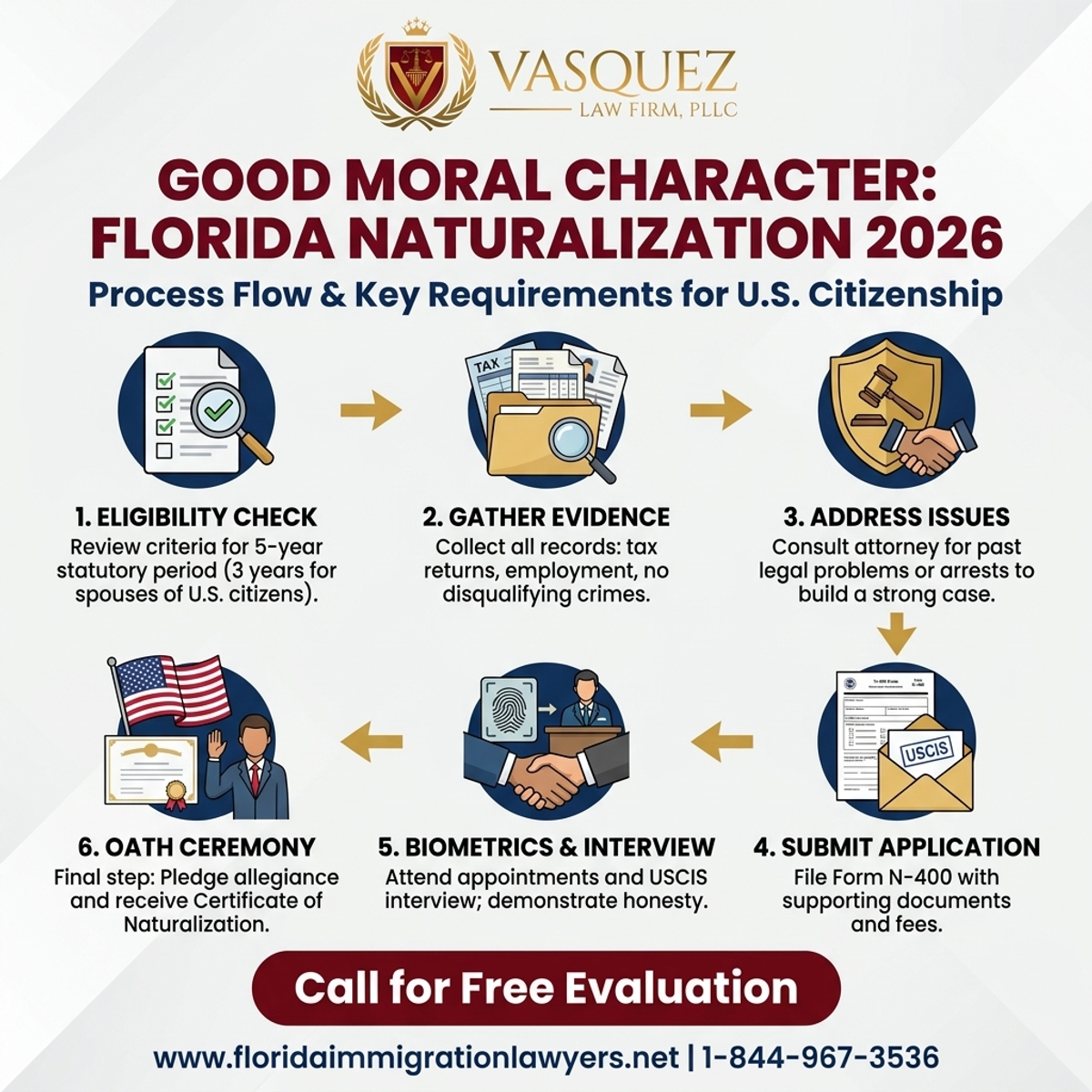
Step-by-Step Process — Good Moral Character for Naturalization in Florida 2026
Florida-Specific Considerations for Criminal History
Florida's diverse legal landscape means that various types of offenses are handled differently across counties like Orange, Miami-Dade, or Hillsborough. USCIS field offices in Orlando, Miami, and Tampa are familiar with Florida state laws and judicial processes. They will specifically look at state court records and may even consult with local law enforcement. For instance, a first-time DUI in Florida might be treated with a temporary bar, while repeat offenses will likely lead to a permanent bar to good moral character. The nuances of Florida's expungement and sealing laws also warrant careful consideration, as they do not always erase the offense for immigration purposes. It's essential to present a clear and complete picture of any criminal past to USCIS.
Do not navigate this process alone. Contact Florida Immigration Lawyers today.
What is the Step-by-Step Process for Demonstrating Good Moral Character?
Demonstrating good moral character is an ongoing process that begins well before you file your N-400 application and continues until you take the Oath of Allegiance. Here's a step-by-step guide:
-
Maintain Lawful Conduct During the Statutory Period: This is the most crucial step. For most applicants, this means maintaining lawful conduct for the five years (or three years if married to a U.S. citizen) immediately preceding your N-400 filing. This includes avoiding arrests, convictions, and any activities that could be deemed contrary to good moral character. This period extends until the oath ceremony.
-
Gather All Relevant Documentation: Before filing, compile all documents related to your past conduct. This includes certified court dispositions for any arrests or convictions, police reports, proof of tax payments, child support records, and any evidence of rehabilitation or community involvement. If you've had an expungement or sealing of a record in Florida, you still need to disclose it and provide the relevant court orders.
-
Complete Form N-400 Accurately and Honestly: The N-400 application requires you to disclose all your criminal history, even if charges were dismissed, expunged, or occurred outside the statutory period. Honesty is paramount; providing false information under oath is an automatic bar to good moral character. Be thorough and provide exact dates and locations for every incident.
-
Attend Biometrics Appointment: After filing, you will receive a notice for a biometrics appointment at an Application Support Center (ASC), such as the one in Orlando or Jacksonville. Here, your fingerprints and photograph will be taken for federal background checks. These checks will reveal any criminal history, even if you failed to disclose it.
-
Prepare for the Naturalization Interview: During the interview with a USCIS officer, you will be questioned about your N-400 application, including your moral character. Be prepared to discuss any past issues honestly and provide any additional documentation requested. The officer will assess your credibility and determination to be a law-abiding citizen. An officer might ask about your understanding of U.S. history and government, as well as your willingness to support the U.S. Constitution.
-
Demonstrate Rehabilitation (If Applicable): If you have a questionable past, be ready to present evidence of rehabilitation. This could include proof of completing probation, community service, drug or alcohol counseling, consistent employment, volunteer work, or strong community ties. Letters of recommendation from employers, community leaders, or religious figures can also be helpful.
-
Attend the Oath of Allegiance Ceremony: If your application is approved, you will be invited to an Oath of Allegiance ceremony. Your good moral character must continue until this final step. Any adverse conduct between the interview and the oath ceremony can lead to revocation of approval.
Document Checklist for Good Moral Character Assessment
To ensure a smooth naturalization process, it's vital to have all necessary documents ready for your good moral character assessment. Here's a comprehensive checklist:
- Certified copies of all arrest reports, court dispositions, and sentencing records for every interaction with law enforcement, regardless of the outcome or date.
- Proof of payment for any fines, restitution, or court-ordered fees.
- Evidence of completion of probation, parole, or any alternative sentencing programs.
- Certified copies of divorce decrees, marriage certificates, and child support orders, along with proof of consistent child support payments.
- Income tax returns for the last five years (or three years if applying based on marriage to a U.S. citizen) to demonstrate tax compliance.
- Selective Service registration records (for males aged 18-26 at the time of their initial entry or adjustment of status).
- Letters of recommendation from employers, community organizations, or religious leaders attesting to your good character and community involvement.
- Any other documents that demonstrate your rehabilitation or positive contributions to society, such as volunteer certificates or awards.
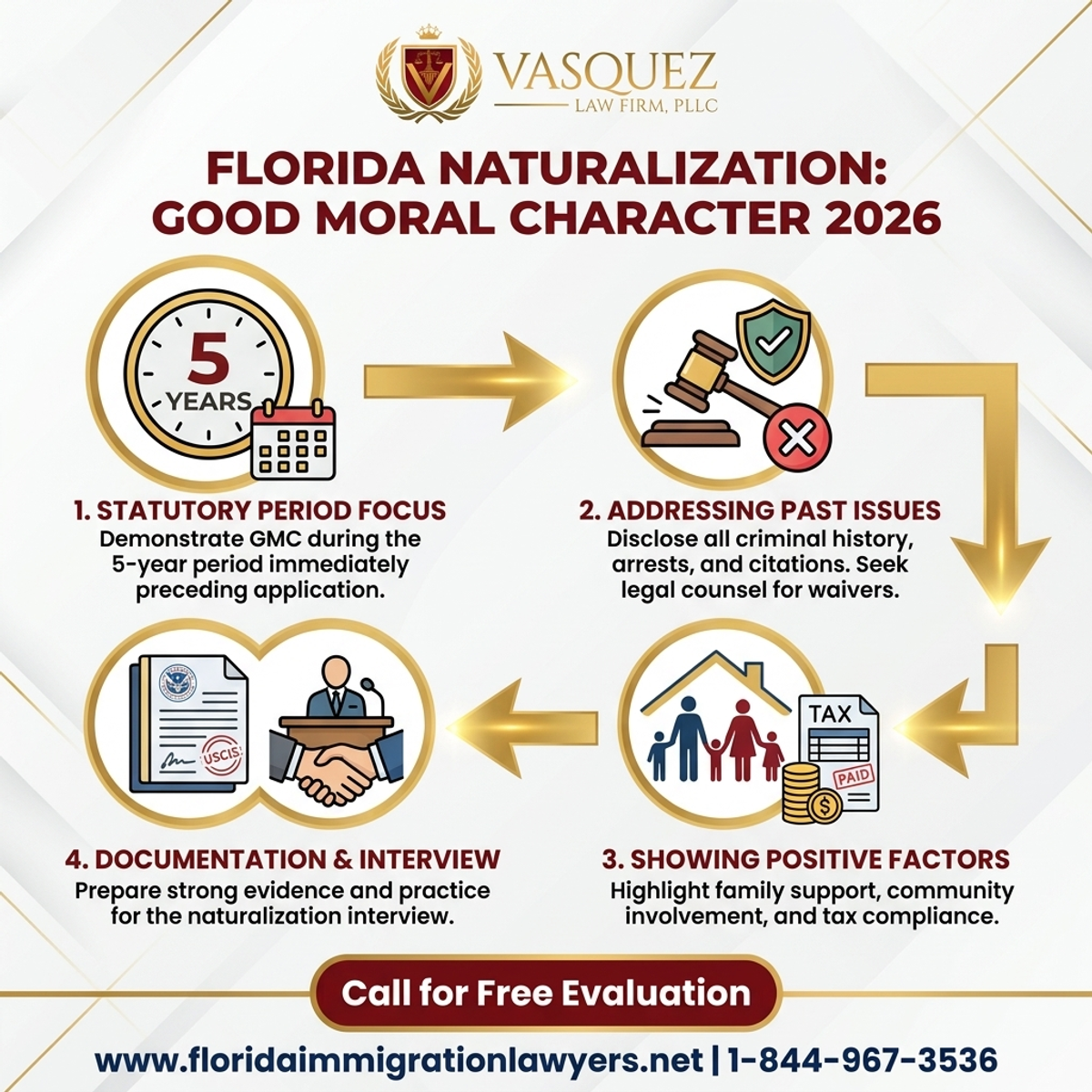
Key Statistics — Good Moral Character for Naturalization in Florida 2026
Timeline and Processing Expectations for Naturalization in 2026
As of 2026, the naturalization process, including the assessment of good moral character, can vary significantly depending on the USCIS field office processing your application and the complexity of your case. For Florida residents, applications are typically processed by the USCIS field offices in Orlando, Miami, or Tampa. While USCIS aims for efficiency, delays can occur, especially if there are issues with background checks or requests for additional evidence (RFEs).
| Stage | Typical Timeframe (As of 2026) | Notes |
|---|---|---|
| File N-400 Application | Day 1 | Ensure all documents are complete and accurate. |
| Receipt Notice (I-797C) | 1-3 weeks | Confirmation that USCIS received your application. |
| Biometrics Appointment | 3-8 weeks after receipt | Fingerprints and photos for background checks. |
| Interview Scheduling | 3-12 months after biometrics | Varies by field office (e.g., Orlando vs. Miami). |
| Naturalization Interview | Scheduled date | Officer reviews application, tests English/Civics, assesses GMC. |
| Decision Notice (I-797) | Immediately or within 120 days of interview | Approval, denial, or request for more evidence. |
| Oath of Allegiance Ceremony | 2-8 weeks after approval | Final step to becoming a U.S. citizen. |
| Total Processing Time | 8-24 months (average) | Complex cases, criminal history, or RFEs can extend this. |
It is important to regularly check the USCIS website for current processing times specific to your field office. USCIS updates these times monthly. If your case involves complex good moral character issues, such as a criminal history, expect the process to take longer due to additional scrutiny and potential requests for further documentation. Sometimes, cases might be referred to an immigration judge, such as Judge Cynthia Goodman, if there are significant legal questions regarding eligibility, but this is less common for straightforward naturalization applications.
Cost Factors and Fee Breakdown for Naturalization in Florida
The cost of naturalization in Florida primarily involves USCIS filing fees, but can also include legal fees if you choose to hire an attorney. As of 2026, these fees are subject to change, so it's always best to check the official USCIS website for the most current amounts. However, here's a general breakdown of typical costs:
| Item | Typical Fee (As of 2026) | Notes |
|---|---|---|
| Form N-400 Filing Fee | Varies (e.g., $725 including biometrics) | Check USCIS website for current fee. Some applicants may be eligible for a fee waiver or reduced fee. |
| Biometrics Fee | Included in N-400 fee | Covers fingerprinting and background checks. |
| Attorney Fees | Varies widely ($2,000 - $10,000+) | Depends on case complexity, attorney's experience, and services provided. Essential for complex GMC issues. |
| Document Retrieval Fees | Varies (e.g., $10-$50 per record) | Costs for obtaining certified court records, police reports, etc., from Florida agencies. |
| Translation Services | Varies (e.g., $20-$40 per page) | If any supporting documents are not in English, certified translations are required. |
| Travel Costs | Varies | To ASC for biometrics, USCIS field office for interview, and oath ceremony. |
While the USCIS filing fee for Form N-400 is a standard cost, the legal fees for an attorney can fluctuate significantly. For cases involving complex good moral character issues, such as extensive criminal history, multiple arrests, or previous immigration violations, legal representation is highly recommended and will likely incur higher fees due to the increased time and expertise required. An attorney can help you gather necessary documentation, prepare a strong legal argument, and represent you during the interview, potentially saving you from costly delays or denials.
Do not navigate this process alone. Contact Florida Immigration Lawyers today.
Common Mistakes to Avoid When Proving Good Moral Character
The path to naturalization is fraught with potential missteps, especially when it comes to demonstrating good moral character. Avoiding these common mistakes can significantly improve your chances of approval:
-
Failing to Disclose All Criminal History: This is perhaps the most critical error. Many applicants believe that if a charge was dismissed, expunged, or occurred long ago, it doesn't need to be disclosed. USCIS has access to comprehensive databases and will likely discover any undisclosed incidents. Deliberate concealment can be considered false testimony, an independent and permanent bar to good moral character, leading to a denial and potentially even deportation proceedings.
-
Not Providing Certified Court Documents: Simply listing an arrest or conviction is not enough. You must provide certified copies of all court dispositions, police reports, and sentencing records. Without these, USCIS cannot fully assess the nature of the offense and may issue a Request for Evidence (RFE), delaying your case.
-
Misunderstanding the Statutory Period: While the statutory period is typically 3 or 5 years, some offenses (like aggravated felonies) are permanent bars, regardless of when they occurred. Additionally, the good moral character requirement extends until the oath ceremony, meaning any misstep during this entire period can be detrimental.
-
Failing to Pay Taxes or Child Support: Willful failure to pay federal, state, or local taxes, or to support your dependents, can be a discretionary bar to good moral character. USCIS will often request tax transcripts and child support payment records. Ensure you are current on all obligations.
-
Assuming Minor Offenses are Irrelevant: While a single minor traffic ticket might not be an issue, multiple minor offenses, or a single DUI, can raise red flags. Each incident contributes to the totality of circumstances USCIS considers.
-
Giving False Testimony Under Oath: Any attempt to deceive USCIS during the interview or on the application form, even about a seemingly minor detail, can be grounds for a denial. This includes lying about past criminal acts, marital history, or residences.
-
Not Seeking Legal Advice for Complex Cases: If you have any criminal history, multiple arrests, or other complex issues (e.g., bankruptcy, previous immigration violations), attempting to navigate the N-400 process without an experienced immigration attorney is a significant risk. An attorney can assess your specific situation and advise on the best course of action.
-
Having Multiple DUIs in Florida: In Florida, repeat DUI offenses are taken very seriously. Multiple DUI convictions can make it extremely difficult, if not impossible, to establish good moral character for naturalization purposes, often leading to a permanent bar.
-
Failing to Demonstrate Rehabilitation: If you have a past criminal record, simply waiting out the statutory period isn't always enough. USCIS may expect you to show evidence of rehabilitation, such as consistent employment, community involvement, or completion of counseling programs. Without this, your application might be denied.
When to Call a Florida Immigration Lawyer
While some naturalization applications are straightforward, many involve complexities that warrant the expertise of an experienced immigration attorney. If any of the following scenarios apply to you, it is highly advisable to seek legal counsel from Florida Immigration Lawyers:
- You have any criminal history, including arrests, charges, convictions, or expungements, regardless of how minor or old they are.
- You have received a Request for Evidence (RFE) from USCIS regarding your good moral character or any other aspect of your application.
- You have previously been denied naturalization or faced deportation proceedings.
- You have issues with tax compliance, child support payments, or other financial obligations.
- You have ever given false testimony to an immigration officer or on an immigration form.
- You have spent significant time outside the U.S. during the statutory period, potentially affecting your continuous residence.
- You are unsure about how to answer specific questions on the N-400 form or during the naturalization interview, particularly those related to your moral character.
- You have concerns about your ability to demonstrate attachment to the U.S. Constitution and good order and happiness of the United States.
Our attorneys at Florida Immigration Lawyers can help you assess your eligibility, gather all necessary documentation, prepare a compelling case for good moral character, and represent you during your USCIS interview. We understand the nuances of immigration law and the specific requirements of USCIS field offices in Orlando, Miami, and Tampa. Don't risk your chance at U.S. citizenship. We are here to help.
About Florida Immigration Lawyers
Florida Immigration Lawyers is a leading immigration law firm dedicated to serving individuals and families across the entire state of Florida. With offices strategically located in Orlando, our experienced attorneys provide comprehensive legal services, guiding clients through the complexities of U.S. immigration law. We understand that every immigration journey is unique, and we are committed to providing personalized, compassionate, and effective legal representation.
Our practice areas include naturalization and citizenship, asylum, deportation defense, family-based immigration, business immigration, and more. We pride ourselves on our deep understanding of federal immigration regulations and our ability to navigate the specific requirements of USCIS and immigration courts throughout Florida. Available 24/7, we offer free case reviews to help you understand your options and develop a strong legal strategy. When your future in the U.S. is at stake, trust the dedicated advocates at Florida Immigration Lawyers. Call us today at 1-844-967-3536 to schedule a free consultation.
Sources and References
- U.S. Citizenship and Immigration Services (USCIS)
- Executive Office for Immigration Review (EOIR)
- U.S. Department of State
- Immigration and Nationality Act (INA) Section 101(f) (8 U.S.C. § 1101(f))
- INA Section 101(a)(43) (8 U.S.C. § 1101(a)(43)) - Definition of Aggravated Felony
- 8 Code of Federal Regulations (CFR) § 316.10 - Requirements for Good Moral Character
- USCIS Policy Manual, Volume 12, Part D - Good Moral Character
Related services: citizenship test preparation, dual citizenship guidance.
This article provides general legal information and is not intended as legal advice. Every case is unique, and outcomes depend on specific facts and circumstances. Contact an attorney for advice about your particular situation.
Secure Your Future: Contact Florida Immigration Lawyers Today
Don't let concerns about good moral character jeopardize your dream of U.S. citizenship. The requirements are complex, and the stakes are high. Florida Immigration Lawyers is here to provide the expert legal guidance you need. We offer free case reviews and are available 24/7 to discuss your specific situation. Call us at 1-844-967-3536. Se Habla Espanol - Estamos aqui para ayudarle.
If you need legal assistance, learn more about our citizenship and naturalization services, or call us at 1-844-967-3536 for a free case review.
Do Not Navigate This Process Alone
Our experienced immigration attorneys are ready to fight for you. Get a free, confidential case review today.
Se Habla Español
Or leave your details and we’ll call you:
Free Evaluation in 24 Hours
Or talk to us right now
AI voice assistant — available 24/7
FreeFrequently Asked Questions

William J. Vásquez
Founding Attorney · Vasquez Law Firm
U.S. Air Force veteran and immigration attorney with years of hands-on U.S. immigration experience. J.D., NCCU School of Law. AILA member. Admitted to the 4th, 5th, and 11th Circuit Courts.
Available 24/7 - Free Evaluations
Reviewed for legal accuracy by William J. Vásquez
Licensed in North Carolina; U.S. immigration is federal practice.
Related Legal Services
Our Florida immigration attorneys can help you with immigration lawyer cost in Florida, experienced immigration attorneys and asylum protection. Call today at 1-844-YO-PELEO for a free case review.
Related Links
Related Topics
Free Legal Case Review
Discuss your case with our experienced attorneys. We're available 24/7.
Se Habla Español - Estamos aquí para ayudarle.
Related Articles
Immigration Lawyer Orlando Free Consultation in Florida
For individuals and families in Orlando, Florida, navigating the complexities of U.S. immigration law requires expert guidance. An immigration lawyer in Orlando offers crucial support for everything from visa applications and green card processes to naturalization and deportation defense. This comprehensive guide details what a free consultation covers, providing a step-by-step overview of immigration pathways, essential document checklists, and expected timelines in 2026. We also highlight common mistakes to avoid, discuss the critical role of legal counsel in deportation and asylum cases, and explain why choosing a local Orlando immigration attorney is beneficial. Florida Immigration Lawyers is dedicated to serving the diverse community of Orlando with compassionate, effective legal solutions, ensuring you receive personalized advice and robust representation for a successful immigration journey.
Immigration Rights: Know Your Protections in Florida 2026
Understanding your immigration rights in Florida is paramount for your protection and peace of mind. This comprehensive guide details your core constitutional protections, including the right to remain silent and the right to an attorney, regardless of your immigration status. Learn essential strategies for interacting with ICE, what vital documents to carry, and a step-by-step overview of the immigration detention and removal process in Florida. We also cover common mistakes to avoid and when it's crucial to seek expert legal counsel. Florida Immigration Lawyers are dedicated to empowering you with the knowledge and support needed to navigate complex immigration challenges. Our firm offers free case reviews and serves clients across the entire state, ensuring you have access to experienced legal representation when you need it most.
EAD Advance Parole Combo Card: A Guide for Military
For military families in Florida, the EAD Advance Parole Combo Card is a pivotal document, combining work authorization and travel permission for non-citizen family members applying for a green card. This guide from Florida Immigration Lawyers explores how Parole in Place (PIP) paves the way for this card, detailing eligibility, required documents, and processing timelines. We cover the financial aspects, including potential fee waivers for military families, and highlight the critical importance of avoiding common mistakes like traveling without approved advance parole. Understanding these complex immigration benefits is crucial for maintaining family unity and stability while a loved one serves our nation. Our firm is dedicated to providing expert legal assistance to ensure a smooth and successful immigration journey for military families across Florida, from Orlando to every corner of the state. Learn how this essential card can provide peace of mind and flexibility during the adjustment of status process.
Good Moral Character for Naturalization in Florida
Exploring the role of good moral character in the Florida naturalization process, this guide provides insights into how criminal history and personal integrity affect your N-400 application. Learn the steps to demonstrate good moral character and avoid common pitfalls.