Formulario I-864 Actualizado in Florida for 2026
Discover the essentials of completing the updated I-864 Affidavit of Support form in Florida for 2026. This guide covers requirements, documents needed, and common mistakes to avoid. Florida Immigration Lawyers are available for personalized assistance.
- Essential for most family-based immigrants and some employment-based immigrants.
- Sponsors must meet income requirements, typically 125% above the poverty line.
- Joint sponsors can help if the primary sponsor falls short financially.
Introduction
Immigrating to Florida, particularly the vibrant city of Orlando, requires navigating various legal processes. One essential component is the I-864, Affidavit of Support. This form is crucial for those sponsoring a family member or certain employment-based immigrants. It assures the U.S. government that the immigrant will not become a public charge. This article provides a comprehensive guide on completing the I-864 form, focusing on sponsors residing in Florida.
Understanding the intricacies of the I-864 is paramount, as it forms a legally binding agreement. For many families dreaming of a new life in the Sunshine State, this document stands as a gateway, proving financial capability and commitment. Without a properly executed I-864, the immigration process can stall, leading to significant delays and potential heartbreak. Given the evolving nature of immigration laws, staying informed about the latest requirements, especially for 2026, is vital for a smooth application.
Florida, known for its diverse communities and welcoming environment, is a popular destination for immigrants. Whether you are sponsoring a spouse, child, or parent to join you in Orlando, Miami, or Tampa, the I-864 is a universal requirement that demands careful attention. This guide aims to demystify the process, offering practical advice and highlighting the specific considerations for Florida residents acting as sponsors. Remember, the goal is to demonstrate a clear and consistent ability to financially support the incoming immigrant, preventing them from needing public assistance.
For personalized assistance, call Florida Immigration Lawyers at 1-844-YO-PELEO for a free consultation.
What is the Affidavit of Support I-864?
The I-864, Affidavit of Support, is a legally binding contract between the sponsor and the U.S. government, ensuring the sponsored immigrant will not rely on public benefits. As of 2026, this form is required for many family-based immigrants.
The form demonstrates that the sponsor's income is at least 125% of the federal poverty guidelines. This requirement helps the U.S. government ensure that the immigrant will have financial support.
Florida, with its growing immigrant population, sees many residents acting as sponsors. Understanding the document requirements and obligations is crucial for a successful application process.
This affidavit is not merely a formality; it's a long-term commitment. By signing the I-864, a sponsor agrees to financially support the immigrant until they become a U.S. citizen, work for 40 quarters (approximately 10 years), leave the U.S. permanently, or pass away. Should the sponsored immigrant receive certain means-tested public benefits, the government can seek reimbursement from the sponsor. This underscores the seriousness of the undertaking and why careful consideration of one's financial stability is essential before signing.
The 125% of the federal poverty guidelines threshold varies based on household size and changes annually. For instance, a sponsor supporting a spouse and two children (a household of four including the immigrant) will need to demonstrate a significantly higher income than a sponsor supporting only a single parent. It's crucial to consult the most current poverty guidelines published by USCIS or the Department of Health and Human Services to ensure compliance. If the primary sponsor's income alone isn't sufficient, a joint sponsor or household members can pool their resources, a common scenario in Florida families.
How to Complete Form I-864 in Florida
Completing the I-864 form involves several steps, including gathering financial documents and understanding the sponsor's obligations. As of 2026, these steps remain crucial for ensuring compliance with immigration laws.
- Gather Financial Documents: Include tax returns, pay stubs, and employment letters to prove income.
- Fill the Form Accurately: Provide correct information about the sponsor and the immigrant.
- Submit Supporting Documents: Attach a copy of the sponsor's most recent tax return and W-2 forms.
- Review and Sign: Ensure all sections are complete and sign the form under penalty of perjury.
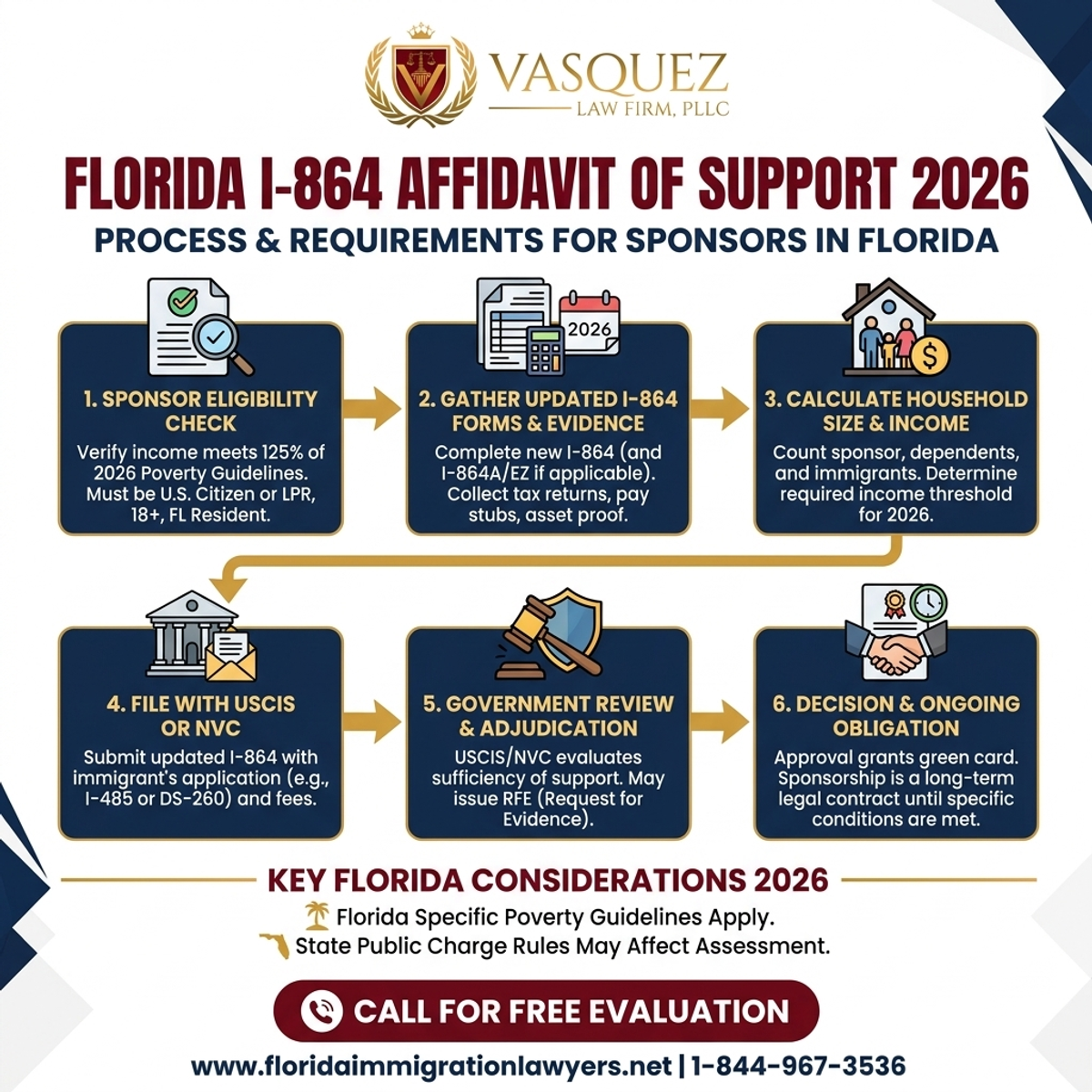
Step-by-Step Process — Formulario I-864 Actualizado in Florida for 2026
In Orlando, USCIS offices provide resources and assistance for completing this form. Ensuring accuracy is vital to prevent delays.
When gathering financial documents, it's not enough to just collect them; organize them meticulously. For example, if you have multiple sources of income, ensure each source is clearly documented with corresponding pay stubs, employer letters, or tax forms. For self-employed individuals, detailed tax schedules (like Schedule C or F) and profit/loss statements are crucial. Providing a clear and comprehensive financial picture from the outset can significantly streamline the review process and reduce the likelihood of a Request for Evidence (RFE).
Filling the form accurately means double-checking every field. A common mistake is using an outdated version of the form, which can lead to immediate rejection. Always download the latest version directly from the USCIS website. Pay close attention to sections requiring personal identifiers, addresses, and income figures. A simple typo in a social security number or an incorrect calculation of household size can trigger delays. It's often helpful to have another person review the completed form before submission to catch any overlooked errors.
Submitting supporting documents should be done logically and clearly labeled. Do not send original documents unless specifically requested; certified copies are generally sufficient. For instance, when attaching your tax returns, include all pages, not just the summary. If you're relying on assets to meet the income requirement, provide clear evidence of ownership and value, such as bank statements or property deeds. For complex cases or if you're unsure, consulting with Florida Immigration Lawyers can provide invaluable guidance and ensure all documentation meets USCIS standards.
Document Checklist for the I-864 Form
- Completed I-864 form
- Copy of sponsor's tax return (most recent year)
- W-2 forms
- Proof of current employment (pay stubs, employment letter)
- Proof of citizenship or legal residency
- Bank statements (if necessary)
Having these documents ready can expedite the process and ensure that the application is not delayed due to missing information.
Beyond the primary list, consider additional documents that might strengthen your application. For example, if your income fluctuates, providing tax returns for the past three years can demonstrate a consistent earning history. If you've recently changed jobs, an employment verification letter stating your new salary and start date is crucial. For sponsors relying on assets, include clear documentation of the asset's value and liquidity, such as a recent appraisal for real estate or a statement for investment accounts. The more transparent and complete your financial presentation, the smoother the process will be.
Proof of citizenship or legal residency is non-negotiable. This could be a copy of your U.S. birth certificate, a naturalization certificate, a U.S. passport, or a Permanent Resident Card (Green Card). Ensure these copies are clear and legible. For any documents not in English, a certified translation is mandatory, along with a copy of the original document. Florida Immigration Lawyers can assist with identifying all necessary documentation and ensuring proper translation and certification, preventing common pitfalls that lead to RFEs.
Timeline and Processing Expectations
The processing time for the I-864 can vary. As of 2026, applicants should be prepared for potential delays due to increased application volumes.
| Stage | Typical Timeframe | Notes |
|---|---|---|
| Initial Submission | 2-4 weeks | Ensure all documents are included to avoid delays. |
| USCIS Review | 6-8 weeks | Processing times can vary based on workload. |
| Response to RFE (if needed) | 4-6 weeks | Respond promptly to any request for additional information. |
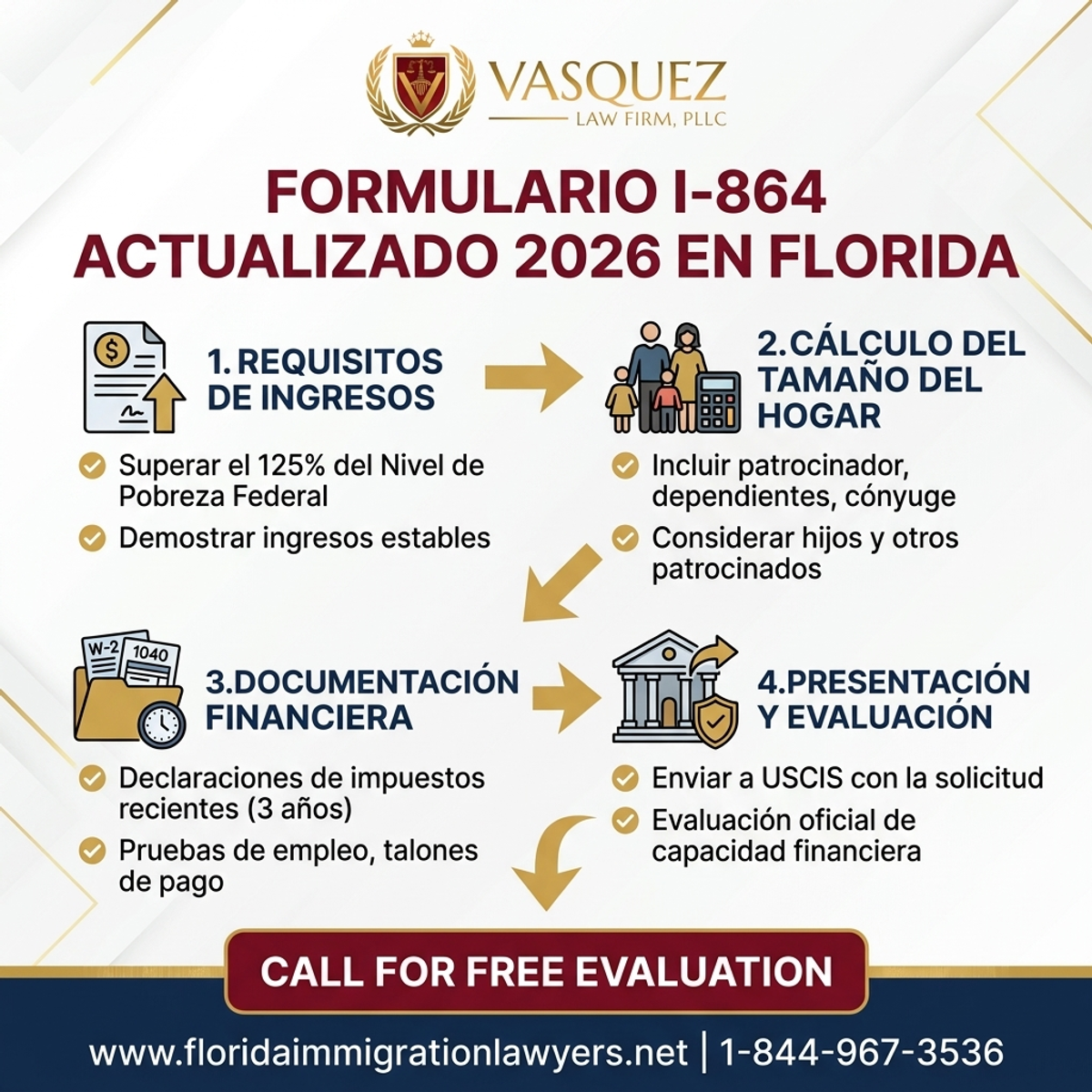
Key Statistics — Formulario I-864 Actualizado in Florida for 2026
Stay informed of any changes by checking the USCIS website.
Processing times can be influenced by various factors, including the specific USCIS service center handling your application, the completeness of your submission, and global events impacting immigration services. For instance, an application submitted with all required documents and no errors will generally move faster than one that requires an RFE. It's a good practice to retain copies of everything you submit and to use a tracking number if sending documents by mail, allowing you to monitor delivery.
Once your application is submitted, you can track its status online using the receipt number provided by USCIS. While the typical timeframes offer a general expectation, it's not uncommon for cases to take longer, especially if there are complexities or a high volume of applications. If you receive an RFE, address it immediately and comprehensively. Failing to provide the requested information or providing incomplete responses will lead to further delays or even a denial. Florida Immigration Lawyers can help you prepare a robust response to an RFE, ensuring all concerns are properly addressed.
For those living in Florida, local USCIS field offices may have slightly different processing nuances, though the overall guidelines are federal. Being proactive, thoroughly preparing your application, and promptly responding to any communications from USCIS or the National Visa Center (NVC) are the best strategies to keep your application moving forward. Patience is key, but so is diligent follow-up and readiness to act when required.
Cost Factors and Fee Breakdown
While there is no filing fee for the I-864 itself, there may be costs associated with obtaining necessary documents. Understanding these costs can help applicants budget accordingly.
| Item | Typical Fee | Notes |
|---|---|---|
| Tax Transcripts | Varies | Can be requested from the IRS. |
| Copy of Tax Returns | Varies | May require notarization. |
| Translation Services | Varies | Necessary for non-English documents. |
Beyond the direct costs, applicants should also consider indirect expenses. For example, travel costs to obtain documents, postage for mailing applications, and fees for certified copies of birth certificates or marriage licenses from government agencies. These seemingly small expenses can add up, so it's wise to create a detailed budget from the outset. Being prepared for these costs will prevent unexpected financial strain during an already significant process.
One of the most significant potential costs, though often an investment, is legal representation. While not mandatory for everyone, engaging an experienced immigration attorney, like those at Florida Immigration Lawyers, can save you time, reduce stress, and prevent costly errors that could lead to delays or denials. Legal fees vary based on the complexity of the case, but a free consultation can help you understand the scope of services and associated costs. Remember, a successful application often outweighs the cost of professional guidance.
For detailed assistance with the I-864 process, do not navigate this process alone. Contact Florida Immigration Lawyers today.
Common Mistakes to Avoid
Navigating the I-864 process can be complex, and even minor errors can lead to significant delays or outright denials. Being aware of the most common mistakes can help sponsors and immigrants avoid these pitfalls and ensure a smoother application journey. Diligence and attention to detail are paramount.
- Incorrect Information: Errors in the form can lead to delays or denials.
- Missing Documents: Omitting required documents is a common cause of delays.
- Not Meeting Income Requirements: Ensure the sponsor meets the financial criteria.
- Failure to Include Joint Sponsor: If needed, include a joint sponsor to meet income requirements.
- Ignoring USCIS Requests: Always respond promptly to any requests for additional information.
- Submitting Unofficial Documents: Ensure all documents are official and certified.
- Overlooking Changes in Income: Update USCIS if there are significant changes in income.
- Not Consulting an Attorney: Legal advice can prevent costly mistakes.
For instance, incorrectly calculating household size is a frequent error. Remember to include yourself, the sponsored immigrant(s), your dependents, and any other individuals for whom you have previously filed an I-864 that is still in effect. A miscalculation here can lead to an incorrect income threshold assessment, resulting in an RFE. Similarly, providing only one W-2 form when you've had multiple employers in the last year will present an incomplete picture of your income.
Another critical mistake is failing to understand the exact requirements for a joint sponsor. A joint sponsor must also meet the 125% poverty guideline independently, without combining their income with the primary sponsor. They must also be a U.S. citizen or legal permanent resident. If a joint sponsor is needed, ensure all their documentation is as meticulously prepared as the primary sponsor'Florida Immigration Lawyers can help clarify these nuances and ensure all parties meet the necessary criteria.
When to Call a Lawyer
Legal assistance is crucial in complex immigration cases. Consider consulting a lawyer if:
- You have a complicated immigration history.
- The sponsor does not meet income requirements.
- You receive a Request for Evidence (RFE) from USCIS.
- You are unsure about the documentation needed.
Florida Immigration Lawyers can provide the expertise needed to navigate these challenges. Our team is here to help you understand your options and improve your chances of success.
Beyond these specific scenarios, a lawyer's expertise becomes invaluable when dealing with nuanced situations. For example, if the sponsor is self-employed, relies on assets rather than income, or has a complex tax history, proving financial stability can be challenging. An attorney can help present this information clearly and persuasively to USCIS, anticipating potential questions and preparing robust documentation. They can also advise on the best course of action if there are prior immigration issues that could impact the application.
Furthermore, if you are sponsoring multiple family members, or if there are dependents involved, the complexity of the I-864 increases. A lawyer can ensure all family members are properly accounted for and that the financial support requirements are met for each individual. Don't hesitate to reach out to Florida Immigration Lawyers at 1-844-YO-PELEO for a free consultation to assess your unique situation and determine if legal guidance is the right step for you.
Frequently Asked Questions About Form I-864
Who is required to file Form I-864?
Form I-864 is generally required for most family-based immigrants and certain employment-based immigrants. This includes relatives of U.S. citizens or lawful permanent residents, such as spouses, children, parents, and siblings. It's also required for employment-based immigrants who will be accompanied by family members or who have a relative petitioning for them. Always check the specific visa category to confirm the requirement.
What happens if the sponsor's income is not sufficient?
If the primary sponsor's income doesn't meet 125% of the federal poverty guidelines, there are a few options. Firstly, household members (like a spouse or adult child living with the sponsor) can contribute their income by filing Form I-864A. Alternatively, a joint sponsor who meets the income requirements independently can file a separate I-864. You can also use significant assets to make up the shortfall, but this requires detailed documentation.
Can a sponsor withdraw the I-864?
Generally, once the I-864 has been accepted by USCIS or a U.S. Embassy/Consulate and the sponsored immigrant has been granted permanent residency, the Affidavit of Support cannot be withdrawn. It is a legally binding contract that remains in effect until a terminating event occurs, such as the immigrant becoming a U.S. citizen or working for 40 quarters. Withdrawal before the immigrant gains residency is highly complex and rarely successful.
What are the sponsor's obligations after the immigrant arrives?
After the immigrant arrives, the sponsor is legally obligated to provide financial support to prevent the immigrant from becoming a public charge. This means if the immigrant receives certain means-tested public benefits, the government can seek reimbursement from the sponsor. Sponsors must also update USCIS of any change of address within 30 days using Form I-865. This commitment can last for many years, highlighting its serious nature.
How long does the I-864 obligation last?
The I-864 obligation is a long-term commitment. It typically lasts until the sponsored immigrant becomes a U.S. citizen, has worked for 40 qualifying quarters under the Social Security Act (approximately 10 years of work), permanently departs the United States, or passes away. In some cases, if the sponsored immigrant is ordered removed from the U.S. and departs, the obligation may also terminate. It does not end with divorce or separation.
About Florida Immigration Lawyers
Florida Immigration Lawyers is dedicated to providing expert legal assistance across Florida. Our services include family immigration, asylum, deportation defense, business immigration, and citizenship applications. We offer free consultations and are available 24/7 to support your immigration journey. Call us at 1-844-YO-PELEO or visit our website at floridaimmigrationlawyers.net.
Our firm understands that navigating U.S. immigration law can be daunting, especially when dealing with critical forms like the I-864. We pride ourselves on offering compassionate yet rigorous legal support, ensuring our clients feel informed and confident every step of the way. From initial document review to responding to complex RFEs, our team is equipped with the knowledge and experience to handle even the most challenging cases, helping families achieve their dream of living and working in Florida.
With offices strategically located to serve the diverse communities of Florida, we are more than just legal advisors; we are partners in your immigration journey. We stay abreast of the latest immigration policy changes, including those anticipated for 2026, to provide the most current and effective strategies. Let Florida Immigration Lawyers be your trusted guide in securing your family's future in the United States. Your success is our priority.
Sources and References
To ensure the accuracy and reliability of the information provided, this guide draws upon official U.S. government sources and legal statutes. Always refer to these primary sources for the most current regulations and forms.
- U.S. Citizenship and Immigration Services (USCIS) - I-864
- Executive Office for Immigration Review (EOIR)
- 8 U.S.C. Chapter 12 - Immigration and Nationality Act
- Code of Federal Regulations (CFR) Title 8
Related services: immigration practice areas, family immigration services.
This article provides general legal information and is not intended as legal advice. Every case is unique, and outcomes depend on specific facts and circumstances. Contact an attorney for advice about your particular situation.
For comprehensive assistance, call Florida Immigration Lawyers at 1-844-YO-PELEO. Se Habla Español - Estamos aquí para ayudarle.
If you need legal assistance, learn more about learn about our immigration practice, or call us at 1-844-YO-PELEO for a free consultation.
Do Not Navigate This Process Alone
Our experienced immigration attorneys are ready to fight for you. Get a free, confidential case review today.
Se Habla Español
Or leave your details and we’ll call you:
Free Evaluation in 24 Hours
Or talk to us right now

AI voice assistant — available 24/7
FreeFrequently Asked Questions

William J. Vásquez
Founding Attorney · Vasquez Law Firm
U.S. Air Force veteran and immigration attorney with years of hands-on U.S. immigration experience. J.D., NCCU School of Law. AILA member. Admitted to the 4th, 5th, and 11th Circuit Courts.
Available 24/7 - Free Evaluations
Reviewed for legal accuracy by William J. Vásquez
Licensed in North Carolina; U.S. immigration is federal practice.
Related Legal Services
Our Florida immigration attorneys can help you with deportation defense, family immigration services and immigration lawyer cost in Florida. Call today at 1-844-YO-PELEO for a free case review.
Related Links
Related Topics
Free Legal Case Review
Discuss your case with our experienced attorneys. We're available 24/7.
Se Habla Español - Estamos aquí para ayudarle.
Related Articles
Immigration Lawyer Orlando Free Consultation in Florida
For individuals and families in Orlando, Florida, navigating the complexities of U.S. immigration law requires expert guidance. An immigration lawyer in Orlando offers crucial support for everything from visa applications and green card processes to naturalization and deportation defense. This comprehensive guide details what a free consultation covers, providing a step-by-step overview of immigration pathways, essential document checklists, and expected timelines in 2026. We also highlight common mistakes to avoid, discuss the critical role of legal counsel in deportation and asylum cases, and explain why choosing a local Orlando immigration attorney is beneficial. Florida Immigration Lawyers is dedicated to serving the diverse community of Orlando with compassionate, effective legal solutions, ensuring you receive personalized advice and robust representation for a successful immigration journey.
Annual Asylum Fee: No Cost for I-589 in Florida 2026
For those seeking asylum in Florida, a critical question often arises: Is there an annual asylum fee for Form I-589 applications? The straightforward answer for 2026 is no, U.S. Citizenship and Immigration Services (USCIS) does not charge a fee to file this humanitarian application. This policy ensures that financial barriers do not prevent individuals from seeking protection from persecution. However, while the application itself is free, applicants should be prepared for associated costs such as legal representation, document translation, and travel expenses for appointments. This comprehensive guide from Florida Immigration Lawyers details the asylum application process in Florida, outlining eligibility requirements, step-by-step procedures, necessary documentation, and typical processing timelines. We also address common mistakes to avoid and highlight when it is crucial to seek legal counsel to strengthen your case and protect your rights. Understanding these nuances is essential for a successful asylum claim.
2026 I-539 H-4 Change of Status Processing Time: Months
Navigating the complexities of U.S. immigration, especially the I-539 H-4 change of status processing time, requires precise information and strategic planning. As of 2026, H-4 dependents and individuals seeking F-1 student status in Florida face processing times ranging from 6 to 18 months, influenced by USCIS service centers, application completeness, and potential requests for evidence. This comprehensive guide details the Form I-539 application process, eligibility criteria, essential document checklists, and associated costs. We also explore common pitfalls, such as late filing or unauthorized employment, and discuss critical considerations for Florida applicants, including interaction with local USCIS field offices. Understanding these elements is vital to maintaining lawful status and achieving your immigration goals. Florida Immigration Lawyers offers expert guidance to help you navigate these challenges successfully.
H-2A Visa for Florida Agricultural Workers in 2026
Florida's agricultural industry relies on the H-2A visa program to address temporary labor shortages. This comprehensive guide, updated for 2026, details the multi-agency application process for Florida growers seeking to employ foreign agricultural workers. Learn about eligibility, step-by-step procedures involving the DOL, USCIS, and DOS, crucial documentation, and estimated timelines. We also cover significant cost factors, common pitfalls to avoid, and when legal counsel is indispensable. Florida Immigration Lawyers provides expert assistance to ensure compliance and streamline the H-2A visa journey for your farm, protecting your operations and securing the necessary workforce.