Florida Comparative Negligence: 50% Bar Rule Explained
Florida's 50% bar rule, established by HB 837 in 2023, is a critical component of the state's modified comparative negligence system. If you are found to be 50% or more at fault for an accident, you are barred from recovering any damages. For those less than 50% at fault, compensation is reduced proportionally. This significant change impacts all personal injury claims across Florida, including in Orlando, Kissimmee, and Hollywood. Navigating these complex laws requires expert legal guidance to protect your rights and maximize your potential recovery. Learn how this rule affects your injury claim and the steps you should take after an accident.

Florida's comparative negligence 50% bar rule, codified in Florida Statute §768.81, dictates how damages are recovered in personal injury cases where multiple parties share fault. Effective March 24, 2023, with the passage of HB 837, Florida transitioned from a 'pure' comparative negligence system to a 'modified' one. This means if you are found to be 50% or more at fault for an accident, you are barred from recovering any damages. If you are less than 50% at fault, your recoverable damages will be reduced by your percentage of fault. This change significantly impacts how personal injury claims are handled across Florida, including in Orlando, Kissimmee, and Hollywood.
- Florida now uses modified comparative negligence.
- The 50% bar rule prevents recovery if you are 50% or more at fault.
- HB 837 brought this significant legal change.
- Your percentage of fault directly reduces your compensation.
- Legal guidance is crucial for understanding your rights.
Accidents can happen in an instant, leaving you with injuries, medical bills, and a mountain of questions. When you're involved in a car crash, a slip and fall, or any other personal injury incident in Florida, one of the most critical factors determining your ability to recover compensation is fault. But what happens if you share some blame for the incident? This is where Florida's comparative negligence laws, specifically the 50% bar rule, come into play.
Understanding these complex legal principles is essential for anyone pursuing a personal injury claim in Orlando, Kissimmee, Hollywood, or anywhere else in the Sunshine State. The laws governing fault and damages underwent significant changes with the passage of House Bill (HB) 837 in 2023. This article will explain what comparative negligence means in Florida, detail the crucial 50% bar rule, and outline how these changes could impact your potential recovery. We will also provide actionable steps to protect your rights after an accident.
Do not navigate the complexities of Florida personal injury law alone. If you have been injured due to someone else's negligence, call Florida Immigration Lawyers at 1-844-967-3536 for a free consultation. Our experienced personal injury attorney, Harold Estrada-Rodriguez, is ready to help you understand your options and fight for the compensation you deserve.
Understanding Florida's Comparative Negligence and the 50% Bar Rule (§768.81)
For many years, Florida operated under a system known as 'pure' comparative negligence. Under this system, an injured party could recover damages even if they were 99% at fault for an accident, though their recovery would be reduced by their percentage of fault. For example, if you suffered $100,000 in damages but were 70% at fault, you could still recover $30,000.
However, this changed dramatically with the enactment of House Bill (HB) 837, which became effective on March 24, 2023. This landmark legislation significantly altered Florida's civil litigation landscape, particularly for personal injury claims. Florida Statute §768.81 now establishes a 'modified' comparative negligence system. This new rule introduces a critical threshold: the 50% bar.
Under the modified comparative negligence 50% bar rule, if a claimant is found to be 50% or more at fault for their injuries, they are legally barred from recovering any damages from other at-fault parties. This means that if a jury determines you are 51% responsible for a car accident in Hollywood, you will receive no compensation, regardless of the severity of your injuries or the total damages incurred. This is a stark contrast to the previous 'pure' system and places a much greater emphasis on proving the other party's fault.
If you are found to be less than 50% at fault, your damages will still be reduced proportionally. For instance, if you sustain $100,000 in damages but are found 20% at fault, you would be able to recover $80,000. This percentage reduction applies to all types of damages, including medical expenses, lost wages, pain and suffering, and property damage. The 50% bar rule is a cornerstone of modern Florida personal injury law, making it more challenging for individuals who share significant fault to secure compensation.
The shift to modified comparative negligence was a major legislative effort aimed at reforming Florida's tort system. It underscores the importance of thoroughly investigating accident scenes and gathering strong evidence to minimize any perceived fault on your part. Understanding this rule is not just academic; it directly impacts your financial recovery after an accident. Consulting with an attorney is paramount to understanding how this statute applies to your unique situation.
How Comparative Negligence Works in Florida Personal Injury Claims
When you file a personal injury claim in Florida, the at-fault party's insurance company or defense counsel will almost certainly try to argue that you bear some responsibility for the accident. Their goal is to reduce their payout, or, under the new 50% bar rule, eliminate it entirely. This makes the process of assigning fault a highly contentious and critical aspect of any personal injury case.
Consider a common scenario: a car accident in Orlando. You are driving, and another driver runs a red light, colliding with your vehicle. However, the other driver's attorney might argue that you were speeding, or that your brake lights were not functioning properly, contributing to the collision. In a slip and fall case at a Kissimmee grocery store, the store's defense might claim you were distracted by your phone and failed to notice an obvious wet floor sign.
In these situations, the court or an insurance adjuster will assess the evidence to determine each party's percentage of fault. This assessment typically involves reviewing:
- Police Reports: These documents often contain initial assessments of fault, witness statements, and accident diagrams.
- Witness Statements: Eyewitnesses can provide crucial perspectives on how the accident occurred.
- Photographs and Videos: Visual evidence from the scene, dash cams, or security cameras can be invaluable in establishing fault.
- Expert Testimony: Accident reconstructionists or medical experts may be called upon to provide opinions on causation and fault.
- Traffic Laws: Violations of traffic laws by either party can be strong indicators of negligence.
Once a percentage of fault is assigned to each party, the 50% bar rule comes into play. If your assigned fault is 49% or less, your total damages will be reduced by that percentage. If your fault is determined to be 50% or more, you will receive no compensation. This underscores why every piece of evidence and every detail matters when proving your case in Florida. Your attorney will work diligently to gather and present evidence that clearly establishes the other party's negligence, minimizing any potential fault assigned to you.
The Impact of HB 837 on Florida Personal Injury Cases
House Bill (HB) 837, signed into law in March 2023, represents the most significant overhaul of Florida's tort system in decades. Beyond the shift from pure to modified comparative negligence, this bill introduced several other changes that profoundly affect personal injury claims throughout the state. Understanding these changes is crucial for anyone involved in an accident in 2026 and beyond.
One of the most impactful changes, as discussed, is the implementation of the 50% bar rule in Florida Statute §768.81. This means that if a jury finds an injured party equally or more responsible for their injuries than the other party, that injured party cannot recover any damages. This places a higher burden on plaintiffs to demonstrate that the defendant was primarily at fault. For residents of Hollywood, Orlando, or Kissimmee, this change means that even a slight misstep in proving fault could be detrimental to their case.
Another critical change introduced by HB 837, found in Florida Statute §95.11(4)(a), is the shortening of the statute of limitations for general negligence claims. Previously, injured parties had four years from the date of the accident to file a lawsuit. Now, this period has been reduced to two years. This accelerated timeline means that accident victims must act quickly to consult with an attorney and initiate their legal process. Missing this two-year deadline will almost certainly result in the forfeiture of your right to pursue compensation.
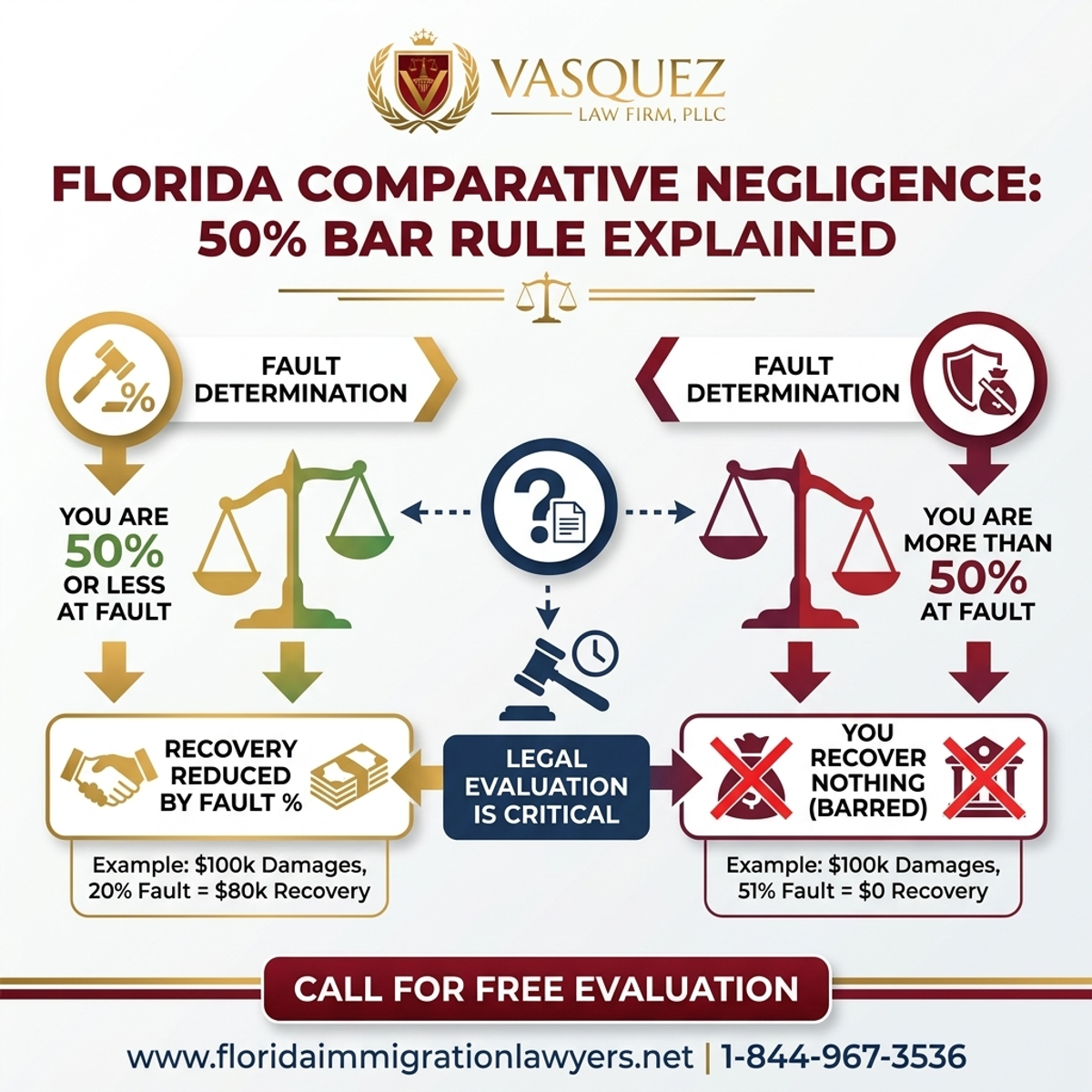
Step-by-Step Process — Florida Comparative Negligence: 50% Bar Rule Explained
HB 837 also introduced significant changes to bad faith insurance claims and premises liability laws, among others. These reforms collectively aim to reduce litigation and insurance costs for businesses and insurers in Florida. However, for injured individuals, they often make the path to recovery more complex and challenging. It is more important than ever to have a knowledgeable personal injury attorney on your side who understands the intricacies of these new laws and how they apply to your specific situation. These changes affect every aspect of a personal injury claim, from initial investigation to potential settlement negotiations or trial strategy.
Steps to Take After a Florida Accident When Comparative Negligence Applies
The immediate aftermath of an accident can be chaotic and stressful. However, the actions you take in the moments, days, and weeks following an incident can significantly impact your personal injury claim, especially given Florida's comparative negligence laws. Following these steps can help protect your rights and strengthen your case.
- Seek Immediate Medical Attention: Your health is the top priority. Even if you don't feel injured, some serious conditions, like whiplash or internal bleeding, may not manifest symptoms immediately. Prompt medical evaluation creates a crucial record of your injuries, linking them directly to the accident. Florida Statute §627.736 mandates seeking initial medical care within 14 days of an accident to qualify for Personal Injury Protection (PIP) benefits, which cover up to $10,000 in medical expenses regardless of fault.
- Report the Accident: For car accidents, call 911 immediately. For slip and falls on commercial property, report the incident to the manager or owner and ensure an incident report is filed. Obtain a copy of this report.
- Gather Evidence at the Scene: If possible and safe, take photos and videos of the accident scene, vehicle damage, your injuries, skid marks, road conditions, and any relevant signage. Collect contact information from witnesses and any involved parties. Do not rely solely on the police or property owner to do this for you.
- Do Not Admit Fault: Avoid making statements that could be interpreted as admitting fault, even if you are unsure about what happened. Apologies can be misconstrued. Stick to the facts when speaking with police or other parties. Remember, under Florida's 50% bar rule, even a small admission could be used against you.
- Consult a Florida Personal Injury Lawyer Promptly: Given the two-year statute of limitations (§95.11(4)(a)) and the complexities of comparative negligence, contacting an attorney as soon as possible is vital. An experienced lawyer can investigate the accident, gather evidence, handle communication with insurance companies, and build a strong case to minimize any fault attributed to you and maximize your potential recovery.
- Keep Detailed Records: Maintain a file of all medical records, bills, receipts for accident-related expenses, lost wage statements, and any communication with insurance companies or legal teams. This documentation is essential for proving your damages.
By taking these proactive steps, you significantly improve your chances of a successful personal injury claim in Florida, even when comparative negligence is a factor. Early legal intervention can make all the difference.
Calculating Damages and Your Potential Recovery in Florida
When you suffer injuries due to someone else's negligence, understanding the types of damages you can claim and how comparative negligence affects your recovery is crucial. In Florida, personal injury damages are generally categorized into two main types: economic and non-economic.
Economic Damages
These are quantifiable financial losses directly resulting from your accident. They include:
- Medical Expenses: Costs for emergency care, hospital stays, doctor visits, surgeries, medications, physical therapy, and future medical care.
- Lost Wages: Income lost due to time off work for recovery, as well as future lost earning capacity if your injuries prevent you from returning to your previous job or working at full capacity.
- Property Damage: Costs to repair or replace damaged property, such as your vehicle.
- Other Out-of-Pocket Expenses: Costs for transportation to medical appointments, home modifications, or assistive devices.
Non-Economic Damages
These are subjective and harder to quantify, representing the non-financial impact of your injuries. They include:
- Pain and Suffering: Physical pain, discomfort, and emotional distress caused by the accident and injuries.
- Mental Anguish: Psychological impacts such as anxiety, depression, PTSD, or fear.
- Loss of Enjoyment of Life: Inability to participate in hobbies, activities, or daily routines you enjoyed before the accident.
- Disfigurement or Impairment: Compensation for permanent scars, disfigurement, or physical limitations.
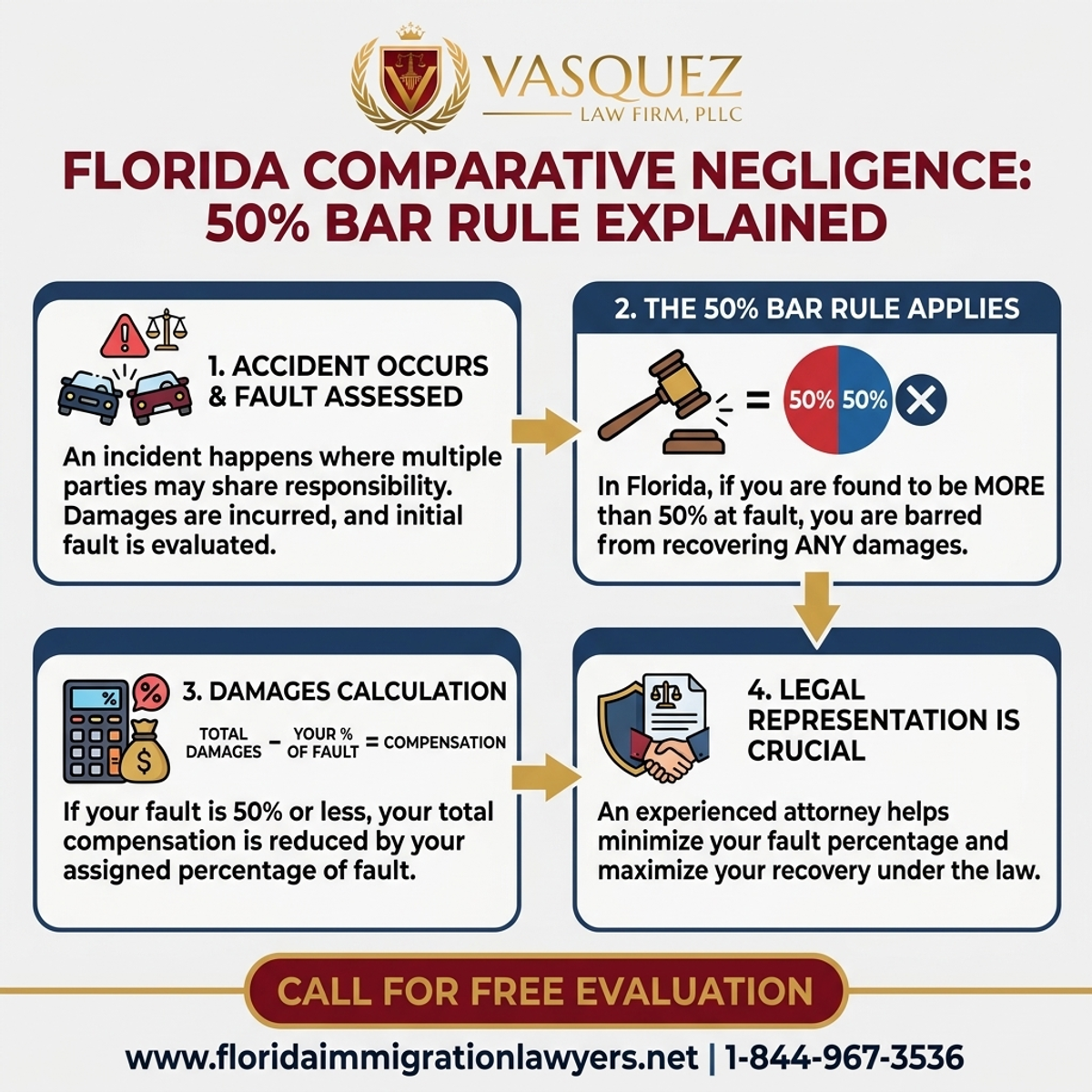
Key Statistics — Florida Comparative Negligence: 50% Bar Rule Explained
The total value of these damages forms the basis of your claim. However, this total is directly impacted by Florida's modified comparative negligence 50% bar rule, as outlined in Florida Statute §768.81. If you are found to be 25% at fault for an accident, and your total damages are calculated at $200,000, your recoverable amount would be reduced by 25%, leaving you with $150,000. If your fault is determined to be 50% or more, you would recover nothing.
This is why the role of a skilled personal injury attorney is invaluable. Your attorney will meticulously calculate your full range of damages, gather evidence to support each claim, and strategically argue to minimize any fault attributed to you. They will represent your interests in settlement negotiations with insurance companies or, if necessary, in Florida's Circuit Courts where larger personal injury cases are heard, fighting to maximize your recovery despite the challenges posed by comparative negligence laws.
Do not navigate the complexities of Florida personal injury law alone. If you have been injured due to someone else's negligence, contact Florida Immigration Lawyers today. Our attorney, Harold Estrada-Rodriguez, offers free consultations to discuss your case and explain how the 50% bar rule impacts your potential for compensation. Call us at 1-844-967-3536.
Common Mistakes to Avoid in Florida Personal Injury Claims
Navigating a personal injury claim in Florida can be challenging, especially with the state's modified comparative negligence laws. Avoiding common pitfalls can significantly impact the success of your case and your ability to recover compensation. Here are some critical mistakes to steer clear of:
- Not Seeking Immediate Medical Attention: Delaying medical treatment can not only jeopardize your health but also weaken your claim. Insurance companies may argue your injuries are not serious or were not caused by the accident if there's a gap in treatment. Remember the 14-day rule for PIP benefits (§627.736).
- Admitting Fault at the Scene: Never apologize or accept blame for an accident, even if you feel partially responsible. Such statements can be used against you to increase your percentage of fault under Florida's 50% bar rule, potentially eliminating your right to recovery.
- Failing to Gather Sufficient Evidence: Without photos, witness contact information, and detailed notes from the scene, it becomes harder to prove the other party's negligence and minimize your own. Document everything possible.
- Talking to Insurance Adjusters Without Legal Counsel: Insurance adjusters work for the insurance company, not for you. They may try to get you to make recorded statements that can be used against your claim or pressure you into accepting a lowball settlement offer.
- Missing the Statute of Limitations: Florida's statute of limitations for negligence claims is now two years from the date of the accident (§95.11(4)(a)). Failing to file your lawsuit within this strict timeframe will result in your case being permanently dismissed.
- Not Understanding the Impact of HB 837: Many accident victims are unaware of the significant changes brought by HB 837, particularly the 50% bar rule. This lack of knowledge can lead to unrealistic expectations or critical errors in strategy.
- Accepting the First Settlement Offer: Initial offers from insurance companies are often far below the true value of your claim. An experienced attorney can negotiate on your behalf to secure fair compensation.
- Failing to Keep Detailed Records: Losing track of medical bills, receipts, lost wage statements, or accident-related communications can make it difficult to prove the full extent of your damages.
- Delaying Legal Consultation: Waiting too long to speak with a personal injury lawyer can hinder evidence collection, make witness testimonies less reliable, and push you closer to the statute of limitations deadline.
- Posting About Your Accident on Social Media: Anything you post online, including photos, videos, or comments, can be used by defense attorneys to undermine your claim, even if taken out of context.
When to Call a Florida Personal Injury Lawyer
While some minor accidents might be resolved without legal intervention, many situations warrant the expertise of a Florida personal injury attorney. It is especially critical to seek legal advice when:
- You Have Sustained Serious Injuries: If your injuries require extensive medical treatment, surgery, or result in long-term disability, a lawyer can help ensure you receive full compensation for current and future medical costs, lost wages, and pain and suffering.
- Fault is Disputed: If the other party or their insurance company disputes their responsibility, or attempts to place significant blame on you, an attorney is essential to protect your rights under Florida's 50% bar rule and fight for a fair fault allocation.
- Multiple Parties Are Involved: Accidents involving several vehicles, complex premises liability issues, or commercial entities can quickly become complicated. A lawyer can navigate these complexities and identify all potential at-fault parties.
- The Insurance Company is Unresponsive or Offering a Low Settlement: Insurance companies are businesses, and their goal is to pay as little as possible. An attorney can negotiate effectively on your behalf, ensuring you are not undervalued or taken advantage of.
- You are Unsure of Your Rights or the Legal Process: Florida personal injury law is intricate, with strict deadlines and specific procedures. A lawyer can provide clarity, explain your options, and guide you through every step of the legal journey.
- You Need to Understand HB 837's Impact: With the recent changes to comparative negligence and the statute of limitations, an attorney can explain how these new laws specifically affect your case and strategy.
Do not hesitate to seek professional legal guidance. An early consultation with a knowledgeable attorney from Florida Immigration Lawyers can provide peace of mind and significantly improve the outcome of your personal injury claim. Our team is dedicated to protecting the rights of accident victims in Orlando, Kissimmee, Hollywood, and throughout Florida.
About Florida Immigration Lawyers
At Florida Immigration Lawyers, we are dedicated to serving the diverse legal needs of our community in Orlando, Kissimmee, Hollywood, and across the entire state of Florida. While our firm is known for its comprehensive immigration services, we also provide robust representation for victims of personal injury. Our personal injury practice is led by Harold Estrada-Rodriguez, Florida Bar No. 1041171, an attorney committed to fighting for justice and fair compensation for those injured due to others' negligence.
We understand the physical, emotional, and financial toll an accident can take. Our goal is to alleviate your burden by handling all legal aspects of your personal injury claim, allowing you to focus on your recovery. We work on a contingency fee basis for personal injury cases, meaning there is no recovery, no fee. You pay nothing unless we win your case.
Our services include thorough accident investigation, evidence collection, skilled negotiation with insurance companies, and aggressive representation in court if necessary. We are dedicated to ensuring that Florida's comparative negligence laws, including the 50% bar rule, do not unfairly hinder your right to compensation.
We offer free consultations and are available 24/7 to answer your questions and provide immediate assistance. Se Habla Español. Contact Florida Immigration Lawyers today at 1-844-967-3536 or visit www.floridaimmigrationlawyers.net to learn how we can help you.
Reviewed By
This article was reviewed for Florida legal accuracy by Harold Estrada-Rodriguez, Florida Bar No. 1041171, the attorney responsible for personal injury matters at Florida Immigration Lawyers. Personal injury representation in Florida only. No recovery, no fee.
Sources and References
- U.S. Department of Justice
- U.S. Citizenship and Immigration Services (USCIS)
- U.S. Department of State
- Florida Statutes §768.81 - Comparative Fault
- Florida Statutes §95.11(4)(a) - Limitations, Actions Other Than Real Property
- Florida Statutes §627.736 - Required personal injury protection benefits
- House Bill 837 (2023) - Civil Remedies
Related services: Florida car accident claims, slip-and-fall premises liability, Florida wrongful death claims.
This article provides general legal information and is not intended as legal advice. Every case is unique, and outcomes depend on specific facts and circumstances. Contact an attorney for advice about your particular situation.
If you or a loved one has been injured in an accident in Florida, do not face the legal challenges alone. Understanding Florida's comparative negligence 50% bar rule and its impact on your claim is crucial. Florida Immigration Lawyers is here to provide the dedicated legal representation you need. Contact us today for a free, confidential consultation. Call 1-844-967-3536. Se Habla Español - Estamos aqui para ayudarle.
If you need legal assistance, learn more about speak with a Florida personal injury attorney, or call us at 1-844-967-3536 for a free consultation.
Do Not Navigate This Process Alone
Our experienced immigration attorneys are ready to fight for you. Get a free, confidential consultation today.
Se Habla Español
Frequently Asked Questions
Florida Immigration Lawyers
Immigration Attorney | Founder, Vasquez Law Firm
U.S. Air Force veteran and immigration attorney with thousands of cases resolved. J.D., NCCU School of Law. AILA member. Admitted to the 4th, 5th, and 11th Circuit Courts.
Available 24/7 - Free Evaluations
Related Legal Services
Our Florida immigration attorneys can help you with Florida car accident claims, slip-and-fall premises liability and Florida wrongful death claims. Call today at 1-844-967-3536 for a free consultation.
Related Links
Related Topics
Free Legal Consultation
Discuss your case with our experienced attorneys. We're available 24/7.
Se Habla Español - Estamos aquí para ayudarle.
Related Articles
Florida's 50% Bar Rule in Comparative Negligence | VLF Florida
Learn how Florida's 50% bar rule in comparative negligence affects personal injury claims. Contact Florida Immigration Lawyers for assistance.
Understanding Florida PIP No-Fault Medical Benefits
Discover how Florida's PIP no-fault insurance provides medical benefits to car accident victims. Learn about coverage, common mistakes, and when to seek legal help. Call Florida Immigration Lawyers for expert guidance.
Florida Truck Accident: 18-Wheeler Crashes on I-4 | VLF Florida
Truck accidents on I-4 in Florida involving 18-wheelers are complex and often involve multiple parties. Understanding FMCSA regulations and seeking timely legal advice is crucial. Contact Florida Immigration Lawyers for guidance.
Florida Wrongful Death Survivor Damages Explained | VLF Florida
Discover how Florida's wrongful death statutes §§768.16-768.21 help survivors seek compensation. Learn the process, common mistakes, and when to call a lawyer.
