Florida Asylum Application Process: Your 2026 Guide
Navigating the asylum application Florida process can be complex. Learn about I-589, eligibility, and steps for 2026. Contact Florida Immigration Lawyers for a free consultation.

The asylum application Florida process involves submitting Form I-589 to USCIS or an immigration court, demonstrating a well-founded fear of persecution based on specific protected grounds. Eligibility generally requires filing within one year of arrival, though exceptions exist. Seeking legal counsel from Florida Immigration Lawyers is crucial for a successful outcome in 2026.
- File Form I-589 with USCIS or an Immigration Court.
- Prove well-founded fear of persecution on protected grounds.
- Generally, apply within one year of U.S. entry.
- Legal assistance is highly recommended for this complex process.
- Florida Immigration Lawyers offers support throughout Florida.
Imagine arriving in Florida, seeking safety, but facing a complex legal system to secure your future. For many, the journey to finding refuge in the United States begins with an asylum application. This process, particularly in a high-volume state like Florida, can feel overwhelming and fraught with uncertainty.
Our comprehensive guide for 2026 aims to demystify the asylum application Florida process, offering clarity on eligibility, procedures, and crucial steps. We understand the profound challenges you face and are here to provide the essential information you need. We will cover everything from filing your I-589 form to understanding potential timelines and costs. If you are considering applying for asylum in Florida, understanding these steps is vital for your journey towards safety and stability. Do not navigate this critical process alone. Call Florida Immigration Lawyers at 1-844-967-3536 for a free consultation to discuss your specific situation and how we can help you pursue protection.
Understanding the Asylum Application Florida Process: An Overview
Applying for asylum in the United States offers protection to individuals who have suffered persecution or fear they will suffer persecution in their home country. This fear must be based on one of five protected grounds: race, religion, nationality, membership in a particular social group, or political opinion. Florida, with its diverse immigrant communities, sees a significant number of asylum seekers annually, particularly in areas like Miami.
The process typically begins with filing Form I-589, Application for Asylum and for Withholding of Removal. This form is central to your case, detailing your personal story and the persecution you have endured or fear. Whether you file affirmatively with USCIS or defensively in immigration court depends on your current immigration status. Understanding these distinctions is crucial for anyone considering an asylum application Florida. Our firm, Florida Immigration Lawyers, regularly assists individuals across the state with their asylum claims, recognizing the importance of meticulous preparation and compassionate representation.
Affirmative vs. Defensive Asylum in Florida
Affirmative asylum is sought by individuals not in removal proceedings. They voluntarily apply to U.S. Citizenship and Immigration Services (USCIS). In Florida, your application would generally be processed through the USCIS Asylum Office in Miami. After filing your I-589 form, you typically undergo an interview with an asylum officer.
Defensive asylum is sought by individuals already in removal proceedings before an immigration judge. This often happens if you entered the U.S. without authorization or overstayed a visa. Your asylum claim is then presented as a defense against deportation in immigration courts in Florida, such as those in Miami and Orlando. The stakes are particularly high in defensive asylum cases, as a denial can lead directly to a removal order.
The Legal Basis for Asylum (INA Section 208)
The right to seek asylum in the United States is enshrined in federal law, specifically in the Immigration and Nationality Act (INA) Section 208. This section outlines the eligibility requirements, stating that an individual may be granted asylum if they are a refugee. A refugee is defined as someone who is outside their country of nationality and is unable or unwilling to return due to a well-founded fear of persecution. This legal framework forms the bedrock of every asylum claim, guiding both applicants and immigration authorities in the decision-making process. Understanding INA 208 is key to building a robust asylum application Florida.
A Step-by-Step Guide to Filing Your Asylum Application in Florida
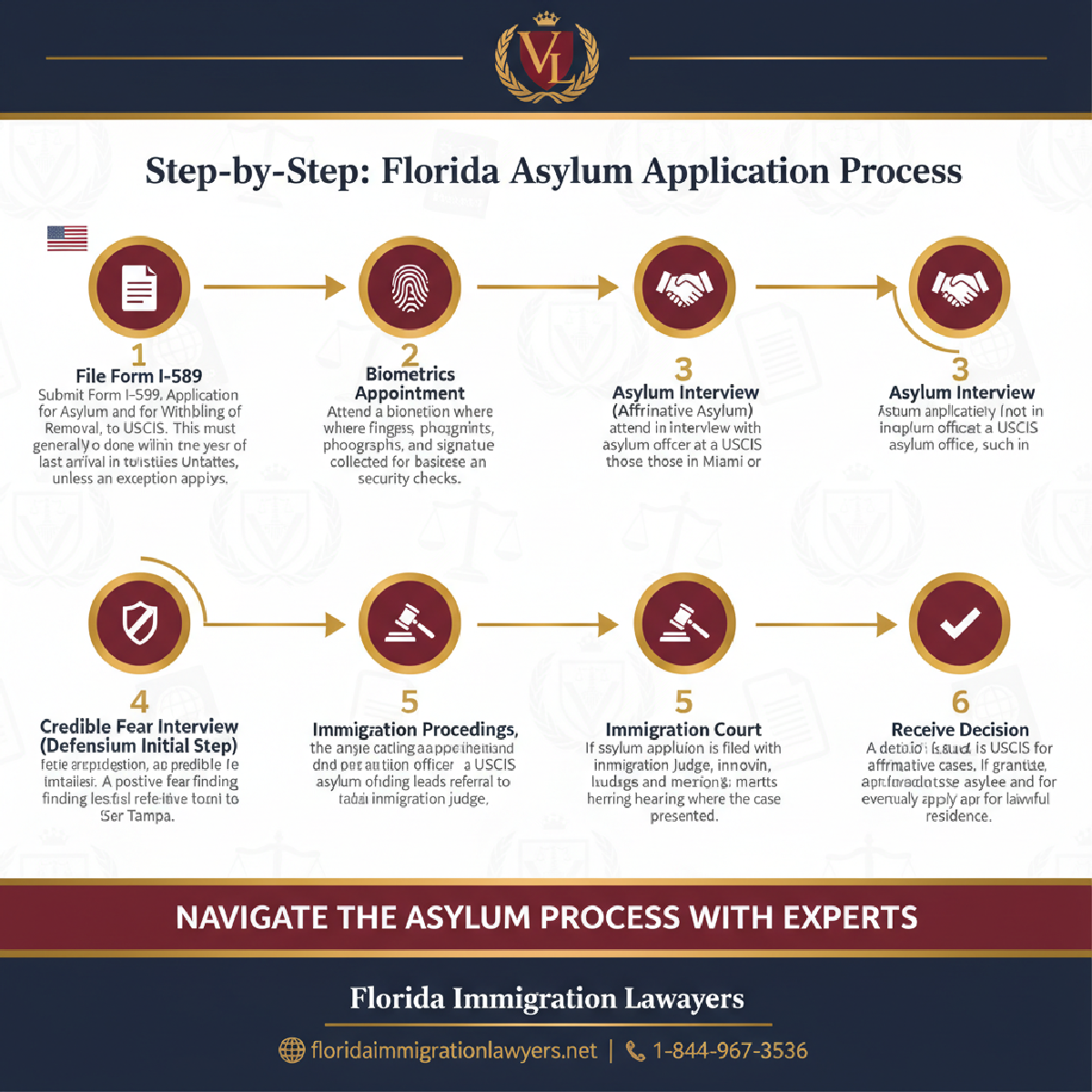
Embarking on the asylum application Florida process can seem daunting, but breaking it down into manageable steps makes it clearer. Here is a general guide to help you understand what to expect. Each step is critical and requires careful attention to detail and adherence to strict deadlines.
-
Step 1: Understand Eligibility and the One-Year Filing Deadline. You must establish a well-founded fear of persecution based on a protected ground. Generally, you must file your Form I-589 within one year of your last arrival in the United States. Failing to meet this deadline can severely impact your case, though limited exceptions exist for changed circumstances or extraordinary situations. Prompt assessment of your eligibility and filing window is vital.
-
Step 2: Prepare and Submit Form I-589. This is the cornerstone of your asylum application. The I-589 form requires detailed personal information, a comprehensive narrative of your persecution, and family information. Accuracy and completeness are paramount. You will submit this form to the appropriate USCIS Service Center or, if in removal proceedings, to the immigration court.
-
Step 3: Attend Fingerprinting (Biometrics Appointment). After filing your I-589 form, USCIS will send you a notice for a biometrics appointment at an Application Support Center (ASC). Your fingerprints, photograph, and signature will be collected for background checks and security clearances. This is a mandatory step for all applicants.
-
Step 4: Receive Your Asylum Interview Notice (Affirmative Asylum). If you filed affirmatively, you will eventually receive a notice to appear for an asylum interview at the USCIS Asylum Office in Miami. This interview is a crucial opportunity to present your case directly to an asylum officer. Having an attorney present can be immensely beneficial.
-
Step 5: Attend Your Asylum Interview or Immigration Court Hearing. During an affirmative asylum interview, an asylum officer will ask questions about your I-589 application and your fear of persecution. For defensive asylum process, you will present your case before an immigration judge in a series of hearings. In both scenarios, providing consistent and credible testimony is essential.
-
Step 6: Receive a Decision. After your interview or hearings, a decision will be made. If approved for affirmative asylum, you typically receive asylum status. If denied by USCIS, your case may be referred to an immigration judge for defensive proceedings. If denied by an immigration judge, you generally have the right to appeal to the Board of Immigration Appeals (BIA) via justice.gov.
Essential Documents for Your Asylum Application Florida
A well-prepared asylum application Florida requires a robust collection of supporting documents. These documents serve as evidence to corroborate your claim of persecution and strengthen your credibility. Gathering these materials carefully is a critical step in building a successful case.
- Form I-589: The original application form and two copies, properly signed and dated.
- Personal Statement: A detailed, sworn declaration outlining your story of persecution, why you fear returning, and how it relates to one of the five protected grounds.
- Identity Documents: Copies of your passport, birth certificate, national ID, and any other relevant identification documents.
- Proof of Entry/Presence in the U.S.: I-94 arrival record, visa, or other documents showing your entry or presence.
- Evidence of Persecution: This is often the most critical category. It can include police reports, medical records, newspaper articles, human rights reports, or photos, or affidavits from witnesses. Country condition reports from reputable sources (e.g., U.S. Department of State) are also vital.
- Proof of Relationship (if applicable): Marriage certificates, birth certificates for dependents included in your application.
- Translations: Any document not in English must be accompanied by a certified English translation.
- Photographs: Two passport-style photos for each applicant.
Our experienced team at Florida Immigration Lawyers can help you meticulously compile and organize these documents, ensuring your asylum application Florida is as complete and compelling as possible.
Gathering Corroborating Evidence
Corroborating evidence is vital to support your personal testimony and strengthen your asylum application Florida. This can include a wide array of documents, from official government records to personal correspondence. Examples often include police reports, medical records of injuries, newspaper clippings detailing events in your home country, or human rights reports from organizations like Amnesty International. Sworn affidavits from witnesses who can attest to your persecution or fear are also highly valuable. The more comprehensive and credible your evidence, the stronger your case for protection will be. Our legal team can assist you in identifying and collecting these crucial materials.
Asylum Application Florida: Timelines and Processing Expectations for 2026
The processing time for an asylum application Florida can vary significantly, often causing considerable anxiety for applicants. While USCIS aims to prioritize recent filings, backlogs can lead to lengthy waits. Understanding these general timelines can help manage expectations in 2026.
- Initial Filing and Biometrics: After filing Form I-589, you typically receive a receipt notice within a few weeks. The biometrics appointment usually follows within 1-3 months.
- Asylum Interview Scheduling (Affirmative): This is where timelines become less predictable. While some cases are scheduled relatively quickly, others can wait for several years due to high volume at the Miami Asylum Office. USCIS uses a "last-in, first-out" approach for interview scheduling, but this is not always strictly followed.
- Interview Decision (Affirmative): You generally receive a decision within 1-3 weeks of your interview, though sometimes it can take longer.
- Immigration Court Proceedings (Defensive): If your case is in immigration court, the timeline is dictated by the court's calendar and the judge's schedule. This can involve multiple hearings over months or even years.
- Work Authorization (EAD): You typically become eligible to apply for an Employment Authorization Document (EAD) 150 days after filing your asylum application, provided it is still pending. You can apply using Form I-765.
It is crucial to remember that these are general estimates. Factors like country conditions, policy changes, and the individual complexity of your case can all influence processing times. Staying informed and consulting with an attorney from Florida Immigration Lawyers can help you understand the most current expectations for your specific asylum application Florida case.
Cost Factors and Fee Breakdown for Asylum Applications in Florida
One of the significant advantages of the asylum application Florida process is that there is no filing fee for Form I-589 itself. This policy ensures that individuals fleeing persecution are not barred from seeking safety due to financial constraints. However, while the application is free, other associated costs can arise during the process.
- Legal Fees: This is often the most substantial cost. Hiring an experienced immigration attorney, like those at Florida Immigration Lawyers, is highly recommended. Legal fees vary based on case complexity and services provided, but legal counsel significantly increases your chances of success.
- Translation Costs: If any supporting documents are not in English, you will need to pay for certified translations. These costs depend on the volume and language of the documents.
- Document Retrieval Fees: You might incur fees to obtain official records from your home country or other sources, such as police reports or medical records.
- Medical Examination Fees (if applicable): If you are granted asylum and later apply for adjustment of status (green card), a medical examination by a USCIS-approved civil surgeon incurs a separate fee.
- Travel Expenses: Account for travel to USCIS offices for biometrics and interviews, or to immigration courts in Miami or Orlando for hearings.
- Application for Work Authorization (Form I-765) Fee: While the I-589 is free, applying for an Employment Authorization Document (EAD) with Form I-765 typically requires a filing fee, though fee waivers may be available.
While the core asylum application Florida is fee-exempt, budgeting for these ancillary costs is an important part of preparing for the process. Our firm offers transparent discussions about potential legal fees during your free consultation.
The asylum application Florida process is a journey filled with critical legal nuances and potential pitfalls. Do not navigate this process alone. Contact Florida Immigration Lawyers today to ensure your case is handled with the expertise and compassion it deserves. Our dedicated team is ready to assist you.
Common Mistakes to Avoid During Your Asylum Application Florida
Navigating the asylum application Florida process requires meticulous attention to detail. Even small errors can lead to significant delays or even denial. Being aware of common mistakes can help you avoid them and strengthen your case.
-
Missing the One-Year Filing Deadline: This is perhaps the most critical mistake. Unless you qualify for an exception, failing to file your I-589 within one year of your last entry to the U.S. can lead to a mandatory denial of your asylum claim.
-
Inconsistent or Incredible Testimony: Your story must be consistent across all applications, interviews, and hearings. Any discrepancies, even minor ones, can raise doubts about your credibility and weaken your case significantly. Credibility is paramount in asylum cases.
-
Lack of Sufficient Corroborating Evidence: While your testimony is vital, strong evidence is crucial. Failing to provide available documents, country condition reports, or witness affidavits to support your persecution claim can be detrimental. Gather all possible supporting materials.
-
Incomplete or Inaccurate Form I-589: Errors or omissions on your asylum application form can cause delays, requests for evidence, or even a denial. Every section must be filled out truthfully and completely. Review your form meticulously.
-
Failing to Disclose All Travel and Criminal History: Attempting to conceal past travel or any criminal history, no matter how minor, will likely be discovered through background checks. This can lead to a denial for misrepresentation or statutory bars to asylum.
-
Not Preparing for the Asylum Interview or Court Hearing: Walking into an interview or court hearing unprepared is a significant risk. You must be ready to discuss your narrative, answer questions about your evidence, and explain any inconsistencies. Practice with your attorney.
-
Not Understanding the Five Protected Grounds: Your fear of persecution must be directly linked to your race, religion, nationality, political opinion, or membership in a particular social group. Many denials occur because applicants fail to articulate this connection clearly. Seek legal guidance on this.
-
Failing to Update Contact Information: If you move, you must notify USCIS and the immigration court of your new address promptly. Missing important notices or appointments due to outdated contact information can lead to a denial or even a removal order. Always update your address.
When to Call Florida Immigration Lawyers for Your Asylum Case
The asylum application Florida process is incredibly complex and emotionally challenging. While some individuals attempt to navigate it alone, the benefits of legal representation are immense. You should consider contacting Florida Immigration Lawyers if any of the following scenarios apply to your situation:
- You are unsure about your eligibility for asylum or the one-year filing deadline. Our attorneys can assess your case and determine the strongest path forward, including potential exceptions to the one-year rule, guided by the USCIS Policy Manual.
- You are in removal proceedings or have received a Notice to Appear (NTA) in immigration court in Miami or Orlando. This is a critical juncture where defensive asylum may be your primary defense against deportation. Our firm specializes in deportation defense.
- You need help gathering compelling evidence and writing a detailed personal statement. Crafting a credible narrative and supporting it with strong evidence is crucial. We can guide you through this process.
- You are preparing for an asylum interview or an immigration court hearing. Our attorneys can prepare you thoroughly, practice potential questions, and represent you effectively during these critical moments.
- You have a complex case, such as a prior criminal conviction, a previous immigration denial, or have been previously removed from the U.S. These factors can complicate your asylum claim, and
Do Not Navigate This Process Alone
Our experienced immigration attorneys are ready to fight for you. Get a free, confidential consultation today.
Se Habla Español
Frequently Asked Questions
Florida Immigration Lawyers
Immigration Attorney | Founder, Vasquez Law Firm
U.S. Air Force veteran and immigration attorney with thousands of cases resolved. J.D., NCCU School of Law. AILA member. Admitted to the 4th, 5th, and 11th Circuit Courts.
Available 24/7 - Free Evaluations
Related Legal Services
Our Florida immigration attorneys can help you with deportation defense, citizenship and naturalization and family immigration services. Call today at 1-844-967-3536 for a free consultation.
Related Links
Related Topics
Free Legal Consultation
Discuss your case with our experienced attorneys. We're available 24/7.
Se Habla Español - Estamos aquí para ayudarle.
Related Articles
Stokes Interview: Navigating Marriage Fraud in Florida
A Stokes interview is a specialized, separate interview conducted by USCIS when there are suspicions of marriage fraud in a green card application. This rigorous process involves individual questioning of spouses, focusing on inconsistencies in their testimonies to determine the authenticity of their marital bond. For couples in Florida, navigating this high-stakes interview requires meticulous preparation, extensive documentation, and often the strategic guidance of an experienced immigration lawyer. Understanding the process, preparing for detailed questions, and presenting a strong case are crucial for overcoming marriage fraud allegations and securing your immigration future. Florida Immigration Lawyers stands ready to assist you.
Immigration Attorney Gainesville: North Florida Legal Help
For those in Gainesville, Alachua County, and throughout North Florida, navigating U.S. immigration law requires expert guidance. An experienced immigration attorney can simplify complex processes, from family-based petitions and employment visas to critical asylum claims and deportation defense. This comprehensive guide outlines the essential services provided by an immigration attorney, details necessary documentation, clarifies processing timelines, and discusses associated costs. We also highlight common mistakes to avoid and crucial scenarios where legal counsel is indispensable. Florida Immigration Lawyers serves all of Florida, including Gainesville and St. Petersburg, providing dedicated legal support to help you achieve your immigration goals. Contact us for a free consultation to discuss your specific needs.
Military Naturalization Expedited at Florida Bases
Explore expedited military naturalization processes for service members at Florida bases like MacDill. Learn about eligibility, steps, and common mistakes. Contact Florida Immigration Lawyers for a free consultation.
Protect Yourself from Immigration Scams in Florida
Learn how to protect against immigration scams in Florida, focusing on St. Petersburg. This guide covers identifying scams, verifying credentials, and getting legal help. Call Florida Immigration Lawyers at 1-844-967-3536 for assistance.