H-1B Visa Guide for Florida Employers | VLF Florida
Learn how Florida employers can sponsor H-1B visas, navigate the application process, and avoid common pitfalls. Call Florida Immigration Lawyers for a free consultation.

H-1B Visa Guide for Florida Employers | VLF Florida
For Florida businesses looking to secure top international talent, the H-1B visa program is often the most viable pathway. This non-immigrant visa allows U.S. employers to temporarily employ foreign workers in specialty occupations, which generally require a bachelor's degree or higher in a specific field. Navigating the complexities of H-1B sponsorship, from understanding the annual cap to ensuring compliance with stringent regulations, can be challenging. This comprehensive guide is designed to equip Florida employers with the knowledge needed to successfully sponsor H-1B visas, attract skilled professionals, and grow their businesses.
Understanding the H-1B Visa Program for Florida Employers
The H-1B visa is a critical tool for Florida's diverse economy, enabling companies across sectors like technology, healthcare, tourism, and engineering to fill specialized roles that require specific expertise. The program is designed for positions that demand theoretical and practical application of a body of highly specialized knowledge, and a bachelor's degree or higher in the specific specialty (or its equivalent) as a minimum for entry into the occupation.
Eligibility Criteria for Employers and Employees
- Employer Eligibility: Florida employers must demonstrate a legitimate need for a specialty occupation worker and offer a wage that meets or exceeds the prevailing wage for that occupation in the geographic area of employment. The employer must also agree to comply with all H-1B program requirements, including maintaining a public access file.
- Employee Eligibility: The foreign national must hold a bachelor's degree or its equivalent, or possess a license in a specialty occupation field, or have work experience equivalent to a bachelor's degree. The job offered must also qualify as a specialty occupation.
The Annual H-1B Cap and Lottery System
Each fiscal year, the U.S. government sets a cap on the number of H-1B visas issued. Currently, the annual cap is 65,000 for the regular category, plus an additional 20,000 for those with a U.S. master’s degree or higher (the “master’s cap”). Due to high demand, the number of petitions often exceeds the available visas, necessitating a lottery system. The H-1B cap registration period typically opens in early March, and employers must register prospective employees electronically. If selected in the lottery, employers then have a window to file the full H-1B petition. Certain organizations, such as universities and non-profit research institutions, are exempt from the annual cap.
Key Benefits for Florida Businesses
Sponsoring H-1B visas allows Florida companies to tap into a global talent pool, bringing in specialized skills that may be scarce domestically. This can drive innovation, improve productivity, and enhance competitiveness in the global market. It also fosters diversity in the workplace and can lead to long-term contributions to the local economy.
The Step-by-Step H-1B Application Process
The H-1B application process is multi-faceted and requires meticulous attention to detail. Understanding each stage is crucial for a successful outcome.
1. Prevailing Wage Determination (PWD)
Before filing a Labor Condition Application (LCA), employers must obtain a Prevailing Wage Determination from the Department of Labor (DOL) or use an acceptable independent authoritative source. This ensures that the H-1B worker is paid at least the prevailing wage for their occupation in the specific geographic area, preventing adverse effects on U.S. workers.
2. Labor Condition Application (LCA) (Form ETA 9035)
The employer must file an LCA with the DOL, attesting to several conditions, including paying the prevailing wage, providing working conditions that will not adversely affect other workers, and that there is no strike or lockout in the occupation. The DOL reviews and certifies the LCA, which is a prerequisite for filing the H-1B petition.
3. H-1B Cap Registration (If Applicable)
For cap-subject petitions, employers must register their prospective H-1B employees with USCIS during the designated registration period. Only those selected in the lottery can proceed to file the full petition.
4. Form I-129 Petition for a Nonimmigrant Worker
Once the LCA is certified and, if applicable, the H-1B registration is selected, the employer files Form I-129, Petition for a Nonimmigrant Worker, with U.S. Citizenship and Immigration Services (USCIS). This petition includes the certified LCA, evidence of the employee's qualifications, details of the specialty occupation, and supporting documentation about the employer's business.
5. Consular Processing vs. Change of Status
- Change of Status: If the beneficiary is already in the U.S. in a valid nonimmigrant status, they can request a change of status to H-1B. Upon approval, their status automatically changes.
- Consular Processing: If the beneficiary is outside the U.S. or prefers to obtain the visa abroad, they will attend an interview at a U.S. embassy or consulate in their home country after the I-129 petition is approved.
Required Documentation Checklist
A comprehensive list of documents is required, including but not limited to: certified LCA, employee's educational degrees and transcripts, resume, professional licenses, employer's business documents, offer letter, and detailed job description. Missing or incorrect documentation can lead to delays or denials.
Costs and Fees Associated with H-1B
Employers are responsible for several fees, including the USCIS filing fee for Form I-129, the American Competitiveness and Workforce Improvement Act (ACWIA) fee, the Fraud Prevention and Detection fee, and potentially the Public Law 114-113 fee (for employers with 50 or more employees, with more than 50% in H-1B or L-1 status). Attorney fees for legal assistance are also a significant consideration.
Premium Processing: When and Why
For an additional fee, employers can opt for Premium Processing, which guarantees USCIS will adjudicate the petition within 15 calendar days. This option is particularly useful for employers with urgent hiring needs or critical project timelines.
Navigating H-1B Compliance and Employer Responsibilities
Beyond the initial approval, H-1B employers in Florida have ongoing responsibilities to ensure compliance with federal regulations. Failure to adhere to these rules can result in severe penalties, including fines, debarment from future immigration programs, and even criminal charges. This section details critical aspects of H-1B compliance that every sponsoring employer must understand and implement.
Maintaining Public Access Files
Employers must maintain a Public Access File (PAF) for each H-1B worker. This file must be available for public inspection and contain specific documents, including a copy of the certified LCA, documentation of the wage rate paid to the H-1B worker, an explanation of the actual wage system, and evidence of compliance with notice requirements. The PAF must be maintained for one year beyond the period of employment specified on the LCA or one year from the date of the LCA filing, whichever is later.
Wage and Working Condition Requirements
Employers must pay the H-1B worker at least the higher of the actual wage paid to other employees with similar experience and qualifications, or the prevailing wage for the occupation in the area of intended employment. Any significant change in the H-1B worker's job duties, work location, or salary may necessitate filing an amended H-1B petition and a new LCA. Employers must also ensure that the H-1B worker is provided working conditions that do not adversely affect U.S. workers similarly employed.
Non-Discrimination and Recruitment
While not a direct requirement for all H-1B employers, it's crucial to avoid any discriminatory practices in hiring or employment based on nationality. For H-1B dependent employers (those with a high percentage of H-1B workers), additional recruitment attestations are required, demonstrating that U.S. workers were not displaced and were considered for the position.
Employer Site Visits and Audits
USCIS conducts site visits to H-1B employer locations to verify information provided in petitions. These visits are often unannounced and aim to ensure compliance. Employers should be prepared to provide documentation, allow access to work sites, and facilitate interviews with H-1B employees and their supervisors. The DOL also conducts audits to verify LCA compliance, including wage payment and working conditions. Maintaining accurate and organized records is paramount for successful navigation of these audits.
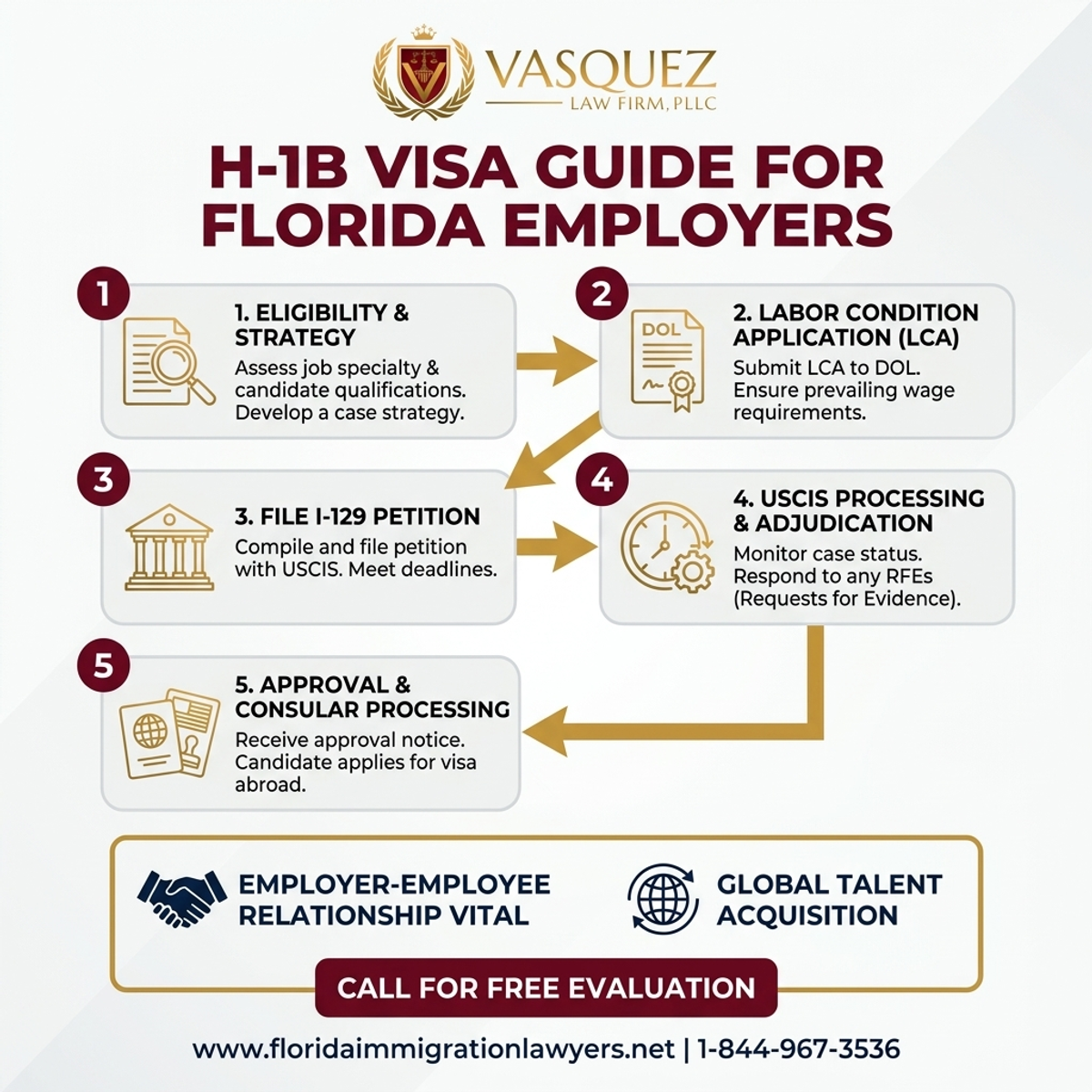
Step-by-Step Process — H-1B Visa Guide for Florida Employers | VLF Florida
H-1B Portability and Amendments
The H-1B portability rule allows H-1B workers to begin working for a new employer upon the filing of a new H-1B petition, rather than waiting for its approval. However, if there are material changes to the H-1B employment, such as a significant change in job duties, a new work location outside the metropolitan statistical area, or a reduction in hours, an amended H-1B petition must be filed. Proactive management of these changes is essential to maintain lawful status for the employee and compliance for the employer.
Record-Keeping Best Practices
Maintaining meticulous records is a cornerstone of H-1B compliance. This includes payroll records, time sheets, LCA documents, I-129 petitions, public access files, and any correspondence with government agencies. These records should be kept for at least three years from the date of the H-1B worker's termination or the end of the LCA validity period, whichever is later.
Consequences of Non-Compliance
Non-compliance can lead to severe repercussions, including substantial monetary penalties, back wages owed to employees, debarment from sponsoring future H-1B visas, and even criminal charges for willful violations. Engaging with experienced legal counsel can help Florida employers mitigate these risks and ensure ongoing adherence to all H-1B regulations.
H-1B Visa Extensions, Transfers, and Green Card Pathways
The H-1B visa is typically granted for an initial period of three years and can be extended for another three years, totaling a maximum of six years. However, there are provisions for extending H-1B status beyond the six-year limit, particularly for those pursuing permanent residency.
Extending H-1B Status Beyond Six Years
An H-1B worker may be eligible for extensions beyond the six-year limit under two main circumstances:
- Per Section 104(c) of AC21: If an I-140 immigrant petition has been approved, but the immigrant visa number is not yet available due to retrogression, the H-1B status can be extended in three-year increments.
- Per Section 106(a) of AC21: If a PERM Labor Certification application or an I-140 immigrant petition has been filed at least 365 days prior to the end of the H-1B worker's six-year limit, the H-1B status can be extended in one-year increments until a decision is made on the green card application.
H-1B Transfers: Changing Employers
H-1B portability allows a foreign national to change employers and begin working for the new employer once the new H-1B petition is filed with USCIS, without waiting for its approval. This provides flexibility for H-1B workers and allows Florida employers to hire H-1B talent already in the U.S. The new employer must file a new I-129 petition on behalf of the employee.
Dual Intent: H-1B as a Path to Permanent Residency
The H-1B visa is unique in that it is a 'dual intent' visa, meaning that an H-1B holder can legally intend to both temporarily work in the U.S. and eventually seek permanent residency (a Green Card) without jeopardizing their nonimmigrant status. This makes it an attractive option for foreign professionals and for Florida employers seeking long-term talent.
The PERM Labor Certification Process
For most employment-based green card categories (EB-2 and EB-3), the first step is typically the PERM Labor Certification. This process, managed by the Department of Labor, requires the employer to conduct a recruitment process to test the U.S. labor market and demonstrate that there are no qualified, willing, and available U.S. workers for the position. Only after this certification is obtained can the employer file an I-140 immigrant petition.
Employment-Based Green Card Categories (EB-1, EB-2, EB-3)
After a PERM certification (if required), the employer files Form I-140, Immigrant Petition for Alien Worker, with USCIS. The appropriate category depends on the employee's qualifications and the nature of the job:
- EB-1: Priority Workers (e.g., extraordinary ability, outstanding professors/researchers, multinational executives). Does not require PERM.
- EB-2: Professionals holding advanced degrees or persons of exceptional ability. Requires PERM, unless a National Interest Waiver (NIW) is granted.
- EB-3: Skilled workers, professionals, or other workers. Requires PERM.
Once the I-140 is approved and an immigrant visa number becomes available, the employee can either adjust status within the U.S. (Form I-485) or undergo consular processing abroad to obtain their Green Card.
Beyond H-1B: Alternative Work Visas for Florida Businesses
While the H-1B visa is a popular choice, it's not the only option for Florida employers seeking to hire foreign talent. Depending on the employee's nationality, skills, and the nature of the employment, several other immigration pathways and work visas may be suitable. Exploring these alternatives can provide flexibility, especially for cap-exempt scenarios or specialized needs.
L-1 Intracompany Transferee Visa (L-1A, L-1B)
The L-1 visa is for employees of international companies who are being transferred to a parent, subsidiary, affiliate, or branch office in the U.S. The employee must have worked for the qualifying organization abroad for at least one continuous year within the preceding three years in a managerial, executive (L-1A), or specialized knowledge capacity (L-1B). This is an excellent option for multinational corporations with operations in Florida.
O-1 Visa for Extraordinary Ability
The O-1 visa is for individuals who possess extraordinary ability in the sciences, arts, education, business, or athletics, or who have a demonstrated record of extraordinary achievement in the motion picture or television industry. This visa requires extensive documentation of awards, publications, and recognition in their field. It's a cap-exempt option for highly distinguished professionals.
TN Visa for NAFTA Professionals
Canadian and Mexican citizens may be eligible for the TN (Trade NAFTA) visa to work in the U.S. in specific professional occupations listed under the USMCA (formerly NAFTA) agreement. This visa typically requires a bachelor's degree or licensure in a qualifying field. The process is generally faster and less complex than the H-1B, making it a valuable alternative for Florida employers hiring from Canada or Mexico.
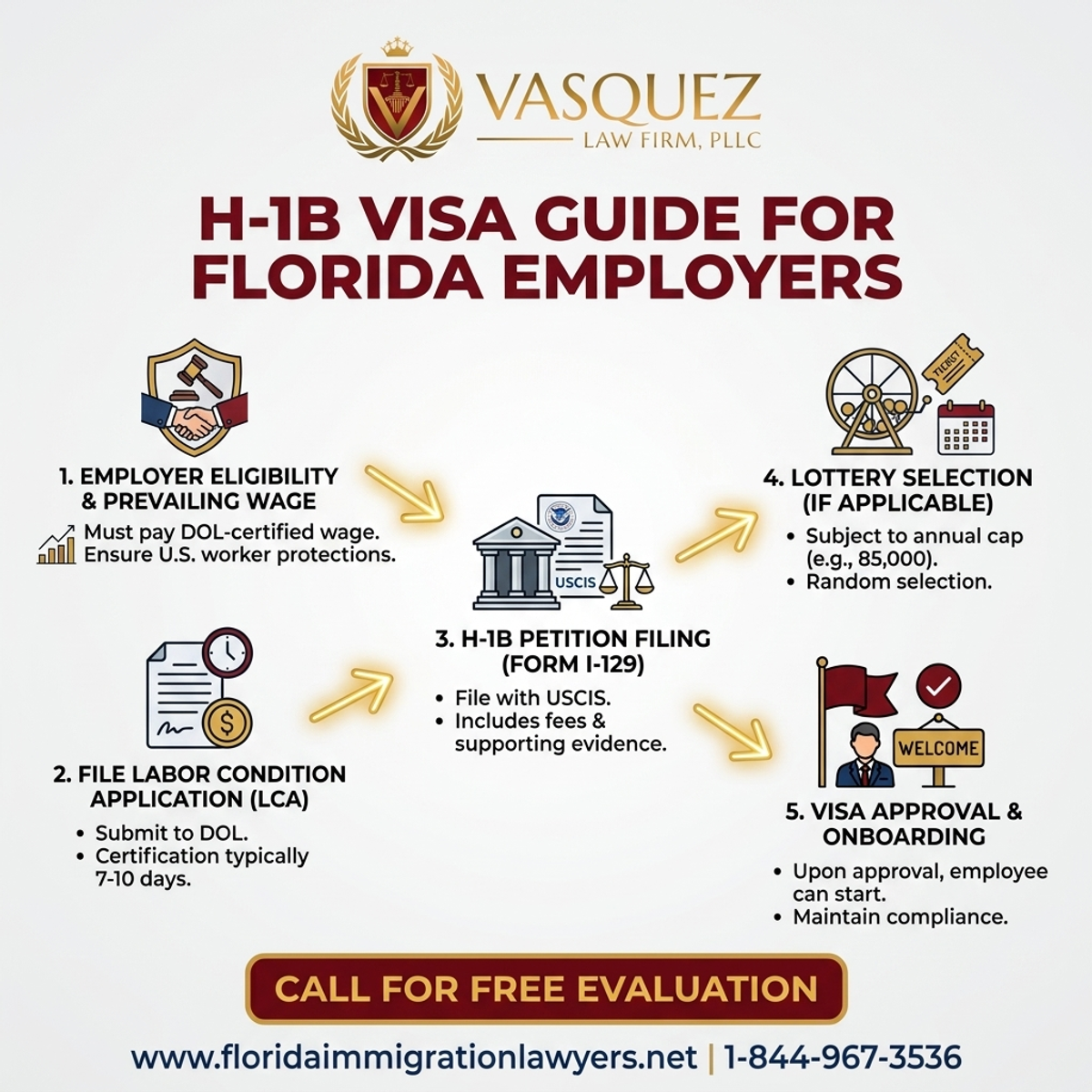
Key Statistics — H-1B Visa Guide for Florida Employers | VLF Florida
E-3 Visa for Australian Nationals
The E-3 visa is exclusively available to Australian citizens coming to the U.S. to perform services in a specialty occupation. Similar to the H-1B, it requires a bachelor's degree or higher in a specific field. The E-3 visa has its own annual cap (10,500) but is often undersubscribed, making it a more accessible option for eligible Australian professionals.
Other Options for Specialized Professionals
Depending on the specific industry and the foreign national's background, other visa categories might be considered, such as the H-2B visa for temporary non-agricultural workers, or specific visas for cultural exchange. Consulting with an experienced immigration attorney can help identify the most appropriate work visa strategy for your Florida business needs.
Why Choose VLF Florida for Your H-1B Needs?
Navigating the intricate landscape of U.S. immigration law requires specialized knowledge and experience. For Florida employers, partnering with a dedicated legal team can make all the difference in successfully securing H-1B visas and ensuring long-term compliance. VLF Florida stands as a trusted resource, committed to providing comprehensive and strategic immigration solutions.
Expertise in Florida Immigration Law
Our attorneys possess deep expertise in H-1B visas and the broader spectrum of U.S. immigration law, with a particular focus on the unique needs of Florida businesses. We stay abreast of the latest regulatory changes, USCIS policies, and DOL guidelines to provide up-to-date and effective counsel. Our understanding of the local economic landscape allows us to tailor strategies that align with your business goals and the specific industries thriving across Florida.
Personalized and Proactive Service
At VLF Florida, we believe in a personalized approach. We take the time to understand your company's specific hiring needs, the roles you seek to fill, and the qualifications of your prospective employees. Our proactive service means we anticipate potential challenges, guide you through every step of the application process, and provide clear, consistent communication. We aim to simplify the complex, allowing you to focus on your core business operations while we handle your immigration matters.
Comprehensive Immigration Support
Our commitment extends beyond just H-1B petitions. As a full-service immigration law firm, we offer a wide range of services to support Florida businesses and individuals. Whether you need assistance with other work visas, permanent residency pathways, or require representation in more challenging situations, our team is equipped to help. We provide robust support for various immigration practice areas, ensuring that all your needs are met under one roof. This includes critical services like asylum applications and deportation defense, highlighting our holistic approach to immigration law.
A Team You Can Trust
Our dedicated attorneys are not just legal professionals; they are strategic partners invested in your success. We pride ourselves on our ethical practice, transparent communication, and unwavering commitment to our clients. When you choose VLF Florida, you gain a team that is passionate about helping Florida businesses thrive by connecting them with the global talent they need.
Conclusion
The H-1B visa program offers Florida employers an invaluable opportunity to bring highly skilled foreign professionals into their workforce, fostering innovation and contributing to economic growth. While the process can be intricate and demanding, a thorough understanding of the requirements, diligent preparation, and adherence to compliance standards are key to success. By partnering with experienced immigration counsel, Florida businesses can confidently navigate the H-1B landscape, ensuring a smooth and efficient process for both employers and their prospective employees.
Don't let the complexities of immigration law deter you from securing the talent your business needs. For expert guidance on H-1B visas or any other immigration matter, reach out to VLF Florida today. Contact us for a free consultation and let our dedicated team help you achieve your hiring goals.
Frequently Asked Questions (FAQs)
- What is the H-1B visa?
The H-1B visa is a non-immigrant visa that allows U.S. employers to temporarily employ foreign workers in specialty occupations that require a bachelor's degree or higher in a specific field. - What is a 'specialty occupation'?
A specialty occupation is one that requires the theoretical and practical application of a body of highly specialized knowledge, and a bachelor's degree or higher in the specific specialty (or its equivalent) as a minimum for entry into the occupation. - What is the H-1B cap, and how does the lottery work?
The H-1B cap is an annual limit on the number of H-1B visas issued. If the number of registrations or petitions exceeds the cap, USCIS conducts a lottery to select eligible petitions. - Can an H-1B visa be extended beyond six years?
Yes, under certain circumstances, such as when a green card application (PERM or I-140) has been filed and is pending for a certain period, or an I-140 has been approved but a visa number is not yet available. - What are an employer's responsibilities after H-1B approval?
Employers must comply with wage requirements, maintain public access files, notify USCIS of material changes (e.g., job location, duties), and be prepared for potential site visits or audits. - Can an H-1B worker change employers?
Yes, H-1B workers can 'port' their visa to a new employer. The new employer must file a new H-1B petition, and the employee can often start working for the new employer upon the filing of the petition. - What are the main costs associated with H-1B sponsorship?
Costs include USCIS filing fees (I-129, ACWIA, Fraud Prevention and Detection, Public Law 114-113 if applicable), and legal fees for attorney assistance. - Is the H-1B visa a path to a Green Card?
Yes, the H-1B is a 'dual intent' visa, meaning holders can legally pursue permanent residency while maintaining their H-1B status.
Sources and References
- U.S. Citizenship and Immigration Services (USCIS)
- Executive Office for Immigration Review (EOIR)
- U.S. Department of State - Bureau of Consular Affairs
- Immigration and Nationality Act (INA), 8 U.S.C. Chapter 12
Do Not Navigate This Process Alone
Our experienced immigration attorneys are ready to fight for you. Get a free, confidential consultation today.
Se Habla Español
Frequently Asked Questions
Florida Immigration Lawyers
Immigration Attorney | Founder, Vasquez Law Firm
U.S. Air Force veteran and immigration attorney with thousands of cases resolved. J.D., NCCU School of Law. AILA member. Admitted to the 4th, 5th, and 11th Circuit Courts.
Available 24/7 - Free Evaluations
Related Legal Services
Our Florida immigration attorneys can help you with business immigration, asylum protection and deportation defense. Call today at 1-844-967-3536 for a free consultation.
Related Links
Related Topics
Free Legal Consultation
Discuss your case with our experienced attorneys. We're available 24/7.
Se Habla Español - Estamos aquí para ayudarle.
Related Articles
OPT STEM Extension Florida: F-1 Work Authorization
For F-1 students in Florida with STEM degrees, the 24-month OPT STEM extension is a vital pathway to extend work authorization and gain invaluable professional experience. This detailed guide covers everything from eligibility requirements and the step-by-step application process to essential documents, timelines, and associated costs. We also highlight common mistakes that can jeopardize your application, such as late filing, incorrect Form I-983 submissions, or working for non-E-Verify employers. Understanding these complexities is crucial for a successful outcome. Florida Immigration Lawyers offers expert guidance to help you navigate the intricate regulations of the OPT STEM extension, ensuring your application is accurate and timely. Discover when legal assistance is most beneficial and how our firm can support your journey from Pembroke Pines and across the state. Secure your professional future in Florida by understanding the STEM OPT extension thoroughly.
U Visa Crime Victims in Florida: Immigration Relief
Discover how the U visa offers crucial immigration relief to crime victims in Florida. Learn about eligibility, the application process, and how Florida Immigration Lawyers can help you navigate this complex process. Call 1-844-967-3536 for a free consultation.
Responding to an RFE: Florida Immigration Guide | VLF Florida
Receiving a Request for Evidence (RFE) from USCIS in Florida can be daunting. This guide provides insights on responding effectively, focusing on Orlando and surrounding areas. Learn about timelines, costs, and when to consult a lawyer. Call us at 1-844-967-3536 for a free consultation.
Immigration Services in Kissimmee, Florida | VLF Florida
Explore immigration services available in Kissimmee, Florida, tailored for a diverse community, including a significant Puerto Rican population. Learn about local resources and legal requirements for visas, green cards, and more.