Responding to an RFE: Florida Immigration Guide
Receiving a Request for Evidence (RFE) from USCIS in Florida can be daunting. This guide provides insights on responding effectively, focusing on Orlando and surrounding areas. Learn about timelines, costs, and when to consult a lawyer. Call us at 1-844-967-3536 for a free consultation.

- Carefully review the RFE to understand what is being requested.
- Gather all necessary documentation promptly.
- Consider consulting with an immigration attorney for complex cases.
- Submit your response before the deadline to avoid application denial.
Introduction
Receiving a Request for Evidence (RFE) from USCIS can be a daunting experience, especially for immigrants in Florida. An RFE is not a denial but a chance to provide additional information to strengthen your case. This guide will walk you through the steps to effectively respond to an RFE, focusing on those living in Orlando and other parts of Florida. Call Florida Immigration Lawyers at 1-844-967-3536 for a free consultation.
Many applicants initially feel a wave of anxiety upon seeing that official USCIS envelope. However, it's essential to understand that an RFE is a standard part of the immigration process for many cases. It signifies that your application is still active and under review, but USCIS requires more clarity or supporting evidence to make a final decision. This additional scrutiny can be due to various factors, from minor omissions to complex legal interpretations.
For individuals and families across Florida, from the bustling streets of Miami to the quieter communities of the Panhandle, navigating an RFE requires precision and a clear understanding of immigration law. The stakes are high, as an inadequate or delayed response can lead to significant setbacks, including denial of your application. Our aim is to demystify this process, providing you with the knowledge and practical tips needed to respond confidently and effectively.
Understanding RFEs and Their Impact
A Request for Evidence (RFE) is issued by USCIS when more information is needed to make a decision on your immigration application. It could relate to various applications, including green cards, work permits, or family-based visas. In recent years, changes in immigration policies have increased the scrutiny of applications, making RFEs more common.
According to recent news, shifts in USCIS policies have left many applicants in limbo, highlighting the importance of understanding RFEs. For residents of Florida, especially in areas like Orlando, navigating these challenges requires careful attention to detail and timely action.
RFEs are typically issued for several reasons. Sometimes, it's due to a simple oversight, like a missing signature or an outdated form. Other times, USCIS may question the veracity of your claims, the sufficiency of the evidence provided, or require additional proof to establish eligibility under specific immigration categories. For example, a family-based petition might receive an RFE if the spousal relationship evidence is deemed insufficient, or an employment-based petition might need more proof of the applicant's specialized skills.
The impact of an RFE extends beyond just a delay in your application. It can cause significant stress, financial burdens, and uncertainty about your future in the U.S. Understanding the specific nature of your RFE is the first critical step. Is it a request for financial documents, proof of a bona fide marriage, or evidence of a specific educational background? Each RFE is tailored to your unique case, and a generic response will likely fall short. Florida Immigration Lawyers are well-versed in interpreting these complex requests and can help you understand the precise requirements.
Step-by-Step Guide to Responding to an RFE in Florida
- Carefully Review the RFE Notice: Begin by thoroughly reading the RFE notice to understand what specific information or documentation is required. Each RFE is unique, and missing a detail could lead to a denial. Pay close attention to the specific section of law cited, the exact wording of the request, and any examples provided by USCIS. A common mistake is to skim the RFE and assume what is needed, leading to an incomplete or irrelevant response.
- Gather Required Documentation: Collect all necessary documents as outlined in the RFE. This may include additional forms, financial records, or evidence of relationships. Ensure that all documents are current, accurate, and directly address the points raised in the RFE. For instance, if USCIS requests updated financial information, provide recent tax returns, pay stubs, and bank statements, not just those submitted with your initial application.
- Organize Your Response: Clearly label each document and provide a cover letter summarizing your response. Ensure that your response is comprehensive and directly addresses each point in the RFE. A well-organized response makes it easier for the USCIS officer to review your submission, reducing the chance of further delays or misunderstandings. Your cover letter should act as a table of contents, referencing the RFE's specific requests and indicating where the corresponding evidence can be found in your package.
Consider using tabs or dividers for different sections of evidence. Create an index or table of contents if you have a large volume of documents. Always include a copy of the RFE notice itself as the first item in your package. Presenting a neat, logical, and easy-to-follow package demonstrates your thoroughness and respect for the process, which can positively influence the officer's review.
- Submit Before the Deadline: USCIS typically provides a deadline by which you must respond. Ensure your package is submitted well before this date to avoid delays or denials. The deadline is not a suggestion; it is a strict requirement. Missing it can lead to an automatic denial of your application, requiring you to start the entire process over and potentially lose filing fees.
It is highly recommended to send your RFE response via a method that provides tracking and delivery confirmation, such as certified mail with a return receipt or a courier service. This provides proof that you submitted your response on time. Keep a complete copy of everything you send to USCIS for your records. If you foresee any issues meeting the deadline, contact Florida Immigration Lawyers immediately to explore your options, though extensions are rarely granted for RFEs.
- Consult an Immigration Attorney: If your case is complex or you are unsure about your response, consider consulting with an immigration attorney. Our firm offers expertise in handling RFEs in Florida. An attorney can provide invaluable assistance by interpreting the RFE, identifying the most effective evidence, drafting compelling legal arguments, and ensuring your response is comprehensive and timely.
Take your time to dissect each point. If the RFE asks for proof of a bona fide marriage, it might specify types of evidence like joint bank accounts, shared utility bills, or affidavits from friends and family. A checklist approach, ticking off each requirement as you gather it, can be incredibly helpful. If any part of the RFE is unclear, this is an immediate red flag that warrants professional legal advice from Florida Immigration Lawyers.
Sometimes, obtaining these documents can be challenging, especially if they involve third parties or international records. Start this process immediately. If a document is in a foreign language, it must be accompanied by a certified English translation. Remember, quality and relevance of evidence often outweigh quantity. Focus on providing clear, compelling proof that directly answers USCIS’s concerns. If you're struggling to obtain a specific document, an attorney can advise on alternative forms of evidence or how to explain the unavailability.
This is particularly crucial for RFEs that delve into complex legal issues, require waivers, or involve previous immigration history challenges. An attorney can spot potential pitfalls, advise on the best strategy, and prepare a response that maximizes your chances of approval. Don't hesitate to reach out to Florida Immigration Lawyers at 1-844-967-3536 for a free consultation to assess the complexity of your RFE.
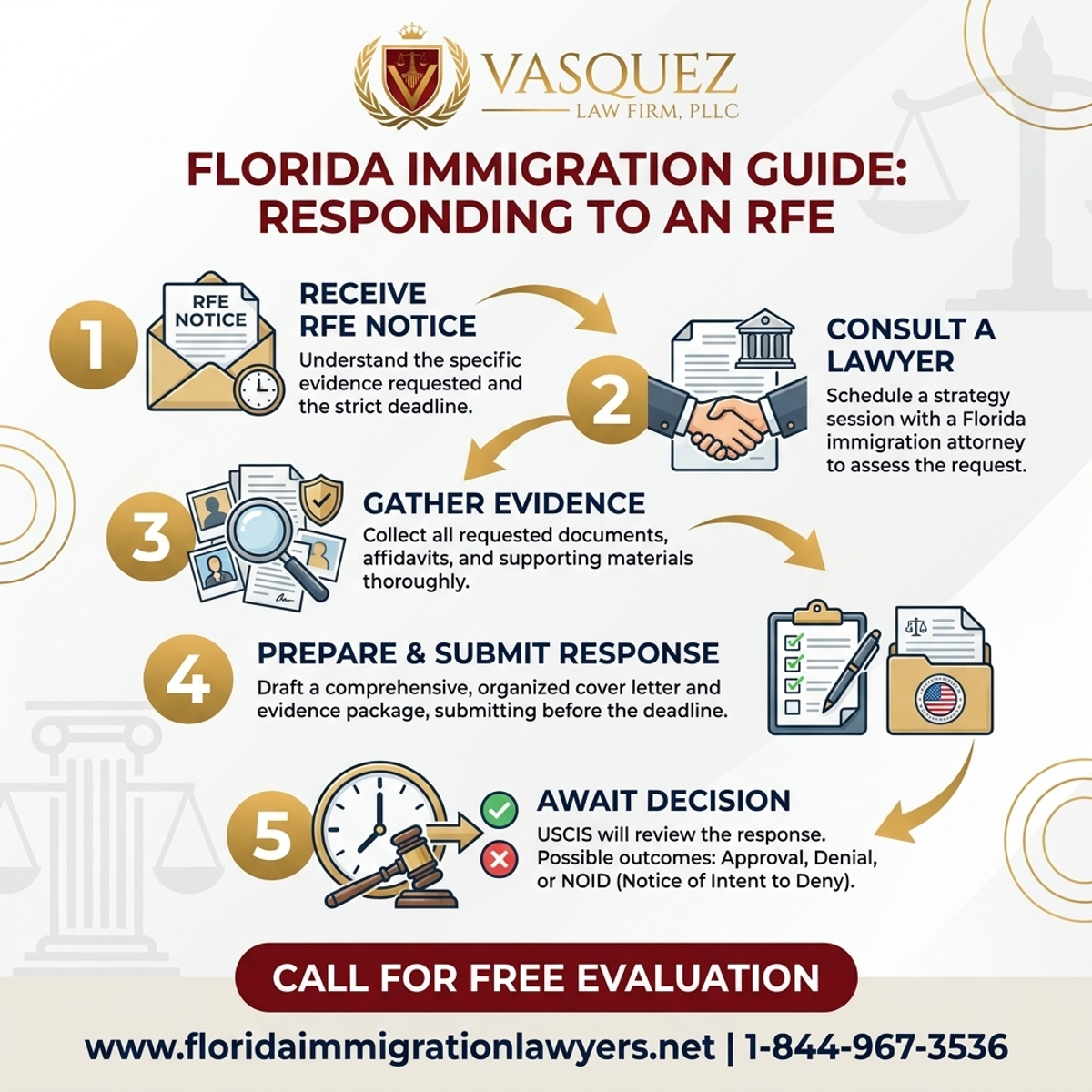
Step-by-Step Process — Responding to an RFE: Florida Immigration Guide
Document Checklist for RFE Responses
When preparing your RFE response, a meticulously organized set of documents is paramount. This checklist serves as a foundational guide to ensure you include all critical components, demonstrating to USCIS that you have carefully addressed their concerns.
- Copy of the original RFE notice: Always include the RFE notice itself. This helps USCIS quickly identify your case and the specific requests being addressed.
- Cover letter summarizing your response: This letter should clearly list each item requested in the RFE and indicate where in your submission the corresponding evidence can be found. It acts as a roadmap for the USCIS officer.
- Supporting documents requested by USCIS: This is the core of your response. Ensure every document specifically asked for is included, along with any additional evidence that might strengthen your case.
- Proof of any previous submissions: If the RFE references a document you already submitted, include a copy of that original submission to avoid confusion.
- Any additional evidence that strengthens your case: While you must address the RFE's specific requests, you can also submit supplementary evidence that further supports your eligibility, even if not explicitly requested. This proactive approach can sometimes prevent future RFEs.
Remember to make copies of everything for your personal records before mailing your response. This ensures you have a complete archive of your submission, which can be vital if there are any questions or issues later on. Florida Immigration Lawyers can assist in compiling and reviewing this checklist to ensure nothing is overlooked.
Timeline and Processing Expectations
Typically, USCIS provides 30 to 90 days to respond to an RFE. Once your response is submitted, it may take several weeks to months for USCIS to process it. Staying within the provided timeline is crucial, as delayed responses can result in application denial. In Florida, processing times can vary based on the local USCIS office workload. Keep in mind that cases may take longer due to recent policy shifts, as seen in the USCIS policy shift affecting green card applicants.
After you submit your RFE response, USCIS will typically send a receipt notice confirming they have received your documents. This notice is important for tracking your case. The processing time following an RFE response can be unpredictable. While some cases are adjudicated quickly, others may take several months, depending on the complexity of the evidence submitted, the specific USCIS service center handling your case, and current backlogs. It's not uncommon for applicants to experience anxious waiting periods.
It's important to continuously monitor your case status online using the receipt number provided by USCIS. While direct inquiries immediately after submission are unlikely to speed up the process, being aware of general processing trends can help manage expectations. If an unusually long period passes without an update, or if you receive another RFE, consulting with Florida Immigration Lawyers can help you understand the next steps and potentially inquire with USCIS on your behalf. Patience, combined with proactive monitoring, is key during this phase.
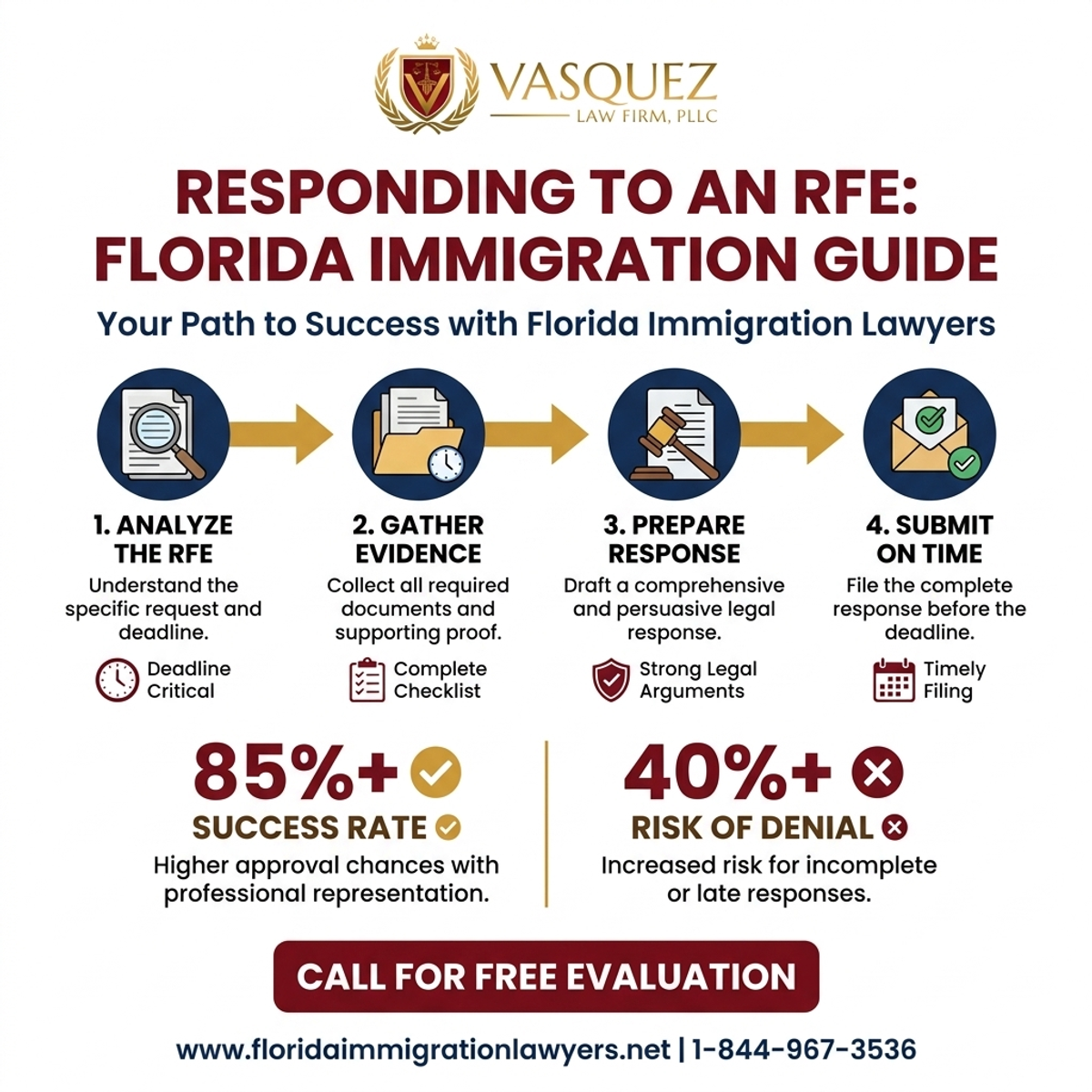
Key Statistics — Responding to an RFE: Florida Immigration Guide
Cost Factors and Fee Breakdown
Responding to an RFE may incur additional costs, including fees for obtaining new documents or consulting legal experts. While USCIS does not charge a fee for submitting an RFE response, the associated costs can vary depending on the complexity of your case. Consulting with an attorney can provide clarity on potential expenses and help you budget accordingly.
Beyond legal fees, applicants might face expenses for certified translations of foreign documents, which are mandatory for any non-English evidence. There could also be costs associated with obtaining official records, such as birth certificates, marriage licenses, police clearances, or academic transcripts, especially if these need to be expedited or requested from international sources. In some cases, an RFE might require an expert opinion, such as from a medical professional or an academic evaluator, which can also involve significant fees.
While these additional costs can seem daunting, viewing them as an investment in the success of your immigration application is crucial. A poorly prepared or incomplete RFE response due to cost-cutting measures can lead to a denial, forcing you to restart the entire application process and incur even greater expenses in the long run. Florida Immigration Lawyers can discuss these potential costs during your free consultation at 1-844-967-3536, helping you understand the financial landscape and plan effectively.
Do not navigate this process alone. Contact Florida Immigration Lawyers today.
Common Mistakes to Avoid
Navigating an RFE response can be complex, and even minor errors can lead to significant delays or even outright denial of your application. Being aware of common pitfalls can help you avoid them and strengthen your case.
- Ignoring the RFE or missing the deadline. Consequence: Application denial.
- Submitting incomplete or incorrect documentation. Consequence: Delays or additional RFEs.
- Failing to provide translations for non-English documents. Consequence: USCIS may reject your response.
- Sending original documents instead of copies. Consequence: Loss of important documents.
- Not seeking legal advice for complex cases. Consequence: Increased risk of denial.
- Disregarding the instructions in the RFE. Consequence: Misunderstanding requirements.
- Assuming the RFE can be ignored if you have pending applications. Consequence: Possible denial of all related applications.
- Overlooking the importance of a well-organized response. Consequence: Confusion and potential denial.
By diligently avoiding these common mistakes, you significantly increase the likelihood of a successful RFE response and a positive outcome for your immigration application. When in doubt, always err on the side of caution and seek professional guidance from Florida Immigration Lawyers.
When to Call a Lawyer
If you receive an RFE, consider contacting a lawyer if:
- You are unsure about the requirements or documentation needed. An attorney can decipher complex legal jargon and clarify precisely what USCIS is asking for.
- Your case involves complex immigration laws or multiple applications. Interconnected cases or those touching upon nuanced legal precedents often require expert interpretation and strategic planning.
- You face language barriers in understanding the RFE. A lawyer can help ensure you fully comprehend the notice and the implications of your response.
- There are changes to your personal circumstances since the last submission. Significant life events like a new job, change in marital status, or a criminal charge can complicate an RFE response and require legal guidance.
Our team at Florida Immigration Lawyers is equipped to handle RFEs and provide the necessary guidance to navigate this process effectively. We can help you identify the best evidence, craft a compelling legal argument, and ensure your response is submitted accurately and on time. Don't leave your immigration future to chance; a free consultation at 1-844-967-3536 can provide the clarity and support you need.
Even if you believe your RFE is straightforward, a quick review by an experienced immigration attorney can offer peace of mind and identify potential issues you might overlook. A lawyer can also represent you in communication with USCIS, alleviating much of the stress associated with the process. Proactive legal engagement is often the best defense against potential complications and denials.
About Florida Immigration Lawyers
Florida Immigration Lawyers is a trusted firm dedicated to helping clients navigate the complexities of immigration law. Our team provides comprehensive services including family immigration, business immigration, asylum, and deportation defense. With a commitment to client satisfaction, we offer free consultations and are available 24/7. Contact us at 1-844-967-3536 or visit our website at https://www.floridaimmigrationlawyers.net.
Our firm understands the unique challenges faced by immigrants in Florida, from Orlando to every corner of the state. We pride ourselves on offering personalized legal strategies tailored to each client's specific situation, ensuring that every RFE response is not just complete, but also strategically sound. We believe in empowering our clients with knowledge and providing unwavering support throughout their immigration journey.
When you choose Florida Immigration Lawyers, you're not just getting legal representation; you're gaining a dedicated partner committed to achieving the best possible outcome for your case. Our extensive experience with USCIS procedures and current immigration policies makes us uniquely qualified to handle even the most intricate RFE challenges. Reach out today for a free consultation and let us help you secure your future in the United States.
Sources and References
Understanding the legal framework and official guidelines is crucial when responding to a Request for Evidence. The following sources provide authoritative information on immigration laws and procedures.
- U.S. Citizenship and Immigration Services (USCIS)
- Executive Office for Immigration Review (EOIR)
- 8 U.S.C. Chapter 12 - Immigration and Nationality Act
- U.S. Department of State
These resources are invaluable for staying informed about immigration policy changes and specific requirements that might impact your RFE response. However, interpreting these complex legal documents often requires professional expertise, which Florida Immigration Lawyers can readily provide.
Related services: immigration practice areas, family immigration services.
This article provides general legal information and is not intended as legal advice. Every case is unique, and outcomes depend on specific facts and circumstances. Contact an attorney for advice about your particular situation.
Contact Florida Immigration Lawyers today at 1-844-967-3536 for a free consultation. Se Habla Español - Estamos aquí para ayudarle.
If you need legal assistance, learn more about get immigration legal help today, or call us at 1-844-967-3536 for a free consultation.
Frequently Asked Questions (FAQs) About RFEs
Do Not Navigate This Process Alone
Our experienced immigration attorneys are ready to fight for you. Get a free, confidential consultation today.
Se Habla Español
Frequently Asked Questions

William J. Vásquez
Founding Attorney · Vasquez Law Firm
U.S. Air Force veteran and immigration attorney with thousands of cases resolved. J.D., NCCU School of Law. AILA member. Admitted to the 4th, 5th, and 11th Circuit Courts.
Available 24/7 - Free Evaluations
Related Legal Services
Our Florida immigration attorneys can help you with asylum protection, deportation defense and citizenship and naturalization. Call today at 1-844-967-3536 for a free consultation.
Related Links
Related Topics
Free Legal Consultation
Discuss your case with our experienced attorneys. We're available 24/7.
Se Habla Español - Estamos aquí para ayudarle.
Related Articles
Biometrics Appointment in Florida: What to Expect in 2026
Navigating a biometrics appointment in Florida is crucial for your USCIS process. Learn what to expect, how to prepare, and common pitfalls to avoid. Florida Immigration Lawyers are here to help with personalized guidance and support.
Withholding of Removal Explained: Florida Defense in 2026
For those in Florida facing deportation and fearing persecution or torture in their home country, understanding withholding of removal is critical. This form of protection prevents removal to a dangerous country, though it differs significantly from asylum in its eligibility criteria and benefits. It requires proving a "more likely than not" chance of persecution based on protected grounds or torture, a higher standard than asylum's "well-founded fear." While withholding of removal does not lead to a Green Card, it offers mandatory protection if the stringent criteria are met, even for some individuals barred from asylum. The process involves complex legal proceedings before an immigration judge, often in Miami or Orlando immigration courts. A comprehensive application, detailed testimony, and robust supporting evidence, including country conditions reports and affidavits, are essential. Given the high stakes and intricate legal requirements, securing the expertise of a Florida immigration lawyer is paramount to building a strong defense and navigating the path to safety.
US Visa Policy Changes July 2026: What Students in Florida
As of July 2026, international students in Florida seeking a change of status to an F-1 student visa must prepare for potential adjustments to U.S. visa policies. This comprehensive guide from Florida Immigration Lawyers explores the anticipated policy changes, detailing their potential impact on application requirements, processing times, and eligibility criteria. We provide a step-by-step overview of the change of status process, including a document checklist, expected timelines, and cost considerations. Understanding these complexities and avoiding common mistakes is crucial for a successful application. With potential changes approaching, proactive planning and expert legal guidance are more important than ever. Our firm is dedicated to helping students in Tampa and across Florida navigate these challenges, offering tailored advice and robust representation. Learn how to protect your academic future and ensure a smooth transition to F-1 student status.
Dual Citizenship Lawyer: Your 2026 Guide to Naturalization
Achieving U.S. citizenship is a profound milestone, but the path to naturalization, especially with dual citizenship in mind, is fraught with legal intricacies and a critical interview process. This comprehensive guide from Florida Immigration Lawyers demystifies the journey, offering essential citizenship interview tips and highlighting the invaluable role of a dual citizenship lawyer. We cover eligibility, document preparation, timelines, and common pitfalls, all tailored for Florida residents in areas like Pembroke Pines. Discover how expert legal counsel can prepare you for your naturalization interview, address dual nationality concerns, and ensure a smooth, successful application. From initial assessment to interview representation, we provide the support needed to navigate USCIS requirements confidently. Call Florida Immigration Lawyers for a free consultation to start your journey.